EXPERIENTIAL LEARNING IN MANDARIN CLASSROOMS: THE CASE
FOR SIMULATION
Noor Hanim Rahmat1+
Mok Soon Sim2 Lau Suk Khin3 Fan Pik Shy4
1,2,3Akademi Pengajian Bahasa, Universiti Teknologi MARA, Malaysia.
4Institute of China Studies, University of Malaya, Malaysia.
(+ Corresponding author)
ABSTRACT
Article History
Received: 8 January 2020 Revised: 10 February 2020 Accepted: 12 March 2020 Published: 14 April 2020
Keyword
s
Experiential learning Simulation Interaction Millennials Real-life.The environment that millennials learn in is relaxed and allows for maximum interaction. This type of environment mirrors their real life that is rather “laid-back”. Next, millennials strive for personal relationships. They strive well in environment that encourage interaction, for instance group work. In order to bring that “real-life” environment into the classrooms, teachers can plan “simulation” activities as part of the classroom routine. Simulation activities allow learners to gain “hands-on” experience in the form of experiential learning. One way to enable learners to learn through interaction in “real-life” environment is by using simulation. The objective of this quantitative study is to explore the use of simulation in learning Mandarin. 20 respondents were chosen for this study. The instrument used was a survey with 11 items on a 5 point Likert-scale. Findings revealed that activities done during simulation mirror the benefits of experiential learning. The study also revealed that learners learning using concrete example, abstract conceptualization, converging ideas, as well accommodating old ideas with new learning.
Contribution/ Originality:
The objective of this quantitative study is to explore the use of simulation in learning Mandarin. 20 respondents were chosen for this study.1. INTRODUCTION
1.1. Background of the Study
Learning today can take place in many forms and can result in more unplanned consequences. According to Rahmat (2020) millennials learn in a variety of ways. Firstly, they learn in a relaxed environment. They crave for relaxed learning environment that offers minimum pressure. This type of environment mirrors their real life that is rather “laid-back”. Next, millennials strive for personal relationships. They strive well in environment that encourage interaction, for instance group work. According to Chua, Guan, and Ying (2015) technology has entered the classroom. This may not be all negative for the unplanned outcome of learners. Technology can provide learners with “real-life” and authentic situations into the classrooms. So, in order to bring that “real-life” environment into the classrooms, teachers can plan “simulation” activities as part of the classroom routine. Simulation activities allow learners to gain “hands-on” experience in the form of experiential learning.
The research is done in Universiti Teknologi MARA (UiTM), Malaysia. According to Mok, Lau, Sankaran, and Suchithra (2019) at present, UiTM has the greatest number of Malay students studying Mandarin language in a
International Journal of Asian Social Science
ISSN(e): 2224-4441
ISSN(p): 2226-5139
DOI: 10.18488/journal.1.2020.104.171.180 Vol. 10, No. 4, 171-180.
© 2020 AESS Publications. All Rights Reserved.
single educational setting in Malaysia. Most of the undergraduate students are the beginners of learning Mandarin language as their second language. As to enable the Malay students to communicate efficiently in the target language, simulation is adopted as one of the assessment methodologies. The simulation is a very valuable method for second language teaching and learning. “In order for a simulation to occur the participants must accept the duties and responsibilities of their roles and functions, and do the best they can in the situation in which they find themselves" (Jones, 1982) so that to carry out their role responsibilities, students are required to express themselves to their peer in a group setting. They have to write simulation scripts based on a given situation. In the process of writing the script, students need to look into their past experience, and then conceptualize what they have learnt, finally they manage to put into practice by creating a new script. In other words, students are expected to practice the experiential learning model in Mandarin classroom.
1.2. Statement of Problem
Ideally, language learning involves the learners learning the rules of the language. Learners need to learn the structure in a conducive, authentic, and natural learning environment. The problem is: more often than not, language learning are often planned in teaching environment (Yang, 2018). The content is often structured and learning takes place in a planned, non-authentic environment. So, one possible solution to provide learners a conducive language learning environment is through the use of simulation. Solution-simulation in learning a language allows students to learn the language through experiential learning.
A various teaching strategy has been adopted in order to achieve the learning outcomes effectively since the commencement Mandarin courses in UiTM in 1960s. Simulation was started as an assessment since year 2017. However, there is lack of study which to evaluate the effectiveness of simulation in achieving learning goals of Mandarin courses in UiTM. Therefore, this study aims to solve the gap by examining how experiential learning cycle are practiced in Mandarin simulation and subsequently investigate the reliability of simulation to attain the learning outcomes in Mandarin classroom.
1.3. Objective of the Study
The main objective of this study is to investigate the use of simulation in the learning of Mandarin. Specifically, this study explores how experiential learning influence the use of simulation in learning Mandarin.
1.4. Research Question
1. How do learners use their concrete experience in learning Mandarin? 2. How do learners portray abstract conceptualization in learning Mandarin? 3. How are converging and accommodating displayed in learning Mandarin?
2. LITERATURE REVIEW
2.1. Introduction
This section discusses the problems in learning Mandarin, group and experiential learning, Past studies and theoretical frame work.
2.2. Problems in Learning Mandarin
Mandarin is not an easy language to learn for several reasons. According to Chua et al. (2015) Chinese is a tonal language and it contains five tones that include high level (first tone), rising (second tone), falling rising (third tone), falling (fourth tone) and toneless to distinguish characters that are pronounced identically. For example, the character, 爸/ba/ with first tone, means „father‟ while the character, 拔/ba/ with the second tone, means „pull out‟.
of the Mandarin tones. In a study by Mok, Lau, and Lee (2009) on the pronunciation of Mandarin tones among the Malay students in Malaysia, the subjects had made most mistakes in the pronunciation of second tone, followed by fourth tone, third tone and first tone. Hence, the learning of Mandarin tonal knowledge is essential for comprehending and producing spoken Mandarin (Liu, Hao, Li, & Shu, 2011). Another challenge related to tone is the large number of identical sound pattern or homophones in Mandarin but expressed by a distinctive visual pattern so as their meaning. For instance, 14 characters share the pronunciation /li/ with the fourth tone, each of which has a different meaning. This situation will confuse the learners more.
Another problem faced by the learners is the grammar errors which they usually make in the writing of Mandarin sentences or scripts. The most fundamental general feature of Mandarin grammar is that it does not depend on morphological changes, but mainly uses other grammatical means such as word order and function words to express grammatical relationships and grammatical meanings (Shao, 2002). The Mandarin leaners whose mother tongue is languages with lot of morphological changes are definitely cannot get used to the Mandarin grammar. Besides, there is another difficulty lies in the diversification of Chinese semantics, often the same sentence can express a completely different meaning. For instance, „能吃多少吃多少‟/neng chi duo shao chi duo shao/ is
literally translated as „can eat more or less, eat more or less‟. But the actual meaning of the sentence is “eat as much as you can”, or “eat as little as possible”.
2.3. Simulation in Language Learning
Simulations, sometimes known as role-plays, are instructional scenarios where the learner is placed in a "world" defined by the teacher. Simulations represent a reality within which students interact. This strategy encourages student-centred learning as well as constructivist learning and teaching. Simulation is a controlled representation of reality. Simulation means role-playing or rehearsal in which the process of teaching is carried out artificially.
Simulation is a yet another way learners can learn a language. According to Vlachopoulos and Makri (2017) simulations help to create a scenario-based environment. This is the environment where students interact to apply previous knowledge and practical skills to real-world problems, and also allow teachers to reach their own goals. According to Angelini and Garcia-Carbonell (2019) simulation can be done in three phases; briefing, action and debriefing. There are some benefits of this approach. Firstly, students can become familiar with the content and build new vocabulary and expressions outside the classroom. In addition to that, instructors and students can spend class time to activate their knowledge of the content and the target language through minor-scale simulations, debates and forums. Simulation can benefit learners in many ways. According to Ranchhod, Gurau, Loukis, and Trivedi (2014) simulation provides many benefits. Firstly, simulation motivates learners. The activities during simulation provide opportunities for learners to participate in the learning process. These activities are usually fun and learners would relax.
2.4. Group Work and Experiential Learning in the Language Classroom
meaningful with it through an active participation. It emphasizes learning in which the learner is directly in touch with the phenomenon being studied, rather than just watching it or reading, hearing or thinking about it.
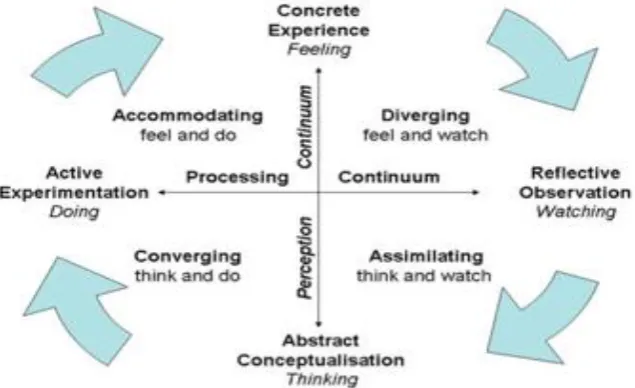
Learning is a process of discovery on the part of the learners. Figure 1 presents the theory of experiential learning introduced by Kolb (1984). As the name implies, the “end-product” of learning is the experience that learners gained throughout the length of the learning activities. According to Kolb (1984) learning involves four cyclical stages: (a) concrete experience, (b) reflective observation, (c) abstract conceptualisation and (d) active experimentation. Experiential learning begins with the learner gaining concrete experience by doing the activity. Next, the learner reviews his/her experience and this makes up the learner‟s reflective observation. After reflecting on his/her observation, the learner forms an abstract conceptualisation as he/she concludes from the experience. The final stage of experiential learning is when the learner begins active experimentation when he/she tries out what he/she has learnt.
Figure-1. The theory of experiential learning (Kolb, 1984). Source: Kolb (1984).
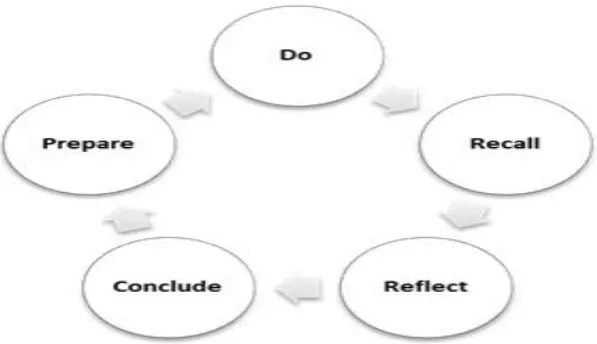
How is experiential learning displayed in terms of classroom learning? Learning often takes place when the learner undergoes changes. Figure 2 presents the actions that take place throughout the process of experiential learning. The process of learning involves several steps. Firstly, the early stages of learning requires the learners to participate in “doing something” (Do). Next, learning takes place when the learner recalls what had happened (Recall). The next stage of learning involves the learner reflecting on what he/she has gone through (Reflect). The learner then draws conclusions from the reflections made (Conclude). Finally, successful learning takes place when the learner uses the conclusions made to inform and prepare for future practical experience.
Figure 3 presents the learners‟ behaviour during activities that encourage experiential learning. At the start of the activities, learners go through concrete experience. Initially, learners would watch and begin to diverge their understanding of topics brought up. This is the stage where the learners would feel and watch the on-goings of the tasks planned for them. This is also the stage where the learners watch and reflect on their observations. The may assimilate with what they already knew and ponder upon the new experiences gained. Some learners may then form abstract conceptualization and think further about their experiences. At this stage of learning, learners may then learn to accommodate with new knowledge and converge with new ideas with other learners.
Figure-3. Learner‟s behaviour during experiential learning. Source: Kolb (1984).
2.5. Past Studies
Past studies have revealed that Mandarin is not an easy language to learn. The study by Yang (2018) investigated the perception of beginner learners of Mandarin as a foreign language. The study looked into how the learners face the difficulties in learning Mandarin and also how they overcame the difficulties they encountered. The participants for the study were 179 students from two state secondary schools in England. The instrument used was a questionnaire as well as interviews. Findings revealed that the respondents found that character recognition was more difficult than their production. Learners were also worried with the use of those homophones in Mandarin. They also felt that this language lacked links between the sound and logography of characters. It is true learning a new language is not easy. Perhaps, measures could be taken to make learners acquire the language instead of learn it.
Role paly is done as part of group work activity can encourage learning. In the theory of social constructivism (Santrock, 2009) learners gain more as a group than when they are alone. In addition to that, the theory of constructivism claims that humans are better able to understand the information that they have constructed by themselves. This is because learning is a social advancement that involves language use, the real world, and interaction and collaboration among learners. In the constructivist classroom, the teacher is the facilitator and a guide. He or she guides and also provides direction to the learners (Rahmat, 2018).
and comprised of 60 undergraduate students who registered for a Business programme. A series of tasks were designed to facilitate the development of skills at each stage of the cycle. A pre and post strategy evaluation was done using the SILL (Strategy Inventory for Language Learning) devised by Oxford (1990). In addition to the SILL, data were collected through semi-structured interviews and students reflections through reflective learning journals. Findings revealed that there was an extremely significant difference between the pre and post SILL survey results after the period of intervention. It resulted in a rise in strategy use from medium to high. Implications for further research into innovative pedagogical approach that would develop high strategy users are discussed. Another study by Zakaria, Rahmat, Aripin, Jasman, and Ibrahim (2019) looked into role play in ESL classroom. The quantitative study used a survey as instrument. 32 students participated in the study which used the classic theories of behaviourism, social constructivism, pragmatism to facilitate role-play activities. Learners learn through peer interaction and also modelling.
Another study to explore further benefits of experiential learning is done by Sharifi and Shariati (2017). The study compared the roles of experiential and traditional learning. The study investigated two homogeneous classes; one group was the experimental group, while the other group was the control groups. The experimental group received a new way of teaching (viz., experiential) as the treatment within 3 months while the control group received a traditional way of teaching for the same amount of time. At the end of the treatment, the researcher used the SPSS software to analyze the data. The quantitative results showed that although there was no significant difference between the two groups, the experimental group outperformed the control group in a sense that the use of experiential learning was more effective than traditional learning. A key element of experiential learning, therefore, is the student, and that learning takes place (the knowledge gained) as a result of being personally involved in this pedagogical approach.
2.6. Theoretical Framework of the Study
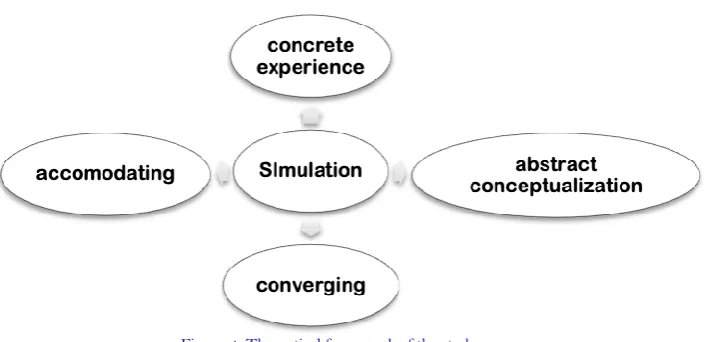
Figure-4. Theoretical framework of the study. Source: Rahmat et al. (2019) (adapted from Kolb (1984); Vlachopoulos and Makri (2017)).
Figure 4 presents the theoretical framework of the study. This framework is rooted from the theories of Kolb
3. METHODOLOGY
3.1. Research Design
This quantitative research explores how simulation allows learners to practice experiential learning. 20 learners responded to 11 items on 5-point Likert scale. SPSS analysis of the instrument reveled a Cronbach Alpha of 0.80 Table 1 thus revealing good internal validity of the instrument.
Table-1. Cronbach alpha for instrument. Reliability Statistics
Cronbach's Alpha N of Items
.801 11
3.2. Method of Data Collection and Data Analysis
Data was collected from goggle form from students who completed a Mandarin class chosen by the researcher. The data collected was analysed using SPSS version 24.
4. FINDINGS
4.1. Introduction
This section presents the findings of the study. The finding is presented based on the research questions. The research questions are:
1. How do learners use their concrete experience in learning Mandarin? 2. How do learners portray abstract conceptualization in learning Mandarin? 3. How are converging and accommodating displayed in learning Mandarin?
4.2. Concrete Experience in Learning Mandarin
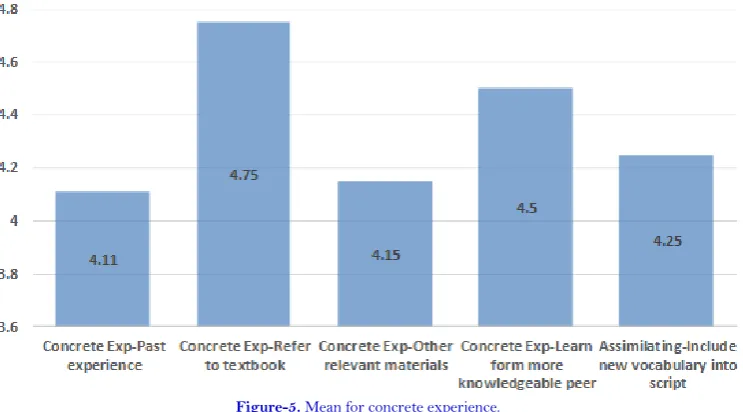
Figure-5. Mean for concrete experience.
4.3. Abstract Conceptualization in Learning Mandarin
Figure-6. Mean for abstract conceptualization
The next stage involves more planning. Figure 6 reveals the mean for abstract conceptualization. The mean for “form new ideas from learning material” and “apply new ideas is 3.85.
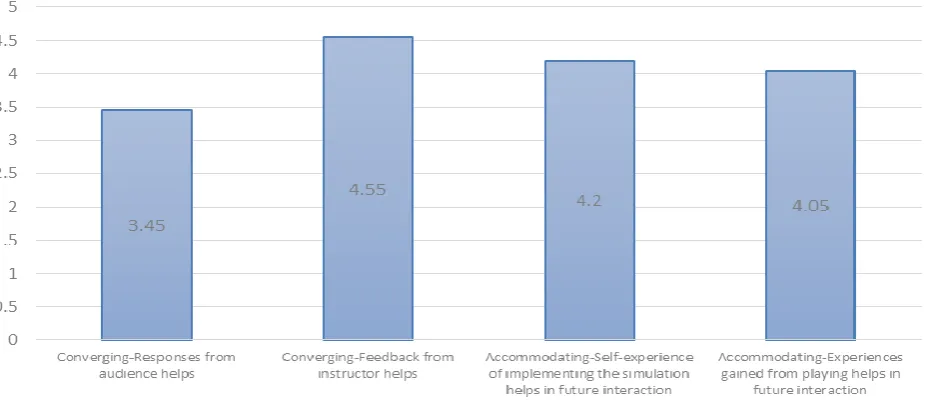
4.4. Converging and Accommodating
Figure-7. Mean for converging and accomodating.
This is the final stage- the stage where learners actually doing the stimulation. Figure 7 presents the mean for converging and accommodating. The highest mean is “converging -feedback from instructor helps” (4.55). In addition to that, learners also felt that their “self-experience of implementing the simulation helps in future interaction” (4.2).
5. CONCLUSION
5.1. Discussion of Findings
5.2. Pedagogical Implications
Simulation is an interesting way to learn a language. It provides pseudo-authentic environment. Learners sometimes get a sense of being in the real environment. This provides learners to go through experiential learning through the activities. In addition to that, the social interaction that takes place allow more levels of learning to occur.
5.3. Suggestion for Future Research
Future researcher could look into how to make simulation more effective as a learning tool in the language classrooms. In addition to that, there could be future research to look into what happens during group interactions through conversation analysis. This can help future instructors to focus more on what is lacking during group discussion so learners gain maximum benefit.
Funding: This study received no specific financial support.
Competing Interests: The authors declare that they have no competing interests.
Acknowledgement: All authors contributed equally to the conception and design of the study.
REFERENCES
Angelini, M. L., & Garcia-Carbonell, A. (2019). Developing English speaking skills through simulation-based instruction. Teaching English with Technology, 19(2), 3-20.
Boggu, A. T., & Sundarsingh, J. (2016). The impact of experiential learning cycle on language learning strategies. International
Journal of English Language Teaching, 4(10), 24-41.
Chua, W. H., Guan, T. T., & Ying, L. C. (2015). A review of challenges in learning Chinese characters among non-native
learners in Malaysia. Indian Journal of Arts, 5(16), 93-100.
Jones, K. (1982). Simulations in language teaching. Cambridge: Cambridge U. Press.
Kolb, D. (1984). Experiential learning as the science of learning and development. Englewood Cliffs, NJ: Prentice Hall.
Liu, Y., Hao, M., Li, P., & Shu, H. (2011). Timed picture naming norms for mandarin Chinese. PLoS ONE, 6(1), e16505.
Mok, S. S., Lau, S. K., Sankaran, K., & Suchithra, S. (2019). The error analysis of learning mandarin endocentric phrases among
the Malay Students in Malaysia. 3(2), 49-62.
Mok, S. S., Lau, S. K., & Lee, A. (2009). A study on the pronunciation of the four mandarin tones among UiTM students”, Issue in Language Teaching and Learning Amongst Non-Native Speakers: Language competence and performance (pp. 115-126). Shah Alam UPENA UiTM.
Mollaei, F., & Rahnama, H. (2012). Experiential education contributing to language learnin. International Journal of Humanities
and Social Sciences, 2(12), 268-279.
Oxford, R. L. (1990). Language learning strategies :What every teacher should know. Boston: Heinle & Heinle.
Rahmat, N. H. (2020). Innovation in education: Barriers and facilitating factors. European Journal of Education Studies, 6(10),
55-66.
Rahmat, N. H., Othman, N. A., Muhammad, A. M., Anuarudin, A. S., & Arepin, M. (2019). Assimilation and accomodation:
Exploring the dynamics of class disucssions. European Journal of Education Studies, 6(1), 222-238.
Rahmat, N. H. (2018). Educational psychology: A tool for language research. PEOPLE: International Journal of Social Sciences,
4(2), 655-668.
Ranchhod, A., Gurau, C., Loukis, E., & Trivedi, R. (2014). Evaluating the educational effectiveness of simulation games: A value
generic model. Information Science, 264(2), 75-90.
Santrock, J. W. (2009). Educational psychology (4th ed.). New Year: Mc Graw Hill.
Shao, J. M. (2002). Xiandai hanyu tonglun the general theory of modern Mandarin. Shanghai: Shanghai Jiaoyu Chubanshe.
Sharifi, N., & Shariati, M. (2017). Using experiential learning to enhance students‟ foreign language proficiency. Translation
Vlachopoulos, D., & Makri, A. (2017). The effect of games and simulations on higher education: A systematic literature review. Technology in Higher Education, 1-33(22), 1-33.
Yang, J. (2018). What makes learning Chinese characters difficult? The voice of students from English secondary schools. Journal of Chinese Writing Systems, 2(1), 35-41.Available at: https://doi.org/10.1177/2513850217748501.
Zakaria, N., Rahmat, N. H., Aripin, N., Jasman, N. H., & Ibrahim, N. (2019). Exploring perceptions of role play activities in
English as a second language (ESL) classrooms. International Journal of Engineering and Advanced Technology, 8(5C),
868-872.