Journal of Chemical and Pharmaceutical Research, 2013, 5(12):507-514
Research Article
CODEN(USA) : JCPRC5
ISSN : 0975-7384
Design of sampling method based on sampling comparative test of volatile
organic components
Liu Jingtao, Sun Jichao, Zhang Yuxi*, Chen Xi, Zhu Liang and Zhang Yuanjing
The Institute of Hydrogeology and Environmental Geology, Chinese Academy of Geological
Sciencesy, Shijiazhuang, China
____________________________________________________________________________________________
ABSTRACT
Effects on volatile and semi-volatile organic components (VOCs) in water have been studied by comparison of three sampling methods, which were applied in typical groundwater contaminated site. The results show that DS technique of sampling is stable and reliable, better than both bailer sampler and peristaltic pump in terms of collecting water samples to obtain content of VOCs in water. Factors Factors with impact on loss of VOCs during sampling are negative pressure, contact with outside atmosphere and turbulent flow in order from strong to weak, where loss of VOCs caused by negative pressure is apparently higher than that caused by contact with outside atmosphere and turbulent flow; comparative analysis indicates that short-time sampling with sampler made of stainless steel, polyfluortetraethylene, and silica gel tube has no strong corrosion over water sample, and the effect on samples are negligible through analysis of chemical constituents. Based on that, DS sampling method is designed, applicable to sampling of underground water of open well, 110cm monitoring well, and shallow layer- 30cm shallower and 60cm shallower, and in the meanwhile, with introduction of automatic control circuit and sensors for water level, pressure, temperature, PH value and EC, the function of measuring and storing in-situ physical and chemical parameters accompanying sampling is achieved.
Keywords: sampling method; comparative trial; deep-set; in situ
____________________________________________________________________________________________
INTRODUCTION
EXPERIMENTAL SECTION
SAMPLE COLLECTION
The sampling site is located in living areas of platform marginal region of a delta where there is no significant industrial source of pollution, and 1.0m away from the site, there is a sewage ditch with width of approximately 2m, set by bricks and floated with much oil. The sampling site is an open well, a source of water for daily use of neighboring residents with occasional drinking purpose (Figure 1), with a diameter of 0.8m, of which the groundwater level depth is 1.8m. There is no significant air pollution source around the sampling site and the air quality there is good.
Two sets of groundwater sample had been collected with interval of five months respectively in March and August of 2008 by stainless steel deep-set in-situ sampler (DS sampler) and sent to Hong Kong ALS laboratory for testing, stored under the temperature of 4℃. The four VOCs, namely carbon disulfide, cis-1,2-dichloroethene,
trichloroethene and tetrachloroethene through sample analysis are detected as shown in Table 1.
Three months later, i.e. November, 2008, comparison test is carried out at above stated sampling site with sampling depth 50cm under water surface, atmospheric temperature detected as 25.2℃and the water temperature of 25.0℃.
German WTW Multi 340i portable multi-parameter water quality tester was used to test the in-situ chemical indicators, of which the results are similar to those of two previous sampling (refer to Table II). And there is no abnormities in sampling environment and groundwater environment. Three sampling methods employed are as shown below:
Fig.1 Overview of sampling site
Table.1 Detetable result of organic pollutants (Mg/L)
Analysis Description LOR First Sampling Second Sampling Carbon disulfide 0.5 <0.5 1.2 cis-1,2-Dichloroethene 0.5 7 9.8 Trichloroethene 0.5 0.9 1.3 Tetrachloroethene 0.5 1.4 1.7
Table.2 Results of physical and chemical characteristics of groundwater on-site test in three times
Sampling Date (µs/cm) EC DO
(mg/L) pH First Sampling 189 No detection 5.19 Second Sampling 210 1.84 5.37 Sampling Comparison Test 201 2.20 5.63
Stainless steel DS sampler: As shown in Figure 2, there are three sampling bottles in the sampling tube (1), where
is higher than water inlet (7), water sample spills into large sampling bottle and then into small sampling bottle. After sampling is finished, lift the sampling rod, which will cause sensor get actuated to close electromagnetic valve, draw out sampler, fasten bottle lid underground, to which the whole sampling process is completed.
This kind of sampler is made of stainless steel which can collect on-site water sample of set depth. In the process of sampling, the period of water sample contacting with outside air is almost zero, however the turbulent flow is generated when water goes through the sampling bottle.
Fig.2 Structural scheme of DS sampler
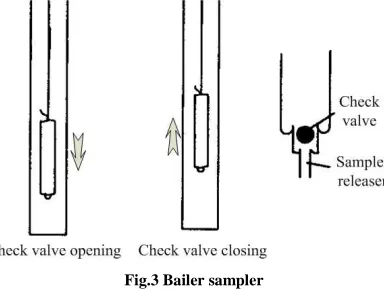
[image:3.595.241.369.158.390.2]Bailer Sampler: Bailer sampler is composed of two parts, namely tube body and check calve (refer to Figure 3)[3]. Lower the sampler when sampling and the check valve will be opened when the sampler reaches the water surface; Stop lowering when the predetermined depth is reached and then lift the sampler; after sampler is drawn out, water sample is led into the sample bottle through sampler releaser.
Fig.3 Bailer sampler
This sampling employs bail sampler made of poly-tetrachloroethylene that is able to collect water samples of predetermined depth but passing through of upper layer by sampler may cause cross pollution in case the upper water has polluted layer. What’s more, after the collection, there must be a releaser delivering the sample into the sampling bottle, during which contact with outside air is available.
Sampling with Peristaltic Pump: Peristaltic pump is a kind of suction and emission sampling pump, as shown in
Figure 4: putting the suction side of the pipeline into a desired depth of the well and the emission side into the sample container. Then vacuum is generated in the pipeline through electric rotation of three rollers to extract the well water to the ground.
[image:3.595.209.401.466.611.2]but vacuum state generated in the sampling process may lead to volatile and sensitive air foaming. Besides, sampling pipeline may absorb organic components.
Fig.4 Peristaltic Pump
From 2005 to 2008, 937 groundwater samples were collected in the Zhujiang Delta. The samples were from the civil wells and manual excavated pits. The depths of the wells were below 10 meters, so the samples belong to shallow groundwater. Before taking samples from the civil wells, the well water was drained as much as possible. Till the next day, after the recovery of the water level, samples were taken from the fixed place below 50cm from the surface. As for the area with no wells, pits were excavated manually. Samples were taken after the water level was stable and the water was clear. All samples were filtrated through 0.45µm membranes and acidified on the spot, then were detected by the Guangzhou Mineral Resources Supervision Inspection Center of the Ministry of Land and Resources of China.
Determinations of Be, Al in all samples were performed using Inductively Coupled Plasma – Atomic Emission Spectrometry (ICP-AES). PH value was tested on the spot by applying the potentiometric method with the WTW Multi 340i portable tester made by Germany.
RESULTS AND DISCUSSION
After collection, samples were numbered as 1 to 3 and preserved at 4℃. An extra set of field blank samples was
taken along together. In that afternoon, they were sent to Hong Kong ALS laboratory for test under the same condition. There were 57 items for volatile organic components test and 83 items for semi-volatiles organic components. The detection was limited in the scope of 0.05-5µg/L. The specific analysis methods and number of analyzing items are shown in Table 3 and Table 4.
The blank sample had no detection; the three sets of water samples were all detected with three kinds of VOCs: cis-1,2-dichloroethene, trichloroethene and tetrachloroethene. The test results are shown in Table 5.
Table.3 Analytical procedures and indexes of VOCs
Method Analysis description Numbers
Table.4 Analytical procedures and indexes of svocs
Method Analysis description Numbers
EP-075A: Phenols 11 EP-075B: Polyaromatic hydrocarbons 17 EP-075C: Phthalate esters 6 EP-075C: Nitrosamines 10 EP-075E: Nitroaromatics and ketones 17 EP-075F: Haloethers 4 EP-075G: Chlorinated hydrocarbons 10 EP-075H: Anilines and benzidines 8
Influence of Sampler Material on Sample Components: Stainless Steel: the main chemical components are iron.
It also contains chromium, nickel, carbon, manganese, silicon, phosphorus, sulfur and other components. Different series of stainless steel have different strength, ductility, temperature and corrosion resistance and its surface adsorption force is not strong.
Table.5 Detection of organic contaminants with different sampling processes (µg/L) Analysis Description DS Sampler Bailer Sampler Peristaltic Pump cis-1,2-Dichloroethene 9.4 8.5 5.6 Trichloroethene 1.1 1.1 0.6 Tetrachloroethene 1.3 1.2 0.6
Polytetrafluoroethylene: the basic structure: - (CF2)n -, CF2unit arranged by the saw-tooth shape and form a spiral distorted chain. It has a strong chemical, biological inertia, high and low temperature resistance, corrosion resistance and the surface tension is of low adhesion.
Silica: the main chemical components are mSiO2·nH2O. Except addition to alkali and hydrofluoric acid, it does not react with other substances. Different types of silica have different micro porous structure because of their different manufacturing methods. It is of strong adsorption, thermal stability, mechanical strength and chemical stability.
Phthalic ester organics shall to be added as plasticizers during manufacturer of polytetrafluoroethylen, a major material for the short cables of stainless steel DS sampler and bailer sampler. For the three sampling methods, contact time between water samples and sampling materials is within 1min and actually no phthalic ester was detected. In addition, no abnormity is detected in 140 items of organics. It is revealed that sampling with the three samplers, in short time has no strong corrosion over water sample, and the effect on samples is negligible.
The three kinds of sampling materials cannot precipitate the three detected organic components, the surrounding environment has no source of secondary pollution that causes three detected organics detected in water samples, and sampling is in strict accordance with defined sampler and sampling bottle. That is to say there is only the possibility of loss as a result of volatilization and adsorption of the three detected organic components during sampling, namely the larger the test result of samples sampled by three samplers, the close it is to true value. Thefore, maximum values of each test items are taken as true values. The losses of volatile components caused by different sampling methods are shown in Table 6. It is obvious to see that DS sampler causes the least loss, followed by bailer sampler, of which the loss is within 10% relative to DS sampler. Loss caused by peristaltic pump is the largest, up to 34%-50% compared with DS sampler. It is deemed that the strong adsorption capability of silica gel, material for sampling of peristaltic pump, is one of the reasons for the loss of volatile components.
Table.6 Contrast of loss of VOCs Caused by THE THREE sampling methods (%)
Analysis description DS Sampler Bailer Sampler Peristaltic Pump cis-1,2-Dichloroethene 0.00 9.57 34.12 Trichloroethene 0.00 0.00 45.45 Tetrachloroethene 0.00 7.69 50.00 Average 0.00 5.76 43.19
Influence of Sampling Style on Sample ComponentsAs stated above, all three sampling approaches can be used to get samples from desired depth, but with different turbulent flow, negative pressure and contact time with outside atmosphere generated during sampling: Through comparison between Table 6 and Table 7 that
sampling with peristaltic pump features turbulent flow, negative pressure and contact with outside atmosphere. On the basis of maximum value as standard, the average loss of volatile component caused by turbulent flow and contact with atmosphere is totaled around 6%, and that caused by peristaltic pump is 43%, namely, solos of volatile component caused by negative pressure is 37% approximately, much higher than both turbulent flow and contact with atmosphere.
Table.7 Contrast of loss of VOCs through different sampling methods
Sampler Turbulent Flow Contact with Atmosphere Negative Pressure DS Sampler √
Bailer Sampler √
Peristaltic Pump √ √ √
DESIGN OF SAMPLING METHODS
Based on above stated conclusions, different DS sampling methods are designed to cater to different sampling demands:
DS sampling method with electric control : To avoid aeration caused by DS sampler pulling out tube lid, DS
sampling method with electric control is designed (Figure 5). When sampler is lowered to predefined depth, liquid level sensor (10) sends out signal, microscopic power supply (11) switches to bottom electromagnetic valve (14) to make the latter open, thus water sample flows from electromagnetic valve (14) into tube body (1), gas discharges from exhaust port (12), and after sampling is finished, lift sampler, liquid level sensor (10) sends out signal to close electromagnetic valve (14), to which the entire sampling process is accomplished. This method is applicable to collect samples of open well underground water and shallow ground water.
Fig.5 Structural Scheme of the DS Sampler
DS sampling method with small diameter and sampling depth of 30m: As shown in Figure 6: inside the 1L
sampling tube, there is holding bracket to fix 40ml sampling bottle for volatile organic water samples and electromagnetic valve is equipped at both tube bottom and lid, used as water inlet and exhaust port. For sampling depth over 5m, sealing strip shall be used to seal tube body and tube lid. Electromagnetic valve cable is connected to upper winch, boasting also load-bearing function and winch cable joint connects with battery set and manual switch. This sampler is able to collect both samples of 110cm monitoring well and of ground water in DS manner, with maximum sampling depth up to 30m.
DS sampling and analysis method with automatic control for deep water: Sampler (Figure 6) consists of
and connected with sampling tube body, and on the lid, there is check-valve exhaust hole; sensors include water level sensor (18), temperature sensor (19), PH value sensor( 17) and conductivity sensor( 20).
Open and close of water inlet of sampler water sample container are controlled by electromagnetic valve, of which drive command is sent out from control circuit on the sampler. Sampler is equipped with parameter (temperature, liquid level, PH value, and EC) sensors that can measure real-time in-situ water quality parameters and transmit to its control circuit for treatment so as to effectively collect water samples, guarantee water sample quality and realize automatic control of sampling process with maximum sampling depth up to 60m under water.
装配时此结合面应涂满密封胶
Fig.6 Structural Scheme of Sampler
CONCLUSION
Effects on volatile and semi-volatile organic components (VOCs) in water have been studied by comparison of three sampling methods, which were applied in typical groundwater contaminated site. The results show that DS technique of sampling is stable and reliable, better than both bailer sampler and peristaltic pump in terms of collecting water samples to obtain content of VOCs in water. Factors with impact on loss of VOCs during sampling are negative pressure, contact with outside atmosphere and turbulent flow in order from strong to weak, where loss of VOCs caused by negative pressure is apparently higher than that caused by contact with outside atmosphere and turbulent flow; comparative analysis indicates that short-time sampling with sampler made of stainless steel, polyfluortetraethylene, and silica gel tube has no strong corrosion over water sample, and the effect on samples are negligible through analysis of chemical constituents. Based on that, DS sampling method is designed, applicable to sampling of underground water of open well, 110cm monitoring well, and shallow layer- 30cm shallower and 60cm shallower, and in the meanwhile, with introduction of automatic control circuit and sensors for water level, pressure, temperature, PH value and EC, the function of measuring and storing in-situ physical and chemical parameters accompanying sampling is achieved.
Acknowledgment
Assessment of Pollution of Groundwater in Northwest District (No.1212011220982) and Integrated Research on Investigation & Evaluation of Groundwater Pollution in Central and Western China (No.1212011121167).
REFERENCES
[1]Chinese Ministry of Health, China National Standardization Management Committee. Standards for Drinking Water Quality.1996:3-6.