Analyzing The Hive Performance on Large Data
A. Prathima1, Y. Rama Mohan2
1
PG Student, Computer Science and Engineering Dept, GPREC, Kurnool (District), Andhra Pradesh-518007, INDIA. [email protected]
2
Guide: Asst.Prof. in Computer Science and Engineering Dept, GPREC, Kurnool (District), Andhra Pradesh-518007, INDIA. [email protected]
Abstract
This paper presents an implementation of a scientific data
management benchmark, on Hive, a MapReduce-based data
warehouse. A complete strategy of migrating HDFS to Hive is
described in detail including query HQL implementation, data
partition schema and adjustments of underlying storage facilities.
It have tuned the performance using several system parameters
provided by Hive, Hadoop and HDFS. This paper provides
preliminary results and analysis.. The purpose of this project was
to compare the scalability of open-source relational database
management systems and distributed data management systems
for small and medium data sets. To make this comparison, a
business intelligence case study was investigated using three data
management solutions: MySQL, Hadoop MapReduce, and Hive.
This experiment involved a payment history analysis which
considers customer, account, and transaction data for predictive
analytics. Experiments were executed on data sets ranging from
200MB to 800MB. The results show that the single server
MySQL solution performs best for trial sizes ranging from
200MB to 800MB, but does not scale well beyond that.
MapReduce outperforms MySQL on data sets larger than 800MB
and Hive outperforms MySQL on sets larger than 2GB. This
demonstrates MapReduce and Hive as viable techniques for
small and medium businesses who want to implement scalable
data management techniques.
Keywords: Big Data, Hadoop,Hive,HDFS,SQL,Map-reduce
1. Introduction
Big data and Hadoop
From the early days of the Internet’s mainstream
breakout, the major search engines and ecommerce
companies wrestled with ever-growing quantities of data.
More recently, social networking sites experienced the
same problem. Today, many organizations realize that the
data they gather is a valuable resource for understanding
their customers, the performance of their business in the
marketplace, and the effectiveness of their infrastructure.
The Hadoop ecosystem emerged as a cost-effective way of
working with such large datasets. It imposes a particular
programming model, called MapReduce, for breaking up
computation tasks into units that can be distributed around
a cluster of commodity, server class hardware, thereby
providing cost-effective, horizontal scalability. Underneath
this computation model is a distributed file system called
the Hadoop Distributed File System (HDFS). Although the
file system is “pluggable,” there are now several
commercial and open source alternatives.
However, a challenge remains; how do you move
an existing data infrastructure to Hadoop, when that
infrastructure is based on traditional relational databases
and the Structured Query Language (SQL)? What about
the large base of SQL users, both expert database
designers and administrators, as well as casual users who
use SQL to extract information from their data warehouses?
This is where Hive comes in. Hive provides an SQL
dialect, called Hive Query Language (abbreviated HiveQL
or just HQL) for querying data stored in a Hadoop cluster.
Hive is most suited for data warehouse
response times are not required, and when the data is not
changing rapidly. Hive is not a full database. The design
constraints and limitations of Hadoop and HDFS impose
limits on what Hive can do. The biggest limitation is that
Hive does not provide record-level update, insert, nor
delete. You can generate new tables from queries or output
query results to files. Also, because Hadoop is a
batch-oriented system, Hive queries have higher latency, due to
the start-up overhead for MapReduce jobs. Queries that
would finish in seconds for a traditional database take
longer for Hive, even for relatively small data sets. Finally,
Hive does not provide transactions.
Hive
As the MapReduce framework provides measurability and
low-level flexibility to run complicated jobs on huge data
sets, it may acquire hundreds of minutes or even more than
one day to execute a single MapReduce job. Considering
this, Facebook built up Hive which is based on similar
concepts of tables and partitions allowing a high-level
query tool for getting data from their living Hadoop
warehouses. The result is, on the top of Hadoop a data
warehouse layer is built which permits for querying and
handling structured data using a HiveQL, Hive query
language that is similar to SQL (Structured query language)
and optional custom MapReduce scripts which may be
added into queries. During the compilation process, Hive
converts Hive Query Language transformations to a series
of MapReduce jobs and Hadoop Distributed File System
operations and applies several optimizations.
The Hive data model is formed into tables, buckets and
partitions. The tables in Hive data model are same as that
of RDBMS tables. They correspond to an HDFS directory.
Each table can be divided into partitions that can be further
divided into buckets. Partitions correspond to
sub-directories within an HDFS table directory and buckets are
stored as files within the HDFS directories. It is important to remember that Hive was designed for batch job handling,
extensibility and scalability but not for real-time queries
and low latency performance. Hive query response times
for smallest jobs and larger jobs upto some extent can be
of several minutes.
Hadoop HDFS stores records on its own way, under flat
files in key value pair. Hive has an interface above Hadoop
HDFS which would allow users to query Hadoop by using
a language HiveQL which is familiar to SQL. Hive is a
data warehouse system for Hadoop. It provides
comfortable data summarization, ad-hoc queries, and the
analysis of huge datasets laid in Hadoop compatible file
systems. Using HiveQL we query the data which has been
structured by a mechanism provided by Hive. HiveQL is
the query language used by Hive, to carry out all the tasks.
Hive is similar to SQL and prepares data into four major
sections. Databases and tables are familiar and Partitions
and Buckets are dissimilar. During partitions each table are
made to distinguish with one or more partition keys,
deciding how data is stored. Whereas the rows are
efficiently recognized when certain standards are equalled.
Based on the hash value obtained of the column of a table,
partitioned data is further divided into buckets,. It is also
important to remember that, there is no need of data in the
tables to be partitioned or bucketed, but doing so spreads
the large quantity of data across the nodes, in turn helping
in faster query execution.
2.Proposed System
2.1 Existing System
The data-intensive scientific discoveries are
generating huge amounts of data at an alarming rate. Most
of the data are multidimensional and stored in array-based
file formats. The processing of such big data becomes an
and easy-to-use array-based query system. Hive enables
scientists to process raw array datasets in parallel with a
SQL-like query language. This implement Hive as an
extension of Hive which is a data warehouse system on
Hadoop. Hive maps the arrays in files to a table and
executes the queries via MapReduce. Files are loaded
dynamically as needed. So Hive does not need any
additional pre-loading or format conversion procedure. In
addition, Hive includes two optimization methods to
reduce the generated rows. Experiments with different
queries on representative datasets show that the
optimizations are very effective in most cases and Hive is
scalable to handle large datasets
.
2.2 Proposed System
Hive is an open-source Hadoop-based data
warehouse framework. With series of tools that Hive
provides, structured data files can be mapped to database
tables. Hive also defines a SQL-like language called Hive
Query Language, which is compatible to SQL. HQL
statements can be translated into MapReduce tasks to run
on multiple nodes. Data in Hive can be stored in three
formats, text, sequence binary and RCFile. Text is the
default data store format of Hive. It is often used in log
processing and data loading. The drawback of text format
is that the costs for parsing are much higher than using the
binary format and data should be parsed repeatedly for
each time of query execution. Sequence file is a binary
format provided by Hadoop[15] and also supported in
Hive. Sequence file uses standard writable interface to
implement serialization and deserialization. Data are stored
as <key, value> pairs in sequence file. RCFile, Record
Columnar File, is designed for storing relational tables on
clusters using the MapReduce framework. It divides table
data first horizontally and then vertically. Table records are
divided into row groups. The result will be displayed in
table format. After processing the data in sql and hive
compare them.
Fig:2.2 Data flow diagram of proposed system
3. Methodology
3.1 Hive Architecture and functionality
Hive is a data warehousing infrastructure placed
on Hadoop. On commodity hardware a massive scale out
and fault tolerance capabilities for data storage and
processing is provided by hadoop by using the map-reduce
programming paradigm.
Data summarization, ad-hoc querying and
analysis of large volumes of data can be easily enabled by
designing Hive. A simple query language called Hive QL,
which is based on SQL is provided by Hive. Users
familiar with SQL can easily adapt to this Hive query
language. To do more sophisticated analysis which are not
supported by built-in-capabilities of the language HiveQL
allows traditional map/reduce programmers to plug in their
custom mappers and reducers.
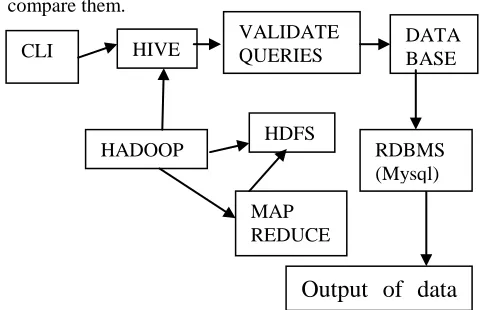
Hive architecture explains the major components
of hive and its interactions with Hadoop which is shown in
Figure 3.1 below:
CLI HIVE
HADOOP
VALIDATE QUERIES
HDFS
MAP REDUCE
DATA BASE
RDBMS (Mysql)
Fig:3.1:HiveArchitecture
3.1.1. Meta store
The metastore is the system catalog which contains
meta-data about the tables stored in Hive. This metadata is
specified during table creation and reused every time the
table is referenced in HiveQL. The metastore
distinguishes Hive as a traditional warehousing solution
(ala Oracle or DB2) when compared with similar data
processing systems built on top of map-reduce like
architectures like Pig and Scope.
The metastore contains the following objects:
Database
It is a name space for tables. The database
‘default’ is used for tables with no user supplied database
name.
Table
Metadata for table contains list of columns and
their types, owner, storage and SerDe information. It
can also contain any user supplied key and value data;
this facility can be used to store table statistics in the
future. Storage information includes location of the
table’s data in the underlying filesystem, data formats
and bucketing information. SerDe metadata includes the
implementation class of serializer and deserializer
methods and any supporting information required by
that implementation. All this information can be provide
during the creation of table.
Partition
Each partition can have its own columns and
SerDe and storage information. This can be used in the
future to support schema evolution in a Hive warehouse.
The storage system for the metastore should be
optimized for online transactions with random accesses
and updates. A file system like HDFS is not suited since
it is optimized for sequential scans and not for random
access. So, the metastore uses either a traditional
relational database (like MySQL, Oracle) or file system
(like local, NFS, AFS) and not HDFS. As a result,
HiveQL statements which only access metadata objects
are executed with very low latency. How-ever, Hive has
to explicitly maintain consistency between metadata and
data.
3.2. Compiler
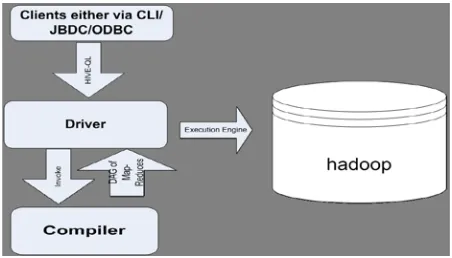
The driver invokes the compiler with the HiveQL
string which can be one of DDL, DML or query statements.
The compiler converts the string to a plan. The plan
consists only of metadata operations incase of DDL
statements, and HDFS operations incase of LOAD
statements. For insert statements and queries, the plan
consists of a directed-acyclic
graph(DAG)ofmap-reducejobs.
3.2.1. Query Processor:
Figure 3.2.1. shows how a typical query flows through
the system. The UI calls the execute interface to the Driver
The Driver creates a session handle for the query and
sends the query to the compiler to generate an execution
plan(step 2). The compiler gets the necessary metadata
from the metastore (steps 3 and 4). This metadata is used
to typecheck the expressions in the query tree as well as to
prune partitions based on query predicates. The plan
generated by the compiler is a DAG of stages with each
stage being either a map/reduce job, a metadata operation
or an operations on hdfs. For map/reduce stages, the plan
contains map operator trees(operator trees that are
executed on the mappers) and a reduce operator tree(for
operations that need reducers). The execution engines
submits these stages to appropriate components. In each
task(mapper/reducer) the deserializer associated with the
table or intermediate outputs is used to read the rows from
hdfs files and these are passed through the associated
operator tree. Once the output is generated, it is written to
a temporary hdfs file though the serializer(this happens in
the mapper in case the operation does not need a reduce).
The temporary files are used to provide data to subsequent
map/reduce stages of the plan. For DML operations the
final temporary file is moved to the table’s location. This
scheme is used to ensure that dirty data is not read(file
rename being an atomic operation in hdfs). For queries, the
contents of the temporary file are read by the execution
engine directly from hdfs as part of the fetch call from the
Driver.
4. Implements and Results
4.1. Implementation of MySql Connector
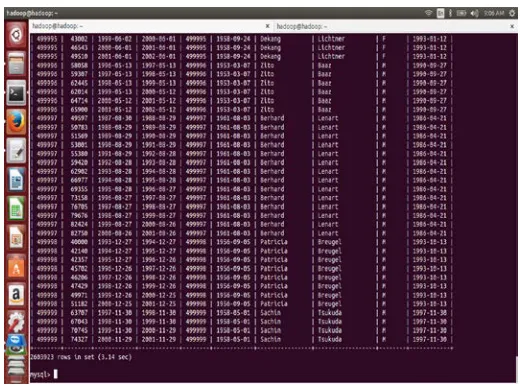
In MySql only small amount of data is processed
without any delay in fraction of seconds. But as the data is
being increased in day by day life, it became difficult to
process large amount of data with high performance by
MySql.
For starting the MySql connector in hadoop command can
be given as
Fig: 4.1. Data running on mysql
4.2. Creation of Databases:
The Hive concept of a database is essentially just
a catalog or namespaceof tables. However, they are very
useful for larger clusters with multiple teams and users, as
a way of avoiding table name collisions. It’s also common
to use databases to organize production tables into logical
groups. If you don’t specify a database, the default
database is used.
The simplest syntax for creating a database is
shown in the following example; here we are taking a
payment history analysis of a company in that we are using
the database is payment:
If u want to see in which database u are in then we
can use these commands:
hive>set hive.cli.print.current.db = true;
5. Joins:
MapReduce can perform joins between large
From scratch is fairly involved. Rather than writing
MapReduce programs, you might consider using a
higher-level framework such as Pig, Hive, or Cascading, in which
join operations are a core part of the implementation.
Let’s briefly consider the problem we are trying
to solve. We have two datasets; for
Example, the weather stations database and the weather
records—and we want to reconcile the two. For example,
we want to see each station’s history, with the station’s
metadata inlined in each output row.
How we implement the join depends on how large the
datasets are and how they are partitioned. If one dataset is
large (the weather records) but the other one is small
enough to be distributed to each node in the cluster (as the
station metadata is), then the join can be effected by a
MapReduce job that brings the records for each station
together (a partial sort on station ID, for example). The
mapper or reducer uses the smaller dataset to look up the
station metadata for a station ID, so it can be written out
with each record.
Fig: 5.0: An Example for joining station records
5.1. Partitioning Hive Tables:
Hive is a powerful tool to perform queries on
large data sets and it is particularly good at queries that
require full table scans. Yet many queries run on Hive have
filtering where clauses limiting the data to be retrieved and
processed, e.g. SELECT * WHERE state=’CA’. Hive
users tend to have or develop a domain knowledge,
understand the data they work with and the queries
commonly executed or scheduled. With this knowledge we
can identify common data structures that surface in queries.
This enables us to identify columns with a (relatively) low
cardinality like geographies or dates and high relevance to
key queries. For example, common approaches to slice the
airline data may be by origin state for reporting purposes.
We can utilize this knowledge to organise our data by this
information and tell Hive about it. Hive can utilize this
knowledge to exclude data from queries before even
reading it. Hive tables are linked to directories on HDFS or
S3 with files in them interpreted by the meta data stored
with Hive. Without partitioning Hive reads all the data in
the directory and applies the query filters on it. This is
slow and expensive since all data has to be read. In our
example a common reports and queries might be generated
on an origin state basis. This enables us to define at
creation time of the table the state column to be a partition.
Consequently, when we write data to the table the data will
be written in sub-directories named by state
(abbreviations). Subsequently, queries filtering by origin
state, e.g. SELECT * FROM Airline_Bookings_All
WHERE origin_state = ‘CA’, allow Hive to skip all but the
relevant sub-directories and data files. This can lead to
tremendous reduction in data required to read and filter in
the initial map stage. This reduces the number of mappers,
IO operations. [11]
5.2. Comparison of Hive and SQL:
Apache Hadoop MapReduce[20] is a framework
for processing large data sets in parallel across a Hadoop
cluster. Data analysis uses a two-step map and reduce
analysis functions and the Hadoop framework provides the
scheduling, distribution, and parallelization services.
The top level unit of work in MapReduce is a job.
A job usually has a map and a reduce phase, though the
reduce phase can be omitted. For example, consider a
MapReduce job that counts the number of times each word
is used across a set of documents. The map phase counts
the words in each document, then the reduce phase
aggregates the per-document data into word counts
spanning the entire collection.
During the map phase, the input data is divided
into input splits for analysis by map tasks running in
parallel across the Hadoop cluster. By default, the
MapReduce framework gets input data from the Hadoop
Distributed File System (HDFS). Using the MarkLogic
Connector for Hadoop enables the framework to get input
data from a MarkLogic Server instance. For details,
see Map Task.
The reduce phase uses results from map tasks as
input to a set of parallel reduce tasks. The reduce tasks
consolidate the data into final results. By default, the
MapReduce framework stores results in HDFS. Although
the reduce phase depends on output from the map phase,
map and reduce processing is not necessarily sequential.
That is, reduce tasks can begin as soon as any map task
completes. It is not necessary for all map tasks to complete
before any reduce task can begin.
MapReduce operates on key-value pairs.
Conceptually, a MapReduce job takes a set of input
key-value pairs and produces a set of output key-key-value pairs by
passing the data through map and reduce functions. The
map tasks produce an intermediate set of key-value pairs
that the reduce tasks uses as input. The diagram below
illustrates the progression from input key-value pairs to
output key-value pairs at a high level:
Fig: 5.2. Joining the Data in Hive Query Lang.
Example Hive table partitioning It is important to consider
the cardinality of a potential partition column and avoid
fragmenting the data too much. Itinerary ID would be a
very poor choice for partitioning. Queries for single
itineraries by ID would be very fast but any other query
would require to parse a huge amount of directories and
files incurring serious overheads. Additionally, HDFS uses
a very large block size of usually 64 MB or more which
means that each file, even with only a few bytes of data,
will have to allocate that block size on HDFS[3]. This can
potentially fill the file system up with large number of files
Fig:5.2.1. comparison of sql and hive query lang.
6. CONCLUSION
A Simple SQL query reads the entire
dataset and performs the operations on the datasets which
results in higher latency rate. This becomes a bottleneck
for running operation on vast datasets. So as an alternative
to this Hive is used, the efficiency of hive collating to SQL.
HiveQL Analyze and Hive join operation the results of
required Hive query are displayed in tabular form i.e
structured format. It can be observed from the map-reduce
program performance comparison between Hive and SQL
that, Hive performance remained constant and better for all
sizes of data, matching and surpassing MapReduce
performance specially in case of larger data sets. Hence it
is concluded that Hive is aviable technique for
implementing in small and medium businesses who want to
implement scalable data management techniques.
Future Direction:
Beyond the scope of this project, we can further
compare Hive’s performance with PIG or Spark
technologies
.
References
[1]Sachchidanand Singh,Nirmala Singh,“Big Data Analytics”,
International Conference on Communication, Information &
Computing Technology (ICCICT),Oct. 19-20, Mumbai,
India.
[2]A.Bialecki,M.Cafarella,D.Cutting,andO.OSMalley,"Hadoop:
A Framework for Running Applications on Large Clusters
Built of Commodity Hardware," Wiki at http://lcene.
apache.Orglhop
[3] T. White, "The Hadoop Distributed Filesystem," Hadoop:
The Definitive Guide, pp. 41-73, GravensteinHighwaNorth,
Sebastopol: O’Reilly Media, Inc., 2010.
[4] https://hadoop.apache.org/
[5]J.shi,j.zou,j.lu,z.cao,s.li,and c.wang,”MRTuner:A toolkit to
enable Optimization for MapReduce Jobs,”PVLDB,vol. 7,no.
13,pp.1319-1330,2014.
[6]https://cwiki.apache.org/confluence/display/Hive/LanguageM
anual.
[7]http://blog.safaribooksonline.com/2012/12/05/tip-using-joins-inhive/).
[8] Anja Gruenheid,Edward Omiecinski, Leo Mark, “Query
Optimization Using Column Statistics in Hive”, Procedings
of the 15th Symposium on International Database
Engineering & Applications,2013.
[9] http://hive.apache.org/
[10] https://www.mapr.com/products/apache-hadoop
[11] http://hive.apache.org/
[12]Herodotos Herodotou and Harold Lim and Gang Luo and
Nedyalko Borisov and Liang Dong and Fatma Bil-gen Cetin
and Shivnath Babu, “Starfish: A Self-tuning System for Big
Data Analytics,” in In CIDR, 2011, pp. 261–272.
[13]L. C. Abhishek Verma and R. H. Campbell, “ARIA:
Automatic Resource Inference and Allocation for Mapreduce
Environments",in Proceedings of the 8th ACM International
Conference on autonomic.
[14].Ms.VibhavariChavan,Prof.Rajesh.N.Phursle,”survey paper
on bigdata”,(IJCSIT),VOL.5 ,2014.
[15]."Welcome to Apache Hadoop". hadoop.apache.org.
Retrieved 2015-12-16.
[16].Serge Blazhievsky, “Introduction to Hadoop,Map Reduce
and HDFS for Big Data Application”. SNIA Education,
2013.
[17].Vishal S Patil, Pravin D. Soni, “hadoop skeleton & fault
tolerance in hadoop clusters”, International Journal of
Application or Innovation in Engineering & Management
(IJAIEM)Volume 2, Issue 2, February 2013 ISSN 2319 –
4847 [8] Sanjay Rathe.
[18].Harshavardhan S.Bhosale, prof.Devendra P.Gadekar,”A
review paper on big data and Hadoop”,(IJSRP)10 ,October
2014.
[19].Mahesh Maurya ,Sunita Mahajan,”performane analysis of
[20].Trong -Tuan Vu, fabric Huet,” A light weight continuous
jobs mechanism for MapReduce frameworks”,IEEE,2013.
First Author: Prathima.A was born in Andhra Pradesh, India. She received the B.Tech Degree in
Computer Science and Engineering from Jawaharlal Nehru
Technological University Anantapur branch, India in 2014
and M.Tech Degree in also same branch and University.
Her research interests are in the area of Semantic Web and
Big Data Analytics.
Second Author : Y. Rama Mohan, M.Tech, was born in Andhra Pradesh, India. He is working as Asst.Prof. in Computer Science & Engineering Dept,
GPREC Kurnool(district),A.P.518007,INDIA.His research