The
X
(3872)
as a charmonium state plus an extra component due to
contin-uum coupling effects
J. Ferretti1,2
1INFN, Sezione di Genova, via Dodecaneso 33, 16146 Genova (Italy)
2Instituto de Ciencias Nucleares, Universidad Nacional Autónoma de México, 04510 México DF, México
Abstract.We discuss the results of an unquenched quark model (UQM) calculation of the self energy correc-tions to charmonium spectrum due to the coupling to the meson-meson continuum. In our approach, the effects of quark-antiquark pairs are introduced explicitly into the QM through a3P
0 quark-antiquark pair-creation
mechanism. Our results are fitted to the experimental data, so that the sum of the bare and self energies gives the values of the physical masses of the states of interest. Our results for the charmonium spectrum are used to discuss the nature of theX(3872) resonance.
1 Introduction
The quark model (QM) [1–15] reproduces accurately enough the general trend of observables such as the spec-trum and the magnetic moments. See also Refs. [16– 19]. Nevertheless, it neglects continuum coupling (or pair-creation) effects, that give rise to virtualqq¯−qq¯(qqq−qq¯) components in the hadron wave function and determine a shift of the physical mass with respect to the bare mass [20]. These effects have already been studied by several authors in the baryon [21–25] and meson [26–39] sectors. Some examples are the resonanceΛ(1405), strongly in-fluenced by the nearby ¯KNchannel [40], and the f0(980),
that behaves remarkably as aKK¯molecule [41]. The pair-creation effects are also important in the case of such ob-servables as the contribution of the orbital angular momen-tum to the spin of the proton [42], the flavor asymmetry of the proton [43] and the strangeness content of the nucleon [44]. See also Ref. [45]. The loop corrections can be rele-vant to the study of theX(3872) meson [46], whose quark structure is still unknown, because there are currently two possible interpretations for the meson: a weakly-bound DD¯∗ molecule [35, 47–50] or acc¯state [31, 38, 51, 52], both withJPC=1++.
In this contribution, we present our results for the charmonium spectrum with self energies corrections [38], computed within the UQM formalism for mesons [37–39]; the bare masses are calculated within Godfrey and Isgur’s relativized QM of Ref. [4]. We use our results for the cc¯ spectrum to discuss the nature of the X(3872) reso-nance that, according to us, is compatible with the meson χc1(23P1), withJPC =1++. Finally, we present some
re-sults for the strong decay widths of charmonium 3S, 2P, 1Dand 2Dstates [38], calculated within a modified ver-sion of the3P0pair-creation model [37–39]. This is
impor-tant to set the values of the 3P0 model’s parameters, that
are necessary to compute the vertex function of the UQM.
2 Self energies in the UQM
We consider the UQM Hamiltonian,
H=H0+V, (1)
whereH0acts only in the bare meson space andVcouples
a meson state |A to the meson-meson continuum|BC. The UQM approach is based on a QM, to whichqq¯pairs with vacuum quantum numbers are added as a perturbation and where the pair-creation mechanism is inserted at the quark level [37–39, 42–44]. This is a generalization of the unitarized quark model by Törnqvist and Zenczykowski [21] (see also Ref. [53]).
The dispersive equation, resulting from a nonrelativis-tic Schrödinger equation, is
Σ(Ea)= BC
∞
0
q2dq Va,bc(q)
2
Ea−Ebc (2)
and the bare energyEasatisfies:
Ma=Ea+ Σ(Ea). (3)
Here, Ma is the physical mass of the mesonA, with self energyΣ(Ea); the couplingVa,bcbetween|Aand|BCis computed within the UQM for mesons [37–39]:
Va,bc(q)=
J
BCqJ |T†| A . (4)
The symbol T† is a modified 3P
0 quark-antiquark
pair-creation operator [37–39, 54, 55], where we substituted the 3P0 model pair-creation strengthγ0 with an effective
DOI: 10.1051/
C
Owned by the authors, published by EDP Sciences, 2014 /2 01
epjconf 4 7200008
This is an Open Access article distributed under the terms of the Creative Commons Attribution License .0, which permits unrestricted use, distribution, and reproduction in any medium, provided the original work is properly cited.
Table 1.Parameters of the3P
0model from Ref. [38].
Parameter Value
γ0 0.510
α 0.500 GeV
rq 0.335 fm
mn 0.330 GeV ms 0.550 GeV
mc 1.50 GeV
one,γe0ff [30, 37–39], and introduced a Gaussian quark form factor [37–39, 42–44, 53, 56]. A is the meson, B andCare the intermediate state mesons, with energiesEa,
Eb=
M2
b +q2andEc=
M2
c+q2,qandthe relative radial momentum and orbital angular momentum between BandCandJ=Jb +Jc+is the total angular momentum. The wave functions of the mesons A, BandC are writ-ten as harmonic oscillator wave functions, depending on a single oscillator parameterα =0.5 GeV. The values of the pair-creation model’s parameters, used to compute the strong decays of Sec. 3 and the verticesBCqJT†|Aof Eq. (4), are reported in Table 1. The value ofγ0is fitted to
the reproduction of the experimental data of Table 2.
3 Open charm strong decays in the
3P
0pair-creation model
Here, we discuss our results for the open charm strong de-cay widths ofcc¯ mesons (see table 2) [38]. The decay widths are computed as [37–39, 54, 58, 59]
ΓA→BC= ΦA→BC(q0)
,J
BCq0JT†|A 2
, (5)
whereΦA→BC(q0) is the standard relativistic phase space
factor [37–39, 54, 58, 59],
ΦA→BC =2πq0Eb
(q0)Ec(q0)
Ma , (6)
that depends on the relative momentum q0 between B
andC and on the energies of the two intermediate state
mesons,Eb=
M2
b+q20andEc=
M2
c+q20.
Finally, the results of our calculation, obtained with the values of the3P
0model parameters of Table 1, are reported
in Table 2.
4 Bare and self energy calculation of
c
c
¯
states
Here, we discuss our results of Ref. [38] for thec¯c spec-trum with self energy corrections. The bare energiesEa’s are computed within the relativized QM [4], with the val-ues of the model parameters of Table 3, and the self en-ergies within the UQM for mesons [37–39]. At variance with QM calculations, such as those of Ref. [4] and Table 2, second column, the quantities fitted to the experimental data [57] are the physical massesMa’s of Eq. (3), instead
Figure 1. Comparison between the calculated masses (black lines) of cc¯ states via Eq. (3) [38] and the experimental ones [57] (boxes). The bare masses are calculated with the values of Godfrey and Isgur’s model parameters of Table 3.
0 1 1 0 1 2 2 2 3 J
3872
1.5 2.0 2.5 3.0 3.5 4.0
e
of the bare energiesEa’s, and therefore the fitting proce-dure is an iterative one.
The self energies Σ(Ea)’s of Eq. (2) are cal-culated summing over a complete set of accessible SUf(4)⊗SUspin(2) 1S intermediate states. If the bare en-ergy of the initial mesonAis above the thresholdBC, the self energy correction due to the channelBCis given by
Σ(Ea)(BC) = PM∞
b+Mc
dEbc
Ea−Ebc
qEbEc
Ebc BCqJT
†|A2
+ 2πi qEbEc
Ea BCqJT
†|A2
Ebc=Ea
, (7) where the symbolPstands for a principal part integral and 2πi qEbEc
Ea BCqJT
†|A2
Ebc=Ea
is the imaginary part
of the self energy.
Finally, the results of our calculation, obtained with the set of parameters of Table 1, are given in Fig. 1 [38].
5 Nature of the
X
(3872)
resonance
The quark structure of theX(3872) resonance, discovered by Belle [46] and later confirmed by CDF [60], D0 [61] and BABAR [62], still remains an open puzzle. Indeed, at the moment, there are two possible interpretations for the meson: a weakly bound molecule [35, 47–50] or a charmonium state [31, 38, 51, 52], both with JPC =1++
quantum numbers. Recently, LHCb [63] has ruled out the JPC=2−+hypothesis.
Table 2.Open charm strong decay widths (in MeV) of 3S, 2P, 1Dand 2D cc¯states [38]. The values of the model parameters are given in Table 1. The symbol – in the table means that a certain decay is forbidden by selection rules or that the decay cannot take place because it is below threshold. The experimental values of the meson masses (if available) are taken from the PDG [57],
otherwise from the theoretical predictions of Ref. [4].
State DD¯ DD¯∗ D∗D¯∗ DsDs¯ DsD¯∗s D∗sD¯∗s Total Exp. ¯
DD∗ DsD¯ ∗s
ηc(31S0) – 38.8 52.3 – – – 91.1 –
Ψ(4040)(33S
1) 0.2 37.2 39.6 3.3 – – 80.3 80±10
hc(21P
1) – 64.6 – – – – 64.6 –
χc0(23P0) 97.7 – – – – – 97.7 –
χc2(23P2) 27.2 9.8 – – – – 37.0 –
Ψ(3770)(13D
1) 27.7 – – – – – 27.7 27.2±1.0
Ψ3(13D3) 1.7 – – – – – 1.7 –
ηc2(21D2) – 62.7 46.4 – 8.8 – 117.9 –
Ψ(4160)(23D
1) 11.2 0.4 39.4 2.1 5.6 – 58.7 103±8
Ψ2(23D2) – 43.5 49.3 – 11.3 – 104.1 –
Ψ3(23D3) 17.2 58.3 48.1 3.6 2.6 – 129.8 –
Table 3.Values of Godfrey and Isgur’s model parameters, obtained by fitting the results of Eq. (3) to the experimental data [57]. Table from Ref. [38].
mc =1.562 GeV b =0.1477 GeV2 αcr
s =0.600 Λ =0.200 GeV c =0.069 GeV σ0 =1.463 GeV
s =2.437 c =−0.2500 t =0.0300
so(V) =−0.0314 so(S) =0.0637
QM [4] predicts this state to be at energy of 3.95 GeV, almost 80 MeV higher than X(3872)’s mass. Thus, our idea is thus to see whether the introduction of loop correc-tions into the QM can help to improve this result for the X(3872), whose unusual properties are due to its proxim-ity to theDD¯∗decay threshold.
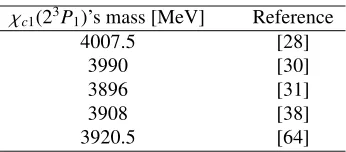
In our calculation of Ref. [38], our result for the mass of theχc1(23P1) state, i.e. 3.908 GeV, is compatible with
the mesonX(3872), that includes an extra component due to the coupling to the meson-meson continuum, responsi-ble for the downward energy shift. The difference between our prediction and the experimental data is within the er-ror of a QM calculation, of the order of 30−40 MeV. In Table 4, our UCQM result forχc1(2P)’s mass is compared
to those obtained by other authors, introducing continuum coupling effects in their calculations.
Table 4.Our UCQM result for the mass of theχc1(23P1) meson,
that in our picture corresponds to theX(3872), is compared to those of other calculations.
χc1(23P1)’s mass [MeV] Reference
4007.5 [28]
3990 [30]
3896 [31]
3908 [38]
3920.5 [64]
In Refs. [28, 64], the authors calculated the charmo-nium spectrum with continuum coupling effects. They computed the bare masses within the Cornell potential and the continuum coupling effects with a refined version of the Cornell coupled-channel model. Their result for the
mass of theχc1(23P1) meson seems incompatible with this
interpretation for theX(3872); on the contrary, the authors suggest the assignments 13D
2and 13D3for theX(3872).
In Ref. [30], the author calculated the spectrum ofcc¯ mesons up to 2Pstates, considering the effects of open-charm loops on open-charmonium masses. The bare energies were computed within the standard non-relativistic poten-tial model and the vertices within a3P
0-type model. Their
result forχc1(23P1)’s mass, i.e. 3990 MeV, seems
incom-patible withX(3872)’s experimental mass.
In Ref. [31], the authors computed the self energy cor-rections to thecc¯ spectrum, including the effects of open and nearby closed meson-meson channels. The authors used the results of Ref. [59] for the bare masses and com-puted the self energy corrections within an approach re-lated to the Dyson summation for the inverse meson prop-agator. Their result for the mass of theχc1(23P1) seems
compatible with the interpretation of theX(3872) as a 23P 1
c¯cstate.
The second possibility is to treat the X(3872) as a DD¯∗molecular state, with JPC = 1++[35, 47]. Accord-ing to Refs. [65], the DD¯∗ system withJPC = 1++ can be found by pion exchange and forms a meson-meson molecule. More recent molecular model calculations [66], that include quark exchange kernels for the transitions DD¯∗ → ρJ/Ψ, ωJ/Ψ, to predict the ωJ/Ψdecay mode
of the X(3872) [49], introduce large isospin mixing due to the mass difference betweenD0D¯∗0andD+D¯∗−.
Perhaps, the most important test for the properties of the X(3872) is to calculate its strong and radiative decay rates [49, 51, 52]. Ref. [52] re-examines the re-scattering mechanism for the X(3872): its results for the ratioRρ/ω≈
1, between theX(3872) → J/ψρ andX(3872) → J/ψω decay modes, and for the rate X(3872) → D0D¯0π0,
fa-vor a charmonium interpretation for the X(3872). Ref. [51] observes that the binding mechanism and the produc-tion rates are incompatible with the molecule interpreta-tion. However, these results have been criticized in sev-eral works [67, 69–73]. In particular, Ref. [71] observes that the production rates in the molecular interpretation are compatible with Tevatron data once the charm-meson re-scattering effects are considered. In Refs. [74, 75], the au-thors observe also prompt production at CDF and discuss whether a meson-meson molecule, with a size of a few fm and intrinsic fragility, can be promptly produced. By con-trast, Refs. [35, 47–49] propose a molecular interpretation for theX(3872).
In conclusion, we do not think that our previous argu-ments can, on their own, clarify the picture of theX(3872) resonance completely. Analysis of other properties of the X(3872), such as decay modes, is necessary to draw defini-tive conclusions.
6 Discussion of the results
In this contribution, we discussed the results of an un-quenched quark model calculation of the self energies cor-rections to the spectrum of charmonia [38]. The self ener-gies are corrections to the meson masses arising from the coupling to the meson-meson continuum.
Although the self energy corrections to the spectrum of bb¯ [39] and c¯c[38] mesons are relatively small, ap-proximately 1−2% and 2−6% of the corresponding me-son mass, respectively, these continuum-coupling effects can become qualitatively important in the case of sus-pected nonqq¯states, such as theX(3872) [46] orχb(3P) mesons [76, 77], that are states close to a meson-meson decay threshold. In particular, in Ref. [38] it is shown that the continuum coupling effects of theX(3872) give rise to DD¯∗andD∗D¯∗components in addition to thecc¯core.
In conclusion, our results of Ref. [38], that we analysed in this contribution, seem compatible with the χc1(23P1) interpretation for theX(3872).
References
[1] E. Eichten et al., Phys. Rev. Lett.34, 369 (1975); E. Eichtenet al., Phys. Rev. D17, 3090 (1978);21, 203 (1980).
[2] N. Isgur and G. Karl, Phys. Rev. D18, 4187 (1978);
19, 2653 (1979);20, 1191 (1979).
[3] W. Buchmuller and S. H. H. Tye, Phys. Rev. D24, 132 (1981).
[4] S. Godfrey and N. Isgur, Phys. Rev. D 32, 189 (1985).
[5] S. Capstick and N. Isgur, Phys. Rev. D 34, 2809 (1986).
[6] F. Iachello, N. C. Mukhopadhyay and L. Zhang, Phys. Rev. D44, 898 (1991).
[7] W. Lucha, F. F. Schoberl and D. Gromes, Phys. Rept.
200, 127 (1991).
[8] R. Bijker, F. Iachello and A. Leviatan, Annals Phys.
236, 69 (1994).
[9] M. M. Giannini and E. Santopinto, Phys. Rev. C49, 1258 (1994); M. Ferraris, M. M. Giannini, M. Pizzo, E. Santopinto and L. Tiator, Phys. Lett. B364, 231 (1995); E. Santopinto, F. Iachello and M. M. Gian-nini, Nucl. Phys. A 623, 100C (1997); Eur. Phys. J. A1, 307 (1998); M. Aiello, M. M. Giannini and E. Santopinto, J. Phys. G24, 753 (1998); R. Bijker, F. Iachello and E. Santopinto, J. Phys. A31, 9041 (1998); M. D. Sanctis, M. M. Giannini, L. Repetto and E. Santopinto, Phys. Rev. C62, 025208 (2000); M. M. Giannini, E. Santopinto and A. Vassallo, Eur. Phys. J. A 12, 447 (2001); Nucl. Phys. A 699, 308 (2002); L. Tiator, D. Drechsel, S. Kamalov, M. M. Giannini, E. Santopinto and A. Vassallo, Eur. Phys. J. A19, 55 (2004); M. Gorchtein, D. Drechsel, M. M. Giannini, E. Santopinto and L. Tiator, Phys. Rev. C70, 055202 (2004); M. De Sanctis, M. M. Gi-annini, E. Santopinto and A. Vassallo, Eur. Phys. J. A19, 81 (2004); Nucl. Phys. A 755, 294 (2005); Phys. Rev. C76, 062201 (2007); E. Santopinto and M. M. Giannini, Phys. Rev. C86, 065202 (2012). [10] L. Y. Glozman, D. O. Riska, Phys. Rept.268, 263
(1996).
[11] U. Loring, B. C. Metsch and H. R. Petry, Eur. Phys. J. A10, 395 (2001).
[12] R. Bijker, M. M. Giannini and E. Santopinto, Rev. Mex. Fis.50S2, 88 (2004); Phys. Lett. B 595, 260 (2004); Eur. Phys. J. A22, 319 (2004).
[13] E. Santopinto, Phys. Rev. C 72, 022201 (2005); J. Ferretti, A. Vassallo and E. Santopinto, Phys. Rev. C 83, 065204 (2011); M. De Sanctis, J. Ferretti, E. Santopinto and A. Vassallo, Phys. Rev. C 84, 055201 (2011); AIP Conf. Proc.1488, 280 (2012). [14] E. Santopinto and G. Galatá, Phys. Rev. C 75,
045206 (2007); G. Galatá and E. Santopinto, Phys. Rev. C86, 045202 (2012).
[15] P. Colangelo, F. De Fazio, F. Giannuzzi and S. Nicotri, Phys. Rev. D86, 054024 (2012).
[16] P. Guo, A. P. Szczepaniak, G. Galata, A. Vassallo and E. Santopinto, Phys. Rev. D77, 056005 (2008); Phys. Rev. D78, 056003 (2008).
[17] S. Capstick, A. Svarc, L. Tiator, J. Gegelia, M. M. Giannini, E. Santopinto, C. Hanhart and S. Schereret al., Eur. Phys. J. A35, 253 (2008). [18] A. Ostrander, E. Santopinto, A. P. Szczepaniak and
A. Vassallo, Phys. Rev. D86, 114015 (2012). [19] I. G. Aznauryan et al., Int. J. Mod. Phys. E 22,
1330015 (2013).
[20] C. Patrignani, T. K. Pedlar and J. L. Rosner, arXiv:1212.6552 [hep-ex].
P. Zenczykowski, Annals Phys.169, 453 (1986). [22] K. G. Horacsek, Y. Iwamura and Y. Nogami, Phys.
Rev. D32, 3001 (1985).
[23] W. Blask, M. G. Huber and B. Metsch, Z. Phys. A
326, 413 (1987).
[24] M. Brack and R. K. Bhaduri, Phys. Rev. D35, 3451 (1987).
[25] B. Silvestre-Brac and C. Gignoux, Phys. Rev. D43, 3699 (1991).
[26] S. Ono and N. A. Törnqvist, Z. Phys. C 23, 59 (1984); K. Heikkila et al., Phys. Rev. D 29, 110 (1984); S. Onoet al., Phys. Rev. D34, 186 (1986). [27] E. van Beveren and G. Rupp, Phys. Rev. Lett. 91,
012003 (2003); E. van Beverenet al., Phys. Rev. D
74, 037501 (2006); G. Rupp and E. van Beveren, Eur. Phys. J. A31, 698 (2007).
[28] E. J. Eichten, K. Lane and C. Quigg, Phys. Rev. D
69, 094019 (2004).
[29] D. S. Hwang and D. -W. Kim, Phys. Lett. B601, 137 (2004).
[30] Y. S. Kalashnikova, Phys. Rev. D72, 034010 (2005). [31] M. R. Pennington and D. J. Wilson, Phys. Rev. D76,
077502 (2007).
[32] T. Barnes and E. S. Swanson, Phys. Rev. C 77, 055206 (2008).
[33] B. -Q. Li and K. -T. Chao, Phys. Rev. D79, 094004 (2009).
[34] I. V. Danilkin and Y. .A. Simonov, Phys. Rev. D81, 074027 (2010).
[35] I. V. Danilkin and Yu. A. Simonov, Phys. Rev. Lett.
105, 102002 (2010).
[36] J. -F. Liu and G. -J. Ding, Eur. Phys. J. C72, 1981 (2012).
[37] J. Ferretti, G. Galatá, E. Santopinto and A. Vassallo, Phys. Rev. C86, 015204 (2012).
[38] J. Ferretti, G. Galatá and E. Santopinto, Phys. Rev. C
88, 015207 (2013).
[39] J. Ferretti and E. Santopinto, arXiv:1306.2874 [hep-ph].
[40] R. H. Dalitz and S. F. Tuan, Phys. Rev. Lett.2, 425 (1959).
[41] S. M. Flatteet al., Phys. Lett. B38, 232 (1972). [42] E. Santopinto and R. Bijker, Few Body Syst.44, 95
(2008); R. Bijker and E. Santopinto, Phys. Rev. C80, 065210 (2009).
[43] E. Santopinto and R. Bijker, Phys. Rev. C82, 062202 (2010).
[44] R. Bijker, J. Ferretti and E. Santopinto, Phys. Rev. C
85, 035204 (2012).
[45] E. Santopinto, R. Bijker and J. Ferretti, Few Body Syst. 50, 199 (2011); E. Santopinto and R. Bijker, Few Body Syst.54, 761 (2013).
[46] S. K. Choiet al.[Belle Collaboration], Phys. Rev. Lett. 91, 262001 (2003); D. Acostaet al. [CDF II Collaboration], Phys. Rev. Lett.93, 072001 (2004). [47] C. Hanhartet al., Phys. Rev. D76, 034007 (2007). [48] V. Baruet al., Phys. Rev. D84, 074029 (2011).
[49] E. S. Swanson, Phys. Lett. B588, 189 (2004);598, 197 (2004).
[50] F. Aceti, W. H. Liang, E. Oset, J. J. Wu and B. S. Zou, Phys. Rev. D86, 114007 (2012).
[51] M. Suzuki, Phys. Rev. D72, 114013 (2005). [52] C. Meng and K.-T. Chao, Phys. Rev. D75, 114002
(2007).
[53] P. Geiger and N. Isgur, Phys. Rev. D55, 299 (1997). [54] L. Micu, Nucl. Phys. B 10, 521 (1969); A. Le Yaouancet al., Phys. Rev. D8, 2223 (1973);9, 1415 (1974); Phys. Lett. B71, 397 (1977);72, 57 (1977). [55] R. Kokoski and N. Isgur, Phys. Rev. D 35, 907
(1987).
[56] P. Geiger and N. Isgur, Phys. Rev. Lett. 67, 1066 (1991); Phys. Rev. D 44, 799 (1991); 47, 5050 (1993).
[57] J. Beringer et al. [Particle Data Group Collabora-tion], Phys. Rev. D86, 010001 (2012).
[58] E. S. Ackleh, T. Barnes and E. S. Swanson, Phys. Rev. D54, 6811 (1996).
[59] T. Barnes, S. Godfrey and E. S. Swanson, Phys. Rev. D72, 054026 (2005).
[60] D. Acosta et al. [CDF Collaboration], Phys. Rev. Lett.93, 072001 (2004).
[61] V. M. Abazovet al.[D0 Collaboration], Phys. Rev. Lett.93, 162002 (2004).
[62] B. Aubertet al.[BABAR Collaboration], Phys. Rev. D71, 071103 (2005).
[63] R. Aaijet al.[LHCb Collaboration], Phys. Rev. Lett.
110, 222001 (2013).
[64] E. J. Eichten, K. Lane and C. Quigg, Phys. Rev. D
73, 014014 (2006).
[65] M. B. Voloshin and L. B. Okun, JETP Lett.23, 333 (1976) [Pisma Zh. Eksp. Teor. Fiz.23, 369 (1976)]; A. De Rujula, H. Georgi and S. L. Glashow, Phys. Rev. Lett. 38, 317 (1977); N. A. Tornqvist, Phys. Rev. Lett.67, 556 (1991).
[66] N. A. Tornqvist, Phys. Lett. B590, 209 (2004). [67] E. Braaten, M. Lu and J. Lee, Phys. Rev. D 76,
054010 (2007).
[68] S. Fleming, M. Kusunoki, T. Mehen and U. van Kolck, Phys. Rev. D76, 034006 (2007).
[69] C. M. Zanetti, M. Nielsen and R. D. Matheus, Phys. Lett. B702, 359 (2011).
[70] M. Nielsen and C. M. Zanetti, Phys. Rev. D 82, 116002 (2010).
[71] P. Artoisenet and E. Braaten, Phys. Rev. D 81, 114018 (2010) [arXiv:0911.2016 [hep-ph]].
[72] C. E. Thomas and F. E. Close, Phys. Rev. D 78, 034007 (2008).
[73] E. S. Swanson, Phys. Rept.429, 243 (2006). [74] C. Bignamini, B. Grinstein, F. Piccinini, A. D. Polosa
and C. Sabelli, Phys. Rev. Lett.103, 162001 (2009). [75] G. Bauer [CDF Collaboration], Int. J. Mod. Phys. A
20, 3765 (2005).
![Table 1. Parameters of the 3P0 model from Ref. [38].](https://thumb-us.123doks.com/thumbv2/123dok_us/8197339.1369209/2.595.313.538.142.403/table-parameters-p-model-ref.webp)