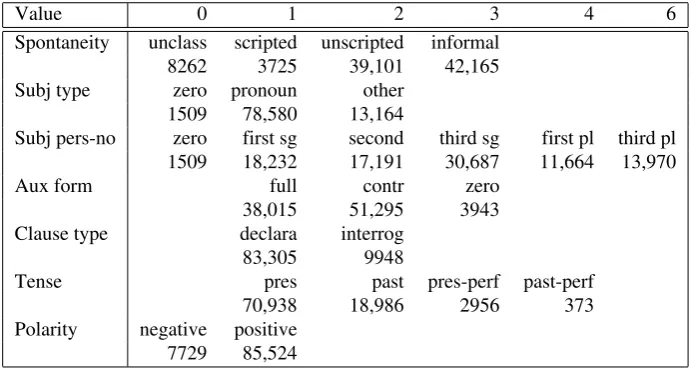
con-Value 0 1 2 3 4 6 Spontaneity unclass scripted unscripted informal
8262 3725 39,101 42,165
Subj type zero pronoun other
1509 78,580 13,164
Subj pers-no zero first sg second third sg first pl third pl 1509 18,232 17,191 30,687 11,664 13,970
Aux form full contr zero
38,015 51,295 3943
Clause type declara interrog
83,305 9948
Tense pres past pres-perf past-perf
70,938 18,986 2956 373
Polarity negative positive 7729 85,524
Table 2: Properties of the 93,253 progressive aspect verb groups in sBNC.
Zero subj 2nd interrog Other Overall
Progressives 1509 4923 86,821 93,253
Full aux 18% 71% 39% 41%
Contr aux 0% 2% 59% 55%
Zero aux 82% 27% 2% 4%
Table 3: Auxiliary form by construction type (selected) in sBNC.
Research Council (UK) grant number EP/F030061/1. Both authors thank the anonymous reviewers for their construc-tive criticism which was of much assistance in preparing this paper for submission. Finally, both authors sincerely acknowledge the support and guidance of Norman Cobley, Alan Horne, Jyothi Katuri, Barbara Lawn-Jones, Michael McCarthy and Peter Stoehr.
7.
References
The British National Corpus, version 3 2007. Distributed by Oxford University Computing Services on behalf of the BNC Consortium. http://www.natcorp.ox.ac.uk/ L. Burnard (ed.) 2000. The British National Corpus
User’s Reference Guide. http://www.natcorp.ox.ac.uk/ docs/userManual/
A.P. Caines 2010 ‘You talking to me?’ Zero auxiliary con-structions in British English. Ph.D thesis, University of Cambridge.
A.P. Caines and P.J. Buttery 2010. ‘You talking to me?’ A predictive model for zero auxiliary constructions. In:
Proceedings of the Workshop on NLP and Linguistics:
Finding the Common Ground (ACL 2010), 4351.
Associ-ation for ComputAssoci-ational Linguistics.
S. Crowdy 1993. Spoken corpus design. Literary and
Lin-guistic Computing8: 259-265.
S. Crowdy 1994. Spoken corpus transcription.Literary and Linguistic Computing9: 25-28.
A
DTD
( 6 )
<?xml v e r s i o n= ” 1 . 0 ” e n c o d i n g = ”UTF−8” ?> <!ELEMENT CAINESCORPUS (BNCDOC+ )> <!ELEMENT BNCDOC ( S + )>
<!ELEMENT S (ANNOTATIONS)>
<!ELEMENT ANNOTATIONS ( PROGRESSIVE ? , FUTURE ANNOTATION ? )> <!ELEMENT PROGRESSIVE ( SUBJECT , AUXILIARY , CLAUSE )>
<!ELEMENT SUBJECT EMPTY> <!ELEMENT AUXILIARY EMPTY> <!ELEMENT CLAUSE EMPTY>
<!ELEMENT FUTURE ANNOTATION EMPTY> <!ATTLIST BNCDOC ID CDATA #REQUIRED> <!ATTLIST S ID CDATA #REQUIRED>
B
XML examples
( 7 )
<BNCDOC ID= ”KR0”>
<S ID= ” 185 ” SPONTANEITY= ” 3 ”> <ANNOTATIONS>
<PROGRESSIVE>
<SUBJECT TYPE= ” 1 ” PERSNO= ” 2 ” /> <AUXILIARY FORM= ” 3 ” />
<CLAUSE POLARITY= ” 0 ” TENSE= ” 1 ” TYPE= ” 2 ” /> </ PROGRESSIVE>
</ ANNOTATIONS> </ S>
</BNCDOC>
( 8 )
<BNCDOC ID= ”KBW”>
<S ID= ” 13768 ” SPONTANEITY= ” 3 ”> <ANNOTATIONS>
<PROGRESSIVE>
<SUBJECT TYPE= ” 0 ” PERSNO= ” 0 ” /> <AUXILIARY FORM= ” 1 ” />
<CLAUSE POLARITY= ” 1 ” TENSE= ” 2 ” TYPE= ” 1 ” /> </ PROGRESSIVE>
</ ANNOTATIONS> </ S>
</BNCDOC>
( 9 )
<BNCDOC ID= ” D95 ”>
<S ID= ” 430 ” SPONTANEITY= ” 2 ”> <ANNOTATIONS>
<PROGRESSIVE>
<SUBJECT TYPE= ” 2 ” PERSNO= ” 3 ” /> <AUXILIARY FORM= ” 1 ” />
<CLAUSE POLARITY= ” 0 ” TENSE= ” 2 ” TYPE= ” 1 ” /> </ PROGRESSIVE>
</ ANNOTATIONS> </ S>