Computational Linguistics and Chinese Language Processing
Vol. 14, No. 2, June 2009, pp. 205-220 205 © The Association for Computational Linguistics and Chinese Language Processing
[Received July 1, 2009; Revised January 22, 2010; Accepted January 28, 2010]
Effects of Collocation Information on Learning Lexical
Semantics for Near Synonym Distinction
Ching-Ying Lee
∗,+and Jyi-Shane Liu
#Abstract
One of the most common lexical misuse problems in the second language context concerns near synonyms. Dictionaries and thesauri often overlook the nuances of near synonyms and make reference to near synonyms in providing definitions. The semantic differences and implications of near synonyms are not easily recognized and often fail to be acquired by L2 learners. This study addressed the distinctions of synonymous semantics in the context of second language learning and use. The purpose is to examine the effects of lexical collocation behaviors on identifying salient semantic features and revealing subtle difference between near synonyms. We conducted both analytical evaluation and empirical evaluation to verify that proper use of collocation information leads to learners’ successful comprehension of lexical semantics. Both results suggest that the process of organizing and identifying salient semantic features is favorable for and is accessible to a good portion of L2 learners, and thereby, improving near-synonym distinction.
Keywords: Lexical Semantics, Near-synonym Distinction, Lexical Collocation Behavior.
1.
Introduction
One of the most common lexical misuse problems in the second language context concerns near synonyms. Near synonyms are lexical pairs or sets that have very similar cognitive or denotational meanings. Dictionaries and thesauri often overlook the evaluative distinctions among near synonyms and ‘end up showing certain circularity’ in providing semantic meaning (Tognini-Bonelli, 2001). L2 learners are left with individual judgment and preference in lexical choices of almost synonymous words. Near synonyms, however, may vary in
∗
Department of English, National Taiwan Normal University, Taipei, Taiwan
+
Department of Applied Foreign Languages, Kang Ning Junior College, Taipei, Taiwan E-mail: [email protected], [email protected]
#
206 Ching-Ying Lee and Jyi-Shane Liu
collocational or implicative behavior (Partington, 2004). Among a group of nearly synonymous words, some may indicate favorable conditions while others refer to unfavorable situations, and some may show approval while others imply disapproval. These subtle distinctions between near synonyms are not easily identified and may never be acquired by L2 learners.
Lexical use is an area where L2 learners frequently demonstrate a number of errors. Many L2 learners rely on dictionaries and thesauri to provide denotational meaning of a lexical item without being aware of the subtle implications embedded in contexts. Implicit knowledge of lexical items is not easily taught. Semantic infelicities due to inappropriate lexical use leads to miscommunication and unfavorable social consequences. Therefore, misuse of lexical items, particularly among near synonyms, calls for more attention and treatment in L2 lexical learning.
The purpose of this research is to explore the potential of applying computerized linguistic resources and observing collocation behaviors in semantic learning for near synonym distinction. We propose a categorized collocation profile with graded association strength to filter and organize salient semantic features. It serves as a guided process to help develop concrete conceptual links so semantic meaning and unique features of lexical items become more easily accessible to L2 learners. Both analytical evaluation and empirical evaluation are performed to examine the effects of collocation information on near synonym distinction. Observations and implications in regards to L2 semantics learning are described.
2.
Literature Review
Knowledge of the appropriate contextual use of the particular languages’ resources is a crucial component of linguistic competence (Barron, 2003). L2 learners often face difficulties in understanding subtle and elusive nuances of appropriateness (Dewaele, 2008). The task of making proper lexical decisions between near synonyms is particularly challenging for L2 learners and requires adequate semantic competence. It is inadequate to only know a word meaning or definition. A core lexical competence is characterized by appropriateness of word choices, particularly between near synonyms.
The idea of using collocation information to observe the word sense has been developed in post-Firthian corpus linguistics. The relevant studies investigate how a lexical item functions to convey semantic meanings, or how it carries out its discursive or evaluative properties (Sinclair, 2003; Channell, 2000; Stubbs, 2001; Partington, 2004). L2 learners should be aware that lexical meanings cannot be determined only by semantics. Therefore, it is helpful to examine the effects of collocation information on lexical meaning and functions.
Effects of Collocation Information on Learning Lexical Semantics for 207 Near Synonym Distinction
and among collocates themselves’ (2001). The collocational information is interpreted through the proximity of a consistent series of collocates (Louw, 2000). Its main function is to convey the speaker or writer’s attitude or evaluation. According to priming theory, Partington (2004) indicates that a person has a set of mental rules in the priming process, combined with the mental lexicon, of how items should collocate. In addition, the process by which lexical items are primed in one’s mind is highly contextually dependent. The corpus linguistic techniques for lexical collocation provide a distinctive way to study semantic profiles.
The problem of near synonym distinction and appropriate lexical choice is especially daunting for second language learners (Mackay, 1980). The majority of vocabulary errors made by advanced language learners reflect learners’ confusion among similar lexical items in the second language. The language of explanations in dictionaries is somewhat arcane such that it becomes limited in accessibility and usefulness in practical L2 contexts. Martin (1984) discussed instructional approaches to synonym teaching and suggested the importance of providing common collocates to students. With the availability of computerized corpora, recent research has exploited concordances and collocation data for advising L2 learners in lexical choice (Yeh, et. al., 2007; Chang, et. al., 2008). Through enquiry into the interplay between lexical semantics of near synonyms and their collocation information, this study provides analytic and empirical observations and contributes to reducing L2 learners’ confusion of sophisticated lexical connotations and applications.
3.
Methodology
Corpus-based approaches to applied linguistics assert that lexical semantics can be revealed by study of a large corpus. The analysis of the corpus uses computational techniques to identify words that typically co-occur with a lexical item under investigation. Our study attempts to understand the potential of adopting corpus linguistics for the purpose of improving learners’ performance in lexical semantics. In particular, we focus on investigating the effects of lexical collocation information on near-synonym distinction in either the self-learning or the classroom context.
208 Ching-Ying Lee and Jyi-Shane Liu
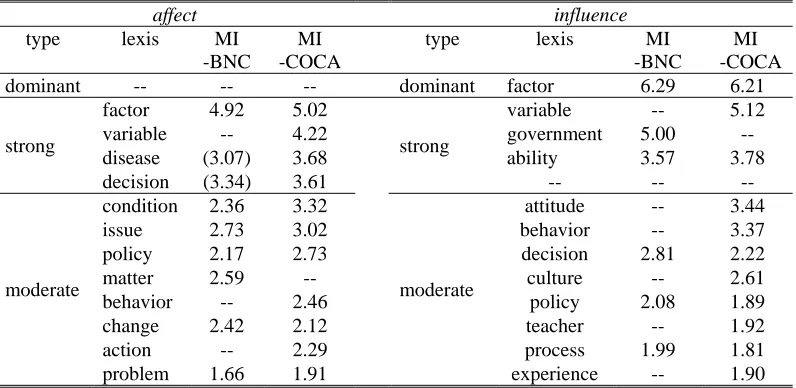
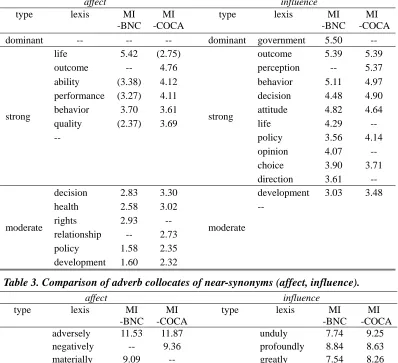
The notion of collocational profile is proposed to provide an organized description of collocation behavior. Collocates are grouped by POS categories and graded by association strength with a keyword. The statistical measure chosen to gauge association strength in the study was the mutual information (MI) measure (Church & Hanks, 1990). The MI measure compares the probability of two words occurring together through intention with the probability of the two words occurring together by chance. Higher MI scores indicate strong association between two words. An MI score greater than 2 can be considered high enough to show a substantial association between two words. The MI measure, however, has been known to unduly overvalue infrequent words. The list of words considered in the collocational profile is restricted to the top 20 with the highest frequency of occurrence and has a minimum number of 5. These adjustments have allowed us to partly offset the drawbacks of MI measure.
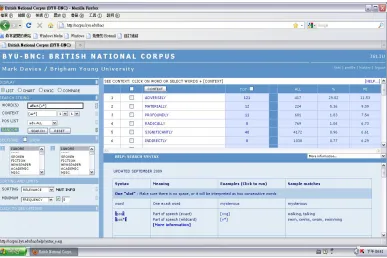
For transitive verbs such as affect/influence, we focus on the basic syntactic pattern of S (subject noun) +V (transitive verb) + O (object noun) and a few extended patterns, such as Adv (adverb) + V + O, and V + Adv + O. Words that meet the constraints of POS tags and occurrence positions with respect to the keyword (transitive verb) are retrieved by VIEW and classified into three categories: subject collocates, object collocates, and adverb collocates. The positional constraint for subject collocates is the left horizon of the keyword within a span of five words. Object collocates are restricted to the right horizon of the keyword within a span of five words. Adverb collocates must be immediately before or after the keyword.
When the list of most frequent collocates is retrieved, the collocates are further graded by their MI scores. Collocates with MI scores higher than 5.5 are graded as dominant collocates. Collocates with MI scores lower than 3.5 are graded as moderate collocates. Those in between are graded as strong collocates. The grade order of dominant, strong, and moderate indicates the decreasing strength of association between the collocates and the keyword. The POS categorization and the graded association strength of collocates provide a profile that highlights the significant semantic links and illustrates the interactive network of semantic meaning. This will help enhance a concept map of the keyword where semantic features become more recognizable and synonym distinction is clarified.
Effects of Collocation Information on Learning Lexical Semantics for 209 Near Synonym Distinction
Figure 1. Screenshot of VIEW providing collocation information.
4.
Evaluation
Two sets of tests are conducted to explore and verify the effects of collocation information on lexical semantics acquisition and near synonym distinction. In the first test, we walked through the process of producing a collocational profile, acquiring semantic features, and illuminating semantic distinction between near synonyms. The purposes were performing an objective analysis on the effects of collocational profiles in leading to a clear description of semantic features and allowing comparative induction that reveals subtle semantic differences between near synonyms. The second test involved a written test and survey given to a group of recruited test subjects. The purpose was to solicit language learners’ actual experience and observe the effects of collocational profiles on language learners’ performance in near synonym distinction tasks. By conducting both analytical and empirical verification, we hoped to achieve a sound investigation to better understand the extent to which collocational profiles can help reveal semantic distinctions of near synonyms to L2 learners.
4.1 Analytical Verification
Effects of Collocation Information on Learning Lexical Semantics for 213 Near Synonym Distinction
2. When dictionary definitions were provided for consultation, the subjects scored lower (from 6.25 to 5.53) than the phase one test with self lexical recognition. Nevertheless, confidence levels in performing the task show a considerable increase (from 4.3 to 6.48). The performance degradation in phase two seems to indicate that dictionary consultation for affect and influence does not result in better understanding and seems to bring difficulty to subjects’ near-synonym recognition. Yet, the subjects made lexical choices with higher confidence and seemed to not be aware of the newly-created misuse. This reveals a significant problem in the near-synonym self-learning context. A considerable portion of language learners may not be capable of using L2 dictionaries for successful near-synonym distinction and may perceive inaccurate lexical knowledge.
3.
The effects of providing collocation information seem to be positive in the near-synonym distinction task. In the phase three test, the subjects became more cautious (5.9 vs. 6.48) on potential lexical misunderstanding but scored better (6.15 vs. 5.53) than the phase two test with dictionaries. Although the test score does not show improvement over the phase one test with subjects’ self lexical recognition, the lexical decision was made with higher confidence (5.9 vs. 4.3), indicating the subjects did gain useful information from the collocational profile for distinguishing the near-synonyms.4.
The subjects’ perception of the usefulness of additional semantic information seems to be consistent with the test scores. The subjects perceived the lowest usefulness (42.5%) in the distinction task with dictionaries, which were fittingly accompanied by the lowest test score (5.53). More than two-thirds (67.5%) of the subjects perceived the collocational profile as useful information in near-synonym distinction.The empirical study reveals that language learners do experience difficulty in near-synonym semantic recognition. The problem should be brought to the attention of language teachers and needs to be addressed adequately. The overall test results support the positive effects of collocation information on near-synonym semantic distinction. Both the test scores and the subjects’ perception show meaningful enhancement in better understanding of lexical semantics. The positive effects are not as evident in difficult near-synonyms, and this can be logically expected. Some collocation information for distinguishing similar semantics may not be obvious to language learners. This indicates that the positive effects of collocation information on near-synonym semantic recognition may be greatly improved by pedagogical instruction over self-learning for most language learners.
5.
Discussion and Conclusion
214 Ching-Ying Lee and Jyi-Shane Liu
the target word. The scale of collocate association strength helps distinguish salient semantic features that are conducive to L2 learners’ comprehension of the target word. When the target word is a transitive verb, the collocational profile of subject, object, adverb, and adjective collocates with graded association strength serves as an effective instrument in revealing the semantics and improving learners’ recognition of the target word. The collocational profile also provides analytical evidence for L2 learners in comparing and discriminating near-synonyms. In self-learning with dictionary consultation, L2 learners are often briefed by abstract definition and left with vague and shallow lexical recognition. Collocational profiles, together with denotational meaning in dictionaries, give a solid conceptual grounding of target word for L2 learners in getting full grasp of the lexical semantics.
In this study, we used VIEW as a concordancing tool, to retrieve collocation information related to the targeted words for investigation. Our position is not to design and develop a new system that outperforms current concordancing tools, such as VIEW and SKETCH ENGINE. Instead, we attempt to point out that there is a gap between L2 learners’ proficiency and the powerful investigative functions provided by these concordancing tools. We addressed the problem of how the linguistic resources and the computational functions, as provided by current concordancing tools, can be further built upon to benefit L2 learners.
We proposed a categorized collocational profile with graded association strength to filter and organize salient semantic features. It serves as a guided process to help develop concrete conceptual links such that semantic meaning and unique features of lexical items becomes more easily accessible to L2 learners. The process of constructing collocational profiles that we manually simulated on top of VIEW can be automated by a computer program and can be potentially developed as an online lexical query instrument for L2 learners in pedagogical and self-learning contexts. The development of such a software system, however, is not within the scope of the paper.
Effects of Collocation Information on Learning Lexical Semantics for 215 Near Synonym Distinction
Acknowledgments
The authors would like to thank Prof. Miao-Hsia Chang of NTNU for her research advice and Prof. Huei-Ling Lai of NCCU for her assistance in questionnaire administration. Anonymous reviewers’ comments also helped improve the content of the paper.
Reference
Barron, A. (2003). Acquisition in interlanguage pragmatics. Amsterdam: Benjamins.
Burnard, L. (1995). British National Corpus: User's reference guide for the British National Corpus. Oxford: Oxford University Computing Service.
Chang, Y. C., Chang, J. S., Chen, H. J., & Liou, H. C. (2008). An automatic collocation writing assistant for Taiwanese EFL learners: A case of corpus-based NLP technology. Computer Assisted Language Learning, 21(3), 283-299.
Channell, J. (2000). Corpus-based analysis of evaluative lexis. In S. Hunston & G. Thompson (Eds.), Evaluation in Text (pp. 38-55). Oxford University Press.
Church, K. W., & Hanks, P. (1990). Word association norms, mutual information, and lexicography. Computational Linguistics, 16(1), 22-29.
Davies, M. (2008a). VIEW. Available online at http://view.byu.edu/.
Davies, M. (2008b). The Corpus of Contemporary American English: 385 million words, 1990-present. Available online at http://www.americancorpus.org.
Dewaele, J. (2008). Appropriateness in foreign language acquisition and use: Some theoretical, methodological and ethical considerations. International Review of Applied Linguistics in Language Teaching, 46(3), 245-265.
Kilgarriff, A., Rychly, P., Smrz, P., & Tugwell, D., (2004). The Sketch Engine. In Proceedings of the Eleventh EURALEX International Congress, 105-116. Lrient.
Levinson, S. (1983). Pragmatics. Cambridge: Cambridge University Press.
Louw, B. (2000). Contextual prosodic theory: Bring semantic prosodies to life. In C. Heffer, H. Sauntson & G. Fox (Eds.), Words in Context: A Tribute to John Sinclair on his Retirement. Birmingham: University of Birmingham.
Mackay, S. (1980). Teaching the syntactic, semantic, and pragmatic dimensions of Verbs. TESOL Quarterly, 14, 17-26.
Marin, M. (1984). Advanced vocabulary teaching: The problem of synonyms. The Modern Language Journal, 68, 130-137.
Partington, A. (2004). Utterly content in each other’s company: Semantic prosody and semantic preference. International Journal of Corpus Linguistics, 9(1), 131-156.
Sinclair, J. (2003). Corpora for lexicography. In Sterkenberg, P. Van (Ed.), A Pactical Guide to Lexicography. Amsterdam: John Benjamins.
216 Ching-Ying Lee and Jyi-Shane Liu
Tognini-Bonelli, E. (2001). Corpus linguistics at work. Amsterdam: John Benjamins.
Effects of Collocation Information on Learning Lexical Semantics for 217 Near Synonym Distinction
Appendix. Questionnaire
Part I. Circle the word which is appropriate for the context of the sentence.
Both “affect” and “influence” are translated as 影響 in Chinese and both are used as verb in the following sentences.
1. How did your past experiences affect or influence the way you coped with changes?
sure not sure
2. Environmental issues continue to affect or influence us all. sure not sure
3. It's going to affect or influence the quality of the lives of people in Taipei.
sure not sure
4. We believe that the culture and language of individualism affect or influence these trends.
sure not sure
5. Price and easy availability heavily affect or influence consumers' choices.
sure not sure
6. Local networks have more power to affect or influence public opinion than any other media.
sure not sure
7. The amount and type of fat that you eat can affect or influence the health of your heart.
sure not sure
8. A market leader’s actions may greatly affect or influence the industry structure.
sure not sure
9. They could severely affect or influence the success or failure of the program.
sure not sure
10. The party can heavily affect or influence the political agenda. sure not sure