Experimental Analysis of Bio Oil under
Transestrification Process by Using Babool
Tree Seeds
Radhakrishnan.C1, Yogeshwaran.K1, Karunaraja.N1, Tamilselvan.R2, Sriram Gopal2, Kavin Prasanth.K2,
Assistant Professor1, Department of Automobile Engineering, Dr.Mahalingam College of Engineering and Technology, Pollachi, Tamil Nadu, India
UG Scholar2, Department of Automobile Engineering, Dr.Mahalingam College of Engineering and Technology,
Pollachi, Tamil Nadu, India
ABSTRACT: Nowadays due to the increase in population of vehicle, more amount of fuel is needed. Due to this fact the alternative fuels are needed in the future. In India where fossil fuel resources are very limited, the production and use of biodiesel from vegetable oils and fats may be a feasible solution for supplementing the ever growing demand of diesel in the country. However while selecting the sources of triglycerides for biodiesel production, special attention must be given to utilize the indigenous non-edible oils. In the forests of India, of the south in particular, a large variety of oilseeds bearing trees and shrub species grow well in their natural habitats. The seeds of some of such trees are not normally used for any purpose, productive or otherwise. While searching for oil seeds attracted by babool tree which produces seeds.With a view of utilizing the seeds, it is converted to oil then it make as biodiesel and to examine the feasibility of using them as a fuel for diesel engine.
In this work concentrates on developing an alternative fuel using the babool tree seeds. (Prosopis juliflora). The oil taken from babool tree seeds and undergone a various testingto find out its properties.This study helps the babool tree can be used as a source of biodiesel and used in blends with optimum proportion.
KEYWORDS: Biodiesel, Transesterification, Blending, VCR Engine.
I. INTRODUCTION
II. RELATEDWORK
The seed from the babool tree is collected. More amounts of seed are needed to get the oil. The seed is completed dried under the influence of sunlight for several days. The shell is removed after drying the seeds. The seeds dried again after removing the shell. Then the oil is taken from the seed. The oil may contain dirt’s soit should be filtered. The filtered oil undergoes Transesterification process. By means of transesterification process the oil’s properties can be improved. Then the oil is blended with diesel. The blending ratios are B5 and B10 for the oil taken. The properties of oil were tested. The blend is analysed in the VCR engine. In the VCR Engine the various compression ratio can be used. The details of a VCREngine is given below,
IC Engine set up under test is Research Diesel having power 3.50 kW @ 1500 rpm which is 1 Cylinder, Four stroke , Constant Speed, Water Cooled, Diesel Engine, with Cylinder Bore 87.50(mm), Stroke Length 110.00(mm), Connecting Rod length 234.00(mm), Compression Ratio 16.00, Swept volume 661.45 (cc).
The different loads given to the engine and the efficiencies for the different load are found out. Then compression ratio for the diesel fuel is taken from 16 to 24.
III.METHODOLOGY
The aim of this work to produce the biodiesel using the babool tree seeds. Figure. 1 shows the methodology of the process. The main process is transesterification. Then the property of the oil is tested. Then the engine is operated by using the blended oil.
Figure.1 Methodology flow chart PRODUCTION OF BIO DIESEL
MATERIAL COLLECTION
TRANSESTERIFICATION
TESTING OF BIO DIESEL
methanol or ethanol).
Material Collection& Preparation: The materials required for producing the oil should be collected. The amount of raw material (babool tree seeds) required should be about 5 kgs. In Tamil Nadu, the species grows widely in the districts of Salem, Erode, Dharmapuri and Coimbatore. It is absent in coastal districts and higher hills. The species has been widely planted in tank foreshore plantations under social forestry programmes. The seeds are collected from the trees and the seeds are dried in the sunlight for several hours. Figure. 2 shows the babool tree seeds.
Figure.2 Selecting Materials babool tree seeds
Acid esterification: 100 ml of refined babool tree seed oil is poured into the flask and heated up to 60˚C. The 45% v/v methanol is added with the preheated oil and stirred for a few minutes. 0.5% of sulphuric acid is added with the mixture. Heating and stirring should continue about 45min at atmospheric pressure. After completion of this reaction, the mixture is poured into a separating funnel for separating the excess alcohol, impurities and sulphuric acid. The excess alcohol, sulphuric acid and impurities move to the top layer and it’s discarded. The lower layer is separated for further processing of Trans esterified into methyl ester. This process reduces the acid value of refined oil to less than 1% of FFA
.
Transesterification:The Transesterification of natural glycerides with methanol to methyl esters is a technically important reaction that has been used extensively in the soap and detergent manufacturing industry worldwide for many years. Almost all biodiesel is produced in a similar chemical process using base catalysedtransesterification as it is the most economical process, requiring only low temperatures and pressures while producing a 98% conversion yield. The transesterification process is the reaction of a triglyceride (fat/oil) with an alcohol to form esters and glycerol. A triglyceride has a glycerin molecule as its base with three long chain fatty acids attached. The characteristics of the fat are determined by the nature of the fatty acids attached to the glycerin. The nature of the fatty acids can, in turn, affect the characteristics of the biodiesel. This equation 1 shows the transesterification process.
Equation. 1 for transesterification process
IV.EXPERIMENTAL RESULTS
Tabulation shows the results of biodiesel. The test results yields the various properties of oil.
VISCOSITY:
Hydrodynamic flow of lubricating oil is called viscosity. The viscosity should remain constant at the temperatures. Viscosity Index is an indication of the change of viscosity of oil with temperature. A high viscosity index means less change of oil with temperature rise. The viscosity is listed below on the table.
FLASH POINT:
Flash point is the temperature at which the oil burns. The flash point of the oil should be sufficiently high so as to avoid flashing of oil vapors’ otherwise, the oil will firing at any time. The flash point is listed below in the table
FIRE POINT:
Fire point Is the temperature at which the oil burns continuously at least for 5 seconds.The fire point is listed below in the table
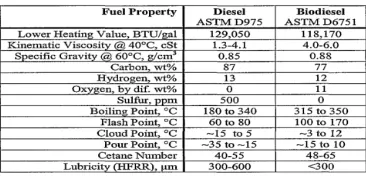
Table. 1 shows the standard values of diesel & biodiesel. Flash point of the biodiesel should be higher than the diesel. The cetane number is also higher for the biodiesel. The general comparison between the diesel and biodiesel can be studied from this table.
Table. 2 shows the properties of oil after transesterification with using the penksy martin apparatus and redwood viscometer apparatus. This table is compared with Table. 1. The value of viscosity for the biodiesel is more than the standard value. The value of the flash and fire point is good for the transesterified oil. The values are given below,
KINEMATIC VISCOSITY 20.2 Centistokes @ 400C
FLASH POINT 1390c
FIRE POINT 1460c
Table.2 Properties for the oil after transesterification
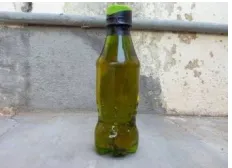
The raw is produced from the seeds. The color of the oil is black. Figure. 3 shows the raw oil. The viscosity of a raw oil is higher than the transesterified oil. The 250 ml of the raw oil is collected from the seeds. The raw oil may contain dirt and impurities so, it should be filtered.
Figure.3 Raw oil
The raw oil is transesterified by using two methods. They are acid esterification and alkaline Transesterification. Figure. 4 shows the transesterification done on the raw oil.Transesterification is the conversion of a carboxylic acid ester into a different carboxylic acid ester.
Figure.4 Transesterification done on raw oil
The transesterified oil is blended with diesel by 5% and 10%. Figure. 5 shows the oil blended with diesel. The blended oil is operated in the VCR Engine. The blending ratios are generally B5, B10, B20, and B100 (pure oil).For 500ml of diesel 25ml (5% blend), 50ml (10% blend) of oil is mixed.
Figures. 5 5% blend (left) 10% blend (right)
Efficiency for 5% blend Efficiency for 10% blend
TORQUE, Mechanical &Volumetric Efficiency TORQUE, Mechanical &Volumetric Efficiency Speed(rpm) 1536.00
Load(kg) 3.27
Torque(Nm) 5.94
Mechanical Efficiency (%) 28.64
Volumetric Efficiency (%) 76.49
Table. 3 Efficiency of 5% blend Table. 4 Efficiency of 10% blend
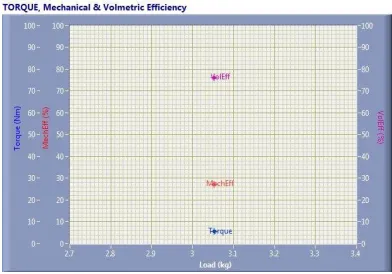
These Tables 3&4 shows the difference between 5 % blend and 10% blends mechanical and volumetric efficiencies. It also shows the speed, Torque and Load. When comparing these tables the efficiency of 5% blend is higher than the 10% blend.
V. CONCLUSION
From the babool trees, the seed is collected and dried. Then the oil is extracted from the seeds and transesterificationprocesses were done. Their properties were found out. Finally, the biodiesel was tested in VCR engine. The volumetric and mechanical efficiencies are found out. And viscosity is found out by using redwoods viscometer. Then the flash point & fire point was found out by using pensky martin apparatus.
This experiment was conducted for loadsat 3 kg, 6kg, 9kg by both 5% &10% blended oil. From the test conducted in VCR Engine the Mechanical efficiency is less on the blended oil. So this oil cannot give more efficiency when compared to the diesel’s efficiency.
ACKNOWLEDGMENTS
The support by the Dr.Mahalingam College of Engineering And Technology, Pollachi, Tamilnadu. Speed(rpm) 1539.0
Load(kg) 3.05
Torque(Nm) 5.54
Mechanical Efficiency(%) 27.25
REFERENCES
1. G.Sucharitha, A.Kumaraswamy Experimental Analysis of Using Neem Oil as an Alternative Fuel, International Journal of Engineering Research and Applications, Vol. 3, Issue 1, January -February 2013, pp.320-325
2. T. Sathya, A. Manivannan Biodiesel production from neem oil using two step transesterification, International Journal of Engineering Research and Applications, Vol. 3, Issue 3, May-Jun 2013, pp.488-492
3. Pranab K. Barua Biodiesel from Seeds of Jatropha Found in Assam, India, International Journal of Energy, Information and Communications, Vol. 2, Issue 1, February 2011
4. S.Ramkumar, V.Kirubakaran Biodiesel from Vegetable oil as alternate fuel for C.I Engine and feasibility study of thermal cracking. Energy conversion management, volume 118,15june 2016, pages 155-169
5. Tanzer Eryilmaz, Murat Kadir Yesilyurt, Biodiesel production potential from oil seeds in turkey, Renewable energy, Volume 58, May 2015, Pages 842-851.
6. Mr.Radhakrishnan.C is an Assistant Professor in Automobile Engineering Department, Dr.Mahalingam College of Engineering and Technology, Pollachi, Tamilnadu, India. He has presented papers in 1 International and 2 National conferences. He has published 3 International journals.
7. Mr.Yogeshwaran.K is an Assistant Professor in Automobile Engineering Department, Dr.Mahalingam College of Engineering and Technology, Pollachi, Tamilnadu, India. He has presented papers in 2 International and 1 National conference. He has published 3 International journals. 8. Mr.Karunaraja.N is an Junior Research Fellow DST-Project in Mechanical Engineering Department, Dr.Mahalingam College of Engineering
and Technology, Pollachi, Tamilnadu, India. He has presented papers in 1 International and 5 National conferences. He has published 2 International journals.
9. Tamilselvan.R is an UG Scholar in Automobile Engineering Department, Dr.Mahalingam College of Engineering and Technology, Pollachi, Tamilnadu, India. He is going to complete his graduation in May 2017.
10. SriramGopal.A is an UG Scholar in Automobile Engineering Department, Dr.Mahalingam College of Engineering and Technology, Pollachi, Tamilnadu, India. He is going to complete his graduation in May 2017.