Procedia Computer Science 46 ( 2015 ) 1510 – 1517
1877-0509 © 2015 The Authors. Published by Elsevier B.V. This is an open access article under the CC BY-NC-ND license (http://creativecommons.org/licenses/by-nc-nd/4.0/).
Peer-review under responsibility of organizing committee of the International Conference on Information and Communication Technologies (ICICT 2014) doi: 10.1016/j.procs.2015.02.071
ScienceDirect
International Conference on Information and Communication Technologies (ICICT 2014)
A Proactive Approach to Reversible Data Hiding in Encrypted
Images
Nirmal S. Nair
a,*, Tojo Mathew
a, Neethu A.S.
a, Viswajith P. Viswanath
a,
Madhu S. Nair
a, M. Wilscy
aaDepartment of Computer Science, University of Kerala, Kariavattom, Thiruvananthapuram-695581, Kerala, India
Abstract
We present a reversible data hiding method for encrypted images that guarantees reversibility, i.e., the exact recovery of secret
data and cover image by the receiver. This work is based on Zhang’s reversible data hiding in encrypted images. Spatial
correlation of pixels in the cover image is exploited for data hiding. In the proposed method, the sender proactively chooses suitable blocks in the cover image to hide secret data. The stego image is then encrypted so that privacy of cover image as well as
secret data is protected. Zhang’s method attains reversibility only with sufficiently large block size, thereby sacrificing payload capacity. The proposed method achieves reversibility at all block sizes, while significantly improving the embedding capacity over many of the state-of-the-art methods.
© 2014 The Authors. Published by Elsevier B.V.
Peer-review under responsibility of organizing committee of the International Conference on Information and Communication Technologies (ICICT 2014).
Keywords:Image encryption; image recovery; pixel classification; reversible data hiding; spatial correlation;
1.Introduction
Data hiding is the technique of hiding secret data into a cover media. This might often produce a distorted version of the cover media, known as stego media. Several data hiding methods, using digital images as cover media, have been proposed in the past1,2,3. Based on the extent to which the original cover image can be recovered from the stego
* Corresponding author. Tel.: +91-9895403183.
E-mail address:[email protected]
© 2015 The Authors. Published by Elsevier B.V. This is an open access article under the CC BY-NC-ND license (http://creativecommons.org/licenses/by-nc-nd/4.0/).
Peer-review under responsibility of organizing committee of the International Conference on Information and Communication Technologies (ICICT 2014)
image, data hiding techniques can be classified into: irreversible (lossy) data hiding, and reversible (lossless) data hiding. Reversible data hiding (RDH)5,13,14,17 allows the cover image to be completely reconstructed from the stego image, along with extraction of embedded secret data, by the receiver. Most commonly used approaches for RDH are histogram shifting, difference expansion and compression11. For example, Ni et al.5 and Chen et al.15 use the histograms obtained from cover image for embedding data by histogram shifting. Difference expansion methods6,16 expand the variation in adjacent pixel values to accommodate additional data. Methods [4,7] create room for payload by lossless compression of suitable regions of the image. RDH techniques find applications in remote sensing, medical imaging, forensics etc. where accuracy of the image content is highly sought.
Recently, reversible data hiding in encrypted images8,9,10 (RDH-EI) has attracted much attention in application areas where privacy of the cover image is to be protected. Cloud storage of images, medical imaging, military and law enforcement etc. are some of the application areas where privacy of the cover images is equally important as the data hidden in them. For example, nowadays there are many web service providers offering cloud based storage space for personal data. Images, videos etc. stored in this cloud space are encrypted. Additional information such as source details, content description, tags etc. can be embedded into the encrypted content, which will enable the web service provider to manage those files without infringing the content privacy. Medical imaging is another field where images are encrypted to ensure patient privacy. Using RDH-EI, confidential information like patient details, diagnosis etc. can be hidden within the image. Error-free retrieval of the hidden data and restoration of the original image are crucial for such applications.
Ma et al.12 defined two possible approaches for RDH-EI. First approach is to find room for additional data after encrypting the image, referred as ‘Vacating Room After Encryption’ (VRAE). Methods [8-10] follow this approach. The second approach is to reversibly reserve required amount of space for additional data before encrypting the
image. After encryption, additional data is hidden into the space reserved. This is referred as ‘Reserving Room
Before Encryption’ (RRBE). In the proposed method, we adopt the VRAE approach and address limitations of other
VRAE methods [8-10]. The major limitation of these methods is conditional reversibility, i.e., recovery of the cover image and error-free extraction of hidden data are not guaranteed in all scenarios. In these methods, true reversibility and payload capacity are a trade-off to choose between. To ensure true reversibility, payload capacity has to be compromised. Increasing the payload capacity beyond a limit will cause errors during data extraction. The proposed method provides significant improvement in payload capacity while ensuring true reversibility in all scenarios.
2.Related work
One of the pioneering techniques in RDH-EI has been proposed by Zhang8. Later, Hong et al.9 improved this method by enhancing the accuracy of the extraction process. In [8] and [9], an 8-bit cover image ܫ of size m × n is divided into ݇ non-overlapping blocks of size s × s. The pixels in each block ܤ݅ is randomly classified into two sets ܵͲ and ܵͳ, using a data hiding key ܭܦ. Each block ܤ݅ can carry at most one bit. A random sequence ݎ of size m × n × 8 bits is generated using an encryption key ܭܧ. ܫ is encrypted by performing a bitwise XOR operation with ݎ.
ܫ′ൌ ܫ ْ ݎ (1)
Secret data is embedded bit-by-bit in row-major order of the blocks. If the bit to embed in a block is 0, the 3 LSBs of pixels in ܵͲ are flipped. If the bit to embed is 1, the 3 LSBs of pixels in ܵͳ are flipped. Every block is
either embedded with 0 or 1. Let ܫԢԢ denote the encrypted image embedded with secret data.
The receiver requires ܭܧ, ܭܦ, and ݏ for data extraction and image recovery. The receiver decrypts the encrypted
image ܫԢԢ using ܭ
ܧ and partitions it into ݇ non-overlapping blocks of size s × s. The pixels in each block are
classified into two sets ܵͲ and ܵͳ, using ܭܦ. The receiver processes the blocks in the same order as the sender. The
objective of the receiver is to determine, for each block, whether the pixels in ܵͲ or the pixels in ܵͳ were flipped by
the sender. Let ܪ݅ represent the blocks of the decrypted stego image. ܪ෩݅ is obtained by flipping pixels in ܵ Ͳ and ܪ݅
is obtained by flipping pixels in ܵͳ. If the embedded bit in ܪ݅ is 0, ܪ෩݅ matches the original block ܤ݅ and ܪ݅ matches
the fully flipped block ܤത݅. If the embedded bit in ܪ݅ is 1, ܪ෩݅ matches ܤത݅ and ܪ݅ matches ܤ݅. ܤതݑ݅ǡݒൌ ܤ
The pixels in the original block ܤ݅have better spatial correlation than ܤത݅. Zhang proposed a fluctuation function
to capture the spatial correlation of pixels in each block.
݂ൌ ฬݑǡݒെ ݑെͳǡݒ ݑͳǡݒ ݑǡݒെͳ ݑǡݒͳ Ͷ ฬ ݏെͳ ݒൌʹ ݏെͳ ݑൌʹ (3) where ݑǡݒ is the pixel value at location (u,v) in the block. Hong et al. improved the fluctuation function by
including the border pixels of blocks as well as taking into consideration the correlation between adjacent blocks.
݂ൌ หݑǡݒെ ݑǡݒͳห ݏെͳ ݒൌͳ ݏ ݑൌͳ หݑǡݒെ ݑͳǡݒห ݏ ݒൌͳ ݏെͳ ݑൌͳ (4) By applying the fluctuation function, the fluctuation of ܪ෩݅ and ܪ݅ is calculated as ݂ሚ݅ and ݂መ݅, respectively. Let the
difference between ݂ሚ݅ and ݂መ݅ be denoted as ܣ݅.
ܣ݅ൌ ݂ሚ݅െ ݂መ݅ (5)
The block having lower fluctuation value will be regarded as the original block. If ܣ݅ ൏ Ͳ, a bit 0 is extracted and ܪ෩݅ is regarded as the original block. Otherwise, a bit 1 is extracted and ܪ݅ is regarded as the original block. In [9], หܣ݅ห is calculated for all blocks and sorted in descending order. A higher value for หܣ݅ห implies that the block ܤ݅ is
more dissimilar to ܤത݅. [9] uses this sorted order of หܣ݅ห for data extraction and image recovery of blocks. It also uses
a ‘side-match’ mechanism for improving the accuracy.
3.Proposed method
Methods [8] and [9] assume that the pixels of an original block ܤ݅ will have better spatial correlation than the
corresponding flipped version ܤത݅. The chosen block size ݏ should be sufficiently large for this assumption to hold
true for all blocks. Using a large block size leads to reduction in embedding capacity, whereas a smaller block size results in more blocks that violate this assumption. Such blocks, for which the flipped version has better correlation than the original one, cause errors during data extraction at the receiver. These errors can be eliminated if the sender identifies and blacklists such blocks instead of blindly embedding secret data into all available blocks. The proposed method expands on this idea, thus guaranteeing reversibility for any block size.
3.1. P-Z-N classification of blocks
Let ݂݅ and ݂ҧ݅ represent the fluctuation values of blocks ܤ݅ and ܤത݅, respectively. The difference ܦ݅ is obtained as:
ܦ݅ൌ ݂ҧ݅െ ݂݅ (6)
Based on the value of ܦ݅, block ܤ݅ can be classified into one of three classes: Positive (P), Zero (Z), or Negative (N). ܤ݅߳ቐ ܲǡ ܦ݅ Ͳ ܼǡ ܦ݅ ൌ Ͳ ܰǡܦ݅ ൏ Ͳ (7)
P-blocks are ideal for data embedding, since the embedded data bit can be correctly extracted by the receiver. Z-blocks do not have data carrying capacity, and hence are not used for data hiding. Any data bit embedded in N-blocks will be incorrectly extracted by the receiver. This also leads to an incorrect image reconstruction. Therefore, reversibility of cover image and secret data can be achieved if only P-blocks are used for data hiding.
3.2. Improved fluctuation function
An ideal fluctuation function should classify all blocks as ܲ, regardless of the block size used. As the block size decreases, the total number of pixels available to evaluate the fluctuation decreases, hence, the accuracy of the fluctuation function decreases. Based on empirical results, we propose a new fluctuation function which gives a better estimation than equations (3) and (4).
݂ൌ ʹ ൈݑǡݒെሺݑǡݒെͳݑǡݒͳሻ ݏെͳ ݒൌʹ ݏ ݑൌͳ ʹ ൈݑǡݒെ ሺݑ െͳǡݒ ݑͳǡݒሻ ݏ ݒൌͳ ݏെͳ ݑൌʹ (8) Table 1 shows the experimental results obtained by applying the fluctuation functions (3), (4), and (8) on various images. ݊ሺܲሻ, ݊ሺܼሻ, and ݊ሺܰሻ denote the number of blocks belonging to class ܲ, ܼ, and ܰ, respectively. The objective of the fluctuation function is to maximize ݊ሺܲሻ. Equation (8) provides better results on almost all test images.
Table 1. Comparison of number of P-blocks, n(P) , obtained using fluctuation functions fZhang (3), fHong (4), and fProposed (8).
Cover Image C Block size s ൈ s Total blocks k
n(P)
fZhang fHong fProposed
Lena (512 ൈ 512) 12ൈ12 1,764 1,761 1,761 1,763 8ൈ 8 4,096 4,022 4,039 4,052 4ൈ4 16,384 13,435 14,574 14,835 F-16 (512 ൈ 512) 12ൈ12 1,764 1,693 1,697 1,697 8ൈ 8 4,096 3,751 3,803 3,812 4ൈ4 16,384 11,542 13,051 13,117 Man (512 ൈ 512) 12 ൈ12 1,764 1,729 1,722 1,742 8 ൈ 8 4,096 3,837 3,861 3,945 4ൈ4 16,384 12,127 13,683 13,978 Baboon (512 ൈ 512) 12 ൈ12 1,764 1,603 1,668 1,680 8 ൈ 8 4,096 3,378 3,633 3,624 4ൈ4 16,384 10,740 12,436 12,191 Spine (490 ൈ 367) 12ൈ12 1,200 580 589 594 8ൈ8 2,745 984 1,024 1,035 4ൈ4 11,102 2,025 2,333 2,377 (a) (b) (c) (d) (e)
3.3. Reducing number of Z-blocks
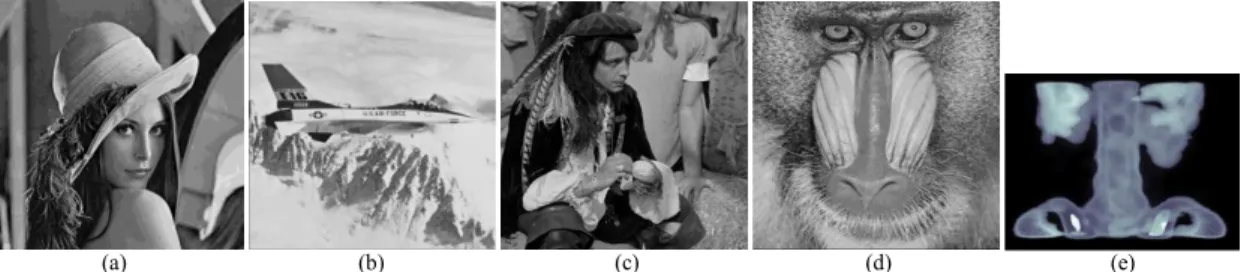
For most images, ݊ሺܲሻ is much larger than ݊ሺܼሻ and ݊ሺܰሻ. However, in certain images like X-ray images, MRI images etc., ݊ሺܼሻ will be significantly high. The test image Spine shown in Fig. 1(e) is an example. In such images, the change in intensity values between adjacent pixels is very small or often nil. Hence, there will be a large number of blocks, where all the pixels contained in it, has the same intensity value. For such blocks, fluctuation values of ܤ݅
and ܤത݅ evaluate to 0. Consequently, ܦ݅ becomes 0 for every such block, leading to a high value for ݊ሺܼሻ. Since Z-blocks are not used for data embedding, this gravely affects the image’s data carrying capacity.
To reduce ݊ሺܼሻ, instead of randomly dividing the ݏʹ pixels of each block into ܵ
Ͳ and ܵͳ, we randomly divide
them into three sets ܵͲ, ܵͳ, and ܷܵ, using key ܭܦ. The pixels belonging to ܷܵ are kept unchanged during data
embedding. From (2), it is evident that introducing ܷܵ causes fluctuation of ܤത݅ to become a non-zero value, thereby
reducing ݊ሺܼሻ. Table 2 shows the difference in P-Z-N classification when ܵͲ, ܵͳ, and ܷܵ is used.
Table 2. Effect of 3-set classification on n(P), n(Z) and n(N) compared to 2-set classification of [8] and [9].
3.4. Sender side
Similar to [8] and [9], the cover image ܥ is divided into ݇ non-overlapping blocks of size s × s. The pixels in each block are classified into three sets ܵͲ, ܵͳ, and ܷܵ, based on a data hiding key ܭܦ. P-Z-N classification of the blocks is
performed using (6), (7), and (8). From (6), it can be seen that the receiver does not have the ability to distinguish between a P-block and N-block, since only หܦ݅ห is available to the receiver. To overcome this limitation, a threshold
mechanism is used. Let ܮ denote the values of ܦ sorted in descending order. The absolute value of the smallest element in the list, ȁܮ݇ȁ, is taken as the threshold ݐ. Based on ݐ, all blocks can be further classified into Viable (V),
Unviable (U), or Exception (E) as follows:
ܤ݅߳൞
ܸǡหܦ݅หݐܽ݊݀ܤ݅߳ܲ
ܷǡหܦ݅ห൏ ݐ
ܧǡหܦ݅หݐܽ݊݀ܤ݅߳ܰ
(9)
Cover Image C Block size s × s Total blocks k Sets
fProposed n(P) n(Z) n(N) Lena (512 ൈ 512) 4ൈ4 16,384 ܵͲ, ܵͳ 14,835 1,019 530 ܵͲ, ܵͳ, ܷܵ 15,673 132 579 F-16 (512 ൈ 512) 4ൈ4 16,384 ܵͲ, ܵͳ 13,117 2,639 628 ܵͲ, ܵͳ, ܷܵ 15,115 284 985 Man (512 ൈ 512) 4ൈ4 16,384 ܵͲ, ܵͳ 13,978 1,103 1,303 ܵͲ, ܵͳ, ܷܵ 14,760 180 1,444 Baboon (512 ൈ 512) 4ൈ4 16,384 ܵͲ, ܵͳ 12,191 231 3,962 ܵͲ, ܵͳ, ܷܵ 12,162 187 4,035 Spine (490 ൈ 367) 4ൈ4 11,102 ܵͲ, ܵͳ 2,377 8,687 38 ܵͲ, ܵͳ, ܷܵ 10,943 89 70
Block number corresponding to ܮ݇ should be communicated to the receiver. This is done by embedding extra data
into the cover image, called ‘header-data’, in addition to the secret data. To increase capacity, instead of using ȁܮ݇ȁ
as the threshold, we can use a block further up in the sorted list to get the threshold. This may increase ݊ሺܸሻ and
݊ሺܧሻ, where ݊ሺܸሻ and ݊ሺܧሻ represent the number of V-blocks and E-blocks, respectively. However, block numbers of all E-blocks, should be included in header-data. Each block number is represented using ݓ bits, where ݓൌ
ڿʹ݇ۀ. The first ݓ bits of header-data represent ݊ሺܧሻ. The next n(E) × w bits are used to represent block-numbers
of E-blocks in ascending order of ܦ݅. Secret data carrying capacity of the image is then obtained as:
ܲܽݕ݈ܽ݀ܥܽܽܿ݅ݐݕൌ݊ሺܸሻ െሺ݊ሺܧሻ ͳሻൈݓ (10)
The sender then chooses a threshold ݐ, which maximizes this capacity. Once the final V-blocks sequence is known the cover image is encrypted using (1) to obtain ܥԢ. Then, secret data is embedded into the identified V-blocks in the
following order. First, header-data is embedded bit-by-bit in blocks of descending order of ܦ݅. Then, secret data is
embedded bit-by-bit in V-blocks in ascending order of block number, while skipping those previously embedded with header-data. U-blocks and E-blocks are embedded with bit 0 so that the original image block ܤ݅ can be
recovered at the receiver by computing ܪ෩݅ of those blocks. The final encrypted stego image is referred as ܥԢԢ. 3.5. Receiver side
The receiver first decrypts the received image ܥԢԢ using ܭ
ܧ to obtain ܥԢ. It is then partitioned into ݇
non-overlapping blocks of size s × s. The pixels in each block are then classified into three sets ܵͲ, ܵͳ, and ܷܵ using ܭܦ.
Similar to [8] and [9], the receiver computes ܪ෩݅ and ܪ݅ for each ܪ݅. Their corresponding fluctuation is estimated as ݂ሚ݅ and ݂መ݅, using equation (8). The difference between ݂ሚ݅ and ݂መ݅ corresponds to ȁܦ݅ȁ. The receiver sorts ȁܦ݅ȁ in
descending order and uses this sorted order for extraction of header-data. The first ݓ blocks are processed initially, which gives ݊ሺܧሻ. Then, the next n(E) × w blocks are processed, which gives the block-numbers of blocks belonging to ܧ. ȁܦ݅ȁ of the block corresponding to last w bits of header-data is taken as the threshold ݐ.
After extraction of header-data, the sorted list is discarded and processing of blocks is done in row-major order. Using ݐ and ܧ, the receiver can be sure that for any block, if หܦ݅หݐ and does not belong to ܧ, then it belongs to ܸ. Also, if หܦ݅ห൏ ݐ, the block belongs to ܷ. For extraction of secret data, the receiver processes only V-blocks,
excluding those containing header-data. Similar to [8], ܣ݅ is calculated using equation (5). If ܣ݅ ൏ Ͳ, a bit 0 is
extracted and ܪ෩݅ is regarded as the original block. Otherwise, a bit 1 is extracted and ܪ݅ is regarded as the original
block. Although, U-blocks and E-blocks do not contain secret data, they are required for exact recovery of cover image. Since U-blocks and E-blocks are embedded with bit 0, the original block ܤ݅ can be obtained by computing ܪ෩݅.
4.Experimental results
The proposed method has been tested with standard test images from SIPI database18, including Lena, F-16, Man, Baboon, and Spine, shown in Fig. 1. The results are compared with state-of-the-art methods [8-10] that follow VRAE approach. Table 1 compares the performance of the proposed fluctuation function (8) to that of methods [8] and [9]. From the table, it is apparent that equation (8) gives better results than equations (3) and (4) for all images except Baboon.
The values for ݊ሺܲሻ, ݊ሺܼሻ, and ݊ሺܰሻ obtained using 2-set and 3-set pixel classification are given in Table 2. In highly textured images like Baboon, ݊ሺܼሻ is low irrespective of whether 2-set or 3-set classification is used. In smooth images like Spine, due to the constant background, the value for ݊ሺܼሻ with 2-set classification will be very high. 3-set classification of the proposed method reduces ݊ሺܼሻ and increases ݊ሺܲሻ, thereby improving payload capacity. From the table, it can be seen that 3-set classification reduces ݊ሺܼሻ for all test images.
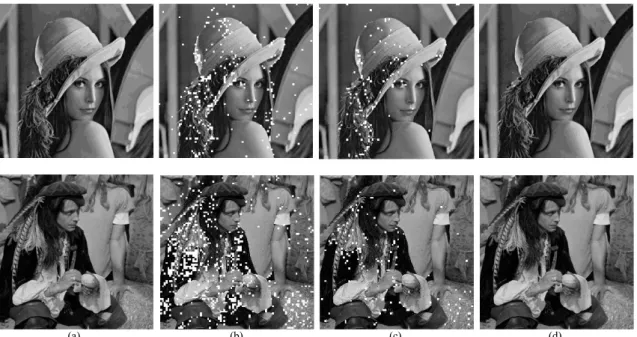
The maximum payload capacities of methods [8-10], in case of true reversibility, are compared in Table 3. The capacity achieved by the proposed method exceeds the other methods for most of the images. Fig. 2 highlights the blocks of incorrect data extraction for images Lena and Man, when the block size ݏൌ . For Lena image, [8] produces 254 bit errors and [9] produces 125 bit errors. For Man image, [8] produces 624 bit errors and [9] produces 141 bit errors, whereas the proposed method gives no error at all. For most images, [8] requires a minimum block
size of 20 × 20 and [9] requires a minimum block size of 12 × 12 for data hiding to be reversible, whereas the proposed method imposes no such constraints.
Table 3. Maximum embedding capacity (bits) without compromising reversibility
Cover Image C Zhang [8] Hong et al. [9] Zhang [10] Proposed method
Lena (512 ൈ 512) 1,296 2,601 9,175 11,767 F-16 (512 ൈ 512) 625 1,764 8,126 9,933 Man (512 ൈ 512) 441 1,024 6,553 7,451 Baboon (512 ൈ 512) 361 625 2,097 1,954 Spine (490 ൈ 367) 289 529 െ 17,813 5.Conclusion
The proposed method is well suited for medical, military, and forensic applications since error-free data extraction and image recovery is guaranteed, regardless of block size. The sender takes a proactive approach by identifying and avoiding all blocks that are incapable of carrying data. Payload capacity is significantly improved by
(a) (b) (c) (d) Figure 2. (a) Original image. Blocks of incorrect data extraction using (b) Zhang [8], (c) Hong et al. [9], and (d) Proposed method.
using smaller block sizes. The 3-set pixel classification technique further improves payload capacity for images having constant background, like medical images. Using the proposed method, it is possible to embed about 5-20 kb of secret data in a 512 × 512 grayscale image.
References
1. Van R. Anderson and F. Petitcolas, On the limits of steganography. IEEE J. of Selected Areas in Commun., 1998. 16(4), pp. 474-481. 2. R.G. van Schyndel, A.Z. Tirkel, and C.F. Osborne, A digital watermark. IEEE Int. Conf. Image Process., 1994. 2, pp. 86-90. 3. W. Bender, D. Gruhl, N. Morimoto, and A. Lu, Techniques for data hiding. IBM Syst. J., 1996. 35(3-4), pp. 313-336.
4. M. Arsalan, S.A. Malik, A. Khan, Intelligent reversible watermarking in integer wavelet domain for medical images, J. Syst. Softw., 2012. 85(4), pp. 883-894.
5. Z. Ni, Y.Q. Shi, N. Ansari, and W. Su, Reversible data hiding. IEEE Trans. Circuits Syst. Video Techn., 2006. 16(3), pp. 354-362. 6. J. Tian, Reversible data embedding using a difference expansion. IEEE Trans. Circuits Syst. Video Techn., 2003. 13(8), pp. 890-896. 7. M.U. Celik, G. Sharma, A.M. Tekalp, and E. Saber, Lossless generalized-LSB data embedding. IEEE Trans. Image Process., 2005. 14(2),
pp. 253-265.
8. X. Zhang, Reversible data hiding in encrypted images. IEEE Signal Process. Lett., 2011. 18(4), pp. 255-258.
9. W. Hong , T. Chen, and H. Wu, An improved reversible data hiding in encrypted images using side match. IEEE Signal Process. Lett., 2012. 19(4), pp. 199-202.
10. X. Zhang, Separable reversible data hiding in encrypted image. IEEE Trans. Inf. Forensics Security, 2012. 7(2), pp. 826-832.
11. J.B. Feng, I.C. Lin, C.S. Tsai, and Y.P. Chu, Reversible watermarking: Current status and key issues. Int. J. Netw. Security, 2006. 12(3), pp. 161-171.
12. K. Ma, W. Zhang, X. Zhao, N. Yu, and F. Li, Reversible data hiding in encrypted images by reserving room before encryption. IEEE Trans. Inf. Forensics Security, 2013. 8(3), pp. 553-562.
13. C.W. Honsinger, P.W. Jones, M. Rabbani, and J.C. Stoffel, Lossless recovery of an original image containing embedded data. U.S. Patent 6,278,791, 2001.
14. T. Kalker and F.M. Willems, Capacity bounds and code constructions for reversible data-hiding. Proc. 14th Int. Conf. Digital Signal Process., 2002. 1, pp. 71-76.
15. X. Chen, X. Sun, H. Sun, Z. Zhou, J. Zhang, Reversible watermarking method based on asymmetric-histogram shifting of prediction errors. J. Syst. Softw., 2013. 86(10), pp. 2620-2626.
16. O.M. Al-Qershi, B.E. Khoo, High capacity data hiding schemes for medical images based on difference expansion. J. Syst. Softw., 2011. 84(1), pp. 105-112.
17. A. Khan, A. Siddiqa, S. Munib, S.A. Malik, A recent survey of reversible watermarking techniques. Information Sciences, 2014. 279, pp. 251-272.
![Table 2. Effect of 3-set classification on n(P), n(Z) and n(N) compared to 2-set classification of [8] and [9]](https://thumb-us.123doks.com/thumbv2/123dok_us/1318682.2676251/5.816.67.741.354.672/table-effect-set-classification-p-compared-set-classification.webp)