Agricultural Robot for Automatic Seeding
Prof. Ayane swapnil1, Bhor Rajashri A.2, Madane Kajal A.3
Assistant Professor, Dept. of E&TC Engg, PCCOE, Pune, India1
Dept. of E&TC Engg, PCCOE, Pune, India 2, 3
ABSTRACT: This paper strives to develop a robot capable of performing operations like automatic ploughing, seed
dispensing. It also provides manual control when required and keeps tabs on the humidity with the help of humidity sensors. The main component here is the AVR Atmega microcontroller that supervises the entire process. Initially the robot tills the entire field and proceeds to ploughing, simultaneously dispensing seeds side by side. The device used for navigation is an ultrasonic sensor which continuously sends data to the microcontroller. On the field the robot operates on automated mode, but outside the field is strictly operated in manual mode. For manual control the robot uses the Bluetooth pairing app as control device and helps in the navigation of the robot outside the field. The field is fitted with humidity sensors placed at various spots that continuously monitor the environment for humidity levels. It checks these levels with the set point for humidity and alerts the farmer. The alerting mechanism is GSM module that sends a text message to the farmer informing him about the breach in set point. The farmer then responds via SMS to either switch on the water sprinklers or ignore the alert. The water sprinklers, if on, bring down the humidity level thus providing an ideal growing environment to crop.
KEYWORDS: Movement, Agricultural robot, Arduino, Robot Architecture.
I. INTRODUCTION
II. PROPOSEDSYSTEM
Fig.1.Block diagram of Robot Section
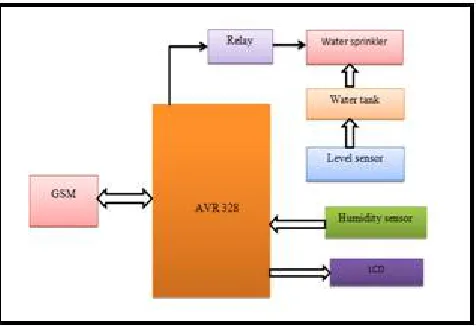
Fig. 2. Block diagram of Field Section
A. Block Diagram Explanation:
2.1 Field Section
1) AVR Microcontroller:
2) Ultrasonic Sensor:
This is the HC-SR04 ultrasonic ranging sensor. This economical sensor provides 2cm to 400cm of non-contact measurement functionality with a ranging accuracy that can reach up to 3mm. Each HC-SR04 module includes an ultrasonic transmitter, a receiver and a control circuit. There are only four pins that you need to worry about on the HC-SR04: VCC (Power), Trig (Trigger), Echo (Receive), and GND (Ground).
3) Motor Driver IC (L293D):
L293D is a dual H-bridge motor driver, i.e. by using one IC we can control two DC Motors in both clock wise and counter clockwise directions. The L293D can provide bidirectional drive currents of up to 600-mA at voltages from 4.5 V to 36 V. IC is designed to drive inductive loads such as dc motors, bipolar stepping motors, relays and solenoids as well as other high-current or high-voltage loads in positive-supply Applications. The main purpose is for driving purpose.
4) DC motor:
A DC motor is any of a class of rotary electrical machines that converts direct current electrical energy into mechanical energy. The most common types rely on the forces produced by magnetic fields. Nearly all types of DC motors have some internal mechanism, either electromechanical or electronic; to periodically change the direction of current flow in part of the motor. The universal motor can operate on direct current but is a lightweight motor used for portable power tools and appliances.
5) Relay:
The electromechanical relay is an output device which comes in whole host of shapes size and design and has many uses and application in electronic circuits. In this project the relay switch has a coil which is driven by the npn transistor. The coil of the relay switch gets energized due to the collector current of the transistor according to that switch gets on and off to control the water sprinkler.
6) Humidity Sensor:
Humidity is defined as the presence of water in air. The amount of water vapour in air can affect human comfort as well as many manufacturing processes in industries. The presence of water vapour influences various physical, chemical and biological processes. In agriculture, measurement of humidity is important for plantation protection, dew prevention, soil moisture monitoring etc.
7) Bluetooth Module
Here Bluetooth is used as a basic universal Remote control for Bluetooth enabled serial devices such as Bluetooth modules connected to the microcontroller. It is a short-range wireless networking technology and is used to link (or pair) two devices, such as smart phones and headsets, cameras and printer Ms, and keyboards and computers, it is sometimes called a cable-replacement technology. Both devices must support Bluetooth in order to be paired, if they do, though paring the paring is designed to happen automatically, with little to no user interaction. The Bluetooth module used here is a HC-05 based on SPP support. HC-05 module is an easy to use Bluetooth SPP (Serial Port Protocol) module, designed for transparent wireless serial connection setup. In our idea we have made use of blue tooth Control App available on Android as controlling software more like a remote control for the manual operation of the robot.
2.2 Seeding Section
IV.CONCLISION
The main focus of this system is its Automatic way of sowing the seeds. The seeds are been sowed in a proper sequence which results in proper germination of seeds. This automatic way of sowing seeds using a robot reduces the labour requirement. Here the wastage of seeds is also been reduced to a greater extent. This system has been developed for the sowing of seeds in an automatic way. Here with the help of a robot the seeds are been dispensed in the soil in a proper sequence hereby reducing the wastage of seeds. This robot will help the farmers to do the farming process efficiently.
REFERENCES
1. Shivaprasad B S , Ravishankara M N , B N Shoba, “ Design and implementation of seeding and fertilizing agriculture robot”, International Journal of Application or Innovation in Engineering & Management (IJAIEM), Volume 3, Issue 6, June 2014.
2. Abdulrahman, Mangesh Koli, Umesh Kori, Ahmadakbar, “Seed Sowing Robot”, International Journal of Computer Science Trends and
Technology (IJCST) – Volume 5 Issue 2, Mar – Apr 2017.
3. Amrita Sneha.A, Abirami.E, Ankita.A, Mrs.R.Praveena, Mrs.R.Srimeena, “Agricultural Robot for Automatic Ploughing and Seeding”, 2015
IEEE International Conference on Technological Innovations in ICT for Agriculture and Rural Development (TIAR 2015).
4. Pranita A. Bhosale, Prof. V. V. Dixit, “Water Saving-Irrigation Automatic Agricultural Controller”, INTERNATIONAL JOURNAL OF
SCIENTIFIC & TECHNOLOGY RESEARCH VOLUME 1, ISSUE 11, DECEMBER 2012.
5. Gore Jayashari, Patil Mansi, Solar Operating Traveling Sprinkler For Irrigation ,International Engineering Research Journal (IERJ) Volume 1
Issue 11 Page 1701-1703 , 2016, ISSN 2395-1621
6. Yuan Yan-weiand Zhang Xiao-chao, “Study on precision irrigation technology of large scale irrigator”, Chinese Academy of Agricultural
Mechanization Sciences, 2009, pp 618-621.
7. Xingye Zhu, Shouqi Yuan, Junping Liu and Yin Luo, “Strategy of Energy-saving for Variable-Rate Irrigation Sprinkler”, Technical and