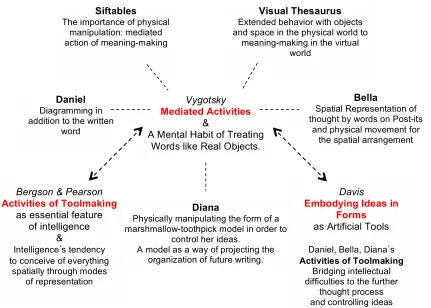
I criticize the typewriting model and linear writing structure of Microsoft Word software for writing in the computer. I problematize bodily movement in writing that the error of the software disregards. In this research, writing activity is viewed as bodily, spatial and
mediated activity under the premise of the unity of consciousness and activity, and embodied mind. In order to explore the role and importance of bodily movement in writing tools, I hypothesized that when tools respond to human bodily movement well, and when they work as if they are extensions of the body, the best conditions of use during the process of writing will be possible. Also, spatial arrangement activity in writing was assumed to be a self-generated tool-making process for writing that regulates thought and behavior. And, I supposed that spatial image schemas could be manipulated with conceptually in the activity of writing.
In an attempt to examine the assumption and hypothesis, and develop the concept, I investigated design graduate students’ thesis document writing process in which I
specifically checked the assumption by studying the effects of spatial activity. The design graduate students’ writing process was interpreted through the lenses of activity theory, embodied reasoning, and Csikszentmihalyi’s creative process model which included preparation, incubation, insight, evaluation and elaboration.
I found that spatial activities such as the physical manipulation of written units, spatializing words, creating signs, and manipulating spatial-formal relations for concept development played an important role in reading, understanding, connecting, analyzing, synthesizing, hierarchizing, structuring, remembering, retrieving, communicating, a design project, an explorative research process, and integrating reading, a design project into writing. In the beginning of the writing process, having an hierarchically organized
The indeterminate qualities of writing tools enabled the correlation of the body, gesture, and the written units that the body manipulated to be physically easier. From an unorganized material basis, manipulating conceptual relations consisted of concrete physical skills such as using Post-its, making matrices, outlines, note cards, user path maps, concept maps, narrative concept maps, signs, sketch, diagrams, and models. Writers showed the significant difference in perceptions of tool affordances and concrete skills. In relation to spatial activity in the use of writing tools, writers showed five types of difference: an
© Copyright 2012 by Joo Hee Huh
by Joo Hee Huh
A dissertation submitted to the Graduate Faculty of North Carolina State University
in partial fulfillment of the requirements for the degree of
Doctor of Philosophy
Design
Raleigh, North Carolina
2012
APPROVED BY:
_______________________________ ______________________________
Meredith Davis Christopher B. Mayhorn
Committee Chair
________________________________ ________________________________
DEDICATION
BIOGRAPHY
Joo Hee Huh was born in Seoul, Korea. She received a Bachelor’s degree and Master’s degree in visual communication design at Hongik University in Korea before joining the Ph.D. in Design program at the College of Design, North Carolina University, in August of 2007. Any comments on this study are welcome. Joohee Huh’s email address is
ACKNOWLEDGEMENTS
I am grateful for having the opportunity to build good relationships with people, to learn a new language, to share my culture with friends, and to do research in a new world. I am also grateful for being able to see, to hear, to talk, to go for a walk, and to cook.
I am deeply thankful to my advisor, Professor Meredith Davis, for leading me in the pursuit of knowledge, practice, and courage. I thank her for helping me understand the values that she wanted to share with me during my research. I also thank Professor Davis for giving me the opportunity to obtain a scholarship that allowed me to continue my studies.
I thank my advisory committee for providing me with questions, useful resources, and valuable critique so that I was able to think about my research from different perspectives. The committee members’ insightful opinions enabled me to learn critical concepts and reflect on them, which played an important role in doing my research. I was fortunate to learn about new approaches to research and how they could be used to conduct interdisciplinary study. My advisor and my committee helped me realize the value of collaboration in research.
I thank Dr. Christopher B. Mayhorn in the Department of Psychology for giving me useful advice and a different perspective throughout my research; he provided me with assistance in getting interview transcriptions and analyzing them during the fieldwork.
I thank Dr. Christopher Martin Anson in the Department of English for encouraging me to think about writing in greater depth and from different viewpoints; he shared his precious insight and experience with me.
I thank Professor Martha Scotford in the Department of Graphic Design for sharing her invaluable opinions and experience with me, which allowed my study to proceed.
I owe the completion of my research project to my advisor and my advisory committee, but I am responsible for any insufficiency in this study.
I thank the writers in my pilot study in 2009, Diana, Daniel, Scully, and Bella, for sharing the studio space with me, for allowing me to observe their writing activity, and for sharing the writing process with me. I thank the writers in this study, Alex, Claire, Dalton, Monica, and Tom, for voluntarily recording their own writing processes for this study, showing me their personal notebooks, and spending time with me when their time was the most priceless thing to them during the process of writing their final thesis document. I will remember the writers’ practice, which made this study possible.
I thank Diana Marie Beck and Marvick Burgos for transcribing interviews and giving me useful feedback as intercoders.
I thank the researchers that I mentioned in this study. In particular, Henri Bergson made the discussion of bodily movement in the material world in this study possible. Michel Foucault enabled me to see bodily experience and social systems in a new way. I also thank Mark Johnson for sharing his ideas with me in person.
I thank Dr. Paul Tesar for sharing his ideas about space and architecture with me. I thank Dr. Sharon Joines for her thoughtful consideration that allowed me to do my work for her while working on my research efficiently. I thank Professor Denise Gonzales Crisp for sharing the writing process for her book with me.
I thank Namhee Kim for teaching me the value of learning a new language. I thank Dr. Wonjun Chung for his encouragement and for sharing his experience with me.
I thank Dr. Lucjan M. Mordzak for reviewing my papers and providing me with useful questions since 2007. I thank my friends Jaeyoung Lee, Jongsun Lee, and Vin Lim.
I thank Dr. Deborah Kathleen Littlejohn for sharing her experience and useful resources with me. I thank the Director of Design Library, Karen DeWitt, for reviewing my paper. I thank Sharon Silcox and Guiwoong Kim for their encouragement.
TABLE OF CONTENTS
LIST OF TABLES ... xi
LIST OF FIGURES ... xii
CHAPTER 1. INTRODUCTION ... 1
1.1. Writing as bodily, spatial and mediated activity ... 4
1.2. Non-spatial Microsoft Word contradictory to novice writers' need for the expansion of thought ... 9
1.3. The purpose of the study ... 11
CHAPTER 2. LITERATURE REVIEW ... 12
2.1. Verbal Syntax versus Visual Syntax ... 12
2.2. Writing as Technology, Tools, and the Materiality of Writing ... 27
2.3. Homo Faber, not Homo Sapiens, Embodied Mind, and Embodiment ... 39
2.3.1. Five examples in relation to spatial arrangement of words ... 41
2.3.1.1. The Visual Thesaurus ... 41
2.3.1.2. Siftables ... 43
2.3.1.3. Making artificial tools by design graduate students ... 49
2.3.1.3.1. Daniel, “I layer and I layer and I layer” ... 49
2.3.1.3.2. Diana, “Get this stuff out and then keep moving forward into new territory” ... 52
2.3.1.3.3. Bella, “More wall space, put everything out and see everything as I’m working on it” ... 56
2.3.2. Homo Faber, not Homo Sapiens: intelligence and tool ... 60
2.3.3. The intellect’s tendency to conceive of everything spatially through modes of representation ... 65
2.3.4. The rotation of mental images and the imagined transformations as an analog process ... 74
2.3.5. Cognitive spatial-motor processes ... 86
2.3.6. The mental and the neural: psychological and neural studies of mental rotation ... 89
2.3.7. Neural coding of movement direction in space ... 91
2.3.8. The neural and the mental: Mental rotation ... 92
2.3.9. Neural bases for visuomotor and visual mental rotations ... 96
2.3.10. The nervous system and cognition: neuronal structure and the interneuronal network that generates sensorimotor correlations ... 101
2.3.11. The nervous system and action ... 109
2.3.12. The interdependence of hand and brain function ... 113
2.3.12.2. The indetermination implied in the structure of the nervous system ... 117
2.3.12.3. A hand-thought-language nexus ... 118
2.3.13. Language, Tools and Brain: manipulating objects and manipulating words . 123 2.3.13.1. Agrammatic Broca’s aphasics lack of hierarchical organization in their syntactic production and manual object combination ... 126
2.3.14. A purposeful regulating and organizing activity ... 135
2.3.15. A controversy between Parmenides and Heraclitus: reality ... 140
2.3.16. Body in the mind: the bodily basis of meaning, imagination and reason ... 141
2.3.17. The mind-body problem ... 145
2.3.18. The mind-body problem in Design ... 150
2.3.19. Embodiment ... 154
2.3.20. Embodied reasoning ... 157
2.3.21. The embodied nature of spatial-relations concepts ... 161
2.3.22. Two types of imaginative structure: image schemata and metaphorical projections ... 165
2.3.23. Creativity by means of the metaphorical structuring of experience and understanding ... 169
2.3.24. Embodied imagination ... 171
CHAPTER 3. RESEARCH DESIGN AND METHODOLOGY ... 173
3.1. Cultural-historical activity theory as theoretical perspective ... 173
3.2. Conceptual framework ... 180
3.3. Csikszentmihalyi’s creative model for the writing process ... 185
3.4. Hypothesis ... 186
3.5. Research questions ... 188
3.6. Key terms ... 188
3.7. Selection of research context and writers for the study ... 190
3.8. Qualitative research, data collection strategy and methods ... 194
3.9. An additional assumption ... 196
3.10. Data analysis procedures ... 200
3.11. Limitations of the research ... 205
3.12. Quality standards: credibility, transferability, dependability and confirmability . 205 CHAPTER 4. FINDINGS ... 210
4.1. Writers’ context in writing activity ... 210
4.1.1. Writers’ experience in writing education ... 210
4.1.2. The challenges of teaching writing in graduate school ... 216
4.2. Five types of writing tool system ... 223
4.2.1. A spatial, hierarchical and visual-written parallel writing tool system ... 226
4.2.1.1. Reading ... 234
4.2.1.3. Understanding ... 261
4.2.1.4. Connecting ... 263
4.2.1.5. Analyzing ... 263
4.2.1.6. Synthesizing ... 266
4.2.1.7. Hierarchizing and structuring ... 268
4.2.1.8. Remembering and retrieving ... 273
4.2.1.9. Design project ... 274
4.2.1.10. Communicating ... 282
4.2.1.11. Integrating reading, a design project into writing ... 282
4.2.2. A spatial, interwoven and visual-written parallel writing tool system ... 290
4.2.2.1. Reading ... 297
4.2.2.2. Research process for exploration ... 299
4.3.2.3. Understanding ... 301
4.2.2.4. Connecting ... 304
4.2.2.5. Analyzing ... 306
4.2.2.6. Synthesizing ... 306
4.2.2.7. Hierarchizing and structuring ... 309
4.2.2.8. Remembering and retrieving ... 313
4.2.2.9. Design project ... 314
4.2.2.10. Communicating ... 316
4.2.2.11. Integrating reading, a design project into writing ... 316
4.2.3. A not fully voluntarily spatial and mainly written writing tool system ... 316
4.2.3.1. Reading ... 320
4.2.3.2. Research process for exploration ... 321
4.2.3.3. Understanding ... 327
4.2.3.4. Connecting ... 328
4.2.3.5. Analyzing ... 328
4.2.3.6. Hierarchizing and structuring ... 329
4.2.3.7. Remembering and retrieving ... 330
4.2.3.8. Communicating ... 331
4.2.4. An initial outline writing tool system ... 332
4.2.4.1. Reading ... 338
4.2.4.2. Research process for exploration ... 339
4.2.4.3. Analyzing ... 339
4.2.4.4. Hierarchizing and structuring ... 339
4.2.4.5. Remembering and retrieving ... 342
4.2.4.6. Design project ... 344
4.2.4.7. Integrating reading, a design project into writing ... 344
4.2.5. An unorganized and non-mediated writing tool system ... 345
4.2.5.1. Reading ... 349
4.2.5.2. Connecting ... 352
4.2.5.3. Remembering and retrieving ... 353
4.2.5.4. Hierarchizing and structuring ... 354
4.4. The relationship between motivation, spatial arrangements as writing tools,
and perceptions of tool affordances ... 357
Sub-question 1. What kinds of physical manipulation do writers employ during the writing process? ... 360
Sub-question 4. What are the differences in writers’ perceptions of tool affordances? ... 364
4.5. Needs for spatial activity involving physical manipulation throughout writing activities ... 369
Sub-question 3. Why do writers use specific tools for exploration of multiple, and divergent ideas and at which stages of writing? ... 369
4.6. The relationship between transitions of difficulty and spatial activity ... 372
4.7. The indetermination implied in the qualities of tools ... 375
Sub-question 2. What are the common qualities of tools that writers use? ... 376
CHAPTER 5. CONCLUSION AND DISCUSSION ... 383
5.1. Summary of research and findings ... 383
5.2. The value of creativity as a needed assumption, imagination as a needed thinking practice, embodiment with spatial tools as needed skills for imagination, and the value of exploration as needed research in writing ... 386
REFERENCES ... 389
APPENDICES ... 394
Appendix 1: Institution Review Board approval ... 395
Appendix 2: The use of the notebook ... 396
Appendix 3: Interview questions: writers’ educational background, goals, social interaction ... 397
Appendix 4: Writers' educational background ... 400
Appendix 5: A list of tools during the writing process ... 401
Appendix 6: Thinkaloud protocol and a survey for the thinkaloud with video recording ... 402
Appendix 7: Alex’s writing tool system ... 403
Appendix 8: Alex’s diary for writing research ... 404
Appendix 9: Alex’s worksheet to record writing tools ... 404
Appendix 10: Alex’s worksheet example ... 405
Appendix 11: Alex’s writing tool system map ... 406
Appendix 12: Alex’s work space ... 407
Appendix 13: Alex’s writing process map ... 407
Appendix 14: Monica’s writing tool system ... 408
Appendix 15: Monica’s diary for writing research ... 409
Appendix 17: Monica’s worksheet example ... 410
Appendix 18: Monica’s writing tool system map ... 411
Appendix 19: Monica’s work space ... 411
Appendix 20: Monica’s writing process map ... 412
Appendix 21: Claire’s writing tool system ... 413
Appendix 22: Claire’s diary for writing research ... 414
Appendix 23: Claire’s worksheet to record writing tools ... 414
Appendix 24: Claire’s worksheet example ... 416
Appendix 25: Claire’s new version of worksheet example ... 417
Appendix 26: Claire’s work space ... 418
Appendix 27: Claire’s writing process map ... 418
Appendix 28: Tom’s writing tool system ... 419
Appendix 29: Tom’s diary for writing research ... 420
Appendix 30: Tom’s worksheet to record writing tools ... 420
Appendix 31: Tom’s worksheet example ... 421
Appendix 32: Tom’s writing tool system map ... 422
Appendix 33: Tom’s work space ... 422
Appendix 34: Tom’s writing process map ... 423
Appendix 35: Dalton’s writing tool system ... 423
Appendix 36: Dalton’s worksheet to record writing tools ... 424
Appendix 37: Dalton’s worksheet example ... 425
Appendix 38: Dalton’s writing tool system map ... 426
Appendix 39: Dalton’s work space ... 427
Appendix 40: Dalton’s writing process map ... 428
Appendix 41: Writers’ participation in the research ... 429
Appendix 42: Daily photos of writers’ work space in the studio ... 430
Appendix 43: Definitions of codes ... 431
Appendix 44: Codes and coding ... 433
Appendix 45: An analysis of writing tool systems ... 433
LIST OF TABLES
Table 1 Writing as technology: human writing practice in relation to physical properties
of writing materials ... 31
Table 2 A summary of the five examples in relation to spatial arrangement of words ... 58
Table 3 The problem of inquiry of Wilson and Greenfield ... 125
Table 4 Broca’s speech sample and Wernike’s speech sample in the Greenfield’s study ... 132
Table 5 Information on writers ... 193
Table 6 Definition of codes ... 201
Table 7 Alex’s specific skills in spatial activity and their functions ... 232
Table 8 Monica’s specific skills in spatial activity and their functions ... 295
Table 9 Claire’s specific skills in spatial activity and their functions ... 319
Table 10 Tom’s specific skills in spatial activity and their functions ... 336
Table 11 Dalton’s behavior during the writing process ... 348
Table 12 The notion of writing and intention and their consequence ... 355
Table 13 Transition of writers’ motives during the writing process ... 358
Table 14 The four levels of everyday creativity follow a developmental path ... 361
Table 15 Types of physical manipulation skills and specific functions ... 363
Table 16 Needs for spatial activity throughout writing activities ... 370
Table 17 The relationship between transitions of difficulty and spatial activity ... 373
Table 18 The common qualities of tools that writers use for spatial activity ... 377
Table 19 A breakdown of the correlation of the body, the gesture and the written units that the body manipulates in the computer ... 381
LIST OF FIGURES
Figure 1 The logical relationship between the use of signs and of tools ... 7
Figure 2 The linguistic sign ... 16
Figure 3 Associative Relations ... 20
Figure 4 Verbal syntax versus Visual syntax ... 27
Figure 5 A spatialization of the very objects of analyses in Linné’s classification system ... 33
Figure 6 Writing as technology, tools, and the materiality of writing ... 39
Figure 7 The Visual Thesaurus ... 42
Figure 8 Siftables’ examples: a Fibonacci sequence (left) and a word game (right) ... 45
Figure 9 ‘Yes/No’ gestures (left) and Sugar Pack Snap’ gesture (right) ... 47
Figure 10 Artificial tools: a self-dialogue (left) and a diagram (right) ... 51
Figure 11 Artificial tools: concept map ... 52
Figure 12 Artificial tools: a 3-D marshmallow-toothpick model and the model in the computer ... 53
Figure 13 Artificial tools: Post-it® notes on the whiteboard and doing a concept map ... 56
Figure 14 The Visual Thesaurus, Siftables, and design major students’ practice ... 60
Figure 15 Euclidean space: every point in three-dimensional Euclidean space is determined by three coordinates ... 76
Figure 16 Normal and backward versions of the six alphanumeric characters used as test stimuli in Experiment I ... 78
Figure 17 Normal and backward versions of one of the six characters, illustrating the six orientations in which it might appear as a test stimulus ... 78
Figure 18 The making of movements at an angle from a stimulus direction ... 87
Figure 19 Vector contributions of 241 directionally tuned motor cortical cells are shown for each of the eight movement directions tested ... 92
Figure 20 Results from a direct (left) and rotation movement (right) ... 94
Figure 22 Three-dimensional reconstruction of all the synaptic contacts that the cell
body receives from a motoneuron of the spinal medulla ... 102
Figure 23 Neuronal diversity: (left to right) bipolar cell of the retina, cell body of a motoneuron of the spinal medulla, mitral cell of the olfactory bulb, pyramidal cell of cerebral cortext of a mammal ... 104
Figure 24 Sensorimotor correlation in movement of the arm ... 107
Figure 25 The relationship between the nervous system, perception, and action ... 111
Figure 26 The relationship of studies between Vygotsky, Pearson, Bergson, Shepard-Cooper, Lurito-Georgakopoulos-Georgopoulos, Georgopoulos-Pellizzer, and Maturana-Varela ... 113
Figure 27 The development of increasing hierarchical complexity in early syntax ... 127
Figure 28 Hierarchical tree structures used as models in Grossman's study ... 128
Figure 29 Reproduction of symmetric and asymmetric models by Broca's and fluent aphasics ... 129
Figure 30 Hierarchical tree structures and recreating the model's hierarchical structure by Broca's aphasics and Wernike's aphasics ... 131
Figure 31 Typical construction strategies at different ages ... 133
Figure 32 The relationship of studies between Vygotsky, Bergson, Matura and Varela, Wilson, and Greenfield ... 140
Figure 33 Container schema logic ... 160
Figure 34 Center-periphery ... 167
Figure 35 Path ... 167
Figure 36 Equilibrium ... 167
Figure 37 Axis balance ... 167
Figure 38 Twin-pan balance ... 168
Figure 39 Point balance ... 168
Figure 40 Out 1 ... 168
Figure 41 Out 2 ... 168
Figure 42 The relationship of studies between Bergson, Matura and Varela, Johnson, Lakoff and Johnson, and Davis ... 173
Figure 44 Hierarchical levels of an activity ... 178
Figure 45 A structure of a human activity system model ... 181
Figure 46 Conceptual framework ... 183
Figure 47 Reliability ... 201
Figure 48 Strategy of inquiry, data collection and data analysis ... 204
Figure 49 A spatial, hierarchical and visual-written parallel writing tool system ... 231
Figure 50 Reading, hierarchizing and structuring the content by mapping ... 234
Figure 51 Using the narrative concept map for thesis ... 235
Figure 52 A visual hierarchy, metaview of the system and user path ... 236
Figure 53 Connecting the narrative concept map to writing ... 237
Figure 54 Expanding thought by mapping ... 238
Figure 55 Expanding maps for expanding needs ... 239
Figure 56 Making a subject matter map in the beginning ... 241
Figure 57 Embodying an object for exploration in the context ... 247
Figure 58 Externalizing and manipulating the abstract relationship based on spatiality ... 249
Figure 59 An active engagement with the subject matter by physically interacting with content on the whiteboard ... 252
Figure 60 Growing thought through embodiment of a relational structure, iteration, incubation, evaluation and manipulation ... 254
Figure 61 Visualizing conceptual relations in formal relations and generating questions . 256 Figure 62 Externalizing ideas and reflecting on them: System model sketch on the whiteboard ... 257
Figure 63 Representing and manipulating ideas: from ‘system model’ to ‘an adaptive system model’ ... 259
Figure 64 Visualizing use path with a persona and scenario: user path of Drake ... 260
Figure 65 Layering, emphasizing, and reflecting ideas ... 261
Figure 66 Image scheams in a diagram to understand a theory ... 262
Figure 67 Making connections between key words of two theories ... 263
Figure 68 Analyzing and categorizing concepts of theories ... 264
Figure 70 Understanding ideas, manipulating ideas, and changing the model by
diagramming ... 266
Figure 71 Image schemas in synthesizing two theories, evaluation, and reflection process ... 268
Figure 72 Hierarchizing information with a color code: the first step in the notebook ... 269
Figure 73 Hierarchizing information with a color code: the second step on the whiteboard ... 270
Figure 74 Hierarchizing information with a color code: the final step in the computer .... 272
Figure 75 Concept map in front of me as a preliminary structure in my mind ... 273
Figure 76 Refining ideas through an iterative process ... 275
Figure 77 Embodying a conceptual user path in detail ... 277
Figure 78 Moving forward through externalization of the complexity of ideas ... 279
Figure 79 Understanding of the system by specifying the relationship of ideas: System knowledge ... 280
Figure 80 Systemic expanding ideas through embodiment ... 281
Figure 81 Spatialization of written units as self-generating tools to understanding, think, reflect and imagine 1 ... 283
Figure 82 Spatialization of written units as self-generating tools to understanding, think, reflect and imagine 2 ... 284
Figure 83 Spatialization of written units as self-generating tools to understanding, think, reflect and imagine 3 ... 285
Figure 84 Spatialization of written units as self-generating tools to understanding, think, reflect and imagine 4 ... 286
Figure 85 Expansion of thought based on the systematic relationship of spatial tools: an individual dimension ... 288
Figure 86 Systematic Expansion of spatial tools ... 289
Figure 87 A spatial, interwoven and visual-written parallel writing tool system ... 294
Figure 88 Making a bibliography map ... 298
Figure 89 Using a matrix to structure researchable points ... 300
Figure 91 Understanding how everything would come together ... 303
Figure 92 Connecting ideas in the notebook ... 305
Figure 93 Mapping to synthesize ideas ... 307
Figure 94 Writing down keywords and concepts that I wanted to discuss ... 310
Figure 95 Transferring the ideas from scraps of paper Post-it® on the wall in my apartment ... 311
Figure 96 Attempting to build hierarchical conceptual relations in the middle of the writing process ... 312
Figure 97 Using a bulb icon for a quick retrieval ... 313
Figure 98 Weaving theories and ideas in a system map ... 315
Figure 99 A not fully voluntarily spatial and mainly written writing tool system ... 318
Figure 100 Layering thought by attaching Post-it® notes ... 321
Figure 101 Making a concept map voluntarily ... 322
Figure 102 Making a concept map by professor Walker’s suggestion ... 323
Figure 103 Transferring a concept map from the whiteboard into to the computer ... 324
Figure 104 The final concept map ... 325
Figure 105 Reflecting and linking ideas on the concept map ... 326
Figure 106 Using a matrix to understand the content ... 327
Figure 107 Generating ideas and connecting ideas ... 328
Figure 108 Content analysis ... 329
Figure 109 Putting Post-it® notes on the desktop for structure and organization ... 330
Figure 110 Retrieving Post-it® notes on the book ... 330
Figure 111 Communicating with the committee ... 331
Figure 112 An initial outline writing tool system ... 335
Figure 113 Making Post-it® notes in the book ... 338
Figure 114 Relying on Post-it® notes to retrieve information ... 339
Figure 115 Making a material timeline, an initial outline, and user path and putting them on the wall ... 341
Figure 116 Color coding to differentiate three main ideas ... 343
Figure 117 Highlighting to set up the priorities for the really important items ... 343
Figure 119 Tom’s desk in the studio ... 345
Figure 120 An unorganized and non-mediated writing tool system ... 348
Figure 121 Using Post-it® notes in reading ... 349
Figure 122 Having unorganized ideas ... 350
Figure 123 Having unorganized conceptual relations ... 352
Figure 124 Keeping Post-it® notes in the yellow folder to remember ... 353
Figure 125 Putting important Post-it® notes on a surface ... 353
Figure 126 Cutting and pasting the paper to structure writing ... 354
Figure 127 The relationship between knowledge, spatial arrangements, writing, motivation, and a creative imagination ... 356
Chapter 1. Introduction
Have you recently written five paragraphs, without any tool, and in one draft? I raise this question to think about the relationship between the function of tools and thought in writing. Since writing activity, as one of the external symbolic forms, is based on visual
representation, it necessarily involves tools. The tools have material properties, and our body works with the tools. At this moment, the materiality of any tool is important in that it determines the ways we interact with written words. In addition, tools mediate and enable certain thought and the physical reality of language as written form. Therefore, bodily
movement matters in the use of the tool and in the development of thought and representation of thought.
Let me narrow down the range of writing tool analysis to a software program in the computer, Microsoft Word (MS Word). If we open MS Word, a white background appears. You find tens of fonts as options waiting for your selection like clothes in a wardrobe. Other menu options such as left or right paragraph arrangement are easy to see. If you type a sentence longer than the page width, the cursor goes one step down as if there is an invisible staircase. But, can you represent easily Mallarmé’s concrete poetry using MS Word?
Probably not. Obviously, what is given is 2-D space, but what Microsoft not so subtly
implies is the space of typewriting and the printed novel model of linear writing. It isn’t even implicitly hierarchical. It is about continuing text. This is the current cultural selection that many schools and institutions adopt as the primary tool for writing. Could we say that our choice of writing tool is satisfactory in all respects? We even call this a “word processing” not a “writing” or “thought processing” program.
thought in writing interacts with objectified words and spatial arrangement in addition to written words. But, the functions of a tool for writing, in particular, MS Word does not presume such a process. The five students left MS Word to work in another way. In other words, there seemed to be a gap between the way the students oriented their attention in writing activity and the functions of the tool on the computer.
Further, the five students’ writing did not proceed in a linear way, either in a material or intellectual sense. In most cases, their writing did not start with opening of MS Word. Writing activity did not always proceed like reeling silk from cocoons. This raises a question about how writing proceeds, the use of specific tools, and understanding of the process of constructing text.
In addition, something other than the alphabet came out in the students’ writing process. Written words were arranged spatially on the page along with frequent appearances of concept maps, diagrams and personal notes and drawings. Those signs accompanied words, or sometimes stood alone. Some written words, located in a diagram, were moved from time to time, and circles in a diagram were superimposed or divided. There were lines linking certain words, and some written units stayed on Post-it® slips for a while and then
disappeared. Students were working on paper when I observed. Once they externalized ideas, they grouped or linked ideas with simple tools such as flash cards. Also, as the thesis project grew, individual ways of over controlling evolving ideas appeared. Surely, there were various forms of transitional states of writing and elements that MS Word could not fulfill with ease.
The thesis projects did not advance following the already known problems, not just by recording of the facts of yesterday, but through searching for an understanding of the problems themselves. Namely, since the writing took place simultaneously with larger
investigations of the theses project, the process could be called an activity of knowing as well as of writing.
The behavior that emerged in the process of the five students’ writing activity
or future discussion. Some students built 3-D models of concept relationships, using
marshmallows and toothpicks. The models represented the multiple relationships between the concept and other ideas in the text. They served as three-dimensional concept maps1 that the student rotated in space as a way of thinking about how the written narrative would be different if ordered by alternate points of entry to the discussion. After, they made three-dimensional models and took pictures of them, they viewed them on the computer, moving them this way or that way from various perspectives. Raised and active in a hypermedia environment, for these students, writing is spatial. Each unit of information has many connections to the rest of the text, not just to the paragraph immediately before or after. These behaviors raised questions.
Why did these students make visual signs in addition to words and use them in writing process? Where did a writing process in which people move letters spatially and transform spatial arrangement of signs continuously come from? Why did they need spatial arrangement and movement to resolve writing? Considering that the artificial spatial arrangement of signs was a manifestation of their thinking as part of the invention process, either as a conscious or unconscious activity, we can say that those signs and spatial arrangement of the signs were used as cognitive tools. This observation raised questions about the nature of cognitive tools. Moreover, it brought up a question of the relationship between the cognitive tool, the activity of thinking and knowing, and external representation.
Finally, the students’ writing activity was beyond the range and modes that MS Word could support. Only during a short period of the entire writing process was MS Word used. Although MS Word was not their own preference for writing, it was used because of a required format for sharing among readers and its grammar checking function and ease of editing by faculty. This observation raised a conflict between personal choices about how to work and write, and the institutional demands for editing by a second person. And, it speaks to the degree to which certain software programs have become standards that may be shaping
or constraining development and practice of certain thinking competencies—word processing rather than thought processing.
1.1. Writing as bodily, spatial and mediated activity
The behaviors observed in the five students’ thesis projects suggest interesting connections to Lev Semyonovich Vygotsky’s study of aphasic behavior in the book, The Vygotsky Reader (Van der Veer & Valsiner, 1994). Vygotsky’s observations and study of aphasia are
noteworthy in that he approaches the relationship between language and thought by understanding people who suffer from language problems and their distinguishing
characteristics. The comparison of aphasic patients and graduate students enables us to see the taken-for-granted characteristics of language and thought clearly, not from a view of normal or abnormal behavior. The comparison illuminates the obscure parts of everyday behaviors and tells us that my ordinary behaviors could be otherwise.
The biggest difference between the behavior of the students and the aphasics in Vygotsky’s study seems to be a self-controlling, artificial, manipulative behavior over objects relating to one’s purpose. The observed student behaviors contrast with those of an aphasic in terms of controlling voluntary attention.
The breakdown of speech is accompanied here by the disappearance of sign operations...the aphasic suffering from an affliction of higher sign operations becomes in his practical actions completely subject to the elementary laws of the optic field. The most serious consequences of the affliction of the higher symbol systems manifests themselves in the following ways such as the immediate motor manifestation of impulses coupled to an impossibility of delaying action and of forming an intention postponed in time, the inability of transforming a given image through transferred attention, the total incapability of abstracting judgment and action from intelligent and familiar structures, and finally, the reversion to primitive forms of reflective imitation” (Van der Veer & Valsiner, 1994, p.141).
These specific aphasic behaviors have a direct and non-mediated quality. Vygotsky presents examples,
Once, during a conversation which took place on a nice sunny day, when he was asked to repeat the sentence “Today the weather is bad and it is raining,” he could not bring himself to carry out this request. The first words were uttered easily and
confidently, but then he became confused, stopped speaking and could not bring himself to finish the sentence in the way it had been given to him. He kept on changing over to another form, which corresponded to the observed reality (Van der Veer & Valsiner, 1994, p. 266).
The case above shows that there is the zero point of distance between what the patient could say artificially and what he was actually seeing in reality. Vygotsky gives us another example that shows “the inability to form any resolutions” in cases of aphasia, “a disorder which results from disturbed verbal activity and thinking in concepts” (Van der Veer & Valsiner, 1994, p. 268).
precisely the main source of the difficulty. During my studies we have frequently been able to observe how difficult it is for certain aphasics to repeat a sentence which contains an indefinite statement from the point of view of a concrete concept (Van der Veer & Valsiner, 1994, p. 268).
In the case above, the fact that the aphasic was not able to find a starting point means that he could not distinguish or select among options, which shows that his behavior cannot follow his own choice. In addition, it means that he cannot build behaviors in order, and select an order of behaviors autonomously. This shows a close link between language as mediated activity, will, and behaviors.
In addition, in Guillaume et Meyerson’s experiments “involving the analysis of the use of tools by apes...which compares the intellectual operations of an ape with the process of solving concrete problems as exhibited by people suffering from aphasia. The authors find that the methods used by the aphasic and the ape to accomplish a given task are similar in principle and coincide in certain essential points....Unable to speak (speech would have freed him from being tied to the visually evident situation and rendered possible and the planned consecutiveness of successive actions), he becomes the slave of the situation—one hundred-fold more than the speaking child” (Van der Veer & Valsiner, 1994, p. 112). Thus, this finding leads to that using tool without an ability to exercise a mediated thought confines one to fulfilling only direct necessities.
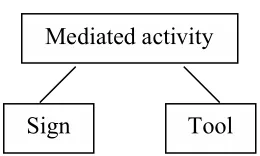
Vygotsky suggests that tool and symbol can be placed on the same plane in terms of mediated activity, but they are different in that they produce different behaviors (Figure 1). Vygotsky explains the logical relationship between the use of signs and of tools using as follows.
On the purely logical plane of the relation between the two concepts, our schema represents the two means of adaptation as diverging lines of mediated activity. This divergence is the basis for our second point. A most essential difference between sign and tool and the basis for the real divergence of the two lines, is the different ways that they orient human behavior. The tool’s function is to serve as the conductor of human influence on the object of activity; it is externally oriented; it must lead to changes in objects. It is a means by which human external activity is aimed at
mastering, and triumphing over, nature. The sign, on the other hand, changes nothing in the object of a psychological operation. It is a means of internal activity aimed at mastering oneself; the sign is internally oriented (Cole, John-Steiner, Scribner, & Souberman, 1978, p. 55).
Figure 1 The logical relationship between the use of signs and tools (Cole, John-Steiner, Scribner, & Souberman, 1978, p. 54).
Then, how can we define the notion of behavior? In the book, The Tree of Knowledge: the Biological Roots of Human Understanding (1998), Humberto R. Maturana and Francisco J. Varela define behavior as follows.
Mediated activity
By behavior we mean the changes of a living being’s position or attitude, which an observer describes as movements or actions in relation to a certain environment. What we call behavior in observing the changes of state of an organism in its environment corresponds to the description we make of the movements of the organism in an environment that we indicate. Behavior is not something the living being does in itself (for in it there are only internal structural changes) but something that we point to (p. 136).
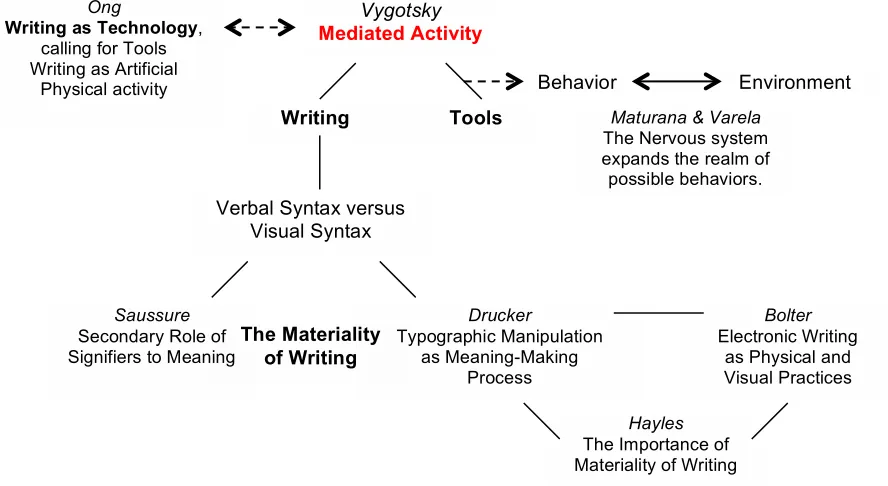
Maturana and Varela’s definition of behavior deals with the transactional relationship between an organism and its environment. In addition, their definition of behavior is based on the study of the nervous system. Their study will be addressed again later in this
dissertation. The implication of a simultaneous approach to the behavior of an organism in its environment is useful in this study, however.
Maturana and Varela’s study of movement and behavior, based on an understanding of the nervous system, facilitates an empirical approach to my issue of writing as activated partially by physical movement in using tools in that we do not consider bodily movement in using tools for writing as taken-for-granted. Their study of behavior allows us to see bodily movement as an object of analysis in studying the presumed cognitive activity of writing.
In other words, Maturana and Varela’s study does not see bodily movement itself as already determined or built-in. Rather, they explain the coupling between the inner parts of the body and external behavior through the nervous system; they account for the role of the nervous system through a notion of mediation that expands the possibilities of behaviors. “The behavior of living beings is not an invention of the nervous system and it is not
exclusively associated with it, for the observer will see behavior when he looks at any living being in its environment. What the nervous system does is expand the realm of possible behaviors by endowing the organism with a tremendously versatile and plastic structure” (p. 138). Now, we see that my discovery of physical movement in using a tool for writing is integrated into a discussion of the study of nervous system.
summoning tools for external representation and invisible objects into physical being, that delays voluntary attention or selection? And, from where does the necessity of expansion of the artificial tool arise?
1.2. Non-spatial Microsoft Word contradictory to novice writers’ need
for the expansion of thought
Working memory is defined as “a temporary memory system that you use in order to help you do other complicated cognitive tasks such as reasoning, learning and comprehending” (Baddeley, 2011). In the study of Writing and Cognition: Implications of the Cognitive Architecture for Learning to Write and Writing to Learn (2008), McCutchen, Teske and Bankston discussed the novice writers’ working memory resources and long-term memory resources that affect the quality of the paper in the cognitive process of writing. Working memory is constrained by “the amount of the material it can hold” and “the length of time it can hold it” (MacArthur, Graham & Fitzgerald, 2006, p. 29). According to McCutchen, Teske and Bankston, “all of the major writing processes such as planning, text production and revising make demands on working memory resources” and “long-term memory depends on the availability of sufficient resources within the limited capacity of working memory” (p. 456). First of all, novice writers with the lack of task schema in long-term memory resources may “frequently focus on retrieving relevant content rather than developing conceptual plans” (p. 454). Also, “without the benefit of deep topic knowledge and a familiar genre, even skilled writers may resort to less mature strategies” and working memory constraints can affect “the development and functional use of global planning, ” “the structural
complexity of texts” and “reading texts critically in a macrostructure of the text level” (pp. 456-460).
The structure is something that needs to be made, thus, it exists as indeterminate and needs to expand. But, it should have a logical order for the argument.
The theoretical background for the need of tools based on spatial activity comes from an embodied nature of abstract reasoning. George Lakoff, in his book, Women, Fire and Dangerous Things: What Categories Reveal about the Mind (1987), explains metaphorical extensions of the bodily movements to abstract domains as follows.
Schemas that structure our bodily experience preconceptually have a basic logic. Preconceptual structural correlations in experience motivate metaphors that map that logic onto abstract domains. Thus, what has been called abstract reason has a bodily basis in our everyday physical functioning. It is this that allows us to base a theory of meaning and rationality on aspects of bodily functioning (p. 278).
Among bodily schemas, for example, the configuration of a baby in his mom’s arms is a container schema, which is used to describe a certain conceptual category. The whole
configuration of the relationship between the baby and the mom consists of a gestalt structure. For another example, a scenario consists of an initial state, a sequence of events, and a final state when “the scenario is structured by a source-path-goal schema in the time domain” (p. 285). The initial state is the source, and the events are the locations on the path, and the final state becomes the destination. Also, the movement from the initial state to the final state is preconceptually structured as a link schema or causal relations (p. 286). But, we don’t think usually that our spatial activity is related to our abstract thought. When the abstract relations among concepts become complex, and when they go beyond our working memory capacity, embodiment becomes important. And, through analysis and synthesis, discoveries emerge. The need to see the complexity of relations lies in the fact that such relations need to be made. The core of the expansion of thought, the formation of an argument and its logical
development are abstract relationships, aren’t they? Also, people think spatially and spatiality can be used efficiently. Then, why do we lose such an opportunity?
1.3. The purpose of the study
The purpose of the study is to look into the role of the use of tools involving spatial activity, in particular, writing activity pursuing the logical expansion of thought. Especially, it is the role of spatial activity in writing where five graduate students in Design write their argument and propose a new design system based on their written argument.
This study addresses thought formation, its transformation and its expansion as the core problem in writing, not grammar. It is important to study how writers’ ideas are
connected, what they discover in the world, and how ideas are coming together and how they locate them and through what process they grow. Because writing activity is not just about a summary of reading material, but it is the very way which writers analyze text from various resources and from different levels from their own point of viewpoint and make their own order.
Writing a thesis document requires a special thought process. The activity requires that graduate students create their own problem area based on their interest, think logically and deal with various resources unlike in everyday writing activities such as, grocery list, text messaging, blog entries, and thankyou notes.
In their thesis document project, students need to build their own new order in content that they think is important. The problem is not given. And, they need to deal with new reading material with depth and breadth. It is a precious opportunity to shape an argument, thus, a creative activity. Also, all parts of their written documents and the relationship of ideas should be logically linked each other along with their own new order in every corner. The writing is not the simple sum of individual ideas. It is the whole power of thought and linked ideas. It is a structured logic. Thus, the writer needs to have a critical control of the whole process.
not well-served by software that ignores this important aspect of organizing thought; that spatial tools would expand the value of word processing software.
Thus, I will look into the functions of spatialization of written units during the writing process, assuming the principle of mediation of spatialization of written units as writing tools.
Chapter 2. Literature review
2.1. Verbal Syntax versus Visual Syntax
The observation that something other than an alphabet is involved in writing requires us to analyze the use of an alphabet and something other than an alphabet carefully. Completed writing in the case of English, is read from the left to right side of the page, and has a regular grammatical structuring in which the location of the word contributes to its meaning. For example, a sentence in English is arranged according to a subject, a verb, and an object. In contrast to the linearity of the completed sentence, the process of writing is not usually conceived only in linear terms. Rather, the students I observed had a tendency to arrange words spatially in non-linear form. What does this non-linear characteristic in the writing process tell us? What role does the tendency to arrange words spatially play in thinking about a text? How can we analyze such non-linear characteristics?
First of all, we need to look at linguistic theories about writing for discussions of linearity. This study will find the discussion about non-linearity in the dynamic interplay in the use of letters and something other than letters against the linearity of writing.
The discussion about writing starts with Ferdinand De Saussure’s linguistic theory. Here, we see the core concepts of Saussure’s linguistic theory, and how those concepts are related to my study. To be specific, I will address the problems of linearity and nonlinearity that the writing process raises.
Ferdinand De Saussure, in his book, Courses in General Linguistics (Bally &
asked, “what is language.” In that Saussure’s interest in linguistics asked about a process of language in use and examines the nature of language regardless of which specific language, his study is very different from his predecessors’ approach to linguistics that dealt with discrete language forms and genealogical lineages.
Saussure defines language as “a system of signs in which the only essential thing is the union of meanings and sound-images, and in which both parts of the sign are
psychological” (p. 15). According to Saussure, “language is a form and not a substance” (p. 122). And, “language is a system of interdependent terms in which the value of each term results solely from the simultaneous presence of the others” (p. 114). Here, Saussure emphasizes that linguistic values emanate from the linguistic system, in particular,
oppositional relations in a linguistic system (p. 122). He analyzes linguistic values within the system in terms of the functioning of linguistic oppositions as follows.
Linguistics then works in the borderland where the elements of sound and thought combine; their combination produces a form, not a substance...Not only are the two domains that are linked by the linguistic fact shapeless and confused, but the choice of a given slice of sound to name a given idea is completely arbitrary. The arbitrary nature of the sign explains in turn why the social fact alone can create a linguistic system. The community is necessary if values that owe their existence solely to usage and general acceptance are to be set up; by himself the individual is incapable of fixing a single value. In addition, the idea of value, as defined, shows that to consider a term as simply the union of a certain sound with a certain concept is grossly
misleading. To define it in this way would isolate the term from the system; it would mean assuming that one can start from the terms and construct the system by adding them together when, on the contrary, it is from the interdependent whole that one must start and through analysis obtain its elements (p. 113).
content would go to its competitors...The value of just any term is accordingly determined by its environment (p. 116).
Instead of pre-existing ideas then, we find in all the foregoing examples values emanating from the system. When they are said to correspond to concepts, it is understood that the concepts are purely differential and defined not by their positive content but negatively by their relations with the other terms of the system. Their most precise characteristic is in being what the others are not...in French the concept “to judge” is linked to the sound-image juger; in short, it symbolizes signification. But it is quite clear that initially the concept is nothing, that is only a value
determined by its relations with other similar values, and that without them the signification would not exist (p. 117).
The conceptual side of value is made up solely of relations and differences with respect to the other terms of language, and the same can be said of its material side. The important thing in the word is not the sound alone but the phonic differences that make it possible to distinguish this word from all others, for differences carry
signification...Arbitrary and differential are two correlative qualities (pp. 117-118). When we compare signs—positive terms—with each other, we can no longer speak of difference; the expression would not be fitting, for it applies only to the comparing of two sound-images, e.g. father and mother, or two ideas, e.g. the idea “father” and the idea of “mother”; two signs, each having a signified and signifier, are not different but only distinct. Between them there is only opposition. The entire mechanism of language, with which we shall be concerned later, is based on
oppositions of this kind and on the phonic and conceptual differences that they imply (p. 121).
for designating diverse aspects of the same general fact: the functioning of linguistic oppositions (p. 122).
Saussure paid attention to the nature of the linguistic sign from three aspects. First, the relationship between sign, signified, and signifier. Second, the arbitrary nature of the sign. Third, linearity or the non-linear nature of the signifier. And, Saussure presented four kinds of duality: signified and signifier, langue and parole, syntagmatic relations and associative relations, and synchrony and diachrony.
First of all, the relationship between sign, signified, and signifier, and the notion of arbitrariness. Saussure defines the linguistic sign as “a two-sided psychological entity” and explains the linguistic sign as a combination of a concept and a sound-image. The link between signified and signifier is arbitrary, meaning that the link between signified and signifier depends on social convention, not on some natural relationship. Saussure says,
The linguistic sign unites, not a thing and a name, but a concept and a sound-image. The latter is not the material sound, a purely physical thing, but the psychological imprint of the sound, the impression that it makes on our senses. The sound-image is sensory, and if I happen to call it “material,” it is only in that sense, and by way of opposing it to the other term of the association, the concept, which is generally more abstract. The psychological character of our sound-images becomes apparent when we observe our own speech. Without moving our lips or tongue, we can talk to ourselves or recite mentally a selection of verse. Because we regard the words of our language as sound-images, we must avoid speaking of the “phonemes” that make up the words. This term, which suggests vocal activity, is applicable to the spoken word only, to the realization of the inner image in discourse. We can avoid that
misunderstanding by speaking of the sounds and syllables of a word provided we remember that the names refer to the sound-image.
Figure 2 The linguistic sign (Bally & Reidlinger, 1959, p. 66).
The two elements are intimately united, and each recalls the other. Whether we try to find the meaning of the Latin word arbor or the word that Latin uses to designate the concept “tree,” it is clear that only the associations sanctioned by that language appear to us to conform to reality, and we disregard whatever others might be imagined...I call the combination of a concept and a sound-image a sign, a word, for example (arbor, etc.) One tends to forget that arbor is called a sign only because it carries the concept “tree,” with the result that the idea of the sensory part implies the idea of the whole (Bally & Reidlinger, 1959, pp. 66-67).
I propose to retain the word sign [signe] to designate the whole and to replace concept and sound-image respectively by signified [signifié] and signifier [signifiant]; the last two terms have the advantage of indicating the opposition that separates them from each other and from the whole of which they are parts (p. 67).
The bond between the signifier and the signified is arbitrary...The linguistic sign is arbitrary...every means of expression used in society is based, in principle, on collective behavior or on convention (pp. 67-68).
Next, the linear nature of the signifier. We cannot pronounce auditory signifiers, multiple words at the same time. When one speaks a title, ‘Alice in Wonderland,’ because time exists between pronounced signifiers, ‘Alice’ and ‘Wonderland’ we can say that auditory signifiers have a linear nature. On the other hand, if one tries to visualize those pronounced signifiers on paper, they can be differentiated from auditory signifiers in that those words can exist
concept
simultaneously. In other words, visual signifiers can be non-linear. But, auditory signifiers and the use of auditory signs are linear because of the implication of time.
The signifier, being auditory, is unfolded solely in time from which it gets the following characteristics: (a) it represents a span, and (b) the span is measurable in a single dimension; it is a line...In contrast to visual signifier (nautical signals, etc.) which can offer simultaneous groupings in several dimensions, auditory signifiers have at their command only the dimension of time. Their elements are presented in succession; they form a chain. This feature becomes readily apparent when they are represented in writing and the spatial line of graphic marks is substituted for
succession in time (Bally & Reidlinger, 1959, p. 70).
Reading is linear, but in a typographic sense, writing is not. The word “western” set in a typeface that looks like a fence or the word “staccato” widely spaced or small word next to large word or the juxtaposition of the big word “small” next to the small word “big” demands that we read its linear form and visual characteristics simultaneously. In this respect, written language is different from spoken language.
However, Saussure gives an analysis of writing, as another system of signs, as follows.
characteristic. 5) Whether I make the letters in white or black, raised or engraved, with pen or chisel—all this is of no importance with respect to their signification (pp. 119-120).
Saussure, in the analysis above, mentions the arbitrary nature of the graphic sign, as writing. However, for Saussure, the graphic sign and the value of letters are understood only in terms of formal differences to be distinguished from other letters within the system. In other words, the material qualities of written words, graphic representation of language, have nothing to do with linguistic values. This will be addressed with Drucker’s analysis of Saussure.
In addition, there is a difference between langue and parole. Saussure distinguishes langue (language) from parole (speaking). When an individual expresses her thought in a certain language, this is called parole (individual speech acts). However, langue is a grammatical system that a linguistic collective uses in common. Thus, langue is working immanently in individual speech acts or parole. Parole is individual speech acts based on langue in a collective that uses the same language. In that time exists between a word pronounced first and a word pronounced last in speaking, parole is linear. Parole has the linear nature.
If we could embrace the sum of word—images stored in the minds of all individuals, we could identify the social bond that constitutes language (langue). It is a storehouse filled by the members of a given community through their active use of speaking, a grammatical system that has a potential existence in each brain, or, more specifically, in the brains of a group of individuals. For language is not complete in any speaker; it exists perfectly only within a collectivity. In separating language from speaking we are at the same time separating: (1) what is social from what is individual; and (2) what is essential from what is accessory and more or less accidental.
Speaking (parole), on the contrary, is an individual act. It is willful and
psychological mechanism that allows him to exteriorize those combinations (Bally & Reidlinger, 1959, pp. 13-14.).
Next, the syntagmatic relations and the associative relations. Parole can be understood from the syntagmatic relations and associative relations. This distinction deconstructs two special relationships in the use of language. In that there are the preceding part and the following part among words, what matters in the syntagmatic relations is the position of each element in the whole relations or the horizontal position of a word in a sentence.
In a language-state everything is based on relations. How do they function? Relations and differences between linguistic terms fall into two distinct groups, each of which generates a certain class of values. The opposition between the two classes gives a better understanding of the nature of each class. They correspond to two forms of our mental activity, both indispensable to the life of language. In discourse, on the one hand, words acquire relations based on the linear nature of language because they are chained together. This rules out the possibility of pronouncing two elements
simultaneously. The elements are arranged in sequence on the chain of speaking. Combinations supported by linearity are syntagms. The syntagm is always composed of two or more consecutive units. In the syntagm a term acquires its value only because it stands in opposition to everything that precedes or follows it or to both... The syntagmatic relation is in praesentia. It is based on two or more terms that occur in an effective series (pp. 122-123).
On the other hand, the associative relations exist as possibilities. The associative relations refer to all the possible words that could reasonably be in that position.
renseigner ‘acquaint,’ etc.; or armement ‘armament,’ changement ‘amendment,’ etc.; or éducation ‘education,’ apprentissage ‘apprenticeship,’ etc.). All those words are related in some way. We see that the co-ordinations formed outside discourse differ strikingly from those formed inside discourse. Those formed outside discourse are not supported by linearity. Their seat is in the brain; they are a part of the inner
storehouse that makes up the language of each speaker. They are associative relations...the associative relation unites terms in absentia in a potential mnemonic series (p. 123).
Figure 3 Associative Relations (Bally & Reidlinger, 1959, p. 126).
Figure 3 Associative Relations shows the various relationships that could be evoked in relation to a word enseignement. “In enseignement ‘teaching,’ enseigner ‘teach,’ enseignons ‘(we) teach,’ etc., one element, the radical, is common to every term; the same word may occur in a different series formed around another common element, the suffix (cf.
enseignement, armement, changement, etc.); or the association may spring from the analogy of the concepts signified (enseignement, instruction, apprentissage, éducation, etc.); or again,
enseigner ensignons etc.
etc. apprentissage éducation
etc. etc.
changement armement
etc. etc.
clément
justement etc. enseignement
simply from the similarity of the sound-images (e.g. enseignement and justement ‘precisely’). Thus there is at times a double similarity of meaning and form, at times similarity only of form or of meaning. A word can always evoke everything that can be associated with it in one way of another” (pp. 125-126).
Saussure explains the difference between the syntagmatic relations and the associative relations like this. “The syntagmatic relation is in praesentia (presence). It is based on two or more terms that occur in an effective series. Against this, the associative relation unites terms in absentia (absence) in a potential mnemonic series” (p. 123). Figure 3 Associative Relations above shows various possibilities that could be laid in the associative relations, i.e., it presents the associative relations simultaneously. Figure 3 Associative Relations, also, shows the possibilities that “similarity of meaning and form” or “similarity only of form or of meaning” could recall.
But, when Saussure gives an explanation of the syntagmatic relation as an effective series and the associative relation as a potential mnemonic series as two different kinds of relations, the syntagmatic relation is diachronic while the associative relation is synchronic and therefore not linear. In other words, it is not possible to pronounce two elements at the same time in parole, but the various possibilities of elements in Figure 3 Associative Relations shows a selective system in parole. Thus, parole performs a grammatical system and a selective system at the same time.
Figure 3 Associative Relations leads us to another point in addition to the associative relations. Without a tool, for example, a paper and inscription, can we reveal easily those forms of a diagram, potential relations, and possibilities? When we visualize simultaneous possibilities of the syntagmatic relations as in a way of Figure 3 Associative Relations, it is easier for us to understand it. In other words, in that a tool enables us to objectify auditory signifiers into visual signifiers and to manipulate them, reveals the advantage and functions that an intervention of a tool could bring in my analytical thought. A tool and inscription’s non-linearly objectifying function as technology shows here. The discussion of a tool and writing will be dealt with again.
deals with present meaning that exists in the collective mind of speakers and be used, diachronic linguistics deals with the meaning of the sign as released or built across in time.
Then, how are Saussure’s duality and nature of language—signified and signifier, langue and parole, syntagmatic relations and associative relations, and synchrony and diachrony—related to my study? Saussure’s conceptual separation between signified and signifier enables us to discuss the material qualities of the signifier such as the visual, spatial, and kinesthetic attributes which are represented in its form. And, we can discuss additional meanings that the material qualities of the signifier impose. Meredith Davis, in the book, Graphic Design Theory and Practice (2012), tells us the significance of Saussure’s separation between signified and signifier, and typographic form.
This separation of the physical representation (signifier) from the mental idea of the thing it stands for (signified) seems simple to us today. However, had Saussure not made this distinction (a concept he called duality), it would not be possible to discuss the visual, spatial, temporal, auditory, or kinesthetic attributes—the material
qualities—of the signifier or their contributions to meaning as distinguished from the mental concept for which the signifier stands. Theoretically, typographic form—
letterforms and all their possible variations (typeface, weight, size, etc.), their
composition on the page, and the material qualities of ink on paper or pixels on screen, for example—would be considered irrelevant to the meaning of the text, were the signifier not seen as distinct from the thing for which it stands. The designation of the signifier as a discrete component of language, therefore, makes it possible to discuss writing as different from speech, visual signs as different from verbal signs, and consequently, form itself as a critical contributor to meaning (Davis, 2012, chapter six, in production).