A Survey Paper on Data Mining Techniques
Prof. S.P Vanjari1, Rutuja Burate2, Gayatri Keskar2, Priya Dhanure2, Sadanand Gadve2
Assistant Professor, Department of Information Technology, Zeal College of Engineering and Research, Narhe, Pune, Maharashtra, India1
B. E Student, Department of Information Technology, Zeal College of Engineering and Research, Narhe, Pune, Maharashtra, India2
ABSTRACT: Classification is a data mining (machine learning) technique used to predict group membership for data
instances. In this paper, we present the basic classification techniques. Several major kinds of classification method including support vector machine, K-MEANS techniques. The goal of this survey is to provide a comprehensive review of different classification techniques in data mining & analyse the performance of both.
.
KEYWORDS: Support Vector Machine, Classification techniques.
I.INTRODUCTION
There are several applications for machine learning (ML), the most significant is data mining. Data mining involves sophisticated data analysis tools for discovering historical unknown, right patterns and relationships on to the large data set. These tools include statistical models, mathematical algorithm and machine learning methods. Frequently data mining consists of analysis and prediction. Classification technique applicable for processing a wider variety of data than regression.The actual data mining task is automatic analysis of large amount of data to extract historical unknown, gripping patterns such as groups of data records (cluster analysis), unusual records and dependencies. Data mining is the analysis step of the "knowledge discovery in databases" process, or KDD.
II. OVERVIEW OF CLASSIFICATION & CLUSTERING
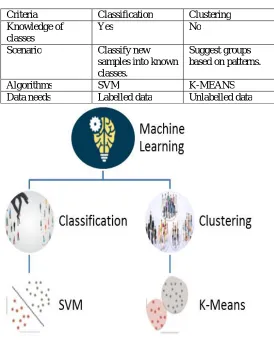
Clustering & Classification are two different concept of machine learning.
Table1. CLASSIFICATION VS CLUSTERING
Criteria Classification Clustering Knowledge of
classes
Yes No Scenario Classify new
samples into known classes.
Suggest groups based on patterns. Algorithms SVM K-MEANS Data needs Labelled data Unlabelled data
Fig 1.Machine Learning Techniques
IV. SUPPORT VECTOR MACHINE
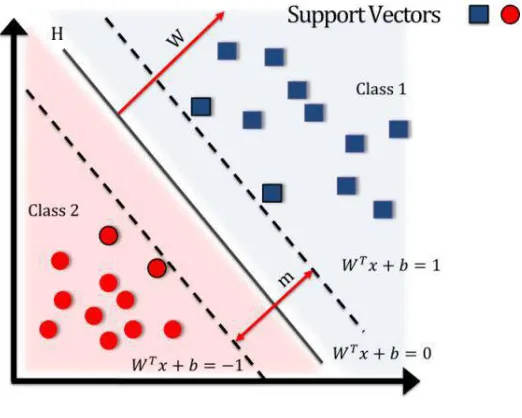
Support Vector Machine (SVM) states as it is a discriminative classifier which is formally defined by a separating hyper plane. We can say that the given labeled training data (supervised learning).
Fig 2.SVM Classification
V. K-MEANS
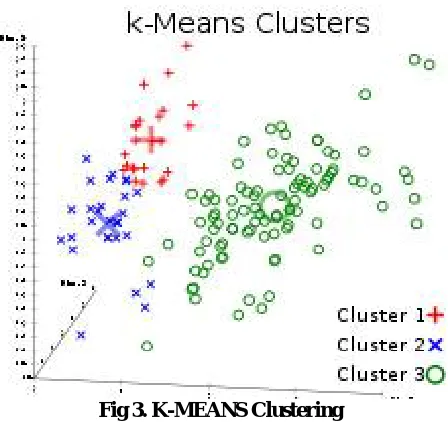
K-means clustering is known for unsupervised learning, which has been used when there is unlabelled data. Main motive of this algorithm just to find groups in the data, with the finding out the number of groups which is represented by the variable K. This algorithm just works step by step iteratively to give each data point one of K groups which is based on the features so to provide it. The centroids for this K clusters, which is used to label new data. Labels for this training data (each data point is assigned to a single cluster).
This algorithm, summarized as follows.
1. Initialization: The first thing k-means does, is randomly choose K examples (data points) from the dataset as initial centroids and that’s simply because it does not know yet where the center of each cluster is.
Fig 3. K-MEANS Clustering
3. Then, all the data points that are the closest (similar) to a centroid will create a cluster. If we’re using the Euclidean distance between data points and every centroid, a straight line is drawn between two centroids, then a perpendicular bisector (boundary line) divides this line into two clusters.
4. Move the centroid.
5. Now, we have new clusters, that need centers. A centroid’s new value is going to be the mean of all the examples in a cluster.
Advantages Ability to learn dimensionality of the feature space.
Easy to implement
With a large number of variables, K-Means may be faster than hierarchical clustering (if K is small). k-Means may produce Higher clusters than hierarchical clustering
Disadvantages 1)Kernel selection 2)Parameter tuning
Applications 1) Face detection 2) Text and hypertext categorization 3) Classification of images.
1)K-means clustering is rather easy to implement and apply even on large data sets, particularly when using heuristics such as Lloyd's algorithm .
2)It has been successfully used in various topics,
including market
segmentation, computer vision, astronomy and agriculture.
Table2. : Advantages & limitations of SVM &K-Means
VI. CONCLUSION
For this work, data mining procedure was used to extract patterns which can be profitable in predicting success and failure. The data mining techniques were applied to a work done. The data went through the cleaning and combining processes .Data mining deals with searching trends and patterns in a given data. Data mining approach is valuable since it can be easier to identify the hidden designs and relationships among various variables. These relationships can in turn help in recognizing sequence of events, classification, clustering, and predicting future events. Data mining techniques could be used in countless scenarios.
ACKNOWLEDGMENT
This work is supported in a movie prediction system of any state in India. Authors are thankful to Faculty of Engineering and Technology (FET), Savitribai Phule Pune University, Pune for providing the facility to carry out the research work.
REFERENCES
1. AGGARWAL, C.C., HINNEBURG, A., and KEIM, D.A. 2000. “On the surprising behavior of distance metrics in high dimensional
space”. IBM Research report, RC 21739. AGGARWAL, C.C.
2. PROCOPIUC, C., WOLF, J.L., YU, P.S., and PARK, J.S. 1999a. Fast algorithms for projected clustering. In Proceedings of the ACM
SIGMOD Conference, 61-72, Philadelphia, PA.
3. AGGARWAL, C.C., WOLF, J.L., and YU, P.S. 1999b. A new method for similarity indexing of market basket data. In Proceedings of the ACM SIGMOD Conference, 407- 418, Philadelphia, PA.
4. AGGARWAL, C.C. and YU, P.S. 2000. Finding generalized projected clusters in high dimensional spaces. Sigmod Record, 29, 2, 70-92. AGRAWAL, R., FALOUTSOS, C., and SWAMI, A. 1993. Efficient similarity search in sequence databases. In Proceedings of the 4th International Conference on Foundations of Data Organization and Algorithms, Chicago, IL.
5. Wang, H., & Zhang, “Movie genre preference prediction using machine learning for customer-based information.” 2018 IEEE 8th Annual Computing and Communication Workshop and Conference (CCWC). doi:10.1109/ccwc.2018.8301647
6. Apala, K. R., Jose, M., Motnam, S., Chan, C.-C., Liszka, K. J., & de Gregorio, F. “Prediction of movies box office performance using social
media.” Proceedings of the 2013 IEEE/ACM International Conference on Advances in Social Networks Analysis
andMiningASONAM’13.doi:10.1145/2492517.2500232
8. Mestyán, M., Yasseri, T., & Kertész, J. (2013). “Early Prediction of Movie Box Office Success Based on Wikipedia Activity Big Data.”
PLoS ONE, 8(8), e71226. doi:10.1371/journal.pone.0071226
9. Cristian E. Briguez,Maximiliano C.D. Budán, Cristhian A.D. Deagustini , Ana G. Maguitman,Marcela Capobianco , Guillermo R. Simari“Argument-based mixed recommenders and their application to movie suggestion” Bahía Blanca, Buenos Aires, Argentina. Published by Elsevier Ltd.2014
10. Nick Armstrong, Kevin Yoon “Movie Rating Prediction” Robotics Institute Carnegie Mellon University 2015
11. Andre Luiz Vizine Pereira , Eduardo Raul Hruschka “Simultaneous co-clustering and learning to address the cold start problem in
recommender systems” University of São Paulo, São Carlos, Brazil Rubens Lara College of Technology, FATEC-RL, Santos, Brazil
Published by Elsevier Ltd. 2015
12. He, G., & Lee, S. “Multi-model or Single Model? A Study of Movie Box-Office Revenue Prediction.” 2015 IEEE International Conference