AR-Book Application Integrated with
Augmented Reality and Cloud Storage
Divvya Mehta1, Devansh Dave2, Ravi Koshiya3
T.E Student, Dept of IT, K.J.Somaiya College of Engineering, Mumbai, India1,2,3
ABSTRACT: The advent of digital era has changed the lifestyle of people by leaps and bounds. This paper proposes an android application catering to the needs of education and security of government and private companies. Digitization has enriched the learning experience of students and also has let to maintenance and analysis of data for companies. The downside of this is diminishing traditional art of reading and over reliance on digitally stored data. Security attacks like viruses can cause harm to database. This AR-book adopts a two-way approach for data storage, by preserving data summary on paper and its related details on cloud, thus preventing data loss. This model also helps the governmental organizations who still rely on data stored on paper and are on the way of transition to digital data storage. It also provides a rich learning experience to student community through AR along with preserving art of reading.
KEYWORDS: Augmented Reality, Cloud storage, android, Vuforia target recognition service.
I. INTRODUCTION
The digital era has brought changes everywhere around us. Smartphones have ushered in for providing ease into our day to day life. Global Communications, Internet, and Social media have radically improved communication with people all over the world. All small-scale and multinational companies are highly dependent on digital technologies. The learning experience of students has been enriched with the great pool of knowledge from Internet.
Digital era has its share of cons too. Over- dependence on data storage of computers and losing of traditional art of reading are among them. Multinational Companies relies heavily on digitally stored data. On the other hand, governmental organizations rely on data handwritten on paper and are transforming to digital data storage. A security or cyber attack like virus can severely harm the digital data whereas some accidents like fire or earthquake can destroy the data on paper. A common ground has to be found where both aspects of storage are taken care. Student communities also are heavily addicted to social media and can be a victim to bad influence. The traditional art of reading is also being lost.
The AR-book model solves the above challenges appropriately. This model stores the data summary on paper and its related confidential information or details on cloud. This accomplishes two-way storage as the data can be restored even if one of the sources has been compromised. The governmental organizations transforming moving towards digital technology can also adopt the AR-book model.
Educational organizations can adopt this model for all their study materials. Students can read the related subject content from paper along with interacting with its related content on Internet in the form of videos, recent research, blogs and discussions on social websites through Augmented Reality on their Smartphones. This enriches the learning experience without losing the art of reading. Students will get the required content related to the subject in short amount of time.
II. RELATED WORK
A. Augmented Reality:
Augmented reality (AR) is this technology to create a “next generation, reality-based interface” [4] and is moving from laboratories around the world into various industries and consumer markets. AR supplements the real world with virtual (computer-generated) objects that appear to coexist in the same space as the real world.
On the reality-virtuality continuum by Milgram and Kishino (Fig. 1), AR is one part of the general area of mixed reality [1]. In addition, Milgram and Kishino defined Milgram’s Reality-Virtuality Continuum as shown in Fig 1. They describe a continuum that spans from the real environment to a pure virtual environment and in-between there are Augmented Reality (closer to the real environment) and Augmented Virtuality (is closer to the virtual environment) [3]. Following [1], an AR system:
combines real and virtual objects in a real environment; registers (aligns) real and virtual objects with each other;
and
runs interactively, in three dimensions, and in real time.
Figure 1: Reality-Virtuality Continuum [2]
B. Cloud Storage:
Cloud computing as a new business model is developed from distributed processing, parallel processing and grid computing [5]. Cloud storage is a system that provides functions such as data storage and business access. It can be presumed as a large capacity storage for cloud computing. Cloud storage system architecture mainly includes storage layer, basic management layer, application interface layer and access layer [5]. Cloud Computing plays a pivotal role in bringing rich applications and using full potential of Internet. Cloud data Storage is the storage mode of Cloud environment.
III. PROPOSED WORK
The AR-book model is designed to provide rich visual experience through Augmented Reality and two-way storage by Cloud database. It primarily targets two types of audience-:
1)The Student Community or Educational institutes.
2) Companies planning on preventing data loss from security attacks or governmental organizations in a transition phase from paper to digital data.
difference lies in the end result. The main aim of AuEdu is rich visual experience with interactive learning for students while AuJama focuses on data reliability and robustness with two- way storage. AuJama can also be used for showing statistical analysis in the form of graphs, related news of the data on paper. AuJama can also be implemented in company’s brochures or catalogues to give a good visual experience about their products to customers.
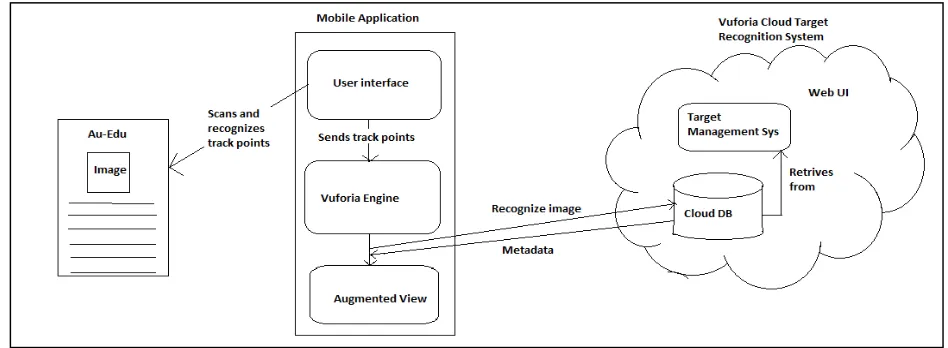
The AR-book model as in fig. works as follows:
1) AuEdu is the book where content and related images are on the same page. The image is scanned by the camera on Smartphone.
2) The tracking points are marked and recorded by the android application.
3) This track points are sent to the Vuforia Engine which sends to Cloud database in Vuforia Cloud Recognition System.
4) The inbuilt Recognition system then matches the track points with the help of Target Management system. 5) If matched, the related activity is sent as metadata to the Vuforia engine.
6) The engine then renders an augmented view for the user.
Figure 2: AuEdu system model
IV. MODELDESIGN
A. Use case Diagram:
The use-case diagram in Fig.3 shows the various user activities performed in system. They are described as follows:
1)Scanning Image.
2)Tracking Image markers.
3)Searching Image on Cloud.
Figure 3: Use case Diagram
B.Sequence Diagram:
The sequence diagram is as shown in Fig.4. It shows the interaction between different components of the system. The components of this system are Android camera, AR controller, Vuforia Target Recognition Service, AR markers and book.
The user starts the application and then scans the image using camera. The image is detected and if matched with some related activity on cloud, the augmented view of it is rendered to the user.
Figure 4: Sequence Diagram
V. IMPLEMENTATION AND RESULTS
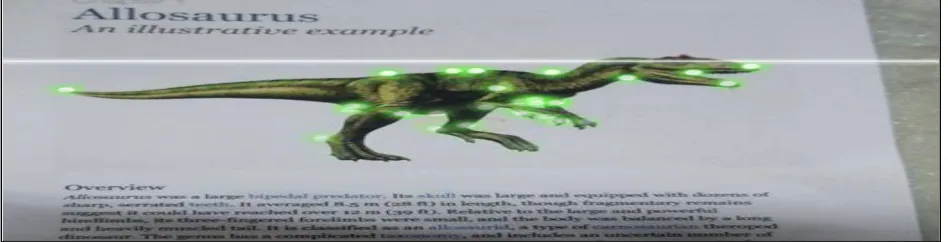
Figure 5: Tracking points on the image
The image in the AuEdu model is scanned and track points are recognized by the application and related content is searched in the cloud storage. Figure 5 shows the points tracked during the scanning process.
Figure 6: Augmented view retrieved from cloud
The tracking and matching process is implemented by Vuforia Target recognition service. Augmented view is rendered when the tracked points match with some related activity on cloud as shown in Figure 6 where 3D model of T- Rex is shown. This enriches the visual experience of user.
VI. FUTURE WORK
Augmented Reality is one of trending and popular concept in digital era. But it has yet not been included in security systems or model. Internal attacks by disgruntled or rogue employees remain one of the biggest security threats for any company. Secret Sharing is an approach wherein a secret is divided into equal parts, giving each participant a unique part and some or all of them are needed to reconstruct it. Captcha is a challenge-response system to differentiate between humans and machine. Captcha are possible to break in today’s world but augmented Captcha can be very difficult to break. The integration of augmented reality and cloud computing in security using secret sharing approach to hinder internal attacks is precisely the future work.
VII. CONCLUSION
model for students and AuJama model for companies. This model is a step forward towards digital empowerment of citizens in all ways.
REFERENCES
1. Van Kreveren D.W.F.and Poelman R., “A survey of augmented reality technologies, application and limitations”, The International Journal of
Virtual Reality, 2010, 9(2):1-20.
2.Pan Z., Cheok A. D., Yang H., Zhu J. and Shi J. (2006). Virtual reality and mixed reality for virtual learning environments, Computers &
graphics, Vol. 30, No. 1, 20- 28.
3.Milgram, Paul, H. Takemura, A. Utsumi and F. Kishino (1994). "Augmented reality: a class of displays on the reality-virtuality continuum"
(pdf). "Proceedings of Telemanipulator and Telepresence Technologies". pp. 2351–34. Retrieved2007-03-15.
4. T. Jebara, C. Eyster, J. Weaver, T. Starner, and A. Pentland. Stochasticks: Augmenting the billiards experience with probabilisticvision
and wearable computers. In ISWC’97: Proc. Int’l Symp. On Wearable Computers, pp. 138–145, Cambridge, MA, USA, Oct. 13-14 1997. IEEE
CS Press. ISBN 0-8186-8192-6.
5. Kun Liu, Long-jiang Dong. “Research on Cloud Data Storage Technology and Its Architecture Implementation” 2012 International Workshop
on Information and Electronics Engineering, Volume 29, 2012, Pages133–137.
BIOGRAPHY
1.
2.
3.
Devansh Dave is an undergraduate student in Information Technology Department, K.J.Somaiya College of Engineering, Mumbai, India. He is currently pursuing research in security with AI, Operational Systems, Data mining and various Software complexity metrics.
Ravi Koshiya is an undergraduate student in Information Technology Department, K.J.Somaiya College of Engineering, Mumbai, India. He is currently pursuing research in Operational Systems, Augmented Reality and Cloud Computing.