Jurnal Teknologi, 35(B) Dis 2001: 1–12 © Universiti Teknologi Malaysia
A PERFORMANCE-BASED BUILDING CODE IN USE
KEVIN NEWHOUSE*
Abstract. The trend in development of building codes has been to move away from prescrip-tive codes that describe a particular method that must be complied with, to performance-based or objective-based codes that describe the outcome or level of performance to be achieved. The development of the Building Code of Australia followed this trend, with a fully performance-based version of the code being released in 1996.
An independent review of the Australian Building Codes Board, including the impact of the performance-based code was undertaken in 1999. This review reached conclusions about whether the code had met the expectations that were originally envisaged.
The performance-based Building Code of Australia followed the ‘Nordic model’ of perfor-mance hierarchy, consisting of Objectives, Functional Statements and Perforperfor-mance Requirements. After 3 years of use of the code, and with a major review of how the code should develop in the future under way, the appropriateness of the Nordic model is being questioned.
This paper identifies the experiences gained from use of the Building Code of Australia’s performance hierarchy, and factors associated with the regulatory environment that have the potential to influence its success. The code re-development process will be described and current thinking on changes to the performance hierarchy will be exposed. The results from the indepen-dent review of the performance-based code will be reported.
1.0 INTRODUCTION
The Australian Building Codes Board (ABCB), established in 1994 by an inter-government agreement (IGA, 1994), is the peak Australian body responsible for achieving a wide range of building regulatory reforms. The ABCB reports directly to the Commonwealth, State and Territory Ministers responsible for building regulatory matters, and provides an important link for the building industry between building practice and Government building regulatory policy.
The ABCB’s mission is to achieve community expectations of safety, health and amenity in the design, construction and use of buildings through nationally consistent, efficient and cost effective technical building requirements and regula-tory systems. In 1996, the ABCB achieved a major milestone with the release of BCA96, the performance-based Building Code of Australia (ABCB, 1996).
BCA96 was given effect from July 1997 by virtue of its reference in the building regulatory legislation of Australia’s eight States and Territories. Since the develop-ment of BCA96, the ABCB has been the subject of a review as foreshadowed by the original inter-government agreement that established the ABCB. One objective of
*
the review was to report on whether the actions taken by the ABCB had delivered benefits and value for money for industry, governments at Commonwealth, State, Territory and local level and the community generally. The review initiated a study of the success of the ABCB’s regulatory reform initiatives, including the perfor-mance-based BCA96, to assist it in reaching its conclusions.
In recognition of maintaining regulatory reform in Australia, the ABCB has begun a review of BCA96. There is a risk of building codes becoming irrelevant if they are perceived as static documents. The recent attack on the World Trade Centre Towers is an example of an event that has the potential to change commu-nity expectations about the role and extent of code requirements.
The review of BCA96 will take the form of a re-evaluation of BCA96 objectives and will include consideration of current community expectations on a range of matters including maintenance, energy efficiency and environmental issues as objectives that a contemporary building code might need to take into account.
The Future Building Code will be developed with a flexible framework in mind and with the ability to easily accommodate future evolution of building regulatory changes and community needs. In addition to the scope, one of the issues being considered as part of the Future Building Code project is the structure of the perfor-mance hierarchy.
AUSTRALIA’S BUILDING REGULATORY ENVIRONMENT In the building regulatory area, Australia has historically had individual systems in each of its 6 States and 2 Territories. The Australian Constitution sets out the roles, responsibilities and powers of the Commonwealth Government. By standard convention, those matters that are not mentioned in the Australian Constitution remain the responsibility of the States and Territories. As the Constitution does not mention matters with regard to the safety, health and amenity of people in buildings, responsibility for them rests with the State and Territory Governments. This has led to 8 separate Acts of Parliament concerned with the regulation of building.
BCA96 is given legal effect by building regulatory legislation in each State and Territory of Australia. This legislation prescribes or ‘calls up’ BCA96 to fulfil any technical requirements which have to be satisfied in order to gain approval of a building proposal. Each State and Territory building regulatory legislation consists of an Act of Parliament and subordinate legislation which empowers the regulation of certain aspects of the building process, and contains the administrative provisions necessary to give effect to the legislation. Administrative-type matters covered in the enabling or subordinate legislation include:
• Plan submission and approval procedures.
• Inspections during and after construction.
• Provision of evidentiary certificates.
• Issue of certificates of occupancy or compliance.
• Review and enforcement of standards.
• Fees and charges.
BCA96
Until the early 1990s, each State and Territory produced its own technical require-ments (building code). The first national building code for Australia (BCA90) was progressively adopted by most States and Territories from that time.
Development of the performance-based BCA96 began in January 1995 and it was officially launched in October 1996. The new Code allowed and encouraged build-ing designers to propose innovative buildbuild-ing solutions that were efficient and cost-effective.
It is important to note that BCA96 still contains ‘deemed to satisfy’ provisions that can be used if the designer elects not to use a performance-based approach. Thus, BCA96 combines a high degree of certainty with a high degree of flexibility. Under BCA96, the required outcome is stated in the Performance Requirements; and one set of methods to achieve them are set out in the Deemed-to-Satisfy (DTS) Provi-sions. The DTS Provisions do not need to be assessed for compliance with the Performance Requirements because they, by definition, are deemed to comply.
REVIEW OF THE ABCB
The inter-government agreement that established the ABCB called for a review of the operation of the Board and the administration of the inter-government agree-ment within 5 years of its establishagree-ment. One objective of the review was to report on whether the actions taken by the ABCB had delivered benefits and value for money for industry, governments at Commonwealth, State, Territory and local level and the community generally.
To assist the review panel in reaching its conclusions, a study of the success of the ABCB’s regulatory reform initiatives was commissioned. This study sought to quan-tify the savings experienced by the building industry and its customers as a result of building regulatory reform initiatives, including the performance-based BCA96.
posi-tioning), there was general agreement that the performance-based BCA96 had pro-duced significant benefits (Laver et al, 2000).
General findings of the study
The benefits of the performance-based BCA96 identified in the case studies were primarily associated
with-• cost savings related to efficiency of design and construction;
• enhanced functionality for owners and end users because designs were better able to meet their requirements;
• the ability to preserve heritage aspects of buildings;
• the flexibility to accommodate new products and materials; and
• the level of life safety, particularly through adoption of situation-specific modelling.
In general, the study indicated that project savings using BCA96 were in the order of 1-3% of the capital costs.
Other benefits identified include the ability to preserve heritage features of historic buildings, more latitude to achieve aesthetically pleasing solutions and more extensive collaboration between all parties in the design and construction cycle, harnessing their capacity for innovation. This is not limited to the professional parties such as building surveyors and designers but flows to sub-contractors and manufacturers, as designers seek innovative solutions that call for new manufactur-ing or installation practices. Many commented that new materials and technologies are much more easily accommodated by using a performance-based design than would be the case if using standard deemed-to-satisfy solutions.
Unfortunately such things as heritage values, aesthetics, creativity and innovation, whilst unquestionably of benefit to the community, are difficult to quantify in cost terms. Other tangible benefits include reduced design costs through a lower likeli-hood that designs will be rejected at a late stage, and less onerous certification procedures.
Offsetting these savings, it needs to be noted that the additional survey, engineer-ing and design costs to develop new solutions are not inconsequential. Also the maintenance costs for the buildings over their lifetime increased in some cases where, for instance, active fire protection systems replaced passive systems. As designers are pushed to provide ever cheaper solutions, there is a danger that an even greater shift of up-front capital costs to recurrent maintenance costs will occur.
Case studies
Multi-purpose Stadium (Melbourne)
This project, costing approximately A$450 million, is the cornerstone development for an entire precinct and was funded through a consortium of private operators. Major features of the 52,000 seat multi-purpose stadium include:
• one of the world’s largest retractable roofs, weighing approximately 4,000 tonnes;
• moveable seats for 16,000 people;
• dining facilities for 6,500, including a 2,000 seat function room;
• 66 corporate boxes;
• 2,500 carparking spaces of which 1,400 are under the stadium playing field;
• a 5,000 square metre sports bar;
• a continuous basement service roadway; and
• extensive intelligent building technology, including a video surveillance system, a complete audio sound system, two large video re-play screens and extensive media facilities.
Fire safety design changes represented the most prominent benefit brought by the performance-based code. Fire modelling undertaken for the stadium provided savings of A$19 million on egress costs alone. The performance-based code also allowed the deletion of inappropriate fire protection measures. As an example, there were significant savings on fan levels because modelling proved that convection would effectively clear the building spaces of smoke.
In the opinion of the building surveyors, this flexibility not only provided more discretion but encouraged the development of better solutions. By obviating inap-propriate systems, funds can allow better quality systems to be installed and enable redeployment into other more effective systems.
The building surveyors for the project estimated a saving of approximately 3% of overall building cost, while the builders estimated the saving to be closer to 5% taking into account fire egress paths, ramps, stairs and access points which were not needed under the performance-based design. Had these been required, the foot-print of the building would have been enlarged by approximately 5%.
Shopping Centre (Sydney)
Shopping centres pose a unique set of needs that were highlighted in this case study. A typical project of this kind may include:
• 12 cinemas;
• 300 shops;
• major department and supermarket stores;
• a food court of 800 seats;
• parking for 3,500 cars; and
• approximately 90,000 square metres of leaseable space.
Typically, the budget for such a development would be in the order of A$200-250 million.
In relation to this, and other similar shopping centre developments, fire engineer-ing is the key area that has changed significantly under BCA96. Indicative changes that were accommodated under the performance-based design included:
• Historically, retail space was subject to three hour fire ratings on floor slabs which were reduced to two hours using fire modelling.
• Parking spaces require four hour fire ratings under the DTS Provisions The fire ratings were reduced to 11/2 hours using fire modelling.
In the respondents’ opinions, the BCA96 DTS Provisions for fire stairs and egress points were designed to accommodate tall buildings rather than single level shop-ping centres. The result is to over-cater in some areas which resulted in adverse impact on construction costs. Fire engineering studies enabled deletion of a signifi-cant number of fire stairs and exits. As a result, the buildings are cheaper to con-struct, which creates lower operating overheads and increases leaseable space while still providing suitable safety standards.
Because of these design simplifications, savings to the overall structure (excluding services) approximate 0.75% to 1%. In addition, services savings of approximately half a percent have been achieved and leaseable retail space has been increased by 1,000 square metres. In overall terms, the saving were assessed to be in the range of 3-4% of overall project costs. Specific areas of saving in the services area
include-• an estimated 20-40% reduction in the capacity of smoke ventilation sys-tems, leading to a 2% saving in smoke control costs;
Cultural Arts Centre (Melbourne)
This cultural arts centre is up to five stories high with a maximum height of approxi-mately 30 metres. It comprises a live theatre complex, a movie theatre, a museum, television production studios, some retail outlets, and computer generated art works. The building geometry is considered to be unique in terms of innovation and pro-gressiveness. A significant part of the construction is over suburban railway lines. The indicative construction cost is A$280 million.
The application of the performance-based provisions is demonstrated by refer-ence to the primary structural plate spanning over the railway lines which have an area of approximately 30,000 m2. The initial design called for a pre-cast concrete solution in respect of the support pillars and the design team recognised the need to seek alternative solutions consistent with BCA96 and the Fire Engineering Guide-lines (FCRC, 1996).
Performance-based risk analysis was used to demonstrate that any potential fire risk was localised, and as the fire risk related to a continuous membrane, there was little risk of thermal deformation. It was also demonstrated that it was not necessary to provide sprinklers or FRL’s to achieve the necessary fire rating.
Given the size, configuration and functional requirements of the development, it would not have been able to be constructed in accordance with the DTS Provisions. Hence, it has significantly benefited by both design flexibility and cost efficiencies by the effective use of the Performance Requirements of BCA96 applied to the development on a global basis.
As a result of the performance-based evaluation, the final deck design was that of a concrete plate supported on a steel tray decking. The outcome for the end user is that the final design is more flexible than it would have otherwise been. For example the owners could, if they wished, add a mezzanine floor with relatively little addi-tional reinforcement. Similarly the size of the supporting members is smaller and the required positioning more flexible, relative to the initial proposition, with the result that there is greater flexibility in terms of internal design and a greater amount of useable space.
As noted earlier, the initial design called for a pre-cast concrete solution. By adopting a different solution, it is estimated that some A$670,000 of capital cost was saved. The time frame necessary to construct the initial design was estimated to be 3 months. Consequently, in addition, it is estimated that the avoided cost of the likely construc-tion time delay was in the order of A$18 million once items such as delayed cash flow from income streams and working capital costs are factored in.
REVIEW OF BCA96
Committee and a Housing Sub-committee have been established, consisting of rep-resentatives from industry and government to provide advice and guidance to the ABCB on the broad range of contemporary issues that may need to be addressed. The review will take the form of a re-evaluation of BCA96 Objectives and will include consideration of current community expectations on a range of matters including maintenance, energy efficiency and environmental issues as objectives that a contemporary building code might need to take into account. The future Building Code will be developed with a flexible framework in mind and with the ability to easily accommodate future evolution of building regulatory changes and community needs.
It is proposed that through this review process, the Future Building Code
will-• better reflect community expectations particularly in relation to emerging and contemporary issues;
• reflect international best practice, where possible;
• have technical provisions that reflect latest building technology;
• have performance requirements and supporting technical solutions;
• have an appropriate structure to deliver a practical application;
• achieve the broadest possible application within industry;
• become clearer and more concise; and
• maintain minimum health and amenity levels in buildings acceptable to the general community.
The project has been divided into two stages. The first stage is the Policy Deve-lopment Program which will consider scope, format and delivery options. The second stage is the Technical Development Program which will develop Perfor-mance Requirements and supporting technical solutions for the issues to be covered by the Future Building Code.
In conjunction with the development of the Future Building Code, the ABCB is addressing the appropriate location of public policy matters within the building regulatory framework. Public policy matters are defined as matters that express the community expectation for acceptable standards of building construction. They form the bases from which building regulations are developed.
THE BUILDING CODE PERFORMANCE HIERARCHY
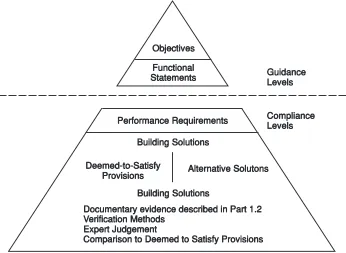
The performance hierarchy of BCA96 was based on the Nordic model and is closely aligned with the New Zealand Building Code. The hierarchy consists of Objectives, Functional Statements, Performance Requirements and Building Solutions as shown in Figure 1.
The Objectives are statements that represent the reason the community wants a matter regulated. They are primarily expressed in general terms, and usually refer to the need to safeguard people and protect adjoining buildings or other property. An example of a BCA96 Objective is:
The objective is to safeguard the occupants from injury or loss of amenity caused by inadequate height of a room or space.
The Functional Statements set out in general terms how a building could be expected to satisfy the objectives (or community expectations). An example of a BCA96 Functional Statement is:
A building is to be constructed to provide height in a room or space suitable for the intended use.
Figure 1 BCA96 performance hierarchy
Performance Requirements Performance RequirementsPerformance Requirements Performance Requirements Performance Requirements Building Solutions Building Solutions Building Solutions Building Solutions Building Solutions Guidance Guidance Guidance Guidance Guidance Levels Levels Levels Levels Levels Compliance Compliance Compliance Compliance Compliance Levels Levels Levels Levels Levels Alternative Solutons Alternative SolutonsAlternative Solutons Alternative Solutons Alternative Solutons Deemed-to-Satisfy Deemed-to-Satisfy Deemed-to-Satisfy Deemed-to-Satisfy Deemed-to-Satisfy Provisions ProvisionsProvisions ProvisionsProvisions Building Solutions Building SolutionsBuilding Solutions Building Solutions Building Solutions
Documentary evidence described in Part 1.2 Documentary evidence described in Part 1.2Documentary evidence described in Part 1.2 Documentary evidence described in Part 1.2Documentary evidence described in Part 1.2 V
VV
VVerification Methodserification Methodserification Methodserification Methodserification Methods Expert Judgement Expert JudgementExpert Judgement Expert JudgementExpert Judgement
Comparison to Deemed to Satisfy Provisions Comparison to Deemed to Satisfy ProvisionsComparison to Deemed to Satisfy Provisions Comparison to Deemed to Satisfy ProvisionsComparison to Deemed to Satisfy Provisions
The Performance Requirements outline a suitable level of performance which must be met by building materials, components, design factors, and construction methods in order for a building to meet the relevant functional statements and, in turn, the relevant objectives. An example of a BCA96 Performance Requirement is:
A room or space must be of a height that does not unduly interfere with its intended function.
The hierarchy has been split into guidance levels (Objectives and Functional Statements) and compliance levels (Performance Requirements and Building Solu-tions). This was done as part of the first amendment to BCA96 at 1 July 2000 to coincide with the call-up by States and Territories of BCA96 in legislation. The effect of this split is that the Objectives and Functional Statements may be used as an aid to interpretation, but cannot be used as a direct means of proving compliance with the code without reference to the mandatory Performance Requirements.
From the inception of the performance hierarchy within BCA96, there has been considerable debate, from both the industry and regulators, in relation to the struc-ture of this hierarchy. The main focus of that debate has been on the existence and role of the Functional Statements. The major criticism has been that there is often very little difference between the expression of a Functional Statement and the Objectives and/or the Performance Requirements. That is, sometimes the wording is only slightly changed for each level and no new information is conveyed through the modified wording.
Whilst the Functional Statements provide a level of detail that may assist in deter-mining why certain regulatory requirements are in place and what they are trying to achieve, this level of detail can be unnecessarily confusing for most people using the code on a regular basis (builders, designers and regulators).
The need for Functional Statements in the performance hierarchy was considered by the ABCB shortly after the introduction of BCA96. At that time, the Board decided not to change the levels, but to review them as part of the overall code review.
As part of the code review process, one option under consideration is that the Functional Statements be deleted from the hierarchy, and where a Functional State-ment does bring about information beyond the Objectives, this information could be incorporated into revised Objectives.
CONCLUSION
savings in construction costs to be achieved whilst meeting the level of performance expected by the community. Other less tangible benefits of the performance-based code have also been realised, from preservation of heritage elements of buildings through to improving the viability of projects of community significance.
Experience in the application and use of the performance-based BCA96 has led to suggestions for continuing improvements including a simplified performance hierarchy, and a scope that includes both contemporary and emerging building regulatory issues of a local and global nature.
Recent events like the attack on the World Trade Centre Towers have prompted code writers around the world to consider whether their code provisions reflect community expectations in a range of areas. The transfer of public policy matters from Australian Standards to the building code will provide an effective means of considering the acceptability of risk in the context of community expectations. These and other issues are being considered in the development of Australia’s Future Building Code.
REFERENCES
Australian Building Codes Board. 1996. Building Code of Australia – Volumes One and Two. ABCB, Canberra. Fire Code Reform Centre. 1996. Fire Engineering Guidelines. Fire Code Reform Centre Limited, Sydney. IGA, 1994. An agreement between the Commonwealth of Australia, the States and the Territories to establish the
Australian Building Codes Board.
KPMG. 2000. Impact Assessment of Major Reform Initiatives. ABCB, Canberra.