Home Lighting and Appliance Control System
using Internet of Things
Shivani S. Adsar1, Tanvi D.Mutha2, Prof. Prashant Lahane3
Student, Dept. of Computer Engineering, MIT College of Engineering, Pune, India1,2
Assistant Professor, MIT College of Engineering, Pune, India 3
ABSTRACT: A home automation system consists of a smart lighting control system which can be easily monitored by
one or more central computing devices. The inputs and outputs given to the system can be remotely controlled by these devices. The advancements in mobile technology and the reduction in costs have made it easier and convenient to incorporate mobile technology into home automation systems.
This paper proposes developing a low-cost Home automation control system which can be accessed by a hybrid mobile application. The system consists of a home server, an android application and an internet based application. It is controlled by a microcontroller (Wi-Fi microcontroller) which gets the commands from the home server and the android application. The commands are first passed on to the home server from the android application and then to the microcontroller through wireless network (Wi-Fi technology). These commands are controlled by the user through an android application to switch on/off the AC appliances.
KEYWORDS: Sensors, Mobile application, Microcontroller, I2C protocol, lights control, Wi-Fi module
I. INTRODUCTION
A. OVERVIEW
The increasing technology and digitization demands for a low-cost and efficient system. The proposed system makes use of an efficient and low-cost technology for controlling the appliances thus minimizing the power consumption. [1] Primarily, the system makes use of wireless technology and Internet to control the home appliances using a hand-held device. It makes use of a versatile system to ease the mobility of the user and emphasizes on controlling the appliances with maximum security, low cost, convenience and efficiency.
B. ADVANTAGES
The home automation system gives various advantages which can be gained only with wireless technology.[11], [14]
1. Reduced Installation Costs: Due to the reduction in cabling and use of wireless networks, the costs can be
reduced effectively.
2. System Scalability: The system can be easily extended whenever there are new advancements or extensions.
3. Integration: With the use of mobile handsets, it has become easier to communicate through any location and is
hence location independent. There is no need of the device’s exact geographical location.
II. RELATED WORK
not provide a Graphical User Interface and the users had to know the commands so as to control the devices.Many home automation systems were proposed using the Simple Object Access Protocol (SOAP) over the Ethernet network. The limitation of this system was that it increased the overhead for the client-server system and was complex. This caused slower operation and more bandwidth requirement.The Stratecast architecture was proposed by IBM for connecting various devices to the cloud. This architecture involved connecting various devices directly to the cloud and those devices had to communicate with a single platform. A better approach for this system would have been if a middleware was employed which could connect the cloud and the devices.
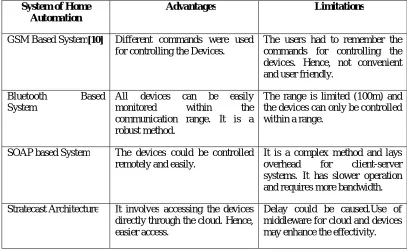
Table 1 – Comparison of Home Automation Systems
System of Home Automation
Advantages Limitations
GSM Based System[10] Different commands were used
for controlling the Devices.
The users had to remember the commands for controlling the devices. Hence, not convenient and user friendly.
Bluetooth Based
System
All devices can be easily
monitored within the
communication range. It is a robust method.
The range is limited (100m) and the devices can only be controlled within a range.
SOAP based System The devices could be controlled
remotely and easily.
It is a complex method and lays
overhead for client-server
systems. It has slower operation and requires more bandwidth.
Stratecast Architecture It involves accessing the devices directly through the cloud. Hence, easier access.
Delay could be caused.Use of middleware for cloud and devices may enhance the effectivity.
III.CATEGORIES OF HOME AUTOMATION
There have been many new advancements in Home automation systems over the past few years. The various categories are given below.
1. ZigBee based Automation: ZigBee is used for connecting various devices wirelessly. Hence, reduces the wiring
overhead. The program is fed into ZigBee’s control unit. Based on the input given by the users, the device sends commands to the subsystems and controls the appliance. [3]This method is power efficient. The signals are received wirelessly through the device and are controlled remotely.
2. Automation using PLC and Energy Conservation Methodology: The Power Line Conservation (PLC) connects
controlled with maximum security. In this system wired or wireless receivers are installed at each appliance and these receivers are given ID’s so that multiple appliances can be controlled at the same time.
4.SMS based Home Automation System: In this system, GSM technology is used to control the appliances. The SMS
can be sent from any GSM based phone and only a phone with GSM can receive the SMS. The GSM module is connected to the microcontroller which is used to control the appliances. It is a serial communication and requires RS-232 for communication. [5] The system takes the username and password from the user for authentication. The drawback of this system is that it uses GSM for communication, so roaming charges could be applicable which could increase the cost of the system.
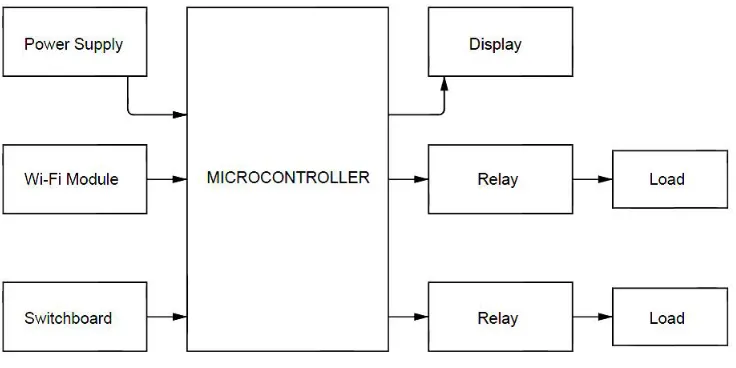
5.Home Automation System using Microcontroller and Mobile Phone: In this home automation system, the
microcontroller receives commands from the home server and through the mobile application, the home server is given the commands. (Fig. 1)[7]
Fig. 1 – Block Diagram of Home Automation System
This is how the microcontroller controls the appliances. The microcontroller consists of sensors which senses the system and operates the AC devices efficiently which improves convenience and also reduces the total power consumption of the system. The main objective of this system is to make it power efficient and reduce the cost.
IV.ARCHITECTURE
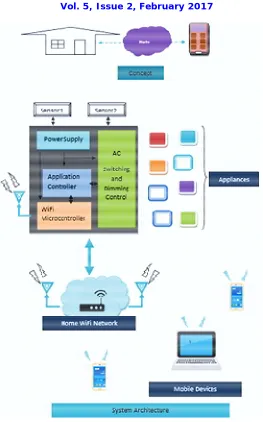
Home appliances are connected to the Home system through Microcontroller board. In this, the home system fetches sensors data from microcontroller board and upload it to the AC Switching and Dimming control and information is given to the android users to perform the task.[14]
Fig. 2 – Architecture of Home Automation System
The mobile application consisting of user interface is employed for commencing, configuring and controlling this switch board. All the switch board will be integrated in one mobile application and will be controlled centrally seamlessly. Mobile application need to be in synch with all switchboards to show appropriate status of each switch on board. Pressing the switches should control the switch in respective boards.
The current embodiments suggest the design of wireless switch board to be retrofit and fit behind existing switchboards, thereby reducing the need of any rewiring to automate any existing house or commercial complex. This also ensures a securecommunication and system of data connectivityfor end users.
V. CONCLUSIONANDFUTUREWORK
This paper presents the study and survey of different home automation systems. These systems have many applications and are very efficient. Also, these systems have vast scope and help in reducing the power consumption. The home automation systems are very useful for handicapped and elderly people to control appliances remotely thus saving electricity, time and cost.
REFERENCES
[1] Proceedings of 2015 Global Conference on Communication Technologies (GCCT 2015)
[2] Al-Ali, Abdul-Rahman, and Mohammad Al-Rousan. "Java-based home automation system - Consumer Electronics’’,IEEE Transactions on 50.2 (2004): 498-504.
[3] Freddy K Santoso, and Nicholas C H Vun School of Computer Engineering, Nanyang Technological University, Singapore. [4] 2015 International Conference on Computation of Power, Energy, Information and Communication.
[5] Dr. M. Thiyagarajan Professor Emeritus and Dean, Research Cell Nehru Group of Institution, 2015 InternationalConference on Green Computing and Internet of Things (ICGCIoT)
[6] Atzori, Luigi, Antonio Iera, and Giacomo Morabito. "The internet of things: A survey." Computer networks 54.15 (2010): 2787-2805.
[7] Kelly, Sean Dieter Tebje, Nagender Kumar Suryadevara, and Subhas Chandra Mukhopadhyay. "Towards the implementation of IoT for environmental condition monitoring in homes." Sensors Journal, IEEE 13.10 (2013): 3846-3853.
[8] Zhang, Weizhe, and Baosheng Qu. "Security Architecture of the Internet of Things Oriented to Perceptual Layer." International Journal on Computer 2 (2013): 2-13.
[9] Jain, Sarthak, Anant Vaibhav, and Lovely Goyal. "Raspberry Pi based interactive home automation system through E-mail." Optimization, Reliability, and Information Technology (ICROIT), 2014 International Conference on. IEEE, 2014.
[10] Zhao, Yanbo, and Zhaohui Ye. "A low-cost GSM/GPRS based wireless home security system." Consumer Electronics, IEEE Transactions on 54.2 (2008): 567-572.
[11] Assaf, Mansour H., et al. "Sensor based home automation and security system." Instrumentation and Measurement Technology Conference (I2MTC), 2012 IEEE International. IEEE, 2012.
[12] Chowdhury, Md Nasimuzzaman, Md Shiblee Nooman, and Srijon Sarker. "Access Control of Door and Home Security by Raspberry Pi Through Internet."International Journal of Scientific and Engineering Research 4 (2013).
[13] Moreno, M., et al. "A holistic IoT-based management platform for smart environments." Communications (ICC), 2014 IEEE International Conference on. IEEE, 2014.
[14] Gubbi, Jayavardhana, et al. "Internet of Things (IoT): A vision, architectural elements, and future directions." Future Generation Computer Systems 29.7 (2013): 1645-1660.