Implementation of User Based Collaborative
Algorithm in Real Estate Property
Pallavi Paunikar, Payal Modake, Shamali Wagh, Prof.Prerna Mishra,
Project Scholar, Department of Information Technology, J D College of Engineering, Nagpur (M.H), India
Project Scholar, Department of Information Technology, J D College of Engineering, Nagpur (M.H), India
Project Scholar, Department of Information Technology, J D College of Engineering, Nagpur (M.H), India
Assistant Professor, Department of Information Technology, J D College of Engineering, Nagpur (M.H), India
ABSTRACT: An excessive amount of information available in the Internet due to the unsteady evolution of
information has thus made information search as complicated process. As much as information became accessible digitally, the necessities for effective essence of information and complement of filtering tool.User faces many problems due to lots of information known as intoxication. To conquer this intoxication Recommender system (RS) can be used in commercial sites. RS provides personalized advice to users and, thus helps in making good decisions about which property to buy from the vast amount of property choices. The internet has made a meaningful proceedings platform for the online estate industry. However, use of the internet does not benefits homebuyer in terms of search time, flexibility, and intuitive results. We are choosing an algorithm which creates an accurate and efficient result. User’s gets more accurate and systematic approach by using collaborative filtering algorithm. This paper will provide a basic approach for its implementation and exceeding efficiency in prediction intricacy.
KEYWORDS: Collaborative Filtering (CF), User-Based CF, Search Pattern, Recommender System (RS), Real Estate
Property, Buying Renting and Selling (BRS).
I. INTRODUCTION
user-item relationship neighbours are computed which makes the prediction easy. The weights of all the neighbours are calculatedseparately. The proposed method is stated to provide recommendation in 0.2 milliseconds. The training also takes less time unlike very length time in large scaleapplications. The proposed method was tested on data which consisted of 2.8 million queries which was processed in 10 minutes.In [5] author proposed a semantic web personalization. In this, web contents are modified based on the user’s searching and navigational behaviour. In [5] author proposed a technique that incorporates web recommendation and personalization of websites based on the user interest. They have taken web logs for their source. They have used the data structures such as Web-Interest Matrix, User-Interest Matrix, Class-Interest Matrix and Frequent-Path Matrix to keep track of user interest and change the website based on the impact of the users. Probabilistic memory-based collaborative filtering (PMCF) combines memory-based and model-based techniques [10]. They use a mixture model built on the basis of a set of stored user profile and use the posterior distribution of user ratings to make predictions. To address the new user problem, an active learning extension to the PMCF system can be used to actively query a user for additional information when insufficient information is available. To reduce the computation time, PMCF selects a small subset called profile space from the entire database of user ratings and gives predictions from the small profile space instead of the whole database.In [4] author, discussed about recommending data sources for news articles or web sites after learning the taste of the user by learning his profile. It mentioned various types of information that can be considered to learn the profile of a user.Real Estate portals nowadays are not more interactive, where user can search the property randomly. Existing system does not provide effective search patterns for selling, renting and leasing.
III.PROPOSED ALGORITHM
A. PROPOSED WORK OF SYSTEM:
This paper proposes a method by the means of real estate portal which offers better searching facility to user using collaborative search algorithm.
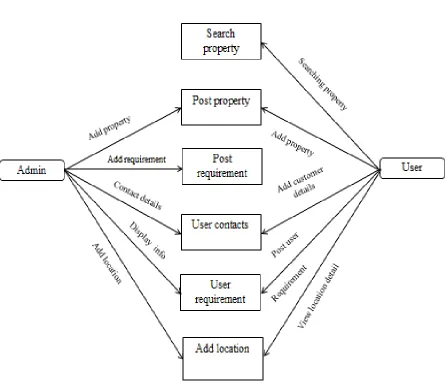
Fig. 1 shows the data flow diagram of online real estate management through which individual agents or buyers can maintain their property. The user does not need to register itself to post his/her property to sell or rent.
The algorithm often requires: 1. User’s active participation
2. An easy way to represents user’s interest and
3. Algorithms that are able to match people with similar interest
Typically, the workflow of a collaborative filtering system is:
Fig.4. Isolation of the co-related users and similarity computation. [21]
Above Fig. 4 shows the isolation of the co-related users and similarity computation. The user based collaborating filtering algorithm is somewhat similar to item based collaborative filtering algorithm. This paper focuses on the similarity between two users instead of computing the similarity between two items. This will used relativity-based method of computing similarity between two users u, v which is the similar as in item-relativity-based method. , Denote
the similarities. Compute the rating similarity between the users search pattern and select highly rated search pattern in a critical phase in item based CF also by applying the similarity computation techniques, determine the similarity. In this isolate the user who has rated both the items. The prediction on property for a user u is calculated by computing weighted sum of different users search patterns on property i. The prediction ,is given by,
, =
∑ ( , ∗ , )
∑ ,
Where , is the search pattern of user u on property i.
Benefits of using user based collaborative algorithm are: CF system does not require content information about
neither users nor items to be machine recognizable. Pure CF methods utilize rating and do not require any additional information about users or items. This system can make an assessment of quality, style or viewpoint by consideration of other people’s experience. The main benefits is that CF system can produce personalized recommendations, because they consider other people’s experience and recommendations are based on that experience. Another notable attainment is that CF recommender systems can suggest item by observing similar-minded people’s behaviour.The limitation is that CF system cannot produce recommendations if there is no previous search pattern available. They manifest poor accuracy when there is little data about user’s search pattern, this pros is called Cold-Start problem.
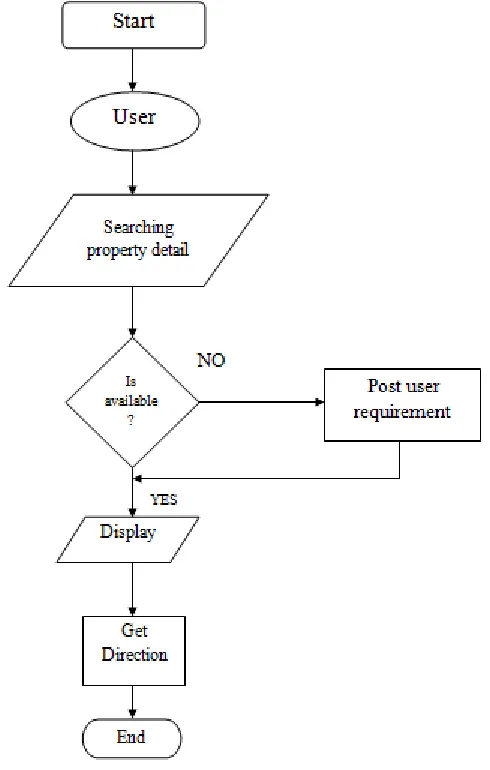
Fig.5. Data flow graph of User-Based CF
5 K. Suneetha, and M. Usha Rani, “Web page recommendation approach using weighted sequential patterns and markov model”, Published in Global Journal of Computer Science and Technology, Vol.12 Issue.09 ,pp.1-3, April-2012.
6 Haibo Liu, Hongjie Xing, Fang Zhang, “Web personalized recommendation algorithm incorporated with user interest change”,Published in Journal of Computational Information Systems, Vol.8 Issue.04, pp.1383-1384, 2012.
7 Qinjiao Mao, BoqinFeng, Shanliang Pan, “Modeling User Interests Using Topic Model”, Journal of Theoretical and Applied Information Technology, Vol.48, Issue.1, pp.600-604, 2013.
8 Xiaoyuan Su and Taghi M. Khoshgoftaar, “A survey of collaborative filtering techniques”, Published in Hindawi journal of Advances in Artificial Intelligence, August-2009..
9 D Jia, F Zhang, S Liu, “A robust collaborative filtering recommendation algorithm based on multidimensional trust model”, Published in Journal of Software, Vol.8, pp.11-17, January-2013.
10 O Lee, MS Hong, WJ Lee, JD Lee, “Scalable collaborative filtering technique based on adaptive clustering”, Published in Journal of Intelligence and Information System, Vol.20 Issue.02, pp.31-32, 2014.
11 MaddaliSurendra Prasad Babu and Boddu Raja Sarathkumar, “An implementation of the user-based collaborative filtering algorithm”, Published in International Journal of Computer Science and Information Technologies (IJCSIT), Vol.2 Issue.3, pp.1283-1285, 2011.
12 Zhi-Dan Zhao and Ming-Sheng Sheng, “User-based collaborative-filtering recommendation algorithm on hadoop”, Published in International Conference on knowledge Discovery and Data Mining, pp.478-480, December-2013.
13 Poonam B Thorat, R.M. Goudar and SunitaBarve,” Survey on Collaborative Filtering, Content-based Filtering and Hybrid Recommendation System”, published in International journal of Computer Applications, Vol.110, pp.31-34, January -2015.
14 AtishaSachan and VineetRichariya,” A Survey on recommender systems based on Collaborative filtering technique”, Published in International journal of innovation engineering and technology (IJIET), Vol.2 Issue.02, pp.1-12, April-2013.