Title
The Emotion of Disgust among Medical and Psychology Students Authors
Artemios Pehlivanidis, Niki Pehlivanidi , Katerina Papanikolaou, Vassileios Mantas, Elpida Bertou, Theodoros Chalimourdas, Vana Sypsa and Charalabos Papageorgiou Artemios Pehlivanidis: 1st Department of Psychiatry, Medical School- National and Kapodistrian University of Athens, Eginition Hospital, Vas Sophias 72, 11528, Athens, Greece
Niki Pehlivanidi: Medical School- National and Kapodistrian University of Athens, Eginition Hospital, Vas Sophias 72, 11528 Athens, Greece
Katerina Papanikolaou: Department of Child Psychiatry, Medical School-National and Kapodistrian University of Athens, “Agia Sophia” Children’s Hospital, Thivon and Papadiamantopoulou Street, 11527 Athens, Greece
Vassileios Mantas: 1st Department of Psychiatry, Medical School-National and Kapodistrian University of Athens, Eginition Hospital, Vas Sophias 72, 11528 Athens, Greece
Elpida Bertou.: School of Psychology - National and Kapodistrian University of Athens, Eginition Hospital, Vas Sophias 72, 11528 Athens, Greece
Theodoros Chalimourdas: 1st Department of Psychiatry, Medical School-National and Kapodistrian University of Athens, Eginition Hospital, Vas Sophias 72, 11528
Athens, Greece
Vana Sypsa: Department of Hygiene, Epidemiology and Medical Statistics, Medical School, National and Kapodistrian University of Athens, Mikras Asias 75, Athens 11527 Greece
Charalabos Papageorgiou: 1st Department of Psychiatry, Medical School- National and Kapodistrian University of Athens, Eginition Hospital, Vas Sophias 72, 11528 Athens, Greece
Corresponding author: Artemios Pehlivanidis: 1st Department of Psychiatry, Medical School- National and Kapodistrian University of Athens, Eginition Hospital, Vas Sophias 72, 11528 Athens, Greece
Email: [email protected]
Abstract
Disgust evolved as a way to protect one’s self from illness. DS-R measures disgust propensity of three kinds of disgust (Core, Animal Reminder and Contamination). Although the DS-R scale was refined mainly with young and largely female student population its impact on educational orientation has not been assessed. In the present study we examined the DS-R scoring and the choice of postgraduate studies in medical (n= 94) and psychology (n= 97) students. They responded to an anonymous web-based survey and completed the DS-R and a questionnaire on their demographics and plans for postgraduate studies. Female students outnumbered males (3:1) and scored higher in Total DS-R score (median: 59 vs. 50, p<0.05). Psychology students scored higher in all three kinds of disgust (p<0.05), indicating a higher level of
disease avoidance. Medical students willing to follow Internal Medicine scored higher in Core Disgust (p<0.05) while psychology students willing to study Experimental Psychology scored lower in Animal Reminder subscale (p<0.001). Also, the higher the psychology students scored in Core Disgust scale the higher was the probability to choose Experimental Psychology. In conclusion, disgust propensity as rated by DS-R differentiates medical from psychology students and is also related to orientation preferences in postgraduate studies.
Introduction
Disgust is one of the basic emotions in Plutchik’ s (1980) [1] theory of emotions and there is strong support that it evolved as a way to protect one’s self from illness. [2,3] Disgust has been extensively studied by Rozin et al (1987) [4] who proposed a
classification system of four broad categories of disgust elicitors. Core elicitors are characterized by a real or perceived threat of oral incorporation and a reactive sense of offensiveness (e.g. spoiled milk, feces, and rats). Animal-reminder elicitors consist of our own mortality and inherent animalistic nature (attitudes and practices surrounding sex, injury of the body or violations of its outer envelope and death). Interpersonal disgust is elicited by contact with individuals who are unknown, ill or tainted by disease, misfortune or immorality. Socio-moral disgust elicitors is a subclass of moral violations that the person is morally “sick” or “twisted”. Haidt et al. (1994) [5]
developed the Disgust Scale (DS) with eight subscales. The Disgust Scale – Revised (DR-R) provided by Olatunji et al (2008) [6] revealed three distinct factors with a better internal consistency and conceptualized three subscales namely the Core, Animal Reminder and Contamination disgust. The Core disgust factor is primarily characterized as a food rejection response centered on oral incorporation of offensive stimuli (e. g. eating monkey meat). The Animal – Reminder factor highlights stimuli or behaviors that serve as reminders of the original of humans (e.g. touching a dead body). The Contamination disgust factor (e.g. accidentally drinking from someone else’s cup) reflects disease spread by people whereas Core disgust reflects disease spread by objects. The DS-R scale has been validated and its three factors confirmed internationally, including a Korean sample [7], students in the Netherlands [8]
samples from the United States [9], Israel [10], Greece [11] and samples from Brazil, Australia, Germany, Italy, Japan, and the Netherlands [12].
However there is still need for further investigation on the influence of demographic characteristics on disgust propensity. Berger and Anaki (2014) [10] in a large
heterogeneous sample (N= 1427) investigated the role of demographic variables on disgust’s sensitivity. Gender was found to have a large effect on DS-R score, while the effects of other demographic variables, such as religion, political view, education and age, were exceptionally modest. They suggest that demographic variables create some of the diverse contexts in which disgust is evoked, without modulating the intensity of the subjective disgust sensitivity. Chalimourdas et al (2019) [11]
administered the Greek version of the DS-R in a sample of 754 healthy participants. Women scored higher than men in all three subscales and religiousness was
associated with heightened levels of disgust. There was a weak negative correlation between levels of disgust and years of education.
subscales since different orientations involve distinct patterns of exposure to disgust-eliciting stimuli.
Studies suggest that decisions regarding medical specialization have been associated with demographic and outcome-expectancy type variables [14], personality-type characteristics [15], institutional factors and personal values [16], exposure to role models [17]. Reports examining the role of disgust sensitivity in decisions regarding post-graduate career specializations are scarce. According to Consedine & Windsor (2014) [18] disgust sensitivity predicted interest in careers of varying procedural intensity among medical students.
The present study has a twofold aim. First, to compare a sample of medical students to a sample of psychology students in order to assess the impact of academic
background on DS-R scoring. Second, to investigate their future plan for postgraduate studies in relation to DS-R scoring. Our hypotheses were that educational orientation would elicit different disgust scores and that postgraduate orientation with less human contact and treatment (such as Experimental Psychology or Laboratory Specialty) might elicit different DS-R scores in the two samples of students.
Materials and Methods Design and participants
During a two-week period at the beginning of the academic year 2019-2020, 94 medical students and 97 psychology students of the National and Kapodistrian University of Athens (NKUA) responded to a web-based survey, which guaranteed their anonymity. Participants were reached through their University Social Media groups. All students completed the DS-R and a questionnaire comprising their demographics and their plans for postgraduate studies. All subjects gave their informed consent for inclusion before they participated in the study. The study was conducted in accordance with the Declaration of Helsinki, and the protocol was approved by the Ethics Committee of the 1st Department of Psychiatry of the NKUA, Eginition Hospital (ADA:BIPM46Ψ8NZ-OΩΩ).
Instruments
The anonymous questionnaire comprised information on sex, age, year of study. Medical students had to choose one among three possible future options of medical specialty, namely: Internal Medicine, Surgical Specialty, Laboratory Specialty while psychology students had to choose one of the three following postgraduate studies directions: Clinical Psychology, Educational Psychology and Experimental
Psychology. The DS-R scale
Statistics
Participants’ characteristics were described using mean and standard deviation for quantitative variables or proportions for categorical variables. DS-R scores were summarized using median and (25th, 75th) percentiles. The demographic
characteristics of the two groups of students as well as their DS-R scores were
compared using t-test, chi-squared test or Mann-Whitney test, as appropriate. Multiple logistic regression models were used to assess factors independently associated with reporting Laboratory Specialty as future option (among medical students) and post graduate Experimental orientation (among psychology students) compared to all the other available options.
Results
Completed data were available for 94 medical and 97 psychology students (total N=191). Approximately three quarters of them (77.5%, n=148) were females. Students’ mean (SD) age was 20.2 (2.2) years. 121 (63.4%) were students in the introductory two years of their studies. Among medical students, Internal Medicine and Surgical Specialty were the most frequently reported future options (42.5% and 47.9% respectively) while Laboratory Specialty was an option only for the 9.6% of them. Among psychology students, 67.0% chose Clinical Psychology as a
post-graduate option, 21.7% Educational Psychology and 11.3% Experimental Psychology. The two groups did not differ in age (Table 1). A larger number of medical students in comparison to psychology students were males and belonged to an advanced study year. Medical students scored lower in all DS-R subscales compared to psychology students, with a median (25th, 75th) total score of 49 (38, 61) and 62 (52, 75), respectively (p<0.001) (Table 1), although score distribution of DS-R subscales did not differ between the two faculty students in relation to sex (Table 4). Medical
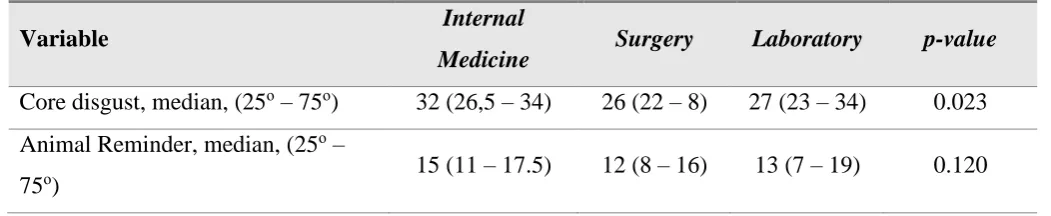
students with Internal Medicine orientation scored higher in the Core Disgust subscale compared to Surgical and Laboratory Specialty (median (25th, 75th): 32 (26.5, 34), 26 (22,28) and 27 (23, 34), respectively, p=0.023) (Table 2). Psychology students with Experimental postgraduate orientation scored lower in the Animal Reminder subscale (Tables 2, 3).
Among medical students, there was no association between age, sex, study year and DS-R subscales with the odds of reporting Laboratory Specialty as future option compared to the other specialties (data not shown). From a multiple logistic
Table 1. Demographic characteristics and DS-R scoring in the total number of participants and according to Faculty.
Variable Total Medical
Students
Psychology
Students p-value
(N = 191) (N =94) (N = 97)
Age (years), mean., (SD) 20.15 (2.21) 20.31 (2.27) 20.00 (2.15) 0.336
Sex, n (%) <0.001
Males 43 (22.51) 33 (35.11) 10 (10.31) Females 148 (77.49) 61 (64.89) 87 (89.69)
Study Year, n (%) 0.023
1-2 years 121 (63.35) 52 (55.32) 69 (71.13) 3-6 years 70 (36.65) 42 (44.68) 28 (28.87)
Study Year, n (%) <0.001
1 29 (15.18) 28 (29.79) 1 (1.03) 2 92 (48.17) 24 (25.53) 68 (70.10) 3 32 (16.75) 12 (12.77) 20 (20.62) 4 8 (4.19) 4 (4.26) 4 (4.12) 5 7 (3.66) 6 (6.38) 1 (1.03) 6 23 (12.04) 20 (21.28) 3 (3.09)
Core disgust, median, (25ο – 75ο) 32 (26 – 36) 28.5 (24 – 34) 35 (29 – 40) <0.001 Animal Reminder, median, (25ο – 75ο) 16 (11 – 21) 13.5 (9 – 17) 20 (14 – 24) <0.001 Contamination Disgust, median, (25ο –
75ο) 8 (6 – 11) 8 (6 – 10) 10 (7 – 11) 0.047
Total score, median, (25ο – 75ο) 58 (45 – 66) 49 (38 – 61) 62 (52 – 75) <0.001
Table2. Score distribution in relation to specialty orientation of Medical Students.
Variable Internal
Medicine Surgery Laboratory p-value
Core disgust, median, (25ο – 75ο) 32 (26,5 – 34) 26 (22 – 8) 27 (23 – 34) 0.023 Animal Reminder, median, (25ο –
Contamination Disgust, median, (25ο
– 75ο) 8 (6.5 – 10.5) 8 (6 – 10) 7 (5 – 11) 0.743
Total score, median, (25ο – 75ο) 53.5 (47.5 –
61.5) 42 (37 – 59) 42 (36 – 68) 0.046
Table 3. Score distribution in relation to postgraduate orientation of Psychology Students.
Variable Clinical Educational Experimental p-value
Core disgust, median, (25ο – 75ο) 35 (30 – 41) 34 (30 – 39) 29 (26 – 36) 0.214 Animal Reminder, median, (25ο –
75ο) 20 (15 – 25) 24 (17 – 26) 11 (9 – 18) <0.001
Contamination Disgust, median, (25ο – 75ο
) 10 (7 – 11) 10 (7 – 11) 7 (4 – 10) 0.081
Total score, median, (25ο – 75ο) 63 (53 – 78) 65 (58 – 73) 47 (41 – 58) 0.005
Table 4. Score distribution according to sex.
Variable Males Females p-value
All students (N=191)
Core disgust, median, (25ο – 75ο) 27 (24 – 33) 33 (27 – 38) <0.001 Animal Reminder, median, (25ο –
75ο) 14 (8 – 20) 17 (12 – 22) 0.019
Contamination Disgust, median, (25ο
– 75ο) 8 (7 – 11) 8.5 (6 – 11) 0.912
Total score, median, (25ο – 75ο) 50 (39 – 62) 59 (47 – 68) 0.004
Medical Students (N=94)
Core disgust, median, (25ο – 75ο) 27 (24 – 32) 30 (24 – 34) 0.078 Animal Reminder, median, (25ο –
75ο) 13 (7 – 17) 14 (11 – 17) 0.372
Contamination Disgust, median, (25ο
– 75ο) 8 (7 – 11) 8 (5 – 10) 0.424
Psychology Students (N=97)
Core disgust, median, (25ο – 75ο) 32 (26 – 35) 35 (29 – 40) 0.154 Animal Reminder, median, (25ο –
75ο) 19 (16 – 21) 20 (14 – 26) 0.682
Contamination Disgust, median, (25ο – 75ο
) 9.5 (7 – 10) 10 (7 – 11) 0.729
Total score, median, (25ο – 75ο) 59.5 (49 – 64) 63 (52 – 77) 0.316
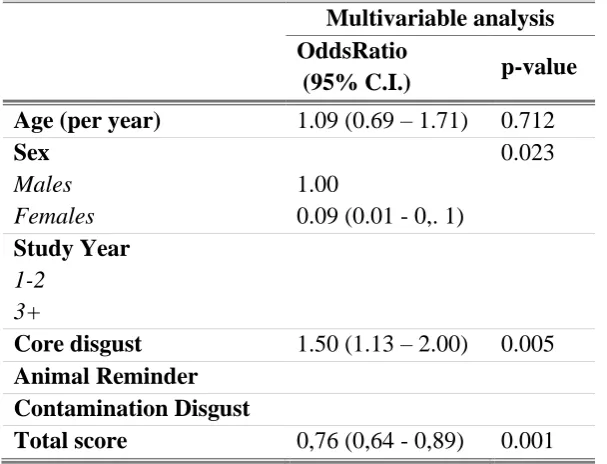
Table 5. Odd ratios (OR) and corresponding 95% confidence intervals (95% CI) of univariable logistic regression for the selection of Experimental psychology (N= 97 Psychology Students)
Multivariable analysis ΟddsRatio
(95% C.I.) p-value
Age (per year) 1.09 (0.69 – 1.71) 0.712
Sex 0.023
Males 1.00
Females 0.09 (0.01 - 0,. 1)
Study Year
1-2 3+
Core disgust 1.50 (1.13 – 2.00) 0.005
Animal Reminder Contamination Disgust
Total score 0,76 (0,64 - 0,89) 0.001
Discussion
The first aim of the study was to explore possible differences in DS-R scoring among medical and psychology students. Medical students scored lower in all DS-R
subscales in comparison to psychology students indicating that educational
contamination. Protection from illness has been considered as one of the evolving roles of disgust [2, 3]. Disgust has been found to increase during the first trimester of pregnancy [19] and certain aspects of disgust have been linked to mate preference [20, 21]. These findings suggest that disgust is associated to various aspects of
reproduction and disease avoidance. Since medical students are expected to be less avoidant of diseases, difference in scoring between medical and psychology students may be attributed to choices when deciding to enter the undergraduate studies. The decision to follow Psychology studies may be influenced by the basic emotion of disgust as it is measured by DS-R in an opposite way to that of medical students. A study closer to the decision making for undergraduate studies could help to further elucidate the influence of the emotion of disgust to the decision making for studies orientation.
In our study DS-R score distribution was not influenced by sex among both medical and psychology students while in the DS-R score distribution of all students in relation to sex, females scored higher. This could be explained by the larger sample when these two groups of students were combined. Female preponderance in disgust sensitivity is a standard finding in previous reports [22, 23]. As mentioned above, evolutionary, women use more energy and resources to birth and raise their children [22] and have to protect themselves and their children from illness. In addition, Spark et al (2018) [24] in an extensive meta-analysis documenting the sex difference of disgust argue that key features of this pattern are best explained as one manifestation of a broad principle of the evolutionary biology of risk-taking for a given potential benefit. They also suggest that disgust and related emotions can be usefully examined through the theoretical lens of decision making under risk in light of human evolution. The second aim of our study was to assess whether in our sample the emotion of disgust as measured by DS-R plays a role to the future postgraduate studies orientation. Medical students who chose Internal Medicine as their future medical specialty scored higher in the Core disgust subscale indicating sensitivity to a real or perceived threat of oral incorporation and a reactive sense of offensiveness (spoiled milk, feces, and rats). Since Internal Medicine involves less exposure to bodily products compared to surgical and laboratory specialties, students with high Core disgust are expected to prefer Internal Medicine to other specialties.
include animals are more likely to expose them to disgust-eliciting stimuli. Finally, contrary to our expectations, the higher they scored in the Core disgust subscale score the higher was the probability to choose Experimental orientation. It seems that some psychology students with high core disgust score prefer an orientation with less human contact and treatment. This is a finding difficult to interpret that has to be replicated. The analysis for medical students as for their future option for Laboratory Specialty did not reveal any significant variable, indicating that in medical students, disgust propensity would not predict the choice of a specialty with less human contact and treatment.
The study has limitations related to the recruitment of participants since it was a web-based survey and there may be a self-selection bias that potentially compromises the generalisability of the findings. In addition, as this process guaranteed the anonymity of participants, we cannot exclude the possibility that a student completed more than once the questionnaire. The modest number of participants is another limitation regarding the generalizability of results. Finally, we should consider that there are many other factors determining students’ decision for undergraduate studies and postgraduate orientation for both psychology and medical students [14-17, 26]. Conclusions
In conclusion, students’ academic orientation was found to be related to DS-R scoring since psychology students scored higher than medical students in DS-R, indicating a higher level of disease avoidance. Since DS-R scale was constructed and refined mainly with young and largely female psychology student population the educational orientation should be taken into account when assessing disgust propensity in
particular populations. Given that disgust propensity and sensitivity are significantly associated with the disease-avoidance functionality, a better understanding of disgust might be particularly helpful in shaping students’ knowledge about disease [3, 27]. Moreover, as already mentioned by other researchers, further work is needed to elucidate the developmental pathways of disgust and to explore how predisposition interact with social norms. Since disgust is plastic, being able to retune according to signals from within the body and from the social and biological environment [27], follow-up study on the emotion of disgust among medical and psychology students during their pre-graduate studies might help to further assess the role of disgust in choosing postgraduate studies. Finally, it seems that individual disgust sensitivities should also be taken into consideration when providing guidance and taking post-graduate career specialization decisions for both psychology and medical students.
Author Contributions
Conceptualization: A.P, N.P, K.P; Methodology: A.P, N.P, K.P, T.C.; Formal
Funding
This research received no external funding. Conflict of interest
The authors declare no conflict of interest
References
1) Plutchik, R. (1980). Emotion: Theory, research, and experience. Vol 1. New York: Academic
2) Oaten, M.; Stevenson, R.J.; Case, T.I. Disgust as a disease-avoidance mechanism.
Psychol Bull, 2009, 135, 303-321. doi:10.1037/a0014823
3) Curtis, V.; de Barra, M.; Aunge, R; Disgust as an adaptive system for disease avoidance behavior, Phil. Trans. R. Soc. B, 2011, 366: 389–401.
doi:10.1098/rstb.2010.0117
4) Rozin, P.; Fallon, A.E. A perspective on disgust. Psychol. Rev. 1987; 94: 23–41. https://doi.org/10.1037/0033-295X.94.1.23
5) Haidt, J.; McCauley, C.; Rozin, P. Individual differences in sensitivity to disgust: A scale sampling seven domains of disgust elicitors. Personal. Individ. Differ, 1994, 16, 701–713. https://doi.org/10.1016/0191-8869(94)90212-7
6) Olatunji, B.; Haidt, J.; McKay, D.; Bieke, D. Core, animal reminder, and contamination disgust: Three kinds of disgust with distinct personality, behavioral, physiological, and clinical correlates. J Res Pers, 2008, 42,1243–1259.
https://doi.org/10.1016/j.jrp.2008.03.009
7) Kang, J.I.; Kim, S.J.; Cho, H.J.; Jhung, K.; Lee, S.Y.; Lee, E.; An, S.K.
Psychometric analysis of the Korean version of the Disgust Scale—Revised. Compr.
Psychiatry, 2012, 53, 648–655. https://doi.org/10.1016/j.comppsych.2011.06.005
8) van Overveld, M.; de Jong, P.J.; Peters, M.L. The disgust propensity and sensitivity scale–revised: Its predictive value for avoidance behavior. Personal. Individ. Differ. 2010, 49, 706–711. https://doi.org/10.1016/j.paid.2010.06.008
9) Olatunji, B. O.; Ebesutani, C.; Haidt, J.; Sawchuk, C. N. Specificity of disgust domains in the prediction of contamination anxiety and avoidance: A multimodal examination. Behav Ther, 2014, 45:469–481.
https://doi.org/10.1016/j.beth.2014.02.006
10) Berger, U.; Anaki, D. Demographic influences on disgust: Evidence from a heterogeneous sample. Personal. Individ. Differ, 2014, 64, 67–71.
11) Chalimourdas, T.; Vitoratou, S.; Matsouka E.; Owens, D.A.; Kalogeraki, L.; Mourikis, I et al. Psychometric Properties, Factor Structure, and Evidence for
Measurement Invariance in the Greek Version of the Disgust Scale-Revised (DS-R),
Diseases, 2019, 7(2), 33. https://doi.org/10.3390/diseases7020033
12) Olatunji, B.O.; Moretz, M.W.; McKay, D.; Bjorklund, F.; de Jong, P.J.; Haidt, J.; Hursti, T.J.; Imada, S.; Koller, S.; Mancini, F. et al. Confirming the three-factor structure of the disgust scale—Revised in eight countries. J. Cross Cult. Psychol, 2009, 40: 234–255. https://doi.org/10.1177/0022022108328918
13) Rozin, P. Hedonic “adaptation”: Specific habituation to disgust/death elicitors as a result of dissecting a cadaver. SJDM, 2008, 3, 191–194.
14) Newton, D,A.; Grayson, M.S.; Foster Thompson, L. Money, lifestyle, or values? Why medical students choose subspecialty versus general pediatric careers. Clin
Pediatr (Phila), 2010, 49, 116–122. https://doi.org/10.1177/0009922809350216
15) Borges, N. J.; Savickas, M. L. Personality and medical specialty choice: A literature review and integration, J. Career Assess, 2002, 10, 362–380.
doi:10.1177/10672702010003006
16) Martini, C.J.; Veloski, J.J.; Barzansky, B.; Xu, G.; Fields, S.K. Medical school and student characteristics that influence choosing a generalist career. JAMA, 1994, 272, 661–668.
17) Wright, S.; Wong, A.; Newill C. The impact of role models on medical students. J
Gen Intern Med, 1997, 12, 53–56.
18) Consedine, N.S.; Windsor, J.A. Specific disgust sensitivities differentially predict interest in careers of varying procedural-intensity among medical students. Adv
Health Sci Educ Theory Pract, 2014,19, 83–201 doi: 10.1007/s10459-013-9469-1
19) Fessler, D.; Eng, S.; Navarrete, C. Elevated disgust sensitivity in the first trimester of pregnancy - Evidence supporting prophylaxis the compensatory hypothesis, Evol.
Hum. Behav, 2005, 26, 344-351.
20) Lee, E.; Ambler, J.; Sagarin, B. Effects of subjective sexual arousal on sexual, pathogen, and moral disgust sensitivity in women and men. Arch. Sex. Behav, 2004, 43, 1115-1121. doi:10.1007/s10508-014-0271-9
22) Tybur, J.M., Lieberman, D; Griskevicius, V. Microbes, Mating, and Morality: Individual Differences in Three Functional Domains of Disgust. J Pers Soc Psychol, 2009, 97, 103-122 doi: 10.1037/a0015474
23) Bassett, J.F. Disgust sensitivity accounts for some but not all gender differences in death attitudes. Omega (Westport), 2017, 75, 26-46. doi:10.1177/0030222815612604 24) Sparks, A.M.; Fessler, D.M.T.; Chan, K.Q.; Ashokkumar, A.; Holbrook, C. Disgust as a mechanism fordecision making under risk: Illuminating sex differences and individual risk-taking correlates of disgust propensity. Emotion (Wash. DC) 2018, 18, 942–958. https://doi.org/10.1037/emo0000389
25) Baron-Cohen, S.; Knickmeyer, R.C.; Belmonte. Sex differences in the brain: implications for explaining autism. Science, 2005, 310 (5749), 819–823.
doi:10.1126/science.1115455
26) Tartakovsky, E; The motivational foundations of different therapeutic orientations as indicated by therapists' value preferences, Psychother Res, 2016, 26(3), 352-364. doi: 10.1080/10503307.2014.989289
27) Curtis, V. Why disgust matters, Phil. Trans. R. Soc. B, 2011, 366, 3478–3490 doi:10.1098/rstb.2011.0165