The Ability To Solve Mathematical Problems
Through Youtube Based Ethnomathematics
Learning
Khathibul Umam Zaid Nugroho, Wahyu Widada, Zamzaili, Dewi Herawaty
Abstract: The purpose of this study was to determine the effect of ethnomatemics oriented youtube learning media on problem solving abilities. The design of this study was quasi-experimental. The population was all students of SMA N 2 and SMA N 6 Kota Bengkulu, Indonesia. The research sample was chosen intact group. The instruments of this study were tests of problem solving ability. The conclusion of this research was the problem solving ability of students who study with ethnomatematics oriented youtube media was higher than students who learn not to ethnomathetics oriented after controlling the students' initial abilities.
Keywords: Problem solving, Etnomatematics, Youtube
————————————————————
1. INTRODUCTION
Initial survey results found that students felt that mathematics was a difficult, complicated, dizzy, and boring subject. That is a result of school mathematics learning being explained structurally. The teacher presents mathematical objects abstractly, deductively-axiomatically. Students assume that mathematics has nothing to do with everyday life. Students have difficulty solving everyday problems using mathematics. The learning becomes meaningless. Therefore we need a learning approach that is close to their minds and culture. That is the ethnomatematics learning approach (Ubiratan D’ambrosio, 1985). The results showed that the students' understanding of math ability taught by a contextual learning is higher than that of students conventionally taught after controlling the student's cognitive style. The ability of mathematical understanding of students who are learning oriented ethnomathematics higher than students who learn is not ethnomathematical oriented after controlling the cognitive style of students (Dewi Herawaty, Marinka, & Febriani, 2018). There was a difference in the ability of mathematical representation between students who are taught with realistic mathematical approaches and conventional learning after controlling students' initial abilities; there was a difference in the ability of mathematical representation between students who are ethnomathematical and non-ethnomathematical oriented after controlling students' initial abilities; there was an interaction effect of the learning approach and orientation of mathematical material on the ability of mathematical representation after controlling students' initial abilities (Widada, Umam, Nugroho, & Sari, 2018).Mathematics learning requires media that adjusts the development of information and communication technology. The observations show that almost all Bengkulu City High School students use smart phones as real time communication and information media.
Therefore, a smart phone can be used as an appropriate learning media for mathematics. Learning through smart phone media has become the choice in carrying out the process of learning mathematics. Research result that teaching mathematics can be made much more interesting, inventive and exploratory using a computer algebra system. The learning includes a small module developed using Pro-MuPAD to support our claim (Kumar & Kumaresan, 2008). The teacher's role is very important to make effective use of available mathematical tools. According to (Taufiqurrochman, 2017) the development of science and science has a positive impact with the emergence of the latest technology that is very helpful to humanity in meeting their needs easily, quickly and cheaply. Technological progress also touches the world of education which with technology, learning becomes more effective and efficient. Therefore, the term e-learning, which is an electronic-based learning model that is supported by a variety of hardware, software and various advanced features that can be used by teachers in the learning process. One of the media that can be continuously and at any time used in learning is through youtube. This media makes it easy for mathematics teachers to interact with students or other youtube users. According to (Horstman, 2015) educators need an adequate level of technological knowledge to confidently incorporate various forms of technology through Youtube into their teaching practices. The results showed that a deeper understanding of teacher practices related to the use of YouTube as a platform for viewing video content. Students feel comfortable using these resources. The teacher incorporates videos into the lessons and how they manage students in the 21st century class. Students learn in an upside-down classroom and how technology is used to teach students knowledge in a revolutionary way (Horstman, 2015). Also, many teachers download Youtube videos at home to take them to school and show students, and teach through the Youtube Based Learning approach (Mayoral, Tello, & Gonzalez, 2010). By utilizing Youtube as a learning medium, students can at any time learn and repeat the learning. If this becomes a habit, it will reduce students playing games that are only tiring and less useful. Students turn to positive things, namely learning mathematics using their smart phone. Because mathematics is a human activity (Gravemeijer, 2008)(Van
_________________
Mathematics Education Postgraduate Program FKIP Universitas Bengkulu, Jl. WR. Supratman Kandang Limun Bengkulu 38371 E-mail of correspondence:
1233
videos as a starting point for learning mathematics must be based on realistic problems or those that are close to students' minds. Such is the local culture as local content or what is often referred to as ethnomatematics (d’Ambrosio, 1985)(Shirley, 2001). Mathematics learning through ethnomatematics-oriented Youtube media leads students to learn mathematics through a horizontal mathematical process (Fauzan, Slettenhaar, & Plomp, 2002) and carry out vertical abstractions. Therefore, students are able to do the process of abstraction (Widada, Sunardi, Herawaty, Pd, & Syefriani, 2018), idealization and generalization (Widada, Herawaty, & Lubis, 2018)(Widada & Herawaty, 2018) through vertical mathematical (Gravemeijer, 2008). Students are easy to reach concepts, understand concepts, and solve mathematical problems (Laurens, Batlolona, Batlolona, & Leasa, 2018). Learning mathematics through YouTube with ethnomatemics content, can make it easier for students to solve problems of daily life using mathematics. Students will actively learn when the starting-point of learning is close to students' minds. This shows that the local culture affects the process and learning outcomes of mathematics. Culture related to mathematics is often called ethnomatematics. The results of the study showed positive things in mathematics learning such as: Herawaty, et.al (2019) concluded that concluded that for groups of students who were given material oriented to ethnomathematics, the ability to understand mathematical concepts from students who were taught with a realistic mathematics learning approach was higher than those taught with direct instruction. In contrast, for groups of students who are given non-ethnomathematic oriented mathematics material, the ability to understand mathematical concepts from students who learn to use
realistic mathematics learning approaches is lower than students who learn by direct instruction. Ethnomatematics learning can improve the ability to understand concepts (Widada, Herawaty, Umam, & Nugroho, 2019). We recommend that mathematics education teachers and researchers continue to apply an approach to learning mathematics that is oriented towards ethnomatematics (Dewi Herawaty et al., 2019). Thus, this study examines the effect of youtube-based ethnomatematics learning (PPBY) on the mathematical problem solving abilities of high school students.
2. METHOD
This research is the final stage of development research, namely the stage of implementation and summative assessment. It implemented a quasi-experimental with a 2x2 Factorial design. The affordable population of this study was selected from students of SMA N 2 and SMA N 6 in Kota Bengkulu. The sample of this study was selected using the Intact Group technique, in each school there were 4 classes selected. The research instrument was a test of problem solving ability. The test is done twice, namely pre-test and postpre-test. Prepre-test is a measure for covariate, and posttest is a measure of the dependent variable. The application of mathematics learning using youtube media and ethnomatematics approach is for Group I. Group II applies youtube media without ethnomatatics, Group III mathematics learning without youtube with ethnomatematics approach. The last group is a group that is given media without youtube, and without ethnomatematics. That is learning for two research schools. Consider the following Table 1.
Table 1. Research Samples Research
Class Research Subject
SMA 02
SMA 06 X MIPA A PPBY and Ethnomathematics 32 34 X MIPA B PPBY and Non-Ethnomathematics 33 36 X MIPA C Non-PPBY and Ethnomathematics 35 33 X MIPA D Non-PPBY and Non-Ethnomathematics 31 30 Based on Table 1, data were collected through ability test
results
problem solving of all students above. Data were analyzed statistically inferior anakova (covariate analysis).
3. Results and Discussion
This research begins with concept analysis. It was carried out using the literature study method. Concept analysis is carried out to identify, detail and systematically arrange the main concepts that will be taught to students in accordance with the initial analysis. Based on the results of the concept analysis, a concept map is obtained about the two-variable linear equation system. The selection of media is intended to determine the right media in designing YouTube-based ethnomathematics learning tools (PPBY) to be tested. In accordance with this research in the form of the development of ethnomathematics learning devices, the media/tools used are as media / tools used by researchers to make learning tools in the form of PPBY videos and
realized through Youtube as a vehicle / container for researchers to publish learning devices and can be directly accessed by product users, both for the subject teachers of the two-variable linear equation system (SPLDV) and for students wherever and whenever so that the learning process can be active, practical, creative, effective, fun, student-centered, and problem solving and create a learning atmosphere which is new compared to before the application of conventional learning devices. Based on the results of the task analysis, material analysis, and facilities available at the school where the research was conducted, the media chosen and used were PPBY videos, student books, Student Activity Sheets, and PPBY modules that could be used directly by teachers and students. Based on the pretest-posttest data problem solving ability of students of SMA N 2 and SMA N 6 Bengkulu City, data analysis to determine the alignment of the regression is listed in Table 2.
Table 2 Tests of Between-Subjects Effects
Source Type III Sum of
Squares df Mean Square F Sig.
Corrected 48557.168a 7 6936.738 559.531 .000
Intercept 17.421 1 17.421 1.405 .237
A * B 4847.191 3 1615.730 130.328 .000
X 4817.918 1 4817.918 388.623 .000
A * B * X 3833.838 3 1277.946 103.082 .000
Error 3173.737 256 12.397
Total 1236157.000 264
Corrected Total 51730.905 263
a. This parameter is set to zero because it is redunandt. Based on the analysis of the data in Table 2, the alignment of the four treatment groups can be described as follows.
Hypothesis Pair: Ho: (AB)ij X = 0 Ha: besides Ho
Table 1 shows that F = 103,082 with db (3, 256) and p-value = 0,000 <0.05 which means that Ho is accepted. Thus it can be concluded: the regression coefficients of the four groups are homogeneous, or the four regression equations are parallel.
Based on the prerequisite test above, that the data variance of mathematical problem solving ability is homogeneous, and the four groups form a parallel regression equation, then the covariance analysis of mathematical problem solving ability data can be continued. Next will be presented a regression equation of mathematical problem-solving ability for the four treatment groups. Look at Table 3 for data analysis to determine the regression equation.
Tabel 3 Parameter Estimates
Parameter B Std. Error T Sig.
Intercept 79.644 3.819 20.852 .000
[A=1.00] * [B=1.00] -91.596 10.830 -8.458 .000
[A=1.00] * [B=2.00] -117.317 6.952 -16.876 .000
[A=2.00] * [B=1.00] -93.841 6.459 -14.529 .000
[A=2.00] * [B=2.00] 0a . . .
X -.123 .065 -1.884 .061
[A=1.00] * [B=1.00] * X 1.598 .167 9.589 .000
[A=1.00] * [B=2.00] * X 1.812 .123 14.784 .000
[A=2.00] * [B=1.00] * X 1.371 .114 11.990 .000
[A=2.00] * [B=2.00] * X 0a . . .000
Based on Table 3, we can present the regression equation of the four treatment groups. The regression equation for PPBY with Ethnomathematics is Y11 = (79,644-91,596) + (- 0,123 + 1,598)X or Y11 = -11,952 + 1,475X. The regression equation for PPBY without Ethnomathematics is Y12 = (79,644-117,317) + (- 0,123 + 1,812)X, or Y12 = -37,673 + 1,689X. The regression
equation for non-PPBY with Ethnomathematics is Y21 = (79,644-93,841) + (- 0,123 + 1,371)X, or Y21 = -14,197 + 1,248X. Finally, the regression equation for non-PPBY without ethnomathematics is Y22 = (79,644 + 0,000) + (- 0,123 + 0,000)X, or Y22 = 79,644 + (- 0.123)X. Fourth is the parallel equation of linear lines. Therefore, we can test the hypothesis through Ancova in Table 4.
Tabel 4. Tests of Between-Subjects Effects
Source Type III Sum of
Squares df
Mean Square F Sig.
Corrected 44723.330a 4 11180.833 413.244 .000
Intercept 1244.252 1 1244.252 45.988 .000
A 1082.402 1 1082.402 40.006 .000
1235
X 2837.035 1 2837.035 104.857 .000
Error 7007.575 259 27.056
Total 1236157.000 264
Corrected Total 51730.905 263
Based on Table 4, it can be described that Fo (A) = 40,006, db = (1, 259) and p-value = 0.00 <0.05, Ho is rejected. Thus there are differences in the ability to solve mathematical problems between students being taught with inquiry and conventional learning tools after controlling students' initial abilities. Fo (B) = 18,933, db (1, 259) and and p-value = 0.00 <0.05, Ho is rejected. Thus there are differences in the ability to solve mathematical problems between students who are given ethnomathematics oriented learning material and those who are not ethnomathematics oriented after controlling students' initial abilities. Fo (AB) = 586,135, db (1, 259) and and p-value =
0.00 <0.05, Ho is rejected. Thus there is the effect of the interaction of PPBY learning devices and the orientation of ethnomathematics in mathematics material to the ability to solve mathematical problems after controlling the students' initial abilities. Fo (X) = 104,857 db (1, 259) and and p-value = 0.00 <0.05, Ho is rejected. Thus there is a linear effect of the student's initial covariate ability on the ability to solve mathematical problems. In the corrected device line, obtained Fo = 51730.905 with db (4, 259) and p-value = 0.00 <0.05 Ho is rejected. Thus the initial ability of students, PPBY Learning tools and ethnomathematics oriented Mathematics Material together affect the ability to solve mathematical problems.
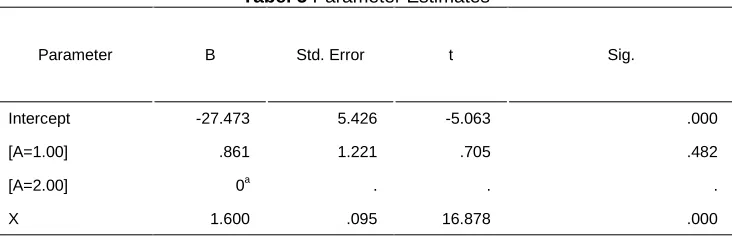
Tabel 5 Parameter Estimates
Parameter B Std. Error t Sig.
Intercept -27.473 5.426 -5.063 .000
[A=1.00] .861 1.221 .705 .482
[A=2.00] 0a . . .
X 1.600 .095 16.878 .000
Based on Table 5, the t test with t arithmetic = 0.705 and p-value = 0.00 <0.05 means Ho is rejected. Means the average mathematical problem solving ability of students
taught with PPBY learning devices is higher than students who are taught with conventional learning devices after controlling students' initial abilities.
Tabel 5 Parameter Estimates
Parameter B Std. Error t Sig.
Intercept -28.506 5.376 -5.302 .000
[B=1.00] -.218 1.204 -.181 .857
[B=2.00] 0a . . .
X 1.627 .093 17.418 .000
Based on Table 5, the t test with t arithmetic = -0.181 and p-value = 0.857 / 2 = 0.4285> 0.05 means Ho is rejected. Mean mean math problem solving ability of
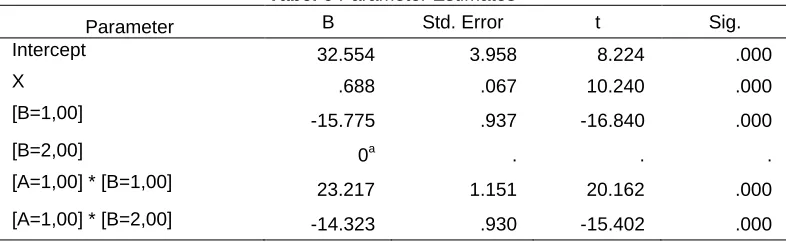
Tabel 6 Parameter Estimates
Parameter B Std. Error t Sig. Intercept 32.554 3.958 8.224 .000 X .688 .067 10.240 .000 [B=1,00] -15.775 .937 -16.840 .000 [B=2,00] 0a
. . . [A=1,00] * [B=1,00] 23.217 1.151 20.162 .000 [A=1,00] * [B=2,00] -14.323 .930 -15.402 .000 Based on the t test of Table 6, A1B1 shows t arithmetic =
20,162 and p-value = 0,000 <0.05, this means that Ho is rejected. Therefore, it means that there is an interaction effect between the factors of PPBY learning devices and the orientation of ethnomathematics mathematics material to the ability to solve mathematical problems after controlling the students' initial abilities. Based on the t test table A1B2 shows the results with t count = -14,323 and p-value = 0,000 <0.05, this means that Ho is rejected. Therefore, it means that there is an influence of interaction between the factors of PPBY learning tools and Non-ethnomathematics mathematics material on the ability to solve mathematical problems after controlling students' initial abilities. Thus, there are differences in problem solving abilities between students being taught with youtube-based learning using conventional learning and after controlling students' initial abilities. There are differences in problem solving abilities between students who study ethnomathematics-oriented and non-ethnomathematics after controlling students' initial abilities. There is an influence of the interaction of learning models and orientation of mathematical material on the ability to solve problems after controlling the initial abilities of students. There is a linear effect of the student's initial covariate ability on problem solving abilities. The initial ability of students, learning models and orientation of mathematics material together affect the ability of problem solving. The problem solving ability of students who are taught with youtube-based learning uses higher than students who are taught conventionally after controlling the students' initial abilities. The problem solving ability of students who study ethnomathematics is higher than students who study not ethnomathematics oriented after controlling students' initial abilities. There is an interaction effect between the learning model factors and the orientation of mathematical material to the ability to solve problems after controlling the initial abilities of students. The results of this study support research upstream, such as students' solved mathematical problems through mathematization process based on ethnomathematics. Students were aware that Rejang Lebong's ethnomathematics was the starting point of horizontal mathematical activity. Just like the traditional house, the culture was a real problem to achieve geometric concepts, such as 2-dimensional and 3-dimensional geometric figures. In particular, students can discover about the surface area and volume of pyramids, prisms, rectangular prism, and cubes. The students' metacognition was used to validate the correctness of the formulas (D. Herawaty,
Widada, Novita, Waroka, & Lubis, 2018). The mathematical problem solving abilities of students after being given ethnomathematics with outdoor learning models were higher than before being given the learning models (Widada, Herawaty, Falaq, et al., 2019). It means that students' mathematical problem solving ability after being given ethnomathematics with an outdoor learning model is higher than before being given a learning model. Thus, learning mathematics by utilizing youtube media with ethnomathematics content can improve problem solving skills. Therefore, we should recommend that mathematics education developers can develop more of this media in wider learning.
4. CONCLUSIONS
The results of this study concluded that the problem-solving ability of students who studied ethnomathematics was higher than students who studied not ethnomathematics-oriented after controlling students' initial abilities. Also, there is an effect of interaction between the learning model factors and the orientation of mathematical material to the problem solving ability after controlling the students' initial abilities.
REFERENCES
[1] d’Ambrosio, U. (1985). Ethnomathematics and its place in the history of mathematics. For the Learning of Mathematics, 5(1), 44–48. https://doi.org/10.2307/40247876
[2] Fauzan, A., Slettenhaar, D., & Plomp, T. (2002). Traditional Mathematics Education vs . Realistic Mathematics Education : Hoping for Changes. Proceedings of the 3rd International Mathematics Education and Society Conference. Copenhagen: Centre for Research in Learning Mathematics, 1– 4.
[3] Gravemeijer, K. (2008). RME Theory and Mathematics Teacher Education. International Handbook of Mathematics Teacher Education 1 283, 283–302.
[4] Herawaty, D., Widada, W., Novita, T., Waroka, L., & Lubis, A. N. M. T. (2018). Students’ metacognition on mathematical problem solving through ethnomathematics in Rejang Lebong, Indonesia. Journal of Physics: Conference Series, 1088. https://doi.org/10.1088/1742-6596/1088/1/012089
1237
Mathematics through Ethnomathematics. Seminar on Advances in Mathematics, Science, and Engineering for Elementary Schools Mercure Hotel Yogyakarta, 16 August 2018 Website: Http://Samses2018.Upiconf.Org, (August). [6] Herawaty, Dewi, Widada, W., Umam, K.,
Nugroho, Z., Falaq, A., & Anggoro, D. (2019). The Improvement of the Understanding of Mathematical Concepts through the Implementation of Realistic Mathematics Learning and Ethnomathematics. Advances in Social Science, Education and Humanities Research, Volume 295, 295(ICETeP 2018), 21– 25.
[7] Horstman, A. (2015). YouTube in the Classroom? Cases on Educational Technology Integration in Urban Schools, (April), 58–60. https://doi.org/10.4018/978-1-61350-492-5.ch015 [8] Kumar, A., & Kumaresan, S. (2008). Use of
Mathematical Software for Teaching and Learning Mathematics. The International Congress on Mathematical Education (ICME) 11, 373–388.
[9] Laurens, T., Batlolona, F. A., Batlolona, J. R., & Leasa, M. (2018). How does realistic mathematics education (RME) improve students’ mathematics cognitive achievement? Eurasia Journal of Mathematics, Science and Technology Education, 14(2), 569–578. https://doi.org/10.12973/ejmste/76959
[10] Mayoral, P., Tello, A., & Gonzalez, J. (2010). YouTube Based Learning. FIG Congress 2010, (April), 11–16.
[11] Shirley, L. (2001). Ethnomathematics as a fundamental of instructional methodology. Zdm, 33(3), 85–87. https://doi.org/10.1007/BF02655699
[12] Taufiqurrochman, H. R. (2017). Pembuatan Live Streaming Youtube untuk Pembelajaran. Workshop Pembelajaran Berbasis Multimedia Senin, 30 Januari 2017 Di MTs Negeri Pagu Kediri Kerjasama.
[13] Ubiratan D’ambrosio. (1985). FLM Publishing Association Ethnomathematics and Its Place in the History and Pedagogy of Mathematics. Source: For the Learning of Mathematics, 5(1), 44–48.
[14] Van den Heuvel-Panhuizen, M., & Drijvers, P.
(2018). Realistic Mathematics Education. Encyclopedia of Mathematics Education, 521– 525. https://doi.org/10.1007/978-94-007-4978-8_170
[15] Widada, W., & Herawaty, D. (2018). The Effects of the Extended Triad Model and Cognitive Style on the Abilities of Mathematical Representation and Proving of Theorem. Advances in Social Science, Education and Humanities Research, 218(ICoMSE 2017), 89–95. https://doi.org/10.2991/icomse-17.2018.16 [16] Widada, W., Herawaty, D., Falaq, A., Anggoro,
D., Yudha, A., & Hayati, M. K. (2019). Ethnomathematics and Outdoor Learning to Improve Problem Solving Ability. Advances in Social Science, Education and Humanities Research, Volume 295, 295(ICETeP 2018), 13– 16.
[17] Widada, W., Herawaty, D., & Lubis, A. N. M. T. (2018). Realistic mathematics learning based on the ethnomathematics in Bengkulu to improve students ’ cognitive level Realistic mathematics learning based on the ethnomathematics in Bengkulu to improve students ’ cognitive level. Journal of Physics: Conference Series, 1088(1), 1–8.
[18] Widada, W., Herawaty, D., Umam, K., & Nugroho, Z. (2019). The ability to Understanding of the Concept of Derivative Functions for Inter-Level Students During Ethnomathematics Learning. Journal of Physics: Conference Series PAPER, 1179(012056), 1–6. https://doi.org/10.1088/1742-6596/1179/1/012056 [19] Widada, W., Sunardi, H., Herawaty, D., Pd, B. E., & Syefriani, D. (2018). Abstract Level Characteristics in SOLO Taxonomy during Ethnomathematics Learning. International Journal of Science and Research (IJSR), 7(8), 352–355. https://doi.org/10.21275/ART2019438