Article
Electrode Cooling Effect on Out-of-Phase
Electrothermal Streaming in Rotating Electric Fields
Weiyu Liu 1, Yukun Ren *,2,3, Ye Tao *,2, Xiaoming Chen 2 and Qisheng Wu 1
1 School of Electronics and Control Engineering, Chang’an University, Middle-Section of Nan’er Huan Road, Xi’an 710064, Shaanxi, China; [email protected] (W.L.); [email protected] (Q.W.)
2 School of Mechatronics Engineering, Harbin Institute of Technology, West Da-zhi Street 92, Harbin, Heilongjiang, China 150001; [email protected]
3 State Key Laboratory of Robotics and System, Harbin Institute of Technology, West Da-zhi Street 92, Harbin, Heilongjiang, China 150001
* Correspondence:
Yukun Ren, Email: [email protected], Fax: 0451-86402658, Phone: 0451-86418028
Ye Tao, Email: [email protected]
Abstract: In this work, we focus on investigating electrothermal flow in a rotating electric field (ROT-ETF), with primary attention paid to the horizontal traveling-wave electrothermal (TWET) vortex induced at the center of the electric field. The frequency-dependent flow profiles in the microdevice are analyzed using different heat transfer models. Accordingly, we address in particular the importance of electrode cooling in ROT-ETF as metal electrodes of high thermal conductivity while substrate material of low heat dissipation capability are employed to develop such microfluidic chips. Under this circumstance, cooling of electrode array due to external natural convection on millimeter-scale electrode pads for external wire connection occurs and makes the internal temperature maxima shift from the electrode plane to a bit of distance right above the cross-shaped interelectrode gaps, giving rise to reversal of flow rotation from a typical repulsion-type to attraction-type induction vortex, which is in good accordance with our experimental observations of co-field TWET streaming at frequencies on the order of reciprocal charge relaxation time of the bulk fluid. These results point out a way to make a correct interpretation of out-of-phase electrothermal streaming behavior, which holds great potential for handing high-conductivity analytes in modern microfluidic systems.
Keywords: electrothermal flow; rotating electric field; out-of-phase smeared structural polarization; electrode cooling; external natural convection; co-field flow rotation
1 Introduction
The rapid advance of lab-on-chip technology requires to exploit new approaches capable of achieving precise fluid actuation and manipulation at the micrometer scale [1-4]. Incorporation of microelectrode structure into confined microfluidic channels stands for an opportunity to exert ponder-motive electrokinetic force either on the suspension medium itself or colloidal particles monodispersed within [5-8]. Research of electrohydrodynamics (EHD) has captured more attention from the microfluidic community than ever before [9-15].
In continuous-phase microfluidics, there exists mainly two categories of EHD flow: electroosmosis (EO) [16,17] and electrothermal (ET) [18,19]. As for EO, both linear and nonlinear electroosmosis are originated by diffuse charge dynamics adjacent to an electrical double layer (EDL) of nano-meter thickness at a solid/electrolyte interface [20,21]. The specific difference between the two electroosmotic techniques comes from the origin of surface charge density on the sharp material interface: DC electroosmosis is due to native surface free charge chemically adsorbed on insulating channel sidewalls [22]. However, induced-charge electrokinetics is related to the polarized bound
charge at the outer surface of Stern layer induced around polarizable dielectric materials in a background electric field [23,24]. The action of a tangential field component on the free charge within the diffuse screening cloud gives rise to electroosmotic slip flow that is full-developed right outside the Debye layer, and nonlinear electroosmosis can even survive in a low-frequency AC electric field due to the field-induced nature of its EDL charge [25]. For electroosmotic devices of both subtypes, however, since the active driven forces merely exist within EDL of nanometer distances from the charged boundary and not throughout the entire volume of micrometer-thick fluid layer, undesired backflow is very likely to take place at slightly larger distances from the charged channel sidewalls [26].
Unlike EO that moves directly on charged surfaces, induction EHD stems from smeared structural polarizations of inhomogeneous liquid medium [27]. Specifically, gradients of solution electric properties are usually induced by non-uniform heating of fluid medium due to either internal Joule heating [28,29] or external heat source from artificial thermal elements [30-33]. Interaction of such heating-induced dielectric gradients with an applied electric field effectively produces a kind of dielectrophoretic (DEP) force exerting directly on the fluid bulk. In light of this, induction EHD is commonly referred to as AC electrothermal flow (ACET) [34]. There are manly two practical prototypes for actively driving ACET fluid motion, including standing-wave electrothermal (SWET) and traveling-wave electrothermal (TWET) [35]. SWET fluid motion is due to in-phase bulk polarization in a stand-wave electric field without change in phases, which can be produced over microelectrode arrays with neighboring electrodes oppositely polarized, and SWET often behaves as multiple vortex flow pairs on electrode surfaces [36,37]. On another hand, TWET streaming is due to out-of-phase bulk polarization in a traveling-wave (TW) electric field with spatial phase variations, which can be generated over interdigitated multi-phase metal-strip electrode array with continuous phase transition along the consecutive distributed microelectrodes, and TWET usually behaves as horizontal streaming flow parallel to the signal-phase propagation [38]. Since there is as least one electrode intrusion between oppositely polarized electrodes in a typical four-phase induction device, SWET and TWET cannot coexist in those traditional configurations with linearized electrode arrays, which intrinsically restrains the rich diversity of ACET flow obtainable in microfluidic systems.
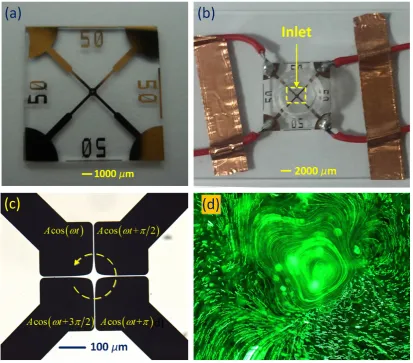
To handle this issue, we developed a device geometry with four-phase polynomial electrode array configured in a circulating style in this work (Fig.1). TW field over such a circulating array is not traveling in a linear route but rotates along a circular trajectory in synchronous with the field frequency, so we call this form of wave propagation as a rotating electric field because of its circularly polarized feature [39,40]. Different from the conventional linear TW array, electrodes of opposite phases are positioned right against one another with quite small space intervals in this circulating electrode design, so both SWET and TWET appear and actively compete against one another within a broad frequency range, which brings additional richness to existing ACET techniques [41]. Consequently, it would be of particular interest and great benefit to study the behavior of electrothermal flow in a rotating electric field (ROT-ETF) where both in-phase and out-of-phase polarizations occur and vary as a function of applied field frequency.
non-cooling models.
2 Materials and methods
2.1 Basic design of the circulating electrode structure
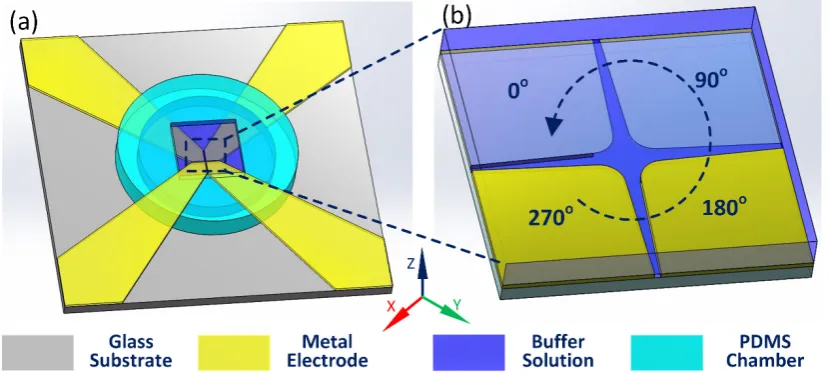
Complicated multilayer fabrication procedure has to be implemented for manufacturing a metal-strip TW electrode array [43]. To evade complex interconnections, we make use of a coplanar polynomial-shaped electrode design to produce a traveling potential wave circulating above the channel bottom surface (Fig.1). By applying 90°-phase-shifted sinusoidal voltage signals to the typical four-electrode configuration with increasing phase in the clockwise direction, a TW electric field is produced above the gaps and propagates anticlockwise in the direction of decreasing field phase. The transient potential imposed on the sequential electrodes is V1=Acos( )ωt , V2Acos(ωt+90°), V3=
( )
co s 1 8 0
A ωt+ ° and V4=Acos(ωt+2 70°), respectively. Here, A is the voltage amplitude, ω the angular field frequency of the applied voltage wave (Table.1). On this basis, electric field vector at the center of circulating electrode array is approximately of the following form:
(
)
(
)
( )
( )
0 0 0 Re cos sin j t x y x yE j e
E t E t
ω
ω ω
= −
= +
E e e
e e (1) Such an electric field of constant magnitudeE0≈2A/d revolves with a circular trajectory in the
direction of the signal-phase propagation, and is referred to as a ‘rotating electric field’. Here, d=50μm denotes the nearest distance between opposing electrodes of 180° difference in voltage phase. 2.2 Chip fabrication
We fabricate the 4-quadrant electrode array for studying ROT-ETF by standard microelectronic technique. After finishing the design of photo mask, EPG533 photoresist layer is spin-coated on a glass slide, which then experiences UV light exposure, development and post-baking in sequence. Subsequently, a 10nm-thick Cr layer and 100nm-thick Au layer are magnetically sputtered onto the photoresist pattern one by one. A lift-off process is carried out to obtain the final pattern of metal electrode layer on the glass substrate. At the same time, a PDMS microchamber is fabricated using standard soft lithography technique, and assembled onto the glass base with polynomial electrode patterns by plasma bonding, eventually giving rise to the microfluidic chip employed in current work, as shown in Fig.1.
2.3 Sample preparation and experimental setup
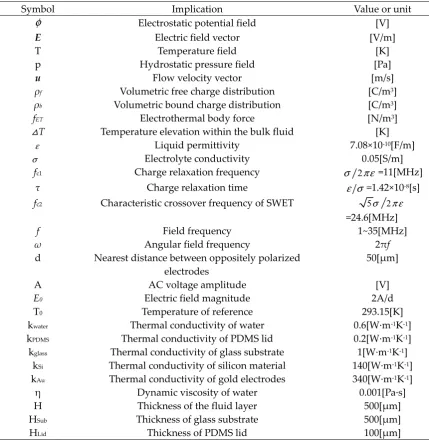
In the experiment, we employ KCl electrolyte solution as the working fluid, as made by adding KCL electrolyte into DI water medium. A conductivity meter is applied to monitor the solution ionic strength until the electric conductivity increases up to σ =0.05S/m. The electrolyte bulk has a characteristic charge relaxation frequencyfc1=σ πε2 =11MHz, beyond which displacement current
begins to dominate over Ohmic conduction. 500nm-diameter fluorescent latex spheres are suspended in the electrolyte solution at a moderate number concentration to keep track of the electrothermal fluid motion. A commercial multi-phase function generator (TGA12104, TTi, UK) was employed to produce sinusoidal voltage waves in a broad frequency range from 1MHz to 35MHz. Four-phase AC voltage signals are applied to the four circulating electrodes so that there is a 90° phase shift between the AC signals imposed on every adjacent phase. Waveform of these phase-shifted voltages is monitored by a multi-channel digital oscilloscope (TDS2024, Tektronix, USA).
knob need another regulation to make the observation plane levitated a vertical distance of 70μm (on the order of electrode separation) above the electrode array on the basis of previous adjustment.
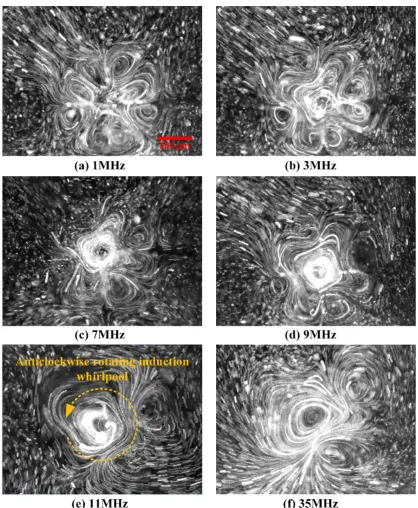
We take consecutive snapshots with a high-speed CCD camera (RETIGA2000R, Qimaging, Canada) and then superimpose the image frames in a software called Image J. The experimental images with particle streamlines due to superimposition operation are shown in Fig.1(d) and Fig.2. Horizontal rotating speed of latex beads due to the action of out-of-phase TWET streaming is calculated manually by dividing the physical distance moved for a particle by the time elapsed under the assistance of Image J software, with the measurement results shown in Fig.6(a)(b).
2.4 Flow components of electrothermal streaming in a rotating electric field
In a circularly-polarized rotating electric field, sufficiently large electrolyte conductivity can induce a vertical bulk temperature gradient through Joule medium heating. This results in inhomogeneous electric properties of liquid medium across the thin fluid layer. Such dielectric gradients interact with the applied rotating field, inducing a volumetric free charge distribution that lags behind the propagation of applied voltage wave. These charged ions experience a Coulomb force in the same electric field which forces them into electrophoretic motion, and drag the surrounding fluid along through viscous effect. The bulk polarization process described above effectively leads to electrothermal vortex flow on the phase-shifted polynomial microelectrode array. According to the basic theory of Maxwell-Wagner structural polarization, ROT-ETF includes two sets of EHD flow components [41]:
(1) TWET component due to out-of-phase induced polarization
Out-of-phase component of the induced polarization generates one horizontal induction vortex rotating along the z axis above the circulating electrode array. The TWET whirlpool is maximized if the period of AC voltage waves is commensurate with the characteristic relaxation time of the dielectric dispersion process [44-46]. That is, the horizontal flow rotation induced by the vertical electrorotational torque is most evident at Debye frequency of the fluid mediumfc1 2
σ πε
= for onset of bulk ionic screening.
(2) SWET component due to in-phase induced polarization
Since electrodes with 180° phase difference are placed opposite to one another in the four-phase polynomial electrode configuration, potent SWET flow component behaving as multiple vortex pairs in perpendicular orientation to the electrode plane can be produced by the in-phase component of applied voltage wave. The vertical SWET streaming possesses a low-frequency conductivity plateau where motion of free charge dominates, as well as a high-frequency permittivity plateau where dielectric polarization plays an important role. Since the Coulomb force and dielectric force counterbalance one other, SWET vortex pairs across the thickness of fluid layer vanish at a characteristic crossover frequency 2
5
2 2
c
f σ β σ
πε α− πε
= = [41]. Because flow field of SWET in DC limit is much stronger than that at high field frequencies, the horizontal TWET rotating whirlpool appears to dominate over the vertical SWET vortex pairs at f >fc2= 5
2
σ
πε . In addition, within low-frequency
ranges f<fc1, fluid motion of TWET whirlpool diminishes, while that of vertical SWET streaming enhances, which would exert a negative impact on the rotating flow pattern of out-of-phase induction vortex. Specifically, the horizontal TWET whirlpool shrinks in size, and exhibits more helical flow streamlines cascading downward at lower field frequencies.
3 Results and discussion
3.1 Experimental observation of ROT-ETF fluid motion
voltage-dependent flow velocity of the horizontal TWET induction vortex is measured and quantified for field frequency fixed at the reciprocal Debye time of medium bulk, f= 1
2
c
f σ
πε
= =11MHz (Fig.6(b)). As shown in Fig.2, at field frequency exceeding 11MHz, the horizontal induction vortex rotating along the z axis is large in size and has quite circular streamlines at the center of rotating field (Fig.2(f)). On the contrary, at field frequency lower than the inverse charge relaxation time of fluid bulk, size of the central whirlpool decreases (Fig.2(a)-(d)), in part, due to a strengthened action of vertical SWET streaming. The TWET whirlpool rotates anticlockwise all the time, in the direction of field propagation (Fig.2(e)), and can be regarded as a typical attraction-type induction vortex. On this basis, the electrode plane should have a lower temperature than the medium bulk. Due to the high thermal conductivity of Si material, a silicon substrate will make the Joule heating-induced hot spot levitate some distance above the electrode surface, which naturally leads to the formation of an attraction-type device (Fig.3(a) in [34]). In current experiment, glass material of low thermal conductivity kglass=1[W·m-1·K-1] is used to construct the insulating base for supporting the circulating electrode array. The low heat dissipation capability of glass material effectively makes the hot spots due to electric heating generation located right on the electrode surface, namely, the maximum temperature rise takes place right in the electrode plane, thereby actuating a repulsion-type induction vortex (Fig.3(b) in [34]). In this sense, preliminary theoretical analysis goes against the counterclockwise rotating whirlpool captured in our experiment with a CCD camera.
3.2 Computational model
Perch-Nielsen et al. have predicted that flow direction of induction pump using a glass substrate is against the signal-phase propagation [42]. The low thermal conductivity of glass material cannot effectively remove the internal electric heat generation to the ambient environment, so that the hot spots of the whole microfluidic system are positioned within the interelectrode gaps right on the channel bottom surface. According to the canonical classification of induction EHD, repulsion-type out-of-phase streaming occurs when electrolyte solution at the electrode surface has higher electric conductivities than other regions within the medium bulk, which is in qualitative agreement with the previous simulation results on TWET pumping from Perch-Nielsen et al [42].
In this work, however, experimental observation indicates that the TWET whirlpool rotating around the central z axis is in the direction of signal-phase propagation. That is, both the rotating electric field and horizontal electrothermal vortex rotate along the counterclockwise direction, which is equivalent to an attraction-type induction pump. For this reason, top surface of the glass substrate has a lower temperature compared to the fluid bulk on top of the electrode array in this microfluidic device. It has been forecasted that induction pumping is in phase with the sinusoidal voltage wave under the condition with a silicon base, since the high thermal conductivity of silicon material ksi=140[W·m-1·k-1] is able to remove the internal Joule heating to exterior of the device with high efficiency. Under such circumstance, the maximum temperature rise takes place in the medium bulk at some vertical distance above the electrode array rather than right on the channel bottom surface. Accordingly, electrolyte solution on the electrode surface has a lower conductivity than that at the hot spots on top of the electrode array, resulting in an attraction-type induction fluidic device.
Although glass substrate is employed in this study, we observed attraction-type out-of-phase electrothermal streaming, which is identical to the situation using a silicon base. In the simulation analysis of Perch-Nielsen et al, Fourier heat conduction on the electrode array was ignored, taking into account a negligibly small thickness (100~200nm) of the thin electrode layer usually involved in lab-on-chip [42]. In typical microsystems, highly conductive materials, such as gold, platinum and so on, are routinely used for depositing microelectrode patterns on insulating substrates, those noble metals are only conducting for electric current but possess high thermal conductivities as well, e.g. that of gold attains as high as kAU=340[W·m-1·k-1].
and ambient environment has a propensity to occur due to external natural convection. Since gold electrodes are good thermal conductors, they can transfer cooling energy from ambient environment to the device internal, which would make the electrode bars not only an isothermal body but also fixed at the referential temperature of atmospheric condition for a sufficiently large heat transfer coefficient. Due to the cooling effect brought by external natural convection, the electrode surface becomes the plane of low temperature, and region of higher temperature elevation is raised up with a bit of vertical distance from the channel bottom surface, resulting in an attraction-type induction device where the rotation of TWET whirlpool is in the direction of signal-phase propagation. In light of preceding analysis, two different heat transfer models are developed herein to reconstruct the heat transfer process across the gold microelectrode arrays:
(1) None-cooling condition
Since thickness of the electrode layer is extremely thin (~100nm) compared to other geometric dimensions in the experimental chip, the electrodes are treated as a transparent medium for heat transfer. That is, both temperature and normal heat flux are continuous across the electrolyte/substrate interface, as if the circulating electrode array does not exist at all.
(2) Cooling condition
Because gold microelectrodes of excellent heat dissipation capability are connected to external wires by large-scale metal pads, electrode cooling due to external natural convection ought to be taken into consideration and modeled by setting the electrode surface at the ambient temperature Telectrode=T0=293.15K.
A commercial FEM software, Comsol Multiphysics 5.2, is used to solve the mathematical boundary-value problem for theoretically obtaining the electrothermal flow field, and detailed governing equations and boundary conditions have been presented in our previous work [34]. For the circulating electrode array, shape of the polynomial electrode edge is represented by the following hyperbolic equation: 2sec 2 tan x d y d θ θ = =
−π 2< <θ π 2 (2) Rotating the hyperbolic curve by 45°around the z axis, we obtain the electrode pattern in the first quadrant. Subsequently, by conducting several steps of mirror imaging operations, the electrode pattern within the entire x-y plane is digitally established, as shown in Fig.3(b). The non-isothermal harmonic electric field, heat transfer and electrothermal flow field are solved in a fully-coupled manner using the enhanced ACET model derived in [34,47]. In the numerical simulation, we only need to calculate the electric field and fluid motion in the electrolyte solution, while the energy balance equation for temperature field has to be solved within the entire fluidic device, including the fluid bulk, glass substrate and patterned gold electrodes (Fig.3(a)):
(a) Glass substrate of 500μm in thickness
This domain has a thermal conductivity kglass=1[W·m-1·k-1]. (b) 500μm-thick liquid layer
The electrolyte solution has an electric conductivity 0.05[S/m], dielectric permittivity
ε
=7.08×10 -10[F/m] and thermal conductivity kwater=0.6[W·m-1·k-1], where several large-voltage effects including nonlinear Joule heating source, temperature-dependent dynamic viscosity and improved electrothermal body force are taken into account [34,47].(c) Four-quadrant polynomial electrodes
3.3 Electrode cooling effect on rotating direction of induction whirlpool
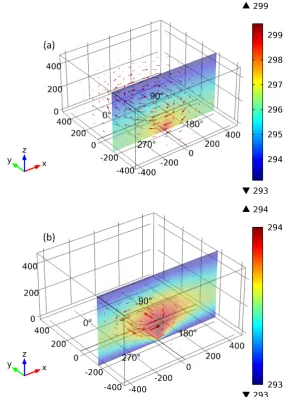
Fig.4 illustrates the temperature field as well as the ACET flow field, by using the two distinct thermal conjunction conditions at the electrode surface. Gonzales et al. [41] have derived self-similar analytical solutions of rotating electrothermal flow field in an ideally vertical temperature gradient caused by external illumination. The temperature field due to internal Joule heating is of a radial pattern (Fig.4), however, so it is reasonable to analyze Joule-heating-induced ROT-ETF by direct numerical simulation.
As shown in Fig.4(a), by ignoring heat conduction of the electrode array, the temperature maxima is located right at the cross-shaped interelectrode gaps on the channel bottom surface, resulting in clockwise rotating TWET vortex opposite to signal-phase propagation, i.e. an equivalent repulsion-type induction device. As shown in Fig.4(b), after incorporating the cooling heat flux of gold microelectrodes by external natural convection, the internal hot spots due to Joule heating are levitated a bit of vertical distance away from the electrode plane, resulting in anticlockwise-rotating TWET vortex, which is in the direction of rotating electric field and can be well compared to an attraction-type induction device. As a result, the co-field rotating induction whirlpool from calculation is in qualitative agreement with the anticlockwise electrothermal streaming captured by experimental observations. Accordingly, though the thickness of gold microelectrode array (~100nm) is much smaller than other geometry dimensions (10μm~500μm), its cooling effect on the entire microfluidic device cannot be safely dropped, which usually gets overlooked by most of previous researchers.
3.4 Comparison between theory and experiment
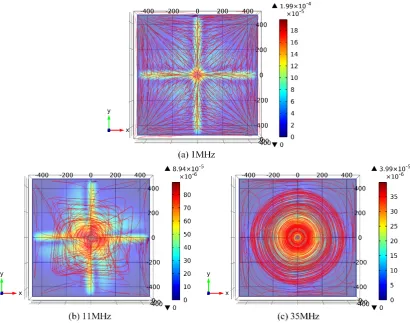
In the presence of electrode cooling, electrothermal flow profiles at different field frequencies are calculated by conducting numerical simulation, as shown in Fig.5. There are eight vortex flow in perpendicular orientation to the electrode plane at f=1MHz (Fig.5(a)), with flow patterns in good accordance with experimental observation in Fig.2(a). Since f=1MHz is much lower than the medium charge relaxation frequency fc1=11MHz, the multiple small in-phase SWET micro-vortices rotating orthogonal to the electrode surface are induced by the oppositely polarized electrodes with 180° phase difference and dominate over the horizontal out-of-phase TWET vortex. In Fig.5(b), one large induction whirlpool is generated at the relaxation frequency, and it is not possible to find the vertical SWET flow components any longer. The out-of-phase induction vortex cascades downward with a helix flow profile, which coincides well with our experimental measurement in Fig.2(e). According to simulation result in Fig.5(c), the electrothermal flow field is completely stipulated by the horizontal out-of-phase TWET whirlpool at f=35MHz, with quite circular rotating streamlines. Since the field frequency 35MHz surpasses the characteristic crossover frequency fc2= 5σ 2πε =24.6MHz for
SWET, the SWET flow component in perpendicular orientation to the electrode plane decays considerably compared to the low-frequency limit, that is, the horizontal co-field TWET whirlpool governs the electrothermal flow field within the entire fluidic chamber at such high field frequencies. Consequently, the rotating electrothermal streamlines seem no longer to spiral downward, which can be validated by the experimental observation in Fig.2(f) as well.
The maximum horizontal flow velocity from theory is 85μm/s without electrode cooling, and it is lowered down to 75μm/s in the presence of conspicuous external natural convection. Both of them, however, are larger than the characteristic flow velocity 60μm/s captured in our experiments. The reason behind may include two aspects: on one hand, because of the high electrolyte conductivity involved, strong electrochemical reactions can occur at the electrode/electrolyte interface even beyond the reciprocal RC time constant for induced double-layer charging, which may suppress the healthy development of electrothermal induced flow. On another hand, the actual situation of internal heat transfer is definitely more complicated than current considerations. Anyway, the improved heat transfer model, which incorporates the electrode cooling effect, can well account for the co-field rotating electrothermal vortex in phase with the signal-phase propagation, and flow velocity predicted from the cooling model is closer to experimental measurement than that given by the non-cooling model. For this reason, in the context of applying an appropriate heat transfer model, the improved ACET theory is able to capture the basic feature of ROT-ETF.
As indicated by Fig.6(b), the voltage-dependence of TWET rotation velocity is clearly a nonlinear function. The fluid motion enhances dramatically for large applied voltages and even exhibits a fourth-power growth trend. In fact, under the condition of electric heat generation acting as the main heat source (implyingΔ ∝T E2), we can see that the induced volumetric charges including both free and bound are proportional to the third-power of field intensity (ρ ∝ Δ ⋅ ∝T E E3), and thereby the
flow velocity scale increases with fourth-power of the applied voltages 4
ET
u∝ f ∝ ρE∝ E . In this sense, ACET is a nonlinear electrokinetic phenomenon, and survives well in the high-frequency circularly-polarized electric field used in current work. Different from the quartic dependence growth trend for internal heating, the flow velocity would have a quadratic voltage-dependence under the condition that external heat source (artificial heat element or illumination) dominates [41]. In Fig.6(c), the maximum temperature elevation without electrode cooling is much higher than that with appreciable external natural convection, which fits well with the actual situation. For this reason, quicker out-of-phase rotating whirlpool is induced in the non-cooling condition compared to that with electrode cooling effect (Fig.6(b)), due to a higher temperature elevation in the bulk fluid (Fig.6(c)).
4 Conclusions
Abbreviations:
EDL, electrical double layer; EHD, electrohydrodynamics; EO, electroosmotic; ET, electrothermal; ROT-ETF, electrothermal flow in a rotating electric field; SWET, standing-wave electrothermal; TW, traveling wave; TWET, traveling-wave electrothermal
Acknowledgement: We sincerely acknowledge the financial support from the National Natural Science Foundation of China (No. 11672095, No. 11702035, No. 11702075), the Chang'an University Fundamental Research Funds for the Central Universities (No. 310832171008, No. 310832163402, No. 310832173701), Self-Planned Task (No. 201510B and SKLRS201606C) of State Key Laboratory of Robotics and System (HIT), and the Foundation for Innovative Research Groups of the National Natural Science Foundation of China (No.51521003).
References:
1. Hu, G.; Li, D. Multiscale phenomena in microfluidics and nanofluidics. Chemical Engineering Science 2007, 62, 3443-3454.
2. Pethig, R. Review article—dielectrophoresis: Status of the theory, technology, and applications. Biomicrofluidics 2010, 4, 022811.
3. Dittrich, P.S.; Tachikawa, K.; Manz, A. Micro total analysis systems. Latest advancements and trends. Analytical chemistry 2006, 78, 3887-3908.
4. Laser, D.; Santiago, J. A review of micropumps. Journal of micromechanics and microengineering 2004, 14, R35. 5. Jones, T.B.; Jones, T.B. Electromechanics of particles. Cambridge University Press: 2005.
6. Morgan, H.; Green, N.G. Ac electrokinetics: Colloids and nanoparticles. Research Studies Press: 2003.
7. Squires, T.M.; Quake, S.R. Microfluidics: Fluid physics at the nanoliter scale. Reviews of modern physics 2005, 77, 977.
8. Zhao, C.; Yang, C. Advances in electrokinetics and their applications in micro/nano fluidics. Microfluidics & Nanofluidics 2012, 13, 179-203.
9. Jia, Y.; Ren, Y.; Liu, W.; Hou, L.; Tao, Y.; Hu, Q.; Jiang, H. Electrocoalescence of paired droplets encapsulated in double-emulsion drops. Lab on a Chip 2016.
10. Ren, Y.; Liu, J.; Liu, W.; Lang, Q.; Tao, Y.; Hu, Q.; Hou, L.; Jiang, H. Scaled particle focusing in a microfluidic device with asymmetric electrodes utilizing induced-charge electroosmosis. Lab on a Chip 2016, 16, 2803-2812.
11. Ren, Y.; Liu, W.; Liu, J.; Tao, Y.; Guo, Y.; Jiang, H. Particle rotational trapping on a floating electrode by rotating induced-charge electroosmosis. Biomicrofluidics 2016, 10, 054103.
12. Tao, Y.; Ren, Y.; Liu, W.; Wu, Y.; Jia, Y.; Lang, Q.; Jiang, H. Enhanced particle trapping performance of induced charge electroosmosis. Electrophoresis 2016.
13. Ristenpart, W.; Aksay, I.; Saville, D. Electrohydrodynamic flow around a colloidal particle near an electrode with an oscillating potential. Journal of Fluid Mechanics 2007, 575, 83-109.
14. García-Sánchez, P.; Ramos, A.; González, A.; Green, N.G.; Morgan, H. Flow reversal in traveling-wave electrokinetics: An analysis of forces due to ionic concentration gradients. Langmuir 2009, 25, 4988-4997. 15. García-Sánchez, P.; Ramos, A.; Green, N.; Morgan, H. Traveling-wave electrokinetic micropumps: Velocity,
electrical current, and impedance measurements. Langmuir 2008, 24, 9361-9369.
16. Pretorius, V.; Hopkins, B.J.; Schieke, J. Electro-osmosis: A new concept for high-speed liquid chromatography. Journal of Chromatography A 1974, 99, 23-30.
17. Green, N.G.; Ramos, A.; González, A.; Morgan, H.; Castellanos, A. Fluid flow induced by nonuniform ac electric fields in electrolytes on microelectrodes. I. Experimental measurements. Physical review E 2000, 61, 4011.
18. Green, N.G.; Ramos, A.; Gonzalez, A.; Castellanos, A.; Morgan, H. Electrothermally induced fluid flow on microelectrodes. Journal of Electrostatics 2001, 53, 71-87.
19. Stubbe, M.; Gimsa, J. A short review on ac electro-thermal micropumps based on smeared structural polarizations in the presence of a temperature gradient. Colloids and Surfaces A: Physicochemical and Engineering Aspects 2011, 376, 97-101.
20. Bazant, M.Z.; Kilic, M.S.; Storey, B.D.; Ajdari, A. Towards an understanding of induced-charge electrokinetics at large applied voltages in concentrated solutions. Advances in colloid and interface science
21. Zhao, C.L.; Yang, C. Ac field induced-charge electroosmosis over leaky dielectric blocks embedded in a microchannel. Electrophoresis 2011, 32, 629-637.
22. Xuan, X.; Xu, B.; Sinton, D.; Li, D. Electroosmotic flow with joule heating effects. Lab on a Chip 2004, 4, 230-236.
23. Bazant, M.Z.; Squires, T.M. Induced-charge electrokinetic phenomena. Current Opinion in Colloid & Interface Science 2010, 15, 203-213.
24. Bazant, M.Z.; Squires, T.M. Induced-charge electrokinetic phenomena: Theory and microfluidic applications. Physical Review Letters 2004, 92, 066101.
25. Squires, T.M.; Bazant, M.Z. Induced-charge electro-osmosis. Journal of Fluid Mechanics 2004, 509, 217-252. 26. Gimsa, J.; Stubbe, M.; Gimsa, U. A short tutorial contribution to impedance and ac-electrokinetic
characterization and manipulation of cells and media: Are electric methods more versatile than acoustic and laser methods? Journal of Electrical Bioimpedance 2014, 5, 74-91.
27. Stubbe, M.; Holtappels, M.; Gimsa, J. A new working principle for ac electro-hydrodynamic on-chip micro-pumps. Journal of Physics D: Applied Physics 2007, 40, 6850.
28. Gimsa, J.; Eppmann, P.; Prüger, B. Introducing phase analysis light scattering for dielectric characterization: Measurement of traveling-wave pumping. Biophysical journal 1997, 73, 3309.
29. Fuhr, G.; Hagedorn, R.; Müller, T.; Benecke, W.; Wagner, B. Microfabricated electrohydrodynamic (ehd) pumps for liquids of higher conductivity. Microelectromechanical Systems, Journal of 1992, 1, 141-146. 30. Iverson, B.D.; Cremaschi, L.; Garimella, S.V. Effects of discrete-electrode configuration on traveling-wave
electrohydrodynamic pumping. Microfluidics and nanofluidics 2009, 6, 221-230.
31. Iverson, B.D.; Garimella, S.V. Experimental characterization of induction electrohydrodynamics for integrated microchannel pumping. Journal of Micromechanics and Microengineering 2009, 19, 055015.
32. Li, Y.; Ren, Y.; Liu, W.; Chen, X.; Tao, Y.; Jiang, H. On controlling the flow behavior driven by induction electrohydrodynamics in microfluidic channels. Electrophoresis 2017, 38.
33. Green, N.G.; Ramos, A.; González, A.; Castellanos, A.; Morgan, H. Electric field induced fluid flow on microelectrodes: The effect of illumination. Journal of Physics D: Applied Physics 2000, 33, L13.
34. Liu, W.; Ren, Y.; Shao, J.; Jiang, H.; Ding, Y. A theoretical and numerical investigation of travelling wave induction microfluidic pumping in a temperature gradient. Journal of Physics D: Applied Physics 2014, 47, 075501.
35. Gunda, N.S.K.; Bhattacharjee, S.; Mitra, S.K. Study on the use of dielectrophoresis and electrothermal forces to produce on-chip micromixers and microconcentrators. Biomicrofluidics 2012, 6, 034118.
36. Lian, M.; Islam, N.; Wu, J. Ac electrothermal manipulation of conductive fluids and particles for lab-chip applications. Iet Nanobiotechnology 2007, 1, 36-43.
37. Park, S.; Koklu, M.; BeskoK, A. Particle trapping in high-conductivity media with electrothermally enhanced negative dielectrophoresis. Analytical chemistry 2009, 81, 2303-2310.
38. Melcher, J.R.; Firebaugh, M.S. Traveling-wave bulk electroconvection induced across a temperature gradient. Physics of Fluids (1958-1988) 1967, 10, 1178-1185.
39. Ren, Y.K.; Morganti, D.; Jiang, H.Y.; Ramos, A.; Morgan, H. Electrorotation of metallic microspheres. Langmuir 2011, 27, 2128-2131.
40. García-Sánchez, P.; Ren, Y.; Arcenegui, J.J.; Morgan, H.; Ramos, A. Alternating current electrokinetic properties of gold-coated microspheres. Langmuir 2012, 28, 13861-13870.
41. González, A.; Ramos, A.; Morgan, H.; Green, N.G.; Castellanos, A. Electrothermal flows generated by alternating and rotating electric fields in microsystems. Journal of Fluid Mechanics 2006, 564, 415-433. 42. Perch-Nielsen, I.R.; Green, N.G.; Wolff, A. Numerical simulation of travelling wave induced electrothermal
fluid flow. Journal of Physics D: Applied Physics 2004, 37, 2323.
43. Liu, W.; Shao, J.; Ren, Y.; Wu, Y.; Wang, C.; Ding, H.; Jiang, H.; Ding, Y. Effects of discrete-electrode arrangement on traveling-wave electroosmotic pumping. Journal of Micromechanics & Microengineering 2016, 26, 095003.
44. Felten, M.; Geggier, P.; Jäger, M.; Duschl, C. Controlling electrohydrodynamic pumping in microchannels through defined temperature fields. Physics of Fluids (1994-present) 2006, 18, 051707.
45. Seyed-Yagoobi, J.; Chato, J.; Crowley, J.; Krein, P. Induction electrohydrodynamic pump in a vertical configuration: Part 1—theory. Journal of Heat Transfer 1989, 111, 664-669.
47. Loire, S.; Kauffmann, P.; Mezić, I.; Meinhart, C. A theoretical and experimental study of ac electrothermal flows. Journal of Physics D: Applied Physics 2012, 45, 185301.
A List of Figures:
A List of Tables:
Table 1. Nomenclature of mathematical symbols invoked in this study
Symbol Implication Value or unit
φ
Electrostatic potential field [V]E Electric field vector [V/m]
T Temperature field [K]
p Hydrostatic pressure field [Pa]
u Flow velocity vector [m/s]
ρf Volumetric free charge distribution [C/m3] ρb Volumetric bound charge distribution [C/m3]
fET Electrothermal body force [N/m3]
△T Temperature elevation within the bulk fluid [K]
ε Liquid permittivity 7.08×10⁻¹⁰[F/m]
σ Electrolyte conductivity 0.05[S/m]
fc1 Charge relaxation frequency σ 2πε =11[MHz]
τ Charge relaxation time ε σ =1.42×10⁻⁸[s]
fc2 Characteristic crossover frequency of SWET 5σ 2π ε =24.6[MHz]
f Field frequency 1~35[MHz]
ω Angular field frequency 2πf
d Nearest distance between oppositely polarized electrodes
50[μm]
A AC voltage amplitude [V]
E0 Electric field magnitude 2A/d
T0 Temperature of reference 293.15[K]
kwater Thermal conductivity of water 0.6[W·m-1K-1] kPDMS Thermal conductivity of PDMS lid 0.2[W·m-1K-1] kglass Thermal conductivity of glass substrate 1[W·m-1K-1]
kSi Thermal conductivity of silicon material 140[W·m-1K-1] kAu Thermal conductivity of gold electrodes 340[W·m-1K-1]
η Dynamic viscosity of water 0.001[Pa·s]
H Thickness of the fluid layer 500[μm]
HSub Thickness of glass substrate 500[μm]