1087
An Evidence-Based Approach To Developing An
Effective Electronic Information Resource
Selection Method For Academic Libraries
Woojin Paik
Abstract: A growing number of researchers in universities prefer using electronic information resources, such as electronic journals and web databases, to conduct their literature reviews. This trend has resulted in continued increases in the electronic information resource acquisitions budgets of academic libraries. Thus, it is crucial to understand the specific needs of these researchers to maximize the effective use of the limited budgets available. The current electronic resource selection methods include surveying university members and analyzing the searches and downloads of journal articles made via the online library management system. However, the electronic resource subscriptions selected using these methods are often insufficient for meeting the information needs of researchers. In this study, the references listed in the academic journal papers published by the members of a particular university were analyzed to determine which e-journal consortia or web databases made the largest contributions to the research reports. This method enabled the discovery of which new resources to subscribe to, as it helped identify the referenced literature that was available through the existing online library management system at the time. Based on the outcomes of this study, academic libraries should be able to better assess the coverage of their electronic information resources in terms of their affiliated members' research outcomes. Eventually, this method should also facilitate the libraries' effective use of their electronic resource acquisition budgets.
Index Terms: academic libraries, electronic information resource, resource selection methods, acquisitions budget allocation —————————— ——————————
1.
INTRODUCTION
Academic libraries subscribe to various e-journal consortia and web databases to provide information resources to meet their affiliated researchers’ information needs. One of the main reasons that libraries do this is to promote research activities that will result in the publication of scholarly papers, as researchers need to access prior research and literature reviews to understand the latest research trends. Most electronic information resources are not free, and the costs of access are rising every year [1]. Academic libraries have limited budgets that have tended to decrease over time. Therefore, rising resource costs and decreasing budgets force libraries to be very selective about the electronic information resources to which they subscribe [2]. The target university's library had four primary electronic information resource selection criteria and one sub-criterion. The acquisition budget of the target university is allocated by the university administration one year prior to purchasing, so the selection process is top-down. The first main criterion specifies that the subscribed journals should be indexed by either Science Citation Index (SCI), Science Citation Index Expanded (SCIE), or Social Science Citation Index (SSCI). The related sub-criterion is that higher Impact Factor (IF) journals are preferred. The second main criterion states that a journal with a more extended subscription history is preferable than those with shorter histories, or newer journals. The third criterion involves the opinions of the affiliating researchers. A questionnaire was sent out to each academic department to solicit which existing subscriptions to continue as well as the new electronic resources to which the university should subscribe. The last criterion is the frequency of access to the journal articles belonging to a particular e-journal consortium or web database by the affiliated researchers. The shortcomings of the current criteria are as follows: In one example, Clarivate might drop a particular journal from its SCI, SCIE, or SSCI index. The library
checks the index status of each subscribed journal when making cancellation decisions, and it also uses IF to determine the subscription priority. Thus, neither Web of Science index nor IF serves a major role in the selection of electronic resources. The yearly questionnaire does not produce any meaningful insight into the subscriptions the library should maintain. It is also challenging to determine whether the suggested electronic resource will be able to serve more than one faculty member. Finally, while it is possible to select which subscription to cancel by examining the access frequency, the frequency cannot be used to discover potentially useful new journals. In summary, the current electronic information resource selection criteria are inadequate for selecting the best possible subscription, particularly when it comes to discovering new resources. A questionnaire survey was used to confirm this conclusion and to identify the electronic information resource use behavior of the affiliated researchers.
2 LITERATURE REVIEW
Gross & Gross [3] assessed the levels of quality of various academic journals by conducting a reference analysis of the articles in those journals, then made suggestions for quality-based information resource selection in the academic libraries. This study was one of the first using citation analysis in the development of libraries' journal-oriented collectionsGarfield [4] confirmed that Bradford's law was applicable in library collection development by showing that a small number of journals were cited the most in each specific field of study. He claimed that citation analysis was useful in evaluating journals and library collection management as well as in facilitating the effective use of library budgets. Similarly, some researchers have evaluated whether the subscribed journals and collections in libraries meet the needs of the libraries’ users based on citation analysis of the publications of the patrons served by those libraries [5], [6], [7]. Several studies have found that using citation analysis of the articles published by the university affiliates to evaluate the quality of the journals cited is a significant factor in determining the continued subscription of the corresponding journals. They also described other factors that were relevant in the subscription ————————————————
1088 decision, including reshelving frequency, cost, and
effectiveness [8], [9], [10], [11]. Chung [12] evaluated the qualities of journals through a number of ways, such as citation analysis, e-journal download frequencies, the journals' impact factors, and licensing fees. Two researchers found that citation analysis of the publications by the affiliated faculty members, along with considering the references' forms, publication years, and the statuses of the journals, plays a crucial role in collection development [13], [14]. Vallmitjana and Sabate [15] suggested three prioritization criteria that libraries could use to subscribe to journals based on reference analysis. The first criterion was to subscribe to higher-ranked journals, with the ranking based on the citation analysis. The second criterion was about the economical use of the acquisition budget by calculating the cost per reference, then choosing the cheaper one first. The third criterion was another budget-saving measure in that the numbers of journals included in the e-journal consortia or web databases should be considered in the subscription decision. Nisonger [16] examined how well academic libraries can function as electronic libraries by evaluating the accessibility of the full-texts of the references included in the articles published in a few prestigious journals via the library system. Wical and Vandenbark [17] focused on one of the e-journal consortia to check whether the full-text forms of the faculty publications and the included references were accessible. These checks are all applicable to evaluating the quality of the subscribed electronic information resources in the forms of e-journal consortia and web databases.
3 QUESTIONNAIRE SURVEY
Of the 469 faculty members working at the university, 46 participated in the survey. Nineteen of these respondents were from medical school, 9 were from the science and engineering disciplines, 6 were from the social sciences, four were from the art department, three were from the liberal arts, and five did not reveal their affiliation. There were twenty-three full professors, ten associate professors, ten assistant professors, and three belonging to the “other” category. The respondents reported using the library homepage more frequently than actually visiting the libraries to find information. Table 1 shows the frequency of visiting the library and of using the library homepage by the respondents.
TABLE1
LIBRARY VISIT AND LIBRARY HOMEPAGE USE FREQUENCIES
almost every day 1-3 times per week 1-3 times per month 1-3 times per semester 1-3 times per year Library physical visit 1 (2.2%) 7 (15.2%) 11 (23.9%) 15 (32.6%) 12 (26.1%) Library homepage use 4 (8.7%) 18 (39.1%) 19 (41.3%) 2 (4.35%) 3 (6.52%)
The most frequently mentioned reason for using library services was to access electronic information resources, such as e-journal consortia and web databases. This reason was cited by 24 faculty members, which represents 52.2% of all respondents. The next most frequently chosen reason, which was chosen by 14 faculty members, was borrowing, returning, and browsing physical information resources such as books or magazines. The third most frequently chosen reason cited by
five members was using the interlibrary loan service. Finally, three members listed searching for research and teaching materials as their primary reason for using library services. Regarding the library resources used, 40 faculty members listed electronic information resources, 26 listed books, 15 listed printed journals, four listed non-book materials, three listed audio-visual materials as well as theses, and two listed reference materials. For this question, the respondents were allowed to select more than one resource. When asked about the reasons for preferring electronic resources such as e-journals over print e-journals, 39 (84.8%) responded with the ease of access concerning time and place. The reasons for using electronic resources were as follows: 33 (71.7%) respondents listed collecting information for journal paper preparation, 11 (23.9%) described finding the latest research trends, and one (2.2%) said that she was looking for information to prepare for a lecture.
TABLE2
LEVELS OF SATISFACTION WITH ELECTRONIC INFORMATION
RESOURCES AMONG FACULTY MEMBERS Very satisfie d Somewha t satisfied Neither satisfied nor dissatisfie d Somewha t satisfied Very satisfie d
Quantity 3 (6.5%) 7 (15.2%) 21 (45.7%) 11 (23.9%) 4 (8.7%) Accessibilit y 4 (8.7%) 16 (34.8%) 15 (32.6%) 10 (21.7%) 1 (2.2%)
Quality 6
(13.0%) 25 (54.4%) 13 (28.3%) 2 (4.4%) 0 (0.0%) Topic variety 3 (6.5%) 14 (30.4%) 17 (37.0%) 9 (19.6%) 3 (6.5%)
Overall 4
(8.7%) 18 (39.1%) 16 (34.8%) 5 (10.9%) 3 (6.5%)
The survey included Likert-scale questions regarding quantity, accessibility, quality, topic variety, and an overall assessment of the available electronic information resources to understand the level of satisfaction. By grouping 'very satisfied' and 'somewhat satisfied' together as 'satisfied,' more than half of the respondents were satisfied with the quality. However, fewer than half of the respondents were satisfied for the remaining aspects. This result indicates that the faculty members were satisfied with the available electronic information resources but required additional resources on various topics. Thus, it is possible to conclude that there is a need for a better electronic information resource selection method. Table 2 shows a detailed breakdown of the responses.
TABLE3
COVERAGE OF SUBSCRIBED ELECTRONIC JOURNAL CONSORTIA AND
WEB DATABASES Subject area No. of article s No. of referenc es No. of references belonging to journals with ISSN No. of covered referenc es Covera ge (%)
Medical 654 17,110 14,244 11,832 83.1
1089 Science
Technolog y
198 4,539 3,266 2,637 80.7
Social Science
126 4,022 1,963 1,718 87.5
Humanitie s
49 1,346 494 415 84.0
Arts 38 866 418 354 84.7
Total 1,189 32,279 24,295 20,291 83.5
4 ANALYSIS STEPS
There were four data analysis steps that were followed after the survey. The first involved identifying the reference-bearing research outcomes from the university-managed faculty research record system. Every faculty member inputs his/her research outcomes as part of the evidence collection process for regular faculty evaluations. Eight types of research outcomes were recorded: journal articles, books, conference papers/posters, patents, research proposals, project reports, awards, and artworks. Two years’ worth of research outcomes for every faculty member, excluding awards and artworks, were collected for the next phase of the analysis. The second step further filtered the research outcomes by selecting only the articles that were published in journals indexed by SCI, SCIE, SSCI, or Korea Citation Index (KCI). Further, the articles were included if the author had uploaded the full-text to the faculty research record system. The analysis only incorporated each article once, even when each author of an article entered the same information separately. There were 5,070 recorded research outcomes, and 1,189 met the criteria to be a part of the analysis. A lookup program was developed to complete the third step. An article is published in a journal, and that the journal in turn belongs to a specific e-journal consortium or web database. The program then checks each referenced journal article or conference paper to identify the corresponding e-journal consortium or a web database. The lookup program includes a dictionary-assisted journal name normalization function. The following is an example reference: "Gdalyahu, Y. and Weinshall, D. Flexible syntactic matching of curves and its application to automatic hierarchical classification of silhouettes. IEEE Trans. Pattern Anal. Mach. 21 (1999) 1312-1328." "IEEE Trans. Pattern Anal. Mach." is the abbreviated name of the source journal. The lookup program converts it to the full name form, “IEEE Transactions on Pattern Analysis and Machine Intelligence.” The fourth and the last step involved counting the number of references by the source e-journal consortia or web databases. This process enabled the identification of consortia or web databases that
were important but not currently being subscribed to by the university.
TABLE4
APPEARANCE OF REFERENCES’ SOURCE JOURNALS IN
UNSUBSCRIBED ELECTRONIC JOURNAL CONSORTIA AND WEB DATABASES
Electronic journal consortia and web databases
Subject area Freq. of appearance
MEDLINE Complete Medical 155
MEDLINE Full Text Medical 136
Nature Publishing Group Medical 95
Lippincott Williams & Wilkins Medical 85
Korean Society for Medical Mycology Medical 48
Elsevier BV Medical 45
American Association of Neurological Surgeons
Medical 25
American Psychological Association Medical 17
Bentham Science Publishers Ltd. Medical 17
S. Karger AG Medical 16
Informa Healthcare Medical 15
John Wiley & Sons, Inc. Medical 15
Psych Articles Medical 13
Hepato-Gastroenterology Medical 12
Research reports Kushiro National College of Technology
Natural Science (Mathematics)
12
Academic Press Medical 11
Springer Healthcare Medical 11
W.B. Saunders Co. Medical 11
5 ANALYSIS RESULTS
1090
TABLE5
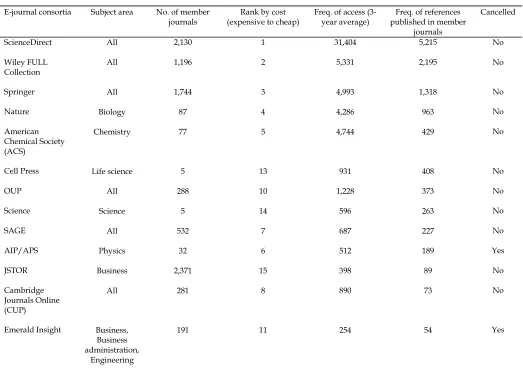
MAINTAINED AND CANCELED E-JOURNAL CONSORTIA INFORMATION
E-journal consortia Subject area No. of member
journals (expensive to cheap) Rank by cost Freq. of access (3-year average) published in member Freq. of references journals
Cancelled
ScienceDirect All 2,130 1 31,404 5,215 No
Wiley FULL
Collection All 1,196 2 5,331 2,195 No
Springer All 1,744 3 4,993 1,318 No
Nature Biology 87 4 4,286 963 No
American Chemical Society (ACS)
Chemistry 77 5 4,744 429 No
Cell Press Life science 5 13 931 408 No
OUP All 288 10 1,228 373 No
Science Science 5 14 596 263 No
SAGE All 532 7 687 227 No
AIP/APS Physics 32 6 512 189 Yes
JSTOR Business 2,371 15 398 89 No
Cambridge Journals Online (CUP)
All 281 8 890 73 No
Emerald Insight Business, Business administration,
Engineering
191 11 254 54 Yes
MIT Press Arts, Economy,
Science 32 12 57 9
Yes
OECD Library Social science 69 9 129 0 Yes
Table 3 shows the coverage of the subscribed consortia and web databases by subject areas. The six major subject areas were medical, natural science, technology, social science, humanities, and arts. For example, social science subject areas encompass a variety of majors, such as business administration, economy, law, social welfare, mass communication, public administration, and early childhood education. The affiliation of the first author was used to determine the subject area of the reference. Based on this, natural science had the highest coverage of 85.3%, while technology had the lowest coverage at 80.7%. This analysis allowed the library to set the subscription priority to support subject areas with lesser coverage in the future. There were 4,004 references that were published in journals that were not included in the subscribed e-journal consortia or web databases. It was possible to identify 821 references that were published in 290 journals belonging to 136 unsubscribing consortia and web databases. The overall coverage would have increased to 86.9% from 83.5% if all 136 of these consortia or web databases were added to the subscription. It was not possible to find the corresponding consortia or web databases for the remaining 3,183 references. Table 4 shows the consortia or databases with more than ten references. Most of the missing consortia or databases were related to medical subjects. This bias is likely due to the facts that 55.0% of all published articles and 58.6% of all references are
medical-oriented. Additionally, there were 117 consortia or databases with one to nine references.
6 APPLYING RESULTS
1091 instead because AIP/APS required a multi-year contract, and a
practical decision was made to have more freedom for the next year in anticipation of the need for further cancellations. Furthermore, JSTOR was the cheapest consortia to license. In summary, four consortia were canceled, and KRW 40,785,393 was saved. There was a discussion about subscribing to a newly discovered e-journal consortium, namely MEDLINE Complete. As shown in Table 4, there were 155 references that were published in the member journals of MEDLINE Complete. However, 155 is less than 189, which is the number of references appearing in the canceled AIP/APS consortium. Thus, MEDLINE Complete was not added.
7 CONCLUSION
Academic libraries consider a number of factors when determining whether to continue subscribing to specific e-journal consortia or web databases, such as the reputations of journals based on indexes such as SCI, SSCI, or SCOPUS; subscription history; regularly monitored opinions of the affiliating faculty; and frequency of accessing particular journals. However, according to the survey, these factors had not resulted in a satisfactory subscription selection process. In addition, it is difficult to identify new resources using the existing methods. The costs of the e-journal consortia and web databases are continuously increasing, and many academic libraries face budget cuts every year. Thus, there is a clear need for better management of the journal collection development using an evidence-based approach. This study suggests a practical and rigorous way to prioritize the importance of the electronic information resource based on the coverage of the references listed in the publications of the affiliated faculty members by subscribed journals or conference proceedings. Furthermore, comparing the references to the unsubscribed journals or conference proceedings facilitates the discovery of new e-journal consortia.
REFERENCES
[1] Harvard Library, “Faculty Advisory Council Memorandum
on Journal Pricing,” Harvard Library,
http://web.archive.org/web/20130903032641/isites.harvar d.edu/icb/icb.do?keyword=k77982&tabgroupid=icb.tabgro up143448/. 2012.
[2] T.J. Tillack, “Pressures, opportunities and costs facing research library acquisitions budgets: an Australian perspective,” The Australian Library Journal, vol. 63, no. 3, pp. 206-219, Sept. 2014.
[3] P.L.K. Gross and E.M. Gross, “College Libraries and Chemical Education,” Science, vol. 66, no. 1713, pp. 385-389, Oct. 1927.
[4] E. Garfield, “Citation Analysis as a Tool in Journal Evaluation,” Science, vol. 178, no. 4060, pp. 471-479, Nov. 1972.
[5] E.T. Smith, “Assessing Collection Usefulness: An Investigation of Library Ownership of the Resources Graduate Students Use,” College & Research Libraries, vol. 64, no. 5, pp. 344-355, Sept. 2003.
[6] J.S. Price, “How many journals do we have? An alternative approach to journal collection evaluation through local cited article analysis,” Serials, vol. 20, no. 2, pp. 134-147, July 2007.
[7] P. Whiting and P. Orr, “Evaluating Library Support for a New Graduate Program: Finding Harmony with a Mixed
Method Approach,” The Serials Librarian, vol. 64, no. 1-4, pp. 88-98, Jan. 2013.
[8] M. Sylvia, “Citation analysis as an unobtrusive method for journal collection evaluation using psychology student research bibliographies,” Collection Building, vol. 17, no. 1, pp. 20-28, March 1998.
[9] S. Edwards, “Citation analysis as a collection development tool: A bibliometric study of polymer science theses and dissertations,” Serials Review, vol. 25, no. 1, pp. 11-20, Dec. 2013.
[10] K.B. LaBonte, “Citation Analysis: A Method for Collection Development for a Rapidly Developing Field. Issues in Science and Technology Librarianship,” Issues in Science and Technology Librarianship, http://www.istl.org/05-summer/refereed.html/. 2005.
[11] D. Abeyrathne, “Citation analysis of dissertations for collection development,” Collection Building, vol. 34, no. 2, pp. 30-40, Apr. 2015.
[12] H. Chung, “An analysis model of creating a core journal collection for academic libraries,” Library Collections Acquisitions and Technical Services, vol. 33, no. 1, pp. 17-24, Dec. 2013.
[13] P. Keogh, “Resource Use by Pharmacy Graduate Students: Dissertations and Theses as Collection Development Tools,” Science & Technology Libraries, vol. 31, no. 2, pp. 200-229, Apr. 2012.
[14] C. Tucker, “Analyzing faculty citations for effective collection management decisions,” Collections Acquisitions and Technical Services, vol. 37, no. s 1-2, pp. 19-33, Dec. 2013.
[15] N. Vallmitjana and L.G. Sabate, “Citation analysis of Ph.D. dissertation references as a tool for collection management in an academic chemistry library,” College & Research Libraries, vol. 69, no. 1, pp. 72-81, Jan. 2008. [16] T. Nisognger, “A Simulated Electronic Availability Study of
Serial Articles through a University Library Web Page,” College & Research Libraries, vol. 70, no. 5, pp. 422-445, Sept. 2009.