R E S E A R C H
Open Access
Security-reliability performance of cognitive
AF relay-based wireless communication
system with channel estimation error
Qi Gu
1, Gongpu Wang
1*, Li Gao
2and Mugen Peng
3Abstract
In this paper, both the security and the reliability performance of the cognitive amplify-and-forward (AF) relay system are analyzed in the presence of the channel estimation error. The security and the reliability performance are
represented by the outage probability and the intercept probability, respectively. Instead of perfect channel state information (CSI) predominantly assumed in the literature, a certain channel estimation algorithm and the influence of the corresponding channel estimation error are considered in this study. Specifically, linear minimum mean square error estimation (LMMSE) is utilized by the destination node and the eavesdropper node to obtain the CSI, and the closed form for the outage probability and that for the intercept probability are derived with the channel estimation error. It is shown that the transmission security (reliability) can be improved by loosening the reliability (security) requirement. Moreover, we compare the security and reliability performance of this relay-based cognitive radio system with those of the direct communication system without relay. Interestingly, it is found that the AF relay-based system has less reliability performance than the direct cognitive radio system; however, it can lower the sum of the outage probability and the intercept probability than the direct communication system. It is also found that there exists an optimal training number to minimize the sum of the outage probability and the intercept probability.
Keywords: Channel estimation error; Secure wireless communication; Cognitive radio; Security-reliability performance; Amplify-and-forward; Relay network
1 Introduction
Nowadays, the increasing demand for high data rate wire-less access and services brings about the problem of spectrum scarcity [1]. Cognitive radio (CR) [2,3] has been recognized as a promising technology to improve spec-trum utilization efficiency and solve the specspec-trum scarcity problem. CR can enable unlicensed users, also referred to as cognitive users or secondary users, to communicate with each other over licensed bands. FCC [4] gives a for-mal definition of CR: ‘A cognitive radio is a radio that can change its transmitter parameters based on interaction with the environment it operates’.
Typically, a cognitive transmission process consists of two essential phases: spectrum sensing phase and data
*Correspondence: [email protected]
1School of Computer and Information Technology, Beijing Jiaotong University, Beijing 100044, China
Full list of author information is available at the end of the article
transmission phase. In the spectrum sensing phase, cog-nitive users attempt to find the spectrum hole, which is a frequency band assigned to the primary users but is not being utilized by the users at a particular time and specific geographic location [5]. The spectrum hole is typically located through the following techniques: energy detec-tion [6], matched filter, and cyclostadetec-tionary detecdetec-tion [7]. In the data transmission phase, cognitive users transmit data to each other through the detected spectrum hole. Different transmission techniques have been studied in [8-11] and references therein.
Due to the broadcasting nature of wireless channel and the openness of cognitive radio architecture where vari-ous unknown wireless devices are allowed to access the licensed spectrum, cognitive radio systems face a chal-lenge of physical layer security. For example, one receiver located near the cognitive source can receive the signal from it and recover the original information.
Much attention has been given to physical layer secu-rity in wireless communication systems [12-14]. It is Wyner who firstly investigated the physical-layer secu-rity problem in an information-theoretic sense [15] in 1975. Shortly after, the authors in [16] extended Wyner’s results to Gaussian wiretap channels and derived the secrecy capacity. In recent years, a multiple-input single-output (MISO) wiretap channel is considered in [12], and a multiple-input multiple-output (MIMO) wiretap chan-nel is studied in [13]. Besides, cooperative relay-aided secure communication has been suggested in [14]. Fur-thermore, the authors in [17] characterize the security-reliability trade-off performance of conventional direct transmission from source to destination in the presence of an eavesdropper, where the security and reliability are evaluated by the intercept probability at the eaves-dropper and the outage probability at the destination, respectively.
All the previous works for traditional point-to-point networks [12-14] and relay-based systems [17-19] about secure wireless communication assumed perfect channel state information (CSI). However, in a practical situa-tion, perfect CSI cannot be obtained. For most prac-tical wireless communication systems, training symbols are transmitted so that the receiver can estimate the channel [20].
Almost in every situation, channel estimation error exists. To our best knowledge, secure wireless communi-cation for relay-based networks has not been addressed in the case of the presence of channel estimation error, which motivates our present work.
In this paper, we study the security and reliability performance of the cognitive amplify-and-forward (AF) relay system in the presence of channel estimation error, and we compare its performance with that of the direct communication cognitive radio system. Specifically, we assume that all communication systems utilize linear min-imum mean square error estimation (LMMSE) to obtain channel parameters and derive the corresponding chan-nel estimation error. Based on chanchan-nel estimates, the detection of data symbols can be found and the chan-nel capacity in the presence of chanchan-nel estimation error can be obtained. Next, we derive the outage probabil-ity and the intercept probabilprobabil-ity to evaluate the reliabil-ity and securreliabil-ity performance, respectively. We find that the transmission security (reliability) can be improved by loosening the reliability (security) requirement. More-over, comparing the security and the reliability perfor-mance of this relay-based system with those of the direct communication system without relay, we find that the AF relay-based system has less reliability performance than the direct system; however, it can lower the sum of the outage probability and the intercept probability than the direct communication system. We also show
that there exists an optimal training number to minimize the sum of the outage probability and the intercept probability.
This paper is organized as follows: Section 2 gives the system model and Section 3 shows the sensing perfor-mance of the cognitive system. Next, the capacity analysis in the presence of channel estimation error is presented in Section 4. The security and the reliability performance are analyzed in Section 5, and numerical results are pro-vided in Section 6 to corroborate our proposed studies. Finally, Section 7 concludes the paper.
2 System model
Consider a joint existence of the primary network and a cognitive system (Figure 1). The primary network con-sists of two primary users: PU1 and PU2, that are com-municating over certain licensed bands. The secondary network is a cognitive one-way relay network with one source, one destination, and one relay. One eavesdrop-per is assumed to intercept the cognitive transmission from the source to the destination. The solid and dash lines in Figure 1 represent the main links (one from the source via the relay to the destination and the other from the source directly to the destination) and wiretap links (from the source and from the relay to the eavesdropper), respectively.
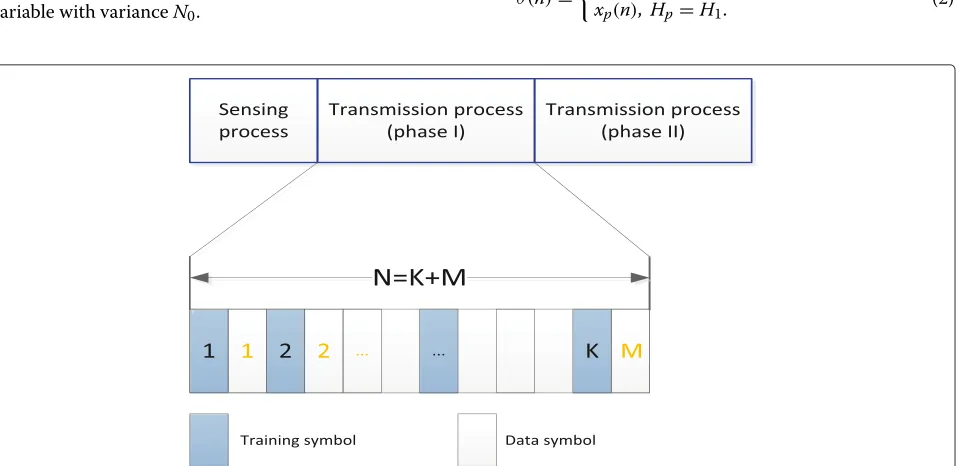
The cognitive wireless system works in a slotted struc-ture, and the whole communication from the source to the destination has two processes: the sensing process and the transmission process (Figure 2). The source will sense the spectrum hole forSsymbols’ period at the beginning of each slot and will start the transmission process when sensing the spectrum whole and stop after N symbols are transmitted. The whole slot containsLslot = S+2N symbols.
The transmission process involves two phases. In the first phase, the source node broadcasts signals to the relay node and the destination node; in the second phase, the relay node employs the amplify-and-forward (AF) proto-col to resend the received signal to the destination node. That is, the relay node amplifies its received signal with a constant factorαand then forwards it to the destination.
Suppose the subslot transmitted from the source con-tainsN symbols that consist ofK training symbolsp(n) andMdata symbolss(n), as shown in Figure 2. Clearly, N = K+M. LetTpdenote the index set of the training symbols while denoteTdas the index set of data symbols. The full time index set is thenT = Td
Tp = {n = 1, 2,. . .,N}.
Figure 1A cognitive AF relay-based system against an eavesdropper.
Without loss of generality, we suppose PU1is transmitting signalxp(n) to PU2 in the case of Hp = H1. As did in [21], we model Hp as a Bernoulli random variable with parameterP∅(the probability of the channel being avail-able for secondary users), i.e., Pr(Hp = H0) = P∅ and Pr(Hp=H1)=1−P∅.
Let Hˆs represent the sensing decision by the source node, i.e.,Hˆs=H0orHˆs=H1.
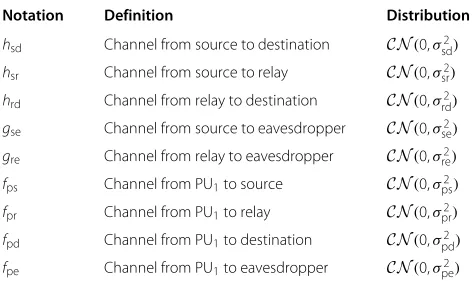
For notational convenience, the channels are defined in Table 1. We assume that all channels are Rayleigh fad-ing. In addition, the noise produced in the transmission on the channelhabfrom node a to node b is denoted as wabwhich is assumed as a zero-mean complex Gaussian variable with varianceN0.
2.1 Source
At the beginning of each slot, the source will sense the licensed channel and decide its existence or not. If it decidesHˆ =H0, then the source will transmitNsymbols to the relay and the destination, and next the relay will forward the receivedNsymbols to the destination.
The signal received by the source at the firstSsymbol periods is
s(n)=fps
Ppθ(n)+wps(n), 1≤n≤S, (1)
wherewps(n) is the noise at the source node andθ(n)is the signal transmitted from the PU
θ(n)=
0, Hp=H0
xp(n), Hp=H1. (2)
Table 1 List of the channel notations
Notation Definition Distribution
hsd Channel from source to destination CN(0,σsd2)
hsr Channel from source to relay CN(0,σsr2)
hrd Channel from relay to destination CN(0,σrd2)
gse Channel from source to eavesdropper CN(0,σse2)
gre Channel from relay to eavesdropper CN(0,σre2)
fps Channel from PU1to source CN(0,σps2)
fpr Channel from PU1to relay CN(0,σpr2)
fpd Channel from PU1to destination CN(0,σpd2)
fpe Channel from PU1to eavesdropper CN(0,σpe2)
2.2 Relay
Suppose the transmission power at the source node and at the PU1isPsandPp, respectively. The signal received at the relay node is
r(n)=hsr
Psx(n)+wsr(n)+fpr
Ppθ(n), (3)
where the transmitted signalx(n)is defined as
x(n)=
p(n), n∈Tp
s(n), n∈Td
(4)
andθ(n)is the signal transmitted from the PU defined in (2).
In the next phase, the relay will amplify the received sig-nalr(n)with a factorα and forward it to the destination node. The factorαis defined as
α=
Pr
Psσsr2+N0
. (5)
2.3 Destination
The signal received at the destination in the first phase and in the second phase can be respectively expressed as
d1(n)=hsd
Psx(n)+fpd
Ppθ(n)+wsd(n), (6)
d2(n)=αhrd
Prr(n)+fpd
Ppθ(n+N)+wrd(n)
=αhsrhrd
PrPsx(n)+wsrd(n)+Ipd(n), (7)
whereIpd(n)is the interference from the primary user
Ipd(n)=αhrdfpr
PrPpθ(n)+fpd
Ppθ(n+N) (8)
andwsrd(n)is the combined noise defined as
wsrd(n)=αhrd
Prwsr(n)+wrd(n). (9)
Clearly, the combined noise wsrd(n) is zero-mean Gaussian-distributed with variance
Nsrd= |α|2σrd2PrN0+N0. (10)
2.4 Eavesdropper
The signals received at the eavesdropper during the first phase and the second phase can be respectively expressed as
e1(n)=gse
Psx(n)+wse(n)+fpe
Ppθ(n), (11)
e2(n)=αgre
Prr(n)+wre(n)+fpe
Ppθ(n+N)
=αhsrgre
PrPsx(n)+wsre(n)+Ipe(n), (12)
wherewsre(n)is the combined noise defined as
wsre(n)=αgre
Prwsr(n)+wre(n) (13)
andIpe(n)is the interference from the primary user
Ipe(n)=αgrefpr
PrPpθ(n)+fpe
Ppθ(n+N). (14)
Obviously, the combined noise wsre(n) is zero-mean Gaussian-distributed with variance
Nsre= |α|2σre2PrN0+N0. (15)
3 Sensing performance
With the assumption of the energy detector utilized by the source node, we can find the false alarm probabilityPf as
Pf = { ˆHs=H1|Hp=H0}
=Pr
S
n=1
|wps(n)|2> λED
, (16)
whereλEDis the decision threshold of the energy detector. Note that Sn=1|wps(n)|2 can be considered as a cen-tral chi-squared random variableX22Swith 2Sdegrees of freedom [22]. Therefore, Equation 16 can be found as [23]
Pf =exp
−λED
N0 S−1
k=0
λED
N0 k
k! . (17)
In the case ofHp=H1, the signal received at the source isxp(n)plus noise. The individual detection probabilityPd at the source node can be thus obtained as
Pd=Pr{ ˆHs=H1|Hp=H1}
=Pr S−1
k=0
|Ppfpsxp(k)+wps(k)|2> λED
=Pr
S
k=1
|Ppfpsxp(k)+ni(k)|2 (Ppσps2 +N0)/2 >
2λED Ppσps2 +N0
.
Note that Sk=1| √
Ppfpsxp(k)+ni(k)|2
(Ppσps2+N0)/2 can be also consid-ered as a central chi-squared random variableX22S with 2Sdegrees of freedom [22]. Hence, we can further obtain (16) as
Pd=exp
− λED
Ppσps2 +N0 S−1
k=0
λED
Ppσps2+N0 k
k! . (19)
4 Channel capacity with estimation error
In this section, the channel estimation and data detection process at the destination and also at the eavesdropper are analyzed. The LMMSE method is chosen due to its optimal estimation performance for Gaussian signals [24]. Based on the analysis of estimation and detection process, the mathematical expressions for channel capacity with estimation error are derived.
The source will begin transmission in the two cases of ˆ
Hs=H0: one is that it successfully detects the existence of the spectrum hole when there is no transmission between the primary users; the other is that it mistakenly detects the appearance of the spectrum hole when the primary users are communicating. In the former case, the nodes in the cognitive system can communicate without any interference from the primary users. Suppose the achiev-able channel capacity in this case isCI. In the latter case, both PU1, the cognitive source and the cognitive relay will transmit signals and will interfere with each other. In such case, the cognitive system can also obtain certain chan-nel capacityCII. However, the capacity gain is limited and negligible especially whenPp, the transmission power of PU1, is high [21]. Thus, in the following capacity analysis, we focus on the first case.
4.1 Signal processing at destination
4.1.1 The first phase
In the case ofHp = H0, the itemθ(n)in Equation (6) is zero. Stackd1(n), p(n), and wsd(n)from the set Tp into
K×1 vectorsd1p,p, andwd1p, respectively. We can obtain the following equation from (6)
d1p=hsd
Psp+wd1p. (20)
Multiplying both sides of Equation 20 withpHwill give
pHd1p=hsd
PspHp+pHwd1p. (21)
Let y1p = pHd1p. Utilizing the LMMSE method, the estimate of the channelhsdcan be found from (21) as
ˆ
hsd=E(hsdyH1p)(E(y1pyH1p))−1y1p (22)
= √
Psσsd2pHd1p
Psσsd2pHp+N0
, (23)
whereE(.)denotes the statistical expectation throughout this paper. The mean of the channel estimatehˆsd is zero and the variance is
ς2 sd=
Psσsd4pHp
Psσsd2pHp+N0
. (24)
Therefore, the estimation error of the channelhsdis
sd= ˆhsd−hsd (25)
= √
Psσsd2pHwd1p−hsdN0 Psσsd2pHp+N0
. (26)
It can be readily checked that the channel estimation errorsdis zero-mean Gaussian-distributed with variance
2 sd=
σ2 sdN0 Psσsd2pHp+N0
. (27)
In order to detect data symbols with channel estimate ˆ
hsd, Equation 6 will be rewritten as
d1(n)= ˆhsd
Pss(n)−sd
Pss(n)+wsd(n), (28)
forn∈Td.
4.1.2 The second phase
In the case ofHp = H0, the itemIpd(n)in Equation 7 is zero. Stack d2(n) andwsrd(n) from the setTp intoK × 1 vectorsd2p andwd2p, respectively. We can obtain the following equation from (7)
d2p=αhsrhrd
PsPrp+wd2p. (29)
Multiplying both sides of (29) withpHwill produce
pHd2p=αhsrhrd
PsPrpHp+pHwd2p. (30)
Supposey2p = pHd2pand define the combined channel
hsrd = hsrhrd. Clearly, the mean of hsrdis zero and the variance ofhsrdisσsrd2 =σsr2σrd2.
We can obtain the estimate of the combined channel hsrdwith the LMMSE method as
ˆ
hsrd=E(hsrdyH2p)(E(y2pyH2p))−1y2p
= ασsrd2 √
PsPrpHd2p α2σ2
srdPsPrpHp+Nsrd
The channel estimatehˆsrdhas zero mean and its vari-ance is
ς2 srd=
α2σ4
srdPsPrpHp α2σ2
srdPsPrpHp+Nsrd
(32)
The estimation error of the combined channelhsrdcan be found as
srd= ˆhsrd−hsrd
= ασsrd2 √
PsPrpHwd2p−hsrdNsrd
α2σ2
srdPsPrpHp+Nsrd
. (33)
Clearly, E(srd) = 0 and the variance of the channel estimation errorsrdis
2 srd=
σ2 srdNsrd
α2σ2
srdPsPrpHp+Nsrd
. (34)
To perform data detection with the estimate, Equation 7 will be rewritten as
d2(n)=αhˆsrd
PsPrs(n)−αsrd
PsPrs(n)+wsrd(n), (35)
forn∈Td.
Remark 1.Only the LMMSE method can produce the
result that the channel estimation error is uncorrelated with the channel estimate, that is,
E(hˆsdsdH)=0, E(hˆsrdsrdH )=0. (36)
This will guarantee that the interference which resulted from the channel estimation error can be translated into a sort of noise independent from the source signals [25], which will facilitate the capacity analysis in the following part.
4.1.3 Channel capacity
Next, from (28) we can find the capacity of the direct channelhsdas
Csd = M Lslot
log2
1+ |ˆhsd| 2P
s |sd|2Ps+N0
. (37)
In addition, from (35) we can obtain the capacity of the AF relay channelhsrdas
Csrd= M Lslot
log2
1+ α
2|ˆh
srd|2PrPs α2|
srd|2PrPs+Nsrd
. (38)
Assume that the destination chooses selection diversity combining, i.e., when two signals are received at the des-tination, a signal copy with higher signal-to-noise ratio (SNR) than the other will be employed for decoding the source message. Thus, the capacity achieved at the
desti-nation in the case that the source successfully detects the existence of the spectrum hole is
CI=max(Csd,Csrd). (39)
Finally, we can express the total achievable capacity at the destination as
Cd =P∅Pr(Hˆs=H0|Hp=H0)CI
+(1−P∅)Pr(Hˆs=H0|Hp=H1)CII =P∅(1−Pf)CI+(1−P∅)(1−Pd)CII
≈P∅(1−Pf)max(Csd,Csrd), (40)
wherePf is the false alarm probability defined in (17) and
Pdis the detection probability defined in (19). The approx-imation is due to thatCIIrepresents the channel capacity in the case that the cognitive users mistakenly detect the appearance of the spectrum hole when the primary users are communicating. In such case, both PU1, the cogni-tive source, and the cognicogni-tive relay will interfere with each other, which will result in a small value ofCIIas in [21,26]. Moreover, we can adjust the threshold so that the detec-tion probabilityPd can approach 1. Therefore, the item (1−P∅)(1−Pd)CIIin (40) is negligible.
4.2 Signal processing at the eavesdropper
Since the eavesdropper will take a similar estimation and detection process as the destination, the process is described briefly in this subsection.
4.2.1 The first phase
Stacke1(n) andwse(n) from the set Tp into K ×1 vec-tors e1p andwe1p. We can find from (11) the following equation:
e1p=gse
Psp+we1p. (41)
Using the same LMMSE method in Section 4.1, the esti-mate of the channelhsecan be obtained as
ˆ gse=
√
Psσse2pHe1p
Psσse2pHp+N0
. (42)
Clearly, E(gˆse) = 0 and the variance of the channel estimategˆseis
ς2 se =
Psσse4pHp Psσse2pHp+N0
. (43)
The channel estimation error is
se= ˆgse−gse
= √
Psσse2pHe1p−hseN0 Psσse2pHp+N0
Also, we haveE(se)= 0 and the variance of the channel estimation errorseis
2
To detect data symbols with channel estimate hˆse, Equation 11 will be rewritten as
e1(n)= ˆgse
4.2.2 The second phase
Stacke2(n)andwsre(n)from the setTpintoK×1 vectors
e2p andwe2p, respectively. We can obtain the following equation from (12):
e2p=αhsrgre
PsPrp+we2p. (47)
Define the combined channel gsre = hsrgre. Clearly, E(gsre)=0 and the variance ofgsreisσsre2 =σsr2σre2.
We can obtain the estimate of the combined channelgsre with the LMMSE method as
ˆ channel estimatehˆsreis
ς2
The estimation error of the combined channelgsreis
sre= ˆgsre−gsre estimation errorsreis
2
To perform data detection with the estimate, Equation 7 will be rewritten as
e2(n)=αgˆsre
From (46) we can find the capacity of the direct channel hseas
In addition, from (52) we can obtain the capacity of the AF relay channelhsreas
Csre=
Similar to the derivation of (40), the total capacity achievable at the eavesdropper can be approximated as
Ce≈P∅(1−Pf)max(Cse,Csre). (55)
5 Security-reliability performance
5.1 Outage probability
When the channel capacity becomes less than the data rateR, the destination node is unable to recover the source signal and an outage event will occur in this case. Thus, the outage probability of the main links is given as
P(oRut) =PrP∅(1−Pf)Cd<R
The first part in (56) can be found as
Pr
Substituting (24) and (27) into (59) will give
Using (38), we can find the second part in (56) as
Pr and|sd|2follow exponential distribution, we can further obtain
After straight calculation steps, we can get
Pr
Substituting (32) and (34) into (63) will produce
Pr
Finally, the outage probability can be obtained as
P(oRut)=
If the wiretap channel capacity is greater than the data rate, the eavesdropper is able to decode the source
message. Thus, an intercept event happens when the wire-tap channel capacity becomes larger than the data rateR. Hence, the intercept probability for both channelshseand hsreis
With the same process in obtaining (60), we can find
Pr
Also, using the same method in finding (64), we can obtain
Pr
Finally, the intercept probability can be obtained as
Pint(R)=1−
N0, we can have the following approximation:
ς2
sd≈σsd2, ςse2 ≈σse2, ςsrd2 ≈σsrd2 , ςsre2 ≈σsre2 .
Suppose BSPK or QPSK modulation is adopted, and thus, pHp=K. Also assume that
σ2
Therefore, we can rewrite the outage probability and
5.4 Comparison with direct channel
If there is no relay, that is, there are only two channelshsd andgse, the outage probability and intercept probability can be found as
P(oDut)=1− simplify (73) and (74) as
P(oDut)=1−
Proposition 1.The outage probability for the relay-based transmission is larger than that for direct transmis-sion, while the intercept probability for the relay-based transmission is smaller than that for direct transmission.
P(oRut) >Po(Dut), Pint(R)<Pint(D). (77)
Proposition 2.Suppose the total probability is the sum of the outage probability and the intercept probability and
is a function of data rate R. The minimum value of the total probability for the relay-based transmission is less than that for direct transmission, i.e.,
min
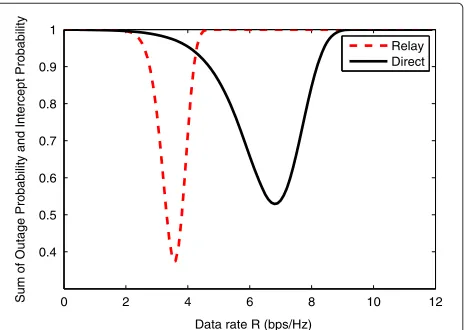
Note that the sum of the outage probability and the intercept probabilityP(oRut) +P(oRut) can be considered as a parameter to measure the overall performance. It needs to be pointed out that the strictly mathematical proof of the two propositions is challenging; however, they can be numerically verified through computer simulationsa.
6 Simulation results
In this section, we numerically evaluate both the security and reliability performance of the cognitive relay system with channel estimation error. Let us fix the slot length Lslot =1,000 and sensing durationS =2 and choose the threshold of the energy detectorλED = 9.2 so that the false alarm probability in (17)Pf =0.01.
First, we setK = 10,Ps = Pr = 1, 000,N0 = 1,σsd2 =
σ2
sr=σrd2 =8, andσse2 =σre2 =2. Increasing the data rate Rfrom 0 to 12 bps/Hz, we can obtain the outage prob-ability and the intercept probprob-ability from (65) and (69), respectively. For comparison, the outage probability and the intercept probability of direct transmission without relay are also found from (73) and (74). The outage proba-bility and intercept probaproba-bility versus data rateRis plotted in Figure 3. The sum of outage probability and intercept probability versus data rateRin the case of one relay and no relay is also plotted in Figure 4.
Second, we increase the transmission power Ps = Pr from 0 to 1,000 and increase the number of training sym-bolsKfrom 1 to 100, and then we can find the minimum value of the probability sum for the relay-based transmis-sion and direct transmistransmis-sion, respectively. The minimum
0 2 4 6 8 10 12
0 2 4 6 8 10 12 0.4
0.5 0.6 0.7 0.8 0.9 1
Data rate R (bps/Hz)
Sum of Outage Probability and Intercept Probability
Relay Direct
Figure 4Sum of outage probability and intercept probability versus data rateR.
sum of the outage probability and the intercept probability versus the transmission power and the training number is plotted in Figure 5. It can be seen that the relay-base trans-mission system can obtain lower probability sum than the direct transmission system, which implies better joint security and reliability performance of the relay-based transmission system than the direct transmission system.
Next, we increase the number of training symbols K from 1 to 300 and obtain the outage probability and the intercept probability from (65) and (69), respectively. Figure 6 plots the outage probability, the intercept prob-ability, and the sum of the two probabilities versus the training number K. The increasing value of the training number K will result in less data symbols M and thus reduced channel capacityCd. Therefore, given data rate
R, the outage probability will increase while the intercept probability will decrease with the larger training number K. However, it can be seen from Figure 6 that the sum of the outage probability and the intercept probability first decreases and then increases when the training numberK
0 200
400 600
800 1000 0
50 100
150 0.1
0.2 0.3 0.4 0.5 0.6
Training number K Transmission power Ps (W)
Minimum value of the total probability
Relay−based transmission Direct transmission
Figure 5The minimum value of the total probability for relay-based transmission and direct transmission.
0 50 100 150 200 250 300
0 0.1 0.2 0.3 0.4 0.5 0.6 0.7 0.8 0.9
Training Number K
Probability
Outage Intercept Sum
Figure 6Outage probability and intercept probability versus the number of training symbolsK.
increases from 1 to 400. Clearly, there exists an optimal value ofKso that the probability sum can be minimized.
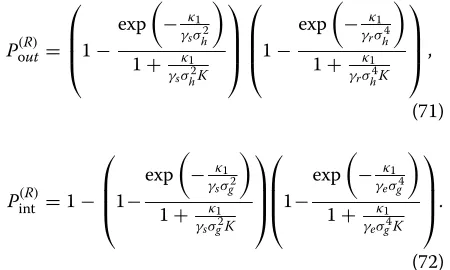
We also examine the approximation performance of the outage probability and the intercept probability. The approximate value and the exact value for the outage prob-ability are obtained from (71) and (65), respectively. So are those for the intercept probability from (72) and (69). Figure 7 shows the nice agreement of approximate values with theoretical ones.
7 Conclusion
This paper evaluated both the security and the reliability performance of the cognitive amplify-and-forward (AF) relay system in the presence of the channel estimation error. Specifically, LMMSE is utilized by the destination node and the eavesdropper node to obtain the CSI, and the closed form for the outage probability and that for the intercept probability are derived. Based on these, the security and the reliability performance were evaluated
0 5 10 15 20 25 30
0 0.1 0.2 0.3 0.4 0.5 0.6 0.7 0.8 0.9 1
SNR (dB)
Probability
Pout(R) Theory
Pout(R) Approx.
Pout(D) Theory
Pout(D) Approx. Pint(R) Theory
Pint(R) Approx.
Pint(D) Theory
Pint(D) Approx.
in the form of the outage probability and the intercept probability, respectively. It was shown that the transmis-sion security (reliability) could be improved by loosening the reliability (security) requirement. Moreover, the secu-rity and the reliability performance of this relay-based system were compared with those of the direct commu-nication system without relay. Interestingly, it was found that the AF relay-based system has less reliability perfor-mance than the direct system; however, it can lower the sum of the outage probability and the intercept probability than the direct system. It was also found that there exists an optimal training number to minimize the sum of the outage probability and the intercept probability.
Endnote
aThis is the reason for the name of proposition, instead
of theorem.
Competing interests
The authors declare that they have no competing interests.
Acknowledgements
This study is supported in part by the Key Laboratory of Universal Wireless Communications, Ministry of Education, China. This study is also supported in part by the National Natural Science Foundation of China (No. 61201202, No. 61372116, and No. 61071077) and by Tsinghua-Tencent Joint Laboratory for Internet Innovation Technology.
Author details
1School of Computer and Information Technology, Beijing Jiaotong University, Beijing 100044, China.2State Key Laboratory of Information Photonics and Optical Communications, School of Digital Media and Design Arts, Beijing University of Posts and Telecommunications, Beijing 100876, China.3School of Information and Communication Engineering, Beijing University of Posts and Telecommunications, Beijing 100876, China.
Received: 23 November 2013 Accepted: 29 January 2014 Published: 5 March 2014
References
1. S Haykin, Cognitive radio: brain-empowered wireless communications. IEEE J. Sel. Areas Commun.23(2), 201–220 (2005)
2. J Mitola, Cognitive radio for flexible mobile multimedia communications,
inProc. IEEE International Workshop on Mobile Multimedia Communications
(MoMuC), (San Diego, CA, Nov. 1999), pp. 3–10
3. J Mitola,Cognitive radio: an integrated agent architecture for software
defined radio. Ph.D. dissertation, KTH Royal Institute of Technology, 2000
4. FCC, 2003, ET Docket No. 03-222, No.ice of proposed rule making and order. Tech. Rep., December, 2003
5. P Kolotzy, Next generation communications: kickoff meeting, inProc.
DARPA,Vol. 10, (2001)
6. H Urkowitz, Energy detection of unknown deterministic signals. Proc. IEEE.55(4), 523–531 (1967)
7. WA Gardner, CM Spooner, Signal interception: performance advantages of cyclic-feature detectors. IEEE Trans. Commun.40, 149–159 (1992) 8. JN Laneman, DNC Tse, GW Wornell, Cooperative diversity in wireless
networks: efficient protocols and outage behavior. IEEE Trans. Inf. Theory. 50(12), 3062–3080 (2004)
9. TE Hunter, S Sanayei, A Nosratinia, Outage analysis of coded cooperation. IEEE Trans. Inf. Theory.52(2), 375–391 (2006)
10. Y Zou, B Zheng, J Zhu, Outage analysis of opportunistic cooperation over Rayleigh fading channels. IEEE Trans. Wireless Commun.8(6), 3077–3385 (2009)
11. A Bletsas, H Shin, MZ Win, A Lippman, A simple cooperative diversity method based on network path selection. IEEE J. Sel. Areas Commun. 24(3), 659–672 (2006)
12. A Khisti, GW Wornell, Secure transmission with multiple antennas: the MISOME wiretap channel. IEEE Trans. Inf. Theory.56(7), 3088–3104 (2010) 13. F Oggier, B Hassibi, The secrecy capacity of the MIMO wiretap channel.
IEEE Trans. Inf. Theory.57(8), 4961–4972 (2011)
14. L Dong, Z Han, AP Petropulu, HV Poor, Improving wireless physical layer security via cooperating relays. IEEE Trans. Signal Process.58(3), 1875–1888 (2010)
15. AD Wyner, The wire-tap channel. Bell Syst. Tech. J.54(8), 1355–1387 (1975) 16. SK Leung-Yan-Cheong, ME Hellman, The Gaussian wiretap channel. IEEE
Trans Inf. Theory.24, 451–456 (1978)
17. Y Zou, X Wang, W Shen, L Hanzo, Security versus reliability analysis of opportunistic relaying. 10.1109/TVT.2013.2292903
18. C Xing, M Xia, F Gao, Y Wu, Robust transceiver with Tomlinson-Harashima precoding for amplify-and-forward MIMO relaying systems. IEEE J. Sel. Areas Commun.30(8), 1370–1382 (2012)
19. C Xing, S Ma, Z Fei, Y Wu, H Vincent Poor, A general robust linear transceiver design for multi-hop amplify-and-forward MIMO relaying systems. IEEE Trans Signal Process.61(5), 1196–1209 (2013)
20. J Cavers, An analysis of training symbol assisted modulation for Rayleigh fading channels [mobile radio]. IEEE Trans. Veh. Technol.40(4), 686–693 (1991)
21. Y Zou, YD Yao, B Zheng, Cognitive transmissions with multiple relays in cognitive radio networks. IEEE Trans. Wireless Commun.10(2), 648–659 (2011)
22. SM Kay,Fundamentals of Statistical Signal Processing: Detection Theory. (Prentice-Hall, Englewood Cliffs, 1993)
23. M Abramowitz, IA Stegun,Handbook of Mathematical Functions with
Formulas, Graphs, and Mathematical Tables. (Dover, New York, 1972)
24. SM Kay,Fundamentals of Statistical Signal Processing: Estimation Theory. (Prentice-Hall, Englewood Cliffs, 1993)
25. B Hassibi, B Hochwald, How much training is needed in multiple-antenna wireless links. IEEE Trans. Inf. Theory.49(4), 951–963 (2003)
26. G Wang, Y Zou, J Lu, C Tellambura, Cognitive transmission and performance analysis for amplify-and-forward two-way relay networks, in
Proc. IEEE ICC, (Sydney, June 2014), pp. 1–6
27. G Wang, Y Zou, F Gao, Z Zhong, Secuirity-reliability tradeoff for secure wireless communications with channel estimation error, inProc. IEEE HMWC, (Shanghai, Nov. 2013), pp. 1–4
doi:10.1186/1687-6180-2014-28
Cite this article as:Guet al.:Security-reliability performance of cognitive AF relay-based wireless communication system with channel estimation error.EURASIP Journal on Advances in Signal Processing20142014:28.
Submit your manuscript to a
journal and benefi t from:
7Convenient online submission
7 Rigorous peer review
7Immediate publication on acceptance
7 Open access: articles freely available online
7High visibility within the fi eld
7 Retaining the copyright to your article