The CSQUARE Transform
?Tom St Denis
Abstract. In this paper we show how to combine the design concepts of the SQUARE and CS block ciphers to produce a pseudo-random per-mutation CSQUARE suitable for use in block cipher and hash design with a very high multi-round trail weight. The new design inherits the hardware efficiency of the SQUARE linear transform pattern as well as the efficiency of the fast pseudo-Hadamard transform over a finite field. We demonstrate the DMWT hash function which makes use of our new results.
Keywords. Pseudo-Hadamard Transform, Branch Analysis, Pseudo-Random Permutations.
1
Introduction
In the SQUARE block cipher [1] a new technique of combining a Maximum Distance Separable (MDS) code along with the “SQUARE Propagation Pattern” resulted in a design which had a high provable four round differential and linear trail weight. Similarly in the CS-Cipher [3], the concept of a pseudo-Hadamard transform was enhanced to raise the minimal eight round differential and linear trail weight.
In this paper we take the results of FPHT analysis in [7] and apply them to the SQUARE propagation pattern to derive a new permutation which has a considerably higher minimal trail weight. Along with our successful design we also demonstrate two similar design constructions which fail to achieve a trail weight greater than the trail weight of the SQUARE design.
We shall conclude this paper with a section discussing implementation details and our DMWT hash function. We prove that through our DMWT design any minimal four round trail has a weight of at least 144 which compares favourably to the minimal trail weight of WHIRLPOOL which is 81.
In section two we discuss the relevant background required for our new re-sults. Section three discusses our new design as well as the two similar designs. Section four discusses the design justification and section five discusses our new DMWT design.
?
2
Background Theory
2.1 SQUARE
The SQUARE [1] block cipher was a unique approach to cipher design when it was first proposed. It was an efficient design that provided for a high and provable minimal trail weight. The design would later change into the Rijndael block cipher which became the American AES cipher.
The relevant design concepts of SQUARE are the following. Letθrepresent a transform which applies a non-linear substitution to all of the coordinates of the input. Letζrepresent a length four MDS code overGF(2)[x]. Letγrepresent the sixteen coordinate input organized as a 4×4 matrix. Then the relevant portions of the SQUARE round function can be expressed as the following.
γi+1=ρ(γi, Ki) :γi×Ki→(ζ◦θ◦(γi⊕Ki)) T
(1)
While it was not proven in the SQUARE, paper the design has two provable qualities which are proven in the subsequent Rijndael papers. Letβ represent the branch of theζ transform.
Theorem.Every two rounds has at leastβ active columns. Theorem.Every four rounds has at leastβ2 active coordinates.
For the purposes of this paper we are merely concerned with the first theorem. This theorem is trivial to prove. If there arexactive columns then through the transposition there shall be one row with at leastxactive coordinates. Through the subsequentζ transform there shall be the greatest of (β−x,1) active coor-dinates. As a result there arex+β−x=β active columns.
2.2 CS-Cipher
The CS-Cipher [3] used non-linear multipermutations interconnected in a fashion that promotes fast diffusion. Instead of placing the non-linear substitutions at the boundaries of the linear transform they placed them throughout the transform. In [4], the full eight round trail weight was counted by brute force to prove the security of the design against differential and linear cryptanalysis. This design in particular has several useful properties.
1. The round function can be computed inO(logn) time. 2. The mixing network is non-linear.
3. The branch of the round function is bounded.
3
New Design - CSQUARE
3.1 Construction
Our new design permutes a block of data γ organized as a square matrix by combining a CS-Cipher style mixing network with the SQUARE propagation pattern. Let n = 2k for k ≥ 2 represent the width of γ. Let ζ represent the mixing network made of aHk transform implemented as in [7, Fig.1], with the
H1 transforms replaced by a non-linear (2,3)-multipermutation θ [6]. Let βk represent the branch of theζ transform.
We note that with each application of θwithin ζ the inputs are “keyed” by some keyK. This allows a Markov chain to be produced throughout the design.
Our new design is simply stated as
y=ρ(γ, K) :γ×K→ζ◦(ζ◦ζ◦γ)T T
(2)
Note that the three compositions ofζrequire 3k·22k
key words to be provided by some form of key schedule. For the purposes of this paper we shall assume some form of suitable key schedule has been provided. This design relies on two theorems to achieve a provable four round trail weight bound.
3.2 Design Theory
Theorem 1. Two compositions ofρwill always have at leastβk active columns.
Proof. This proof is simply an adaptation of the two round proof for the SQUARE block cipher. If the input hasx active columns then the transposition will have one column with at mostxactive coordinates. Through the thirdζ composition of the ρ transform there shall be the largest of (βk−x,1) active coordinates. When the matrix is transposed again those active coordinates are placed in
unique columns. ut
The second theorem we are concerned with is concretely establishing the two round trail weight ofζ.
Theorem 2. The two round trail weight for aζ transform of dimensionn= 2k
is at least3·2k−1
.
A general proof of this theorem is still being developed. However, we can show that the theorem is true fork={1,2,3,4}and we shall provide an argument in favour of the theorem.
Case k= 1. This case is fairly trivial. The branch ofθ is three which immedi-ately yields a minimum two round weight of three.
Case k = 2. In both rounds at least one θ transform must be active. As a result at least six active coordinates must be present. Therefore, the theorem is true fork= 2 since 3·2k−1
= 6.
Case k= 3. In this case we rely on the branch ofζ3 which is provably [7] six. As a result the minimal trail weight is caused by an input weight of two which cause a minimal output weight of four after the first round. If the layers of the two rounds are placed end-to-end it is obvious that over the first two layers there is at least one activeθ. Over the middle two rounds there are at least two and over the last two at least one more activeθ. Therefore, there are four activeθ
transforms which produce the 3·2k−1= 12 active coordinates.
Casek= 4. This proof is similar to the case ofk= 3. Again the lowest weight trail is caused by the input weight of two. For the first round, the first two layers will have at least one activeθ and the last two layers will have at least three activeθtransforms. The second round at the very least will be a mirror of the first round. In total there shall be at least eight activeθ transforms which achieves the desired 3·2k−1= 24 active coordinates.
Conjecture fork≥5. Our conjecture for the general case lies in the topology of the underlying mixing network. In every layer each of the θ transforms are applied to a unique pairing of the input coordinates. As a result, in layeri of a transform, any active θ transform will be connected to at least two activeθ
transforms in at least one of layeri−1 ori+ 1. It seems very plausible that over thekpairs of layers in the two rounds of ζk transforms there are at least 2k−1 activeθtransforms.
3.3 Results
As a result of the two theorems the two round trail weight of theρtransform is at least the product of the branch ofζkand the two round trail weight ofζk. Let
σn denote the four round trail weight of theρconstruction with a dimension of
n×n.
σn= 6·8k, ifn= 22k
σn= 18·8k, ifn= 22k+1 (3)
The four round minimal trail weight of the SQUARE design is the branch of the “MixColumn” transform squared. The trail weights for even dimensionζ
3.4 Related Designs
Through the course of this study two other design constructs have been analyzed and both fail to achieve the desired level of trail weight. The first design construct is based on the SQUARE design mixed with the CS-Cipher directly. That is,
y= ˆρ1(γ, K) :γ×K→(ζ◦γ)
T
(4)
However, this design lacks2an easy method of counting the trail weight over
multiple rounds. The second design was a straight adaptation of this design.
y= ˆρ2(γ, K) :γ×K→(ζ◦ζ◦γ)
T
(5)
However, this design does not enforce a high enough active column count over two rounds. Another modification we considered but rejected for efficiency reasons is the construction:
y= ˆρ3(γ, K) :γ×K→
ˆ
ζ◦(ζ◦ζ◦γ)T T
(6)
Where ˆζ is a 2k
dimension MDS code. The resulting four round minimal trail weight of this design would beσ3
n.
ˆ
σ3
n= 3· 4 k
+ 2k
, ifn= 2k
(7)
Which compares very well against the original SQUARE design. However, the ˆρ3approach involves using an MDS code which is something we are striving
to avoid since they are slower than theζ transform to implement. Therefore, we rejected this approach for this paper. The approach is still ideal if a very high trail weight is sought.
As a remark even the SHARK design [8] which specified that the input be a single column and each round has one MDS transform cannot compete with the minimal trail weight of the ˆρ3 design. Any four round trail of SHARK must
have at leastσS
n active coordinates.
σnS = 2 k+1
+ 2, ifn= 2k (8)
Since σ3
n > σ S
n and the ρ3 design requires a square root of the time the
SHARK design the SHARK design is not scalable.
4
Design Justification
4.1 Security
The purpose of this new design is to modify the original SQUARE design and produce a transform which has a higher multi-round trail weight. In doing so we also removed much of the linearity from within the design using the approach of
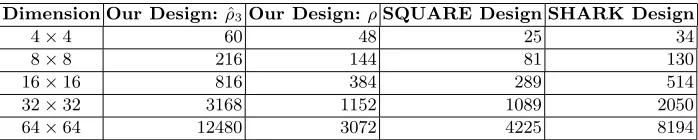
Dimension Our Design:ρˆ3Our Design: ρSQUARE Design SHARK Design
4×4 60 48 25 34
8×8 216 144 81 130
16×16 816 384 289 514
32×32 3168 1152 1089 2050
64×64 12480 3072 4225 8194
Fig. 1.Four round minimal trail weights of ˆρ3,ρ, SQUARE and SHARK.
[3]. As a result, differential and linear cryptanalysis are easy to prove ineffective after only a few rounds that use the CSQUARE design.
We have also applied a summation attack against a 8×8 implementation of the ρfunction. Using single and double coordinate input counters3 we have
found no useful characteristic that can break more than two rounds of the design. The only known pattern is to use two counters in the zeroth coordinate of the first and middle row ofγ. After one round the EOR–sum of all of the outputs will be zero which leads to a trivial two round attack.
4.2 Hardware Efficiency
The first property of this design that is immediately obvious is that it requires more transformations than the SQUARE design. The ρfunction applies three transformations per round compared to the single transformation used in a SQUARE round.
However, the saving grace of this design is that theζtransform has an efficient
O(n) space andO(logn) time implementation. In fact the serious bottleneck of this design is the non-linear transform applied within θ. The actual transform that produces the (2,3)−multipermutation quality desired can be accomplished with a very small number of EOR gates. A further optimization is that since a singleζ transform is likely to be very small4 it can be implemented in parallel
for every column of the input. As a result the critical path of the transform is at least as long as three invocations of theζ transform.
While no concrete implementation of this design exists it is not likely to be much slower than the original SQUARE design for small dimensions and would be much faster for large dimensions.
4.3 Software
In software this design would be much slower than the SQUARE approach for small dimensions as table driven approaches cannot be used as effectively.
How-3
Over all 28
and 216
ever, the approach is not unreasonable and can be implemented using a very small amount of code and data memory5
.
5
Example Construction
We have taken the 8×8 ρ function and produced a 512−bit message digest function named DMWT. Each coordinate of γ is an eight bit value. The non-linear multipermutationθ is constructed by applying the substitution function
Σfrom WHIRLPOOL6
[2] followed by theH1 FPHT overGF(2)[x]/(x8+x4+
x3+x+ 1).
To make the design simpler to implement we break convention and apply theζ transform across a row since the data is loaded in row-major order. Each message is padded with a single 1 bit followed by enough zero bits to make the message length congruent to 448 modulo 512 bits. The original message length is stored in little endian fashion as a 64-bit integer at the end of the padding.
The 512−bit state is organized as 64 eight bit wordsS0..63and is initially set
to the first 64 values ofΣ. The message is compressed in blocks of 64 eight bit wordsM0..63. The compression function is created by the synthetic approach [5,
Scheme 10].
1. M0 ←M, S0←S 2. forx= 0 to 8 do
(a) M0←ρ(M0, S0) (b) S0←ρ(S0, Σ
24x)
3. M0 ←ρ(M0, S0) 4. S←S⊕M⊕M0
In step (2.a) the notation Σ24x implies using the values of Σ24x...24x+63 as
the key for theρfunction. The key schedule for theρfunction is equally simple. We use the words of the 64 element key cyclically with the convention thatζ
is applied to the zeroth row first and theζ network is computed in three layers from top to bottom, left to right with the zero’th coordinate to the left.
5.1 Efficiency
Since this design could not be very fast the design was optimized to save space. By using the Σ contents as the initial state and the keys for the key schedule 640 bytes of code space were saved. With GCC 3.3.2 optimizing for space on the AMD Athlon processor the entire hash occupies 1,836 bytes7
.
5
Comparable to an implementation of the SQUARE design for equal dimensions. 6
We used the revised edition of the WHIRLPOOL design. 7
Which compares nicely to MD2 which with the same compiler options occupies 1,484
5.2 Security
Synthetic Approach The hash function is actually constructed by using a 512-bit block cipher in chaining mode. In this design we chose “Scheme 10” of [5] since it was shown to resist all five dedicated attacks against hash function constructions. It is also the same construction used in WHIRLPOOL.
Differential and Linear Cryptanalysis This design uses ten rounds of theρ
function which means that over eight rounds there are at least 2·18·8 = 288 active coordinates. We recall from [2] that theΣ was chosen to have a differential and linear profile maximum of 2−5and 2−3respectively. As a result the probability
and deviation of the best eight round differential and linear attacks would be 2−1440 and 2−577respectively.
The saturation attack was also applied to this design and could not break more than two rounds. Due to the high trail weight along with the reasonably strongΣfunction we reason that the DMWT hash provides sufficient strength to be used as a cryptographic one-way hash function.
6
Conclusion
We have presented a new data transformation CSQUARE, along with a strong argument concerning the proof of the minimal multi-round trail weight. We have shown that for several dimensions the CSQUARE design yields a higher four round trail weight than the SQUARE design. We have also argued that the CSQUARE design possesses the qualities of speed and space efficiency when implemented in hardware.
As a demonstration of the design in use we have presented the DMWT 512-bit cryptographic one-way hash function. Based on the minimal trail weight of the CSQUARE design we have proven that DMWT emits no differential or linear bias with a probability above uniformly random.
Future work should concentrate on proving the general case of k for the second theorem as well as seeking a more efficient method of implementation. I would like to thank Jean-Luc Cooke for some helpful comments during the initial research period of this project.
References
[1] J. Daemen and L. Knudsen and V. Rijmen, “The Block Cipher SQUARE”, Fast Software Encryption, v.1267 of Lecture Notes in Computer Science, pp. 149–165. Springer-Verlag, 1997
[2] P. Barreto and V. Rijmen, “The WHIRLPOOL Hashing Function”
[3] J. Stern and S. Vaudenay. CS-Cipher. In Fifth International Workshop on Fast Software Encryption, Berlin, Germany, March 1998. Springer-Verlag. [4] S.Vaudenay, “On the Security of the CS-Cipher”, Fast Software Encryption,
[5] B. Preneel, R. Govaerts and J. Vandewalle, “Hash Functions based on block ciphers: a synthetic approach.”, Crypto ’93, Springer-Verlag, 1993, pp. 368–378 [6] S. Vaudenay, “On the Need for Multipermutations: Cryptanalysis of MD4 and
SAFER”, LIENS - 94 - 23, November 1994
[7] T. St Denis, “Fast Pseudo-Hadamard Transforms”, Cryptology ePrint Archive, Report 2004-010
Appendix A - Test Vectors
The following are test vectors for our DMWT hash function.
""
df 5a ae f5 a8 7e 72 41
80 0b b0 6d db ce cc 1b
c6 4c 5f de ed fc bc 87
76 0e 8c 8e 70 c4 cb 99
1f 6b 1c 6a 59 01 05 20
a5 88 59 4e 89 93 07 65
22 e8 38 aa 30 27 ae f0
b6 38 dd fe f1 b3 3b 60
"abc"
8e 74 d6 f0 2f 41 bc f8
12 d3 86 2a c7 2a 54 3f
b6 32 0d 14 43 43 c4 a9
0c f6 f8 bb 87 f1 5f 9f
6b da 6b 0b 43 2e 8a fb
e7 78 81 b1 17 5c f0 00
7b b3 e2 e9 bf 64 bf ba
a2 d6 f3 f3 d5 3e b3 88
"aaaabbbb" x 12 times
e6 b1 b1 44 98 ca f6 ca
c6 ed 7c c2 a3 f2 b4 67
bb 02 d8 f6 4e 96 13 20
82 0b 7d 7a de 67 49 98 1b d1 85 ec ed 7e 3d 05
92 07 79 6c 8f ba d5 51
3b e0 d9 88 9e ca cc 09
2e 85 c6 a5 cf 82 c8 61
This article was processed using the LA