Western University Western University
Scholarship@Western
Scholarship@Western
Electronic Thesis and Dissertation Repository
10-25-2012 12:00 AM
A Modest Proposal: A Chamber Opera in One Act
A Modest Proposal: A Chamber Opera in One Act
Kevin Morse
The University of Western Ontario
Supervisor Dr. David Myska
The University of Western Ontario
Graduate Program in Music
A thesis submitted in partial fulfillment of the requirements for the degree in Doctor of Philosophy
© Kevin Morse 2012
Follow this and additional works at: https://ir.lib.uwo.ca/etd Part of the Composition Commons
Recommended Citation Recommended Citation
Morse, Kevin, "A Modest Proposal: A Chamber Opera in One Act" (2012). Electronic Thesis and Dissertation Repository. 941.
https://ir.lib.uwo.ca/etd/941
This Dissertation/Thesis is brought to you for free and open access by Scholarship@Western. It has been accepted for inclusion in Electronic Thesis and Dissertation Repository by an authorized administrator of
A MODEST PROPOSAL: A CHAMBER OPERA IN ONE ACT
(Spine title: A Modest Proposal: A Chamber Opera in One Act) (Thesis Format: Monograph)
by
Kevin Lowell Morse
Graduate Program in Music (Composition)
A thesis submitted in partial fulfillment of the requirements for the degree of
Doctor of Philosophy
The School of Graduate and Postdoctoral Studies The University of Western Ontario
London, Ontario, Canada
!
ii
THE UNIVERSITY OF WESTERN ONTARIO School of Graduate and Postdoctoral Studies
Certificate of Examination
Supervisor Examiners
Dr. David Myska Dr. Carol Beynon
Second Reader Dr. Omar Daniel
Dr. Paul Frehner Dr. Peter Hatch
Dr. John Hess
The thesis by Kevin Lowell Morse
entitled
A Modest Proposal: A Chamber Opera in One Act is accepted in partial fulfillment of the
requirements for the degree of Doctor of Philosophy
iii
Abstract
A Modest Proposal is a chamber opera in one act adapted from the 1729 satirical essay of the same name by Jonathan Swift. The opera’s narrative was developed in close partnership with Toronto-based Governor-General’s Literary Award-nominated playwright Lisa Codrington, whom I commissioned to write the libretto. Set in an unnamed city in the present day, the work explores themes of economic disparity, social class, political power and process, parents and children, love, anger, and revenge. I integrate musical quotations from (or references to) folk lullabies and the works of Mahler, Debussy, and Schoenberg to support and enhance the richness and complexity of the opera’s intertextual meaning. A Modest Proposal is approximately 45 minutes in duration and is scored for three principal voices with a flexible supporting cast of eight voices (or as few as four, if multiple roles are performed), accompanied by an instrumental sextet comprised of a bass clarinet (doubling clarinet), horn, violin, violoncello, piano, and percussion.
Keywords
iv
“
I shall now therefore humbly propose my own thoughts, which I hope will not be liable to the least objection.”
Jonathan Swift
v
To my family:
Dad, who played guitar, sang, and told us stories at bedtime, and who wrote with me (or for me?) my first little tune almost 25 years ago;
Mom, whose love of reading, singing, and playing the piano shaped my growing up, and who, among other things, so patiently shuttled me
back and forth to music lessons as a child; and my brothers Ian and Michael, who put up with all the noise I made,
vi
Acknowledgements
Opera creation, even on a small scale, is in practice a necessarily collaborative process. I am
humbled and grateful as I reflect upon the many people who have been involved in the creation
of this work in one way or another, and without whose input this opera would not have
developed in the way that it has. First among these is my creative partner and the opera’s
librettist, Lisa Codrington, a fine actor and Governor-General’s Literary Award-nominated
playwright, who developed the narrative with me, graciously and thoughtfully wrote and
re-wrote countless drafts of the text, and whose insights during the workshop process encouraged
me to consider new and interesting nuances and subtexts. Lisa and I are both grateful to Tapestry
New Opera Works’ Composer-Librettist Laboratory (“LibLab”) for first bringing us together in
the summer of 2006.
I am particularly thankful for the support of my advisor and mentor, Dr. David Myska, who has
given so generously of his time and expertise, challenged me to consider every musical
possibility, and encouraged me along the way. Dr. Paul Frehner, my second reader, and Prof.
Patricia Green also provided invaluable feedback on drafts of the work and I truly appreciate
their candor, experience, and insight. Members of my Doctoral Advisory Committee, Dr.
Catherine Nolan and Dr. Peter Paul Koprowski, provided guidance in the early stages of this
process and moral support along the way. Shelly Koster, Graduate Program Assistant in the Don
Wright Faculty of Music, has been not only a phenomenal administrative support throughout my
vii
My sincere thanks to all who gave so willingly of their time and boundless enthusiasm for four
workshops of the opera-in-progress: Erin Bestvater, Neal Cabigon, Mike Carver, Steven Craig,
Natalie Donnelly, Brian Donohue, Maria Drost, Christopher Dunham, Conlan Gassi, Jieyin
(Jacqueline) Li, Lina Li, Jonathan Mayorov, John Montgomery, Courtney Murias, Erin
Pickering, Tim Richard, Rachel Schwarz, Xian Ling (Nicole) Tan, Christina Willatt, and Rachel
Wood. Special thanks to Pratik Gandhi for conducting the 2012 workshops, and to Jordana
MacDonald, Lisa Philpott, Taylor Robertson, and the many others who helped to recruit
workshop performers.
I am deeply grateful for the Social Sciences and Humanities Research Council of Canada’s
support of my work through a Vanier Canada Graduate Scholarship. The University of Western
Ontario also provided significant support of this project both through scholarship funding and by
contributing to the cost of workshops through the John Doerksen Fund. I am also grateful to
Mount Allison University for professional development funds that supported some of the travel
associated with creating this work.
Finally, to my family, friends, and colleagues: thank you from the bottom of my heart for
keeping me going. Thank you for checking in on me, for following up with me, and for
understanding when I needed to disappear and write for weeks on end. I hope you enjoy this
viii
Table of Contents
Certificate of Examination ... ii
Abstract ... iii
Keywords ... iii
Acknowledgements ... vi
Table of Contents ... viii
List of Tables ... ix
List of Musical Examples ... x
Part I: Score ... 1
Part II: Discussion Document ... 170
1. Introduction and Overview ... 170
2. Intertextuality and Musical Quotations ... 178
3. Other Compositional Elements ... 201
Works Cited ... 223
ix
List of Tables
Table 1: Comparison of selected text from Jonathan Swift’s “A Modest Proposal” and the
x
List of Musical Examples
Example 1: Gustav Mahler, Kindertotenlieder. Oboe and horn duet from the introduction to “Nun will die Sonn’ so hell aufgeh’n!” (bars 1-4) ...183
Example 2: A Modest Proposal (Overture, bars 5-9) ...183 Example 3: Gustav Mahler, Kindertotenlieder. Opening vocal line from “Nun will die
Sonn’ so hell aufgeh’n!” (bars 5-8) ...184
Example 4: A Modest Proposal (Scene One, bars 151-154) ...185 Example 5: Gustav Mahler, Kindertotenlieder. First vocal phrase from “Wenn dein
Mütterlein” (bars 8-9) ...186
Example 6: Gustav Mahler, Kindertotenlieder. Orchestral introduction to “Wenn dein
Mütterlein” (bars 1-4) ...187
Example 7: A Modest Proposal (Scene Three, bars 778-784, voice, winds, and strings) ...187 Example 8: Gustav Mahler, Kindertotenlieder. Opening vocal line of “In diesem Wetter!”
with low strings (bars 16-19) ...189
Example 9: A Modest Proposal (Scene Two, bars 243-245, vocal line only) ...189 Example 10: A Modest Proposal (Scene One, bars 243-245, voice and bass clarinet) ...189 Example 11: Claude Debussy, Children’s Corner. Theme from movement six, “Golliwogg’s
Cakewalk” (bars 10-13) ...191
Example 12: A Modest Proposal (Scene Three, bars 440-443, violoncello, percussion,
and piano only) ...191
Example 13: A Modest Proposal (Scene Three, bars 447-453) ...192 Example 14: Richard Wagner, Prelude to Tristan und Isolde. Piano reduction of the opening
phrase (bars 1 to 3) ...193
xi
Example 19: A Modest Proposal (Scene Three, bars 756-759, voices, winds, and
strings only) ...198
Example 20: A Modest Proposal (Scene Four, bars 828-835, vocal line only) ...199
Example 21: A Modest Proposal (Scene Three, bars 727-733) ...200
Example 22: A Modest Proposal (Scene Two, bars 243-247) ...202
Example 23: A Modest Proposal (Scene Four, bars 900-904) ...203
Example 24: A Modest Proposal (Scene Two, bars 402-405, voice and piano only) ...204
Example 25: A Modest Proposal (Scene Three, bars 656-660, voice and piano only) ...204
Example 26: A Modest Proposal (Scene Four, bars 825-830, voice and piano only) ...204
Example 27: A Modest Proposal (Scene Two, bars 293-296, piano only) ...205
Example 28: A Modest Proposal (Scene One, bars 87-92). ...206
Example 29: A Modest Proposal (Overture, bars 31-34) ...207
Example 30: A Modest Proposal (Scene Two, bars 223-228) ...208
Example 31: A Modest Proposal (Scene Two, bars 286-291, voices only) ...209
Example 32: A Modest Proposal (Scene Two, bars 382-383, voice only) ...210
Example 33: A Modest Proposal (Scene Two, bars 164-167, piano only) ...211
Example 34: A Modest Proposal (Scene Two, bars 215-218, piano only) ...211
Example 35: A Modest Proposal (Scene Two, bars 232-237, strings only) ...211
Example 36: A Modest Proposal (Scene Three, bars 556-560, strings only) ...212
Example 37: A Modest Proposal (Scene Four, bars 859-861, strings only) ...213
Example 38: A Modest Proposal (Scene One, bars 75-79) ...215
Example 39: A Modest Proposal (Scene One, bars 56-57, voice only) ...216
xii
Example 41: A Modest Proposal (Scene One, bars 151-153, voices only) ...217 Example 42: A Modest Proposal (Scene Two, bars 423-427, voices only) ...218 Example 43: Harmonic comparison of the “Tristan” chord from the Prelude to Tristan und
1
Part I: Score
A Modest Proposal
a chamber opera in one act
Music by Kevin Morse Libretto by Lisa Codrington
Story by Lisa Codrington and Kevin Morse
2
TIME:
Now
PLACE:
Inside and outside of City Hall
CHARACTERS:
Beggar Woman (C4-B5, soprano)
Madame Mayor (A3-A5, mezzo-soprano) Street Meat Vendor (B2-F4, baritone)
Miss, the Mayor’s Assistant (B3-A5, soprano)
The Poor:
Rogue (F4-G5, soprano)
Hustler (Eb4-F5, mezzo-soprano)
The Mayor’s Council: Financier (Eb3-A4, tenor) Police Chief (B2-F4, baritone) Professor (B3-Ab5, mezzo-soprano)
Members of the Press:
Press 1 (E4-Ab5, mezzo-soprano) Press 2 (F3-E4, baritone)
Security Guards: Guard 1 (non-singing) Guard 2 (non-singing)
3
INSTRUMENTAL ENSEMBLE:
Bass Clarinet in Bb (doubling Clarinet in Bb) Horn in F
Violin Violoncello Piano
Percussion (one player: triangle, crotales, five temple blocks, suspended cymbal, two cowbells, bass drum, tubular bells, marimba, tam-tam)
PERFORMANCE NOTES:
Trills Generally begin on the given note, trilling a semitone above, unless otherwise indicated.
Grace Notes Should always be played before the beat.
Glissandi (clarinet) May be executed as the performer is able, through a change in embouchure.
Glissandi (horn) May be executed as the performer is able, either by stopping the instrument with the hand to produce a fall of approximately one whole tone (preferred), or through a lip slur/change of embouchure.
170
Part II: Discussion Document
1. Introduction and Overview
This document is a complement to the score for the purpose of providing significant insights into
my opera, A Modest Proposal, and the process of its creation. This introductory section will discuss the work’s inception, performing forces, and synopsis. It will also outline the main
compositional choices that have guided the writing of the opera, and will identify some of my
musical influences. Subsequent sections will address selected analytic topics, including the use
of musical quotations, formal structure, motivic/melodic material, rhythm, harmony, and
orchestration.
Inception and Development
Jonathan Swift’s 1729 essay, “A Modest Proposal,” in which he suggests that the problems of
poverty and overpopulation in Eighteenth-Century Ireland might be solved by the sale and
consumption of the infants of the poor is widely regarded as the epitome of satire. While not
narrative itself, the essay provides the foundational premise from which a compelling drama can
be constructed (i.e. “What if someone, somewhere, took Swift’s satirical proposal literally?”). In
August 2010 I proposed an adaptation of the Swift essay to actor and playwright Lisa
Codrington, with whom I had worked on several prior operatic projects. After working closely
together to develop the narrative, I independently commissioned the libretto from Codrington,
which was written and revised between September 2010 and January 2011. Work on the score
began in February 2011 and continued through the summer of 2012. Four workshops of the
171
I made the deliberate decision, with Codrington, to avoid a historical interpretation of “A Modest
Proposal” in order to allow for an exploration of some of the essay’s universal themes. We
capitalized on Swift’s use of satire and duality of meaning in the libretto and the music, where
what is said (or heard) is often not what is meant. Themes explored in the opera include the role
of class and wealth in the political system; the responsibility of leaders to consider the
implications of their decisions; the complexities of parent-child relationships; love and jealousy;
and the question of what motivates human decision-making. The working-out of some of these
themes will become clear in the synopsis of the opera that follows.
Performing Forces
The opera is scored for three principal singers, eight supporting voices, and instrumental sextet.
Careful consideration was given to the practicalities of performance, particularly the availability
of singers, and for that reason the cast is predominantly female. The supporting roles can almost
all be performed by either men or women (with octave transposition). Selective doubling of roles
will allow the opera to be performed with as few as four supporting singers in addition to the
three principals, for a total cast of seven. Conversely, some roles – such as the Press – can be
sung by a small chorus to allow for a larger cast.
The instrumental sextet that accompanies the singers bears a resemblance to Arnold
Schoenberg’s now-standard “Pierrot” ensemble with the addition of percussion and substitution
of horn for flute.1 Details of vocal ranges and a full list of percussion instruments can be found
1 Arnold Schoenberg’s Pierrot Lunaire (1914) is scored for voice, flute/piccolo,
172
immediately preceding the score (see page 2), but an abbreviated list of characters and
instruments is provided below.
Singers:
Beggar Woman (soprano)
Madame Mayor (mezzo-soprano)
Street Meat Vendor, the Mayor’s illicit love interest (baritone)
Miss, the Mayor’s assistant (soprano) Other Beggars (2)
The Mayor’s Council (3) Members of the Press (2)
Security Guards (2, non-singing)
Instruments:
Bass Clarinet in Bb (doubling Clarinet in Bb) Horn in F
Violin Violoncello Piano
Percussion (1 player)
Synopsis
A three-minute instrumental movement opens the opera as the lights slowly come up on the set,
the street outside City Hall in the present day. The poor are sleeping on benches, sifting through
trash cans, and beginning to harass passers-by for spare change. The music is uneasy,
foreshadowing trouble to come.
As Scene One begins, the poor accost Madame Mayor on her way to work at City Hall. Among
173
crowd as she stops to buy her lunch from the Street Meat Vendor, with whom it becomes clear she is having a secret affair. The Beggar Woman sees the two lovers but says nothing.
Moments later, in Scene Two, the Mayor observes the chaos and depravity of the city from the window of her comfortable office in City Hall. She instructs her assistant, Miss, to summon her advisory council. When they arrive, the Mayor explains the urgency of finding a solution to the problem of poverty in the city, both for the city’s good (the poor are an “eyesore” and a
“burden”) and – more importantly – in order to ensure her re-election. Each member of the advisory council proposes several solutions, all of which are deemed inadequate. Eventually the advisory council proposes the ultimate solution: enact a law forcing the poor to sell their only assets – their children – for the dinner tables of the wealthy. In doing so, the poor would better their own financial situations and at the same time contribute to the gentrification of the area. While there is some dismay voiced by Miss, the plan is heartily endorsed by the Mayor.
174
with the Street Meat Vendor and the Mayor’s husband is not, in fact, the baby’s father. Chaos
ensues as the media fans the flames of scandal into a frenzy. The scene ends with the heartbroken
Beggar Woman lamenting the loss of her child while the bitterly defeated and humiliated Mayor
looks on.
Scene Four, the opera’s final scene, takes place one year later. The disgraced Mayor has given
birth to her child and is now homeless, begging on the street outside City Hall. She tries to hide
her infant under her coat so as to avoid having the child taken from her and sold. The Beggar
Woman, now a successful businesswoman, passes by and hears the child crying. She recognizes
the former Mayor and, vengeful, calls for security guards to take the baby away. The Mayor
pleads for her child’s life, but the wheels of the law she herself put into place have already been
set in motion.
Compositional Choices and Musical Influences
In writing A Modest Proposal I have made a number of guiding compositional and aesthetic choices, most of which take their cue directly from the work’s source. First, as in Swift’s essay, I
have aimed to make the opera as efficient as possible in its story-telling. In collaboration with the
librettist, the text has been edited and reduced wherever possible, to the point that every
remaining line is necessary for a specific dramatic or musical purpose. I have tried to employ a
similar efficiency in the music, avoiding extended musical interludes or excessive repetition
except for when these devices serve a dramatic purpose. At the same time, I have tried to write
175
encourage the performers to engage with and commit to the musical material for its own sake,
apart from the narrative that the voices and instruments support.
Second, related to the guiding principle of musical efficiency insofar as it also serves the
narrative, is the value I place on the intelligibility of the text in this work. Careful attention is
paid to prosody, aligning – for the most part – vocal rhythms with those of natural speech.
Melismas are used sparingly and the instrumental writing is kept thin in many places. At some
points of the score, the instrumental accompaniment is omitted altogether so as not to obscure the
words. Text of particular importance is sometimes repeated, and both excessively high and low
portions of the vocal range are avoided for text that is critical to the audience’s understanding of
the opera.
The third compositional choice evidenced throughout the work is the importance of the
instrumental ensemble’s contributions to the meaning of the opera. As one would expect, in
addition to supporting the voices and physical action on stage (and, by extension, the text and
subtexts of the opera) the instruments reinforce the emotional expressions of the singers. For
example, the strings help to express the Mayor’s feelings of tension by playing sul ponticello as
she sings disdainfully of the city’s poor in Scene Two; and the instrumental ensemble’s
subsequent crescendo helps to communicate her deepening frustration with the situation (see bars
193-198). More uniquely, however, the instrumental ensemble in this work provides an
additional layer of meaning by presenting musical quotations from a range of sources that
support and enhance (and sometimes contradict) the sung text. With only two brief exceptions,
176
than the voices. Specific examples of these quotations will be discussed in Section Two of this
document.
Sincerity of expression is the fourth and final compositional principle that has guided the
creation of this work. While the first impulse of a composer or librettist might be to develop
Swift’s essay into an absurd comedy, with stereotypically humorous musical gestures and
melodramatically “evil” music underscoring the comically grotesque eating of infants, I have
opted for a subtler and more realistic interpretation and treatment of the premise, which is also at
the core of Swift’s own approach. Swift’s narrator emphasizes the rationality of his proposal,
writing that he has “turned [his] thoughts for many years upon this important subject, and
maturely weighed the several schemes of other projectors.”2 Similarly, he states matter-of-factly
and without emotion,
I have been assured by a very knowing American of my acquaintance in London, that a young healthy child well nursed is at a year old a most delicious, nourishing, and wholesome food, whether stewed, roasted, baked, or boiled; and I make no doubt that it will equally serve in a fricassee or a ragout.3
The satire of Swift’s essay is effective precisely because the narrator is utterly unselfconscious,
unaware that his proposal is in fact horrific. What distinguishes my opera from other works in
which evil thoughts, words, and actions are set to ominous music is the sense of normalcy with
which my characters present their thoughts and ideas. Like the narrator in Swift’s essay, the
2 I consulted several editions of Swift’s essay during the creation of this opera, all of
which were essentially the same. For the purposes of this document I cite Jonathan Swift, “A Modest Proposal,” The Norton Anthology of English Literature, Sixth Ed., W. W. Norton (1996). To facilitate locating the quoted text in other editions of Swift’s essay, I will refer to paragraphs rather than page numbers. This quotation is taken from Paragraph 4.
177
characters in the opera are not self-conscious; there is no hint that they consider their own actions to be deviant in any way. On the contrary, in most cases they believe that their actions are for both their own personal and the collective good. This perspective has profoundly shaped my decisions regarding the tone of the work. For example, when the members of the Mayor’s advisory council propose their plan (bar 354ff) and when the Mayor responds to them (bar 398ff), the music is tense while carefully avoiding musical clichés that might suggest
consciousness of evil intent. Instead of perceiving the Mayor and her entourage as cannibalistic villains, then, we are able to see them in the opera as human beings who, for a variety of reasons, make choices that will eventually have consequences. In short, I have aimed to avoid using the orchestra to project moral judgment onto the antagonists in the opera, cultivating instead a degree of empathy for them as they are given the benefit of the doubt in their positions of conflict.
178
China (1987). Aesthetically, however, I connect this project most to the lyricism and
expressiveness of the music of Alban Berg, particularly his operas, Lulu (1937) and Wozzeck
(1914-1922). The primarily instrumental final scene of Wozzeck, in particular, is for me a model
of orchestral catharsis at the end of an emotionally draining work. While the instrumental
conclusion to A Modest Proposal is significantly shorter than Wozzeck’s final scene, it serves a
similar purpose and provides both a wordless extension of the narrative and an opportunity for
the audience to contemplate and recover from the traumatic events that precede it.
2. Intertextuality and Musical Quotations
As an inter-disciplinary art form, opera draws upon a range of disparate sources to create and
enhance a sense of what the work is about. These varied sources, or intertexts, embedded in the
work bring with them their associated meanings, both to support the libretto and to draw
attention to ideas or relationships that might not otherwise be considered. This opera was
composed with intertextual relationships in mind, and a number of references to other musical
works have been carefully inserted into the score.4 Regardless of whether or not these intertexts are recognized by listeners, they have helped to shape the direction of the opera, and add a
degree of depth for those who are aware of their presence.
4 Particularly helpful in understanding the myriad ways in which intertextuality has been
179 First among the intertextual sources in A Modest Proposal is the satirical essay from which the work is adapted, the language, tone, and style of which have been incorporated into the libretto by Lisa Codrington. I have also employed a number of carefully-selected musical quotations from a range of sources that further enhance the opera’s meaning, and will discuss both the quotation of text and music in the following pages.
Textual Sources
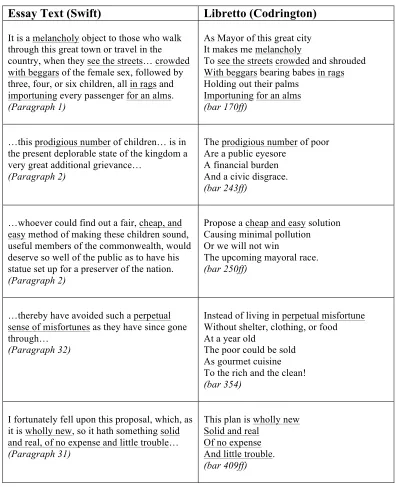
The libretto of A Modest Proposal, by Lisa Codrington, retains a very close connection to the language of Jonathan Swift’s original essay. A significant number of words and phrases have been taken directly from the source, which helps to preserve much of Swift’s tone. For example, the Mayor’s lament for her city (and for her own career prospects) at the beginning of Scene Two expresses her “melancholy” at the “beggars… in rags… importuning… for an alms,” words taken directly from Swift’s opening paragraph (see bar 170ff of the opera).5
True to the style of the essay, the libretto also retains Swift’s brevity and the directness of his language. Whereas other writers might employ innuendo instead of directly proposing infanticide and cannibalism,6 Swift, and Codrington after him, suggests these ideas without hesitation. As forthrightly as Swift’s narrator proposes that “a young healthy child well nursed is at a year old a
5 Jonathan Swift, “A Modest Proposal,” The Norton Anthology of English Literature,
Sixth Ed., W. W. Norton (1996): Paragraph 1.
6 Stephen Sondheim’s 1979 musical, Sweeney Todd, is a delightful example of this type
180
most delicious, nourishing, and wholesome food, whether stewed, roasted, baked, or boiled; and
I make no doubt that it will equally serve in a fricassee or a ragout,”7 so too do the Mayor and
her council in the opera (using, again, many of the same words; see bar 354ff of the opera).
There is neither apology nor knowing wink in Swift’s work, and this operatic adaptation is
similarly straight-faced. Table 1 lists a selection of other portions of the libretto that align very
closely, if not exactly, with Swift’s text.
7 Jonathan Swift, “A Modest Proposal,” The Norton Anthology of English Literature,
181
Essay Text (Swift) Libretto (Codrington)
It is a melancholy object to those who walk through this great town or travel in the country, when they see the streets… crowded with beggars of the female sex, followed by three, four, or six children, all in rags and importuning every passenger for an alms.
(Paragraph 1)
As Mayor of this great city It makes me melancholy
To see the streets crowded and shrouded With beggars bearing babes in rags Holding out their palms
Importuning for an alms
(bar 170ff)
…this prodigious number of children… is in the present deplorable state of the kingdom a very great additional grievance…
(Paragraph 2)
The prodigious number of poor Are a public eyesore
A financial burden And a civic disgrace.
(bar 243ff)
…whoever could find out a fair, cheap, and easy method of making these children sound, useful members of the commonwealth, would deserve so well of the public as to have his statue set up for a preserver of the nation.
(Paragraph 2)
Propose a cheap and easy solution Causing minimal pollution Or we will not win
The upcoming mayoral race.
(bar 250ff)
…thereby have avoided such a perpetual sense of misfortunes as they have since gone through…
(Paragraph 32)
Instead of living in perpetual misfortune Without shelter, clothing, or food At a year old
The poor could be sold As gourmet cuisine To the rich and the clean!
(bar 354)
I fortunately fell upon this proposal, which, as it is wholly new, so it hath something solid and real, of no expense and little trouble…
(Paragraph 31)
This plan is wholly new Solid and real
Of no expense And little trouble.
(bar 409ff)
182
Musical Quotations
Careful selection and placement of a number of musical quotations throughout the opera creates
a secondary perspective from which to consider the work’s themes. While in most cases the
quoted material is fragmented and altered to a significant degree, it will at times become obvious
to the listener, if only briefly.
Most of the quoted material in A Modest Proposal relates in some way to children, who are otherwise absent from the opera despite being critical to the work’s central conflict. Musical
quotations that suggest childhood enable the voiceless victims of the Mayor’s plan to be heard in
the opera’s subtext. The musical work upon which I have most heavily drawn is Gustav Mahler’s
Kindertotenlieder (1905), orchestral settings of five poems by Friedrich Rückert on the death of children. The themes of loss and guilt in Rückert’s text have a particular resonance with the
subject matter of this opera, and the borrowing of Mahler’s emotionally charged music helps to
foreshadow and comment on the opera’s tragedy.
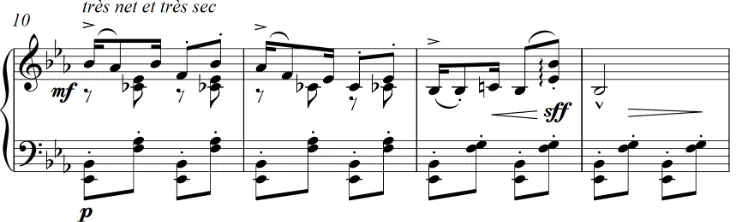
The first occurrence of borrowed material from Kindertotenlieder is found when, in the opera’s overture (bars 6-9 and 12-14), the bass clarinet and horn emerge from the texture to quote in full,
with only a slight rhythmic variation, the entire introductory phrase of the first of the five songs
in the collection, “Nun will die Sonn’ so hell aufgeh’n!” The horn is at the same pitch level as its
source, while the bass clarinet’s line is an octave below where it was originally written for an
oboe. Example 1 shows the opening measures of the Mahler song, while Example 2 shows the
183
Example 1. Gustav Mahler, Kindertotenlieder. Oboe and horn duet from the introduction to “Nun will die Sonn’ so hell aufgeh’n!” (bars 1-4). This material appears in bars 6-9 of the opera score, as shown in Example 2.
184
This first musical quotation is intended to create a parallel between Mahler’s collection of songs,
where the fate of the children is known, and the opera, where the children’s fates are yet to be
determined. It brings to mind the opening text of Kindertotenlieder, which can be translated as “Now will the sun rise as brightly as if no misfortune had befallen in the night!”8 As the sun rises on the opera set, the music foreshadows that a fate similar to that of Mahler’s narrator awaits the
residents of the unnamed city.
A second very brief quotation from “Nun will die Sonn’ so hell aufgeh’n!” occurs in the horn at
the end of the love duet between the Mayor and Street Meat Vendor in Scene One (bars
153-154). Mahler’s opening vocal phrase, shown in Example 3, is expressed in diminution by the
horn immediately prior to the lovers being interrupted by the begging poor. Once again recalling
Rückert’s text about the sun rising after misfortune, the quotation here serves as a subtle pivot
between the lovers’ insular world and the pain and suffering around them as they are jolted back
into reality.
Example 3. Gustav Mahler, Kindertotenlieder. Opening vocal line from “Nun will die Sonn’ so hell aufgeh’n!” (bars 5-8). This material appears in diminution in the horn in bars 153-154 of the opera score, as shown in Example 4.
8 The English translation is taken from Gustav Mahler, Songs of a Wayfarer and
185
Example 4. A Modest Proposal (Scene One, bars 151-154). A brief quotation of the opening vocal line from Mahler’s “Nun will die Sonn’ so hell aufgeh’n!” (in diminution in the horn) acts as a pivot between the Mayor’s and Street Meat Vendor’s insular world and the suffering around them.
186
instead of a G as the second-last note (see bars 778-781 of the opera, shown in Example 7). This is one of only two times in A Modest Proposal that directly-quoted musical material is given to a voice; most other quotations occur in the instrumental parts.
Example 5. Gustav Mahler, Kindertotenlieder. First vocal phrase from “Wenn dein Mütterlein” (bars 8-9). This material appears in altered rhythm and with one altered pitch in the Beggar Woman’s vocal line at bars 778-781 of the opera, as shown in Example 7.
Immediately following this, the opening four bars of the instrumental introduction to “Wenn dein Mütterlein” are presented (Example 6), but with tension added through dissonant notes sustained in the horn (see bars 780-783 of the opera, Example 7). The Beggar Woman, like the singer of the Mahler song, is faced with anguished memories of her deceased child. The text which is recalled by both of these melodic quotations is, in English: “When your dear mother comes in the door… my glance falls first not on her face but on the place… where your dear little face would be if you… came in with her as usual.”9
187
added dissonance in the horn altered rhythm and melody (F#)
Example 6. Gustav Mahler, Kindertotenlieder. Orchestral introduction to “Wenn dein
Mütterlein” (bars 1-4). This material appears with the addition of dissonant sustained notes in the horn at bars 780-783 of the opera, as shown in Example 7.