www.euacademic.org
Knowledge, Attitude and Practice of Nursing
Students about Research with Implementation of
Educational Intervention Program
ROBINA SHAHEEN
Student, Post RN (BSN) Independent College of Nursing, Faisalabad, Pakistan
SHAFQAT INAYAT
Principal Independent College of Nursing Faisalabad, Pakistan
MUHAMMAD HUSSAIN
Assistant Professor School of Nursing The University of Lahore
MUHAMMAD AFZAL
Principal, Lahore School of Nursing The University of Lahore
INTRODUCTION
Nursing research promotes optimum care for patient for patients through evidence- based practice. Students attitude, knowledge and practice motivates them to engage in research, develop research skills and apply research findings in clinical setting to promote positive patient outcome (Memarpour, Fard, & Ghasemi, 2015).
Research is an essential component of medical preparation in developed countries, as it indoctrinates critical analysis and evaluation skills. It is also required for obtaining the necessary reasonable cognitive and interpretation skills, which are of vital importance for the modern clinician.(Ibrahim, Fetyani, & Bashwari, 2013).
Research improves the patient care, promotes the critical thinking and research conduction help in selection of future specialty. (Haseeb et al., 2016).
In the medical filed health research is of great importance. It is trending worldwide that nursing students learn and apply research skills early during their undergraduate’s studies it is of great importance for nursing students to get presented early to methodical research methodology and benefits of conducting their own specific research. (Haseeb et al., 2016).
Research is very important and useful for future profession. And this research conduction secures better chance for taking postgraduate programs. In the financial constrains research is very important. (Memarpour et al., 2015).
It is crucial that medical students appreciate the role of research and submit article of publication. These rates are lower than rates reported from UK study. This difference may be attribute to involving of British students in research. (Ibrahim et al., 2013).
Research involvement has traditionally been documented as an important part of medical education. With increasing importance being placed upon evidence based medicine and the application of logical research to clinical practice, it is becoming increasingly important for medical professionals to possess and understanding of systematic principles and methods, and to be skillful at attainment and critical assessment of new information. (Memoarpour et al., 2015).
Objective of the study is to assess:
1. Knowledge of nursing students about research with the implementation of educational intervention program:
2. Attitude and practice of nursing students about research with the implementation of educational intervention program: 3. Practice of nursing students about research with the
LITERATURE REVIEW:
In the present study, majority of the students had inadequate knowledge on research. This finding was similar with other studies that were conducted among college students by Ibrahim and Hern. One plausible reason could be the orientation of the curriculum is very theoretical and not much priority is given to research. This has led to knowledge gap and misconceptions amongst the medical professionals who play a major role in conducting clinical research. This notwithstanding, there could be other reasons for the observed results like lack of time, perceived complexity of clinical research, lack of monitoring and a casual attitude that leads to undermining the importance of good (Ibrahim et al., 2013).
It is crucial that medical students appreciate the role of research and submit article of publication. These rates are lower than rates reported from UK study. This difference may be attribute to involving of British students in research. (Ibrahim et al., 2013).
cooperation, lack of interest and motivation, and lack of incentives. The study also revealed that the medical students are becoming more enthusiastic about getting involved in research (Memarpour et al., 2015).
On another study that was conducted in New Zealand, among the 756 students enrolled for the academic year, 558 responded, with an overall response rate of 74%. Twenty-five percent of students had participated in some form of research activity during medical school, with summer studentships being the most common type of research experience. Seventy percent of all students surveyed expressed interest in participating in research during medical school. Although 68% of respondents were aware of the intercalated research degree option at the School of Medicine, only 8.6% expressed interest in undertaking this option. The most common reasons for not pursuing an intercalated degree option were lack of interest in this format of research experience (46%), social reasons (29%), and financial reasons (27%). There was no widespread support from the students for having research training as a compulsory part of medical school curriculum. (Memarpour et al., 2015).
MATERIAL AND METHODS
A quantitative descriptive cross-sectional study design was used to assess Depression and Its Contributing Factors among Undergraduate Nursing Students. Study was conducted in the Private sector, Pakistan. Students of Private sector of Jhang, Pakistan. The data was collected from 150 students of Private sector of Jhang, Pakistan. A non-probability convenient sampling technique was utilized to select the proposed sample of undergraduate nursing students. All students of the school of Nursing available at the time of data collection included. Questionnaire adopted from (Nahla Khasmi Ragab Ibrahim, Din M. Fetyani, Jami Ibashwari) was used to collect data from BSN 4th semester and Post RN 4th semester students,
to 150 participants. Collected data was analyze and computed using frequencies, table and percentage by SPSS version 24.0.
RESULTS
1. Age
Table and figure no 1 show that 55.4% (n=144) participants belong to 20-22 age group, while 44.6% (n=116) belong to 22-24 age group.
Age of participant
Frequency Percent Valid Percent Cumulative Percent
Valid
20-22 144 55.4 55.4 55.4
22-24 116 44.6 44.6 100.0
Total 260 100.0 100.0
Figure 1
Gender of participant
Frequency Percent Valid Percent Cumulative Percent
Valid
male 16 6.2 6.2 6.2
female 244 93.8 93.8 100.0
Total 260 100.0 100.0
2. Gender:
Table and figure no 2 show that 93.8% (n=244) participants are females while 6.2% (n=16) are males.
Level of participant
Frequency Percent Valid Percent Cumulative Percent
Valid
Bscn 204 78.5 78.5 78.5
Post RN 56 21.5 21.5 100.0
Total 260 100.0 100.0
Figure 3
3. Level of the participants:
Table and figure no 3 show that 78.5% (n=204) participants belong to BSN while 21.5% (n=56) belong to Post RN.
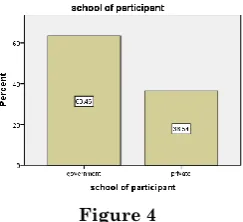
School of participant
Frequency Percent Valid Percent Cumulative Percent
Valid
government 165 63.5 63.5 63.5
private 95 36.5 36.5 100.0
Total 260 100.0 100.0
4. School of participant:
Table and figure no 4 show that 63.5% (n=165) participants belong to Government while 36.5% (n=95) belong to private.
Participant research
Frequency Percent Valid Percent Cumulative Percent
Valid
yes 208 80.0 80.0 80.0
no 52 20.0 20.0 100.0
Total 260 100.0 100.0
Figure 5
5. Participant received training in research:
Table and figure no 5 show that 80.0% (n=208) participants have training in research while 52.0% (n=20) do not have training in research
Conduct a research
Frequency Percent Valid Percent Cumulative Percent
Valid
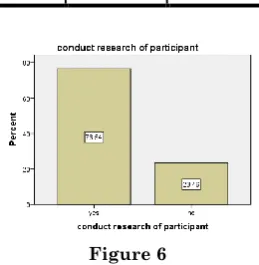
yes 199 76.5 76.5 76.5
no 61 23.5 23.5 100.0
Total 260 100.0 100.0
6. Conduct a research:
Table and figure no 6 show that 76.50% (n=199) participants have conducted a research while 23.5% (n=61) participants do not have conducted a research.
Presented a research in a scientific conference
Frequency Percent Valid Percent Cumulative Percent
Valid
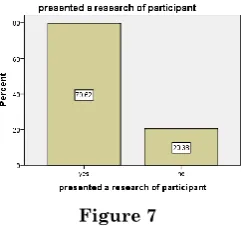
yes 207 79.6 79.6 79.6
no 53 20.4 20.4 100.0
Total 260 100.0 100.0
Figure 7
7. Presented a research in a scientific conference:
Table and figure no 7 show that 79.6% (n=207) participants presented a research in a scientific conference while 20.4% (n=53) participants do not presented a research in a scientific conference.
Knowledge:
Questions Correct answers Wrong answers
No % No %
Component of a specific research 89 34.2 171 65.8
Contents of abstracts 87 33.5 173 66.5
Average no of words in abstracts 35 13.5 225 86.5
Definition of research hypothesis 97 37.3 163 62.7
Sample must be reprehensive 30 11.5 230 88.5
Objective of a research 95 36.5 165 63.5
Uses of pilot study 28 10.8 232 89.2
Contents of methodology section of a research
50 19.2 210 80.8
Characteristic of a good clinical trial
98 37.8 162 62.3
Composition of result section of a research
Relationship between research knowledge and studies variables:
Conniving the total knowledge score open that knowledge about research was generally low between medical students and interns. The mean score on the knowledge test was 2.44±1.96 on 10 knowledge questions. The common of the medical students and interns (83.1 %) gained poor knowledge score. Whereas only 13.8 % and 3.1 % gained fair and reasonable knowledge scores, respectively. Attitudes of medical students & interns towards research that the scholar medical student should contribute in researches (88.0 %) and can carry out a research (70.7 %). Most of the students and interns agreed that research is useful for their coming career (85.9%), for fortifying better position (72.7%) and for a better casual for postgraduate programs. Greatest of the students and interns decided on that the focal barriers to students' investigates are deficiency of training (76.7 %), deficiency of time (74.3 %), substantial educational or clinical shipment (69.5 %) and deficiency or insufficient mentorship. creates the suggested answers for determining problems to research programmer. Most of the contributors agreed that running of more research developments (74.1 %), research exercise (79.8 %), appealing medical students in mentored research (78.1 %) and delivery of compulsory developments on research procedure (71.7 %) are the main explanation (Table 5).
Those who acknowledged research exercise and those who beforehand showed researches or existing a research in indigenous or intercontinental discussions had pointedly (p < 0.05) complex research knowledge score associated to others There were no numerical weighty differences (p > 0.05) between knowledge score about research and contributors' age, level of education, gender & the type of high school (Table 2). The majority of the contestants agreed. Concerning self-reported practice, the study exposed that 28.4 % of the study the sample customary preceding research exercise. Two-fifths (38.1 %) of medical students and interns contributed in researches, 12.3 % accessible their research at a technical meeting and 5.8 % printed a scientific paper in a medical journal.
experience which on condition that them with many research knowledge and skills. demonstrates that 43.7 %, 25.9 %, 10.4 % and 5.9 % of the students and interns thought that readiness of research groups, workshops, logical chairs and research developments are the presented occasions for smoothing transference of researches, respectively. Sharing, presentation and publishing systematic research Percent in the Pre-test, two thirds of contributors (66.7%) got poor knowledge score. This proportion markedly deteriorated to reach only 3% after the program On the other projectile, the percentage of pleasing scores was markedly improved from 15.1% to 90.9 % in the Pre and Post-tests, correspondingly with a statistically noteworthy difference (McNemar test= 39.03, P < 0.001) the mean participants' knowledge score in the Pre- Test was 3.91 ±2.42 (on 10 questions). Clear development was experimental after the involvement program. Their mean score reached8.82±1.59 in the Post-test (paired t-test.
Attitude:
SR: Statement Agree Neutral Disagree
1. Undergraduates should
participate in researches N 219 % 88.0 N 18 % 7.2 N 12 % 4.8 2. Undergrads can carry out a
research and write a paper
176 77.0 42 16.9 31 12.4
3. Conduction of research is difficult
153 61.4 56 22.5 40 16.1
4. Importance of studying
compulsory research
methodology course
196 78.7 32 12.9 21 8.4
5. I feel confident in
interpreting and writing papers
88 35.3 62 24.9 99 39.8
6. Research is useful for my future profession
214 85.9 28 11.3 7 2.8
7. Research conduction secures better residency positions
181 72.7 63 25.3 5 2.0
8. Research conduction secures better chance for taking postgraduate programs
201 80.7 44 17.7 4 1.6
9. Research conduction help in selection of future specialty
188 75.5 42 16.9 19 7.6
10. Research is essential for improving health care
223 89.6 22 8.8 4 1.6
11. Research improves patients care
211 84.7 29 11.7 9 3.6
12. Research promotes critical thinking
13. Research improves searching skills
221 88.8 21 8.4 7 2.8
14. Research improves
communication skills
190 76.3 44 17.7 15 6.0
15. Research improves critical appraisal skills
193 77.5 52 20.9 4 1.6
16. Research improves critical appraisal skills
218 87.6 25 10.0 6 2.4
Practice:
17.
Statement:
Lack of research training N 191 % 76.7 N 38 % 15.3 N 20 % 8.0 18. Lack of time for research
conduction
185 74.3 46 18.5 18 7.2
19. Heavy load (educational or clinical)
173 69.5 57 22.9 19 7.6
20. Financial constraints 140 56.2 86 34.5 23 9.3
21. Lack of interest in research 136 54.6 56 22.5 57 22.9
22. Lack of motivation 152 61.0 73 26.9 30 12.1
23. Lack of time for conduction of research
185 74.3 46 18.5 18 7.2
24. Lack of mandatory courses on research methodology
164 65.9 64 25.7 21 8.4
25. Lack of compulsory
communit projects
152 61.0 73 29.3 24 9.7
26. Lack of satistical support 176 70.7 57 22.9 16 6.4
27. Lack of (insufficient) mentorship
152 61.0 76 30.5 21 8.5
28. Lack of intersonal
communication
137 55.0 84 33.7 28 11.3
29. Lack of incentives for research
125 50.2 111 44.6 13 5.2
30. Provision of more
research projects
185 74.3 52 20.9 12 4.8
31. Provision of more
research training
199 79.9 36 14.5 14 5.6
32. Provision of mandatory courses on research methodoogy
179 71.9 47 18.9 23 9.2
33. Engaging medical
students in mentored health research
195 78.3 43 17.3 11 4.4
34. Boosting more funds for research
168 67.5 71 28.5 10 4.0
35. Targeting medical
students to research early
175 70.3 45 18.1 29 11.6
projects
37. Conduction of more
students conferences
189 75.9 47 18.9 13 5.2
38. Conduction of research methodology workshops
199 79.9 44 17.7 6 2.4
DISCUSSION
Research knowledge is precious to the physician's evidence-based practice. Results of the cross sectional part of the current study exposed that the mainstream of medical students and interns gotten low research knowledge score with a mean score of 2.44±1.96 on the pre-test. This score is minor than the score found from Zagreb University, Croatia, where students' normal knowledge score was 3.2±1.7 on 8 questions. 2 A study from the Aga Khan University, Pakistan, initiate that medical students had a judicious level of knowledge about research. 9 Our study exhibited that there is a numerical relationship amid knowledge about research and preceding research exercise. This overlaps with results of Sabzwari, et al 5 from a study among junior faculty members of Pakistani medical universities. Owing to the benefits of researches, it is not surprising that the majority of medical students and interns in the current study had positive attitudes towards research and they agreed that research is beneficial for their future career. This result is in accordance with results reported from other studies.16-18Research not only improves medical information, but also keeps physicians in touch with revolutions in their field and encourages better communication. 19 Our study revealed that the majority of the sample agreed that research improves their communication skills and critical thinking, as shown by others.5Undoubtedly, research in general practice is crucial for the improvement of patient care outcomes 18,20 Student research is not without problems. Good mentorship is an essential component of the successful undergraduate research, while insufficient mentoring can lead to discontentment.
studies.9,16-18 In the current study, the medical students and interns for improving students' research activities suggested several solutions .It included conduction of research methodology training workshops, integration of research methodology mandatory courses into the undergraduate curriculum, engaging students in mentored research projects, boosting more funds for students' research and conduction of more students' conferences. These concur with the suggestions of students from Alexandria's study. Regarding the practice, our study showed that 38.1% of medical students and interns participated in researches which coincides with results of Sabzwari et al. 5 On the other hand, the current results are better than those reported from Aga Khan University, 9 where only 26.9 % of post graduates had previously participated in research.
The current results are also better than those reported from India21where only 9 % of interns reported their previous research experience during medical school. It is crucial that medical students appreciate the role of research and submit articles for publication.16Our results showed that 12.8% of the study population presented papers in scientific conferences and 5.8% of them published a paper in a scientific journal. These rates are lower than the rates reported from a UK study. 16 This difference may be attributed to involving of British students in research or audit project since early phase of their medical education.
Results of the intervention part of our study Revealed that there was marked improvement in the participants' knowledge score after conduction of the program. Few other studies have addressed the knowledge gains after intervention. The Aga Khan study reported that workshops about research skills potentially improved research knowledge. 9 The vast majority of participants in the current study said that the workshop was valuable and enjoyable experience and provided them with knowledge and skills. This agrees with studies from India 21,22 Croatia 2,3 and Alexandria.
CONCLUSION
research were present. Overall, the vast majority of participants considered research helpful for their profession. About two-fifths of medical students and interns participated in researches, while 5.8% published a scientific paper. The training workshop was very successful in improving participants' knowledge about research. The knowledge of the target population was markedly improved after the educational intervention program. Early provision of mandatory and elective courses on research methodology, summer courses on research, good mentorship, graduating research projects, more funds for students' researches, more students 'conferences, workshops and research training are recommended.
REFERENCES
1. Haseeb, A., Bilal, M., Ansari, M. A., Raheem, A., Khan, A., Arshad, M. H., & Akhtar, M. S. (2016). Impact of mode of curriculum on knowledge and attitudes of medical students towards health research. Journal of clinical and diagnostic
research: JCDR, 10(4), LC15.
2. Ibn Auf, A., Awadalla, H., Ahmed, M. E., & Ahmed, M. H. (2018). Perception, barriers, and practice of research among teaching staff at five Sudanese medical faculties. Journal of
Public Health and Emergency, 2.
3. Ibrahim, N., Fetyani, D. M., & Bashwari, J. (2013). Assessment of the research-oriented knowledge, attitude and practice of medical students and interns of the King Abdulaziz 4. Memarpour, M., Fard, A. P., & Ghasemi, R. (2015). Evaluation of attitude to, knowledge of and barriers toward research among medical science students. Asia Pacific family medicine, 14(1), 1.
5. Shahab, F., Ali, M. A., & Hussain, H. (2013). Involvement and barriers to research amongst students of khyber medical college. Journal of Postgraduate Medical Institute (Peshawar-Pakistan), 27(3).
school. BMC medical education, 10(1), 4. University, Jeddah and the adoption of a research-intervention educational program.