A Survey on Object Removal and Region
Filling In Image
Ravi Kateeyare1, Pankaj Bagal2
Assistant Professor, Dept. of ECE, Central India Institute of Technology, Dewas Road, Indore, India. 1
PG Student [EC], Dept. of ECE, Central India Institute of Technology, Dewas Road, Indore, India.2
ABSTRACT: Sometimes people have been taken photographs, there has been the need to remove unwanted artefacts or damaged areas from these images. This is something previously conducted by experts, using computer tools and extensive user input to produce a visually realistic result. The difficulty of the problem lies in how to fill the missing regions, such that they are perceptually unnoticeable, whilst minimizing user input.
Object removal and region filling algorithm proposed for removing unwanted objects from digital images. The challenge is to fill the hole that is left behind in visually plausible way. This problem has been addressed by two classes of algorithms: i) “Texture synthesis” for generating large image regions from sample textures, and ii) “In-painting” techniques for filling in small gaps. Each being used for images with different characteristics. This dissertation is concerned with investigating whether advances in texture synthesis techniques contain the necessary functionality to cross the divide between the two and successfully fill holes in a variety of images. The advantage of the proposed techniques is that it limits the amount of knowledge required by the user, and performs the region filling autonomously, once started.
I. INTRODUCTION
A. OVERVIEW
For years people have been taking photographs of where they have been and who they have been there with as away of remembering occasions that mean a lot to them. This whole time there has been the problem of what to do when such photographs get damaged or have artefacts in the image that are not wanted. The options have always been limited previously, with only a few tools out there to help fix the problems at hand. In addition, these tools rely on the experience of the user to ensure that the repairing of the image is done to a satisfactory level. This is not the sort of skill that the average user will have, and so the results that they would obtain would not necessarily be satisfactory or of a high standard. Ever since the computer started to become a common appliance in people’s homes, the prospect of being able to produce applications to help users repair their own images has started to become more realistic. Initially the algorithms to perform this did not exist, and when they started to appear, they only really worked on a small subset of images. Currently, people only have a few options if they wish to have an image repaired, or want an artefact removed from an image. There are tools in popular programs such as Adobe’s Photoshop and Corel Draw Pro that aim to help users to repair the images using information in the image. However, these are not perfect, and require the user to be quite computer literate or have experience of manually fixing images to make the best use of the program they have. Over the years there have been many algorithms put forward to repair images, with varying amounts of autonomy and effectiveness. The advances that have been made have occurred due to different demands from the research areas, with the region filling/repairing problem being broken up into texture synthesis and image in-painting based techniques. This diversion of the techniques away from one unified approach for all images has brought the technology to where it is today. The ideal solution is to have an algorithm that will still enable experienced users the ability to tune it to the images, but allow less experienced users to use it. This however presents a challenge due to the complete division of the techniques used for structure and texture reproduction. There have been numerous attempts to create algorithms that try to maximize the possible range of images they can work on, but these have tended to use a merge process to combine result from different techniques on the same image.
II. LITERATE REVIEW
This dissertation addresses the problem of how to fill holes in visual images in a plausible way so that when someone view altered image, they cannot tell that anything has been done to it.
The key issue here is filling in the hole in a way that makes the end result look realistic, and where the filling done is not detectable by an outside observer from the intended viewing distance.
Hole filling or region filling as it is sometimes referred to in literature as ‘to fill in gap of missing data in a form that it is not detectable by an ordinary observer’. The hole in an image could be caused by a number of factors. For example, a user could want to remove an object from a photograph so they would chop out the part of the image they do not want and then this area would require infilling.
A. Why Infill?
There are many areas where hole filling techniques have an important role to play. One of the most obvious area is probably the film industry, in particular the special effect business. The wages and insurance costs for well known actors involved in films these days are very high, and film producer cannot afford to risk the actors being injured during stunts or filming. Therefore safety equipment must be brought in to make sure they are safe when filming the scenes. This is where the problems start to arise; how to avoid the safety equipment obviously should not appear in the final scene, and needs to be carefully removed so that the viewer never realizes that it was there. There are basically two techniques available for infilling, inpainting and texture synthesis.
1. Inpainting
A very good description of the role inpainting plays is given by “to restore and fix small scale flaws in an image, like scratches or stains” [2] [4]. Wilczkowiak et al state that inpainting techniques are best suited for small, low textured holes in images. Criminisi, Perez and Toyama [1] state that inpainting techniques have been developed for the task of ‘image restoration, where speckles, scratches and overlaid text are removed’. Inpainting is solely concerned with the propagation of structures into the hole from the image, and so in effect has no interest in the textures that are on the shapes themselves. The algorithms just see lines and curves, and as the texture is not represented as shapes, the algorithm struggles to propagate this information.
a b
Fig. 1 – Before and After Image of Inpainting
Fig. 1(a) is the original one with a small scratch. Fig. 1(b) shows the image when the scratch has been removed using inpainting.
Fig. 2 Types of Texture
2. Drawbacks of Inpainting
Image inpainting concentrates on the structures contained within the image itself, but the way that it does this creates serious drawbacks to the approach. Criminisi et al [1] state that “the drawback is that the diffusion process introduces some blur, which becomes noticeable when filling large image regions”. As stated earlier, it is broadly accepted that the inpainting technique is best used on small scale image ‘flaws’, where the blurring problem is not such an issue.
It is very easy to see the problem is when you look at an image where inpainting has been applied. Inpainting on a large scale is very difficult due to the nature of the process that you are trying to replicate. Currently the best way we have of doing this kind of work is with a person skilled in the art that “repairs images mostly through his experience and knowledge”. The difficulty is how to represent this skill, knowledge and experience in an algorithmic form.
3. Texture Synthesis
This is the other technique that is used for image hole filling. It approaches the problem of how to realistically fill the hole, not based on the image structure but on its content. Wei and Levoy. And Efros and Leung [5] are two well known for texture synthesis, which concentrate on techniques for filling of large holes in images by finding the best texture matches from the rest of the image.
According to Heeger and Bergen [8], textures are normally categorised into two distinct categories, structure textures and stochastic textures.
a b
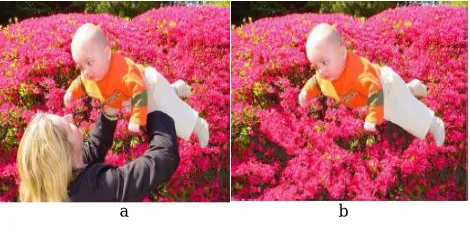
Fig. 3 – Before and After Image of Texture Synthesis
Fig. 3(a) is the original one with two persons. Fig. 3(b) shows the image when the one person has been removed using texture synthesis.
Examples of stochastic textures are sand, granite, bark etc owing to the irregularity of the patterns in the textures. Images normally do not contain a single type of texture, but are usually an amalgamation of different parts that will be different types of texture.
4. Drawbacks to Texture Synthesis
5. Texture synthesis techniques
Depending on reference, texture synthesis can either be split into two. As such, there seems to be no completely accepted division of the techniques within texture synthesis. Texture synthesis can be divided into two distinct areas:-
• Pixel based texture synthesis • Patch based texture synthesis
5.1 Pixel-Based Texture Synthesis
Efros and Leung’s Non-Parametric Sampling synthesizes a texture by repeatedly matching the neighborhood around the target pixel in the synthesis result with the input texture. They perform an exhaustive search for each synthesized pixel. Wei and Levoy’s algorithm is based on Efros/leung, extending it to a synthesis pyramid, which allows the use of smaller neighborhoods at possibly improved quality. Ashikhmin’s[3] intelligent modification significantly reduces search space and achieves interactive frame rates. His paper also thoroughly discusses drawbacks of previous, pixel-based methods, such as blurring.
Fig. 4 –Pixel based Texture Synthesis
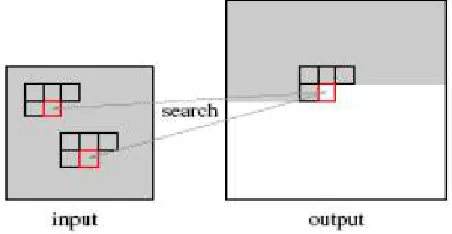
In fig. (4) synthesis process takes place by using pixels. Arrow shows the direction of synthesis process. Current pixel is the pixel which we want to synthesis. Each small square shows the pixel and four white pixels are already synthesized. The value of current pixel depends on already synthesized pixels.
a b
Fig. 5 –Patch based Texture Synthesis
5.2 Patch-Based Texture Synthesis
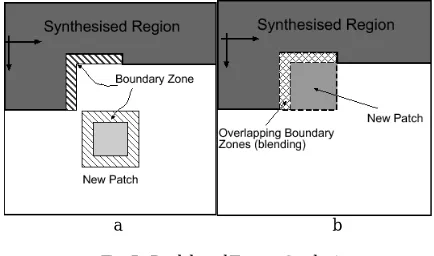
These methods preserve global structure by generating the texture on a per patch basis. Efros and Freeman’s Image
Quilting algorithm aligns adjacent patch boundaries, constrained by overlap, and then performs a minimum-error-boundary-cut (MEBC) within the overlap region to reduce overlap artifacts.
5.3 Method of Texture Synthesis
Non-parametric techniques[5] involve sampling from a series of filters in order to generate textures. Non-parametric sampling as “rather than having a fixed number of parameters they use a series of exemplars to model the texture”. The one characterising feature of all non-parametric sampling techniques is that they sample 1 pixel at a time in order to generate the textures.
Fig. 6 –Pixel-based Non parametric Texture Synthesis
The sampled pixels are normally obtained from areas in the texture where the neighbourhood of pixels are the closest match to the pixels in the neighbourhood of the pixel to be replaced. The most common approach taken to find this pixel is to consider the sum of squared differences of pixel values, and then use a method to minimise the value so you get the best matching pixel colour. Non-parametric techniques are very good at reproducing very structured textures. This is more specific to actual hole filling with texture, than the texture synthesis process itself, but it is a problem with the technique fundamentals.
III.APPLICATIONS
There is wide range of application area for object removal and region filling. There are many areas where hole filling techniques have an important role to play. One of the most obvious area is probably the film industry, in particular the special effect business. The wages and insurance costs for well known actors involved in films these days are very high, and film producer cannot afford to risk the actors being injured during stunts or filming. Therefore safety equipment must be brought in to make sure they are safe when filming the scenes. This is where the problems start to arise; how to avoid the safety equipment obviously should not appear in the final scene, and needs to be carefully removed so that the viewer never realizes that it was there.
IV. CONCLUSION
The characteristics of images and the way that people have divided these up has created the existence of the different types of hole filling techniques. To replace missing ‘Region’ the real technique used are that of inpainting and Texture Synthesis which propagates linear structure into the hole from the known regions. Each technique is good at synthesising the specific types of texture for which it is designed, with each one using a different method in order to accomplish the required results.
REFERENCES
[1] A. Criminisi, P. Perez and K Toyama, “Region Filling and Object Removal by Exemplar based Image Inpainting”, IEEE Transactions on Image Processing, Volume 13, Issue 9, Sept. 2004, 2004.
[2] M. Bertalmio, G. Sapiro, V. Caselles, and C. Ballester, "Image inpainting," SIGGRAPH, pp.417–424, July 2000.
[3] Michael Ashikhmin, “Synthesizing natural textures.”, 2001 ACM Symposium on Interactive Graphics (March 2001), 217–226. ISBN 1-58113-292-1.
[4] IddoDrori, Daniel Cohen-Or and HezyYeshurun, “Fragment Based Image Completion”, ACM Transactions on Graphics (TOG), Proceedings of ACM SIGGRAPH 2003, Volume 22 Issue 3 July 2003, 2003.
[5] Alexei A. Efros, Thomas K. Leung, "Texture Synthesis by Non-Parametric Sampling,"iccv, p. 1033, Seventh International Conference on Computer Vision (ICCV'99) - Volume 2, 1999.
[7] OlivierLeMeurandChristineGuillemot:Super-Resolution-basedInpainting.IEEETRANSACTIONSON MAGEPROCESSINGVOL.PPNO99YEAR2013
[8] DariuM. Gavrila: A Bayesian, Exemplar-Based Approach to Hierarchical Shape Matching. IEEE TRANSACTIONSONPATTERNANALYSISANDMACHINEINTELLIGENCE,VOL.29,NO.8,AUGUST 20071.
[9] JaspreetKaurChhabraand Mr. Vijay Birchha: Detailed Survey on Exemplar Based Image
InpaintingTechniques.(IJCSIT)InternationalJournalofComputerScienceandInformationTechnologies,Vol.5(5),2014,6350-6354
[10] A. Criminisi, P. Perez, K. Toyama, “Region filling and object removal by exemplar-based inpainting”, IEEE Transactions on Image Processing, Vol. 13, No. 9, pages 1200-1212, 2004.
[11] ZongbenXu and Jian Sun, “Image Inpainting by Patch Propagation using Patch Sparsity”, IEEE Transactions on Image Processing, Vol. 19, No. 5, May 2010.
[12] Timothy K. Shin and Rong-Chi Chang, “Digital Inpainting- Survey and Multilayer Image Inpainting Algorithms (Keynote Paper)”, Proceedings of the Third International Conference on Information Technology and Applications (ICITA’ 05), 0-7695-2316-1/05, 2005.
[13] A. Efros and W.T.Freeman. Image quilting for texture synthesis and transfer. In Proc. ACM Conf. Comp. Graphics(SIGGRAPH), pp. 341-346, Eugene Fiume, Aug 2001.
[14] P. Harrison. A non-hierarchical procedure for resynthesis of complex texture. In Proc. Int. Conf. Central Europe Comp. Graphics,Visua. and Comp. Vision, Plzen, Czech Republic, Feb 2001.
[15] J.Jia and C.-K.Tang. Image repairing: “Robust image synthesis by adaptive and tensor voting”, In Proc. Conf. Comp. Vision Pattern Rec., Madison, WI, 2003.
[16] A. Zalesny, V. Ferrari, G. Caenen, and L. van Gool, “Parallel composite texture synthesis”, In Texture 2002 workshop - ECCV, Copenhagen, Denmark, June 2002.