Reducing Power Consumption And Increasing The
Efficiency In Cloud Data Centers
Dhavamani.A1
,Dharmalingam.K2, Sathyalakshmi.S3
1
PG Scholar, Department of Computer Science & Engineering ,Hindustan University, Padur,Chennai, India.
2
PG Scholar, Department of Computer Science & Engineering ,Hindustan University, Padur,Chennai, India.
3
Professor, Department of Computer Science & Engineering ,Hindustan University, Padur, Chennai ,India.
Abstract
Power consumption imposes a major cost for data centers employing cloud system. We have implemented an energy consumption model for existing cloud computing systems. The problem of electricity cost saving within data centers is to minimize the cloud service provider’s electricity cost. The new suggestion is dependent on join
load balancing, Server configuration, and
workload and system performance of cloud systems. The proposed green cloud computing model that achieves not only efficient processing and utilization of computing infrastructure, but also minimize power consumption. The Lyapunov optimization technique that can optimally, exploit hardware devices to minimize the time average cost. Virtualized cloud datacenters that reduces operational cost and provides required Quality of Service.
Keywords – Cloud computing, green cloud,
performance analysis, electricity cost, data center.
I. INTRODUCTION
The growing demand for large-scale computing in the IT field will increase the popularity of cloud computing more and more data centers in the near future. It is common for a cloud service provider to have multiple data centers each having more than thousand servers. To improve reliability and performance, the data centers are placed across the globe. To enhance the energy efficiency such that the same amount of workload can be served with less energy. Virtualization partitions computational resources and allows the sharing of hardware.
Many services often need only a small fraction of the available computational resources of a data center server. However, even when run at a low utilization, servers typically need up to 70% of their maximum power consumption. Such services can be virtualized and run within a virtual machine (VM) resulting in significant increases in overall energy efficiency[3] Virtualization technology allows one of the way to create several Virtual Machines (VMs) on a physical server and therefore, reduce amount of hardware in use and improves the utilization of resources[2]. Since, the physical devices servers
are reduced by the Virtual Machines concept,
the power consumption also reduces. To provide significant cost savings for data centers. A majority of servers will be consolidated using virtualization in the next few years, now that virtualization has become main and important today. The widespread server consolidation and dynamic right-sizing of IT capacity will have a huge economic and environmental impact [8]. Even today the energy efficient data centers consume almost half of their peak power when nearly idle [15].
Energy Efficiency is increased by cloud computing with the following characteristics:
• Efficient utilization of Resources.
• Saving Cost – usage of resources can be adjusted to current requirements of user’s.
The power consumption increases as the CPU utilization increases from the idle state of the server to its full utilization of all the resources [11]. Energy efficient resource management system for virtualized Cloud data centers is to reduce operational cost with good quality of service. In this paper, we proposed a system to reduce power consumption and increasing efficiency in cloud environment.
The current system insists in guaranteeing the QoS by using a random program which integrates the center level load balancing, server-level configuration with battery management [10].They evaluate the proposed algorithm based on real-world datasets and the results show that their approach achieved significant electricity cost saving.
1. Research scope
It mainly focuses on energy-efficient resource management strategies that can be applied on a virtualized data center by a cloud provider [4]. Physical host will be reallocated according to current resource requirements of the file upload process. Idle physical host can be switched off to minimize power consumption. According to the file size the proposed system will analyze and produce result.
• Optimization on multiple system
resources – each time frame, the servers are allocated according to current CPU, RAM and network bandwidth utilization.
• The system performance and the power
consumption will be calculated based on the applications.
• The algorithm will show the power
consumption of the system based on the size of file upload in network. Its shows
the different level of power consumption according to different file size uploads.
II. RELATED WORK
With the popularity of cloud computing more and more data centers are envisioned to be built in the future in order to meet the growing demand of large-scale computing resources [1]. Cloud computing is supported by an infrastructure known as Internet data center (IDC). As cloud computing thrives, the energy consumption and cost for IDCs are increasing exponentially. There is growing interest in the minimization of cost of electricity for IDCs in deregulated electricity markets.[9]. Efficient algorithms are used to minimize the total energy consumption for particular file upload within certain size of memory.
Anshu Gandhi, et.al. [2] It will be optimal to run the servers at minimum power levels or at a moderate power level. But, the analysis shows that it is not easy to run at optimal power levels and it depends on factors. Such as power frequency relationship of processors, highest server frequency, number of jobs at a particular time and server farm configuration.
Austin Donnelly, et.al [4] Write off-loading allows write requests on spun-down disks to be temporarily redirected to determine the storage elsewhere in the data center. The write off loading design and operation achieves these
goals. We estimate it by repeating portions of
our traces on a rack-based test bed.
which aims at capturing some key aspects of energy minimization.
Jianying Luo et.al [7] This paper study is about the steady of leveraging the geographic and temporal variation of energy price to minimize energy cost for distributed IDCs. A spatio-temporal load balancing approach can be used. Considerable evaluations have been done an real life electricity price which demonstrated that this approach significantly reduces energy cost for distributed IDCs.
Sriram Govindan, et.al [5] The energy consumption data centers has more impact on its recurring electricity bill (Op-ex) and one-time construction costs (Cap-ex). Existing cost optimization process depends on strangling devices or workload shaping workloads which had performance degrading. Using peak reduction algorithms are defined that combine the UPS batteries know with existing throttling based techniques for minimizing datacenter power costs.
Yanwei Zhang, et.al [12]. Have investigated algorithm is an innovative approach which reduces the electricity cost of operating cloud scale data centers and also the monthly electricity bill. The solution first of all models the impacts of power demands on electricity prices and the power consumption of cooling and networking in the minimization of electricity cost.
Ziming Zhang, .et.al [15]. Have proposed power consumption and energy efficiency have been computing system such as data centers and compute clouds. Change the settings of hardware components and the number of virtual machines running on each cloud server, and measure the power/energy consumption for different combinations of system configuration and settings.
III.PROPOSED SYSTEM
In this paper, we investigate the issue of exploiting the UPS units within data centers to minimize the cloud service provider’s electricity cost [14]. We propose a joint load balancing,
server configuration and workload, as well as
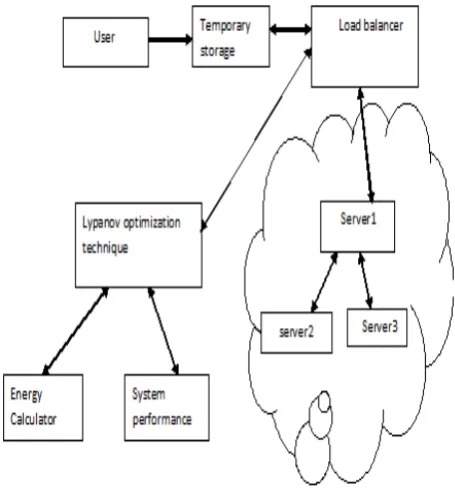
system performance in cloud systems. Since the traffic arrivals and electricity prices are both random processes with possibly unknown statistics, the problem are considered as a stochastic program and then, an online algorithm based on the Lyapunov optimization technique is proposed to solve it.
The architecture of our proposed system is shown in Fig.1.
According to researches of green computing following are few prominent challenges that green computing is facing today.
The major challenging issues found out to be as follows:
•Increase in energy requirement for data centers and growing energy cost.
•Optimally solving the tradeoff between energy saving and performance.
•Determining when or which virtual machines (VMs) and where to migrate in order to minimize energy consumption by system.
Fig. 1 Proposed System
In this study, we determined how to reduce power consumption and minimize cost in the data centers.
• Our proposed optimization technique is
going to provide the overall energy taken by the particular system to perform the uploading process.
• The servers will be selected based on
their RAM size and the available disk space. The energy consumption will be calculated based on their current workload.
• If a server with high RAM capacity in
heavily loaded then the lightly loaded server with less RAM capacity is selected for uploading the file.
IV. ALGORITHM
The system operation consists of the following algorithm steps:
Algorithm for Allocation to Server:
if (job .resource < current_server.resource)
Allocate
else if (job. resource< new_server.resource)
New_server.turnon
Allocate job to new_server
else if (job. resource< new1_server.resource)
New1_server.turnon
Allocate job to new1_ server
Continue till n cases of idle server
Else
Cannot allocate job..
Algorithm for Power Consumption Factor
Here, the minimum power(Min_power) is the maximum power(Max_value) consumed by system (CPU usage).
Consider Min_power = Max_value i.e the total server capacity for n servers,
For ( i = 1 to n )
Min_power > power (server (i))
Min_power = power (server (i))
Min_server = i;
Allocate Min_server = job.
V. CONCLUSION
consider that energy usage of computer systems will become important problem and it will affects the overall power consumption.
REFERENCES
[1].Albers. S, “Energy-Efficient Algorithms,” Comm. ACM, vol. 53, no. 5, pp. 86-96, May 2010. Architectures (SPAA ’06), pp. 190-196, July 2006.
[2]Anshul Gandhi Das. R,” Optimal Power Allocation in Server Farms” March 2009 CMU-CS-09-113, USA.
[3]Anton.B,Rajkumar.B., “Energy Efficient Resource Management in Virtualized Cloud DataCenters” 2010 10th IEEE,Cloud and Grid Computing.
[4]Dushyanth. N ,Austin. D,Antony Row: ”Write Off-Loading: Practical Power Management for Enterprise Storage “ : May 2012.
[5]Govindan. S ,Sivasubramaniam A, and Urgaonkar. B., “Benefits and Limitations of Tapping into Stored Energy for Datacenters,” Proc. 38th Ann. Int’l Symp. Computer Architecture, Mar 2012
[6]Guo.Y, Ding.Z, Fang.Y, and Wu.D, “Cutting Down Electricity Cost in Internet Data Centers by Using Energy Storage,” Proc. IEEE GLOBECOM ’11, Dec. 2011.
[7]Jianying Luo, Lei Rao, Xue Liu.,”Data Center Energy Cost Minimization: a Spatio- Temporal Scheduling Approach”,Proc. IEEE Feb. 2013
[8]Lin .M, Wierman .A, Andrew. L.L.H and Thereska. E., “Dynamic Right-Sizing for Power-Proportional Data Centers,” Proc. IEEE INFOCOM ’11, pp. 1098-1106, Apr. 2011.
[9]Rao L. Xie. W, and Liu W., “Minimizing Electricity Cost: Optimization of Distributed Internet Data Centers in a Electricity-Market Environment,”Proc. IEEE INFOCOM Mar. 2010.
[10]Qureshi. A, Weber. R, Balakrishnan. H, Guttag. J, and Maggs. B, “Cutting the Electric Bill for Internet-Scale Systems,” ACM SIGCOMM Computer Comm., Aug. 2009.
[11]Urgaonkar R, Urgaonkary. B,Neely M.J, and A. Sivasubramaniam,“Optimal Power Cost Management Using Stored Energy in Data Centers,” Proc. ACM Int’l Conf. (SIGMETRICS ’11), June 2011.
[12]Yanwei Zhang, Yefu Wang, and Xiaorui Wang.” Capping the Electricity Cost of Cloud-Scale Data Centers with Impacts on Power Markets”: mar 2011
[13]Yao. F., Demers. A., and Shenker S., “A Scheduling Model for Reduced CPU Energy,” Proc. 36th Ann. Symp. Foundations of Computer Science, Oct.2009.
[14]Yuanxiong Guo,yuguang Fang,”Electricity cost saving strategy in data centers by using energy storage”IEEE transactions on parallel and distributed Systems, june 2013.