Available online:http://internationaljournalofresearch.org/ P a g e | 1193
The Novel Multichip smart grid power sensing module
Dr. V. Padmanabha Reddy
1,
Kiran Subramanyam Kencherla
21
Associate Professor Dept. of ECE, Svr Engineering College Nandyal.
2
PG-ScholarDept. of ECE, Svr Engineering College Nandyal.
Abstract
Smart grid technology is one of the recent developments in the area of electric power systems that aid
the use of non-conventional sources of energy in parallel with the conventional sources of energy.
Monitoring and control of smart grids is essential for its efficient and effective functioning. In this paper,
we propose architecture for monitoring power in smart grid applications using wireless sensor network
(WSN) technology. A prototype power sensing module is designed and developed to calculate the power
for any kind of loads. Using WSN technology, the monitored power is communicated to the sink at
periodic intervals. Multi hop wireless mesh network is set up using IRIS motes to enhance the
communication between the power sensing nodes and the sink. The data collected is a rich source of
repository for data analysis and modeling. A number of smart actions and applications, such as power
theft detection, energy efficient building design, smart automation systems and smart metering can
evolve out of the proposed model. A novel Power theft detection algorithm is proposed and simulated in
this paper. The system is also scaled using GSM technology to extend the range of communication.
Load monitoring can aid distributed architecture in smart grids with automated technology to switch
between the non-conventional source of energy and the grid.
Keywords:multichip, smart grid, power sensing module.
1.
Introduction
Improvements in power electronics technologies
and utilization of renewable energy sources for
power generation have given rise to the use of
distributed generation and create concept of
smart grids and micro grids to overcome rapid
increase in the demands for electricity and
depletion of conventional energy sources.
Monitoring of power system parameters like
voltage, current and power at distribution level
is crucial for efficient functioning of smart
grid.The power exchange between the smart
grid and the utility grid happens by switching.
This switching needs complete synchronism
between the smart grid and the utility grid. An
economic & reliable communication backbone
along with accurate monitoring system is
Available online:http://internationaljournalofresearch.org/ P a g e | 1194
essentially has two main modules:
communication module which is the backbone
and the sensor module for sensing the different
parameters like voltage, current and power. The
basic communication architecture is simple and
the actual network topologies can be very
diverse and depend mostly on the field-level
network. With respect to the communication
requirements, several options are possible
[1]-[4]. Wired communication with dedicated data
networks connecting the field devices is one
possibility. Dedicated wired data networks can
be designed to fulfill the requirements, but the
installation costs do not permit an intensive use
[5].A less expensive option is wireless
networks. Technologies for wireless local area
networks or Personal Area Networks like IEEE
802.15.4 can, in principle, be used as a
replacement for wired links [6, 7]. An alternate
wireless technology is cellular networks as used
in telecommunications, like global system for
mobile communications (GSM) or general
packet radio service (GPRS), or worldwide
interoperability for microwave access
(WiMAX). They have high coverage and low
installation costs for the end devices if the
infrastructure already exists [5].
The downside is the general dependency on the
network provider if public telecommunication
networks are used– regarding both costs for the
communication channels and quality of service
(QoS). A power line communication system is
another popular method for communication [7]–
[11]. They use the existing power cabling and
need only moderate additional network elements
but require a more complex technology in order
to overcome the rather poor communication
channel characteristics. This type of
communication needs higher technical effort
and cannot be used in case of a disaster where
the power lines are disconnected. Recently,
WSNs have been recognized as a promising
technology that can enhance various aspects of
today’s electric power systems, including
generation, delivery and utilization, making
them a vital component of the next generation
electric power systems, smart grids [12].
Wireless sensor networks in conjugation with
SCADA have been implemented in wind power
plants. The wireless sensor network can provide
abundant, real-time data for wind driven
generators’ reliable running, guaranteeing the
steady running of wind power plant [13].
ZigBee based WSN are proven to be more
reliable in packet delivery due to mesh based
multihop networking. The security of 802.15.4
is also proven better than many exiting
protocols in the literature. Generally wireless
sensor networks have the main constraints of
battery power and scalability but these
constraints are well addressed in new ZigBee
Available online:http://internationaljournalofresearch.org/ P a g e | 1195
options and dynamic multihop algorithms. The
proposed application is for smartgrids, so with
little auxiliary charging circuit sensor networks
can be made less energy independent.
In India context of application of WSNs to
power systems, new ideas and implementation
plans are coming up where various parameters
in the system, etc., are being dealt with [14].
The harsh environments of the power systems
need properly designed wireless modules along
with efficient sensing elements. Generally
sensing mechanism for measuring the voltages
and currents in a power systems is to use
potential transformers (PTs) and current
transformers (CTs). This technology for sensing
has proved itself over a long period of time in
industry and in the field. The commonly
available current sensors for higher ratings of
current are magnetic core based CTs. In case of
lower ratings, different transducers like the
Hall-Effect current transducers are also
available [15]. The usual method of measuring
the voltages is by using the potential
transformers. This paper focuses on proposing
architecture for power monitoring system for
smart grid applications using WSN technology.
The mode of communication used is 802.15.4
protocol with a multi-hop network.
Multi-hop wireless communication extends the
range of monitoring with the flexibility of easy
installation of the monitoring system. A power
sensing module is designed and developed to
measure the active power consumption of any
kind of load. In this paper, we also discuss an
algorithm to detect power theft which is one of
the novel applications using the proposed
architecture of the WSN based power
monitoring system. Rest of the paper discusses
the system architecture for WSN based power
monitoring, design of the sensing module,
experimental results, discussion and finally the
conclusion.
2.
Related Work
We can use both wired and wireless
technologies in MGs. Popular wired
technologies are serial communication RS
232/422/485, power line communication, bus
technology and Ethernet. On the other hand,
popular wireless technologies are Wi-Fi,
WiMax, ZigBee, cellular, radio frequency and
microwave [3]. Wired technologies are more
reliable and have higher data bandwidth
however they add to already complex grid
network and have costlier installation process.
Wireless technologies are comparatively
cheaper and suitable for remote location. They
can also easily accommodate any future
expansion needs. The cost of implementing a
wired technology will be significantly high with
every increasing number of meters, sensors and
actuators. Hence, wireless technology is best
Available online:http://internationaljournalofresearch.org/ P a g e | 1196
though they have lower data transmission rates
[4]. The delay of the communication system is
very crucial in MG applications and must be
kept within acceptable limits. The processing
time of ZigBee is about 400 – 600 μs, for
transmitting three different data. ZigBee has two
communication capabilities, i.e., reduce function
device (RFD) and full function device (FFD). A
RFD can communicate with end nodes like
sensors, meters or actuators but it cannot
communicate with other RFDs. Hence it acts as
an end node. FFD can communicate with other
FFDs as well as the sensors, meters or actuators.
Hence it acts as a router [5].
3.
Implementation
A. Block Diagram
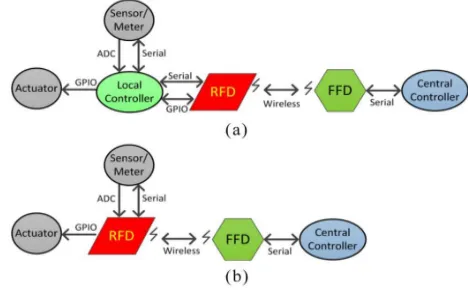
The sensors, actuators and meters in the network
can directly communicate with the local
controller using analog to digital converters,
serial communication or general purpose input
output ports. The local controller can process
this data and transmit it to the central controller
through FFD. Alternatively, the sensors,
actuators and meters can directly communicate
with RFD which will transmit the data to the
central controller. This is shown in Fig. 1(b).
However, there will be no local data processing
capability in second option.
Fig. 1. (b) CB status and voltage/frequency data
transfer to central controller throughRFD.
The connection between the end nodes like
sensors, meters and actuators to the local
controller is wired wherein local controller
communicates to the central controller through a
ZigBee FFD wireless node. The RFDs are
known as reduced functionality devices and can
only connect to end nodes, whereas the fully
functional devices can also connect to other
FFDs.
B. Communication Flow Chart
Due to huge number of end nodes involved, the
micro grid communication system will have
large number of data transmission. As ZigBee
has limited rate of data transmission, a careful
management of data flow is must such that the
network bandwidth can handle the data traffic
[6]. Real time data transfer is required only for
the CB status. Other parameters like voltage
magnitude, frequency and angle can be sent
after a short interval of ∆T. This will reduce the
Available online:http://internationaljournalofresearch.org/ P a g e | 1197
reduce the data transmission, we can define
acceptable limits for data variation such that the
data will be transmitted only if it exceeds the
defined limit ∆L. For example, data variation
limit for frequency will be 49.5 to 50.5 Hz and
for voltage, it will be 210 to 250 volts. Based on
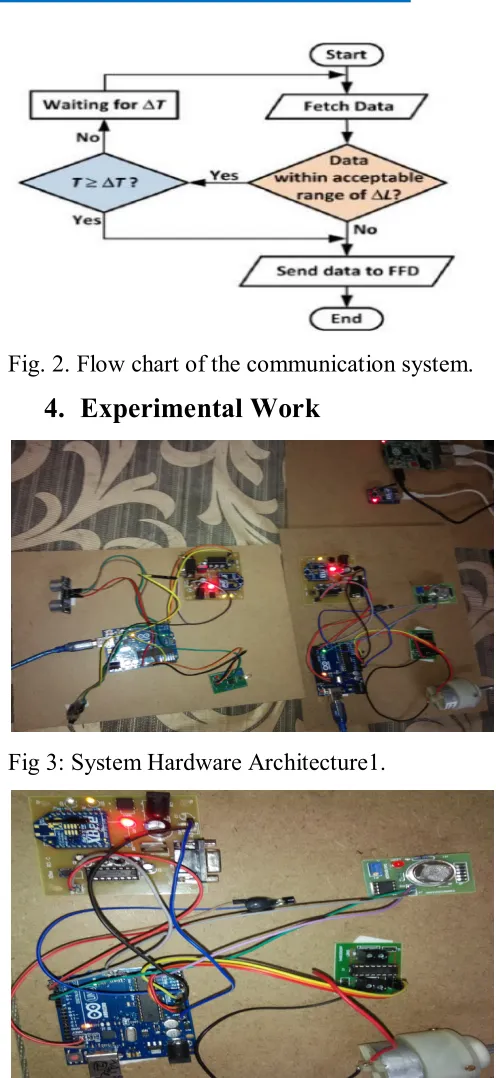
the interval and data variation value, the flow
chart is shown in Fig. 2. Thus we can efficiently
use ZigBee devices which have less data
transmission bandwidth but are but are cheaper
for mass use. The system is designed to have a
dual handshake protocol for better reliability.
Fig. 4 shows the communication sequence of
data transfer between RFDs and FFDs. The
coordinator of FFD sends a request for data
transmission to RFD/FFD. Then, the RFD / FFD
confirm the request by sending an ACK signal
and the requested data. Once the complete data
is received, the coordinator will send an ACK
signal to the respective RFD/FFD. So both the
nodes will have an acknowledgement of data
increasing reliability of the system. Hence by
using the time interval, data variation limit and
dual handshake, we can achieve both low
transmission rate as well as reliability of the
data.
Fig. 2. Flow chart of the communication system.
4.
Experimental Work
Fig 3: System Hardware Architecture1.
Available online:http://internationaljournalofresearch.org/ P a g e | 1198
Fig 5: System Web welcomes Page.
Fig 6: Web page along with Nodes1 and Node2.
5.
Conclusion
In this paper, architecture for power monitoring
system using the wireless sensor network
technology is proposed. Multi-hop mesh
network was set up for long range and reliable
wireless communication. A prototype for power
sensing module was designed and developed for
monitoring single phase system. The sensing
module is calibrated and tested for the accuracy.
The experimentation performed shows that the
measured power almost matches the rated
power. The calibrated sensing module along
with the WSN node communicated the
monitored power value to base/sink at periodic
intervals. With appropriate scaling this model
can be extended to distribution systems also. It
is clear from the experimentations that the
wireless sensor networks may be successfully
employed to smart grids for monitoring purpose.
With proper design we also show that WSN can
be employed to mitigate power theft and can be
effectively used for monitoring the all costly
electrical equipment as part of maintenance. For
large scale deployment, cost effective power
monitoring system is essential, which requires a
reliable and low cost WSN mote design. This
system can be extended for smart home
automation, online billing and smart metering
applications also. This can also be further
extended for complete distribution system
monitoring with the monitoring of transformers’
temperature, oil levels, over-loading, etc.
6. References
[1] A. Ipakchi and F. Albuyeh, ―Grid of the
future,‖ IEEE Power Energy
Mag., vol. 7, no. 2, pp. 52–62, Mar./Apr. 2009.
[2] F. Lobo, A. Cabello, A. Lopez, D. Mora, and
R. Mora, ―Distribution
Network as communication system,‖ in Proc.
SmartGridsDistrib.,
CIRED Semin., Frankfurt, Germany, 2008, pp.
1–4.
[3] M. McGranaghan, D. von Dollen, P. Myrda,
Available online:http://internationaljournalofresearch.org/ P a g e | 1199
experience with developing a smart grid
roadmap,‖ in Proc. Power
EnergySoc. Gen. Meeting—Conversion and
Delivery of Electrical
Energy in the 21st Century, Pittsburgh, PA,
2008, pp. 1–5.
[4] S. E. Collier, ―Ten steps to a smarter grid,‖
in Proc. REPC, Fort
Collins, CO, 2009, pp. B2-1–B2-7.
[5] A. Mahmood, M. Aamir, and M. I. Anis,
―Design and implementation
of AMR Smart Grid System,‖ in Proc. EPEC,
Vancouver, BC, Canada,
2008, pp. 1–6.
[6] C. Bennett and D. Highfill, ―Networking
AMI smart meters,‖ in Proc.
Energy 2030 Conf. (ENERGY), Atlanta, GA,
2008, pp. 1–8.
[7] A. Sarafi, G. Tsiropoulos, and P. Cottis,
―Hybrid wireless-broadband
[8] over power lines: A promising broadband
solution in rural areas,‖
IEEE Commun. Mag., vol. 47, no. 11, pp. 140–
147, Nov. 2009.
[9] G. N. SrinivasaPrasanna, A. Lakshmi, S.
Sumanth, V. Simha, J. Bapat,
and G. Koomullil, ―Data communication over
the smart grid,‖ in Proc.
ISPLC, Dresden, Germany, 2009, pp. 273–279.
[10] M. Bauer, W. Plappert, C. Wang, and K.
Dostert, ―Packet-oriented
communication protocols for Smart Grid
Services over low-speed
PLC,‖ in Proc. ISPLC, Dresden, Germany,
2009, pp. 89–94.
[11] F. Lobo, A. Lopez, A. Cabello, D. Mora, R.
Mora, F. Carmona, J.
Moreno, D. Roman, A. Sendin, and I. Berganza,
―How to design a
communication network over distribution
networks,‖ in Proc. 20th Int.
Conf. Exhib. Elect.Distrib., Prague, Czech
Republic, 2009, pp. 1–4.
[12] Vehbi C Gungor, Bin Lu and Gerhard P.
Hancke, ―Opportunities and
Challenges in Wireless Sensor Networks in
Smart Grid‖, IEEE
Transactions on Industrial Electronics, Vol.57,
pp. 3557-3564, 10
October 2010e, , 1998.
[13] XingzhenBai, XiangzhongMeng, Zhaowen
Du, Maofa Gong, Zhiguo
Hu, ―Design of Wireless Sensor Network in
SCADA for Wind Power
Plant
[14] AryadeviRemanideviDevidas,
ManeeshaVinodini Ramesh, ―Wireless
Smart Grid for Monitoring and Optimizing
Electric Transmission in
India‖, Fourth International Conference on
Sensor Technologies and
Available online:http://internationaljournalofresearch.org/ P a g e | 1200
[15]
http://www.allegromicro.com/en/Products/Part_
Numbers/0712/0712.p
df
[16] nes C manual provided by Crossbow with
the motes
[17] XMDA-MTS manual provide by Crossbow