ISSN (Print) : 2320 – 3765 ISSN (Online): 2278 – 8875
International Journal of Advanced Research in Electrical,
Electronics and Instrumentation Engineering
(A High Impact Factor, Monthly, Peer Reviewed Journal)
Website: www.ijareeie.com
Vol. 6, Issue 10, October 2017
Economic Load Dispatch and Unit
Commitment Solution Using Advanced
Optimization approach-A Review
Md Afzal1 , Manish Kumar Madhav2
PG Student [P.S.], Dept. of EE, Shri Ramswaroop Memorial University, Lucknow(U.P.), India1
Assistant Professor, Dept. of EE, Shri Ramswaroop Memorial University, Lucknow(U.P.), India2
ABSTRACT: Unit Commitment and Economic Load Dispatch problems are two different problems as well as research applications in power systems which are used to optimize the total production cost of the predicted load demand. The UC problem is used to schedule ON and OFF for a combination of generating units while satisfying several operational constraints. On the counterpart, ELD evaluates operational cost of the scheduled generating units while satisfying the load demand of the customers. These problems has been considered by several researchers in their work in the past five decades but still some of the researchers have been working on UC-ELD problem to find a novel approach which can make this problem more realistic. Due to the increasing demand of load, the importance of UC and ELD has also been increased so there is a need of an urgent application in the domain of power sector in order to keep track of the optimization of generating units. In this paper, the main focus is on providing review of the techniques employed in optimizing the problem of Unit Commitment and Economic load dispatch. These techniques have been acquired from the work of several researchers which has been categorized into different areas.
KEYWORDS: Unit Commitment (UC), Economic Load Dispatch (ELD), Fuzzy Logics, Particle Swarm
Optimization, Genetic Algorithm
I. INTRODUCTION
Due to high industrial load in everyday time, the generation of electric power has also been increasing and larger while day time as well as in the evenings because of residential population usage. These power requirements are forecasted beforehand for successive operating day. Consequently, generating units in the systems are scheduled on the hourly basis i.e. a week ahead forecasted. The ON/OFF status of the system is scheduled along with the power outputs of generating units in order to accomplish the demand which is forecasted over a time. With the variations in each day load patterns, there is a requirement of generating enough power to fulfill the need of load [1]. Additionally, to run individual unit every time is not at all economical. Thus, it is required to identify the unit of a system in order to operate for given loads. This problem in electrical power systems is known as unit commitment problem.
ISSN (Print) : 2320 – 3765 ISSN (Online): 2278 – 8875
International Journal of Advanced Research in Electrical,
Electronics and Instrumentation Engineering
(A High Impact Factor, Monthly, Peer Reviewed Journal)
Website: www.ijareeie.com
Vol. 6, Issue 10, October 2017
ON or OFF. On the counterpart, Economic dispatch decides the power output of the scheduled generating unit at each time-point. Among these problems, unit commitment is the most challenging optimization problem. As in the unit commitment, there is excessive number of generating units and their possible combinations of shut down and shut up states makes them difficult in the power system over all the time period in study. Mainly, UC and ELD are treated as two different optimization problems in achieving the objective of economic operation. These problems represent a time decomposed approach. Both problems have taken their own time span where UC takes long time span such as 24 hours or a week. In UC, ON/OFF timing of generating unit has been scheduled in order to minimize the overall operating cost. On the other side, the problem of ELD deals for shorter time span approximately from seconds to the minutes (20 minutes). ELD allocates the generation outputs to the synchronized units with respect to meet the expected load. Consequently, in order to minimize the cost and responsive to the requirement in real time systems, both are necessary approaches [3]. In addition to this, main objective of these approaches is to minimize the cost of the fuel with less time of operation while meeting the imposed constraints in the system. There are several methods have been proposed which were used to switch ON/OFF on the basis of exhaustive search such as GA. Some of the approaches which are used for the same are EPSO, ABC, DE-OBL and CSO. These methods were proven to be effective in meeting the demand of load without any violating against the power balance as well as capacity constraints.
II. LITERATUREREVIEW
From the last decade, numerous algorithms have been developed categorized into two types such as exact and approximate for two different problems UC and ELD. By the term exact solutions means that problems can be acquired through the numerical calculations but these solutions due to computational overheads cannot applicable to real time practical systems. The examples for UC-ELD methods of exact solutions are Dynamic programming, Branch and Bound, Lambda iteration method, mixed integer programming, Lagrangian relaxation method and Newton’s method. Whereas the approximation method include Artificial Neural Network, Simulated Annealing, Particle Swarm Optimization, Tabu search, Evolutionary Programming, Bacterial Foraging Algorithm, Differential Evolution, Bio-geography based optimization and Intelligent Waterdrop algorithms.
1. Fuzzy Logics and genetic algorithm
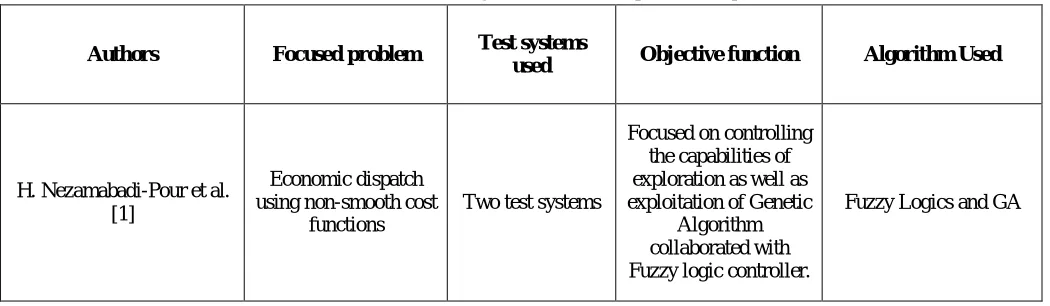
H. Nezamabadi-Pour et al. [1]presented a novel approach to solve the problem of economic dispatch using
non-smooth cost functions with FAGA i.e. Fuzzy Adaptive Genetic Algorithm. The proposed algorithm focused on controlling the capabilities of exploration as well as exploitation of Genetic Algorithm collaborated with Fuzzy logic controller. This method can effectively explore and exploit the optimum solutions. The experimental analysis has performed using proposed and real genetic Algorithm (RGA). From the acquired results, it has confirmed that FAGA i.e. proposed algorithm outperforms other methods with respect to quality, convergence as well as success rates.
Vinay Kumar Sharmaet al. [2]proposed an application based upon fuzzy logic and genetic algorithm in order to solve
the problem of economic load dispatch. Initially, in this paper, an improved genetic algorithm with two fuzzy controller technique has proposed where the crossover probability and mutation rate was adjusted accordingly in the optimization process. Moreover, fuzzy crossover as well as fuzzy mutation’s implementation has also described in this paper. This proposed method can be applied on several optimization problems. The validity of the proposed algorithm was tested on the economic dispatch of six generator system. The simulation analysis were performed and compared with the conventional Genetic Algorithm and Newton-Raphson method. From the results acquired, it has been shown that proposed technique was encouraging. The risk analysis can be possible because the proposed system was robust. Some of the work related to indices can be derived. Furthermore, hedging policies can also be included.
2. Genetic Algorithm
BhushanMakwaneet al. [4] presented an application based upon Genetic Algorithm which was used to resolve the
ISSN (Print) : 2320 – 3765 ISSN (Online): 2278 – 8875
International Journal of Advanced Research in Electrical,
Electronics and Instrumentation Engineering
(A High Impact Factor, Monthly, Peer Reviewed Journal)
Website: www.ijareeie.com
Vol. 6, Issue 10, October 2017
reduce the total generation cost of the system while meeting the demand of load. Thus, the main objective of this paper was to reduce the total generation cost of fuel while maintaining flow of the power within safety limits. The proposed algorithm was tested under given test systems considering transmission line losses.
Gwo-Ching Liao and Ta-Peng Tsao[5]proposed a novel approach which was a combination of genetic algorithm,
fuzzy system and Tabu search. This algorithm was proposed for short terms thermal generating unit commitment. This paper discussed four different improvement plans for genetic algorithm such as:
1. Improvement about regulating the fitness function.
2. Improvement in choosing items as well as in reproduction strategy.
3. The crossover and mutation ratio in the system remained constant and was changed using fuzzy system
method.
4. The best local search method was imported into the algorithm.
Li Maojun and Tong Tiaosheng [6]described an effective approach based upon the genetic algorithm used for unit
commitment. Furthermore, three kinds of genetic operators were constructed. The experiment analysis of this method ensured that proposed algorithm was capable of solving the issue of Unit Commitment problem.
3. PSO
Hardiansyah, Junaidi et al. [7]proposed an effective and reliable particle swarm optimization technique for solving
the problem of economic load dispatch. This paper focused on ELD problem which is consider to be a common task in operational planning of a system that requires to be optimized. The experimental results have been examined for the system that considered standard 3-generator as well as 6-generator systems with transmission losses and without transmission losses. The acquired results were compared with traditional quadratic programming and concluded that proposed method was effective and encouraging.
Jaya Sharma et al. [8]presented a review on the applications of Particle Swarm Optimization in ELD problems. From
the review, it has been concluded that PSO is considered to be an effective and reliable approach. PSO has several merits such as mathematical simplicity, robustness and fast convergence due to which it provides high quality solution and considering this fact, makes this technique as one of the popular optimization problems. This technique has been successfully applied on several fields of power system. Besides the benefits of PSO, ELD has also considered with this algorithm that provide solution in efficient, reliable and low cost.
Nagendra Singh et al. [9] proposed a novel approach based on Particle Swarm Optimization with moderate random
search. This algorithm has proven to be best algorithm which helped in solving the engineering problems. This paper applied the advanced PSO i.e. PSO with moderate random search strategy used to enhance the ability of the particles in order to explore the solution in an effective manner and convergence rates has also increased. This paper demonstrated the performance of MRPSO under 3 and 6 generator systems with valve point loading effect along with the ramp rate limit constraints.
P. Sriyanyong, and Y. H. Song[14] proposed a new method to solve the problem of Unit commitment using PSO with
Lagrange Relaxation method. In order to set the Lagrangian multipliers, the proposed PSO algorithm was used. The proposed system was demonstrated under 4 and 10 unit systems to understand its feasibility.
4. Moth Flame Optimization and Sine Cosine Algorithms
PawanPreet Singhet al. [3]proposed an approach for ELD problem optimization in the power systems. The proposed
ISSN (Print) : 2320 – 3765 ISSN (Online): 2278 – 8875
International Journal of Advanced Research in Electrical,
Electronics and Instrumentation Engineering
(A High Impact Factor, Monthly, Peer Reviewed Journal)
Website: www.ijareeie.com
Vol. 6, Issue 10, October 2017
Sandeep Kaur et al. [13] aimed to solve the problem of unit commitment under 14, 30 and 56 bus system respectively.
The method was proposed using Sine Cosine Algorithm which is one of the modern algorithms used for resolving the UC problem in the power systems. In the unit commitment problem some of the objective functions included is startup cost, shut down cost and fuel cost. Based on the analysis, it has confirmed that there is a requirement of introducing economical as well as optimum schedule of different generating units running with different fuels.
5. Resolving UC-ELD problem
Surekha P et al. [10] distributed the project into different phases. In the first phase, schedule the distribution of
generating unit using GA economically was focused. Optimal load distribution has focused on the second phase of the project with the help of SADE i.e. Self Adaptive Differential Evolution algorithm. During each hour, the combinations of generating unit which commit and de-commit are selected through Genetic Algorithm. And these pre-committed schedules were optimized through SADE algorithm. The proposed algorithm provided a global optimum solution along with effective and feasible solution quality. Moreover, the proposed technique produced cost and time effective with higher precision. The proposed system was investigated on two different test systems worked on 6 and 10 generating units using MATLAB R2008b software tool. The experimental analysis has shown that proposed method was capable in providing the higher quality solution such as fast convergence, mathematical simplicity, scalability, diversity maintenance and robustness.
Zeinab G. Hassan et al. [11]proposed GA and Dynamic Programming in view of resolving the problem of UC and
BAT technique was used to solve the ELD problem of thermal plants that depended upon the results acquired from Unit Commitment solution. For the demonstration, IEEE 30 bus system has used to evaluate the quality of the solution, computation efficiency and application feasibility of BAT algorithm in Economic Load Dispatch problem.
Gaurav et al. [12]presented a solution regarding Unit Commitment problem using dynamic programming over 24 hour
time horizon for multi unit system. By implementing this work, it has been concluded that for the next H hours, it was easy to evaluate the optimal generating unit commitment in power systems. The reduction in total production cost such as maintenance cost and fuel cost was the main motive of this paper.
The analysis of literature survey concluded that most of the work has done for either Unit commitment or ELD Economic Load Dispatch. However, a complete solution regarding both UC-ELD problems can be resolved using heuristic techniques for real time power systems while validating the techniques in view of different performance parameters such as robustness, computational time as well as algorithmic efficiency.
Table 1. Review of different algorithms used for optimization problems.
Authors Focused problem Test systems
used Objective function Algorithm Used
H. Nezamabadi-Pour et al. [1]
Economic dispatch using non-smooth cost
functions
Two test systems
Focused on controlling the capabilities of exploration as well as exploitation of Genetic
Algorithm collaborated with Fuzzy logic controller.
ISSN (Print) : 2320 – 3765 ISSN (Online): 2278 – 8875
International Journal of Advanced Research in Electrical,
Electronics and Instrumentation Engineering
(A High Impact Factor, Monthly, Peer Reviewed Journal)
Website: www.ijareeie.com
Vol. 6, Issue 10, October 2017
Vinay Kumar Sharma et al.
[2] Economic load
dispatch
Six generator system
An improved genetic algorithm with two
fuzzy controller techniques has proposed where the crossover probability and mutation rate was adjusted accordingly
in the optimization process.
Fuzzy Logics and GA
BhushanMakwane et al. [4] Economic load
dispatch
5 generator, 13-generator and
40-generator test cases
To reduce the total generation cost of fuel
while maintaining flow of the power within safety limits
Genetic Algorithm
Gwo-Ching Liao and
Ta-Peng Tsao [5] Unit commitment six, ten, twentyor
thirty units
Improvement in choosing items as well
as in reproduction strategy
Genetic Algorithm
Li Maojun and Tong
Tiaosheng [6] Unit commitment 20-unit problem
solving the issue of Unit Commitment
problem
Genetic Algorithm
Hardiansyah, Junaidi et al.
[7] Economic load
dispatch
3-generator and 6-generator
systems
An effective and reliable particle swarm optimization technique
for solving the problem of economic
load dispatch
Particle Swarm Optimization
Jaya Sharma et al. [8] Economic load
dispatch -
Mathematical simplicity, robustness
and fast convergence
Particle Swarm Optimization
Nagendra Singh et al. [9] Economic load
dispatch
3 and 6 generator systems
Enhance the ability of the particles in order to explore the solution in an effective manner and convergence rates
has also increased
Particle Swarm Optimization
P. Sriyanyong, and Y. H.
Song [14] Unit commitment 4 and 10 unit
systems
To set the Lagrangian multipliers
ISSN (Print) : 2320 – 3765 ISSN (Online): 2278 – 8875
International Journal of Advanced Research in Electrical,
Electronics and Instrumentation Engineering
(A High Impact Factor, Monthly, Peer Reviewed Journal)
Website: www.ijareeie.com
Vol. 6, Issue 10, October 2017
III. CONCLUSION AND FUTURE SCOPE
This paper provides a review on the problem of Unit commitment and Economic load dispatch. Several authors have given their own methodologies in terms of solving these problems using heuristic approaches. From the analysis, it has concluded that swarm intelligence optimization algorithms can be employed to optimize the load demand and scheduling of generating units in power systems. In swarm intelligence optimization algorithms, the solution revolves around the natural behavior of insects and thereby make problem more realistic. Consequently, in future, both UC-ELD problems can be solved through SI optimization problem effectively while reducing overall operational cost.
REFERENCES
1. H. Nezamabadi-Pour, S. Yazdani, M. M. Farsangi And M. Neyestani, “A Solution To An Economic Dispatch Problem By A Fuzzy Adaptive
Genetic Algorithm”, Iranian Journal of Fuzzy Systems, Vol. 8, No. 3, pp. 1-21, 2011
2. Vinay Kumar Sharma and BalramKasniya, “Economic Load Dispatch Using Fuzzy Logic Controlled Genetic Algorithms”, International Journal of Scientific & Engineering Research, Vol. 6, No. 10, Pp. 141-149, October-2015
3. PawanPreet Singh, RohitBains, Gurjit Singh, Neha Kapila and Vikram Kumar Kamboj, “Comparative Analysis on Economic Load Dispatch Problem Optimization using Moth Flame Optimization and Sine Cosine Algorithms”, IJARIIE, Vol. 3, No. 2, Pp. 65-75, 2017
4. BhushanMakwane and S.R. Gawande, “Economic Load Dispatch Using Genetic Algorithm”, IJARIIT, Vol. 2, No. 2, Pp. 1-7.
5. Gwo-Ching Liao, Ta-Peng Tsao, “The Use of Genetic Algorithm/FuzzySystem and Tabu Search for Short-Term Unit Commitment”, Power System Technology, 2002. Proceedings. PowerCon 2002. International Conference on, October 2002.
6. Li Maojun, Tong Tiaosheng, “A Gene Complementary Genetic Algorithmfor Unit Commitment”,Electrical Machines and Systems, 2001. ICEMS 2001. Proceedings of the Fifth International Conference on, pp- 648-651, August 2002.
PawanPreet Singh et al. [3] Economic load
dispatch
3 and 5 generating unit
systems
Utilized the method of converges towards the
light using moth
Moth Flame Optimization and Sine
Cosine Algorithms
Sandeep Kaur et al. [13]
Unit commitment 14, 30 and 56 bus
system
To reduce startup cost, shut down cost and
fuel cost
Moth Flame Optimization and Sine
Cosine Algorithms
Surekha P et al. [10]
UC-ELD problem 6 and 10
generating units
schedule the
distribution of
generating unit
using GA
economically
Optimal load
distribution
Genetic Algorithm andSelf Adaptive Differential Evolution
algorithm
Zeinab G. Hassan et al. [11]
UC-ELD problem 30 bus system
To evaluate the quality of the solution,
computation efficiency and application feasibility
Genetic Algorithm, Dynamic Programming
and BAT technique
Gaurav et al. [12] UC-ELD problem Multi unit system
Reduction in total production cost such
as maintenance cost and fuel cost
ISSN (Print) : 2320 – 3765 ISSN (Online): 2278 – 8875
International Journal of Advanced Research in Electrical,
Electronics and Instrumentation Engineering
(A High Impact Factor, Monthly, Peer Reviewed Journal)
Website: www.ijareeie.com
Vol. 6, Issue 10, October 2017
7. Hardiansyah, Junaidi, Yohannes MS, “Solving Economic Load Dispatch Problem Using Particle Swarm Optimization Technique”, I.J. Intelligent Systems and Applications, Vol. 12, Pp. 12-18, November 2012
8. Jaya Sharma, AmitaMahor, “Particle Swarm Optimization Approach For Economic Load Dispatch: A Review”, International Journal of Engineering Research and applications, Vol. 2, No. 1, Pp. 13-22, February 2013
9. Nagendra Singh, Yogendra Kumar, “Economic Load Dispatch with Valve Point Loading Effect and Generator Ramp Rate Limits Constraint uses MRPSO”, International Journal of Advanced Research in Computer Engineering & Technology, Vol. 2, No. 4, Pp. 1472-1477, April 2013 10. Surekha PN. Archana andDr.S.Sumathi, “Unit Commitment and Economic Load Dispatch using Self Adaptive Differential Evolution”,
WSEAS Transactions On Power Systems, Vol. 7, No. 4, Pp. 159-171, October 2012
11. Zeinab G. Hassan , M. EzzatandAlmoataz Y. Abdelaziz, “Solving unit commitment and economic load dispatch problems using modern optimization algorithms”, International Journal of Engineering, Science and Technology, Vol. 9, No. 7, Pp. 10-19, 2017
12. Gaurav and Dr. JyotiShrivastava, “Analysis of Economic Load Dispatch & Unit Commitment Using Dynamic Programming”, International Journal of Advanced Research in Electrical, Electronics and Instrumentation Engineering, Vol. 4, No. 6, Pp. 5476-5483, June 2015
13. Sandeep Kaur and Shushilprashar, “A Novel Sine Cosine Algorithm for the solution of Unit Commitment Problem”, International Journal of Science, Engineering and Technology Research (IJSETR) Vol. 5, No. 12, Pp. 3298-3310, December 2016