P.V.Vaishnavi
Academic Consultant, Department of IT
University College Of Engineering & Technology For Women’s(KU), Warangal Telangana, India
ABSTRACT: The primary goal of this paper is understanding how we can utilize various cloud computing services offered by the Microsoft Azure in the very best way to be able to get the best overall performance in a cost effective way.It's not feasible for every startup to spend a high quantity of cash for buying servers and recruiting IT staff members that could deal with these servers. Rather than this, the healthier choice is actually the usage of cloud computing, in which businesses simply needed to take providers from cloud computing providers as per requirement. A lot of selections are actually offered while selecting Cloud service provider. Amazon EC2 and Microsoft Azure is actually the instance of such Cloud Service Provider. In this paper, researchers have given brief details of Amazon EC2 and Microsoft Azure Cloud. It's really hard to determine a single cloud service provider from all.
KEYWORDS-Platform, Applications, Azure,
Services,Internet Of Things, Storage, Web.
I. INTRODUCTION
Windows Azure is actually a foundation for operating applications and storing information in the cloud [2]. Instead of providing software that Microsoft customers are able to set up and run themselves on their own computers, Windows Azure today Isa service: Customers put it to use to run programs and store information on the Internet accessible models owned and operated by Microsoft. Thoseapplications may offer expert services to businesses, to customers, or maybe both [1]. Microsoft 's Windows Azure Platformis an internet scale cloud platform. Azure's flexible and interoperable platform may be used to construct new applications to work from the cloud or even improve existing applications with cloud based capabilities [3]. Windows Azure is actually a cloud service operating system which can serve as the development,service web host and service management atmosphere for the Windows Azure
Platform. For instance, physical hardware resources are actually abstracted at bay and exposed as compute methods prepared to be absorbed by cloud applications.Physical storage is actually abstracted with stored energy and exposed through well-defined storage interfaces. A commonWindows fabric abstracts the physical hardware and software platform and also exposes virtualized calculate and storage information. Additionally, each example of the applicationis monitored for scalability and availability, and instantly managed. Windows Azure runs on devices in Microsoft data centers. The objective of Windows Azure is providing developers with an on demand compute and storage space platform to host, scale, and control internet or maybe cloud apps [5]. The platform itself offers and maintains its very own copy of Windows. Developers focus exclusively on producing applications that run on Windows Azure. Windows Azure supports aconsistent development knowledge through its integration with Visual Studio. Windows Azure is actually an open platform that supports both Microsoft and non Microsoft languages and environments. Windows Azure welcomes third party tools and languages like Eclipse, PHP, Ruby, and Python [3].
CC is a natural successor to virtualization which is the technology relying on service-based architecture, providing to the user the abstraction and encapsulation of computer hardware and software elements, with an aim to use them efficiently for certain needs. Virtualization practically allows more efficient infrastructure use, as it enables its simultaneous utilization for different operation systems.When combined for CC needs, it provides more secure and reliable environment, mainly relying on virtual machine’s(VM) isolation. The users of CC technology have no needs to be aware of system details, accessing the documents and resources by a simple web browser account to the interface of
A System of Microsoft Azure Services Platform for cloud
operator's cloud. The most important benefit of such approach is the convenience of having at the disposal a collection of data centres in one place while the price of using this service is several times lower than the cost of maintaining own data centre.
A data center is ideal for companies that need a customized, dedicated system that gives them full control over their data and equipment. A data center, however, has limited capacity - once company builds a data center, it will not be able to change the amount of storage and workload it can withstand without purchasing and installing more equipment. On the other hand, a cloudsystem is scalable to a company business needs. It has potentially unlimited capacity, based on the vendor's offerings and service plans. One disadvantage of the cloud is that user will not have as much control as it would adata center, since a third party is managing the system.
II. RELATED WORKS
The actual term "cloud" borrows from telephony in that telecommunications companies, who until the 1990sprimarily offered dedicated point-to-point data circuits, began offering Virtual Private Network (VPN) services with comparable quality of service but at a much lowercost. By switching traffic to balance utilization as they saw fit they were able to utilize their overall network bandwidth more effectively. The cloud symbol was used to denote the demarcation point between that which was the responsibility of the provider from that of the user. Cloud computing extends this boundary to cover servers as well as the network infrastructure. Cloud computing is having various key features like.
1. Reduce capital expenditure. 2. Device and location independence. 3. Peak-load capacity increases. 4. Reliability is improved. 5. Scalability.
6. Security.
7. Ease of Maintenance.
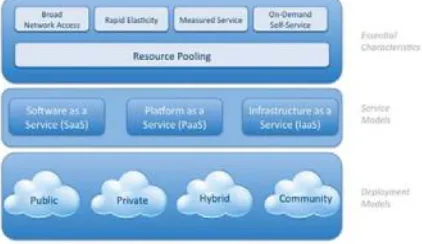
Cloud computing can be deployed in various models. 1. Public cloud
2. Private cloud 3. Hybrid Cloud 4. Community Cloud
Along with these, some articles contains one moredevelopment model that is.Commodity Cloud and Cloud Service Models.
1) Software as a Service (SaaS):Software as a service is a software distribution model in which applications are hosted by a vendor or service provider in cloud and made available tocustomers over a network, typically the Internet.
2) Platform as a Service (PaaS):Platform as a Service (PaaS) is a way to rent hardware, operating systems, storage and network capacity over the Internet. The service delivery model allows the customer to rent virtualized servers and associated services for running existing applications or developing and testing new ones.
3) Infrastructure as a service (IaaS):Infrastructure as a Service is a provision model inwhich an organization outsources the equipment used to support operations, including storage, hardware, servers and networking components.The service provider owns the equipment and is responsible for housing, running and maintaining it. The client typically pays on a per-use basis.
Figure 1 : Cloud Service Models (Source :http://skmahdesia87.blogspot.in/2012/08/articleclou
d-computing-and-its.html)
Cloud Computing Providers: There are many cloud computing providers available in industry. Few companies are leading in this is listed below.
Amazon Elastic Compute Cloud (EC2) Microsoft Azure Services Platform Google App Engine
Akamai EdgePlatform
IBM Computing on Demand (CoD) Rackspace Cloud
Terremark NetSuite
In the last few years, there has been extensive research activity in the emerging area of Cloud. One of the most relevant topics is providing methodology and quantitative evaluation of QoS and different CC service performance levels [6]. Some authors have addressed the problem of possible interference between CCusers when sharing resources, thus have proposed different types of metrics for quantifying the performance isolation of cloud-basedsystems. They also specify new approaches for achieving performance isolation in CC [7].The data centers are consuming a huge amount of energy, which is expected to grow noticeably under the actual technological trends.Thus, a number of studies target the arising problem of providing energy efficient CC solution [8]. To deal with the challenge of the CC resource scheduling optimization, some authors proposed specific cost-effective solution for service request scheduling in CC, with a goal to process more cost-effectively the dynamic user service requests without any Service Level Agreement (SLA)violation [9].The design enhancement, security policies and mechanisms enforcement are also explored in some studies [10-11]. This paper focuses on performance comparison of two CC platforms: Amazon AWS and MSAzure.
III. APPROACH
Windows Azure is Microsoft's application platform for the public cloud. Our applications can use this platform in many different ways. For instance, you can use Windows Azure to build a web application that runs and stores itsdata in Microsoft datacenters. We can use Windows Azureonly to store data, with the applications that use that data running on-premises (that is, outside the public cloud). We can use Windows Azure to help on-premises applications connect with each other or to map between different sets of identity information or in other ways. Because the platform offers a wide range of services, all of these things—and more—are possible [12]
A. Components of windows azure
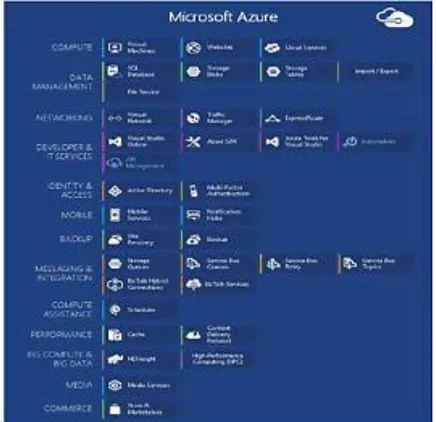
To understand what Windows Azure offers, it's useful to group its services into distinct categories and we need to know what its components do. The Figure 2 shows one way to do this
1) Cloud Applications: Windows Azure provides two types of roles [12]:
Web roles: A web role is designed for code that talks directly with web browsers or other HTTP clients i.e. it depends on IIS, Microsoft's webserver. For example, ASP.NET or PHP application.
Worker roles: A worker role is more general, designed to run a variety or different type of code.For example, application that processes lots of data in parallel. Each role instance is really just a virtual machine (VM) running a flavor of Windows Server and each one executesin a Windows Azure data center (see Figure 2) [12]
Figure 2: Components of Windows Azure (Source : http://azure.microsoft.com/enus/documentation/articl
es/fundamentals-introduction-toazure/)
2) Data Management: Every Windows Azure application runs in one or more VMs. Each VM has local storage, which an application is free to use. Windows Azure provides five data management options(see Figure 4)
SQL Azure Tables
Windows Azure Blobs Storage Service Import / Export
Azure File Service
3) Networking :Azure runs today in many data centers spread across the world. When we run an application or store data, we can select one or more of these data centers to use. We can also connect to these data centers in various ways using the services below.
Virtual Network Traffic Manager Express Route
4) Identity and Access Control :Working with identity is part of most applications. Knowing who a user is lets an application decide how it should interact with that user. Azure provides services to help track identity as well as integrate it with identity stores we may already be using.
Active Directory
Multi Factor Authentication
5) Messaging and Integration: No matter what it's doing, code frequently needs to interact with other code. In some situations, all that's needed is basic queued messaging. In other cases, more complex interactions are required. Azure provides a few different ways to solve these problems. Figure 4 illustrates thechoices.
Storage Queue Service Bus Queue Service Bus Relay Service Bus Topics
Biz Talk Hybrid Connection Biz Talk Service
IV. CONCLUSION
Azure may be cheaper than EC2 in the long run.Azure is a zero maintenance solution. we just deploy our application and Microsoft takes care of the software, patches and backups. There’s a cost to maintenance which has to be taken into account when
using EC2 compared to Azure. The problem is that cost is a bit hard to calculate.
REFERENCES
[1] David Chappell, A white paper on ―Introducing Windows Azure‖, Oct2010.
[2] Dong Xu, ―Cloud Computing: an Emerging Technology‖, InternationalConference On Computer Design And Applications (ICCDA 2010),Volume-1, Pgs (100-104).
[3] Windows Azure Platform: Overview.http://www.azurepilot.com.
[4] David Chappell, A white paper on ―The Windows Azure ProgrammingModel‖, Oct 2010.
[5] Wei Lu, Jared Jackson, and Roger Barga, ―AzureBlast: A Case Study of Developing Science Applications on the Cloud‖, Proceedings of the 1stWorkshop on Scientific Cloud Computing (Science Cloud 2010),Association for Computing Machinery, Inc., 21 June 2010.
[6] D. Armstrong, K. Djemame, ―Performance Issues in Clouds: AnEvaluation of Virtual Image Propagation and I/OParavirtualization‖, The Computer J., vol. 54, no. 6, 2011, pp. 836-849.
[7] R. Krebsa, C. Momma, Kounevb, ―Metrics and techniques for quantifying performance isolation in cloud environments‖, Scienceof Computer Programming, vol. 90, 2014, pp. 116–134.
[8] Y. Jin, Y. Wen, Q. Chen, Z. Zhu, ―An Empirical Investigation of the Impact of Server Virtualization on Energy Efficiency for Green Data Center‖, The Computer J., vol. 56, no. 8, 2013, pp. 977-990.
[9] Z. Liu, S. Wang, Q. Sun, H. Zou and F. Yang, ―Cost-Aware CloudService Request Scheduling for SaaS Providers‖, The Computer J.,vol. 57, no. 2, 2014, pp. 291-301.
[11] W. Zhao, P. Melliar-Smith, L. Moser, ―Low Latency FaultTolerance System‖, The Computer J., vol. 56, 2013, pp. 716-740.
[12] MICROSOFT, SQL Azure. Microsoft, https://azure.microsoft.com /home/features/sql-azure/, accessed September 2014,
[13] WHAT IS CLOUD COMPUTING, Microsoft Azure vs Amazon EC2. What is Cloud Computing,
http://www.whatisthecloudcomputing.com/microsoft-azurevs-amazonec2, accessed August 2014,
[14] FIND THE BEST, Base plan details. Find the Best,http://cloudcomputing.findthebest.com/saved_co mpare/Azure-vs-EC2, accessed October 2014,
[15] LEARNING TREE, Amazon EC2 or Microsoft WindowsAzure. Learning Tree, http://cloudcomputing.learningtree.com
/2011/03/30/amazon-ec2-ormicrosoftwindows-azure/, accessed October 2014,.