GREEDY INTERSECTION-MODE ROUTING STRATEGY PROTOCOL FOR VEHICULAR NETWORKS
MAHMOUD AHMAD SALEM AL-KHASAWNEH
GREEDY INTERSECTION-MODE ROUTING STRATEGY PROTOCOL FOR VEHICULAR NETWORKS
MAHMOUD AHMAD SALEM AL-KHASAWNEH
A dissertation submitted in partial fulfillment of the requirements for the award of the degree of
Master of Science (Computer Science)
Faculty of Computer Science and Information Systems Universiti Teknologi Malaysia
iii
This dissertation is dedicated to all of my family for their endless support and encouragement. Especially for my future wife Dita for her understanding and
iv
ACKNOWLEDGEMENT
First and foremost, I would like to express heartfelt gratitude to my supervisor Assoc. Prof. Dr. Md. Asri Ngadi for his constant support during my study at UTM. He inspired me greatly to work in this dissertation. His willingness to motivate me contributed tremendously to our project. I have learned a lot from him and I am fortunate to have him as my mentor and supervisor
v
ABSTRACT
vi
ABSTRAK
vii
TABLE OF CONTENTS
CHAPTER TITLE PAGE
DECLARATION ii
DEDICATION iii
ACKNOWLEDGEMENT iv
ABSTRACT v
ABSTRAK vi
TABLE OF CONTENTS vii
LIST OF TABLES xi
LIST OF FIGURES xii
LIST OF ABBREVIATIONS xiv
1 INTRODUCTION 1
1.1 Overview 1
1.2 Problem Background 3
1.3 Research Statement 9
1.4 Research Aim 9
1.5 Research Objectives 10
1.6 Scope of the Study 10
1.7 Significance of the Study 11
1.8 Structure of Thesis 11
2 LITERATURE REVIEW 12
viii
2.2 Vehicular Ad hoc Network 13
2.3 Routing Protocols in VANETs 15
2.3.1 Geographical Routing Protocols 16 2.3.1.1 Greedy Perimeter Stateless Routing 16 2.3.1.2 Greedy Perimeter Coordinator Routing 21 2.3.1.3 Greedy Perimeter Stateless Routing +
Advanced Greedy Forwarding 23 2.3.1.4 Cross-Link Detection Protocols 23 2.3.1.5 Vehicle-Assisted Data Delivery 24 2.3.1.6 Greedy Distributed Spanning Tree
Routing
25
2.3.1.7 Geographical Opportunistic Routing 25 2.3.1.8 Connectivity-aware Routing Protocol 26
2.3.1.9 GpsrJ+ 26
2.3.1.10 Landmark Overlays for Urban Vehicular
Routing Environments
28 2.3.1.11 Geographical Delay Tolerant Network
+
Navigation Assistant
29 2.3.1.12 Greedy Routing with Abstract
Neighbor
Table
31 2.3.1.13 Greedy Traffic Aware Routing protocol 32
2.3.1.14 GeoCross Routing 32
2.3.2 Topology-based Routing 33
2.3.2.1 Ad hoc On Demand Distance Vector 33 2.3.2.2 Temporally Ordered Routing Algorithm 35 2.3.2.3 Ad hoc On-demand Vector + Preferred
Group Broadcasting 35 2.3.2.4 Road-Based using Vehicular Traffic-
Proactive 35
2.3.2.5 Road-Based using Vehicular Traffic-
Reactive 36
ix
2.3.3.1 Clustering for Open IVC Networks 38 2.3.3.2 Cluster-base Flooding 39 2.4 Comparison of Routing Protocols in VANETs 41
2.5 Summary 42
3 RESEARCH METHODOLOGY 44
3.1 Introduction 44
3.2 Operational Framework 46
3.2.1 Problem Analysis and Formulation 46 3.2.2 Design and Development of Vehicular Networks 47
3.2.3 Testing and Evaluation 48
3.3 Assumptions and Limitations 49
3.4 Summary 50
4 DESIGN 51
4.1 Introduction 51
4.2 Greedy Intersection mode Routing Strategy (GIRS) 53
4.2.1 Route Establishment 58
4.2.2 Route Discovery Process 60
4.2.3 Route Reply 63
4.2.4 Route Maintenance 64
4.2.5 Greedy Mode 65
4.2.6 Intersection Mode 68
4.2.7 Recovery Mode 70
4.3 Performance Metrics 70
4.4 Evaluation Methodology 71
4.5 Simulation Setup 71
4.6 Summary 73
5 RESULT AND DISCUSSION 74
x
5.2 Simulation Results 75
5.3 Summary 79
6 CONCLUSIONS 80
6.1 Introduction 81
6.2 Conclusion 81
6.3 Future Work 84
xi
LIST OF TABLES
TABLE NO. TITLE PAGE
2.1 Comparison of Most VANET Routing Protocols 43
4.1 compares most VANET routing protocols with the new
design for GIRS 55
4.2 Notations used in Greedy Intersection mode Routing
Strategy (GIRS) algorithm 59
4.3 Neighbour Routing Table 64
4.4 Notations used in Route Discovery and Route Reply
algorithm 64
xii
LIST OF FIGURES
FIGURE NO. TITLE PAGE
1.1 GPSR Failure at Street Intersection 5
1.2 Important Intersection Ignored in Most Widely used VANET
Routing Protocols 7
2.1 VANET Routing Protocols 15
2.2 Right Hand Rule in GPSR Perimeter Mode. 17
2.3 Perimeter Example 18
2.4 A Scenario of GPSR Failures at Intersection 20
2.5 GPCR Routing along Junctions 22
2.6 Next hop selection at intersection in GPCR Vs GpsrJ+ 27
2.7 LOUVRE 29
2.8 Virtual Navigation Interface 31
2.9 Route discovery and route reply process in AODV routing 34 2.10 Route Discovery and Topology Dissemination in RBVT-P
Routing Protocol 37
3.1 Operational Framework 45
4.1 Proposed Geographical Routing Protocol 55
4.2 Establishment of Routes 59
4.3 Existing Problems in Routing 59
4.4 Route Discovery Process of Carrier Nodes 61
4.5 Route Reply Message 64
4.6 Neighbour Node Updating of Routing Table 65
xiii
4.8 Forwarding Packets to Destination 68
4.9 Intersection Mode Occurrences 69
4.10 Simulation Scenario 72
5.1 Comparison of Different Protocols 75
5.2 Routing Protocol Overhead 76
5.3 Packet Delivery Ratio 77
5.4 Throughput 78
xiv
LIST OF ABBREVIATIONS
AODV - Ad hoc On-demand Distance Vector
AODV+PGB - Ad hoc On-demand Vector + Preferred Group Broadcasting
CAR - Connectivity-Aware Routing
CBR - Constant Bit Rate
CBF - Contention-Based Forwarding
CLR - Cross-Link Removal
CLDP - Cross-Link Detection Protocol COIN - Clustering for Open IVC Networks
DSR - Dynamic Source Routing
DTN - Delay Tolerant Network
GG - Gabriel Graph
GDSTR - Greedy Distributed Spanning Tree Routing GeoDTN+Nav - Geographical Delay Tolerant Network +
Navigation Assistant
GeOpps - Geographical Opportunistic Routing
GIRS - Greedy Intersection-mode Routing Steategy GPCR - Greedy Perimeter Coordinator Routing
GPS - Global Positioning System
GPSR - Greedy Perimeter Stateless Routing
GPSR+AGF - Greedy Perimeter Stateless Routing + Advanced Greedy Forwarding
GRANT - Greedy Routing with Abstract Neighbor Table
GSR - Geographical Source Routing
xv
LOUVRE - Landmark Overlays for Urban Vehicular Routing Environments
LORA-CBF - Cluster-base Flooding
MANETs - Mobile Ad hoc NETworks
OLSR - Optimize Link State Routing
PDR - Packet Delivery Ratio
RNG - Relative Neighborhood Graph
RRP - Route Reply Packet
RBVT-R - Road-Based using Vehicular Traffic-Reactive TORA - Temporally Ordered Routing Algorithm
TTL - Time-to-Live
UDP - User Datagram Protocol
VADD - Vehicle-Assisted Data Delivery VANETs - Vehicular Ad hoc NETworks
CHAPTER 1
INTRODUCTION
1.1 Overview
Vehicular Ad-Hoc Networks, (VANET), are a particular kind of Mobile Ad Hoc Network, (MANET), in which vehicles act as nodes and each vehicle is equipped with transmission capabilities which are interconnected to form a network. The topology created by vehicles is usually very dynamic and significantly non-uniformly distributed. In order to transfer information about these kinds of networks, standard MANET routing algorithms are not appropriate (Lee et al., 2010b).
vehicle-to-2
vehicle (V2V) and vehicle-to-infrastructure (V2I) wireless communications (ITS, 2012).
According to architectures of network, VANET can be divided into three categories, the first of which is the Wireless Wide Area Network (WWAN) in which the access points of the cellular gateways are fixed in order to allow direct communication between the vehicles and the access points. However, these access points require costly installation, which is not feasible. The second category is the Hybrid Wireless Architecture in which WWAN access points are used at certain points while an ad hoc communication provides access and communication in between those access points. The third and final category is the Ad Hoc V2V Communication which does not require any fixed access points in order for the vehicles to communicate. Vehicles are equipped with wireless network cards, and a spontaneous setting up of an ad hoc network can be done for each vehicle (Li and Wang, 2007). This study will focus on studying ad hoc V2V communication networks, which are also known as VANETs.
The purpose of VANET is to allow wireless communication between vehicles on the road including the roadside wireless sensors, enabling the transfer of information to ensure driving safety and planning for dynamic routing, allowing mobile sensing as well as providing in-car entertainment. As VANETs have unique characteristics which include dynamic topology, frequent disconnection of the networks, and varying environments for communication, the routing protocols for traditional MANET such as Ad hoc On-demand Distance Vector (AODV) (Perkins and Royer, 1999) are not directly usable for VANETs.
3
sensors on vehicles is limited to a few hundred meters at most and the traffic conditions in a vehicular urban environment often change dynamically. Other than that, VANET routing protocols also face other problems including the issue of unstructured roads, the difference in the sizes of the intersections in a certain area, the sharp curves of the roads, uneven slopes, and other obstacles such as large buildings, traffic lights, trees, and sign boards. As it is impractical to spend
excessively on rebuilding or restructuring the existing roads in urban environments, a routing protocol for the purpose of a larger distance of data communication in one-to-one and one-to-many transfers specifically for VANETs need to be developed. This study will focus on the current challenges in the research of geographical routing protocols for real-time vehicular networks in urban environments.
1.2 Problem Background
Although it is considered not feasible to use the known end-to-end wireless communication which uses multi-hop to represent the highly mobile nodes available in VANETs, there are various mobile communications capable of supporting networks for vehicular purposes, fulfilling the needs to dynamically route file
4
VANETs require geographical routing protocols that utilize the Global Positioning System (GPS) to locate the next available node on the network (Bose et al., 2001; Karp and Kung, 2000; Kuhn et al., 2003; Lee et al., 2010a; Lochert et al., 2005). The use of GPS allows a more dynamic form of communication in which routes do not need to be established between the source nodes and the destination nodes before the data can be forwarded. GPS obtains the neighbour nodes by selecting the next best hop. The Greedy Perimeter Stateless Routing (GPSR) by Karp and Kung, ( 2000) is an example of a popular and widely used geographical routing protocol in which a route is established between the source node and the destination node through the utilization of the greedy and the perimeter modes within the network. Greedy forwarding is first used for the data forwarding in which the packet
5
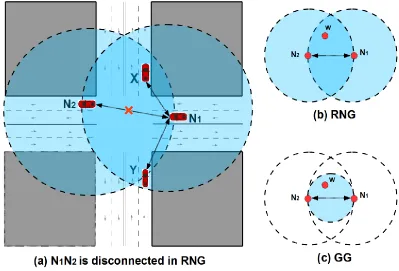
removed by RNG since nodes X and Y are inside the intersection of two circles centered at N1 and N2. Similarly, Figure 1.1(c) GG is used to remove link N1 N2. However, due to obstacles (such as buildings), there is no direct link N1 X or N2 Y. Thus the network is disconnected between N1 and N2, resulting in GPSR’s failure.
Figure 1.1: GPSR Failure at Street Intersection
6
GeoCross, an event-driven geographical routing protocol which can dynamically remove cross-links to avoid the problem of loops. Instead of the usual use of planar graphs, GeoCross uses urban maps with natural planar features. Compared to GPSR and GPCR, GeoCross offers a higher ratio of packet delivery and lower average delay. However, none of the previous protocols attempt to solve the problem of how to forward messages when the intersection is reached.
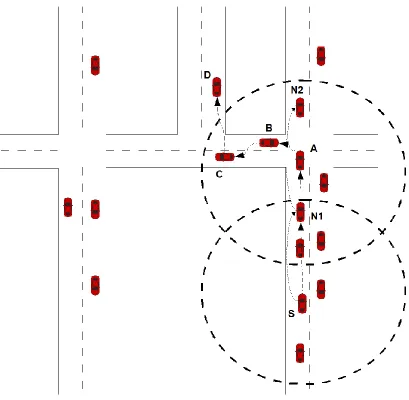
Intersections in a vehicular network are the other main problem in the routing protocols as in VANET. Since traffic is always changing, the intersections in vehicular networks are ineffective. The greedy forwarding technique can be used, since it transfers to the next node. Thus intersection problem can safe. This causes unnecessary routing. In Figure 1.2 where the change in Sackets from source end S to the destination D. the shortest distance in Sackets N2. where the intersection of nodes is A at the road intersection. Thus the intersection between the source and the destination end is most considered. The shortest distance on the parallel streets does consider the distance between the node S and the destination is farther. The intersection is not considered in these parallel streets. The best route is as shown by the dotted arrows in Figure 1.2; S ⇒ N1 ⇒ A ⇒ B ⇒ C ⇒ D.
7
is not usable if there are no nodes, such as in the case of node A in Figure 1.2. GpsrJ+ Lee et al., ( 2007) improves the ratio of packet delivery of the current GPCR protocol through the prediction of road segments.
Figure 1.2: Important Intersection Ignored in Most Widely used VANET Routing Protocols
8
return to the greedy mode. Observation by Jarupan and Ekici (2010) stated that this protocol is not efficient for use in the vehicular networks of a typical urban
environment as the neighbour management around an intersection is considered intensive.
RBVT-R is the name of Road-Based Used Vehicular Traffic information, as Nzouonta et al., ( 2009) proposed and which contains road intersections. It features high probability and network connectivity. Instead of sending frequent messages, RBVT-R introduces a new method to reduce the path sensitivity. It has several parameter values. RBVT-R works in its own environment and does not implement in real VANET where there is always a change in network and traffic conditions.
In a geo-proactive overlay routing called Landmark Overlays for Urban Vehicular Routing Environments (LOUVRE) proposed by Lee et al (2008) creates overlay links on top of an urban topology. In LOUVRE, the nodes at intersections are defined as landmarks and the overlay links are only possible if there is enough traffic density between intersections. LOUVRE’s guaranteed multi-hop routing is a
suitable method for avoiding dead-end roads. Jerbi et al.,(2009) also proposed an intersection-based geographically greedy traffic-aware routing (GyTAR) protocol to find the best routes in urban environments. GyTAR creates routes from source to destination based on a sequence of connected intersections. Two parameters, including change in vehicular traffic information and the remaining distance from the destination, are used to define a best route. GyTAR also uses an improved greedy
9
1.3 Problem Statement
In order to achieve better performance in vehicular communication, the problems regarding intersections need to be handled to improve the transfer of real-time vehicle-to-vehicle data. Although VANETs have proven to be promising for communication in urban environments, VANETs need to be able to provide higher delivery ratios while minimizing delay of all the applications in the networks.
“How to improve the decision for next node selection at intersections in Vehicular Networks”
Therefore, this study needs to answer the following research question:
How to develop a geographical routing protocol that is capable of making better routing decisions at intersections to significantly improve the performance of
VANET?
1.4 Research Aim
This study aims to develop a geographical routing protocol capable of efficiently
handling the problems regarding intersections in real-time vehicular urban environments
10
1.5 Research Objectives
The objectives of this research are:
i To enhance a geographical routing protocol which is capable of making better decisions at intersections.
ii To develop an enhancement of a geographical routing protocol that reduces average delay.
iii To evaluate the performance of the proposed routing protocol as compared to widely-used VANET routing protocols (GPSR, GPCR, GpsrJ+) regarding average delivery ratios and end-to-end delay.
1.6 Scope of the study
The scope of the study covers the following
i The assumed scenario is that vehicles are able to move in a two-way urban environment where no network infrastructure or centralized traffic control is considered.
11
1.7 Significance of the Study
In order to achieve further advancement in the technology of mobile communication, research in the vehicular industry has been done with special emphasis in the areas of routing and routing management, information security, and enabling communication between vehicle-to-vehicle and vehicle-to-infrastructure, as well as technological deployments. In the area of routing, however, real-life urban environments cannot be properly reflected by the currently implemented routing protocols for VANETs. Therefore, this study is done in order to solve the problems regarding roads with intersections by addressing the issues which arise from packet transfers on the road and at intersections. The study focuses on improving VANETs in terms of routing and data forwarding where the characteristics of VANETs are incorporated into the design of a protocol for urban environments.
1.8 Structure of the Thesis
REFERENCES
Bernsen, J. and Manivannan, D. (2009). Unicast routing protocols for vehicular adhocnetworks: Acriticalcomparisonandclassifcation. Pervasive and Mobile Computing. 5(1), 1 –18. ISSN 1574-1192.
Blum, J., Eskandarian, A. and Hoffman, L. (2003). Mobility management in IVC networks. In Intelligent Vehicles Symposium, 2003. Proceedings. IEEE. 150 – 155.
Bose, P., Morin, P., Stojmenovic, I. and Urrutia, J. (2001). Routing with Guaranteed DeliveryinAd Hoc WirelessNetworks. Wireless Networks. 7(6),609–616. Dashtinezhad, S., Nadeem, T., Dorohonceanu, B. and Borcea, C. (2004).
TraffcView: ADriverAssistantDeviceforTraffcMonitoringBased onCar-to-Car Communication. In In IEEE Semiannual Vehicular Technology. May. 17–19.
Fubler, H., Mauve, M., Hartenstein, H., Vollmer, D. and Kasemann, M. (2002). A comparison of routing strategies in vehicular ad-hoc networks. Technical report. UniversittMannheimMarch.
ITS(2012). ITS Standards. Retrievableat http://www.standards.its.dot. gov/about.asp. Jacquet, P., Muhlethaler, P., Clausen, T., Laouiti, A., Qayyum, A. and Viennot, L. (2001). Optimized link state routing protocol for ad hoc networks. In Multi Topic Conference, 2001. IEEE INMIC 2001. Technology for the 21st Century. Proceedings. IEEE International.62 –68.
83
Johnson,D. B. and Maltz, D. A. (1996). Dynamic Source Routing in Ad Hoc Wireless Networks. KluwerAcademic Publishers.
Karp,B.andKung,H.T.(2000). GPSR:greedyperimeterstatelessroutingforwireless networks. InMobiCom ’00: Proceedings of the 6th annual international conference on Mobile computing and networking.New York,NY, USA: ACM, 243–254.
Kim, Y.-J., Govindan, R., Karp, B. and Shenker, S. (2005a). Geographic routing made practical. In Proceedings of the 2nd conference on Symposium on Networked Systems Design & Implementation -Volume 2. NSDI’05. Berkeley, CA, USA: USENIX Association,217–230.
Kim, Y.-J., Govindan, R., Karp, B. and Shenker, S. (2005b). On the pitfalls of geographicfacerouting. In Proceedings of the 2005 joint workshop on Foundations of mobile computing. DIALM-POMC ’05. NewYork, NY, USA: ACM,34–43.
Kuhn, F., Wattenhofer, R., Zhang, Y. and Zollinger, A. (2003). Geometric ad-hoc routing: of theory and practice. In PODC ’03: Proceedings of the twenty-second annual symposium on Principles of distributed computing. New York, NY, USA: ACM, 63–72.
Lee, K., Haerri, J., Lee, U. and Gerla, M. (2007). Enhanced Perimeter Routing for Geographic Forwarding Protocols in Urban Vehicular Scenarios. In
Globecom Workshops, 2007 IEEE. nov. 1 –10.
doi:10.1109/GLOCOMW.2007.4437832.
Lee, K., Le, M., Harri, J. and Gerla, M. (2008). LOUVRE: Landmark Overlays for UrbanVehicularRoutingEnvironments. InVehicular Technology Conference, 2008. VTC 2008-Fall. IEEE 68th.1–5.
Lee, K. C., Cheng, P.-C. and Gerla, M. (2010a). GeoCross: A geographic routing protocol in the presence of loops in urban scenarios. Ad Hoc Networks. 8(5), 474 –
488. ISSN 1570-8705. Vehicular Networks.
84
Lee, U., Zhou, B., Gerla, M., Magistretti, E., Bellavista, P. and Corradi, A. (2006). Mobeyes: smart mobs for urban monitoring with a vehicular sensor network. Wireless Communications, IEEE. 13(5), 52 –57.
Leong,B.,Liskov,B.andMorris,R.(2006). Geographicroutingwithoutplanarization. In NSDI’06: Proceedings of the 3rd conference on Networked Systems Design & Implementation.Berkeley,CA, USA: USENIX Association,25–25.
Li,F. andWang,Y. (2007). Routinginvehicularadhocnetworks: Asurvey.Vehicular Technology Magazine, IEEE. 2(2), 12 –22.
Liu,C. G.,Liu,G.,sungLee,B.,chongSeet,B.,hengFoh,C. andkeeLee,K. (2004). ARoutingStrategyforMetropolisVehicular. In In Proc. International Conference on Information Networking. 533–542.
Lochert, C., Mauve,M., Fubler, H. and Hartenstein,H. (2005). Geographicroutingin city scenarios. SIGMOBILE Mob. Comput. Commun. Rev. 9, 69–72. ISSN 15591662.
Namboodiri,V.,Agarwal,M. andGao,L. (2004). Astudyonthefeasibilityofmobile gateways for vehicular ad-hoc networks. In VANET ’04: Proceedings of the 1st ACM international workshop on Vehicular ad hoc networks.66–75. Nandan, A., Das, S., Pau, G., Gerla, M. and Sanadidi, M. (2005). Co-operative
downloading in vehicular ad-hoc wireless networks. In Wireless On-demand Network Systems and Services. jan. 32 – 41.
Naumov,V., Baumann,R. and Gross,T. (2006). Anevaluationofinter-vehiclead hoc networks based on realistic vehicular traces. In MobiHoc ’06: Proceedings of the 7th ACM international symposium on Mobile ad hoc networking and computing. New York, NY,USA: ACM, 108–119.
Nzouonta, J., Rajgure, N., Wang, G. and Borcea, C. (2009). VANET Routing on City Roads UsingReal-Time Vehicular Traffc Information. Vehicular Technology, IEEE Transactions on. 58(7), 3609 –3626.
85
Perkins, C. E. and Bhagwat, P. (1994). Highly dynamic Destination-Sequenced Distance-Vector routing (DSDV) for mobile computers. SIGCOMM Comput. Commun. Rev. 24(4), 234–244.
Riva, O., Nadeem, T., Borcea, C. and Iftode, L. (2007). Context-Aware Migratory Services in Ad Hoc Networks. Mobile Computing, IEEE Transactions on. 6(12), 1313 –1328.
Santos, R. A., Edwards, A., Edwards, R. M. and Seed, N. L. (2005). Performance evaluation of routing protocols in vehicular ad hoc networks. Int. J. Ad Hoc Ubiquitous Comput. 1(1/2), 80–91.
Schnaufer, S. and Effelsberg, W. (2008). Position-based unicast routing for city scenarios. InWorld of Wireless, Mobile and Multimedia Networks, 2008. WoWMoM 2008. 2008 International Symposium on a.1 –8.
WAVE(2010). Wireless Acess for Vehicular Environment (WAVE).