A DOCUMENT-LIKE SOFTWARE VISUALIZATION METHOD FOR EFFECTIVE COGNITION OF C-BASED SOFTWARE SYSTEMS
SHAHIDA BINTI SULAIMAN
A DOCUMENT-LIKE SOFTWARE VISUALIZATION METHOD FOR EFFECTIVE COGNITION OF C-BASED SOFTWARE SYSTEMS
SHAHIDA BINTI SULAIMAN
A thesis submitted in fulfilment of the requirements for the award of the degree of
Doctor of Philosophy
Faculty of Computer Science and Information System Universiti Teknologi Malaysia
ALHAMDULILLAH…
For my beloved mother and husband who have given the strength and courage, my two energetic kids Erin and Ariff,
ACKNOWLEDGEMENT
The researcher would like to thank Professor Dr Norbik Bashah bin Idris as the supervisor of this research for always delivering his support and sharing his knowledge with the researcher. A lot of thanks go to Associate Professor Dr Shamsul bin
Sahibuddin as the co-supervisor of this research who has given guidelines particularly in the empirical aspects of the research.
A great gratitude also goes to Universiti Sains Malaysia that has funded the three-year PhD study. Not forgetting all software practitioners who had involved in the
preliminary study and the usability study of the prototype tool and also the post-graduates of the Center for Advanced Software Engineering (CASE), UTM, Kuala Lumpur who participated in the experiment. Their co-operation has made me feel motivated and supported in making this research successful in the future.
My gratitude also goes to other researchers of CASE, the examiners who gave their valuable feedbacks on the proposal of this research, the internal and external examiners who delivered their constructive comments for the final manuscript and other individuals who had contributed in this research indirectly until this thesis was finalized.
Last but not least, countless thanks to my beloved mother who has been supporting and blessing me from the day of registering my study until the day of
ABSTRACT
It is clear that maintenance is a crucial and very costly process in a software life cycle. Nowadays there are a lot of software systems particularly legacy systems that are always maintained from time to time as new requirements arise. One important source to understand a software system before it is being maintained is through the documentation, particularly system documentation. Unfortunately, not all software systems developed or maintained are accompanied with their reliable and updated documents. In this case, source codes will be the only reliable source for programmers. A number of studies have been carried out in order to assist cognition based on source codes. One way is through tool automation via reverse engineering technique in which source codes will be parsed and the information extracted will be visualized using certain visualization methods. Most software visualization methods use graph as the main element to represent extracted software artifacts. Nevertheless, current methods tend to produce more complicated graphs and do not grant an explicit, document-like re-documentation
environment. Hence, this thesis proposes a document-like software visualization method called DocLike Modularized Graph (DMG). The method is realized in a prototype tool named DocLike Viewer that targets on C-based software systems. The main contribution of the DMG method is to provide an explicit structural re-document mechanism in the software visualization tool. Besides, the DMG method provides more level of
information abstractions via less complex graph that include inter-module dependencies, inter-program dependencies, procedural abstraction and also parameter passing. The DMG method was empirically evaluated based on the Goal/Question/Metric (GQM)
ABSTRAK
Adalah jelas bahawasanya pengubahsuaian merupakan proses yang penting dan sangat mahal dalam kitaran hidup perisian. Dewasa ini terdapat banyak sistem perisian terutamanya sistem legasi yang sentiasa diubahsuai daripada masa ke semasa apabila terdapat keperluan baru. Satu sumber penting untuk memahami perisian sebelum ia diubahsuai ialah melalui dokumentasi terutamanya dokumentasi sistem. Malangnya tidak kesemua sistem perisian dibangun atau diubahsuai dilengkapi dengan dokumen yang boleh dipercayai dan terkemaskini. Dalam kes ini, kod sumber akan menjadi satu-satunya sumber boleh dipercayai oleh pengaturcara. Terdapat beberapa kajian yang dijalankan untuk membantu kognisi berasaskan kod sumber. Satu cara ialah melalui teknik kejuruteraan berbalik dalam mana kod sumber akan diperiksa dan maklumat didapati akan divisualisasi menggunakan kaedah-kaedah visualisasi tertentu.
Kebanyakan kaedah visualisasi perisian menggunakan graf sebagai elemen utama untuk mewakili artifak perisian didapati. Walau bagaimanapun, kaedah-kaedah masa kini menjurus kepada penghasilan graf yang lebih kompleks dan tidak menyediakan persekitaran pengdokumentasian semula ala dokumen secara jelas. Maka, tesis ini mencadangkan suatu kaedah visualisasi perisian ala dokumen dipanggil “DocLike Modularized Graph (DMG)”. Kaedah ini digunapakai dalam suatu alat prototaip
dinamakan “DocLike Viewer” yang menumpukan kepada sistem perisian berasaskan C. Sumbangan utama kaedah DMG ialah untuk menghasilkan satu mekanisme dokumentasi semula berstruktur di dalam alat visualisasi secara langsung. Di samping itu, kaedah DMG menghasilkan lebih banyak peringkat abstraksi maklumat melalui graf yang kurang rumit termasuklah hubungan antara modul, antara program, abstraksi prosedur dan juga penyerahan parameter. Kaedah DMG telah dinilai secara empirikal berdasarkan
TABLE OF CONTENTS
CHAPTER SUBJECT PAGE
DECLARATION ii
DEDICATION iii
ACKNOWLEDGEMENT iv
ABSTRACT v
TABLE OF CONTENTS vii
1 INTRODUCTION 1
1.1 Introduction to Software Maintenance 1
1.2 Background of the Problem 3
1.2.1 Incomplete, Out-dated, Non Standardized or Absence of Documentation 4
1.2.2 Understanding an Existing Software System is Tedious and Costly 6
1.2.3 CASE Tools or Environment are Not Used or Properly Used 7
1.3 Current Solutions and Proposed Solution 8
1.4 Statement of the Problem 12
1.5 Objectives of the Research 13
1.6 Theoretical Framework 13
1.7 Importance of the Research 15
1.8 Scope of the Research 17
2 LITERATURE REVIEW 21
2.1 Introduction 21
2.2 Software Engineering 21
2.3 Software Maintenance 25
2.4 Program Comprehension 27
2.5 Reverse Engineering 29
2.6 Software Visualization 35
2.7 System Documentation 38 2.8 Computer-Aided Software Engineering
(CASE) Tools 41
2.9 Summary of Literature Review 42
3 SOFTWARE VISUALIZATION METHODS IN
REVERSE ENGINEERING TOOLS 43
3.1 Introduction 43
3.2 Types of Information Required 44 3.3 Current Reverse Engineering Tools 45
3.3.1 Rigi 46
3.3.2 PBS (Portable Bookshelf) 47
3.3.3 SNiFF+ 48
3.3.4 Logiscope 49
3.3.5 Software Visualization Methods Used 49 3.4 Software Maintenance Cases 52 3.4.1 Case Study 1 – Corrective 52 3.4.2 Case Study 2 – Adaptive 52 3.4.3 Case Study 3 – Perfective 54 3.5 Type of Information versus Tool 55 3.6 Drawbacks and Strengths of Existing
Reverse Engineering Tools 58 3.6.1 Software Visualization Methods 59
3.7 Enhancement of Software Visualization Method 63 3.8 Rigi – the Reverse Engineering Environment
for DocLike Viewer 64
3.8.1 Rigi C Language Parser 65
3.9 Summary 67
4 RESEARCH METHODOLOGY 68
4.1 Introduction 68
4.2 Operational Framework or Research Procedures 68 4.3 Formulation of Research Problem 70 4.3.1 Importance of System Documentation 70
4.3.1.1 System Documentation in
Software Life-Cycle 71 4.3.1.2 The Role of Standard in
System Documentation 72 4.3.1.3 The Role of CASE Tools in
System Documentation 72 4.3.2 Importance of Software Visualization 74 4.3.3 Justification of Research Problem 74 4.4 Research Design and Hypothesis 76 4.5 Subject and Source of Information 78 4.6 Instrumentation or Means of Gathering Data 79
4.6.1 Empirical Evaluation – a
Controlled Experiment 79
4.7 Data Analysis 80
4.8 Limitation on the Research and List of
Assumptions 81
5 PRODUCTION AND MAINTENANCE OF
SYSTEM DOCUMENTATION IN PRACTICE 83
5.1 Introduction 83
5.2 The Survey 83
5.3 Objectives of the Survey 87 5.4 The Analysis 87
5.4.1 The Characteristic Element 88 5.4.2 The Behavior Element 90
5.4.3 The Attitude Element 96
5.4.4 The Belief Element 98
5.5 The Findings 100
5.6 Summary 106
6 DOCUMENT-LIKE SOFTWARE VISUALIZATION METHOD EMPLOYED IN DOCLIKE VIEWER 107
6.1 Introduction 107
6.2 The Analysis 108
6.3 The Design 110
6.3.1 Filtering Software Artifacts Extracted by Rigi C Language Parser 111
6.3.2 List of Components 111
6.3.3 The Algorithm 114
6.3.3.1 Algorithm for the NewDialog Class 114
6.3.3.2 Algorithm for the GraphPanel Class 115
6.3.3.3 Algorithm for the GlobalSearchDialog Class 116
6.3.3.4 Algorithm for the SearchDialog Class 118
6.4 DocLike Modularized Graph (DMG) Method 121
6.4.1 Graph Drawing 124
6.4.2 Grid Layout Algorithm of DMG 126
6.4.3 Tradeoff Issues 134
6.5 DocLike Viewer Prototype Tool 137
6.5.1 Documentation Environment for DocLike Viewer 139
6.5.2 Visualizing Graph and Searching Concerned Nodes 140
6.5.3 Understanding Source Codes 146
6.5.4 Re-documenting Software System 147
6.6 Summary 150
7 THE EVALUATION 151
7.1 Introduction 151
7.2 Research Question and Hypothesis 151
7.2.1 Structure of Analysis Using Goal/ Question/Metric (GQM) 153
7.3 Controlled Experiment 155
7.3.1 Subjects and Subject System 156 7.3.2 Questionnaire 157
7.3.3 Procedures 159
7.3.4 Possible Threats 159
7.4 Usability Study 161
7.4.1 Subjects and Subject System 161 7.4.2 Questionnaire 162
7.4.3 Procedures 164
7.4.4 Possible Threats 164
7.5 The Analysis 165
7.6.1 Findings of the Controlled Experiment 173 7.6.2 Findings of the Usability Study 183
7.7 Qualitative Evaluation 183
7.8 Summary 189
8 CONCLUSION 190
8.1 Summary of the Thesis 190
8.2 Contribution 195
8.3 Limitation of the Research 197
8.4 Future Work 197
REFERENCES 199-209
APPENDIX
LIST OF TABLES
TABLE NO. TITLE PAGE
1.1 Cognitive framework to describe and evaluate software
visualization tools (Storey, 1998) 16
2.1 Five sections of activity grouping in Software Life Cycle
Process (SLCP) (IEEE Inc., 1998) 23 2.2 Classification of CASE products (van Vliet, 2000) 41 2.3 Classes of CASE workbenches (Fuggetta, 1993) 42 3.1 The taxonomy of level of information abstraction 45 3.2 The information of the four tools studied 46 3.3 Program versus file cross-reference table 54 3.4 Maintenance category versus information type and
tools’ support 58
3.5 Drawbacks and strengths of software visualization methods 59 3.6 The features provided by the four tools studied 62 5.1 Information sought based on characteristic, behavior,
belief and attitude 85
5.2 Characteristics of software engineers 88 5.3 Task preference versus experience 89 5.4 Usefulness of system documentation (SD) 90 5.5 Software development and maintenance tasks or projects 91 5.6 SDLC phases, tools and diagramming techniques in relation
with SD 91
5.7 Average number of SD produced or modified and
maintenance project without SD 92
5.8 The use of CASE tool versus number of SD and maintenance
5.9 The use of standard/template versus number of SD and
maintenance project without SD 93
5.10 Number of projects and SD produced or modified based on
category of industry 94
5.11 Top three programming languages and databases used 94 5.12 The use of SD standard or template, CASE or reverse engineering
tool 95
5.13 T test of textual versus graphical features 98 5.14 Importance of SD, standard and template 99 6.1 Features in DocLike Viewer described within cognitive
framework 120
7.1 The goal of study 153
7.2 The questions formulated 154
7.3 The metrics used 154
7.4 Formulation of criteria to be evaluated based on cognitive
framework 163
7.5 Last job of subjects 165
7.6 Cross tabulation of last job versus tool used 166 7.7 Cross tabulation of experience versus tool used 166 7.8 Cross tabulation of grade versus tool used 166 7.9 ANOVA table of time taken (T1) for the six questions 168 7.10 ANOVA table of score of the six questions 169 7.11 Job title of respondents in the usability study 170 7.12 Years of experience of respondents in the usability study 171 7.13 ANOVA table of usefulness of the three tools compared 172 7.14 Qualitative comparison of software visualization tools 188 8.1 The contribution of the research work in this thesis compared
LIST OF FIGURES
FIGURE NO. TITLE PAGE
1.1 An example of graph visualization via Rigi tool 11 1.2 A software maintenance support environment (Kwon et al., 1998) 14 1.3 Flow of the thesis diagram 20 2.1 The simple staged model for a software life cycle
consists of five distinct stages (Rajlich and Bennett, 2000) 24 2.2 Taxonomy of reverse engineering techniques (Gannod and Cheng,
1999) 35
3.1 One of the views produced by Rigi via RigiEdit 47 3.2 A “Software Landscape” of a system produced on a
web page by PBS 47
3.3 Windows of file manager and project manager (left), hierarchy browser and its filter utility (top right) and log information in
SNiFF+ (bottom right) 48
3.4 Cross Referencer window in SNiFF+ 48 3.5 A control graph produced by Logiscope, the dotted line shows
Untested path in a ‘while’ instruction 49 3.6 A graph consists of nodes (vertices) and arcs (edges) 49 3.7 Multiple, individual window in Rigi editor 50 3.8 Nested Graph window in SHriMP 50 3.9 Web-based software landscape view in PBS 51 3.10 Column-by-column tree view in SNiFF+ 51
3.11 Hierarchy of modules 53
3.15 An example of C program to be parsed (Rigi, 2004) 65 3.16 The extracted artifacts in RSF format (Rigi, 2004) 66 4.1 Flowchart of operational framework for the research 69 4.2 The relationship of all variables and their attributes 77 5.1 The need of graphical versus textual features and other features 97 5.2 The mean versus reasons for not producing or
maintaining SD 99
6.1 Use Case Diagram of DocLike Viewer 110 6.2 Nodes or vertices are drawn in grid layout 127 6.3 The left figure shows the arc drawn in DMG method, while the
right figure shows the arc mostly drawn in other graph layout
algorithms 128
6.4 Spring layout produced via RigiEdit 130 6.5 Sugiyama layout produced via RigiEdit 130 6.6 Grid layout produced via RigiEdit 131
6.7 Nested graph of SHriMP layout 132
6.8 The figure on the left shows how the labeling of vertices is made by the DMG method compared to other methods like Rigi as
in the right figure 133
6.9 DMG method optimizes the Sugiyama layout based on the
number of vertices to be drawn in the display area 134 6.10 DocLike Viewer consists of Content Panel, Graph Panel and
Description Panel 136
6.11 Modularization process done prior to generating a new view 137 6.12 The best stage to implement DocLike Viewer within software
life cycle 139
6.13 Module decomposition of section 3.1 is selected and the
associated graph representation of type DMG1 is viewed besides
its textual description 140
6.14 Display Information dialog box lists the details of a node clicked 141 6.15 Search utility provided in DocLike Viewer 143
6.16 Search Node dialog box 143
6.17 The sections associated to DMG representations in which the
6.18 The concerned function is highlighted when the section is clicked 145 6.19 Source Code Window displaying highlighted procedure name
based on the vertex clicked 147
6.20 An example of design document generated by DocLike Viewer 148 6.21 Document generation mechanism via DocLike Viewer 149 7.1 The modularized view of subject system generated by
DocLike Viewer 155
7.2 The File View displays the subject files via Microsoft
Visual C++ 156
7.3 The collapsed view of subject system in Rigi 156 7.3 One of the views generated from the List System via DocLike
Viewer 161
7.5 Mean of time taken (T1) versus question by DV, MV and RG group (regardless of correctness) – the asterisk (*) indicates the
significant mean difference 167
7.6 Sum of correct answers (S) versus question for DV, MV and RG
group - the asterisk (*) indicates the significant score difference 168 7.7 Mean of time taken to answer correctly (T2) versus question for
DV, MV and RG group – the asterisk (*) indicates the significant
mean difference 169
7.8 Bar chart – category of industry of respondents in the usability
study 171
7.9 Usefulness of tool (mean values based on Likert scale 1: Strongly disagree, 2: Disagree, 3: Normal, 4: Agree, 5: Strongly
Agree) 172
7.10 The usability criteria as ranked by the respondents – RG: Rigi,
MV: Microsoft Visual C++ and DV: DocLike Viewer 173 7.11 DMG1 representation shows the hierarchy view of the subject
system 174
7.12 The DMG3 representation in DocLike Viewer highlights the
7.16 Details of index_Record function is displayed in a dialog box 178 7.17 Global search provided by Microsoft Visual C++ 179 7.18 The searched processWordToIndex nodes are highlighted
via Rigi 180
7.19 The DMG5 representation of data flow graph in DocLike
Viewer 181
LIST OF ACRONYMS AND SYMBOLS
ADADL - Ada Design and Documentation Language ADC - Aide-De-Camp for C language
ANOVA - Analysis of Variance
C - Set of concerned components
CASE - Computer-Aided Software Engineering CIA - C Information Abstraction System CodeCrawler - A software visualization tool
const - Vertical gap factor of graph drawn CPARSE - Rigi C-Language Parser
D - Set of all data
DERE - Evaluating Reverse Engineering Framework df - difference
DFD - Data Flow Diagram
DIF - Document Integration Facility DTD - Specific Document Type Definitions
DMG - DocLike Modularized Graph proposed in this thesis DMG1 - First type of DMG (system hierarchy view)
DMG2 - Second type of DMG (program dependencies)
DMG3 - Third type of DMG (function dependencies in a module) DMG4 - Fourth type of DMG (function dependencies inter-module) DMG5 - Fifth type of DMG representation (data usage within a module) DMSC - The abstraction of document management system of GI system DocLike Viewer - A software visualization tool developed by the researcher DRE - Database Reverse Engineering
DV - DocLike Viewer used in the experiment and usability study
Ei - Directed edge or arc
F - Frequency
F - Set of functions
Fi - Concerned function
G - Graph
GI - Generate Index
GQM - Goal/Question/Metric paradigm GUI - Graphical User Interface
h1 - Height of display area of graph layout
h2 - Height of vertex
h2’ - Height of vertex when Nv increases
IEEE - The Institute of Electrical and Electronics Engineers, Inc.
inset - Barrier between the edges of the display area and the vertices
j - Horizontal gap factor
k - Relative gap factor for the first vertex with the following vertices in the same row
labeli - Label of vertex number i where i = 0,1,2… Nv
LibAdt - Library used to model the data in the data flows of GI system
M - Set of all modules
Mi - Concerned module
MMIMS - Man Machine Interface Management module of GI system
MT - Maintenance Tasks
MV - Microsoft Visual C++ used in the experiment and usability study
Nm - Number of modules
Nv - Number of vertices
P - Set of all programs
p - Relative vertical gap factor of vertices
Pi - Concerned program PBS - Portable Bookshelf
Rational Rose - A commercial analysis and design tool RE - Reverse Engineering
RG - Rigi used in the experiment and usability study Rigi - A reverse engineering prototype tool
RQ - Research question RSF - Rigi Standard Format RUP - Rational Unified Process
S - Score or number of correct solution for MT
Si - Set of sections associated with any concerned DMG type
S - side
SCM - Software Configuration Management SD - System Documentation
SDLC - System Development Life Cycle SE - Software Engineers
Sec - Set of all default sections in the Content Panel SHriMP - Simple Hierarchical Multi-Perspective
Sig. - Significant value SLC - Software Life Cycle
SLCM - Software Life Cycle Model SLCP - Software Life Cycle Process
SLEUTH - Software Literacy Enhancing Usefulness To Humans
SM - Software Maintainer
SNiFF+ - A commercial reverse engineering tool
SoDA - Rational SoDA for Word, a document tool of Rational Software SODOS - Software Documentation Support Environment
SS - Software System
SU - Software Understanding (measured based on S, T1 and T2)
SV - Software Visualization
SystDoc - The module comprises all document image items of GI system
T1 - Time taken to find solution for MT
T2 - Time taken to find correct solution for MT Td - Search graph component by data
Tf - Search graph component by function
Tm - Search graph component by module
Tp - Search graph component by program
Tv - Search graph component by variable
V - Set of vertices in the graph
Vi - vertex or node in the graph where i = 0,1,2… Nv
View II - A software visualization tool based on XML
w1 - Width of display area of graph layout
w2 - Width of vertex
w2’ - Width of vertex when Nv increases WWW - World Wide Web
xCoord - x coordinate of vertex to be drawn XML - Extended Markup Language Y2K - The year 2000
LIST OF APPENDICES
APPENDIX TITLE PAGE
A Definition of terms 210
B Questionnaire of the survey 214
C Class diagram of DocLike Viewer 224
D1 List of components involved in the sequence diagrams 225 D2 Sequence diagram for normal scenario of “Modularized
Components” 226
D3 Sequence diagram for normal scenario of “View DMG
Representations” 227
D4 Sequence diagram for normal scenario of “Make Global Search 228 D5 Sequence diagram for normal scenario of “Make Local Search 229
E User manual of DocLike Viewer 230
F Questionnaire of the controlled experiment 240 G User manual of DocLike Viewer for DV group 242 H User manual of Microsoft Visual C++ for MV group 245
I User manual of Rigi for RG group 247
J Questionnaire on usability of software visualization tool 249
K Experimenter’s Note 254
CHAPTER 1
INTRODUCTION
1.1 Introduction to Software Maintenance
All objects in the world need to be maintained throughout their life cycles in order to survive and remain useful; and so does computer software. From time to time a software system evolves to meet new requirements and changes. When the technology or language of the software system is obsolete, it becomes a legacy system yet it is still in use to serve users’ needs. Maintaining a software system particularly a legacy system definitely needs a lot of software engineers’ time and effort especially when there is no document available or the existing documents are not updated.
According to Erlikh (2000), 85 to 90 percent of Information System budgets go to legacy system operation and maintenance, which is extremely high. In addition,
Sommerville (1997) cites cost in maintenance could be double to that of development, unless extra development costs are invested in making a system more maintainable that can decrease maintenance costs including overall system costs. Hence software
maintenance should be seen as an important stage in a software life cycle and need a lot of attention from researchers and practitioners.
2002b). As a result software maintainers need to read through all the source codes, which are the most reliable and updated source of the running system. This is very tedious task and often impractical. In this case, the use of CASE (Computer-Aided Software Engineering) products such as reverse engineering tool will be able to automatically extract components in existing source codes and provide graphical
representations of the components to assist software engineers’ program comprehension
or software understanding (von Mayrhauser and Vans, 1993).
Program comprehension or software understanding involves cognition of software that is the mental process of knowing, learning and understanding the software system (Collins, 1988). A number of research and studies have been conducted in order to assist the cognition aspect of a software system based on source codes. One way is through reverse engineering technique in which source codes will be parsed and the information extracted will be visualized. This requires a software visualization method to represent the extracted information graphically (Kwon et al., 1998). There are several approaches in software visualization with the target to improve cognition of software system. Most approaches use graph as the main element to visualize extracted software artifacts in a reverse engineering environment. According to the survey by Koschke (2003), 49 percent of the respondents used graph to visualize software artifacts besides text (14 percent) and Unified Modeling Language (UML) diagram (13 percent).
However, based on the literature review (to be discussed in Chapter 2) and also the comparative study conducted on the diverse software visualization methods employed by the existing reverse engineering tools (to be discussed in Chapter 3), it was
engineering environment to capture the most updated software artifacts from the existing source codes.
This chapter will discuss more on the background of the problem followed by a brief discussion on current solutions and the proposed solution, statement of the problem, objectives of the research, theoretical framework, importance and scope of the research. Definition of terms and organization of thesis will be provided in the last two sections of the chapter.
1.2 Background of the Problem
Problems in software maintenance process are always related to how much system documentation of a software system can assist software engineers particularly programmers in understanding the architecture of the software system and identifying what are the components affected. As stated by van Vliet (2000), some of the major causes of maintenance problems are as follows:
(i) Unstructured code.
(ii) Maintenance programmers having insufficient knowledge of the system or application domain.
(iii) Documentation being absent, out-of-date or at best insufficient. (iv) Software maintenance had a bad image.
The findings depict that the problems do not involve technical issues only but also managerial issues such as the bad image of software maintenance as seen by some
software engineers.
In relation, the survey by Sousa and Moreira (1998) in Portugal shows that 3 biggest problems related to software maintenance process include:
(i) The lack of software maintenance process models. (ii) The lack of documentation of applications.
Both studies deduce that out-dated, incomplete or absence of documentation contribute to software maintenance problems. It will be worse if the documentation problem involves design level document, which is the most vital source to identify components of a system and their interrelationships. Indirectly the documentation problem leads to the problem in understanding or comprehending existing source codes. These problems will be the major focus of this thesis.
1.2.1 Incomplete, Out-dated, Non Standardized or Absence of Documentation
It is understood that each phase in a software development life cycle should have its generic document (Hoffer et al., 1999). Nevertheless, during the initial development itself, documentation often comes off badly because of deadlines and other time
constraints (van Vliet, 2000). The preliminary study of this thesis (Sulaiman et al., 2002b) also found that the two main reasons for not producing system documentation were time constraint and commercial pressures. In addition most programmers tend to forget about the documentation when they need to start with a new software development project. In this case, unless the software managers or customers insist to have the
documentation, then only the documentation will be produced otherwise the
documentation will not exist at all. This factor was identified as the third reason why software engineers did not produce system documentation (Sulaiman et al., 2002b).
Software evolves, thus it always needs to be maintained due to the existence of new requirements, change in environment, transform to new language or many other factors. Thus software maintainability is extremely important to be considered in order to produce long lasting software. Some important factors in software maintainability are: the development process used, documentation and program comprehensibility (Pigoski, 1997). Therefore documentation is also vital to ensure maintainability. Nevertheless, only the documentation for the first maintenance could be reliable. The link between a program and its associated documentation is sometimes vanished during the maintenance process and this may be the consequence of poor configuration management or due to adopting a quick fix approach to maintenance (Sommerville, 1997). Therefore the existing documents are unreliable and out-of-date to be referred to for the following maintenance processes. Maintainers can only rely on the documents to derive the overall picture of the current system.
Thus software maintenance costs are increased due to the time required for a maintainer to understand the software design prior to being able to modify the source codes. Furthermore, most system documentation is produced in a hard copy to be kept as future reference. The soft copy of documentation is hardly being archived properly with the software version or revision. If a maintenance process does not involve major changes, it will be tedious and not practical to redo the documentation (especially if the soft copy has been poorly archived) and reprint the whole document together with the changes made. Hence, the following software maintainers probably will not bother to modify the documentation.
Documentation standard is important to be enforced in all software projects because its purpose is to communicate only necessary and critical information, not to communicate all information (Pigoski, 1997). However, most organizations do not employ any documentation standard (Sulaiman et al., 2002b). Thus programmers who produce the documentation do not follow any formal guidelines. Consequently,
1.2.2 Understanding an Existing Software System is Tedious and Costly
Program comprehension is the most expensive task of a software maintenance process because it includes reading documents, scanning its source codes and
understanding the change to be made (Kwon et al., 1998). For instance, changing an existing variable or introducing a new variable in a function or method will cause a ripple effect towards other functions or methods, or even other programs or classes, or may be other modules or packages, or other integrated system. Furthermore, a concerned change involves the tracing of other de-localized components in the source codes. It could be in the same or different program or class, module or package, or even system. It will be more costly if the existing system does not have any design document or updated
document. In this case, source codes are the only available source of information and the most reliable one. If the size of the software system is very large, the cognition of the software system will be more complex. Thus there is a need to assist the process of program comprehension in order to reduce the cost particularly when design document is absence.
Cognition of a software system involves different program comprehension strategies. According to Storey et al. (1999), these strategies can be influenced by the characteristics of maintainers, programs or maintenance tasks. Maintainer characteristics involve application and programming domain knowledge, maintainer expertise or
1.2.3 CASE Tools or Environment are Not Used or Properly Used
Nowadays, there are a lot of CASE tools of different classes (see Section 2.8) that can assist software developers either in project planning, modeling in analysis and design, testing, producing documentation up to implementation that involves the whole System Development Life Cycle (SDLC). As for the maintenance all CASE tools might be used again while repeating the SDLC. Such fully integrated CASE tools or environment will normally produce a self-generated system documentation that will be very useful to maintainers. However most organizations do not use CASE tools to support all phases of SDLC (Sulaiman et al., 2002b). Without a CASE environment or any CASE tools, software engineers need to use a word processor application to document the textual part and import all graphical representations drawn in other graphic application.
Theoretically, design document should be produced while designing a software system either by using structural modeling such as data flow diagrams and
entity-relationship diagrams or object-oriented modeling such as UML and then the document is updated based on the final written and tested source codes. Otherwise, programmers need to read through the source codes again and transform them into graphical notation.
This can be a tedious job, which requires considerable concentration. It is all too easy for concentration to lapse, for even a very short period, and miss some vital piece of information.
(Lincoln, 1993)
There are a variety of reasons why organizations choose to adopt CASE partially or not to use it at all:
These reasons range from a lack of vision for applying CASE to all aspects of the SDLC to the belief that CASE technology will fail to meet an organization’s unique system development needs.
(Hoffer et al., 1999)
Software developers might just use the CASE tool for instance Rational Rose
design phase of SDLC. However, they do not use code generators or reverse engineering utility provided and also the document generator called SoDA (Rational SoDA for Word) that is integrated with Microsoft © Word, word processor and allows the importing of diagrams done during analysis and design into a specified document template. Therefore, there is a lack of integration between system documents and source codes causing the documents produced by the document generator is not reliable anymore. As a result, the developers still need to produce documentation manually in order to customize it to the particular system. In addition, to employ a CASE environment in an organization (particularly a software house) that produces software of different range of languages could be expensive and unrealistic. Only certain projects can implement the CASE tools since most CASE tools are dedicated for certain languages only. This is why most organizations are not able to bear the costs and just use any facilities provided by development tools they use.
1.3 Current Solutions and Proposed Solution
This section will briefly discuss on current solutions regarding the problems related to documentation as conversed in previous sections. At the end of this section, the proposed solution will be described.
Since the early 1990s, CASE vendors discovered that the “software maintenance crisis” would be resolved by reengineering or redeveloping with CASE tools (Pigoski, 1997). The software maintenance crisis includes problems in documentation as one of the factors. In order to reengineer software the technique of reverse engineering is required. Hence, a lot of tools for software reverse engineering were introduced especially when the computer world faced the Year 2000(Y2K) bugs (Ragland, 1997). Some commercial products are Ada Design and Documentation Language (ADADL)
A number of studies evaluated the existing reverse engineering or software visualization tools from different aspects. For instance Bellay and Gall (1997) compared four reverse engineering tools in term of four functional categories: analysis,
representation, editing or browsing and general capabilities. Another study of Storey et al. (1997) compared three tools in terms of cognitive strategies used by the subjects to solve maintenance tasks. Gannod and Cheng (1999) described criteria that can be used to evaluate tool by-products that is any artifacts that is generated by the process of using the tool. The study of Sim and Storey (2000) observed that those tools without any or advanced search utility, forced users to use other alternative such as “grep” utility in UNIX tool in order to study source codes besides understanding the graph viewed. Thus they conclude that visualization and search tool are complementary to each other. The findings of the four comparative studies depict that no tool is “perfect” in reverse engineering, visualizing and re-documenting existing software systems, which normally involve different languages, platforms and types of information required.
In addition, CASE tools of environment class that serve the activity of the whole SDLC phases such as Oracle Designer/2000, Developer/2000 (Billings et al. 1997) and Rational Rose (OMG, 1999) are incorporated with a utility to reverse engineer the written source codes. However this type of CASE tool focuses more on the forward engineering. Reverse engineering utility can only be benefited if software engineers have designed and developed a software system using the tool. Otherwise, reverse engineering an exiting software system will only produce a high level of abstraction such as Class Diagram in Rational Rose (OMG, 1999).
independent of line numbers. For example if a main program is decomposed, the program is broken into manageable pieces and directly assist a software maintainer in guaranteeing that there are no ripple effects induced by modifications in a sliced component. This gives the maintainer a technique to determine those statements and variables, which may be modified in a component and those, which may not. A research proposes the dynamic slicing and its application in program comprehension by
developing novel dynamic slicing related concepts (Rilling, 1998). This approach exploits dynamic slicing for the purpose of program comprehension and comprehension of program executions on the source code level for instance executable dynamic slices, partial dynamic slicing, influencing variables and contributing nodes. More recent work (Villavicencio, 2001) promotes a technique based on the automatic comparison of slices that allows analyst to focus his attention on a meaningful code for the design of program plans.
Another important method in program comprehension besides program slicing is software visualization. In this method, source codes parsed via reverse engineering will be visualized graphically besides textual information (see Figure 1.1). Most software visualization methods apply graph technique as the main element to visualize a software system under study (Koschke, 2003). Rigi (Muller et al., 1994) applies two approaches which are structural graph views in a multiple, individual window and nested graph view called SHriMP (Simple Hierarchical Multi-Perspective) of Storey (1998). PBS employs a web-based approach that generates “software landscape” view and SNiFF+ (Wind River, 2004) generates column-by-column tree view. Another tool called C Information Abstraction System (CIA) of Chen et al. (1990) utilizes entity-relationship diagram to visualize software artifacts. CodeCrawler (Lanza, 2003) is also an instance of software visualization tool that applies the method of integrating metrics into its graph view. Rational Rose (Rational, 2004) has overlapped with this type of CASE workbench but it focuses more on analysis and design. Although it is also incorporated with a reverse engineering utility, without a proper forward engineering process the tool will only produce the relationships of classes that might not be so meaningful to software
In addition, since most software systems involve databases, the study in database reverse engineering (DRE) is vital too in order to reverse engineer the data structures of a database including that of flat files. Some instances are as in the work of Ghannouchi
et al. (1998) and Henrard and Hainaut (2001). A lot of software systems written in object-oriented programming have become legacy systems. Consequently, numerous research works conducted on object-oriented software understanding for instance the studies of Wilde and Huitt (1992), Lejter et al. (1992), Etzkorn and Davis (1994) and Systa (1998). More work will be elaborated in Chapter 2 of Literature Review and the related work will be criticized in Chapter 3.
Figure 1.1: An example of graph visualization via Rigi tool
However it is believed that the best stage to use such tool is as soon as after software development process has completed and before the following maintenance processes. By applying the tool in early stage of software life cycle, the knowledge on how to cluster or modularize the software artifacts can be captured from software developers. Otherwise such tool should enforce modularization process prior to
visualizing the software artifacts to ensure the visualization for example using the graph technique will not produce very crowded or confined graph representations. Thus this motivates the proposal of a software visualization method in a document-like way in which visualization is made in an explicit re-documentation environment consists of a standardized documentation template tagging with modularized software components. This approach will make software visualization can be fully optimized in re-documenting existing software systems studied. Besides to reduce complexity of graphs generated the proposed method enforce the modularization of software components prior to generating graph views. The proposed document-like software visualization method is called DocLike Modularized Graph, which will be described in Section 6.4. The method is employed in a document-like viewer known as DocLike Viewer that integrates a documentation environment in an existing reverse engineering environment of Rigi (Muller et al., 1994).
1.4 Statement of the Problem
This research is intended to deal with the problems related to system
documentation as discussed in Section 1.2. The main question is “How to produce a
more effective method in re-documenting and visualizing software artifacts that can
enhance cognition of existing software systems for software maintenance?”
The sub questions of the main research question are as follows:
(i) Why some CASE environment, which incorporated with document generator utility; and reverse engineering or software visualization
(ii) What are the important information and features in system documentation, which must be captured by software visualization method and tool during re-documentation of software systems?
(iii) When software visualization tools should be employed in software life cycle in order to extract the most reliable and updated source codes?
(iv) How to validate that a particular method in a software visualization tool is effective and useful for software maintenance?
Sub-questions (i) and (ii) will be answered via preliminary studies and literature reviews which produce the input to design a more effective method in software
visualization. Sub-question (iii) will be countered by the proposed solution. Lastly, sub-question (iv) will lead to the evaluation of the method employed in the prototype tool.
1.5 Objectives of the Research
The objectives of the research are:
(i) To enhance the method of software visualization using graph technique that can grant significant improvement in program comprehension or cognition of software systems.
(ii) To establish a more effective environment for structural re-documentation, which will capture the most reliable artifacts of a software system.
(iii) To produce a prototype tool that employs the enhanced method of software visualization and improves cognitive aspects of such tool.
1.6 Theoretical Framework
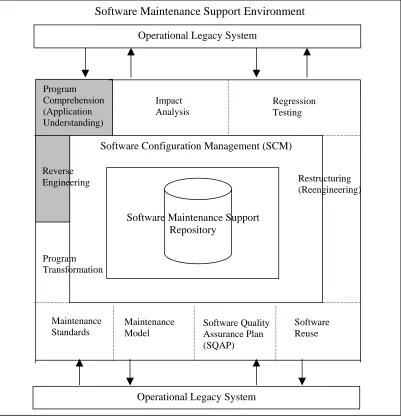
This research lies in the framework of a software maintenance environment by Kwon et al. (1998) as illustrated in the shaded area in Figure 1.2. Referring to the figure, maintenance support environment has three major parts:
(ii) Reverse Engineering part that can be supported by Program Transformation and Restructuring and enables Design Recovery
(iii) Maintenance Model and Standard part that support the process and guidelines of software maintenance
Figure 1.2: A software maintenance support environment (Kwon et al., 1998)
Figure 1.2 shows a software maintenance support environment in which the repository is the central element of the environment. Software configuration management ensures the data in the repository is properly archived. Since software maintenance always deals with legacy systems, these kinds of systems become the major input in the environment. As described in the previous paragraph, the implementation part involves program comprehension, impact analysis and regression testing. The three
Software Maintenance Support Environment
Operational Legacy System
Program Comprehension (Application Understanding)
Software Configuration Management (SCM)
Software Maintenance Support Repository Impact Analysis Regression Testing Program Transformation Maintenance Standards Maintenance Model Software Quality Assurance Plan (SQAP) Software Reuse Restructuring (Reengineering)
Operational Legacy System Reverse
elements are integrated with reverse engineering part that is supported by program transformation and restructuring to enable design recovery of an existing legacy or software system. The maintenance environment also includes maintenance model and standard, quality assurance and software reuse. Without all these three major parts (see previous paragraph) software maintenance will not be conducted properly particularly when it involves legacy systems.
Thus this research will mainly cover program comprehension of implementation part while reverse engineering will be the supporting part of the research (see highlighted areas in Figure 1.2). For the program comprehension part the research will be
specifically based on the work of Storey (1998) and Storey et al. (1999) that provides the cognitive framework to describe and evaluate software exploration tools or in this
research context is referred as software visualization tools. The framework embraces two main elements that are improve program comprehension and reduce the maintainer’s cognitive overhead (see Table 1.1). The two cognitive elements are divided into another three sub-elements respectively. In order to improve program comprehension, it is required to enhance bottom-up comprehension, top-down comprehension and integrate both approaches. In addition, to reduce cognitive overhead, it is necessary to facilitate navigation, provide orientation cues and reduce disorientation. Each cognitive element involves a number of activities and assigned with a code for ease of reference. The method proposed in this research will be partly evaluated based on this cognitive framework.
Hence, a software visualization tool should improve program comprehension at least to certain level (Price et al., 1993) otherwise such tool will be useless to
programmers or software maintainers. Software visualization tool should also reduce cognitive overhead in order to preserve the mental map and cognition of a subject system studied by software maintainers as described in the cognitive framework (Storey, 1998).
1.7 Importance of the Research
merits serious investigation. The cost might be higher if software system is maintained without its system documentation because programmers consume more time to
understand the existing source codes (Pigoski, 1997). As discussed in Section 1.3, software visualization is one of the vital methods to provide a solution related to program comprehension by visualize graphically existing software artifacts and their
interrelationships. This was also proved in the preliminary study in which graphical visualization was significantly preferred by software engineers compared to its textual description (Sulaiman et al., 2002b). Thus to overcome the problem related to program comprehension in the case of design documents are not up-dated or absence, there is a need of a proper and more effective tool to automate and assist program comprehension or cognition in order to eliminate the cost of the activities. It is expected that the deliverable of this thesis will be beneficial to other researchers in software maintenance field and also software maintainers who will use the prototype tool developed.
Table 1.1: Cognitive framework to describe and evaluate software visualization tools (Storey, 1998)
Cognitive elements Activities Code
Indicate syntactic and semantic relations between software objects
E1
Reduce the effect of de-localized plans E2 Enhance
bottom-up comprehension
Provide abstraction mechanisms E3 Support goal-directed,
hypothesis-driven comprehension
E4 Enhance top-down
comprehension
Provide an adequate overview of the system architecture at various levels of abstraction
E5
Support the construction of multiple mental models (domain, situation, program) E6 Improve program comprehension Integrate bottom-up and top-down approaches
Cross-reference mental models E7 Provide directional navigation E8 Facilitate
navigation Support arbitrary navigation E9 Indicate the maintainer’s current focus E10 Display the path that led to the current
focus
E11 Provide orientation
cues
Indicate options for further exploration E12 Reduce additional effort for
user-interface adjustment E13 Reduce the maintainer’s cognitive overhead Reduce disorientation
1.8 Scope of the Research
This research focuses on how to enhance existing methods of software
visualization in a selected existing reverse engineering environment by identifying their weaknesses and strengths via comparative study of existing tools and existing literatures. The scope of reverse engineering process is limited to source codes only but not include DRE. The proposed method should be able to improve the cognitive aspects in software visualization tool by providing a more effective ways to re-document, visualize and understand software system.
In order to justify the research problem and to find the answers of how, what, when and how software visualization tools should support the practice, a survey had been conducted in order to identify the current practice in producing and maintaining system documentation. The survey investigated the actual expectation towards reverse
engineering or software visualization tools that could assist software engineers to solve their maintenance tasks.
Another scope of the research should include developing of a prototype tool that applies the proposed method of software visualization in a better documentation
environment based on the findings from the preliminary studies and literature reviews. The usability of the prototype tool should be evaluated based on the cognitive framework (Storey, 1998). Besides, the controlled experiment to evaluate the significant of program comprehension or software understanding should be based on the identified metrics specified within Goal/Question/Metric (GQM) paradigm of Basili (1992).
1.9 Organization of Thesis
finally Chapter 8: Conclusion. The flow of the thesis is illustrated in Figure 1.3. In addition, the definition of terms used in this thesis is listed in APPENDIX A.
Chapter 1 provides a general introduction of software maintenance and what is the background of problems to be tackled in this research, the current solutions and the proposed solution. It also describes in detail the problem to be solved or eliminated in this research, its objectives, the framework in which the research resides and lastly its importance and scope.
In Chapter 2 readers are informed with the studies or research related to this thesis specifically on the topics of software engineering that indicates where software maintenance resides in a software life cycle, followed by an explanation on software maintenance issues such as the categories, techniques, methods and tools for software maintenance. A section on program comprehension highlights some studies related to comprehending source codes and how we apply the same technique to evaluate this research. The reverse engineering section describes some criteria to evaluate reverse engineering tools and some examples of existing comparative studies. The following section describes software visualization and how it links with reverse engineering and program comprehension areas. The chapter is ended with the studies related to system documentation and a brief discussion on CASE tools to highlight readers in which the deliverable of this research should be categorized.
The fourth chapter (Chapter 4) describes how the research problem was formulated based on the issues of importance of system documentation, software visualization and the drawbacks and strengths of existing tools followed by a brief discussion on the proposed solution. Other sections comprise descriptions on research design, an explanation on subject or source of information and the means used to gather data in this research. Then the following section provides a step-by-step explanation on the research procedures conducted within the planned operational framework. The last two sections discuss on how data is analyzed and possible limitations on the research and the list of assumptions.
The fifth chapter (Chapter 5) covers the details of a survey on the software engineers’ practice in production and maintenance of system documentation. The sections consist of the description on the analysis based on four elements: characteristic, behavior, beliefs and attitude. Then the findings are thoroughly described and the chapter is concluded. The chapter verifies and justifies the research problems addressed in this thesis.
In Chapter 6 the analysis and design of the prototype tool that employs the proposed DMG method are described. Then the DMG method is defined thoroughly including the graph layout algorithm optimized. The tradeoff issues of the enhanced method are also discussed. The last part of this chapter describes about DocLike Viewer prototype tool that is developed to realize the method in the aspect of visualizing,
understanding and re-documenting software systems.
The chapter on validation of the research is explained in Chapter 7. The details of the controlled experiment and usability study conducted, analysis and findings of the evaluation are discussed. In addition the qualitative evaluation of the prototype tool developed compared to other existing software visualization tools are also presented.
1.10 Summary
This chapter has provided an introduction to software maintenance in general. It has also discussed on the background of the problems related to documentation,
understanding source codes and the use of CASE tools. The current solutions of the problem and proposed solution have been explained briefly. It is followed by the description of statement of problem, objectives of the research and the theoretical
framework. The importance and scope of the research has also been explained. The last section has described how this thesis is organized.
Figure 1.3: Flow of the thesis diagram Chapter 8: Conclusion
Chapter 1: Introduction
Chapter 2: Literature Review
Chapter 3: Software Visualization Methods in Reverse Engineering Tools
Chapter 4: Research Methodology
Chapter 5: Production and Maintenance of System Documentation in Practice
Chapter 6: Document-Like Software Visualization Method
Employed in DocLike Viewer