
Cycloaddition reaction versus dimer cleavage at the Si
„
001
…
:C
5H
8interface
Wenchang Lu,*W. G. Schmidt,†and J. Bernholc
Department of Physics, North Carolina State University, Raleigh, North Carolina 27695-8202, USA 共Received 16 October 2002; revised manuscript received 15 May 2003; published 30 September 2003兲 The interface formed between an ordered monolayer of cyclopentene and silicon is studied by
first-principles density-functional calculations. Several different structural models of the interface are considered
and their reflectance anisotropy spectra are calculated. The spectra turn out to be highly structure dependent and can therefore be used to monitor the interface formation. We also find that coadsorption of hydrogen, which leads to dimer cleavage, can stabilize the interface by saturating the dangling bonds and releasing the high strain energy.
DOI: 10.1103/PhysRevB.68.115327 PACS number共s兲: 78.66.Nk, 71.15.Mb, 73.20.At
I. INTRODUCTION
The 共001兲 surface of silicon is the starting point for the fabrication of most microelectronic devices. Therefore, Si surface reactions with metals, hydrogen, oxygen, and halo-gens have been intensively studied in the past.1However, in recent years there is an increasing interest in developing methods for coupling microelectronics with organic-based structures for applications such as nonlinear optics, thinfilm displays, lithography, and molecular electronics. For this rea-son, much effort has been devoted to the preparation and characterization of ultra-thin organic layers on Si共001兲 surfaces.2–12 Organic overlayers may also facilitate the at-tachment of biomolecules, such as DNA, to the semiconduc-tor surface.13,14
Chemisorption of organic molecules on Si共001兲 is typi-cally accompanied by their fragmentation. Alkenes, however, can bond to the surface by breaking the bonds of the alkene and of the Si dimers, and forming two new bonds. This mechanism has been exploited to prepare ordered or-ganic overlayers of cyclopentene,2,10 1,5-cyclooctadiene,4,10 1,3,5,7-cyclooctatetraene,5 and 1,3-dienes6 on the Si sub-strate. These systems have novel and often extremely inter-esting properties. The chemisorption of bifunctional com-pounds such as 1,5-cyclooctadiene, for example, leads to the formation of an ordered array of carbon-carbon double bonds, which can then be utilized for further reactions.10
The adsorption of cyclopentene (C5H8) on Si leads to what can be considered a prototypical alkene-Si共001兲 inter-face. It is experimentally well characterized by scanning tun-neling microscopy 共STM兲 and by infrared and core-level spectroscopies.2,4,9,10 Some adsorption geometries have also been probed by cluster11 and density-functional calculations.15,16 From experiment,2 two possible scenarios have been suggested for the reaction between Si共001兲and a cyclopentene molecule: a关2⫹2兴cycloaddition reaction, leav-ing the Si dimer intact and an insertion reaction, where the Si dimer is broken 共dimer-cleaved model兲. The reactions that leave the dimer intact, result in ‘‘dimerized’’ models共Figs. 1 and 2兲and lead to a chemically saturated, but highly strained interface geometry.17 On the other hand, the dimer-cleavage reaction共Fig. 3兲releases the strain, but leaves unpaired elec-trons in the Si dangling bonds.
In this paper, we present first-principles calculations of
the structural and optical properties of the monolayer cyclo-pentene covered Si共001兲surface. In addition to the interface models discussed above, we consider the effects of hydroge-nation on interface structure and properties. We find that the addition of hydrogen atoms stabilizes and smooths the inter-face, which could be beneficial for further reactions. The optical anisotropy of Si共001兲:C5H8is found to be remarkably sensitive to details of the chemical bonding.
II. METHODOLOGY
The calculations were performed using a massively paral-lel real-space multigrid implementation18 of the density-functional theory共DFT兲within the local-density approxima-tion 共LDA兲19 and within the generalized gradient approximation 共GGA兲.20 The electron-ion interactions were represented by nonlocal, norm-conserving pseudopo-tentials.21 The spacing of the finest mesh used to map the electron wave functions and charge density was 0.16 Å for LDA and 0.12 Å for GGA, corresponding to energy cutoffs of 54 Ry共LDA兲and of 98 Ry共GGA兲in plane-wave calcu-lations. We model the surface by a periodic arrangement of asymmetric slabs consisting of 12 Si layers, separated by vacuum regions of the same thickness. The dangling bonds at the bottom layer of the slab were saturated by hydrogen at-oms. One monolayer 共ML兲 of C5H8 was adsorbed on the Si共001兲surface. A (2⫻2) unit cell was used in our calcula-tions and eight special k points in half of the (2⫻2) surface Brillouin zone were employed for k-space integrations.
In order to assist in the experimental identification of the interface geometry, we used the ground-state electronic structure to determine the surface optical anisotropy. These calculations were performed in the independent-particle ap-proximation following Del Sole22 and Manghi et al.23 To
avoid spurious contributions from the bottom surface of the slab, a linear cutoff function was used.24 The self-energy effects in the surface optical spectra were approximated by the scissors operator approach.25 Our study is thus on the same level as previous ab initio studies of the optical prop-erties of Si共001兲surfaces.26 –28
III. ATOMIC STRUCTURES
We first consider the adsorption of cyclopentene oriented parallel and perpendicular to the Si dimers. For acetylene on Si共001兲, these two adsorption geometries were found to be nearly degenerate energetically.29 However, our results for the adsorption of cyclopentene show that the steric interac-tions between the larger C5H8 molecules strongly favor the parallel configuration, at least for 1-ML coverage. The ad-sorption energy for the latter case is⫺0.5 eV per molecule, i.e., adsorption is not favorable. This agrees with the parallel orientation of the cyclopentene molecules observed by STM.10
For the parallel orientation of the molecule, we consider first the dimerized model. This configuration can be further
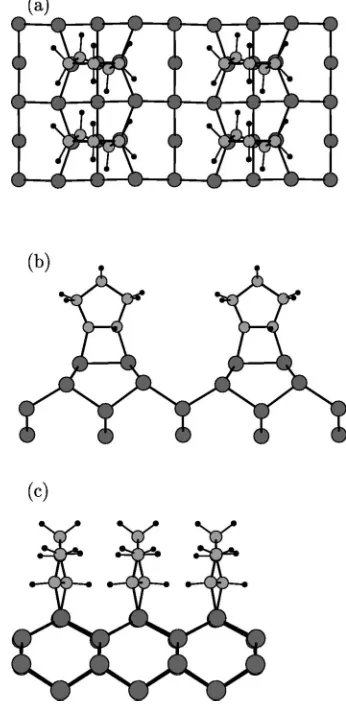
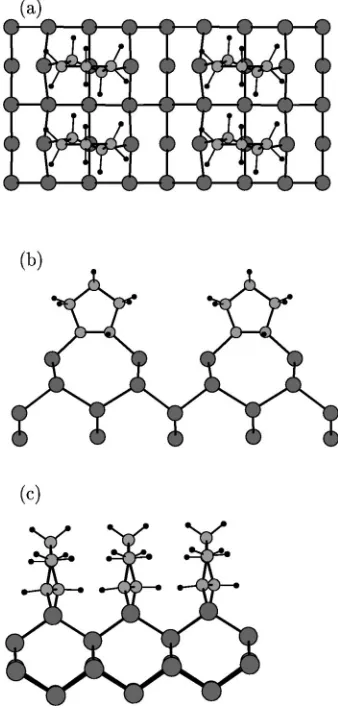
FIG. 2. Optimized geometry for the cis-type dimerized model of cyclopentene monolayer adsorption on Si共001兲: 共a兲 top view, 共b兲 and共c兲side views. Large, medium, and small circles represent
sili-con, carbon, and hydrogen atoms, respectively. model of cyclopentene monolayer adsorption on SiFIG. 3. Optimized geometry for the trans-type dimer-cleaved共001兲: 共a兲 top
classified according to the positions of the hydrogen atoms in the immediate vicinity of the Si surface. In the ‘‘trans-type’’ adsorption, the two H atoms are on alternating sides of the molecule, whereas both H atoms reside on the same side of the molecule in the ‘‘cis-type’’ configuration. The optimized
trans and cis configurations of the dimerized model are
shown in Figs. 1 and 2, respectively. Apart from the positions of the downmost hydrogen atoms, the main structural differ-ence between trans and cis configuration consists in the ori-entation of the molecular C-C bonds near the interface. In the former case they are substantially twisted with respect to the Si dimer, as a consequence of the repulsive interactions be-tween neighboring cyclopentene molecules. We calculate a rotation of 24° with respect to the direction of Si dimers. In addition, the Si dimers are slightly rotated with respect to the ideal direction. This is similar to the cases of C2H2and C2H4 on the Si共001兲surface,30,31in which the hydrogen atoms are twisted to reduce the repulsion between hydrogen charge clouds on neighboring molecules. In the present case, the twist is a consequence of repulsive interactions between the whole neighboring molecules. For the cis-type, there is no twist for the C-C bonds. In this case we calculate adsorption energies of 1.4 eV and 0.6 eV in LDA and GGA, respec-tively. Adsorption in trans-type configuration leads to energy gains of 1.6 and 0.8 eV, calculated within LDA and GGA, respectively. Table I lists the adsorption energies calculated by us and by other groups. Our LDA results are larger than those from literatures15,16and our GGA results are a little bit smaller. But the adsorption energy difference among differ-ent models are very close each other. For example, Akagi and Tsuneyuki15found for monolayer coverage that the trans configuration is favored over the cis-type adsorption by 0.11 eV, which is comparable with 0.2 eV in our both LDA and GGA calculations.
The cyclopentene molecules do not dissociate upon ad-sorption. However, the bond between the two carbon atoms attached to the surface is stretched. We calculate 1.38 and 1.51 Å for the gas phase and the adsorbed molecules, respec-tively. The latter value is typical for single carbon bonds and indicates that the carbon atoms at the interface are s p3 hy-bridized, rather than s p2 as in the free molecule. The Si dimer length does not change significantly upon the adsorp-tion of cyclopentene. The dimer buckling, however, is much reduced to only 1.3°. The Si-C bond length at the interface is 1.85 Å, similar to the bulk SiC bond length.
The relaxed geometry for the dimer-cleaved model is shown in Fig. 3. Similar to the dimerized model, the
cyclo-pentene molecules do not dissociate and the C-C bond near the interface is rotated by 24°. It is stretched to 1.56 Å and the originally dimerized Si atoms are now 4.3 Å apart. The Si-C bond length of 1.91 Å is slightly longer than the value of 1.85 Å in the dimerized model. The overall weaker inter-face bonding together with the partially occupied Si dangling bonds explain why the dimer-cleaved model is energetically less favored than the dimerized model, in spite of the lower interface strain. The calculated adsorption energies per mol-ecule for the dimer-cleaved model amount to 1.3 and 0.5 eV within LDA and GGA, respectively.
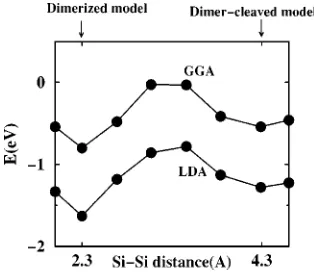
Compared to the adsorption of acetylene and ethylene, where the dimerized adsorption models are favored over the dimer-cleaved geometries by more than 1 eV,32 the energy difference of 0.3 eV 共both in LDA and GGA兲 between the two adsorption geometries of cyclopentene is relatively small. Both interface structures may thus occur at elevated temperatures. The most likely reaction pathway from the dimerized to the dimer-cleaved geometry is the breaking of the Si dimer. In Fig. 4, we show the relative adsorption en-ergy vs the length of the Si dimer. In these calculations, we kept the coordinates of the Si surface atoms along the dimer direction fixed, while the remaining degrees of freedom and all the other atoms were allowed to relax. The energy barrier for the transition between the two structures is 0.85 eV in the LDA and 0.78 eV in the GGA. The two structures could thus coexist at the interface, with the fraction of the dimerized model being much higher.
The addition of the carbon bond to the bond of a symmetric surface dimer via a 关2⫹2兴cycloaddition reaction is orbital-symmetry forbidden. Indeed, the sticking probabil-ity of 0.1% for cyclopentene on the diamond 共001兲 surface, where symmetric dimers form, is very low.33,34However, the symmetry of the surface dimers is broken at the Si共001兲 sur-face. They consist of a more s p2-like ‘‘down’’ atom, which moves closer to the plane of its three nearest neighbors, and an ‘‘up’’ atom, which moves away from the plane of its neighbors and possesses an s-like dangling bond. The direc-tion of the buckling alternates within each dimer row and the registry of the buckling in the neighboring dimer rows is such that the surface ground state is a reconstructed
c(2⫻4).1This symmetry breakage allows for the cycload-dition reaction and is most likely responsible for the nearly
TABLE I. Adsorption energy per molecule of C5H8on Si共001兲
surface.
Our LDA Our GGA GGAa GGAb
Dimerized trans 1.6 0.8 1.05
Dimerized cis 1.4 0.6 1.17 0.94
Dimer cleaved trans 1.3 0.5
Dimer cleaved cis 0.17
aFrom Ref. 16. bFrom Ref. 15.
100% sticking probability for cyclopentene on Si共001兲.33 A possible reaction pathway leading to the di--bonded inter-face configurations discussed here has already been investi-gated by Cho and Kleinman.16They calculated an activation barrier of about 0.2 eV.
The interface geometry is very sensitive to the presence of hydrogen: if atomic hydrogen is added near the Si surface atoms, both the dimerized and the dimer-cleaved configura-tions relax toward the geometry shown in Fig. 5, with a Si-Si distance of 3.8 Å. The hydrogen adsorption stabilizes the interface by releasing the large strain energy in the dimerized model or by saturating the dangling bonds in the dimer-cleaved model. The adsorption energy for the coadsorption system is defined by
⌬E⫽⫺关Etot⫺E共Sisurf兲⫺E共C5H8兲⫺E共H2兲兴,
where Etotis the total energy of the total coadsorbed system,
E(Sisurf) is the energy of the clean Si surface, while
E(C5H8) and E(H2) are the energies of the respective gas-phase molecules. Neglecting temperature effects, our calcu-lations for this system give adsorption energies of 2.8 eV within LDA and 2.7 eV within GGA. Due to the temperature
and pressure dependence of the hydrogen chemical potential
共see, e.g., Ref. 35兲, the relative stability of the coadsorbed system will strongly depend on the preparation conditions.
Cho and Kleinman16 have considered the dissociation of hydrogen from the cyclopentene molecule and found that the atoms in the molecule stay in a planar geometry. In our case, where the extra hydrogen atoms are assumed to adsorb on the Si surface atoms, the molecule is twisted as in the other two models discussed above. The saturation of the Si dan-gling bonds leads to an efficient electronic passivation: the interface electronic states are pushed out of the region of the Si bulk band gap. Some experimental evidence supporting the suggested coadsorption of hydrogen—possibly released from fragmented molecules—is given by the observation of Si-H stretching vibrations in infrared spectroscopy.2
IV. SURFACE OPTICAL ANISOTROPY
The direct verification of the predicted interface geom-etries by techniques such as STM will be very difficult. However, one extremely structure-sensitive experimental technique, which is not restricted to ultrahigh vacuum con-ditions and can thus be used to monitor the interface forma-tion in situ, is reflectance anisotropy spectroscopy 共RAS兲, also termed reflectance difference spectroscopy.36 Compari-sons between the measured data and spectra computed for alternative structural models often allow for unambiguous determination of surface or interface geometries.37,38
In our calculations, the electronic self-energy corrections are approximately included using the scissors operator and the effects of electron-hole attraction and of local fields are omitted. However, these many-body effects usually do not qualitatively alter the spectra,39,40 because RAS measure-ments obtain difference spectra, which are furthermore nor-malized to the bulk dielectric function. The distinct and structure-dependent RAS features predicted below should thus be reliable and well suited for monitoring of interface formation.
Figure 6 shows RAS spectra calculated for the three
trans-type configurations studied here. In either case, the
electronic transitions within the molecule do not contribute significantly to the interface optical properties in the energy range of up to 5 eV. This is expected, since each carbon atom in the cyclopentene molecule is s p3 hybridized and chemi-cally saturated. For the dimerized model, we only find a very weak shoulder A, which is due to optical anisotropies in the C5H8overlayer. The peak B at the E2critical point energy of Si is related to electronic transitions between surface-modified bulk Si wave functions. This feature is typical for dimerized Si共001兲surfaces.26 –28The optical spectrum for the dimer-cleaved model is very different. Transitions involving the Si dangling bonds give rise to a strong anisotropy peak C at 2 eV, suppressing the weak signal from the C5H8 over-layer. For the hydrogenated interface, the weak signal from the C5H8 overlayer is again visible. For both the dimer-cleaved and the hydrogenated interface models, a negative anisotropy D is observed at the E2critical point energy of Si. The change from positive to negative optical anisotropies upon dimer cleavage at the E2 energy calculated here共
tures B and D) has been previously observed in experiments for hydrogenated Si surfaces.41
To further probe the sensitivity of RAS for the details of the interface chemical bonding, we compare in Fig. 7 the spectra calculated for both trans and cis-type dimerized models. We observe pronounced differences. For the cis-type, there are two dips at 1.5 eV and 3.2 eV. The positive high-energy peak splits into two. Again, we find that most of the interface optical anisotropy is not directly from the ad-sorbate molecules, but rather due to electronic transitions at the interface.
V. SUMMARY
We investigated the atomic structure and surface optical properties of the Si共001兲:C5H8interface, using the real-space multigrid DFT method within both the local-density and the
generalized gradient approximations. While the adsorption energy depends on the choice of the exchange-correlation approximation, the relative stabilities of the different models have the same trends in both LDA and GGA calculations. The formation of a dimerized structure via the 关2⫹2兴 cy-cloaddition reaction is favored over the breaking of the sur-face Si dimer. The adsorption of additional hydrogen atoms increases the stability of the interface by releasing the strain energy and saturating the dangling bonds. The resulting sur-face is electronically well passivated. We found strong and structure-dependent surface optical anisotropies, which mainly arise from electronic transitions within the substrate and between the substrate and the overlayer. Even a discrimi-nation between cis and trans-type adsorption configurations is possible, based on measurements of the reflectance anisot-ropy. Surface optical spectroscopies are therefore well suited for monitoring the formation of interfaces between Si sur-faces and hydrocarbon overlayers, as well as for determining the structure of the overlayer.
ACKNOWLEDGMENTS
We gratefully acknowledge support by DoE and ONR, and grants of supercomputer time provided by the DoD Challenge Program and NCSC.
*Electronic address: [email protected]
†Permanent address: Institut fu¨r Festko¨rpertheorie und Theoretische
Optik, Friedrich-Schiller-Universita¨t, Max-Wien-Platz 1, 07743 Jena, Germany.
1J. Dabrowski and H.-J. Mu¨ssig, Silicon Surfaces and Formation
of Interfaces共World Scientific, Singapore, 2000兲, and references therein.
2R.J. Hamers, J.S. Hovis, S. Lee, H. Liu, and J. Shan, J. Phys.
Chem. B 101, 1489共1997兲.
3J.T. Yates, Jr., Science 279, 335共1998兲.
4J.S. Hovis, S. Lee, H.B. Liu, and R.J. Hamers, J. Vac. Sci.
Tech-nol. B 15, 1153共1997兲.
5J.S. Hovis and R.J. Hamers, J. Phys. Chem. B 102, 687 共1998兲.
6J.S. Hovis, H. Liu, and R.J. Hamers, J. Phys. Chem. B 102, 6873 共1998兲.
7R. Akiyama, T. Matsumoto, and T. Kawai, Phys. Rev. B 62, 2034 共2000兲.
8R.J. Hamers, J.S. Hovis, C.M. Greenlief, and D.F. Padowitz, Jpn.
J. Appl. Phys., Part 1 38, 3879共1999兲.
9J.S. Hovis, H. Liu, and R.J. Hamers, Surf. Sci. 402-404, 1共1998兲. 10J.S. Hovis, H. Liu, and R.J. Hamers, Appl. Phys. A: Mater. Sci.
Process. 66, S553共1998兲.
11S.W. Lee, J.S. Hovis, S.K. Coulter, R.J. Hamers, and C.M.
Green-lief, Surf. Sci. 462, 6共2000兲.
12H.B. Liu and R.J. Hamers, Surf. Sci. 416, 354共1998兲.
13N. Pernodet, V. Samuilov, K. Shin, J. Sokolov, M.H. Rafailovich,
D. Gersappe, and B. Chu, Phys. Rev. Lett. 85, 5651共2000兲.
FIG. 6. RAS spectra 关(R[1¯10]⫺R[110])/具R典兴 calculated for the dimerized model, the dimer-cleaved model, and the hydrogenated interface. Zero values are indicated by dashed lines.
14T. Strother, R.J. Hamers, and L.M. Smith, Nucleic Acids Res. 28,
3535共2000兲.
15K. Akagi and S. Tsuneyuki, Surf. Sci. 493, 131共2001兲. 16
J. Cho and L. Kleinman, Phys. Rev. B 64, 235420共2001兲.
17R. Koneeny and D.J. Doren, J. Am. Chem. Soc. 119, 11098 共1997兲.
18E.L. Briggs, D.J. Sullivan, and J. Bernholc, Phys. Rev. B 54,
14 362共1996兲.
19J.P. Perdew and A. Zunger, Phys. Rev. B 23, 5048共1981兲. 20J.P. Perdew, K. Burke, and M. Ernzerhof, Phys. Rev. Lett. 77,
3865共1996兲.
21D.R. Hamann, Phys. Rev. B 40, 2980共1989兲; L. Kleinman and
D.M. Bylander, Phys. Rev. Lett. 48, 1425共1982兲.
22R. Del Sole, Solid State Commun. 37, 537共1981兲.
23F. Manghi, R. Del Sole, A. Selloni, and E. Molinari, Phys. Rev. B
41, 9935共1990兲.
24A.I. Shkrebtii, N. Esser, W. Richter, W.G. Schmidt, F. Bechstedt,
B.O. Fimland, A. Kley, and R. Del Sole, Phys. Rev. Lett. 81, 721
共1998兲.
25R. Del Sole and R. Girlanda, Phys. Rev. B 48, 11 789共1993兲. 26L. Kipp, D.K. Biegelsen, J.E. Northrup, L.-E. Swartz, and R.D.
Bringans, Phys. Rev. Lett. 76, 2810共1996兲.
27M. Palummo, G. Onida, R. Del Sole, and B.S. Mendoza, Phys.
Rev. B 60, 2522共1999兲.
28W.G. Schmidt, F. Bechstedt, and J. Bernholc, Phys. Rev. B 63,
045322共2001兲.
29W.A. Hofer, A.J. Fisher, and R.A. Wolkow, Surf. Sci. 475, 83 共2001兲.
30W. Widdra, A. Fink, S. Gokhale, P. Trischberger, D. Menzel, U.
Birkenheuer, U. Gutdeutsch, and N. Rosch, Phys. Rev. Lett. 80, 4269共1998兲.
31U. Birkenheuer, U. Gutdeutsch, N. Ro¨sch, A. Fink, S. Gokhale,
D. Menzel, P. Trischberger, and W. Widdra, J. Chem. Phys. 108, 9868共1998兲.
32J.H. Cho, L. Kleinman, C.T. Chan, and K.S. Kim, Phys. Rev. B
63, 073306共2001兲; 64, 199902共E兲 共2001兲and references therein.
33J.S. Hovis, S.K. Coulter, R.J. Hamers, M.P. D’Evelyn, J.J.N.
Rus-sel, and J.E. Butler, J. Am. Chem. Soc. 122, 732共2000兲.
34
In addition, the high strain energy associated with the formation of a fourfold carbon ring may hinder the cycloaddition reaction in the case of diamond surfaces.
35C.G. Van de Walle and J. Neugebauer, Phys. Rev. Lett. 88,
066103共2002兲.
36D.E. Aspnes and A.A. Studna, Phys. Rev. Lett. 54, 1956共1985兲. 37W. Lu, W.G. Schmidt, E.L. Briggs, and J. Bernholc, Phys. Rev.
Lett. 85, 4381共2000兲.
38J.R. Power, P. Weightman, S. Bose, A.I. Shkrebtii, and R. Del
Sole, Phys. Rev. Lett. 80, 3133共1998兲.
39W.G. Schmidt, N. Esser, A.M. Frisch, P. Vogt, J. Bernholc, F.
Bechstedt, M. Zorn, Th. Hannappel, S. Visbeck, F. Willig, and W. Richter, Phys. Rev. B 61, R16 335共2000兲.
40P.H. Hahn, W.G. Schmidt, and F. Bechstedt, Phys. Rev. Lett. 88,
016402共2002兲.
![FIG. 7. RAS spectra �dimerized models of the(R[1¯10]�R[110])/�R�� calculated for the trans and cis types](https://thumb-us.123doks.com/thumbv2/123dok_us/1316724.1164413/5.612.85.265.57.299/fig-ras-spectra-dimerized-models-calculated-trans-types.webp)
