FACTORS IMPEDING THE DEVELOPMENT OF OMAN SPATIAL DATA INFRASTRUCTURE
AHMED HAMOOD MOHAMMED AL-WARDI
A thesis submitted in fulfilment of the requirement for the award of the degree of Doctor of Philosophy (Geomatic Engineering)
Faculty of Geoinformation and Real Estate Universiti Teknologi Malaysia
ACKNOWLEDGEMENTS
First of all I thank Allah for His blessing and abundant benevolence in my life and in preparing this thesis. I was in contact with many people, researchers, academicians, and practitioners who have contributed towards my understanding and thoughts. In particular, I wish to express my sincere appreciation to my main thesis supervisor, Dr. Shahidah Mohd Ariff and my co-supervisor Dr. Abdullah Hisam Bin Omar for their supervisions, advices, critics, encouragement, guidance, and acquaintance.
This research would not have been possible, without the support from the staff members of the National Survey Authority (NSA), of the Sultanate of Oman Ministry of Defence. I therefore would like to express my gratitude to all the managers and technicians of the ministries that have willingly participated to be my informative responsible respondents in my study.
ABSTRACT
ABSTRAK
TABLE OF CONTENTS
CHAPTER TITLE PAGE
DECLARATION ii
DEDICATION iii
ACKNOWLEDGEMENTS iv
ABSTRACT v
ABSTRAK vi
TABLE OF CONTENT vii
LIST OF TABLES xii
LIST OF FIGURES xiv
LIST OF ABBREVIATIONS xv
LIST OF APPENDICES xix
1 INTRODUCTION 1
1.1. Background 1
1.2. Problem Statement 3
1.3. Research Questions 4
1.4. Research Aims 4
1.5. Research Objectives 5
1.6. Research Motivations 5
1.7. Significance of Research 5
1.8. Thesis Outline 6
2 LITERATURE REVIEW 7
2.2 Spatial Data and Information Infrastructure concepts 7
2.2.1 Spatial Data and Information 7
2.2.2 Need for spatial data 8
2.2.3 Information Infrastructure 10
2.3 Spatial Data Infrastructure 11
2.3.1 Scope of SDIs 11
2.3.2 Benefits of SDIs 13
2.3.3 Spatial Data Infrastructure Components 13
2.3.4 SDI Hierarchy 15
2.3.5 SDI Perspectives 16
2.4 SDIs Worldwide 17
2.4.1 Nature of SDIs 18
2.4.2 SDI Pioneers 19
2.4.3 First Generations SDIs 19
2.4.4 Second Generations SDIs 21
2.4.5 SDI Development 21
2.4.5.1 SDIs In Europe 22
2.4.5.2 SDIs In Americas 23
2.4.5.3 SDIs in Asia 24
2.4.5.4 SDIs in the Middle East 25
2.4.5.5 SDIs in Africa 25
2.4.6 Special Purpose SDIs 26
2.4.6.1 Marine SDI 26
2.4.6.2 The Arctic SDI 27
2.4.6.3 The Antarctic SDI 28
2.4.6.4 Cultural Heritage SDIs 28
2.4.6.5 Humanitarian SDIs 28
2.4.6.6 Avalanche SDI 29
2.4.6.7 Laser Scanning SDI 30
2.4.6.8 SDIs for Development 30
2.4.7 The Drive for SDI Development 31
2.5 Factors Affecting the Development of SDIs 33
2.5.1 Multi-source Data Integration issues 33
2.5.3 Accessibility of Data 40
2.5.4 Cooperation, Collaboration and Coordination 41
2.5.5 DSI Framework Components 43
2.5.6 Reference Data 45
2.5.7 Economic Factors 45
2.5.8 Funding 46
2.5.9 Government Support 48
2.5.10 Policies 48
2.5.11 Standards 48
2.5.12 SDIs Metadata Standards 49
2.5.13 Awareness 51
2.6 Spatial Data Activities in Oman 51
2.6.1 GIS Activities in Oman 53
2.6.2 E-government Initiatives in Oman 57
2.6.3 Geospatial Data for Disaster Managements 57
2.6.4 SDI Driving Forces in Oman 58
2.6.5 SDI History in Oman 59
2.6.5.1 National Geographic Database 59
2.6.5.2 National Geographic information System Authority 60
2.6.5.3 Oman National Spatial Strategy 60
2.7 Conclusion 62
3 METHODOLOGY 64
3.1 Introduction 64
3.2 Study Area 65
3.3 Initial Study 69
3.4 Data Collection 70
3.4.1 Interviews 70
3.4.1.1 National Survey Authority 71
3.4.1.2 The Supreme Council for Planning 72
3.4.1.4 Muscat Municipality 74
3.4.1.5 Ministry of Housing 74
3.4.1.6 Ministry of Transport and Communication 75
3.4.1.7 Petroleum Development Oman 76
3.4.1.8 National Hydrographic Office 76
3.4.1.9 Ministry of Heritage and Culture 77
3.4.1.10 Ministry of Interior 77
3.4.1.11 OmanTel 77
3.4.2 Questionnaires 78
3.4.3 Data Review 79
3.4.4 Data Analysis Methods 82
3.4.4.1 Qualitative Data Analysis 82
3.4.4.2 Quantitative Data Analysis 82
3.5 SWOT Analysis 84
3.6 Conclusion 84
4 RESULTS AND ANALYSIS 85
4.1 Introduction 85
4.2 Results 85
4.2.1 Results of Initial Study 86
4.2.1.1 Definitions of SDI 86
4.2.1.2 Nature of SDI 86
4.2.1.3 SDI development 86
4.2.1.4 Worldwide Development 87
4.2.1.5 Potential Factors Affecting the Development of SDI 88
4.2.2 Results of Interviews 89
4.2.2.1 Respondents 89
4.2.2.2 Spatial Data Activities 91
4.2.2.3 Access to spatial Data 93
4.2.2.4 Spatial Data Ownership 94
4.2.2.6 Skills and Expertise 96
4.2.3 Results of Survey 99
4.2.3.1 Respondents 100
4.2.3.2 NSDI awareness 100
4.2.3.3 Spatial Data Production 103
4.2.3.4 Use of Spatial Data 104
4.2.3.5 Fundamental Dataset 107
4.2.3.6 Data Access Methods 108
4.2.3.7 User satisfaction 109
4.2.3.8 Data Availability 111
4.2.3.9 Metadata 116
4.2.3.10 Standards 117
4.3 Analysis 116
4.3.1 Factors Affecting the Development of SDI 119
4.3.2 Factors Affecting the Development of Oman SDI 122
4.5 SWOT 125
4.5.1 Strength 125
4.5.2 Weakness 127
4.5.3 Opportunity 128
4.5.4 Threats 128
4.5 Conclusion 129
5 DISCUSSION AND CONCLUSIONS 130
5.1 Summary 130
5.2 Discussion 131
5.3 Findings 135
5.4 Conclusion 136
5.5 Recommendation 137
5.2 Future Research 138
REFERENCES 139
LIST OF TABLES
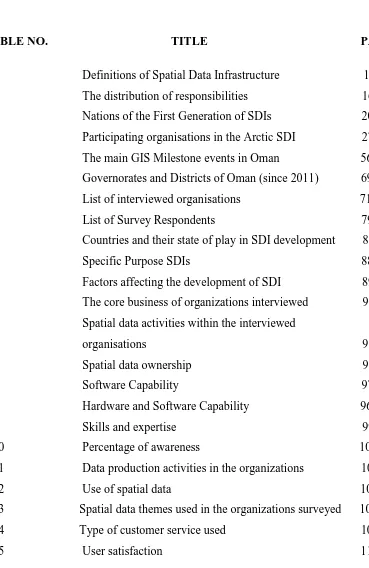
TABLE NO. TITLE PAGE
2.1 Definitions of Spatial Data Infrastructure 15
2.2 The distribution of responsibilities 16
2.3 Nations of the First Generation of SDIs 20
2.4 Participating organisations in the Arctic SDI 27
2.5 The main GIS Milestone events in Oman 56
3.1 Governorates and Districts of Oman (since 2011) 69
3.2 List of interviewed organisations 71
3.3 List of Survey Respondents 79
4.1 Countries and their state of play in SDI development 87
4.2 Specific Purpose SDIs 88
4.3 Factors affecting the development of SDI 89
4.4 The core business of organizations interviewed 90
4.5 Spatial data activities within the interviewed organisations 91
4.6 Spatial data ownership 95
4.7 Software Capability 97
4.8 Hardware and Software Capability 96
4.9 Skills and expertise 99
4.10 Percentage of awareness 102
4.11 Data production activities in the organizations 103
4.12 Use of spatial data 105
4.13 Spatial data themes used in the organizations surveyed 106
4.14 Type of customer service used 109
4.16 Review of available spatial data 111
4.17 Spatial data valuable details 114
4.18 Utilities data available 115
4.19 Satellite Image 116
4.20 Metadata creation within the organisations 117
4.21 Use of Standards by respondents 118
LIST OF FIGURES
FIGURES NO. TITLE PAGE
2.1 Components of a Spatial Data infrastructure 14
2.2 Hierarchy of SDIs 15
2.3 Data flow line for multi-source integrations 34
2.4 Technical and non-technical components of SDI 36
2.5 Rainfall map around the Gulf of Oman 57
2.6 ONSS information system process 61
3.1 Research Plan 65
3.2 The location of the Sultanate of Oman 66
3.3 Oman Physical geography 67
3.4 The Governorate and Regions of Oman 68
3.5 Spatial Data Assessment Model 80
3.6 Data Analysis Methodology 83
4.1 Organizations and their core business 90
4.2 Data access from producer organisations 93
4.3 Organisational hardware ownership 96
4.4 Distribution of Respondents 100
4.5 Summarized factors affecting SDIs Development 122
4.6 Factors affecting data integration in Oman 125
LIST OF ABBREVIATION
AD-SDI - Abu Dhabi Spatial Data Infrastructure ADSIC - Abu Dhabi Systems and Information Centre AGI - Association for Geographic Information
ANZLIC - Australia New Zealand Land Information Council APSDI - Asia-Pacific Spatial Data Infrastructure
APSMA - Australia Public Sector Mapping Agency ASDI - Australia SDI
BSDI - Bahrain Spatial Data Infrastructure CCOG - Canadian Council on Geomatics
CGDI - Canadian Geospatial Data Infrastructure CGIS - Centre for GIS
CMI&C - Constriction Material Industry & contracting CNIG - National Centre for Geographic Information CSDGM - Content Standards for Digital Geospatial Metadata DBMS - Database Management System
DGI - Digital Geographic Information
DGIWG - Digital Geographic Information Working Group
DGMAN - Directorate General of Meteorology and Air Navigation DEM - Digital Elevation Model
DIGEST - Digital Geographic Information Exchange standard DM - Dhofar Municipality
DNF - Digital National Framework DTED - Digital Terrain Elevation Data DTM - Digital Terrain Model
EDB - Economic Development Board
eGU - e-Government Unit
EU - European Union
EUROGI - European Umbrella Organisation for Geographic FACC - Feature and Attribute Coding Catalogue
FGDC - Federal Geographic Data Committee FIPS - Federal Information Processing Standard FRC - Future Requirement Committee
FUGRO - FUGRO Middle East and Partners company GCC - Gulf Cooperation Countries
GDI - Geographical Data Infrastructure
GEMINI - Geo-spatial Metadata Interoperability Initiative GII - Geographical Information Infrastructure
GIS - Geographic Information System GML - Geography Markup Language GNP - Gross Nation Product
GPS - Geographic Positional System GSDI - Global Spatial Data Infrastructure
HM - His Majesty
IACG - Inter-Agency Committee on Geomatics
ICSM - Intergovernmental Committee of Surveying and Mapping ICT - Information and Communication Technologies
INSPIRE - Infrastructure for Spatial Information in Europe ISO - International Organization for Standardization ITA - Information Technology Authority
MaCGDI - Malaysia Canter for Geospatial Infrastructure MECA - Ministry of Environment and Climate Affairs
MGS - Muscat Geo System Company
MM - Muscat Municipality MOAG - Ministry of Agricultural MOH - Ministry of Housing MOHR - Ministry of Heritage MOI - Ministry of Inertial
MONE - Ministry of National Economy
MOTC - Ministry of transport and communication MWS - Military Welfare Service
MyGDI - Malaysian Geospatial Data Infrastructure MZEC - Mazown Electric Company
NaLIS - National Infrastructure for Land Information System NCSP - National Centre for Spatial Planing
NGDB - National Geographic Data Base NGDF - National Geospatial Data Framework
NGISA - National Geographic Information System Authority NGISSC - National GIS Steering Committee
NHO - National Hydrographic Office NIT - Navigation Information Technology NTDB - National Topographic Database NSA - National Survey Authority
NSDI - National Spatial Data Infrastructure
NSGI - Portugal National System for Geographic Information Omantel - Oman telecommunication company
ONSDI - Oman National Spatial Database Infrastructure ORDBMS - Object-Relational Database Management System PCGIAP - Permanent Committee on GIS Infrastructure for Asia
and the Pacific
PCGIAP - Infrastructure of Geographic Information Systems Asia and the Pacific
PDO - Petroleum Development for Oman RDBMS - Relational Database Management system RSDI - Regional National Spatial Data Infrastructure SCTP - Supreme Committee of Town Planning SDI - Spatial Data Infrastructure
SI - Spatial Information
SIPC - Sohar Industry Port company SQL - Structured Query Language
SQU- COA - College of Arts – Sultan Qaboose University
SWOT - Strength Weakness Opportunities Thrust Analysis TDB - Topographic Database
UAE - United Arab Emirates
UK - United Kingdom
UN - United Nation
LIST OF APPENDICES
APPENDIX TITLE PAGE
A Points of Interviow 151
B Questionnaire contants 153
C Revised Spatial data avaiable in Oman 164 D Suggestion to overcome the factores impaded
INTRODUCTION
1.1 Background
Transitional economies such as Brazil have also succeeded in developing their SDI (Davis and Fonseca, 2006). More recently Uganda and Jordan have begun developing their SDI. The Gulf Cooperation Countries (GCC) of Qatar, United Arab Emirates (UAE), Sultanate of Oman, Bahrain, Saudi Arabia and Kuwait had begun developing their SDI systems. Qatar was one of the earliest countries to pioneer SDI development. Besides Qatar, Bahrain and Abu Dhabi in the UAE have also succeeded.
SDIs have been developed for different purposes. Conventional SDI systems were developed mostly for economic and environmental purposes. Following the recognition of the benefits from such SDI systems, a number of countries such as Australia, Canada and Japan are now building marine SDI as an extension to their successful national SDI. There are at present a number of specific purpose SDIs being developed or conceptualised such as the Arctic SDI and the Antarctic SDI. These were created to support scientific data management for scientific research in the Arctic and the Antarctic respectively. Similarly, other specifically developed SDIs include a Cultural Heritage SDI, Humanitarian SDI, Avalanche SDI, Laser Scanning SDI and the recently created Spatial Data Infrastructure for Development (SDI4MDGs). The SDI4MDGs is specifically developed for monitoring and achieving the Millennium Development goals, which relates to the goals established following the Millennium Summit of the United Nations in 2000 which aimed amongst other to eradicate poverty and to promote sustainable development (section, 2.4.6).
reasons. There are also countries in which SDI development has been postponed to allow for changes to reflect their particular needs.
The factors affecting the development of SDIs range from the problem of lack of digital and up-to-date spatial data (as in the case of African countries), lack of funding (as in the case of many transitional and developing countries), lack of internet and telecommunications facilities and electricity as in Nigeria and many other African countries to lack of political support such as in the case of many countries where poverty, food security, health-care (AIDs) and other social problems are their main priority.
1.2 Problem Statement
1.3 Research Questions
This research was carried out by systematically observing the following research questions :
(i) What is a spatial data infrastructure and what does it consist of?
(ii) Which countries have successfully developed their spatial data infrastructure and why?
(iii) What are the factors that affect the development of a spatial data infrastructure?
(iv) What is the current situation of spatial data infrastructure in the Sultanate of Oman?
(v) What are the characteristics and types of spatial data used by the Geographic information (GI) communities in Oman?
(vi) What are the factors affecting or impeding the development of an Omani Spatial Data Infrastructure initiative?
1.4 Research Aim
The aim of this research is to identify the key barriers affecting the development of Oman Spatial Data Infrastructure so that appropriate solutions could be recommended to rectify the current problems in the development of the Oman SDI.
1.5 Research Objectives
The objectives of this research include the following:
(i) to study the nature and the development of a spatial data infrastructure.
(ii) to identify the key factors that affect the development of spatial data infrastructure.
(iv) to recommend steps to be taken to enhance development of Oman spatial data infrastructure initiative.
1.6 Research Motivation
Oman is a developing country seeking to instigate Information Technologies (IT). The reason for this study is to contribute to directing effective implementation of SDI as part of the larger government initiative in promoting IT. By implementing SDI, Oman will be streamlining organisational decision making which will contribute to implementing IT and making Oman a more modern country.
1.7 Significance of the Research
It has been nearly twenty years since the National Survey Authority of Oman first initiated the idea in 1995 to adopt the development of a National Geographic Data Infrastructure (NGDI). While many countries in the world have successfully or partially successful in developing their national spatial data infrastructure within this time period, Oman does not make much progress and it is yet to see the development of the national SDI to materialise. Therefore, this study is important as it seeks to identify the factors which may contribute to Oman's failure and is significant to provide recommendation(s) to rectify the situation and to pave the way forward to a successful implementation of the NSDI.
1.8 Thesis Outline
The thesis is organised in five chapters as outlined below:
(ii) Chapter 2. The chapter outlines the scope of the spatial data infrastructure (SDI) and lists the various definitions of the SDI to indicate its complexity and dynamics. It also provides an overview of the development of SDI systems in other countries to show the various forms they can take and their wide scale acceptance by many countries in the world. Details on special purpose SDI systems are also included in this chapter.
(iii)Chapter 3. This chapter outlines the methods used to identify and describe the current situation in Oman and the user requirements.
(iv) Chapter 4. The chapter presents the result of the research relating to the most important factors identified to affect the development of SDI. These factors are compared to the findings relating to the development of the Oman SDI. It highlights the status of spatial data activities and provides a vision of the most important factors that impede the implementation of the Oman SDI.
REFERENCES
ADSIC, 2009. “Strengthening and Institutionalization Stage”, Abu Dhabi Spatial Data Infrastructure System and Information (AD-SDI), Advances AD-SDI Newsletter, Issue 3, Quarter 3
AGI, 2009. UK GEMINI Standard, Geo-spatial Metadata Interoperability Initiative, Version 2.0
Ahmad Fauzi bin Nordin, 2006 . Topographic-Cadastral Data Integration issue: the Malaysian Case, proceeding Seventeenth United Nations Regional Conference for Asia and the Pacific, Bangkok, 18-22 September 2006
Akinyemi, F.O, 2007. Spatial Data Needs for Poverty Management, In: Onsrud,H.J. (ed.) Research and Theory in Advancing SDI Concepts, pp.262-277, ESRI Press, Redlands, USA
Al-Awadhi, T., 2002. GIS Implementation Strategy in Oman: Past, Present and Future, Geographic Department, Sultan Qaboos University, proceedings.esri.com
Al Bakri, M.M.S., 2012. Developing tools and Models for Evaluating Geospatial Data Integration of Official and VGI Data Sources, PhD Thesis, School
of Civil Engineering and Geosciences, Newcastle University, United Kingdom, https//these.ncl.ac.uk
Al-Balushi, A., 2007. The Use of GIS National Survey Authority. GIS conference, Qatar, http://www.gisqatar.org.qa [accessed 20 March 2008]
Al Jabri, S., 2006. Electronic Archive in the Sultanate of Oman: the Experience of the Ministry of Housing, Cybrarians Journal, No. 6, March 2006,
http://www.cybrarians.info /journal/no8/e-archive.htm , [accessed 20 May 2010]
Ali, S.H. and J.F. Shroder, 2011. Afghanistan’s Mineral Fortune: Multinational influence and development in a post-war economy, Research Paper
ANZLIC, 2010 . Australia and New Zealand Spatial Information Council, http://www.anzlic.org.au, [accessed 5 May 2010]
Ara Toomanian, 2012. Methods to Improve and Evaluate Spatial Data
Infrastructure, Centre for Geographical Information Systems, Lund
University, Lund, http://lup.lub.lu.se, [accessed 22 May 2008]
Azaz, L. K., 2010. Using Remote Sensing and GIS For Damage Assessment After Flooding. The Case of Muscat, proceeding Oman After Gonu Tropical Cyclone 2007, Tagungsband, Vienna, 18-20 May 2010, Urban Planning
Perspective, REAL CORP.
Bait-Ishaq, H and P. Burden, 1997. GIS Implementation in the Ministry of Water Resources in Oman, Annual ESRI Middle East & Africa User
Conference, Qatar, 2002, http://www.gisqatar.org.qa [accessed 29 March
2008]
Baktah, P., 2003. National and Regional Spatial Data Infrastructure (NSDI & RSDI) and National Cartographic Center of Iran’s Activities about it,
proceedings 2nd FIG Regional Conference, Marrakech, Morocco, 2-5 December 2003
Barr, R., 1998. “I had a dream….?, GIS Europe, pg. 16-17, December 1998
Bartoli, F. and C.M. Medaglia, 2012. GeoAvalanche - Spatial Data Infrastructure for Avalanche Awareness Warning, FIG Working Week 2012,
http:www.fig.net, [accessed 6 March 2013]
Borgman, C.L., and M. Krasny, 2000. From Gutenberg to the Global Information Infrastructure: Access to Information in the Networked World, MIT
Press, Cambridge, MA
Bowker, G.C., K. Baker, F. Millerand and D. Ribes, 2010. Toward Information Infrastructure Studies: Way of Knowing in a Networked Environment, International Handbook of Internet Research, pp. 97-117, Springer,
Netherlands
Bregt, A. and J. Crompvoets, 2005. Spatial Data Infrastructures: Hype or Hit? From Pharaohs to Geomatics, FIG Working Week 2005 and GSDI-8, 16-21 April 2005, Cairo, Egypt, http: //www.fig.net
Chan, T.O., M.E.F. Feeny, A. Rajabifard and I. Williamson, 2001. A method of descriptive classification, Geomatica, 55(1), pp.66-72
Casado, M. L., 2006. Some basic mathematical constraints for the geometric conflation problem, 7th International Symposium on Spatial Accuracy Assessment in Natural Resources and Environmental Sciences, Lisbon,
Portugal, pp. 264-274
CGDI, 2008. Canadian Geospatial Data Infrastructure,
http://www.geoconnections.org [accessed 5 August 2008]
Chan, M.E.Freeney, A.Rajabifard and I.P. Williamson, 2001. The Dynamic Nature of SDIs, A method of Descriptive Classification, Department of Natural
Resources and Environment, East Melbourne, Victoria.
Chris Parker, 1997. GIS and Environmental Management in the Sultanate of Oman, http://www.gisqatar.org.qa [accessed 18 March 2008]
Clausen, C. A. Rajabifard, S. Enemark and I. Williamson, 2006. Awareness as a Foundation for Developing Efficient Spatial Data Infrastructures, XXIII FIG Congress, 8-13 October 2006, Munich, Germany
Colless, R., 2005. Interoperability and Security In The Emergency Services Arena. http://www.anzlic.org.au, [accessed 15 May 2009]
Craglia, M. 2010 .Building INSPIRE: The Spatial Data Infrastructure for Europe, ESRI Understanding our world, ArcNews Online,
http://www.esri.com [accessed19 June 2012]
Craglia, M. and A. Annoni, 2007. INSPIRE: An Innovative Approach in the Development of SDIs in Europe, pp. 93- 105, In: Onstrud, H.J., Research and Theory in Advancing Spatial Data Infrastructure Concepts,
ESRI Press, Redlands, USA
Crompvoets, J. and A. Bregt, 2003. World Status Of National Spatial Data Clearinghouses, URISA Journal 15, pp. 43-50, www.researchgate.net [accessed 15 March 2013]
Crompvoets, J., A. Bregt, A. Rajabifard and I. Williamson, 2004. Assessing the Worldwide Developments of National Spatial Data Clearinghouses, International Journal of Geographical Information Science, vol. 18 (7),
Crompvoets, J., 2006. National Spatial Data Clearinghouses Worldwide Development and Impact, PhD Thesis, Wageningen University,
Wageningen, Netherlands
Crompvoets, J., A. Rajabifard, B. van Lonen and T.D. Fernandez (eds.), 2008. A Multi-view Framework to Assess Spatial Data Infrastructures, Space for
Geo-Information (RGI), Wageningen University, Netherlands. Dalrymple, K., I. Williamson, and J. Wallace, 2003, Cadastral Systems within
Australia, Australian Surveyor, vol. 48(1), pp. 37-49. Taylor and Francis Davis, C.A. and F. Fonseca, 2006. Considerations from the Development of a Local
Spatial Data Infrastructure, Information Technology for Development, vol. 12 (4), pp. 273-290
Donker, F.W. and B. van Loenen, 2006. Transparency of accessibility to government-owned geoinformation, 12th EC-GI &GIS Workshop,Innsbruck, Austria, page 1-12, Citeseer.
Drexhage, J. and D. Murphy, 2010. Sustainable Development:From Brundtland to Rio2012,background paper, High Level Panel on Global Sustainability, 19 September 2010, United Nations, New York, www.popline.org Duffy, T. (ed.), 2010. Creating Scotland’s Spatial Data Infrastructure. Cookbook 1:
How to serve a Scottish SDI and INSPIRE Conformant Web Map
Services, British Geological Survey. NERC 2010, UK
Edward, D. and J. Simpson, 2002. Integration and access of multi-source vector data, Symposium on Geospatial Theory, Processing and Applications, Ottawa,
Canada, pp.1-8
Eelderink, L., 2006. Towards key variables to assess National Spatial Data Infrastructures (NSDIs) in developing countries, Geographical
Information Management and Applications (GIMA), http://www.itc.nl, [accessed 27 July 2011]
ESCWA, 2007. National Profile for the Information Society in the Sultanate of Oman, United Nations, www.escwa,un.org, [accessed 22 February 2002]
Fernandez,T.D., 2008. The Spatial Data Infrastructure Readiness model and its worldwide application, In: Crompvoets, J., A. Rajabifard, B. van Lonen and T.D. Fernandez (eds.), 2008. A Multi-view Framework to Assess Spatial Data Infrastructures, pp. 117-134, Space for Geo-Information
FGDC, 1996. The National Spatial Data Infrastructure, http://www.fgdc.gov, [Accessed 10 October 2011]
FGDC, 2010. Federal Geographic Data Committee Steering Committee Charter, http://www.fgdc.gov. [accessed 13 June 2010]
Finn, M.P., L. Usery, M. Starbuck, B.Weaver, and G.M. Jaromack, 2004. Integration of the national map, XXth Congress of the International Society of
Photogrammetry and Remote Sensing, Istanbul, Turkey, p. 1-3
FRC, 2007. Future requirements committee report (unpublished document), National Survey Authority.
GeoConnections, 2004. A Developers Guide to the CGDI: Developing and Publishing geographic information, data, and associated services,
Ottawa, Ontario, Canada.
GSDI, 2014. Global Spatial Data Infrastructure Association-Advancing a Location Enabled World, GSDI and IGS Global News, vol. 4(1), 2014
GSDI, 2009. Spatial Data Infrastructure Cookbook 2009, www.gsdi.org, [accessed October 9, 2012]
Hadley, C. and L. Elliott, 2002 . National Geospatial Data Framework (NGDF) – The UK Model. GIS Development, http://www.gisdevelopment.net, [accessed 21 May 2010]
Hanseth, O. and K. Lyytinen, 2010. Design Theory for Dynamic Complexity in Information Infrastructures: The Case of Building Internet, Journal of Information Technology, vol 25, pp 1–19.
Hansen, H.S., L. Schrøder, L. Hvingel and J. Skovdal, 2011. Towards Spatially Enabled e-Governance – A Case Study on SDI implementation, International Journal of Spatial Data Infrastructures Research,Vol. 6,
pp. 73-96. http://ijsdir.jrc.ec.europa.eu, [accessed 14 March 2012]
Heinbockel, R., F.H. Al-Kindy, F. Zhu, H. Friesacher and S. Hatmiy, 2008. Gravity and magnetic data management in PDO; How it made a difference!, EAGE Workshop Non Seismic Methods, Manama, Bahrain 12-15 October
2008
Hocking, D., 2010. In-Vehicle Telematics: Informing a National Strategy, discussion paper submitted by Spatial Industries Business Association,
Hofle, B., N. Pfeifer and A. Zipf, 2011. Laser Scanning Spatial Data Infrastructure (LaSDI), The European Science Foundation exploratory workshop, September 9 – 10, 2011, www.geog.uni-heidelberg, [accessed 4 May 2012]
ITHACA, 2012. About ITHACA. A Joint Project with World Food Programme, http://www.ithacaweb.org/about [accessed 15 May 2012]
Kay, S.,1988. Geographic Information Systems: An integrated database for Badiyah, In: Dutton, R.W. (ed.) The Scientific Results of the Royal Geographical Society's Oman, Wahaiba Sands Project 1985 - 1987, The Journal of Oman Studies Special Report Number 3,pp.47-54, Office of the Adviser
for Conservation of the Environment, Muscat, Sultanate of Oman. Khalid A. Rahman, 2013. Building a NSDI to support Bahrain National Geospatial
development, UN-GGIM , Doha, Qatar February 2013, www.ggim.un.org.
Klinkenberg, B., 2003. The true cost of spatial data in Canada, The Canadian Cartographer, vol.47(1), pp. 37-49, Wiley Online Library,
www.onlinelibrary.wiley.com
Krolikowski, M., 2007. Subsurface Geological Data and their Integrated in ArcGIS, ESRI Middle East & North Africa User Conference , Oman 29-31-October 2007, http://www.meauc.com, [accessed 19 May 2010]
Lance, K., 2003. Spatial data infrastructure in Africa: spotting the elephant behind trees, www.academia.edu [accessed 22 September 2013]
Maguire, D.J. and Longley, P.A., 2005.The emergence of geoportals and their role in spatial data infrastructures’, Computers, Environment and Urban
Systems, 29: 3–14.
Maitra, J.B., 2002. The National Spatial Data Infrastructure in the United States: Standards, Metadata, Clearinghouse, and Data Access , GIS development electronic magazine, Federal Geographic Data Committee,
http://www.gisdevelopment.net, [accessed 13 June 2010]
Manisa, M. and Nkwae, B., 2007. Developing Botswana Spatial Data Infrastructure: From Concept to Reality, Spatial Data Infrastructures. Strategic
Integration of Surveying Services, FIG Working Week 2007. Hong Kong
SAR, China, 13-17 May 2007
Masó, J., X. Pons and A. Zabala, 2012 .Tuning the second-generation SDI: theoretical aspects and real use cases. International Journal of Geographical Information Science, vol. 26(6)
Masser,I.,1998.Governments and Geographic Information, Taylor & Francis, London
Masser, I.,1999. All Shapes and Sizes: The First Generation of National Spatial Data Infrastructures, International Journal of Geographical Information Science, 3, pp. 67-84.
Masser, I., 2002. Report on A comparative analysis of NSDI’s in Australia, Canada And the United States, Geographic Information Network in Europe,
www.ec-gis.org, [accessed 12 April 2012]
Masser, I., 2005a. GIS Worlds - Creating Spatial data Infrastructures, ESRI Press, Redlands, CA.
Masser, I., 2005b. The Future of Spatial Data Infrastructures, ISPRS Workshop on Service and Application of Spatial Data Infrastructure, XXXVI (4/W6),
14-16 October 2005, Hangzhou, China
McDougall, K., 2010. From Silos to Networks – Will Users Drive Spatial Data Infrastructures in the Future?, FIG Congress 2010 Facing the Challenges – Building the Capacity ,Sydney, Australia, 11-16 April 2010
http://eprints.usq.edu.au
McDougall, K., A. Rajabifard and I. Williamson, 2007. A Mixed-Method Approach for Evaluating Spatial Data Sharing Partnerships for Spatial Data Infrastructure. In:Onsrud, H. (ed.), Research and Theory in Advancing Spatial Data Infrastructure Concepts, pp. 33-54. Redlands, CA: ESRI Press
Mohammadi, H., 2008. The Integration of Multi-source Spatial Datasets in the Context of SDI Initiatives. PhD thesis, University of Melbourne.
Australia.
MOTC, 2010. Ministry of transport and communication, http://www.motc.gov.om [accessed 12 October 2010]
Murakami, H., 2008. Japanese Legislate to Advance Geo-information. GIM International Mapping the world, Vol. 22 (2), February 2008,
http://www.gim-international.com,
Muto, M., 2009. Developing the Marine Information System for Ocean Governance: Towards the Development of Japanese Marine Cadastre, The SUIRO, 150, pp. 27-33.
MyGDI, 2010. About MyGDI, Malaysia Geoportal, www.mygeoportal.gov.my, [ accessed on 22 may 2010]
Najar,C., A.Rajabifard, I.Williamson , C.Giger, 2006. A Framework for Comparing Spatial Data Infrastructures. An Australian-Swiss Case Study. GSDI-9 Conference proceedings, 6-10 November 2006, Santiago, Chile, pp.10-18
Nebert, D., (ed.), 2004. Developing Spatial Data Infrastructures The SDI Cookbook. Version 2.0 Online, http://www.gsdi.org [accessed 25 January 2012] Nebert, D., 2009. Spatial Data Infrastructure: Concepts and Components, U.S.
Federal Geographic Data Committee, http://www.fgdc.gov [accessed 11May 2013]
Nichols, S., D.J. Coleman, and K. Saylam, 1999 .Towards A Conceptual Framework Architecture to Support the Canadian Geospatial Data Infrastructure
(CGDI) .A Report for the GeoConnections Secretariat,
www.geos.ed.ac.uk [accessed 7 May 2011]
Nkambwe, M., 2002. Land information Systems Development and the National Spatial Data Infrastructure in Botswana. ISPRS Commission VI Workshop - Developments and Technology Transfer in Geomatics for
Environmental and Resource Management. 25-28 March 2002. Dar es
Salaam, Tanzania
Nkwae, B. and S. Nichols, 2002. Spatial Data Infrastructures: African Experiences. FIG XXII International Congress, Washington D.C, USA FIG
NSA, 2003. Combined Specification for the production of 1:50,000 and 100,000 National Mapping, edition 1, National Survey Authority, Ministry of Defence, Sultanate of Oman
OER, 2014. Oman Economic Reviewer, http://www.oeronline.com [accessed 3 March 2014]
O’Flaherty, B., E. Hayes, G. Kiely and D. Bartlet, 2006. The Dynamics of a Spatial Data Infrastructure – A National Case Study, 01/2006; proceedings of the Fourteenth European Conference on Information Systems, ECIS 2006, Göteborg, Sweden, 2006, http://is2.lse.ac.uk [accessed 30 March 2010] O’Sullivan, M. J., 2004. Political and Implementation Challenges of Integrating Land
Information into a Coherent Land Administration System for Sustainable Development. UN, FIG, PC IDEA Inter-regional Special Forum on the Building of Land Information Policies in the Americas Aguascalientes,
Mexico 26-27 October 2004
Onah, C.C., 2009. Spatial data Infrastructures Model for Developing Countries: A case study of Nigeria. MSc Dissertation. James I University. Spain, http://run.unl.pt [accessed 11 December 2010]
Ono, A., 2009. Overview of the Japan Spatial Data Infrastructure, i.csis.u-tokyo.ac.jp [accessed 29 November 2013]
Onsrud,H. (ed.), 2007. Research and Theory in Advancing Spatial Data Infrastructure Concepts, ESRI Press, Redlands, California.
Omran, E.- S.E., 2007. Spatial Data Sharing: From Theory to Practice., PhD thesis, Wageningen University, Wageningen The Netherlands
Omtzigt,N., N. de Reus, E. Koomen and A. Arezza, 2008. The Construction of a Spatial Data Infrastructure for Cultural Heritage, In: Cunningham, P. and M. Cunningham (eds.), 2008. Collaboration and the Knowledge Economy: Issues, Applications, Case Studies. Amsterdam, IOS Press, pp.
1366–1373
PCDESR,1993. Khawrs and Springs of the Dhofar Governorate. Survey and Monitoring Studies; Planning Committee for Development and
Environment in the Governorate of Dhofar, Salalah, Sultanate of Oman Pironti, J.P., 2006. Key Elements of a Threat and Vulnerability Management
Program, Information Systems Audit and Control Association Member Journal, pp 1-5.
Rajabifard, A., M.E.F. Feeney, I. Williamson and I. Masser, 2003. Chapter Six National Sdi-Initiatives. In: Williamson, I., A. Rajabifard and M. E. F.
Feeney, 2003. Developing Spatial Data Infrastructures: From Concept To Reality, Taylor & Francis, London, pp. 95–109
Rajabifard, A., I. P. Williamson, P. Holland, and G. Johnstone, 2000, From Local to Global SDI Initiatives: a pyramid building blocks, Proceedings of the 4th GSDI Conference, Cape Town, South Africa
Rajabifard, A., 2009. Realizing Spatially Enabled Societies – A Global Perspective in Response to Millennium Development Goals, 18th UNRCC-AP Conference, 26-30 October 2009, Bangkok, Thailand
http://unstats.un.org
Rhind, D.W., N.P., Green, H.M. Mounsey and J.S. Wiggins, 1984. The Integration of geographical data, Proceedings of Austra Carto Perth, Australian
Cartographic Association. pp. 273-293.
RNO, 2013. Royal Navy of Oman, http://rno.gov.om
Robinson, M., 2008, A History of Spatial Data Coordination, http://www.fgdc.gov, [accessed 14 June 2012]
Russell, I., 2009. What is Marine SDI? Southern Region Autumn Symposium 2009, Hydrographic Society United Kingdom, www.ths.org.uk [accessed 14 August 2013]
Ryttersgaard, J., 2001. Spatial Data Infrastructure-Developing Trends and Challenges, International Conference On Spatial Information For Sustainable Development, Nairobi, 2-5 October 2001
Salvemini,M., F. Vico and C. Iannucci, 2011. Interoperability for Spatial Planning, Plan4all Project, Brussels, Belgium
Sebake, M.D. and S. Coetzee, 2013. Address Data Sharing: Organizational Motivators and Barriers and their Implications for the South African Spatial Data Infrastructure, International Journal of Spatial Data Infrastructures Research, 2013, Vol.8, 1-20
Schrenk, M., J. Neuschmid, O. Rathschüler and S. Kollarits, 2012. Development of a Planning Information System to Support Environmental Planning in the Sultanate of Oman, Frame of the Oman National Spatial Strategy, 48th ISOCARP Congress 2012, http://www.isocarp.net [accessed 4 June 2013]
SCTP, 2008. OMAN TENDER: National Spatial Strategy Consultancy Services, MEED, 15 October 2008, http://www.meed.com [accessed 22 July 2013]
Singh, P. K., 2009. Spatial Data Infrastructure in India: Status, Governance Challenges, and Strategies for Effective Functioning, International Journal of Spatial Data Infrastructure Research, vol. 4, pp. 359-388
Sinton, D.F., 1978. The inherent structure of information as a constraint to analysis: Mapped thematic data as a case study. In: Dutton, G. (ed)., 1978. Harvard papers on geographic information systems, 6, pp.1-17,
http://scholar.google.com .
Snoeren, G., S. Zlatanova, J. Crompvoets, and H. Scholten, 2007. Spatial Data Infrastructure for Emergency Management: The View Of The Users. proceedings of the 3rd International symposium on Gi4DM, Toronto, Canada, 22–25 May 2007
Smit, J. and P. Makanga, 2010. A Review the Status of Spatial Data Infrastructure Implementation in Africa. South Africa Computer Journal, No. 45, July 2010
Sorensen, M. 2006. Workshop Statement and ASDI Road Forward. Final Draft, Afghanistan Central Statistics Office and Afghanistan Geodesy and Cartography Head Office, USGS and USAID, 1st Afghanistan Spatial Data Infrastructure Workshop,17-19 July 2006
Spatial Dimension, 2012. Tanzania Online Mining Cadastre Portal Launched, Asian Surveying & Mapping, 27 September 2012, https://www.asmmag.com
Spatial Dimension, 2013. Design and Implementation of a Mining Cadastre (Mineral Rights Management System), http://spatialdimension.com [accessed 15 Jun 2013]
Subsea, 2013. IHO Marine Spatial Data Infrastructure Meetings Take Place in
Thellufsen, C. B., A. Rajabifard, S. Enemark, and I. Williamson, 2009. Awareness as a foundation developing effective spatial data infrastructures, Land Use Policy 26(2), pp. 254-261
Travers Morgan, 1996. Detailed Land Use Study in Jabal Dhofar, Phase I Final Report, Survey of Current Conditions, Supreme Committee for Town
Planning, Muscat, Sultanate of Oman.
Uitermark, H.T., 2001. Ontology-Based Geographic Data Set Integration, Thesis Twente University, Deventer, the Netherlands, http://doc.utwente.nl [accessed 25 June 2013]
Uitermark,H.T. C. Dutch, and Apeldoorn 1996. The integration of geographic databases: realizing geodata interoperability through the hypermap metaphor and a mediator architecture, Proceedings of the Second Joint European Conference and Exhibition on Geographical Information,
Barcelona, Spain, IOS Press, pp. 92-95. UNDP, 2014. Millennium Development Goals: What they are,
http://www.unmillenniumproject.org , [accessed 11 April 2014]
UN,1992. AGENDA 21, United Nations Conference on Environment and Development, Rio de Janerio, Brazil, 3-14 June 1992, United Nations Sustainable Development, http://sustainabledevelopment.un.org
USA, 1994. Executive Order 12906 . Vol. 59 (71), Presidential Documents, United States of America
Usery, E.L., M.P. Finn and M. Starbuck, 2005. Integrating data layers support the national map of the United States', International Cartographic
Conference, A Corua, Spain, pp. 5
USGS, 2011. U.S. Geological Survey website, http://www.usgs.gov. [accessed 3 May 2011]
Vancauwenberghe, G., J. Crompovoets, G. Bouckaert and D. Vandenbroucke, 2009. A network Perspective on Spatial Data Infrastructure: SDI as support to e-government. GSDI11, 15-19 June 2009. Rotterdam, the Netherlands. Vandenbroucke, D., J. Crompvoets, G. Vancauwenberghe, E. Dessers and J. van
van Loenen, B. and E. van Rij, 2008. Assessment of Spatial Data Infrastructures from an organizational perspective, In: Crompvoets, J., A. Rajabifard, B. van Loenen, and T. D. Fernández (eds.), 2008. A multi-view framework to assess spatial data infrastructures, pp. 173-192.
Vandenbrouke, D. and D. Biliouris, 2010. Spatial Data Infrastructures in The United Kingdom: State of play 2010, K.U.Leuven
Vasdev, S., 2011. Feasibility Study for a National Spatial Data Infrastructure in Jordan. InfoDev Growing Innovation, http://www.infodev.org [accessed
21 Jan 2013]
Vogt, S. 2005. AntSDI: The Coolest SDI on Earth? - Towards a Spatial Data Infrastructure for Antarctica, FIG Working Week 2005 and GSDI-8, Cairo, Egypt April 16-21, 2005, https://www.fig.net
Warnest, M., 2005. A collaboration model for national spatial data infrastructure in federated countries, University of Melbourne, Australia.
Weaver, B., 2004. Implementing of the national map road database, Nashville, Tennessee, the United States of America
Williamson,I., A. Rajabifard and M.E.F. Feeney, 2003, Developing Spatial Data Infrastructures: From Concept to Reality, Taylor and Francis, London,
New York
Williamson,I., D. G. Grant, and A. Rajabifard, 2005. Land administration and spatial data infrastructures. GSDI-8 Conference. Cairo, Egypt.
Yang, K., J. Chen and W. Wu, 2013. Recent progress in China’s NSDI Development, www.sbsm.goc.cn [accessed 18 October 2013]
Young, C., 2013. Zambia and Kenya publish their mining cadastre data online. GOXI Sharing in Governance of Extractive Industries, February 4, 2013. Zeiss, 2012. Denmark's open data initiative estimated to save government over
$45million per year and generate returns of $87 million for the private
sector. Between the Poles, http://geospatial.blogs.com [accessed May