Accessing Data Using Views
Foto Afrati
Rada Chirkova
Prasenjit Mitra
Nat’l Technical University of Athens North Carolina State University Penn State University
Athens, Greece Raleigh, NC, U.S.A. University Park, PA, U.S.A.
[email protected] [email protected] [email protected]
Abstract
A popular technique for answering queries using views is to first rewrite the queries using the views and then to evaluate the queries using the data in the views. Exist-ing work has addressed the problem of find-ing equivalent or maximally-contained rewrit-ings (MCR) of queries using views. At the same time, emerging applications require in-vestigating the problem of rewriting queries using views in a more general setting, and pose new technical challenges. In this paper we consider the problem of finding whether there exist rewritings that (1) are contained in the query, (2) contain the query, or (3) overlap with the query. We investigate com-plexity issues and present efficient sound and complete algorithms that find minimally con-taining rewritings (MiCR) and check for the existence of contained rewritings, which is an easier problem than finding an MCR.
1
Introduction
In many applications, including data integration [23, 14, 20, 22, 26, 34], security, and web applications (e.g., databases accessible via the Internet [8]), users do not have direct access to the data, the available data are incomplete, or users do not have access rights to the entire database [32]. Consider, for instance, a bank ap-plication where customer access to the bank’s database may be restricted to the customer’s own accounts. Other examples include applications that use approxi-mate query answering [2, 9, 11, 29] and security-aware or privacy-aware applications, see [10] for a survey.
In all the above applications, we can think of data sources as views on a global database schema, which is referenced in user queries. At the same time, specific settings and requirements vary depending on the sce-nario. For example, in data-integration applications we would like to use the sources (views) to obtain as much query-related information as possible, whereas in data security our objective is to hide sensitive in-formation from certain classes of users. In the former case, our goal is to find all correct answers to the user query; in the latter case, we would like to ensure that the views do not convey any sensitive information.
A popular technique for answering queries us-ing views is to first rewrite the queries usus-ing the views and then to evaluate the queries using the data in the views. Data-integration applications are mostly focused on obtaining maximally-contained rewritings [30, 28, 16, 21, 4] (or equivalent rewritings if there are any), whereas in security applications it is important to check whether there are contained rewrit-ings that convey too much information to unautho-rized users. In both cases, a designer constructing views or a person performing a security audit of the system needs to determine what information is avail-able from the views.
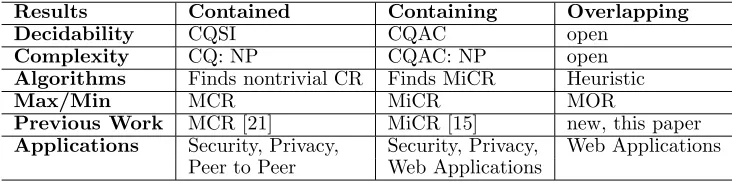
In this paper we consider queries and views that are expressed as select-project-join SQL (i.e., conjunc-tive) queries with arithmetic predicates. We investi-gate the problem of rewriting queries using views in a more general setting than just obtaining equivalent or maximally contained rewritings. Specifically, the problem involves finding whether there exist rewritings that (1) arecontained in the query (that is, users ob-tainsomecorrect answers), (2)containthe query (the answers obtained by users includeallcorrect answers), or (3) overlap with the query (i.e., users obtain some correct and some incorrect answers). Existing work has addressed the problem of finding equivalent or maximally-contained rewritings of queries using views. At the same time, the problem under the more gen-eral setting described above has only recently started to attract interest [15]. We investigate the complexity issues and present sound and complete algorithms that address some of these more general problems. Table 1 gives a summary of our results and contribution.
The following example shows some of the issues in-volved in traditional and new applications of the prob-lem of rewriting queries using views.
Example 1. Suppose a census database stores infor-mation about ages and incomes of the population in a Personrelation that has attributesCensusRecordID, Age, and HouseholdIncome, and stores infor-mation about addresses in an Address relation with attributes CensusRecordID, StreetAddress, ResidencePhone, City,andState.
Results Contained Containing Overlapping
Decidability CQSI CQAC open
Complexity CQ: NP CQAC: NP open
Algorithms Finds nontrivial CR Finds MiCR Heuristic
Max/Min MCR MiCR MOR
Previous Work MCR [21] MiCR [15] new, this paper
Applications Security, Privacy, Security, Privacy, Web Applications
Peer to Peer Web Applications
Table 1: Our results, previous work, and applications.
inquiry could be expressed in SQL as follows:
Q: SELECT ResidencePhone FROM Person P, Address A WHERE P.CensusRecordID = A.CensusRecordID AND City = ‘Raleigh’ AND State = ‘NC’ AND Age >= 62 AND HouseholdIncome >= 70000;
Suppose the database administrator has defined three views to anonymize the information in the census database: ViewV1returns the record IDs and age in-formation for all people whose income exceeds $100K. View V2returns the values of record ID, phone num-ber, and city information for all people in North Car-olina. Finally, view V3 gives the phone numbers and city/state information for all people older than 50. As an illustration, the viewV3could be defined as follows:
V3: SELECT ResidencePhone, City, State FROM Person P, Address A
WHERE P.CensusRecordID = A.CensusRecordID AND Age > 50;
We now discuss three different scenarios for obtain-ing the answers to the user queryQ.
Scenario 1: Contained rewritings. Suppose answers to viewsV1andV2are available. The users can com-bine the two views in this queryQ1:
Q1: SELECT V2.ResidencePhone FROM V1, V2 WHERE V1.CensusRecordID = V2.CensusRecordID AND V2.City = ‘Raleigh’ AND Age >= 62;
As the view V1 returns information for just peo-ple whose household income is strictly greater than $70K, by using the two views our users can get only a subset of the answer to their queryQgiven by a con-tained rewriting. Answers to concon-tained rewritings do not have false positives, but may contain false nega-tives — missing answers to the original query on the database. In this example, the answer to Q1will not contain phone numbers of any people with household incomes between $70K and $100K.
Scenario 2: Containing rewritings. If user data ac-cess is defined using the viewV3only, then all the users can get is asupersetof the answer to the queryQ. In-deed, V3 could be used to return the phone numbers of people in Raleigh whose age is greater than 50:
Q2: SELECT ResidencePhone FROM V3
WHERE City = ‘Raleigh’ AND State = ‘NC’;
The query Q2 contains the user query Q — that is, on any database the answer to Q2 is guaranteed (under the closed-world assumption [1], such as on a
company database) to include the answer toQ. At the same time, depending on the contents of the relations Person and Address, the answer to Q2 may or may not includefalse positives, such as information about people in Raleigh whose age is less than 62.
Scenario 3: Overlapping rewritings. If users can access just the viewV3under the open-world assump-tion [1, 26] (such as in an informaassump-tion-integraassump-tion set-ting), the best they can hope for is to obtain a rewrit-ing that overlaps with the queryQ. For the rewriting, we can use the queryQ2of Scenario 2. Under the open-world assumption, Q2 can return both false positives — such as phone numbers of people whose age is less than 62 — and false negatives, by missing information about higher-income people of retirement age.
We now list some technical challenges in determin-ing whether there are rewritdetermin-ings for each scenario in the above example. In Scenario 1, one could choose to focus on finding maximally-contained rewritings (MCR) of the queryQ. At the same time, the problem of finding MCRs has not been solved in the general case of conjunctive queries with arithmetic compar-isons. In this paper (see Section 3) we study cases in which we do not know how to find an MCR but we show that we can determine whether there exists some non-empty contained (other than maximally con-tained) rewriting of the given query.
In Scenario 2, we would like to find a containing rewriting that gives a minimum number of false posi-tives — aminimally-containing rewriting(MiCR) [15]. In this paper (see Section 4) we present efficient sound and complete algorithms for finding MiCRs of queries with arithmetic comparisons using views with arith-metic comparisons.
and complete algorithms.
The remainder of the paper is as follows. In Sec-tion 2 we provide the background and formal defini-tions. Section 3 contains complexity results on con-tained rewritings and describes an algorithm for find-ing conjunctive contained rewritfind-ings of select-project-join queries with arithmetic comparisons. In Sec-tion 4 we present results on finding containing rewrit-ings, and Section 5 contains results on overlapping rewritings. Section 6 describes an implementation and experimental results on finding minimally containing rewritings of queries.
Related Work
The problem of using views in query answering [25] is relevant in applications in information integra-tion [14, 20, 22, 26, 34], data warehousing [36], web-site design [17], and query optimization [13, 25, 37]. Al-gorithms for finding rewritings of queries using views include the bucket algorithm [18, 26], the inverse-rule algorithm [7, 16, 31], the MiniCon algorithm [30], and the shared-variable-bucket algorithm [28]; see [21] for a survey. Almost all of the above work focuses on in-vestigating rewritings that are contained in the query and mainly maximally contained or equivalent rewrit-ings [34, 1], as it takes its motivation mostly from in-formation integration and optimization.
Since we consider rewritings that may return some false positives, or false negatives, or both, our work can also be described as approximate answering of queries (see [2, 9, 11, 29] and references therein) on databases using views. Approximate query answering is useful when exact answers to the queries cannot be found, and the user would rather have a good-quality approx-imate answer returned by the system.
In [15] the authors consider answering queries using views via equivalent, contained, and containing rewrit-ings, in the presence of access patterns, integrity con-straints, disjunction, and negation. The paper reports complexity results and presents algorithms for produc-ing rewritproduc-ings in that general settproduc-ing. The algorithms depend on the behavior of the chase algorithm and es-pecially hold when the chase terminates and its result is not too large.
Other related work includes the results of [32], where query-rewriting techniques are used for fine-grained access control, and the work by Miklau and Suciu [27], who have performed a formal probabilis-tic analysis of information disclosure in data exchange under an assumption of independence among the rela-tions and data in a database. Related work in security and privacy includes [10, 33].
2
Preliminaries
2.1 Queries, Containment, and Views
We consider conjunctive queries with arithmetic comparisons (CQAC) (i.e., select-project-join SQL queries) of the form:
q( ¯X) :−p1( ¯X1), . . . , pk( ¯Xk), C1, . . . , Cm.
In each relationalsubgoal pi( ¯Xi), predicate pi
repre-sents a base relation, and every argument in the sub-goal is either a variable or a constant. Each arith-metic comparison(AC) subgoalCiis of the formXθY
or Xθc,1
where the comparison operator θ is one of <,≤, >,≥. (We assume that database instances are over densely totally ordered domains.) A variable is called distinguished if it appears in the query head. When there are no comparison subgoals in a query, then we refer to it as a conjunctive query (CQ).
We will use the term semi-interval CQAC(and its abbreviation SI-CQAC) to refer to conjunctive queries with arithmetic comparisons, where each comparison is either one of X < c, X ≤c (left semi-interval) or one of X > c, X ≥ c (right semi-interval). We also consider unions of conjunctive queries, with or without comparisons.
Definition 1. A queryQ1iscontainedin a queryQ2,
denoted Q1 vQ2, if for all databasesD, the answer
toQ1onDis a subset of the answer toQ2onD, that
is,Q1(D)⊆Q2(D).
Chandra and Merlin [12] show that a CQQ1is
con-tained in another CQ Q2 if and only if there exists
a containment mapping from Q2 to Q1. The
con-tainment mapping maps the head and all the sub-goals of Q2 to Q1; it maps each variable to a single
variable or constant, and maps each constant to the same constant. The containment test for CQACs is more complicated. There are two containment tests in the literature [24, 19]; we will describe them very briefly, for more details see, e.g., [5]. The first test for CQACs uses the notion ofcanonical database: For each relational subgoalpi( ¯Xi) of a queryQ, a
canoni-cal database forQhas one tuplet in the base relation Pi, such thatt is a list of “frozen” variables (i.e.,
as-signments of the variables to constants) and constants in ¯Xi. We define one canonical database for each
to-tal ordering of the variables and constants ofQ1 that
satisfies the ACs of the query. Thus, we have as many canonical databases as we have such orderings. The containment test says that a query Q1is contained in
queryQ2 if and only ifQ2 computes its head tuple on
all canonical databases ofQ1.
The second containment test is as follows:
Theorem 1. Q1 vQ2 if and only if the following
logical implication φis true: φ:β0
1⇒µ1(β20)∨. . .∨µk(β20)
where µi’s are all containment mappings from Q02 to Q0
1 and β 0
i is a conjunction of all arithmetic
compar-isons in Q0
i. That is, the comparisons in the
normal-ized query2 Q0
1 logically imply (denoted “⇒”) the
dis-junction of the images of the comparisons of the nor-malized queryQ0
2 under all the mappings µi.
1
We use uppercase letters to denote variables and lowercase letters for constants.
2
An equivalentnormalized versionof a CQAC queryQdoes
When there exists a containment mappingµisuch that
the right-hand side of φ is reduced toµi(β02), we say
thehomomorphism property holds. Note that in gen-eral, the queries have to be normalized before implica-tion can be checked. Afrati et al. [5] have shown that when the homomorphism property holds, the implica-tion can be checked directly on unnormalized queries. Thus, checking CQAC containment is less complex in that case. In Section 4 we use the homomorphism property to design an algorithm for finding minimally containing rewritings.
2.2 Rewriting Queries using Views
We consider the problem of obtaining answers to queries using views where queries are CQ or CQAC and where views, denoted V, V1, . . . , Vm, are defined
on the base relations by CQ or CQAC queries. We consider the problem under the closed-world assumption [1] (i.e., for a given database, each view instance stores all the tuples satisfying the view def-inition), as well as under the open-world assump-tion [1, 26] (i.e., a view instance might store only some of the tuples satisfying the view definition).
Suppose we are given a queryQ, a databaseD, and a set of views V ={V1, . . . , Vm}. We seek an answer
to Q on D using some rewriting R in terms ofV — that is, R is a query defined in terms of the relation names in V. We compute an answer to R on D as follows. The databaseDdetermines a databaseDV = {ans(V1), . . . , ans(Vm)}, where the relation ans(Vi), i 1, . . . , m, is (possibly part of) the answer to the queryVionD.
3
Then the answer toRwith respect to D andV is the resultR(DV) of computing an answer to R on the database DV. We consider four types of rewritingsR of a queryQusing views V:
Definition 2. 1. R is a contained rewriting of Q usingV if on all databasesD,R(DV)⊆Q(D).
2. R is acontaining rewritingofQusing V if on all databasesD,Q(D)⊆R(DV).
3. Ris anequivalent rewritingofQusingV if on all databasesD,Q(D) =R(DV).
4. Ris anoverlapping rewritingofQusingVif on all databasesD, ifQ(D)TR(DV) =φthenQ(D) = φ, whereφis the empty set.
Intuitively, with respect to a given query, contained rewritings cannot contain false positives, contain-ing rewritcontain-ings cannot have false negatives, equivalent rewritings do not contain either false positives or false negatives, and overlapping rewritings may have both. (See Example 1 in Section 1 for illustrations.) In this paper we will use the term rewriting to mean con-tained, containing, or overlapping rewriting of a given query; we will specify the rewriting type whenever it is not obvious from the context.
3
Under the open-world assumption,ans(Vi) may be a proper
subset of the answerVi(D) toVionD.
Definition 3. For a CQAC rewriting R in terms of CQAC views V, anexpansion Rexp of R is obtained
by replacing each view subgoal in Rby the relational and comparison subgoals in the view definition. Exis-tentially quantified variables in the definitions of the views occurring inRare replaced by fresh variables in Rexp. For rewritings that are unions of CQACs, the
expansion is the union of the expansions of the CQACs contained in the rewriting.
The following theorem gives tests for whether a CQAC rewriting R in terms of views V is contained, containing, or overlapping with respect to a CQAC queryQ.
Theorem 2. LetQ, V1, . . . , Vmbe CQAC queries in
terms of base relations, and letRbe a CQAC rewriting of Qin terms of V1, . . . , Vm. Then:
1. R is a contained rewriting of QifRexpvQ.
2. R is a containing rewriting of QifQvRexp.
3. R is an overlapping rewriting of Qif there exists a query Q0 defined on base relations, such that Q0
vQandQ0
vRexp. Furthermore, there exists
at least one database D, such that Q0
(D) is not empty.
We consider query answering and rewriting in set-tings where user access to stored data is defined using views; we refer to these settings as view-based data access. Given a database schema S, a user query Q defined on the schemaS, a setVof views defined onS (the views define the users’ data access), and a type of rewriting (contained, containing, or overlapping), we determine whether there exists a rewriting R, of the given type, of the queryQin terms of the viewsV.
3
Contained Rewritings
The research problem of finding maximally contained rewritings has received a lot of attention, mainly be-cause of its importance in information integration.
Definition 4. A contained rewriting of a queryQ us-ing a set of views V with respect to some query lan-guageLis a maximally contained rewriting(MCR) if it contains as a query all other contained rewritings of QusingV in L.
At the same time, easy subcases are known; for instance, if containment can be checked using a sin-gle containment mapping (homomorphism property), then we can constuct an MCR for a CQAC query and CQAC views [4, 5]. The homomorphism property does not hold in the general case when the queries and views are CQACs [24]. In that case, the problem of con-tainment of two queries is harder (ΠP
2-complete) than
in the case where the queries are simple conjunctive queries (NP-complete) [35]. Typically, the problem of finding MCRs of queries using views is in the same or higher complexity class as the problem of checking the containment of queries, for a particular language.
Thus for the general case there is no known al-gorithm for finding MCRs for CQAC queries and views [4]. In various scenarios, for instance in secu-rity applications, we are interested in finding whether a contained rewriting exists, as opposed to obtaining the maximally contained rewriting. To preserve security and privacy of the data, the owner of a database may want to check that answering a set of high-security queries is not possible using just the available views. If a contained rewriting exists, then some answers to the query are available via the views, even though all the answers are not. In those cases where an algo-rithm to find MCRs exists, this problem is solved: If the algorithm finds a non-empty MCR, then a con-tained rewriting exists, otherwise it does not.
In this section we study the problem of finding con-tained rewritings for the case when we do not know how to find an MCR. Because any query that re-turns the empty set on all databases is contained in all queries, we are interested in findingnontrivial con-tained rewritings — rewritings that have a nonempty answer on at least one database.
Problem (CQAC Contained Rewriting): Given a conjunctive query with arithmetic comparisons (CQAC)Q, a set of CQAC viewsV, and a languageL, is there a nontrivial contained rewriting inLofQ us-ingV? When both views and query are CQs, then we have theCQ Contained Rewriting Existenceproblem.
3.1 Decidabillity and Complexity
Deciding existence of a nontrivial contained rewriting turns out (not surprisingly) to be easier than comput-ing MCR. In this subsection we present decidability and complexity results. At the same time, decidability of the general case remains open. We obtain decidabil-ity for two special cases: (1) when all view definitions do not have nondistinguished variables, and (2) when we use only semi-interval comparison subgoals. We show that for CQs the problem is NP-complete.
The following theorem shows that when the query and the views are CQACs and the view definitions have no nondistinguished variables, then the existence of a contained rewriting can be checked.
Theorem 3. Let Q be a CQAC query, and let V
be a set of CQAC views that do not have nondistin-guished variables. If there is a nontrivial contained
rewriting of Qusing V, then there is a nontrivial con-tained rewriting that uses at most M subgoals, where M is the number of relational subgoals inQ.
This result follows from the observation that if there exists a contained rewriting of Qusing V, then there exists a contained rewriting whose ACs define a total order on the variables and constants of the rewriting.
Proof. If there is a contained rewriting R, then
there is also a contained rewritingR0 with ACs defin-ing a total order on the variables and constants of the rewriting (any total ordering on the variables and con-stants ofRthat satisfies the ACs inRis such a rewrit-ing). Finding R0 is possible because all the view vari-ables are distinguished and we can add ACs that im-pose a total order on all the variables and constants of R. The expansion ofR0 is contained in the query and in fact one mapping proves containment (because of the total order). Hence, we can delete all view subgoals inR0
except those view literals ofR0
whose expansions have subgoals that are images of the query’s subgoals under this single containment mapping. Even after the deletion, the same containment mapping holds be-tween the query and the rewriting because none of the views whose expansion contributes target subgoals of the containment mapping have been removed. The query has M subgoals. Thus, the number of view lit-erals remainingR0after removing the extras, is at most M.
The following theorem shows that in the case where the query and views are conjunctive with semi-interval arithmetic comparisons, if there is a contained rewrit-ing then there is one that uses only semi-interval arith-metic comparisons and is of bounded size.
Theorem 4. Let Q and V be a query and views
which are CQs with semi-interval (SI) arithmetic com-parisons. If there is a nontrivial contained rewriting of the query using the views then there is a nontriv-ial contained rewriting that (1) uses only semi-interval arithmetic comparisons, and (2) uses at most a num-ber of relational subgoals that is exponential only in the maximum arity of the head in a view definition.
Note that this bound on the number of subgoals is higher in this case than for views without nondis-tinguished variables, see Theorem 3. The result of Theorem 4 follows from two claims that we show in the proof: (1) There is no need to consider rewritings that use any new constants (other than the constants in the query and views). (2) It is enough to consider contained rewritings that use only SI comparisons.
Proof. First we show that we do not need to
con-sider rewritings that use new constants (other than the constants in the query and views):
To prove the claim, we argue as follows. Letcbe a constant used inR andc does not occur in the query or any view. Let c1 be the greatest constant in the
query which is less than c and let c2 be the smallest
constant in the query which is greater than c. When the query contains no constant greater than c, set c2
to positive ∞. When the query contains no constant less thanc, setc1to negative∞. We produceR0 from R by replacing each comparison predicate of the form X < c or X ≤ c by X < c2 and by replacing each
comparison predicate of the form X > cor X ≥c by X > c1. Subgoals that use ∞ are just dropped. It
is clear that the expansion of R0 is contained in the query.
We show that if there exists a contained rewriting then there exists one that uses only SI comparisons.
Claim 2: If there exists a contained rewriting then there exists one which uses only SI comparisons.
Let all constants used in the query and views be c1 ≤ c2. . . ≤ cm; we consider all intervals
(−∞, c1],(c1, c2], . . . ,(cm,∞). Let I be the set that
contains exactly those intervals. To prove this claim we argue as follows. We add (to the contained rewrit-ing) SI predicates that do not contradict the predi-cates in the expansion of the rewriting such that all variables are placed by these new predicates in one of the above intervals. There is such a set of SI predi-cates because otherwise the rewriting is either empty or not contained in the query, because there must exist at least one canonical database of the expansion of the rewriting, such that the heads of both the expansion of the rewriting and of the query are computed on this database — if such a database does not exist then the rewriting is either empty (i.e., the head of the rewrit-ing is not computed on any of such databases) or not contained in the query (i.e., the head of the query is not computed on any of such databases). And since a canonical database induces a total order on the frozen variables, we use this total order to add SI subgoals in the rewriting by just copying the interval in which the particular frozen variable belongs.
Thus, we produce rewriting R0, which is contained in the query because R0 is contained in the original rewriting. We drop the non-SI predicates from the rewriting to obtain a new rewriting R. We need to prove that R is contained in the query. Consider all canonical databases of the expansion ofRon all order-ings of the variables and constants. The query applied on each of these databases produces the head tuple in the answers because: A canonical database of the ex-pansion ofRis such that there is a canonical database of the expansion ofR0
in which the only difference is that some variables that are frozen in a particular in-terval are placed (in this inin-terval) in a different order among them. This however does not affect the com-putation of the query because the query only contains SI comparisons.
Now, we are ready to prove the theorem. Let R be a contained rewriting. For each subgoal g of R, we define its signature to be a vector with two entries for each variable in g, one entry for the LSI AC ing
that uses this variable and one entry for the RSI AC similarly (one or both of the entries may be empty in case the particular variable is not used in such an AC). Letdbe the maximum arity of a view head andmbe the number of views andcbe the number of constants used in the query and views definitions. There are at most md! distinct subgoals in R up to renaming of variables.
For each subgoal there are at mostc2d distinct
sig-natures.
Thus, there are two subgoals which are identical up to variable renaming and have the same signature. Create a new rewritingR2 by collapsing (i.e., equate
component-wise the variables) of these two subgoals, say we keep subgoalg1 and delete subgoalg2and also
in the other subgoals, all variables that appeared ing2
are replaced by the corresponding variables ofg1.
We claim that R2 is a nontrivial contained
rewrit-ing. To prove, observe that any canonical database of the expansion ofR2 is a canonical database of the
expansion of R, hence, the query computes the head tuple of the rewriting on all canonical databases ofR2.
(It is easy to see that any canonical database of the ex-pansion ofR2uses a total order which does not violate
any of the ACs in R either. The identified variables that produce R2 from R are chosen so that they do
not contradict any of the ACs in R.)
Finally as we need at mostnsubgoals in the rewrit-ing (n is the number of relational subgoals in the query), we conclude that we can find a contained rewriting with at mostn+c2dmd! relational subgoals.
In the case of CQ queries and views (i.e., without comparison subgoals) the problem is NP-complete:
Theorem 5. The problem of finding a nontrivial
contained rewriting of conjunctive queries using views that are conjunctive queries is NP-complete.
Proof. Proof Sketch
1. The problem is in NP. If the answer is “yes” then the certificate is a contained rewriting together with a containment mapping from the query subgoals to the the subgoals of the expansion of the rewrit-ing. If the size of the rewriting is polynomial then the size of the containment mapping is also polynomial and checking that it is a containment mapping can be done in polynomial time. It remains to be proven that the size of the rewriting is polynomial. Consider any contained rewriting R and the containment mapping which proves that it is contained inQ. The target sub-goals of this mapping are at most equal to the number of subgoals of the query. Obtain a rewritingR0fromR by dropping all view subgoals that do not contribute targer subgoals. R0
is also a contained rewriting. 2. The problem is NP-hard. By reduction from CQ containement. Given queriesQ1andQ2, we construct Q0
1 and Q 0
2: The heads in both use a new predicate
and variablep(X). The body ofQ0 1 andQ
0
2each
new predicate p0
(X, ti) where t1 is the tuple of head
arguments ofQ1andt2is the tuple of head arguments
ofQ2 respectively. Then Q2is contained in Q1 iffQ01
has a contained rewriting which uses as view Q0 2. To
prove, we need to argue that the body of such a rewrit-ing would be exactly one occurrence of Q0
2 as a view
— and no other view subgoals. This is easily shown by observing that any containment mapping fromQ0
1
to the expansion of any rewriting will only use target subgoals from one view due to the predicate pwhich occurs only once in Q0
1.
Note that this result holds in all cases where the homomorphism property holds between the query and the expansion of the rewriting. Afrati et al. [5] have shown examples where the homomorphism property does not hold, identified the conditions under which the homomorphism property holds for CQAC queries, and given an algorithm to find the MCR for the cases where the homomorphism property holds [4].
3.2 Algorithm
In the previous subsection, we proved two results: (1) Unlike finding maximally contained rewritings, it is decidable in many special cases whether there exists a contained rewriting given CQAC queries and views. (2) The problem is still NP-hard, even for queries and views without inequality comparisons. In this subsec-tion we present a heuristic that checks whether there exists a nontrivial (that is, not trivially empty) con-tained rewriting in the case of CQAC query and views. It is known that the containment test (which provides the basis for algorithms for finding rewritings) is more complicated in the CQAC case than in the CQ case. The following Proposition 1, however, says that (1) the complement of the CQAC Contained Rewriting problem can be reduced to the complement of the CQ Contained Rewriting problem (an admittedly much simpler problem), and (2) the search space of candi-date contained rewritings can be restricted to rewrit-ings whose ACs define a total order on the variables of the rewriting. Still this does not buy us the homo-morphism property, as this example shows:
Example 2. Consider a queryQand two views:
q() :−p(X,4), X <4. v1(X) :−p(3, X).
v2(X) :−p(X,4).
In this rewritingR,
r() :−v1(X), v2(X), X≤4,
the homomorphism property does not hold.
In many cases, even though a nontrivial contained rewriting of a query using views does not exist, we are able to check that by just looking at the query and views without arithmetic comparisons. However, such a test is not straightforward, as the following defini-tions and example show.
LetQ=Q0+β be a query andV be a set of views Vi = Vi0+βi, i = 1, . . . , k. Consider the queryQ0
comprising the relational subgoals of Q and a set of views V0 with views as in V but defined using only
the relational subgoals in their bodies. The question is whether we can prove the following: If there exists a contained rewriting of Qusing V, then there exists a contained rewriting of Q0 using V0. Unfortunately,
this result does not hold; here is a counterexample:
Example 3. For a queryQand viewV,
q() :−p(X, X),
v(X, Z) :−p(X, Y), r(Z), X≤Y, Y ≤Z.
a contained rewriting is:
q0() :−v(X, Z), Z ≤ X.
But by removing the ACs from the view we obtain
q :−p(X, X), v(X, Z) :−p(X, Y), r(Z); a rewriting is not possible.
But with a slight modification in the definition of the views we obtain the following result. Before we state the result, we need the following definitions from [5] which we will use in our algorithms here.
The shared-variable requirement is as follows: If one occurrence of a nondistinguished query variable X maps to a nondistinguished view variable Y, then all occurrences of X must map to Y. A corollary of this condition is that all query subgoals that contain X must be covered by the same view.
A nondistinguished variable X of a view V is ex-portable if and only if there exists a head homomor-phismhsuch that in the expansion ofh(V),X can be equated to a distinguished variable inh(V) by either using the ACs in the view or by adding ACs on dis-tinguished variables inh(V). For example, variableY in the view definition in Example 3 is an exportable variable because if we equateX =Z then the ACs in the view definition imply Y =X=Z.
Proposition 1. LetQ=Q0+β be a query and V
be a set of views Vi = Vi0 +βi, i = 1, . . . , k.
Con-sider a query Q0 comprising the relational subgoals of Qand a set of viewsV0with views as inV but (1)
de-fined using only the relational subgoals in their bodies, and (2) with additional head variables, those that are exportable. Suppose there exists a contained rewriting of QusingV. Then:
1. There exists a contained rewriting ofQ0usingV0.
2. There exists a contained rewriting of Q using V with ACs that define a total order on its vari-ables and with relational subgoals that define a contained rewriting of Q0 usingV0.
The proof of Proposition 1 is based on containment mappings for Q0 and V0, which (the mappings) are
Proof. For the first item, consider a contained
rewriting Rand any canonical database of its expan-sion. Clearly there is a mapping from the query re-lational subgoals to the tuples of this database. This mapping produces a containment mapping fromQ0to
the following rewritingR0ofQ0usingV0: Retain inR0
those subgoals of R that provide targets to this map-ping. Some fresh variables from the expansion may be exported due to ACs in the query definition and if we do not use these ACs exporting them is not possi-ble. These variables however are already in the view heads in the definitions ofV0 hence we may use them
as distinguished variables.
The proof of item 2 uses similar techniques that have been used here and the argument for item 1. Note that the contained rewriting ofQ0usingV0may have
many redundant subgoals.
We now outline an algorithm for checking contain-ment of rewritings in queries; the algorithm uses prop-erties of containment tests to prune the search space by (1) testing first for contained rewritings ofQ0using
V0 and halting if none exists, and by (2) considering
containment checks in a systematic way, so that it does not repeat unnecessarily checks that can be deduced from the previous iteration.
Due to lack of space, we give here just an intu-ition for the algorithm. First, the algorithm tests all views for candidacy in a contained rewriting (CR). A view is a candidate view if it covers at least one re-lational subgoal of the query, and the shared-variable (SV) condition is satisfied. Thus, the first stage of the algorithm checks whether there exists a CR ofQ0
us-ingV0. If there exists none, then the algorithm returns
“no”. Otherwise, it starts with any CRR0ofQ0using
V0. Then it considers all rewritings with the relational
subgoals ofR0and with added ACs that define a total
order on the variables, for all total orders.
For each such rewriting it does the following: It checks for containment in the query Q using the canonical-database test. If containment holds, then the algorithm returns “yes”, otherwise it keeps a record of the canonical databases that did not pass the test. In the next stage, the algorithm adds to the rewritings considered in the previous stage one can-didate view (for all cancan-didate views not yet added) and checks containment in the query. The modified check at this stage is restricted only to those canonical databases — in fact, to their extensions, as a new view is now added — that did not pass the test in the pre-vious stage. (Adding a new view to the rewriting does not break containment on those canonical databases that didpass the test in the previous stage. The rea-son is, if the rewriting with the newly added view has a nonempty answer on one such database, then we still get the frozen heads of the view, of the rewrit-ing, and of the query, and thus the containment test is succesful on those databases. If the rewriting with the newly added view has an empty answer on one of those databases, then the frozen head of the rewriting cannot be computed on the database, therefore the
answers to the rewriting are trivially contained in the answers to the query on this database.) Again, for the next stage the algorithm keeps record of the canonical databases that did not pass the test.
In a little more detail: In stage n, the algorithm considers all rewritings of stagen−1, sayRis such a rewriting. R comes with a set of canonical databases (of its expansion) that did not pass the containment test. For all candidate views not yet added in R, the algorithm forms rewritingsR0, where eachR0isRwith an additional subgoal that comes from one of the can-didate views. Then the algorithm checks each R0 for containment. Observe that the algorithm is designed to start with a contained rewriting ofQ0usingV0, say
with k view subgoals. Then stage 2 is checking for containment all rewritings with k+ 1 view subgoals, stage 3 is checking for containment all rewritings with k+ 2 view subgoals, and so on.
Example 4. We refer to Example 3. ForQ0we have
q0() :−p(X, X).
ForV0we have
v0(X, Z, Y) :−p(X, Y), r(Z).
because variable Y is exportable — that is, Y can be equated to a distinguished variable by adding an equality between distinguished variables, in this case by adding the equality X=Z. A contained rewriting ofQ0 usingV0 is:
q0
0() :−v0(X, Z, X).
X = Z is a total order among the variables of V that produces a rewriting of Q using V. Hence we have found a rewriting ofQ:
q0() :−v(X, Z), X=Z.
Theorem 6. Let query and views be CQAC.
• If the algorithm halts then it produces a contained rewriting if there exists one.
• In the case of CQSI query and views or when view definitions have no nondistinguished variables, the algorithm produces a nontrivial contained rewrit-ing if there exists one.
4
Containing Rewritings
In this section we discuss containing rewritings of queries using views (cf. [15]) and describe an algo-rithm to find minimally containing rewritings under the closed-world assumption.
Definition 5. A queryQ0
is aminimally containing rewriting of a query Qusing a set of views V, if and only if: (1) Q0 is a containing rewriting ofQ, and (2) there exists no containing rewritingQ00 ofQusing V, such that the expansion of Q00 properly contains the expansion of Q0.
Under the open-world assumption (OWA), views are incomplete; thus, when a containing rewriting of a query is evaluated using the tuples in views, the answer may not contain all the tuples that satisfy the origi-nal query, even though the expansion of the rewriting contains the original query by definition. Therefore, it makes sense to only talk of a MiCR under the closed-world-assumption (CWA). The rest of the discussion of MiCRs in this section assumes CWA.
We now give some containing rewritings of a query using a set of views and show a MiCR.
Example 5. Suppose we have a base relation Person(CensusRecordID,Age,HouseholdIncome, ResidencePhone), and are interested in a query
q(R) :−p(I, A, H, R), A≥62, H≥70K.
that asks for phone numbers of retirement-age people whose household income is at least $70K.
Suppose we have four views on the base relation:
w1(I, R) :−p(I, A, H, R), A >50.
w2(I, A, R) :−p(I, A, H, R).
w3(I) :−p(I, A, H, R), H≥70K.
w4(I) :−p(I, A, H, R), H >60K.
The following are some rewritings for the query us-ing the views.
r1(R) :−w1(I, R), w2(I, A, R), A≥62.
r2(R) :−w3(I), w1(I, R), w2(I, A, R), A≥62.
r3(R) :−w1(I, R), w4(I).
r4(R) :−w3(I), w1(I, R), w4(I).
r5(R) :−w3(I), w1(I, R), w2(I, A, R), w4(I), A≥62.
We can show that all of these rewritings contain the query Q. There are several useful observations on these rewritings. First, we cannot minimize R2 to
generate R1, because the first subgoal of R2 gives us
a tighter containing rewriting thanR1 of the queryQ.
(The same observation holds on R4 and R3.) In this
example, none of R1, R3, and R4 is a MiCR
rewrit-ing given the views W1 through W4. The reason is,
rewritings R2 and R5 also contain the query Q and
produce a smaller number of false positives than any other rewriting given here.
In general, a MiCR can be a union of conjunctive queries, as we show in the full version of the paper.
4.1 Non-union Condition
The complexity of the problem of finding all contain-ing rewritcontain-ings of a CQAC query uscontain-ing CQAC views is lower if the following condition holds:
Non-union condition: If a containing rewriting of a query exists, it can be expressed as a single conjunc-tive query and the language of unions of conjuncconjunc-tive views is not necessary. We will refer to this condition as thenon-union condition.
Theorem 7. When two syntactic conditions C1
andC2hold, the non-union condition also holds:
• C1: The query and all the views contain only left-semi-interval (LSI) (correspondingly only right-semi-interval, RSI) arithmetic comparisons,
• C2: If the query contains closed-LSI (-RSI) arith-metic comparisons, then the views do not contain open-LSI (-RSI) arithmetic comparisons.
These conditions are not necessary but are sufficient conditions for the non-union condition to hold. These conditions were derived from the conditions provided in [5] under which the homomorphism property holds. Thus, not surprisingly, when the non-union conditions hold, the homomorphism property holds between the expansion of a containing rewriting and the queries.
Theorem 8. For a CQAC query Q and a set of
CQAC views V, where bothQ and the views in V are defined using relational predicates from a set P, and such thatQandV satisfy the non-union conditionsC1 and C2 above. If there exists a containing rewriting R of Q using V, such that R is a union of CQAC queries, then (1) there exists a CQAC queryR0
, which is a containing rewriting of Q using V, and (2) the homomorphism property holds between R0exp andQ.
The proof is by construction ofR0
fromR.
Proof. Without loss of generality, we assume that
the query Q has left-semi-interval arithmetic predi-cates. Construct a canonical database D by freezing each variable in Qto a unique constant and by pop-ulating D with the resulting tuples of the relational subgoals ofQ. Specifically, the variables that appear in the arithmetic predicates ofQare frozen as follows. For any AC (X θ c) of Q where θ is one of < or ≤, freeze X to a valuec−x, where x does not appear
in Q or in any view in V and can be chosen to be arbitrarily small. Because the disjunctive rewritingR containsQ, there must be a conjunctR1inRthat
pro-duces a tuple onV(D) that is also produced byQ(D). Therefore, there must be a containment mapping µ from the relational subgoals of R1 to the predicates
and constants inD that produces the (frozen) head of R1onD. Because the mappingν from the predicates
and variables ofQto the tuples and frozen constants in D is bijective, a composition ofµ withν−1
is also a containment mapping fromR1to the relational
sub-goals of Q.
We now construct fromR1a new purely conjunctive
rewritingR2by dropping any ACs inR1; by
construc-tion, R1 v R2. Because the query Q and the set of
viewsV satisfy the conditionsC1 andC2, and because all ACs inRexp2 come from the expansion of the views
in R2, we conclude that the homomorphism property
holds between Rexp2 and Q. (This conclusion follows
from Theorem 4 in [5].)
Thus, to show containment of Q in R2, it remains
and because the queryQand the viewsV only contain left-semi-interval comparisons, all ACs in R2 are
left-semi interval inequality comparisons of the formX θ k. We constructed the databaseD by choosing the max-imum values for the variables (that is, we chose each c−xto be as large a value as possible). Computing R2onD produces the (frozen) head of R2. It follows
that for each variableX inR2, such thatX maps to a
variableY that occurs in an AC:Y θ cofQ, the range (k) of X is equal to or exceeds the maximum valuec for Y in D, for otherwise computingR2 on D would
not produce the (frozen) head ofR2. We conclude that AC(Q)⇒AC(R2). Thus, R2 is R0 in the statement
of the theorem.
(The only exception to AC(Q) ⇒ AC(R2) could
be when Q has an AC Z ≤ c. Because Z is frozen to c−δ, it could be accepted by R2 having an AC T < c, whereµ(T) =Z. In this case, the implication (Z ≤ c)⇒(Z < c) does not hold. However, this case is precluded by conditionC2. Therefore,R2must
be having an AC T ≤c, where µ(T) =Z. Now, the implication (Z ≤ c)→(Z ≤ c) holds trivially.)
In the rest of the section we assume that the non-union and the homomorphism property condition hold among containing and contained queries.
4.2 Decidability and Complexity
We now examine the complexity of computing con-taining rewritings and show that finding a concon-taining rewriting of a query using views is NP-complete.
Theorem 9. (Rewriting that contains the query)
Given a query Qwhose relational predicates belong to a set of predicatesP, given a set of viewsV such that all views inV have relational predicates only from P, and given that Q and V satisfy the non-union condi-tionsC1andC2, it is NP-complete to decide whether there exists a containing rewriting R0 ofQusing V.
The proof that the problem is in NP uses the result of Lemma 1; NP-hardness is by reduction from CQ containment.
Proof. 1. The problem is in NP. By Theorem 8,
the homomorphism property holds between some con-taining rewriting R0 and the queryQ. If the answer is “yes” then the certificate is a containing rewriting together with a containment mapping from the expan-sion of the rewriting to the query. If the size of the rewriting is polynomial then the size of the contain-ment mapping is also polynomial and checking that it is a containment mapping can be done in polynomial time because the homomorphism property holds. It remains to be proven that the size of the rewriting is polynomial. We do so in Lemma 1; see the statement and proof of the Lemma after the end of this proof.
2. The problem is NP-hard: By reduction from CQ containment. Given queries Q1 andQ2, we construct Q0
1 and Q 0
2: The head in both is p(X) such that p
and X do not appear in Q1 and Q2. The body of Q0
1 and Q 0
2 each contain all the subgoals of Q1 and Q2respectively and a new predicatep0(X, ti) wheret1
is the tuple of variables in the head of Q1 and t2 is
the tuple of variables in the head of Q2 respectively.
Then Q2 is contained in Q1 iff Q02 has a containing
rewriting which uses as viewQ0
1. To prove, we need to
argue that such a rewriting would use only one copy of the view and one copy of the query. This is easily shown by observing that Q0
1is the only view. Q 0 1 has
the variable X in the head. Thus, all subgoals in a contining rewriting must be Q0
1(X) modulo variable
renamings ofX. Any rewriting must have Q0 1(X) in
the body in order to be safe because there is no other view and no different head homomorphisms of Q0
1 is
possible. If the view has conjunctions ofQ0
1with itself,
it can be rewritten with only one copy of the view. Similarly, if the query has multiple copies ofQ0
2, it is
equivalent to a query with one copy ofQ0 2.
The proof of the theorem uses the following lemma. (The proofs of the theorem and the lemma are omitted due to space considerations and are available in [3].)
Lemma 1. If there exists a CQAC rewriting R of
a CQAC query Q, QvR, and if the homomorphism property holds between R and Q, then there exists a CQAC rewriting R0
ofQ, QvR0
, such that the num-ber of views in R0
is less than or equal to the arity of the head of the queryQ.
Proof. Suppose the rewritingRexists. We try to
get a bound on the size of R. There exists a con-tainment mapping µfrom Rexp toQbecause the
ho-momorphism property holds between R and Q. We obtain R0
from R as follows: (1) drop all arithmetic predicates fromR, and (2) drop all subgoals from the body of Rexp except any one view subgoal from the
body of R. Since any subgoal in R0 is also in R, µ proves containment of Q in R0. Note that R0 is CQ and not CQAC because the arithmetic predicates from R were dropped, hence the right-hand side of the im-plication is empty and so one containment mapping is enough to show containment.
Still, R0
may be unsafe. To ensure that the new rewriting is safe, we modify the construction of R0 as follows: (1) drop all arithmetic predicates fromR, and (2) for each distinguished variableX ofR, choose ex-actly one view V such that X is in the head of V in (the body of)R; drop all other views in the body ofR. By construction,R0
hasnviews in its body, wheren is the number of unique distinguished variables ofR. We conclude the proof by noting that the number of unique distinguished variables ofRcannot exceed the arity of the head ofQ.
4.3 Algorithm for MiCR under the CWA
We define a minimal MiCR such that if a subgoal is deleted from the rewriting, then it is no longer a MiCR. For example, the rewritingR5in Example 5 is a MiCR
of the query given the views, but is not a minimal MiCR, whereas R2 is a minimal MiCR. It turns out
Theorem 10. Under the CWA and for queries and
views satisfying conditions C1 and C2, MiCR is unique up to equivalence as expansions.
We prove this result by contradiction: We assume that for some query Q there exist two nonequivalent MiCRs,R1andR2, and then show that there exists a
third rewriting that (1) contains the queryQ, and (2) is properly contained in one of the presumed MiCRs. Thus, by definition, neither of R1 and R2 is a MiCR
of the queryQ.
Proof. By contradiction.
Let us assume that there are two MiCR’s of a query Q,R1 andR2, and thatR
exp 1 andR
exp
2 are not
equiv-alent. Without loss of generality, we assume that the head ofQhas no repeated variables or constants. The two rewritings R1 andR2 contain Q, therefore, their
heads map to the head ofQ. Since the query has no variables or constants repeated in its head, the queries R1andR2must also have no variables or constants
re-peated in their heads, otherwise, the mapping from the head of the rewriting to the head of the query cannot be constructed.
We create a rewritingR3whose head is the same as
that of one of the rewritings, sayR1, and whose body is
the conjunction of the bodies of the two rewritingsR1
and R2. We identify variables inR exp 2 andR
exp 1 that
map to the same query variable. Of these variables, we rename the variables inR2with the corresponding
variable inR1. Clearly,Rexp3 is contained inR exp 1
be-cause R1 appears in R3. We show that R3 does not
containR1 but contains the query — a contradiction
of the hypothesis thatR1 is a MiCR.
Since the body of R3 contains subgoals from R1
and R2 both of which contained the query, it is easy
to show that R3 contains the query. R3 contains the
queryQbecause:
• all subgoals in R3 are from R1 or R2 and have
predicates that appear in the queryQ,
• R1 appears unaltered inR3andR1 containedQ,
thus a partial mappingµ1can be constructed from
the head and the subgoals ofRexp3 obtained from R1 toQ, such thatAC(Q)⇒µ1(AC(R
exp 1 ))
• the R2-subgoals map the variables appearing in
both R1 andR2 to the same query variables
be-cause by construction, they were equated,
• the variables occurring inR2-subgoals but not in R1 were retained from R2 which had a mapping,
sayµ2, toQsuch thatAC(Q)⇒µ2(AC(Rexp2 )).
Therefore, a mapping µ exists fromR3 to Q and R3
containsQ, whereµ(X) =µ1(X) ifX appears in R3
and R1, and µ(X) = µ2(X) ifX appears in R3 and R2. Since the arithmetic comparisons in R
exp 1 were
obtained fromRexp1 and R exp
2 , using the implications
above, it is easy to see thatAC(Q)⇒µ(AC(Re 2xp))
Now, we just need to show thatR3is properly
con-tained inR1; First,we show thatR3expdoes not contain Rexp1 .
By our hypothesis, Rexp2 does not contain R exp 1 .
Therefore, there exists no containment mapping µ from R2exp to R
exp
1 such that AC(R exp 1 ⇒ µ(AC(Rexp2 )). If there is no containment mapping
from Rexp2 to R exp
1 , then one of the following cases
must hold:
1. There exists a subgoal,s, inRexp2 with a different
predicate than those inRexp1 . Clearly,sis inR exp 3
and cannot be mapped to a subgoal inRexp1 .
2. There exists a variableX in R2expwhose two
oc-currences was “mapped” to different variables or constants inRexp1 . This variable (if renamed, the
corresponding renamed variable) is in Rexp3 and
will prevent a containment mapping fromRexp3 to R1exp.
3. There exists a constant in Rexp2 that maps to a
different constant or a variable inRexp1 . The same
constant prevents a containment mapping from R3exptoR
exp 1 .
If there is no containment implication, there must be an arithmetic comparison,Ac inµ(AC(R
exp
2 )) that is
not implied byAC(Rexp1 ). Since all subgoals fromR2
are in R3, Ac creates a subgoal in µ(AC(Rexp3 )) that
is not implied by AC(R1exp. Therefore, R3 does not
containR1.
From (1) R3 does not contain R1 and (2) by
con-struction,R3 is contained inR1, we conclude thatR3
is properly contained inR1because
We now describe an algorithm for finding con-junctive minimally containing rewritings of left-semi-interval, LSI (or right-semi-left-semi-interval, RSI) queries and LSI (or RSI) views satisfying the non-union conditions C1 and C2. This restriction is sufficient because our algorithm only works when the homomorphism prop-erty holds [5]. It is also shown in [5] that in these cases the queries do not need to be normalized. When the homomorphism property does not hold, the number of containment mappings that are required to prove con-tainment is more than one. In addition, the containing rewriting might not exist in the language of conjunc-tive queries; thus, a union of CQs might be necessary. To design an efficient and practical algorithm, we con-centrate on the restricted cases mentioned above.
The algorithm first finds all views whose bodies con-tain some query subgoals, and then constructs buck-ets for query subgoals and the views. The conjunctive rewriting returned by the algorithm has one view sub-goal from each bucket. Notice that each bucket in the algorithm represents a pair of subgoals, a query subgoal and a subgoal in the expansion of the view covering it. The details of the algorithm are found in the pseudocode in the Appendix and are clarified in the examples in the remainder of this section.
q() :−b(A, A, A).
Let the views be as follows:
v1() :−b(X, Y, Z). v2() :−b(X, X, Y). v3() :−b(X, Y, Y). v4() :−b(X, Y, X).
The algorithm creates three buckets correspond-ing to the view subgoals b(X, X, Y), b(X, Y, Y), and b(X, Y, X) that cover b(A, A, A) but do not contain each other. Choosing the views from these buckets, we get an MiCR by conjoining them:
r() :−v2, v3, v4.
The following example shows why we must consider multiple mappings from the view to the query.
Example 7. We use a relation person (p) with at-tributes Name, Address, ZipCode, and Age, and a relationparent(r) whose first attribute is the parent and the second attribute is the child.
Given a query:
q(C) :−p(P, A, Z, E), p(C, A1, Z1, E1), r(P, C), E1<21.
that returns the names of children whose age is less than 21. Suppose our access to the stored relations is via viewsV0 throughV2:
v0() :−p(N0, A, Z, E). v1(N, E) :−p(N, A, Z, E). v2(P, C) :−r(P, C).
First, the algorithm creates a bucket for the query subgoalp(P, A, Z, E) and view subgoalp(N0, A, Z, E),
and inserts V0 in that bucket. Consider the mapping
ofV1 to the first subgoal ofQ. V1 cannot be inserted
in the bucket that containsV0, because the bucket can
only contain views whose subgoals are simple variable renamings of the subgoalp(N0, A, Z, E). The subgoal
in the expansion ofV1(P, E) isp(N, A, Z, E) whereN
is a distinguished variable, whereas the variable N0
is nondistinguished. Therefore, the algorithm creates a new bucket for the query subgoal p(P, A, Z, E) and the view subgoal p(N, A, Z, E). In our algorithm, if the corresponding variable is a shared variable, we prefer to keep the bucket corresponding to the sub-goal with the distinguished variable. This is another of the subtleties of our algorithm worth noting. There-fore, the bucket corresponding to the view subgoal p(N0, A, Z, E) is deleted and the new bucket
corre-sponding top(P, A, Z, E) is retained.
Since there exists no bucket corresponding to the second query subgoal, a bucket is created correspond-ing to the query subgoalp(C, A1, Z1, E1) and the
sub-goal in the expansion of V1(C, E1), E1 < 21, namely p(C, A, Z, E1). We insert the viewV1(C, E1), E1<21
into this bucket. Next, the algorithm considers the viewV2(P, C). There is a mapping from the view
sub-goal to the query subsub-goal, and thus the viewV2(P, C)
is put into the bucket corresponding to the query sub-goalr(P, C) and view subgoalr(P, C).
In the last step of the algorithm all three buck-ets contribute one subgoal each and their conjunction gives us the rewriting
R: Q(P) :−v1(P, E), v1(C, E1), E1<21, v2(P, C).
Now, to show the effect of a view containing multi-ple query subgoals, we add a view
v3(P, C) :−p(C, A, Z, E), r(P, C), E <22.
As explained in the full version of the paper, the min-imal MiCR in that case is
R: Q(P) :−v1(P, E), v3(P, C).
Note that this MiCR is minimal in the number of view subgoals used and is therefore selected by the set-cover subroutine at the last step of the algorithm.
Even though the algorithm tries to find one MiCR and we are operating under the closed-world assump-tion, in general we have to check all the view subgoals to find the tightest cover. For example, if some viewV1
covers a query subgoal p(X, X, X) using a view sub-goal whose expansion provides p(X, Y, X), then the algorithm must check whether another view, say V2,
covers the query subgoal more tightly — that is, using a view subgoal whose expansion providesp(X, X, X). If such a viewV2 exists, we can eliminate the bucket
corresponding to the query subgoal p(X, X, X) and view subgoalp(X, Y, X) that has the viewV1. Once we
have found the tightest possible cover forp(X, X, X), the algorithm can be altered not to look for any other view subgoals, provided we do not seek the minimal MiCR. (If we seek the minimal MiCR, the algorithm must look at all views, because the last view might be covering all the subgoals in the query and might thus render all other views redundant.)
Theorem 11. If a query Qand viewsV satisfy the
non-union conditions C1 and C2, Algorithm A finds the MiCR ofQ usingV.
Proof. The algorithm finds a containing rewriting:
(Sketch) Containing Rewriting: Each view is put in a bucket only if there exists a homomorphism hand a containment mappingµfromh(vi) to a queryQsuch
that AC(Q) ⇒ µi(AC(h(vi)exp, ac)). By
construc-tion, the head variables in the view are replaced by the query variables they map to. Thus, the contain-ment mappingµimaps distinguished view variables to
itself and non-distinguished view variables to a unique query variable or constant. A rewritingRis obtained by conjoining a view from each bucket. A contain-ment mappingµconstructed asµ(X) =µi(X) ifX is
a non-distinguished variable in viewvi andµ(X) =X
for all distinguished view variables. µ is a contain-ment mapping because all µi’s maps a distinguished
because AC(Q)⇒µi(AC(h(vi)exp, ac)) for each view vi, and because all AC’s inRexpare obtained from the
views appearing in it,AC(Q)⇒µi(AC(Rexp)).
The containing rewriting found is minimal: To show that if there exists a containing rewritingR0 ofQ us-ingV such that the homomorphism property holds be-tween R0expand Q, then the algorithm A generates a
containing rewritingRsuch thatR0expcontainsRexp.
For any rewritingR constructed by the algorithm, the homomorphism property holds between Rexpand Q. This fact is proved in the soundness proof above. Since the homomorphism property holds between R0expandQ, there also exists a containment mapping µ from R0
exp to Q such that AC(Q) ⇒ AC(R0exp).
For each view subgoal, vi in the body of R0, the
al-gorithm considered all possible containment mappings from the body ofvi to the body ofQ. Therefore, the
algorithm also considered each µ(vi). Either each vi
is put in one or more buckets corresponding to query subgoals, sayG, it covers or is rejected. The algorithm must have generatedR in the second stage of the al-gorithm, because all buckets are guaranteed not to be empty. Note that all subgoals from R0expmust map to query subgoals. For each query subgoalg, ifR0exp covers it withgi from the viewvi,Rexpalso covers it
with a subgoalgj from vj because in the second stage
of the algorithm we choose a view from each bucket to constructR. By construction,gj is contained ingi
(the algorithm checks for and accepts the view whose expansion containsgior the view was rejected because
there was another view with a subgoalg0 such thatg properly contained g0). This containment implies a partial mapping from vi to vj. The composition of
these partial mappings is also a containment mapping because two occurrences of the same variable in R0exp
map to the same query variable and by construction Rexp has the same query variables. Similarly, it can
be shown thatAC(R0exp)⇒AC(Rexp) because (1) the
added ACs inRare the same as those in the query, (2) if the ACs in R0 came from the views, the algorithm considered them and kept either those views or views with more containing ACs into the buckets.
5
Approximate Query Answering and
Rewriting
5.1 Approximate Query Answering
In the following example, there is neither a contained nor a containing rewriting of the query, however, we can still obtain some information about the answers to the query by accessing only the views.
Example 8. Consider a queryQand two views:
q(Cust) :−pennStCredU nion(Cust, Bal), Bal >0. v1(Cust) :−stanf CredU nion(Cust, Bal), Bal >0.
v2(Cust) :−pennStCredU nion(Cust, Bal), Bal≥0,
age(Cust,32).
Viewv1 does not contribute to the query but view v2 can be used to obtain some answers for customers
of age 32. The set of answers however is not a sub-set or a supersub-set of the sub-set of answers to the query because customers of age not equal to 32 are missing and customers with balance equal to 0 are added.
It might not be possible to obtain either a contained rewriting or a containing rewriting of a given query using given views. At the same time, the query may be answered approximately using the views.
We now provide algorithms to answer queries ap-proximately using views.
Algorithm 1: An brute-force algorithm that gener-ates the maximum number of true positives can be ob-tained as follows. From each view obtain all the data values and obtain the cross produce of all the values to generate tuples. Unfortunately, such a solution will contain a large number of false positives and the size of the result is exponential in the number of values, which may be quite large.
Modified Algorithm 1: This algorithm can be mod-ified and made more efficient by the following adap-tation. First, collect all data values belonging to a particular domain. This can be done by identifying view attributes that are of the same type using some heuristic. Next, for each variable in the query head, we identify its domain. Finally, we use the data val-ues collected from the views to construct all possible tuples while restricting the value of a tuple attribute to values collected from view attributes with the same domain. This algorithm provides all possible tuples derivable from the views but does not guarantee that there will be any overlap between the rewriting and the query.
Algorithm 2: In the Modified Algorithm 1 each head variable is assigned values that are not guarnteed to oc-cur in the same predicates as the head variables ococ-curs in the body of the query. Therefore, in this algorithm we construct result tuples in the same manner as the modified algorithm 1 with the following adaptation. Let a head variable,X, appear in a set of relationsR in the body of the query. Let Y be a distinguished view variable that appears in a set of relationsR0
. X can be only can be bound to values of Y such that there exists a relation p in R and R0 and X and Y appear in the same argument position inp.
In scenarios such as web applications, where it is often desirable to obtain a solution with fewer false positives, it is worthwhile to obtain an overlapping rewriting of the query and then evaluate it to obtain the answers to the query on demand.
5.2 Overlapping Rewritings
An overlapping rewriting is an approximate rewriting that provides more information about the content of the query. In our defintion in Section 2 an overlapping rewriting is defined such that it guarantees to produce an non-empty answer whenever there is a non-empty answer to the query.