Article
1
NN-Harmonic Mean Aggregation Operators Based
2
MCGDM Strategy in Neutrosophic Number
3
Environment
4
Kalyan Mondal 1, Surapati Pramanik 2,*, Bibhas C. Giri 3 and Florentin Smarandache 4
5
1 Department of Mathematics, Jadavpur University, West Bengal, India.
6
Email: [email protected]
7
² Department of Mathematics, Nandalal Ghosh B.T. College, Panpur, PO-Narayanpur, and District: North 24
8
Parganas, Pin Code: 743126, West Bengal, India. Email: [email protected]
9
3 Department of Mathematics, Jadavpur University, West Bengal, India.
10
Email: [email protected]
11
4 University of New Mexico, Mathematics & Science Department, 705 Gurley Ave., Gallup, NM 87301, USA.
12
Email: [email protected]
13
* Correspondence: [email protected]; Tel.: +919477035544; Phone no: +91-33-25601826;
14
Fax no: +91-33-25601826
15
Abstract: The concept of neutrosophic number is a significant mathematical tool to deal with real
16
scientific problems because it can tackle indeterminate and incomplete information which exists
17
generally in real problems. In this article, we use neutrosophic numbers (a + bI), where a and bI
18
denote determinate component and indeterminate component respectively. We explore the
19
situations in which the input information is needed to express in terms of neutrosophic numbers.
20
We define score functions and accuracy functions for ranking neutrosophic numbers. We then
21
define a cosine function to determine unknown criteria weights. We define neutrosophic number
22
harmonic mean operators and proved their basic properties. Then, we develop two novel MCGDM
23
strategies using the proposed aggregation operators. We solve a numerical example to demonstrate
24
the feasibility and effectiveness of the proposed two strategies. Sensitivity analysis with variation
25
of “I” on neutrosophic numbers is performed to demonstrate how the preference ranking order of
26
alternatives is sensitive to the change of “I”. The efficiency of the developed strategies is
27
ascertained by comparing the obtained results from the proposed strategies with the existing
28
strategies in the literature.
29
Keywords: neutrosophic number; neutrosophic number harmonic mean operator (NNHMO);
30
neutrosophic number weighted harmonic mean operator (NNWHMO); cosine function, score
31
function; multi criteria group decision making
32
33
1. Introduction
34
Multi-criteria group decision making (MCGDM) is a significant branch of decision theory
35
which has been commonly applied in many scientific fields such as medical diagnosis [1, 2], decision
36
making [3, 4], supplier selection [5], etc. Because of the indeterminate information and the
37
complexity of decision problems, it is difficult to express criteria in terms of crisp numbers. To tackle
38
the difficulty, neutrosophic number (NN) [6, 7] is proposed in the literature. The NN consists of
39
determinate component and an indeterminate component. So the NNs are more practical to deal
40
with indeterminate and incomplete information in real world problems. The NN is expressed as the
41
function N = p + qI in which p is the determinate component and qI is the indeterminate component. If
42
N = qI i.e. the indeterminate part reaches the maximum label, the worst situation occurs. If N = p i.e.
43
the indeterminate part does not appear, the best situation occurs. Thus, application of NNs is more
44
appropriate to deal with the indeterminate and incomplete information in practical decision making
45
situations.
46
Information aggregation is an essential practice of accumulating relevant information from
47
various sources. Harmonic mean is the reciprocal property of arithmetic mean. It is used to present
48
for aggregation between the min and max operators. Harmonic mean is usually used as a
49
mathematical tool to accumulate central tendency of information.
50
The harmonic mean (HM) is widely used in statistics to calculate central tendency of a set of data.
51
Park et al. [8] proposed multi-attribute group decision making (MAGDM) strategy based on HM
52
operators under uncertain linguistic environment. Wei [9] proposed MAGDM strategy based on
53
fuzzy induced ordered weighted HM. In fuzzy environment, Xu [10] studied fuzzy weighted HM
54
operator, fuzzy ordered weighted HM operator, and fuzzy hybrid HM operator and employed them
55
for MADM problems. Ye [11] proposed multi-attribute decision making (MADM) strategy based on
56
harmonic averaging projection for simplified neutrosophic sets (SNS) environment.
57
In NN environment, Liu and Liu [12] proposed NN generalized weighted power averaging operator
58
for MAGDM. Zheng et al. [13] proposed MAGDM strategy based on NN generalized hybrid
59
weighted averaging operator. Pramanik et al. [14] studied teacher selection strategy based on
60
projection and bidirectional projection measures in NN environment.
61
Literature review reflects that MCGDM strategy using NNs has made little progress in real
62
scientific and engineering fields. Therefore, it is necessary to explore new strategies to handle
63
MCGDM problems in NN environment.
64
In this paper, we develop two MCGDM strategies based on neutrosophic number harmonic
65
mean operator (NNHMO) and neutrosophic number weighted harmonic mean operator
66
(NNWHMO) to solve MCGDM problems. The proposed strategies can handle the indeterminacy of
67
information.
68
The paper is sequenced as follows. Section 2 presents some preliminaries of NNs and score
69
and accuracy functions of NNs. Section 3 devotes NN harmonic mean operator (NNHMO) and NN
70
weighted harmonic mean operator (NNWHMO). Section 4 defines cosine function to determine
71
unknown criteria weights. Section 5 presents two novel decision making strategies based on
72
NNHMO and NNWHMO. In section 6, a numerical example is presented to illustrate the proposed
73
MCGDM strategies and the results show the feasibility of the proposed MCGDM strategies. Section
74
7 compares the obtained results derived from the proposed strategies and the existing strategies in
75
NN environment. Finally, Section 8 concludes the paper with some remarks and future scope of
76
research.
77
2. Preliminaries
78
In this section, the concepts of NNs, operations on NNs, score and accuracy functions of NNs
79
are outlined.
80
2.1. NNs [5, 6]
81
NN consists of a determinate component x and an indeterminate component yI, and
82
mathematically is expressed as z = x + yI for x, y∈R, where I is indeterminacy interval and R is the set
of real numbers. A NN z can be specified as a possible interval number, denoted by z = [x + yIL, x +
84
yIU] for z∈Z (Z is set of all NNs) and I∈[IL, IU]. The interval I∈[IL, IU] is considered as an
85
indeterminate interval.
86
• If yI = 0, then z is degenerated to the determinate component z = x
87
• If x = 0, then z is degenerated to the indeterminate component z = yI
88
• If IL = IU, then z is degenerated to a real number.
89
Let two NNs be z1 = x1+ y1I and z2 = x2 + y2I for z1, z2∈Z, and I∈[IL, IU]. Some basic operational
90
rules for z1 and z2 are presented as follows:
91
(1) I2 = I
92
(2) I.0 = 0
93
(3) I/I = Undefined
94
(4) z1 + z2 = x1 + x2 + (y1 + y2)I = [x1 + x2 + (y1 + y2)IL, x1 + x2 + (y1 + y2)IU]
95
(5) z1 −z2 = x1−x2 + (y1 −y2)I = [x1 −x2 + (y1 −y2)IL, x1−x2 + (y1 −y2)IU]
96
(6) z1×z2 = x1x2 + (x1y2 + x2y1)I + y1y2I2 = x1x2 + (x1y2 + x2y1 + y1y2)I
97
(7) =
z z
2
1 =
I y + x
I y + x
2 2
1 1
2 2 y x x I y x x
y x y x x x
− ≠ ≠ +
−
+ ; 0,
)
( 2 2 2
2
2 1 1 2 2 1
98
(8) =
z1
1
= I y + x
I. +
1 1
0 1
1 1 1 1 1 1
1
1
, 0 ; ) (
1 I x x y
y x x
y
x + ≠ ≠−
− +
99
(9) z12=x12+(2x1y1+y12)I
100
(10) λz1=λx1+λy1I
101
102
Definition 1. For any NN z = x + yI = [x + yIL, x + yIU], (x and y not both zeroes), its score and accuracy
103
functions are defined, respectively, as follows:
104
y x
I I y x z
S U L
2 2
2
) ( )
(
+ − +
= (1)
105
) (
exp 1 )
(z x y IU IL
A = − − + − (2)
106
Theorem 1. Both score function S(z) and accuracy function A(z) are bounded.
107
Proof.
108
x, y∈R and I∈[0, 1], 0 1
2
2+ ≤
≤ y x
x
,0 ( ) 1
2
2+ ≤
− ≤
y x
I I
y U L
109
0 ( ) 2
2
2+ ≤
− + ≤
y x
I I y
x U L
1
2
) ( 0
2
2+ ≤
− + ≤
y x
I I y
x U L
0≤S(z)≤1.
110
Since0 ≤S(z)≤ 1, score function is bounded.
111
Again,
112
1 ) ( exp
0≤ − x+y IU −IL ≤ −1≤ −exp −x+y(IU −IL) ≤0 0≤1−exp − x+y(IU −IL) ≤1
113
Since−1≤A(z)≤ 1, accuracy function is bounded.
Definition 2. Let two NNs be z1 = x1+y1I = [x1+y1IL, x1+y1IU], and z2 = x2+y2I = [x2+y2IL, x2+y2IU], then the
115
following comparative relations hold:
116
• If S(z1) > S(z2), then z1 > z2
117
• If S(z1) = S(z2) and A(z1) < A(z2), then z1 < z2
118
• If S(z1) = S(z2) and A(z1) = A(z2), then z1 = z2.
119
Example 1. Let three NNs be z1 = 10 + 2I, z2 = 12 and z3 = 12 + 5I and I∈[0, 0.2]. Then,
120
S(z1) = 0.5099, S(z2) = 0.5, S(z3) = 0.5577, A(z1) = 0.999969, A(z2) = 0.999994, A(z3) = 0.999997.
121
We see that,S(z1)S(z2)=S(z3), andA(z3)S(z2).
122
Using definition 2, we conclude that,z1 z3z2.
123
3. NN- harmonic mean operator (NNHMO)
124
Definition 3. Let zi = xi + yiI (i = 1, 2, …, n) be a collection of NNs. Then the NNHMO is defined as
125
follows:126
) , , ,NNHMO(z1 z2 zn =
( )
1 1 1 . − = −
ni i
z
n (3)
127
Theorem 2. Let zi = xi + yiI (i = 1, 2, …, n) be a collection of NNs. The aggregated value of the
128
) , , ,
NNHMO(z1 z2 zn operator is also a NN.
129
Proof. NNHMO(z1,z2,,zn) =
( )
1 1 1 . − = −
ni i
z n
130
= i i i
n
i i i i
i i y x x I y x x y x
n ≠ ≠−
+ − + − =
; 0,) ( 1 . 1 1
131
= i i i
n
i n
i i i i i i y x x I y x x y x
n ≠ ≠−
+ − + − = =
; 0,) ( 1 . 1 1 1
132
= i i i
n
i n
i i i i i i y x x I y x x y x
n ≠ ≠−
+ − + − = =
; 0,) ( 1 . 1 1 1
133
=
= = = = = = = = + − − ≠ ≠ + − + + − − + ni i i i i n i i n i i n
i i i i i n i i n i i n
i i i i i n i i y x x y x x I y x x y x x y x x y n x n 1 1 1 1 1 1 1 1 ) ( 1 , 0 1 ; ) ( 1 1 ) ( . 1
134
It shows that NNHMO is also a NN.
135
Definition 4. Let zi = xi + yiI (i = 1, 2, …, n) be a collection of NNs. Then the NN- weighted harmonic
136
mean (NNWHMO) is defined as follows:
137
) , , ,
NNWHMO(z1 z2 zn =
( )
1 1 1 . − = −
ni i i
z
w
(4)138
Theorem 3. Let zi = xi + yiI (i = 1, 2, …, n) be a collection of NNs. The aggregated value of the
139
) , , ,
NNWHMO(z1 z2 zn operator is also a NN.
Proof. NNWHMO(z1,z2,,zn)=
( )
1 1 1 . − = −
ni i i
z
w
142
= i i i
n
i i i i
i
i
i x x y I x x y
y x
w
≠ ≠− + − + − =
; 0,) (
1 1
1
143
= i i i
n
i
n
i i i i i i
i
i x x y I x x y
y
x
w
w
≠ ≠− + − + − = =
; 0,) ( . 1 . 1 1 1
144
= ; 1
) ( . 1 . , 0 1 . ; ) ( . 1 . 1 . ) ( . 1 . 1 1 1 1 1 1 1 1 1 1 = + − − ≠ ≠ + − + + − − +
= = = = = = = = = n i i ni i i i i i n i i i n i i i n
i i i i i i n i i i n i i i n
i i i i i i n i i i
w
w
w
w
w
w
w
w
w
x x yy x x I y x x y x x y x x y x .
145
It shows that NNWHMO is also a NN.
146
Example 2. Let two NNs be z1 = 3 + 2I and z2 = 2+ I and I∈[0, 0.2]. Then,
147
) , NNHMO(z1 z2 =
1 2 1 1 1 2 − + z z = 1 2 1 2 3 1 2 − + +
+ I I = 2.4 + 0.635I.
148
Example 3. Let two NNs be z1 = 3 + 2I and z2 = 2 + I, I∈[0, 0.2] and w1 = 0.4, w2 = 0.6, then,
149
) , NNWHMO(z1 z2 =
1 2 2 1 1 1 1 − + z w z w = 1 2 1 6 . 0 2 3 1 4 . 0 − + +
+ I I =2.308 + 1.370I.
150
The NNHMO operator and the NNWHMO operator satisfy the following properties.
151
P1. Idempotent law: If zi = z for i = 1, 2, …, n then, NNHMO(z1,z2,,zn)=z and
152
z z z
z, , , n)=
NNWHMO( 1 2
153
Proof. For, zi = z,
154
) , , ,
NNHMO(z1 z2 zn =
( )
1 1 1 . − = −
ni i
z
n =
( )
1 1 1 . − = −
ni
z
n = 1
.z− n
n
= z.
155
) , , ,
NNWHMO(z1 z2 zn =
( )
1 1 1 . − = −
ni i i
z
w
=( )
1 1 1 . − = −
ni i
z
w
=( )
1 1 1 1 . . − − − =
n zi
w
i = z.156
P2. Boundedness: Both the operators are bounded.
157
Proof. Ifzmin=min(z1,z2,,zn), zmax=max(z1,z2,,zn)for i = 1, 2, …, n then,
158
max 2
1
min NNHMO(z,z , ,z ) z
z ≤ n ≤ andzmin≤ NNWHMO(z1,z2,,zn)≤zmax.
159
P3. Monotonicity: Ifzi≤zi*for i = 1, 2, …, n then, NNHMO( , , , ) NNHMO( , *2, , *)
* 1 2
1 z zn
z
z
z
nz ≤ and
160
) , , , NNWHMO( ) , , ,NNWHMO( * *
2 * 1 2
1 z zn
z
z
z
nz ≤ .
161
Proof. NNHMO( , , , ) NNHMO( , *2, , *) *
1 2
1 z zn
z
z
z
nz −
163
=( )
( )
1 1 1 * 1 1 1 . . − = − − = − −
n i i n i i z n zn ≤0, forzi≤zi*, for i = 1, 2, …, n.
164
Again,165
) , , , NNWHMO( ) , , ,NNWHMO( * *
2 * 1 2
1 z zn
z
z
z
nz −
166
=( )
( )
1 1 1 * 1 1 1 . . − = − − = − −
n i i i ni i i
z
z
w
w
≤0, forzi≤zi*( i = 1, 2, …, n).167
This proves the monotonicity of the functionsNNHMO(z1,z2,,zn)andNNWHMO(z1,z2,,zn).
168
P4. Commutativity: If(z1,z2,,zn)be any permutation of (z1,z2,,zn)then,
169
) , , , NNHMO( ) , , ,NNHMO(z1 z2 zn =
z
1z
2z
nandNNWHMO(z1,z2, ,zn) NNWHMO(
z
1,z
2, ,z
n)
=
170
Proof. NNHMO(z1,z2,,zn) − NNHMO(
z
1,z
2,,z
n)171
=( )
( )
1 1 1 * 1 1 1 . . − = − − = − −
n i i n i i z n zn = 0, because, (z1,z2,,zn)is any permutation of(z1,z2,,zn).
172
Hence, we haveNNHMO(z1,z2, ,zn) NNHMO(
z
1,z
2, ,z
n) = .
173
Again,174
) , , , NNWHMO( ) , , ,NNWHMO(z1z2 zn −
z
1z
2z
n175
=( )
( )
1 1 1 * 1 1 1 . . − = − − = − −
n i i i ni i i
z
z
w
w
= 0, because, (z1,z2,,zn)is any permutation of(z1,z2,,zn).176
Hence, we haveNNWHMO(z1,z2, ,zn) NNWHMO(
z
1,z
2, ,z
n)
= .
177
4. Cosine function for determining unknown criteria weights
178
When criteria weights are completely unknown to decision makers, the entropy measure [15] can be
179
used to calculate criteria weights. Biswas et al. [16] employed entropy measure for MADM problems
180
to determine completely unknown attribute weights of single valued neutrosophic sets (SVNSs).
181
Literature review reflects that, strategy to determine unknown weights in NN environment is yet to
182
appear. In this paper, we propose a cosine functionto determine unknown criteria weights.
183
Definition 5. The cosine functionof a NN P= xij + yijI = [xij + yijIL, xij + yijIU], (i = 1, 2, ..., m; j = 1, 2, ..., n) is
184
defined as follows:
185
+ π == x y
y n P COS ij ij ij n i j 2 2 1cos2 1
)
( , (xij and yij are not both zeroes) (5)
186
The weight structure is defined as follows.
=
= n
j j
j j
P COS
P COS w
1 ( )
) (
; j = 1, 2, ..., n & 1
1 =
=
n
j wj (6)
188
The cosine function COSj(P)satisfies the following properties:
189
P1. COSj(P)=1, if yij=0.
190
P2. COSj(P)=0, if xij=0
191
P3. COSj(P)≥COSj(Q), if xij of P > xij of Q or yij of P < yij of Q or both.
192
Proof.
193
P1. yij=0 ( ) 1
[
cos0]
11 =
=
= n
i j
n P COS
194
P2. xij=0 cos2 0
1 ) (
1 =
π
=
= n
i j
n P COS
195
P3. For, xij of P > xij of Q
196
Determinate part of P > Determinate part of Q
197
COSj(Q)<COSj(P).
198
For, yij of P < yij of Q
199
Indeterminacy part of P < Indeterminacy part of Q
200
COSj(Q)>COSj(P).
201
For, xij of P > xij of Q and yij of P < yij of Q
202
(Real part of P > Real part of Q) & (Indeterminacy part of P < Indeterminacy part of Q)
203
COSj(Q)>COSj(P).
204
Example 4. Let twoNNs be z1 = 3 + 2I, and z2 = 3 + 5I, then,COS(z1)=0.9066,COS(z2)=0.7817.
205
Example 5. Let twoNNs be z1 = 3 + I, and z2 = 7 + I, then,COS(z1)=0.9693,COS(z2)=0.9938.
206
Example 6. Let twoNNs be z1 = 10 + 2I, and z2 = 2 + 10I, then, COS(z1)=0.9882,COS(z2)=0.7178.
207
5. Multi-criteria group decision making strategies based on NNHMO and NNWHMO
208
Two MCGDM strategies using the NNHMO and NNWHMO respectively are developed in this
209
section. Suppose that L = {L1, L2, . . . , Lm} is a set of alternatives, C = {C1, C2, . . . , Cn} is a set of criteria
210
and DM = {DM1, DM2, . . . , DMk} is a set of decision makers. Decision makers’ assessment for each
211
alternative Li will be based on each criterion Cj. All the assessment values are expressed by NNs.
212
Steps of decision making strategies based on proposed NNHMO and NNWHMO to solve MCGDM
213
problems are presented as follows.
214
5.1. MCGDM Strategy 1 (based on NNHMO)
215
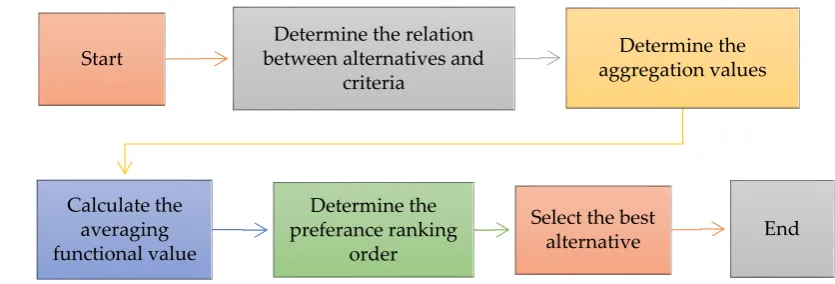
The strategy 1 is presented (see Figure 1) using the following six steps.
216
Step 1.Determine the relation between alternatives and criteria
218
Each decision maker forms a NN decision matrix. The relation between the alternative Li (i = 1, 2, ...,
219
m)and the criterion Cj (j = 1, 2, ..., n) is presented in Table 1.
220
221
Table 1. The relation between alternatives and criteria in terms of NNs
222
+ +
+
+ +
+
+ +
+ =
k mn mn k
m m k m m
k n n k
k
k n n k
k
n
m k
I y x I
y x I y x
I y x I
y x I y x
I y x I
y x I y x
C C
C
L L L C L
DM
2 2 1
1
2 2 22
22 21
21
1 1 12
12 11
11
2 1
2 1 ] | [
223
Here, xij+yijI krepresents the NN rating value of the alternative Li with respect to the criterion Cj
224
for the decision maker DMk.
225
Step 2.Using Eq. (3), determine the aggregation values (DMaggrk(Li)), (i = 1, 2, …, n) for all decision
226
matrices.
227
Step 3.To fuseall the aggregation values (DMaggrk(Li)), corresponding to alternatives Li, we define
228
the averaging function as follows.
229
k L DM L
DM
k
t i
aggr k i
aggr( ) = =1 ( )
(i = 1, 2, …, n) (7)
230
Step 4.Determine the preference ranking order
231
Using Eq. (1), determine the score values S(zi) (accuracy degrees A(zi), if necessary) (i = 1, 2, . . . ,
232
m) of all alternatives Li. All the score values are arranged in descending order. The alternative
233
corresponding to the highest score value (accuracy values) reflects the best choice.
234
Step 5.Select the best alternative from the preference ranking order.
235
Step 6. End.
236
237
Figure 1. Steps of MCGDM strategy 1 based on NNHMO.
238
5.2. MCGDM Strategy 2 (based on NNWHMO)
239
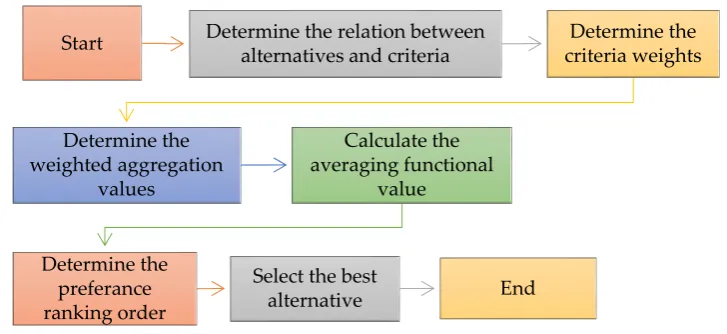
The strategy 2 is presented (see Figure 2) using the following seven steps.
240
Step 1.This step is similar to the first step of strategy 1.
241
Step 2.Determine the criteria weights
242
Start
Determine the relation between alternatives and
criteria
Determine the aggregation values
Calculate the averaging functional value
Determine the preferance ranking
order
Select the best
Using Eq. (6), determine the criteria weights from decision matrices (DMt[L|C]), (t = 1, 2, ..., k).
243
Step 3.Determine the weighted aggregation values (DMwaggrk(Li))
244
Using Eq. (4), determine the weighted aggregation values (DMwaggrk(Li)), (i = 1, 2, …, n) for all
245
decision matrices.
246
Step 4.Determine the averaging values
247
To fuse all the weighted aggregation values (DMwaggrk(Li)), corresponding to alternatives Li, we
248
define the averaging function as follows.
249
k L DM L
DM
k
t i
waggr k i
aggr( ) = =1 ( )
(i = 1, 2, …, n) (8)
250
Step 5.Determine the ranking order
251
Using Eq. (1), determine the score values S(zi) (accuracy degrees A(zi), if necessary) (i = 1, 2, . . . ,
252
m) of all alternatives Li. All the score values are arranged in descending order. The alternative
253
corresponding to the highest score value (accuracy values) reflects the best choice.
254
Step 6Select the best alternative from the preference ranking order.
255
Step 7 End.
256
257
258
259
Figure 2. Steps ofMCGDM strategy based on NNWHMO.
260
6. Simulation results
261
We solve a numerical example studied by Zheng et al. [13]. An investment company desires to
262
invest a sum of money in the best investment fund. There are four possible selection options to
263
invest the money. Feasible selection options are namely, L1: Car company (CARC), L2: Food company
264
(FOODC), L2: Computer company (COMC), L4: Arms company (ARMC). Decision making must be
265
based on the three criteria namely, Risk analysis (C1), Growth analysis (C2), Environmental impact
266
analysis (C3). The four possible selection options/alternatives are to be selected under the criteria by
267
the NN assessments provided by the three decision makers DM1, DM2, DM3.
268
Start Determine the relation between
alternatives and criteria
Determine the criteria weights
Determine the weighted aggregation
values
Calculate the averaging functional
value
Determine the preferance ranking order
Select the best
6.1. Solution using MCGDM Strategy 1
269
Step 1.Determine the relation between alternatives and criteria.
270
All assessment values are provided by the following three NN based decision matrices (shown in
271
Tables 2, Table 3, and Table 4).
272
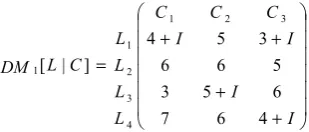
Table 2. NN based decision matrix for DM1
273
+ + + + = I I I I C C C L L L L C L DM 4 6 7 6 5 3 5 6 6 3 5 4 ] | [ 3 2 1 4 3 2 1 1274
Table 3. NN based decision matrix for DM2
275
+ + + = 5 6 6 5 5 4 6 6 5 4 4 5 ] | [ 3 2 1 4 3 2 1 2 I I I C C C L L L L C L DM276
Table 4. NN based decision matrix for DM3
277
+ + + + = I I I I C C C L L L L C L DM 4 6 8 6 5 4 5 7 6 4 5 4 ] | [ 3 2 1 4 3 2 1 3278
Step 2.Determine the weighted aggregation values ( aggr( i)
k L
DM )
279
Using Eq. (3), we calculate the aggregation values ( aggr( i)
kL
DM ) as follows:
280
I L
DMaggr( ) 3.829 0.785 1
1 = + ;DMaggr1(L2)=5.625;DMaggr1(L3)=4.285+0.214I;DMaggr1(L4)=5.362+0.514I;
281
285 . 4 ) ( 12L =
DMaggr
;DMaggr(L ) 5.206 0.415I
2
2 = + ;DMaggr2(L3)=4.196+0.532I;DMaggr2(L4)=5.234+0.618I;
282
I L
DMaggr( ) 4.019 0.605 1
3 = + ;DMaggr3(L2)=5.817+0.433I;DMaggr3(L3)=4.876+0.387I
283
I L
DMaggr( ) 6.023 0.257 4
3 = + .
284
Step 3.Determine the averaging values
285
Using Eq. (7), we calculate the averaging values to fuseall the aggregation values corresponding to
286
the alternative Li.
287
I L
DMaggr( ) 4.044 0.463
1 = + ;DMaggr(L2)=5.549+0.282I;DMaggr(L3)=4.452+0.378I;
288
I L
DMaggr( ) 5.539 0.463
4 = + .
289
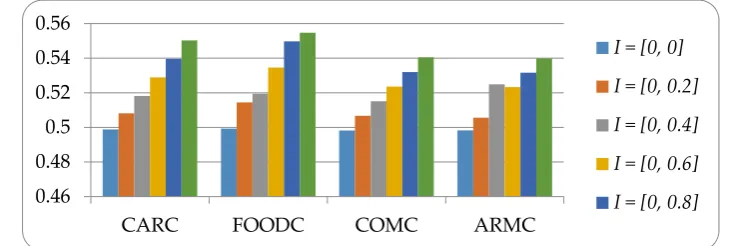
Step 4.Using Eq. (1), we calculate the score values S(Li) (i = 1, 2, 3, 4). Score values and ranking of
290
alternatives for different values of “I” are shown in Table 5.
291
Table 5. Ranking order with variation of “I” on NNsfor strategy 1
293
294
I S(Li) Ranking order
I =[0, 0] S(L1) = 0.4988, S(L2) = 0.4993, S(L3) = 0.4982, S(L4) = 0.4983 L2L1L4L3 I∈[0, 0.2] S(L1) = 0.5081, S(L2) = 0.5144, S(L3) = 0.5067, S(L4) = 0.5056 L2L1L3L4 I∈[0, 0.4] S(L1) = 0.5182, S(L2) = 0.5195, S(L3) = 0.5151, S(L4) = 0.5249 L2L1L4L3 I∈[0, 0.6] S(L1) = 0.5289, S(L2) = 0.5346, S(L3) = 0.5236, S(L4) = 0.5233 L2L1L3L4 I∈[0, 0.8] S(L1) = 0.5396, S(L2) = 0.5497, S(L3) = 0.5320, S(L4) = 0.5316 L2L1L3L4 I∈[0, 1] S(L1) = 0.5503, S(L2) = 0.5547, S(L3) = 0.5405, S(L4) = 0.5399 L2L1L3L4
295
Step 5.Food company (FOODC)is the best alternative for investment.
296
Step 6.End
297
298
299
300
301
302
303
304
305
6.2. Solution using MCGDM Strategy 2
306
Step 1.Determine the relation between alternatives and criteria
307
This step is similar to the first step of strategy 1.
308
Step 2.Determine the criteria weights
309
Using Eqs. (5) and (6), criteria weights are calculated as follows:
310
[w1 = 0.3265, w2 = 0.3430, w3 = 0.3305] for DM1,
311
[w1 = 0.3332, w2 = 0.3334, w3 = 0.3334] for DM2,
312
[w1 = 0.3333, w2 = 0.3335, w3 = 0.3332] for DM3.
313
Step 3.Determine the weighted aggregation values (DMwaggrk(Li))
314
Using Eq. (4), we calculate the aggregation values ( aggr( i)
kL
DM ) as follows:
315
I L
DMaggr( ) 3.861 0.774 1
1 = + ;DMaggr1(L2)=6.006;DMaggr1(L3)=4.307+0.234I;DMaggr1(L4)=5.399+0.541I;
316
288 . 4 ) ( 1
2L =
DMaggr
;DMaggr(L ) 5.219 0.429I
2
2 = + ;DMaggr2(L3)=4.206+0.541I;DMaggr2(L4)=5.251+0.629I;
317
I L
DMaggr( ) 4.024 0.616 1
3 = + ;DMaggr3(L2)=5.824+0.445I;DMaggr3(L3)=4.889+0.393I; DMaggr3(L4)=6.029+0.265I.
318
319
320
0.46 0.48 0.5 0.52 0.54 0.56
CARC FOODC COMC ARMC
I = [0, 0]
I = [0, 0.2]
I = [0, 0.4]
I = [0, 0.6]
I = [0, 0.8]
Step 4.Determine the averaging values
321
Using Eq. (7), we calculate the averaging values to fuseall the aggregation values corresponding to
322
the alternative Li.
323
I L
DMaggr( ) 4.057 0.463
1 = + ;DMaggr(L2)=5.568+0.291I;DMaggr(L3)=4.467+0.389I;
324
I L
DMaggr( ) 5.559 0.478
4 = +
325
Step 5.Determine the ranking order
326
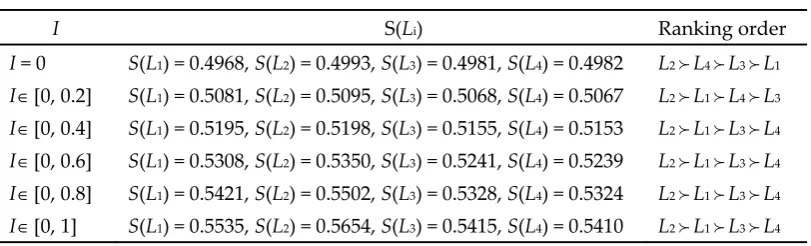
Using Eq. (1), we calculate the score values S(Li) (i = 1, 2, 3, 4). Since scores values are different,
327
accuracy values are not required. Ranking of alternatives are shown in Table 6.
328
Table 6. Ranking order with variation of “I”on NNsfor strategy 2
329
I S(Li) Ranking order
I = 0 S(L1) = 0.4968, S(L2) = 0.4993, S(L3) = 0.4981, S(L4) = 0.4982 L2L4L3L1 I∈[0, 0.2] S(L1) = 0.5081, S(L2) = 0.5095, S(L3) = 0.5068, S(L4) = 0.5067 L2L1L4L3 I∈[0, 0.4] S(L1) = 0.5195, S(L2) = 0.5198, S(L3) = 0.5155, S(L4) = 0.5153 L2L1L3L4 I∈[0, 0.6] S(L1) = 0.5308, S(L2) = 0.5350, S(L3) = 0.5241, S(L4) = 0.5239 L2L1L3L4 I∈[0, 0.8] S(L1) = 0.5421, S(L2) = 0.5502, S(L3) = 0.5328, S(L4) = 0.5324 L2L1L3L4 I∈[0, 1] S(L1) = 0.5535, S(L2) = 0.5654, S(L3) = 0.5415, S(L4) = 0.5410 L2L1L3L4
Step 6. Food company (FOODC)is the best alternative for investment.
330
Step 7. End
331
332
333
334
335
336
337
7. Comparison analysis and contributions of the proposed approach
338
7.1. Comparison analysis
339
In this subsection, a comparison analysis is conducted between the proposed MCGDM strategies
340
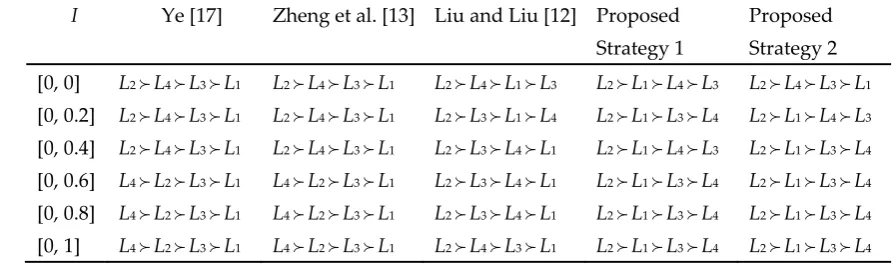
and other existing strategies in NN environment. Table 5 reflects that L2 is the best alternative for I = 0
341
andI≠0. Table 6 reflects that L2 is the best alternative for any values of I. The ranking results
342
obtained from the existing strategies [12, 13, 17] are furnished in Table 7.
343
In strategy [17], deneutrosophication process is analyzed. It does not recognize the importance of
344
the aggregation information. MCGDM due to Liu and Liu [12] is based on NN generalized weighted
345
power averaging operator. This strategy cannot deal the situation when larger value other than
346
arithmetic mean, geometric mean and harmonic mean is necessary for experiment purpose. In Zheng
347
et al. [13], the NN general hybrid weighted averaging operators are proposed. The strategy proposed
348
0.46 0.48 0.5 0.52 0.54 0.56 0.58
CARC FOODC COMC ARMC
I = [0, 0]
I = [0, 0.2]
I = [0, 0.4]
I = [0, 0.6]
I = [0, 0.8]
I = [0, 1]
by Zheng et al. [13] cannot be used when few observations contribute disproportionate amount to the
349
arithmetic mean. To overcome the problem, we have proposed two NN harmonic aggregation
350
operators for MCGDM.
351
Table 7. Comparison of ranking results with variation of ‘I’ on NNs for different strategies
352
I Ye [17] Zheng et al. [13] Liu and Liu [12] Proposed
Strategy 1
Proposed Strategy 2 [0, 0] L2L4L3L1 L2L4L3L1 L2L4L1L3 L2L1L4L3 L2L4L3L1
[0, 0.2] L2L4L3L1 L2L4L3L1 L2L3L1L4 L2L1L3L4 L2L1L4L3
[0, 0.4] L2L4L3L1 L2L4L3L1 L2L3L4L1 L2L1L4L3 L2L1L3L4
[0, 0.6] L4L2L3L1 L4L2L3L1 L2L3L4L1 L2L1L3L4 L2L1L3L4
[0, 0.8] L4L2L3L1 L4L2L3L1 L2L3L4L1 L2L1L3L4 L2L1L3L4
[0, 1] L4L2L3L1 L4L2L3L1 L2L4L3L1 L2L1L3L4 L2L1L3L4
353
7.2. Contributions of the proposed approach
354
• NNHMO and NNWHMO in NN environment are firstly defined in the literature. We also
355
proved their basic properties.
356
• We proposed score and accuracy functions of NN numbers. If two score values are same,
357
then accuracy function can be used for ranking purpose.
358
• The proposed two strategies can also used when observations/experiments contribute is
359
disproportionate amount to the arithmetic mean. The harmonic mean is used when sample
360
values contain fractions and/or extreme values (either too small or too big).
361
• To calculate unknown weights structure in NN environment, cosine function is proposed.
362
• Steps and calculations of the proposed strategies are easy to use.
363
• We have solved a numerical example to show the feasibility, applicability, and effectiveness
364
of the proposed two strategies.
365
8. Conclusions
366
In the study, we have proposed NNHMO and NNWHMO. We have developed two strategies of
367
ranking NNs based on proposed score function and accuracy function. We have proposed cosine
368
function to determine unknown criteria weights in NN environment. We have developed two novel
369
MCGDM strategies based on the proposed aggregation operators. We have solved a hypothetical
370
case study and compared the obtained results with other existing strategies to demonstrate the
371
effectiveness of the proposed MCGDM strategies. Sensitivity analysis for different values of I is also
372
conducted to show the influence of I in preference ranking of the alternatives. The significance of the
373
paper is that we combine NNs with harmonic aggregation operators to cope with MCGDM
374
problems. We hope that the proposed two MCGDM strategies will open up new avenue of research
375
in NN environment for dealing with MCGDM problems and its practical implementation to real
376
world decision making problems in the current neutrosophic decision making arena.
377
Author Contributions: Kalyan Mondal and Surapati Pramanik conceived and designed the experiments;
378
Kalyan Mondal, and Surapati Pramanik performed the experiments; Surapati Pramanik and B. C. Giri
379
analyzed the data; Kalyan Mondal, Surapati Pramanik, and B. C. Giri contributed to analysis tools; Kalyan
380
Mondal and Surapati Pramanik wrote the paper.
Conflicts of Interest: The authors declare no conflict of interest.
382
References
383
1. Ma, Y.X.; Wang, J.Q.; Wang, J.; Wu, X.H. An interval neutrosophic linguistic multi-criteria group
384
decision-making method and its application in selecting medical treatment options. Neural. Comput. Appl.
385
2017, 28, 2745–2765.
386
2. Liu, H.C.; Wu, J.; Li, P. Assessment of health-care waste disposal methods using a VIKOR-based fuzzy
387
multi-criteria decision making method. Waste. Manag. 2013, 33, 2744–2751.
388
3. Tian, Z.P.; Wang, J.; Wang, J.Q.; Zhang, H.Y. Simplified neutrosophic linguistic multi-criteria group
389
decision-making approach to green product development. Group. Decis. Negot. 2017, 26, 597–627.
390
4. Biswas, P.; Pramanik, S.; Giri, B.C. TOPSIS method for multi-attribute group decision-making under
391
single-valued neutrosophic environment. Neural. Comput. Appl. 2016, 27, 727–737.
392
5. Zouggari, A.; Benyoucef, L. Simulation based fuzzy TOPSIS approach for group multi-criteria supplier
393
selection problem. Eng. Appl. Artif. Intell. 2012, 25, 507–519.
394
6. Smarandache, F. Introduction to neutrosophic measure, neutrosophic integral, and neutrosophic.
395
Probability, Sitech & Education Publisher, Craiova, 2013.
396
7. Smarandache, F. Introduction to neutrosophic statistics. Sitech & Education Publishing, Columbus, 2014.
397
8. Park, J.H.; Gwak, M.G.; Kwun, Y.C. Uncertain linguistic harmonic mean operators and their applications to
398
multiple attribute group decision making. Computing. 2011, 93, 47–64.
399
9. Wei, G.W. FIOWHM operator and its application to multiple attribute group decision making. Expert. Syst.
400
Appl. 2011, 38, 2984–2989.
401
10. Xu, Z. Fuzzy harmonic mean operators. Int. J. Intell. Syst. 2009, 24, 152–172.
402
11.Ye, J. Simplified neutrosophic harmonic averaging projection-based strategy for multiple attribute
403
decision-making problems. Int. J. Mach. Learn. Cybern. 2017, 8, 981–987.
404
12. Liu, P.; Liu, X. The neutrosophic number generalized weighted power averaging operator and its
405
application in multiple attribute group decision making. Int J Mach Learn Cybernet. 2016, 1–12.
406
https://doi.org/10.1007/s13042-016-0508-0
407
13. Zheng, E.; Teng, F.; Liu, P. Multiple attribute group decision-making strategy based on neutrosophic
408
number generalized hybrid weighted averaging operator. Neural .Comput. Appl. 2017, 28, 2063–2074.
409
14.Pramanik S.; Roy R.; Roy T.K. Teacher selection strategy based on bidirectional projection measure in
410
neutrosophic number environment. In Neutrosophic Operational Research; Smarandache, F., Abdel-Basset, M.,
411
El-Henawy, I., Eds.; Pons Publishing House / Pons asbl: Bruxelles, Belgium, 2017; Volume 2, ISBN
412
978-1-59973-537-5. (In Press).
413
15. Majumdar, P.; Samanta, S.K. On similarity and entropy of neutrosophic sets. J. Intell. Fuzzy. Syst. 2014, 26,
414
1245–1252.
415
16.Biswas, P.; Pramanik, S.; Giri, B.C. Entropy based grey relational analysis strategy for multi-attribute
416
decision-making under single valued neutrosophic assessments. Neutrosophic. Sets. Syst. 2014, 2,102–110.
417
17. Ye, J. Multiple attribute group decision making method under neutrosophic number environment. J. Intell.
418
Syst. 2016, 25, 377–386.