Spatial Clustering Simulation on Analysis of
Spatial-Temporal Crime Hotspot for
Predicting Crime activities
M.Vijaya Kumar
Assent Professor K.S.R.College of Engineering
Tiruchengode
Dr .C.Chandrasekar Associate Professor
Periyar University Salem
ABSTRACT-This paper presents a spatial‐temporal prediction of crime that allows forecasting of the criminal activity behaviour in a particular district by using structured crime classification algorithm. The quantity of each crime is understood as the forecasted enhance or reduce the particular moment in time and location of the criminal activity. The proposed algorithm used for forecasting crime is based on one year crime reports. It is proposed a new structured crime classification algorithm which improves the prediction performance on the studied dataset of criminal activity. It execute the following analyses: To find the exact hotspot location and disposition analysis, which shows that it is possible to predict crime location promptly, in a specific space and time, and highest percentage of effectiveness in the prediction of the position of crime. The usage of the said algorithm is to identify the particular crime from number of crimes.
Key Words crime hot spots, repeat victimisation, Crime Pattern Theory, Statistical Methods.
1. INTRODUCTION
Public security and crime forecasting activities are some of the most important concerns of both citizens and government. Large amounts of money, human resources, equipment and services are devoted to these activities. In addition, there is a constant concern to justify resources allocated for police. If the police could anticipate, with an acceptable degree of precision, when and where criminal activities of a specific kind are going to take place, it would achieve a double benefit. First, it would be possible to concentrate the necessary logistic activities and resources fighting that specific kind of criminal activity in the geographic area and forecasted time frame, and the comparison between the amount of resources allocated to police forces and the results achieved by them may result in a more adequate basis for planning and distribution of public security.
There are several works dedicated to the study of spatial and temporal verdicts made by criminals, i.e., identifying hotspots where criminal activity is concentrated [1, 2 ]. A commonly used method is the Spatial and Temporal
Fig1: Proposed simulation Model
2. PROPOSED SIMULATION
The Proposed simulation description here is part of a police information system designed to prevent and react to crime. The function first step of the Crime records it was collected the number of past year recorded crimes. The second step contains structured crime classification algorithm it was found the particular crime using classification conditions. The input for the third step is the output of structured crime classification algorithm the predicted specific crime made the instance of the KDE grid, after the instances Clique optimized clustering algorithm performs the separations of the clusters. The created suggestions are classified into four types: (1) suggestions on police patrol to avoid the random (2) suggestions to begin specific defensive movements through the crowd media, (3) suggestions to make the new police station in high sensitive area, and (4) general suggestions on the state of the police resource allocations. The problem of crime prediction requires several different information sources. All of them directly related with public security, but not easily accessible. In this research have chosen three categories crime information on (1) crimes Place, (2) Crime Time, (3) Particular crime (Burglary crime)(4) Density of Population , (5) Number of Promoter Apartments.
2.1 Clique Optimize Algorithm
Clustering is one of the most useful tasks in data mining process which can separate objects of a data set into distinct clusters such that two objects from one cluster are similar to each other, whereas two objects from distinct clusters are not. Spatial clustering means to identify clusters or densely populated areas in a large spatial data set, give out as an important task of spatial data mining. The research of spatial clustering is very active. The main satisfactory methods of this area include: algorithm based on spatial dataset separation such as means, k-medoid, CLARA, etc. algorithm based on hierarchical clustering such as CURE, BIRCH, etc. algorithm based on density such as DBSCAN, and DENCLUE , etc. algorithm based on grid such as SING, wave-cluster and CLIQUE, etc. To estimate the capability of spatial clustering algorithm, some principle is shown as follows:
scalability and the ability of discovering cluster of any shape. With these criterions of spatial clustering, proposed CLIQUE Optimization algorithm for finding the subspace clustering of spatial dataset automatically, non-awareness of the order of data input, the ability of finding any shape clusters and the linear scalability with the addition of dataset.
In this paper, the CLIQUE Optimization algorithm follows the major steps.
Step 1: divide the space with X, Y axis depending on distributing of input spatial data to avoid demolishing of accepted clusters.
Step 2: Apply of pruning concept to find Density area and sparse area.
Step 3: To find the Threshold Parameter (P); Tminimum number of data point’s density area.
Algorithm
Input: Crime Spatial dataset D, T, Points of X, Y
Output: Cluster area for the given D
Step1: To find the particular crime data in the given input crime dataset.
Step2: To find the X, Y axis in the given region and find the scale points of the crime cluster area.
Fig2: Given spatial data space
Fig4: Scale points of crime cluster
Step3: Apply Optimization and find the max out cluster in the data space.
The CLIQUE optimization algorithm finds the max out clusters with the “Hill climbing” method and it trays to look for the pair of points between two max out clusters and the cluster which can satisfy the statistically important.
Fig5: Points of the max out clusters
Step4: To identify the Dense Area clusters and Sparse Area using Threshold parameter (T)
In this step, count the number of data points in every area N, recording the value NUMi, calculating the density of Area with the x, y coordinate value and T
NUMi It is Density of Cluster otherwise It is Sparse area.Fig6: Identify dens clusters and sparse areas based T
3. RESULTS AND FINDINGS
Figure.7 is the initial spatial dataset D shows the clustering results of CLIQUE Optimization setting Findings = 7, T = 1. Depicts the partitions found by CLIQUE Optimization algorithm on this spatial dataset.
The clustering result of new algorithm with T = 1, (P,
Findings) = (1, 7).
Basically, CLIQUE Optimization algorithm is a grid-density clustering algorithm, and CLIQUE is a popular and accepted grid-density algorithm of spatial clustering because of its excellent ability of every aspect. In this experiment, we will compare CLIQUE Optimization algorithm with CLIQUE to approve the more excellent ability of new spatial clustering algorithm.
Fig 7: Spatial Data set D
Fig8: Comparison of CLIQUE and CLIQUE Optimization algorithm
4. CRIME CLASSIFICATIONS.
In this chapter, structured crime classification is the relatively easy method of the concept clustering. The method tries to identify more similar object in the data sets same as general clustering goal. The main idea of structured crime classification includes some steps as following. The first step is querying and gathering Hotspot data relevant to the particular crime, the second step is examining each Hotspot of task-related data and the third step is counting the Crime type with more intangible values repeatedly. The more insubstantial value is defined in the generalized hierarchy grid in advance. In order to define the similarities between crime types, classification on the crime database can be used. Classification is the simplification hierarchy on these crime types. These attributes above can be depicted by classification respectively.
1. Crime based on Places. 2. Crime based on Time.
3. Crime based on Specific Type (Ex., Burglary). 0
5 10 15 20
1 2 3 4 5 6
CLIQUE
Optimize
Alogotithm
CLIQUE
4.1. Structured crime classification Algorithm. Step1. Start
Step2. Collect the crime Record and denote DB. Step3. Assign DB=|DB| Denote number of crime events.
Fig9. All the crime Events in DB Denoted in Hotspots
Step4. Assign
c
i=Similarity (
Obj
1,Obj
2…,Obj
n) whereObj
n ...1 , are Crime Events of the DB.
The objects below study are Peoples intelligence recorded in a given geographical area at a specified time. Temporal data includes the date and time components, while the location refers to the area in which the criminal activity was recorded.
Fig10.Find the similarities c1 to c10
Step5. To find the probability of particular crime
P
I= (requested forecast crime, Crime Dataset), record the Positive Character, the Negative Character descriptions of the Particular Crime.Step6. To find the Threshold Value (T), T= (Cluster Density Area- Sparse Area), in hotspots.
Fig11. Classification of Density and Sparse Areas
Step7. Identify the Classes of crimes types, classes based on the kind of social impact that the criminal activity. Ex- Class1= (Burglary in Apartments, Shops, Small Houses), Class2= (Robbery, Injury, Property damage), Class3=(sex, children abuse, usurp)…, etc.
Table1: Based on the Hotspot crime Classified into Different class
Step8.F(C) =
class
i
P
I(c
i), The properties are subsets of expressive features associated with specific values. For each class, a positive and a negative description are made.Step9.If F (
Class
i)
positive description ThenProduce a Hotspot. Else
Produce a Cold spot.
Fig12: Classification of Hotspot and Cold spot
5. EXPERIMENTS AND TEST RESULTS.
The input data should be entire crime events, and there should be recorded systematically in due time. In the Anna nagar Promoter Apartment area, located in Chennai, area mostly high density of peoples and number of apartments are there. An important part of its task is the collecting of the information from police records, Detective agenesis. Therefore, this area was selected as a case study and test field for both the forecasting crime event reported and the computerized system for behind the conclusion‐making development on communal security.
For the analysis we used Promoter apartment’s burglary data from the Anna nagar area of Chennai. Inside this analysis this research performed experiments for Classification of the crime events. Experiment used data from the Chennai city police crime dataset.
Table 2. Reported crime from the record
The crimes were grouped by category in three different classes:
Class1= (Burglary in Apartments, Shops, Isolated Houses).
Class2= (Robbery, Injury, Property damage). Class3= (sex, children abuse, usurp).
The entire crime record this paper used only 190 records. For the reason that the remaining records have not sufficient information to hand out them between the classes selected.
Table 3.Pre‐processed report used as Classification algorithms
As the algorithm calculate the characteristic features and the complementary features of the sample by applying set of data with 140 crime events 73% of the 370 records from the whole record set. These 140 records were: Burglary in Apartments: 91, Home: 12, Isolated Houses:
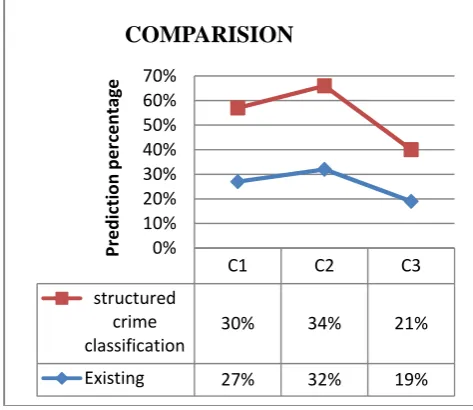
37. The structured crime classification for the positive description is 82%.
Fig13. Comparison of Existing and structured crime classification algorithm
6. SIMULATION RESULTS
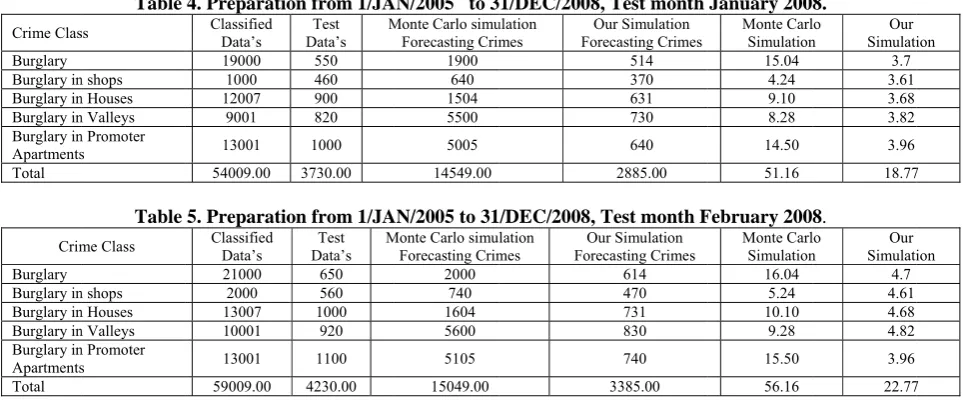
In this section, we present our simulation tests with a different dataset and compare against predictions by the Monte Carlo simulation. Additionally, the experiment results using the Spatial‐Temporal hot spot and cold spot creation. This measure consists of monthly and yearly measurements of forecast crime events it is based on the recorded police crime data set for the particular position.
C= SM
L I
I i
O
1
---- (1)
To test the proposed forecasting Simulation results, the Chennai city crime dataset was used. This dataset contains maximum of 100000 registered crimes and was made available by the Chennai city Police Department. All crimes were committed within 10 inspection sectors (space‐units), over a period of time from January 2005 to December 2008 (time‐units). Crimes were organized into 16 crime Classes as shown in Table 3.
By evaluating only records from the last four years (2005 to 2008), a forecast was considered for time unit January 2008, all registered crime Classes and within all 10 inspection sectors. The forecast number of crimes was then matching up to with the real‐life police records from that same space‐time unit (2,201 crimes during January 2008).
Two limited forecasts of the number (F) of crimes
belonging to the (C) crime Classes to be observed within
the (S) space unit and during (T) time unit are used to
estimate the movement observed in the reference dataset. When the movement is known, it is likely to forecast the next value to be observed by appearing at the last
C1 C2 C3
structured
crime
classification
30% 34% 21%
Existing 27% 32% 19%
0% 10% 20% 30% 40% 50% 60% 70%
Pr
ed
icti
on
percent
ag
e
observed values. To achieve this forecast, the basic tool to be used is a query to the dataset to count the number of crimes, from a specific Class (c) and observed within
specific Region (R) and set of attributes from the Object (S (z)) and time units (T), the result of such a function is
represented by function #(C, R, S(z),T) . Specifically, the
forecast (F) of crimes, belonging to the (C) crime‐family, to be observed within the (R) and set of attributes for the crime objects during time (T), is determined by
F(C, R, S(z),T)
Where C--- Crime Classes R--- Region (or) Area
S(z)—Set of Attributes From the Crime Objects
Ex: S(burglary, sex, Shop Theft, Road Accidents…., Etc..)
T--- Time
Month Based analysis
F(C, R, S(z),T) = #(
1
12
m
m
#(C,R,S(z),
T
m) - (#(C,R,S(z),
T
m1))) --(2)
The function of Month based simulation analysis predicted give up by the analysis of crimes, from the same crime classes, observed within the same Region, set of attributes from the crime objects and time.
Year Based Analysis
F(C, R, S(z),T)= #
ar StraringYe
EndYear
#(C.R.S(z),
T
Year) - #(C,R,S(z),
T
Year1) --(3)
The function of Year based simulation analysis predicted give up by the analysis of crimes, from the same crime classes, observed within the same Region, set of attributes from the crime objects and time observed the last one year in the reference dataset.
Cumulative Percentage Crime Ratio (CPR)
Both simulation analysis can be expressed cumulative Percentage of crime ratio.
CPR =( #
ar StraringYe
EndYear
(#(C.R.S(z),
T
Year) - #(C,R,S(z),
T
Year1)) + (#(
1
12
m
m
(#(C,R,S(z),
T
m)- #(C, R.S (z),
T
m1)) --- (4)
Total Crime Classification
TC
i =
k
i1
CPRi ---P=Year --- (5)
Crime Attribute Ratio
CAR =
K
T
i ci
--- K= Classification --- (6)
Find the Hotspot and Cold Spot
If (
CAR
L
CAR
P)Produce Hot Spot
Else
Crime Clas Burglary Burglary in Burglary in Burglary in Burglary in Apartments Total Crim Burglary Burglary in Burglary in Burglary in Burglary in Apartments Total The resu reference results w Chennai, These si method Simulatio and time Promoter those, in method o each crim for com embrace operation There are first, the by the le informati under stu 0 0.5 1.5 2 Simulat Table ss n shops n Houses n Valleys n Promoter s Table me Class n shops n Houses n Valleys n Promoter s ult compariso e to the usag worked with d
INDIA and in
imulation ou has high u on forecasting units, during r Apartments n common, th only decrease me classes. Su mputerized cri a useful tool ns.
7. e two key ad inductive clas earning proce ion for descr udy. Second, 0 5 1 5 2 Monte Carlo
Result
tion Mo
4. Preparatio Classified Data’s 19000 1000 12007 9001 13001 54009.00 5. Preparatio Classified Data’s 21000 2000 13007 10001 13001 59009.00
on shows Ta ge of the sim different data
n different tim
utcomes show usefulness, w
g all crime e January 2008 s burglary c he proposed f e small in les uch accuracy ime analysis
for developm
CONCLUSION dvantages of o ssification of edure compri ribing the cr the simulation
Our
Approach
t
Compa
onte Carlo 1.72
on from 1/JA Test Data’s M 550 460 900 820 1000 3730.00
on from 1/JA Test
Data’s M
650 560 1000 920 1100 4230.00 able5 present mulation meas a set, with th me.
w that the with a Mont events based 8 (with a total crimes). This forecasting si ss than five e is logically ac systems an ment Forecastin
NS
our Simulatio each class co ses by itself riminal circu n model was
arison
Simulati Our App 1.0
AN/2005 to 3 Monte Carlo simu Forecasting Crim 1900 640 1504 5500 5005 14549.00
AN/2005 to 31 Monte Carlo simu Forecasting Crim 2000 740 1604 5600 5105 15049.00
ted as a sure. The he city of
proposed te Carlo
on space l of 2,219 s returns imulation events of cceptable nd might ng police on model: onstructed precious umstances designed f t y m t [ P [ L [ A N [ e ( P F [ f p [ c D [ d a [ t 1 [ m c p [ f L [ I [ d [ a S on proach 1 1/DEC/2008, ulation mes O Fore /DEC/2008, T lation
mes ForecOu
for dealing w three level of yields the sam model will fo those before re
[1] Amir, M., Pat Press, 1971. [2] Baldwin, J., B London: Tavistoc [3]. S. Godoy‐C Algorithm for Sp No1 April 2010. [4] Block, C., enforcement deci (Eds.), Crime an Police Executive Forum, p. 15−32, [5] S. Guha, R. R for large database pp: 73-84. [6] T. Zhang, R clustering meth Data,Seattle,1996 [7] M. Ester, H. P discovering clust and Data Mining, [8] M. nkerst, M. to identify the clu 1999, pp: 49-60 [9] Xiang Zhang mapping crime h clustering Geoinf pp: 1-5. [10].A. H. Pileva for high-dimensio Letters, 2005, pp: [11] L. Kaufman Introduction to Cl [12] R. Ng., J. Ha data mining”, Ver [13] S. Guha, R algorithm for lar Seattle, 1998, pp:
, Test month Our Simulation ecasting Crimes 514 370 631 730 640 2885.00
Test month F ur Simulation casting Crimes 614 470 731 830 740 3385.00
with space an simulation ba me results. Th orecast new c
egistered in th
REFE tterns in forcible
Bottoms, A. The ck Publications, 1 Calderón, Hiram
patio‐Temporal P
STAC hot‐spot isions. In Block nalysis through c
Research 1995. Rastogi, and K. Sh
es”, Management
R. Ramakrishnan hod for larg 6,pp:103-114..
P. Kriegel, and X ers in large spat Portland, 1996, p
breunig, H. P. K ustering structure
g; Zhiang Hu; Ro hot spots based o formatics,2010, 1
ar, M. Sukumar, onal very large sp
999-1010. n and P. Jrouss luster Analysis, 1 an, “Efficient and ry Large Data Ba R. Rastogi, and rge databases”, 73-84. January 200 Monte Carl Simulation 15.04 4.24 9.10 8.28 14.50 51.16 February 200 Monte Carl Simulation 16.04 5.24 10.10 9.28 15.50 56.16
nd time data, ased on the par
his means tha riminal event he same space
ERENCES rape. Chicago: U
urban criminal: 976.
Calvo., The C Prediction of Crim
t areas: A stat , C. R., Dabdou computer mappin
him, “An efficien t of Data, SIGMO
n, and M. Livny ge databases”.
X. Xu, “A density tial databases”, K
pp: 226-231. Kriegel, and J. San
e”, Management o
ong Li; Zheng Z on improved attr 18 th Internationa
“GCHL: A grid-patial data bases”
seeuw, Finding 1990, New York. d effective cluster ases, Santiago, 19 d K. Shim, “An Management of 8. lo n Our Simulati 3.7 3.61 3.68 3.82 3.96 18.77 8. lo
n SimulatiOur 4.7 4.61 4.68 4.82 3.96 22.77 constructing rameter choic at our simula ts very simila e‐time framew
University of Chi
A study in Shef
CR‐Ω+ Classific minal Activity, v
tistical tool for ub, M., & Fregl ng. Washington,
nt clustering algor OD’98, Seattle, 1
y, “An efficient Management
y-based algorithm Knowledge Disco
nder, “Ordering p of Data, Philadel
Zheng; Detecting ribute oriented in al conference,Be
- clustering algor ”, Pattern Recogn
Group in Data
ing method for sp 994, pp: 144-155.
n efficient clust f Data, SIGMOD
[14] T. Zhang, R. Ramakrishnan, and M. Livny, “An efficient data clustering method for large databases”, Management of Data, Seattle, 1996, pp: 103-114.
[15] M. Ester, H. P. Kriegel, and X. Xu, “A density- based algorithm for discovering clusters in large spatial databases”, Knowledge Discovery and Data Mining, Portland, 1996, pp: 226-231.
[16]. E. Jefferis, “A Multi-Method Exploration of Crime Hot Spots: A Summary of Findings,” National Institute of Justice, Washington, pp: 8, 1999.
[17]. CRIME REVIEW TAMIL NADU 2007. State Crime Records Bureau Crime CID, Chennai Tamil Nadu.
[18]. Tamil Nadu Police Website http://www.tnpolice.gov.in/