Security notions for cloud storage and deduplication
∗Colin Boyd, Gareth T. Davies and Kristian Gjøsteen
NTNU, Norwegian University of Science and Technology, Trondheim, Norway {colin.boyd,gareth.davies,kristian.gjosteen}@ntnu.no
Håvard Raddum Simula@UiB [email protected]
Mohsen Toorani
University of Bergen, Bergen, Norway [email protected]
Abstract
Cloud storage is in widespread use by individuals and enterprises but introduces a wide array of attack vectors. A basic step for users is to encrypt their data, yet it is not obvious what security prop-erties are required for such encryption. Furthermore, cloud storage providers often use techniques such as data deduplication for improving efficiency which restricts the application of semantically-secure encryption. Generic security goals and attack models have thus far proved elusive: primitives are considered in isolation and protocols are often proved secure under ad hoc models for restricted classes of adversaries.
We formally model natural security notions for cloud storage and deduplication using a generic syntax for storage systems. We define security notions for confidentiality and integrity in encrypted cloud storage and determine relations between these notions. We show how to build cloud storage systems that satisfy our defined security notions using standard cryptographic components.
Contents
1 Introduction 3
2 Preliminaries 4
2.1 Notation . . . 4
2.2 Symmetric-Key Encryption (SKE) . . . 5
2.2.1 Confidentiality for Symmetric Encryption . . . 6
2.2.2 Confidentiality for MLE-like Symmetric Encryption . . . 6
2.2.3 Authenticated Encryption with Associated Data (AEAD) . . . 7
2.2.4 Integrity for Symmetric Encryption . . . 8
3 Modelling Cloud Storage 9 3.1 A Model for Cloud Storage . . . 10
3.2 Modelling Existing Schemes and Literature . . . 11
4 Confidentiality 12 4.1 Defining Confidentiality for Cloud Storage . . . 13
4.2 Achieving Confidentiality in Cloud Storage . . . 15
4.2.1 Per-User Keys . . . 15
4.2.2 Per-File Keys . . . 17
4.2.3 Deduplicating Systems using File-Derived Keys . . . 18
4.3 Deduplicating Schemes with non-trivialfkeyGenProcedures . . . 19
5 Integrity 20 5.1 Defining Integrity for Cloud Storage . . . 20
5.2 Achieving Integrity in Cloud Storage . . . 21
5.3 Integrity in Deduplicating Schemes . . . 23
6 Concluding Remarks 25
1
Introduction
When handing over their data to third parties, it is natural that users regard security and privacy as critical concerns. Some users may be willing to trust a cloud storage provider (CSP) to secure their data, but as the Snowden revelations have shown, even well-meaning providers are not immune from compromise. Users increasingly want to manage confidentiality and integrity of their outsourced data without the need to trust the CSP. (We use the termusersto refer to individuals and to businesses accessing a cloud service through a gateway.)
It is perhaps surprising that up to now there seems to be no general model of security for remote storage. What are the essential components of a remote storage system, and how should users protect their data so that they can interact usefully with the system while maintaining the security requirements? It may seem obvious that users should simply encrypt their data, but the remote storage scenario is different from that of communication or local storage. Multiple users interact and files are vulnerable to manipulation by the CSP. Moreover, efficiency factors may conflict with user goals. Specifically, CSPs extensively usededuplicationfor removing redundant copies of data and saving storage.
The overall goal of this paper is to understand how users can achieve basic security properties in remote storage systems. We define a generic abstract model for cloud storage and a natural security model which can be instantiated in various ways depending on the security goal and the adversary’s capabilities. We focus on symmetric (authenticated) encryption as the main mechanism, but we believe that our model can be easily extended to other cryptographic primitives.
Security Goals for Cloud Storage. Users who trust their storage provider can send plaintext data for storage: this is today the most common situation. Several commercial storage providers, however, support client-side encryption so that the cloud provider cannot obtain the plaintext. It is not immediately obvious which security properties are most appropriate for client-side encryption. In this paper we create a fine-grained approach to adversarial capabilities in terms of compromise of both users and servers. We consider three different security goals and show how they can be achieved within our model.
IND This is the usual standard for strong confidentiality of encrypted data: indistinguishabilityof ci-phertexts. We will show that this can be achieved in our cloud storage model by appropriate choice of encryption scheme.
PRV Deduplication cannot take place if strong encryption is deployed. Privacy under achosen distribu-tion attack(PRV-CDA) was considered by Bellare et al. [BKR13] to identify achievable security in the presence of message-derived keys. We will show how this primitive-level goal can be trans-ferred to the protocol level using our model.
INT In many scenarios the user wishes to remove local copies of outsourced files so has no way check-ing if a retrieved file has been modified. We introduce a notion of integrity of ciphertexts for cloud storage schemes (INT-SC), with three flavors corresponding to differing levels of server compro-mise. Furthermore, we consider integrity in deduplicating schemes and link existing definitions of tag consistency to our framework.
Contributions. The literature on secure cloud storage has tended to focus on ad hoc solutions rather than generic models that capture classes of realistic adversaries. We fill this gap by providing a com-prehensive definition of cloud storage in terms of the input/output behavior of the entities in the system. For various security properties we use our framework to define game-based notions.
• create a modular framework for security models in cloud storage;
• cast known and novel attack models and security notions in our framework;
• consider known attacks on schemes.
Previous Work. From the point of view of a single enterprise or an individual, secure outsourced storage seems straightforward: encrypt all files at the client side using strong symmetric encryption, use a message authentication code (MAC) or AE for integrity and keep the key(s) secret. In this mindset, cloud storage appears similar to disk encryption [Gjø05,KMV17], and this is the approach recently taken by Messmer et al. [MRAM17]. Such an approach ignores more complex interactions between different clients and servers lacking mutual trust.
Moreover, the business model that allows CSPs to provide cheap storage relies on individuals not employing encryption so as not to interfere with data deduplication. Since the concept of convergent encryption [DAB+02] was formalized by Bellare et al. [BKR13] there have been a number of proposals for secure deduplication [KBR13,Dua14,SSAK14,LAP15a], with each appearing to provide a new threat model. This has led to uncertainty over what security guarantees these schemes provide. For example, the protocol of Liu et al. (CCS ’15) [LAP15a], as noted later in a revision to the ePrint version [LAP15b] and also in subsequent work by some of the same authors [LDLA18], only provides the security claims if one round of the protocol is considered: for more than one round, any user can infer whether or not any file is stored on the cloud – a side channel that can result in serious security issues [HPS10,ABD+17].
Specific functionalities designed for the cloud storage scenario have been modelled and analysed extensively. These include, but are not limited to: protocols for proofs of retrievability (PoR) [JJ07, SW13], proofs of data possession (PDP) [ABC+07], proofs of ownership (PoW) [HHPS11], secure auditing [YJ13,LLXC16] and privacy of interactions (queries and results) between a data owner and a malicious server [SWP00,Goh03,BCOP04]. PoR schemes assure clients that the data is available on the cloud storage and can be entirely downloaded if needed. PDP schemes enable a client to verify that its stored data has not undergone any modifications. PoW protocols are executed between a client and a CSP and ensure that the user who wants to outsource data really owns (all of) it. In secure auditing protocols an independent auditing service interacts with the CSP on behalf of users to check data integrity. Work on query privacy for outsourced storage is by now extensive, and it is arguable that the literature concerning formal models has indeed caught up with the security properties claimed in papers detailing protocols and implementations.
Organization.After introducing some preliminaries and definitional choices in Section 2 we give a formal model for cloud storage systems in Section 3. Fine-grained security notions for confidentiality in cloud storage are introduced in Section 4. Cloud storage integrity, and the link between our framework and deduplication tags used in prior literature, is analyzed in Section 5.
2
Preliminaries
2.1 NotationWe use the notationa ← f(b)to denote assignment ofato the result of computingf(b) iff is either a function or an algorithm. a ←−$ Dmeans that either ahas been chosen from set D(uniformly) or according to some distribution D. If a is a vector then denote the ith component by a[i], with |a| denoting the number of components. We denote concatenation of two values, usually bit-strings, by
a||b. IfLis a list then the codeL←∪− {a}indicates thatais appended toL.
with some oracles before terminating and providing some value as output. We use the concrete security framework throughout: we make no definition of what it means for a scheme to be secure under a notion and instead formally define adversarial advantage and the security experiment for that notion. Thus we do not regard adversaries in terms of some security parameters: in particular we avoid use of negligible advantage since in the cloud setting the (possibly adversarial) server can perform huge numbers of op-erations per second. We normalize adversarial advantage so that if some adversary’s success probability is worse than guessing then this adversary can be modified to one that wins with probability greater than just by guessing. This removes the need to use absolute values in advantage statements. In our pseudocode for security games,returnb0 =? bis shorthand forifb0 =bthen return1//else return0, with output of1indicating successful adversarial behavior. We will use aninitprocedure to represent initialization of cloud storage systems – this encompasses a number of possible subroutines but for gen-erality and brevity we use a single line. An oracle in a security game that corresponds to the environment simulating some functionalityfuncis denoted byO.func(the simulation may invoke some restrictions on the functionality). In our proofs, if an experiment’s oracle is modified we denote this byO.func0.
Cloud storage infrastructure includes some always-availableservers(the CSP) and someclients(that act on behalf ofusers) that are sometimes available and interact with the servers. There may additionally be some parties that interact with the clients and servers to provide extra functionality, such as a key-server [KBR13] or an auditing mechanism [YJ13,LLXC16]. We regardusersas the entities with distinct logins to a system, andclientsas the devices that interact with the server on behalf of their owner, the user. This allows us to consider two clients that have the same key material, e.g. laptop and phone, of one user.
2.2 Symmetric-Key Encryption (SKE)
Our results aim to build secure schemes from the most simple and well-understood building block in cryptography: symmetric encryption. In traditional SKE, two parties agree some key in advance and then communicate over some (presumed insecure) channel. In the context of outsourced storage the two parties are often the same user at different points in time. Additionally, the ‘channel’ is not only the communication lines between the user and the server but also the server’s storage when the ciphertext is at rest.
We fix the syntax of a symmetric encryption scheme. Our results in Sections 4 and 5 consider au-thenticated encryption with the ability to handle someassociated data(AEAD), but for now we consider SKE without associated data as a distinct primitive. A symmetric encryption schemeSKE over some message space and associated data space is defined by a tuple of algorithms(KG,E,D). The algorithms operate as follows:
• KG: Key generation outputs a symmetric keyk, denotedk←KG.
• E: Encryption takes as input a messagemand key kand outputs a ciphertextc, we write this as
c←Ek(m).
• D: Decryption takes a ciphertextcand keykand outputs either a messagemor error symbol⊥. We denote this bym/⊥ ←Dk(c).
Correctness requires that Dk(c) = m for all messages m, all c ← Ek(m) and all k ← KG. Key generation is a randomized algorithm, the encryption algorithm may be randomized or stateful, and decryption is deterministic.
Note that many authors use the notation E(k, m)to denote that messagemis encrypted under key
2.2.1 Confidentiality for Symmetric Encryption
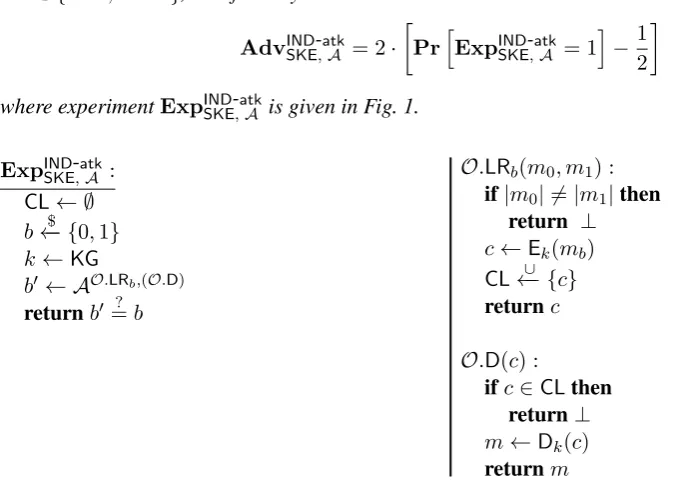
We now define multi-challenge, single-key, left-or-right indistinguishability for symmetric encryption. In this game, an adversary selects a sequence of pairs of equal-length messages1. A left-or-right en-cryption oracleO.LRb(·,·)encrypts one of the messages in each pair according to the bit b: we write this oracle with a subscript b to emphasize that it has the challenge bit hardwired. We also include non-triviality conditions on messages that the adversary provides toO.LR: we will often omit these conditions in the rest of the paper for clarity. Note that an adversary can of course sendm0=m1 to its
O.LRoracle to simulate an encryption oracleE: many authors make such an oracle explicit because in many scenarios a tight reduction is desired in terms of the number ofO.LRqueries the adversary makes. We do not require this distinction and so we only consider a singleO.LRoracle.
We define two variants of left-or-right indistinguishability: one for a chosen plaintext attack (IND-CPA), and one for a chosen ciphertext attack (IND-CCA2) where the adversary is allowed to decrypt any chosen ciphertexts (with the obvious exception of decrypting thechallenge ciphertextsthat have been output by O.LR).
Definition 1(IND-CPA andIND-CCA2 Security for Symmetric Encryption). LetSKE = (KG,E,D)
be a symmetric encryption scheme. Then theIND-atkadvantage for an adversaryAagainstSKE, for atk∈ {CPA,CCA2}, is defined by
AdvINDSKE-,atkA = 2·
Pr
h
ExpINDSKE-,atkA = 1
i
−1
2
where experimentExpINDSKE-,atkA is given in Fig. 1.
ExpINDSKE-,atkA :
CL← ∅
b←− {$ 0,1}
k←KG
b0 ← AO.LRb,(O.D)
returnb0 =? b
O.LRb(m0, m1) :
if|m0| 6=|m1|then
return ⊥
c←Ek(mb) CL←− {∪ c}
returnc
O.D(c) :
ifc∈CLthen return⊥
m←Dk(c)
returnm
Figure 1:The experiments definingIND-CPAandIND-CCA2security for symmetric encryption. ForIND-CPA, the adversary only has access to oracleO.LRb, while forIND-CCA2the adversary additionally has access to a
decryption oracleO.D.
2.2.2 Confidentiality for MLE-like Symmetric Encryption
One method of enabling data deduplication while allowing encryption is to enforce that users with the same file arrive at the same ciphertext. This was the idea behind the convergent encryption(CE) protocol of Douceur et al. [DAB+02], designed for enterprise backup storage. In this scenario, to encrypt file F the user computes k ← H(F) for some hash function H and encrypts F under k using some deterministic SKE scheme. This inherently enables perfect data deduplication, since there is only one possible ciphertext for each plaintext file.
1
In schemes where the encryption key depends solely on the plaintext2, it is not possible to achieve the standard notions of indistinguishability mentioned previously. To see this for CE: adversary chooses distinctm0, m1, computes the key and thus the ciphertext for each value, sends just a single query to
O.LRand compares. In Fig. 2 we detail thePRV-CDAsecurity notion of Bellare et al. [BKR13], which captures the intuition that such a scheme should provide confidentiality if the plaintext values are un-predicatble. The definition is parameterized by amessage sourceMS, an efficient algorithm that outputs two (equal-sized) vectors of messages from some message space along with some auxiliary information:
(m0,m1, Z) ← MS. In the challenge phase the challenger runsMS, then encrypts the output plaintext
messages and returns the resulting ciphertexts andZ to the adversary. Bellare et al. also considered a real-or-random version of this definition, denotedPRV$-CDA, where the source only outputs one mes-sage vector, and the adversary must distinguish an encryption of that from a vector of random strings, but we will not need this notion. Note that unlike the other definitions in this section, we do not include associated data. For ordinary encryption schemes we would use associated data to achieve integrity, but for MLE-like schemes a specific integrity mechanism is often provided by means of a tag, which for example could be the hash of the ciphertext.
Definition 2(PRV-CDASecurity for Symmetric Encryption). LetSKE = (KG,E,D)be a symmetric encryption scheme. Then thePRV-CDAadvantage for an adversaryAagainstSKEis defined by
AdvPRVSKE,-CDAMS,A= 2·
Pr
h
ExpPRVSKE,-CDAMS,A = 1
i
−1
2
where experimentExpPRVSKE,-CDAMS,Ais given in Fig. 2.
ExpPRVSKE,-CDAMS,A :
b←− {$ 0,1}
(m0,m1, Z)←MS
fori= 1, . . . ,|mb|do
k←KG(mb[i])
c[i]←Ek(mb[i])
b0 ← A(c, Z)
returnb0 =? b
Figure 2:The experiment definingPRV-CDAsecurity for symmetric encryption.
2.2.3 Authenticated Encryption with Associated Data (AEAD)
We define authenticated encryption (AE) that can handle associated data as a distinct primitive from SKE. A secure AE scheme will simultaneously provide confidentiality and integrity. The algorithms of AE= (KG,E,D)are specified as follows for completeness:
• KG: Key generation outputs a symmetric keyk, denotedk←KG.
• E: Encryption takes as input a messagem, some associated data AD and key k and outputs a ciphertextc, writtenc←Ek(m,AD).
• D: Decryption takes a ciphertextc, some associated dataADand keykand outputs either a message
mor error symbol⊥. We write thism/⊥ ←Dk(c,AD).
Correctness requires thatDk(c) = m for all messagesm, associated data AD, allc ← Ek(m) and all
k ← KG. Key generation is a randomized algorithm, the encryption algorithm may be randomized or stateful, and decryption is deterministic.
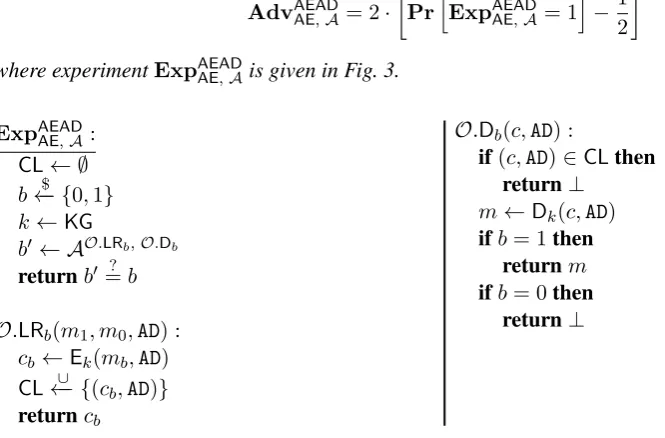
In many definitions of AEAD security, including the original formulation by Rogaway [Rog02], the encryption oracle either works correctly (in the real game) or returns a random string. We consider generic ciphertext spaces in the following definition, and follow e.g. Paterson et al. [PRS11,BPS15, JSSW17] in giving a left-or-right variant of the all-in-one notion of Rogaway and Shrimpton [RS06]. Any scheme secure under Rogaway and Shrimpton’s notion will be secure in the definition below for message spaceM={0,1}∗.
Definition 3. LetAE= (KG,E,D)be a symmetric encryption scheme with some message spaceMand ciphertext spaceC. Then theAEADadvantage for an adversaryAagainstAEis
AdvAEADAE,A= 2·
PrhExpAEADAE,A= 1i−1
2
where experimentExpAEADAE,Ais given in Fig. 3.
ExpAEADAE,A :
CL← ∅
b←− {$ 0,1}
k←KG
b0 ← AO.LRb,O.Db
returnb0 =? b
O.LRb(m1, m0,AD) :
cb ←Ek(mb,AD) CL←− {∪ (cb,AD)}
returncb
O.Db(c,AD) :
if(c,AD)∈CLthen return⊥
m←Dk(c,AD)
ifb= 1then returnm ifb= 0then
return⊥
Figure 3:The experiment definingAEADsecurity for symmetric encryption.
Note that the pair{(c,AD)}is added to the experiment’s forbidden listCLrather than justc, so the adversary is allowed to ask its decryption oracleO.Dfor some{(c,AD0)}ifAD6=AD0.
2.2.4 Integrity for Symmetric Encryption
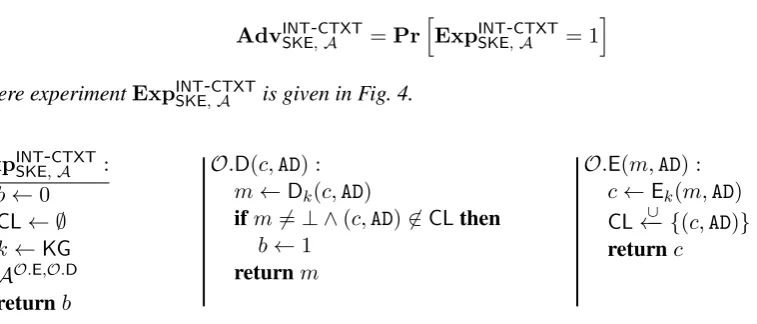
While AE schemes provide integrity by design, it is often useful to consider integrity for symmetric encryption in isolation. To this end we will define integrity in terms schemes that can handle associated data, but of course this input can be ignored to get notions for the setting in which AD is not used. There are three main notions of integrity for symmetric encryption: non-malleability,plaintext integrityand ciphertext integrity[BN00]. Non-malleability formalizes an adversary’s inability to transform a given ciphertext into a different ciphertext so that their corresponding plaintexts are “meaningfully related”. Plaintext integrity formalizes an adversary’s inability to create a new ciphertext decrypting to a message that the sender had never encrypted. Ciphertext integrity formalizes an adversary’s inability to create a ciphertext that decrypts correctly.
Ciphertext integrity implies plaintext integrity, but the two notions are not equivalent. The two in-tegrity notions are usually independent of non-malleability: non-malleability usually implies confiden-tiality, while the two integrity notions do not. Plaintext integrity is often the intuitively correct notion for an application, but usually ciphertext integrity is needed for proofs. This is why we only consider ciphertext integrity in this paper.
Definition 4. LetSKE= (KG,E,D)be a symmetric encryption scheme. Then theINT-CTXTadvantage for an adversaryAagainstSKEis
AdvINTSKE-,CTXTA =Pr
h
ExpINTSKE-,CTXTA = 1
i
where experimentExpINTSKE-,CTXTA is given in Fig. 4.
ExpINTSKE-,CTXTA :
b←0
CL← ∅
k←KG
AO.E,O.D
returnb
O.D(c,AD) : m←Dk(c,AD)
ifm6=⊥ ∧(c,AD)6∈CLthen
b←1
returnm
O.E(m,AD) : c←Ek(m,AD) CL←∪− {(c,AD)}
returnc
Figure 4:The experiment defining ciphertext integrity (INT-CTXT) for symmetric encryption.
Just like in theAEADexperiment, if{(c,AD)} ∈CLthen the adversary is allowed to ask its decryp-tion oracleO.Dfor some{(c,AD0)}ifAD06=AD.
3
Modelling Cloud Storage
Our goal is to study security of cloud storage in terms of confidentiality and integrity of files. Such anal-ysis is only possible if the model provides sufficient detail about adversarial capabilities. The challenge is to provide a sufficiently detailed model that allows analysis, yet is generic enough to facilitate study of natural schemes. It is desirable that the model can easily be extended to incorporate particular exotic design choices. We present here what is to our knowledge the first such model for (secure) outsourced storage that accommodates both widely-deployed (and conceptually straightforward) solutions as well as much of the literature (in particular schemes facilitating encrypted data deduplication). As for any storage scheme, a user of a cloud storage scheme should be able to store, retrieve and delete files. A user must be able to specify which previously stored files to retrieve or delete, and we shall achieve that by having the user choose a unique file handle (identifier) for each file when storing. Correctness can then be defined in the expected way, stated here for a notational introduction:
Definition 5(Correctness). If useruidpreviously storedFunder handleidthen when it later retrieves idthe result will beF, unless client has sentdel(id).
init
01.ST← ∅
newu(uid) 02.ukuid ←kgen
03.KTuid← ∅
04.returnukuid
del(uid,id)
05.KTuid
∪
←− {(⊥,id)}
06.if∃ {uid,·,id,0}inSTthen 07. ST←− {∪ (uid,−,id,1)}
upl(uid, c,id)
08.ST←− {∪ (uid, c,id,0)}
store(uid,F,id)
09.fk←fkeyGen(F,ukuid)
10. c←Efk(F,id)
11.upl(uid, c,id) 12.KTuid
∪
←− {(fk,id)}
retr(uid,id)
13.if∃(uid,·,id,1)∈ST or 14. ∃(⊥,id)∈KTuidthen
15. return⊥
16.if∃(uid, c,id,0)∈ST and 17. ∃(fk,id)∈KTuidthen
18. F←Dfk(c,id)
19. returnF
20.else
21. return⊥
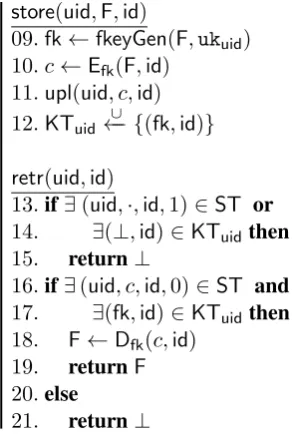
Figure 5:Definition of a cloud storage schemeCS.
3.1 A Model for Cloud Storage
Our model for cloud storage is depicted in Fig. 5. A cloud storage scheme CS[SKE,fkeyGen] = (init,newu,store,retr,del)is parameterized by a symmetric-key encryption schemeSKE= (KG,E,D)
and a file-key generation procedurefkeyGen, and supports natural functionalities:initfor initialization, newufor adding a new user,storefor storing a file,retrfor retrieval anddelfor deletion.
Each user is associated with a user identificationuid, and each file is identified by a storage handle id. We define per-user keysukand per-file keysfk. Each user has some (preferably small) local storage and the server maintains (what is from an abstract perspective at least) a vast data structure. Generation of per-user key material uk(line 02) may include keys for a number of different purposes. The user stores this material and their ownKT(‘Key Table’) locally and the server(s) maintains a databaseST (‘Store Table’) that it uses to track file ownership and retrieval handles. This means that there is only one STbut there could be manyKTs. Our model retains generality: to our knowledge it incorporates almost all intuitive schemes and all protocols from the literature (more details in next subsection). We make no assumption about how files are handled in terms of segmentation, nor do we consider redundancy at the server’s backend. The model that follows is, by design, modular and generic enough to cope with straightforward modifications to incorporate such processes.
We now discuss the design choices that require further attention. In line02 we explicitly regard the per-user key generation procedure as occurring separately from the other procedures, this is to retain generality and to allow us to focus on file-key generation. ST tracks deletion status of each file for each user (lines 13-15), using a bit as the fourth value in each entry. In deployed systems this abstract procedure may not be done as directly as we describe. Line07 indicates that the server may at this point delete the ciphertext for the deleted file, however we do not enforce this: the ‘1’ flag indicates deletion has occurred3for useruid and handle id. Encryption algorithm Etakes id as input (line 10): if SKE is an AEAD scheme thenidcould be the associated data – we model this construction in Theorem 2. Lines 16-19 specify that the file can only be retrieved if it has not been removed either by the client or the server: in particular line 17 says that if there exists anfksuch that(fk,id)∈KTuidthen the retrieve
is allowed to continue.
We differentiate between store– the entire process of storing a file on the server and updating the client’s local storage – andupl– the specific action that occurs server-side. The definition generalizes 3
Scheme fkeyGen(F,uk)
1 No encryption fk← ⊥
2 Per-user key fk←uk
3 Per-file key fk←KG
4 MLE [BKR13] fk←H(F)
5 Liu et al. [LAP15a] fk←PAKE.Out(F)
6 DupLESS [KBR13] fk←OPRF.Out(F)
7 Duan [Dua14] fk←DOKG(F)
8 Stanek et al. [SSAK14] fk←Thr.PKE.KG(F)
9 CDStore [LQLL16] fk←SS(H(F))
Figure 6:Specification forfkeyGenprocedure for existing cloud storage schemes
to include the simplest and most widely-deployed solution, which is without any client-side encryption at all. Any scheme that distributes files among multiple servers is also included, incurring a rather complicated outsourced stateST, however the results in the remainder of this paper will mainly focus on the single server case. To satisfy correctness we require an implicit assumption that the CSP forwards all requests honestly: this approach reflects cryptographic models for key exchange. Iffkused forstore (encryption) is not the same as the one used forretr (decryption) then no scheme can be correct. The adversaries that we consider cannot modifyKTso key symmetry is implicit in our model and for the rest of the paper.
3.2 Modelling Existing Schemes and Literature
In Fig. 6 we detail the file-key generation procedure for natural constructions and a number of schemes from the existing literature. The natural scenarios include a CSP that does not support client-side en-cryption (line 1), a CSP wherein each user holds a per-user key and encrypts all files with that key (line 2), and a CSP wherein a per-file key is randomly chosen at the point of the file being uploaded (line 3). The per-user key scenario (line 2) allows deduplication of a particular user’s files (but not cross-user deduplication) which can still allow great savings, particularly in the backup setting. This case also re-flects some enterprise scenarios in which an organization has a storage gateway (that may interact with trusted hardware, such as a hardware security module) that deduplicates files and encrypts (under one key) on behalf of all of its employees before sending to some public cloud (CSP). The per-file key sce-nario (line 3) intuitively provides increased confidentiality, but introduces challenging key management. A gateway can also be used in this case as described in the Omnicloud architecture [KW14]: this of course requires the gateway to additionally manage the vast number of keys that could be generated in the enterprise scenario.
Schemes in lines 4-9 all aim to provide ‘secure cross-user deduplication’ to some extent, providing more confidentiality than using no encryption (line 1) but at the risk of opening a side channel that may allow a user to learn if a file is already stored on the server [HPS10,ABD+17]. In many schemes such as those of Keelveedhi et al. (DupLESS) [KBR13] and Liu et al. [LAP15a], thefkeyGenprocedure is not a single algorithm but a protocol run between the user and the key server or the other users in the protocol, respectively. Stanek et al. [SSAK14] use both convergent encryption and an outer layer threshold encryption scheme to produce ciphertexts, and thefkeyGenprotocol interacts with two trusted third parties. The protocol of Duan [Dua14] attempts to avoid the single point of failure inherent in having a single (semi-trusted) key server (KS) in DupLESS-like schemes:fkeyGengenerates encryption keys using a distributed oblivious key generation (DOKG), instantiated using a (deterministic) threshold signature scheme. The CDStore protocol of Li et al. [LQLL16] distributes shares of a file to multiple cloud servers using so-calledconvergent dispersal.
using SKE – for these schemesErepresents some other encryption mechanism. In the schemes that do precisely fit our model, generation of file keyfkcould happen as part of the key generation procedure kgen: for example in the per-user key case (line 2 of Fig. 6)fkeyGenis the identity function. This is one of many potential modular extensions of our framework: we could of course consider a model in which (for example) thefkeyGenandEalgorithms are general functions with arbitrary inputs.
Cloudedup [PMÖL13] uses block-level convergent encryption to send ciphertexts to a third party that adds further (symmetric) encryption and manages metadata. Dang and Chang [DC17] similarly assume some trusted entity, in their case hardware. A trusted enclave uses an oblivious PRF (similarly to the key server in DupLESS) to get block-derived keys to allow the enclave to perform deduplication: the enclave acts as a deduplication gateway then applies randomized encryption before sending the ciphertexts to the CSP. In these schemes encryption is essentially done in two phases and the per-block keys are managed by the third party; this does not quite fit our model but it is straightforward to modify howKT(andSKE) works to analyze such schemes. Recently Shin et al. [SKYH17] presented a scheme that attempts to distribute the role of the key server in DupLESS-like schemes by additionally using inter-KS deduplication. Again it is straightforward to extend our model to allow this type of scheme.
To simplify much of our analysis later on we require that every time a new file is stored by a client, a newidis generated. This leads to the following assumption:
Assumption 1. In all cloud storage schemesCSconsidered in this paper,storeis never called on the sameidtwice.
We emphasize thatidis the retrieval handle chosen by the client, and is distinct from the deduplication ‘tags’ used in prior literature. This assumption (and the existence of theid) emphasizes that our handles are there to distinguish file uploads from one another: each{uid,id}pair can only ever occur once.
4
Confidentiality
Now that we have defined a suitable syntax for cloud storage schemes, we can begin to consider the many ways in which security features can be obtained. In this section we turn our attention to confidentiality of files with respect to realistic adversaries. Defining confidentiality notions of security is a two-step process: We first define what we want to prevent the adversary from learning (thegoal), and then we specify the adversary’s capabilities.
There are several possible goals. The classical cryptographic goal is indistinguishability, where one of two adversary-chosen files was stored and the adversary is unable to decide which file was stored. This is similar to semantic security, where a file sampled from one of two adversary-chosen probability spaces was stored, and the adversary is unable to decide which distribution the file was sampled from. A weaker notion is to sample a file from one of two pre-chosen high-entropy probability spaces. The adversary has two distinct capabilities when attacking a cloud storage system. The first is the ability to influence the actions of the honest users. The second is the ability to influence the CSP.
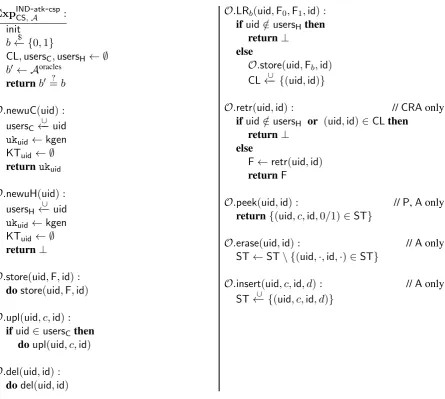
When considering corruption of users, it is important to note that an adversary can usually create genuine logins to a system, and thus receive a validuidanduk for an arbitrary number of users. We model this by distinguishing between two types of newu query: O.newuC creates a valid (Corrupt) user and outputs itsukto the adversary, andO.newuHthat only creates a valid (Honest) user4. For its corrupted users the adversary may not necessarily useukandfkeyGencorrectly (whichO.storecannot handle): we model this capability by giving the adversary access to anO.uploracle that pushes some {(uid, c,id,0)}tuple to the server’s storage tableST. We regard the minimum adversarial capability as being able to have full control over a number of corrupted users and to make honest users store files, we refer to this notion as achosen store attack(CSA). The adversary may even be able to get honest users to retrieve files from the cloud storage system, a chosen retrieve attack5(CRA). Analogously to
4
encryption,CSAandCRAsomewhat correspond toCPAandCCA, respectively.6
The adversary’s control of the CSP can be usefully divided into three levels: the adversary may have no influence at all on the CSP then we have an honest CSP giving the adversaryzero access(Z). The adversary may also be able to look at the CSP’s storage and key material, but not tamper with anything, apassively corrupt(P) CSP. This models both honest-but-curious CSPs and snapshot hackers (of the cloud’s storage servers or the communication channel). And finally, the adversary may have full control over the CSP, an actively corrupt (A) adversary. When the CSP is honest, it may seem that our model always guarantees confidentiality because the adversary would never have access to ciphertexts. However, this is not the case, since the file key generation procedure is regarded as a protocol and may leak information (as mentioned earlier with the protocol of Liu et al. [LAP15a]). Roughly speaking, we can say that when the CSP is honest, we consider only the security of the file key generation protocol. When the CSP is passively corrupt, we must additionally consider the confidentiality of the encryption used. When the CSP is actively corrupt, we must also consider the integrity of the encryption mechanism. This separation of concerns is by design.
4.1 Defining Confidentiality for Cloud Storage
In combination we define a genericIND-atk-cspexperiment with six distinct cases:atk∈ {CSA,CRA}, csp∈ {Z,P,A}and thisIND-atk-cspexperiment is detailed in Fig. 7. Just as in our general definition for storage protocols (Fig. 5) we keep track of the retrieval capability by using a tableST, initially set to empty. The security experiment keeps track of theO.LRqueries using a forbidden listCLto prevent trivial wins.
In order to model the attacker’s influence on the CSP, we introduce three new oracles: O.peek, O.erase and O.insert. These are not functionalities of storage systems so they are not included in Fig. 5. O.peekallows the adversary to see the ciphertext (and deletion status) for some user uidand some storage handleid, and this is available to an adversary that is passively corrupt (P). O.insertand O.erasemodel actively malicious (or completely compromised) CSPs, granting the adversary the ability to store or delete arbitrary items in the CSP’s database: these two oracles are only available to an actively corrupt (A) attacker.
Definition 6 (IND-atk-csp Security for Cloud Storage). Let CS = (init,newu,store,retr,del) be a cloud storage scheme. Then theIND-atk-cspadvantage for an adversaryAandatk ∈ {CSA,CRA}, csp∈ {Z,P,A}againstCSis defined by
AdvINDCS,-Aatk-csp= 2·
PrhExpINDCS,-Aatk-csp = 1i−1
2
where experimentExpINDCS,-Aatk-cspis given in Fig. 7.
On Our Model. Our weakest notion of server compromise,IND-atk-Z, refers to a very limited ad-versary, with no access to the server’s database and only capable of making ‘challenge’ storequeries (modelled byO.LRb) with users that it does not have the key material for, resulting in ciphertexts that it cannot access. Thus, even a scheme with no encryption can be secure under this notion. This is by design: the only schemes that do not meet this minimum requirement are those that leak information about the fileto other usersduring thestoreprocedure.
It is possible to imagine adversaries that may wish to act without being noticed by the users they have infiltrated. ThisCRAadversary would thus retrieve but not store or delete – and yet seems to be more ‘limited’ than aCSAadversary that does perform store/delete operations and does not mind if the user notices its behavior. This is the nature of adversaries in cloud storage: the clear hierarchy that exists for encryption does not easily translate.
6
ExpINDCS,-Aatk-csp :
init
b←− {$ 0,1}
CL,usersC,usersH ← ∅
b0 ← Aoracles
returnb0 =? b
O.newuC(uid) :
usersC
∪ ←−uid
ukuid ←kgen
KTuid ← ∅
returnukuid
O.newuH(uid) :
usersH
∪ ←−uid
ukuid ←kgen
KTuid ← ∅
return⊥
O.store(uid,F,id) : dostore(uid,F,id)
O.upl(uid, c,id) : ifuid∈usersCthen
doupl(uid, c,id)
O.del(uid,id) : dodel(uid,id)
O.LRb(uid,F0,F1,id) :
ifuid∈/usersHthen
return⊥
else
O.store(uid,Fb,id) CL←− {∪ (uid,id)}
O.retr(uid,id) : //CRAonly
ifuid∈/usersH or (uid,id)∈CLthen
return⊥
else
F←retr(uid,id) returnF
O.peek(uid,id) : //P,Aonly
return{(uid, c,id,0/1)∈ST}
O.erase(uid,id) : //Aonly ST←ST\ {(uid,·,id,·)∈ST}
O.insert(uid, c,id, d) : //Aonly ST←− {∪ (uid, c,id, d)}
Figure 7: The experiment defining IND-atk-csp security for cloud storage, for atk ∈ {CSA,CRA}, csp ∈ {Z,P,A}. All adversaries have access to the oracles on the left-hand side andO.LRb. CRAadditionally has
access toO.retr,Padditionally has theO.peekoracle and finallyAadditionally has theO.eraseandO.insert
oracles.
The concept of length equality for files in cloud storage is not as clear cut as it is for bitstrings in an IND-based game for encryption. If the encryption scheme is not length hiding and the adversary submits oneO.LRquery and oneO.peekquery: if the ciphertext lengths differ then the adversary trivially wins the game. As mentioned earlier, this means that an inherent restriction exists onO.LR queries: if the length of (the segmentation of)F0andF1 differs then the experiment does not go ahead with thestore
procedure7.
Relations Between Notions. While we have just defined six adversarial capabilities, in fact only three are distinct. Fig. 8 summarizes how the notions relate to each other, and we detail these relations fully in Appendix A. We give a brief intuition here. If notion A has strictly more oracles than notion B then any CS secure under A will also be secure under notion B. This means that IND-atk-A ⇒ IND-atk-P ⇒ IND-atk-Zforatk ∈ {CSA,CRA}, and alsoIND-CRA-csp ⇒ IND-CSA-cspforcsp ∈ {Z,P,A}. This leaves three equivalences and two separation results. IND-CSA-ZandIND-CRA-Zare
7
equivalent since it is always possible to simulate the O.uplqueries of anIND-CRA-Zadversary: this adversary can only useO.storeto place items inSTthat it can later retrieve (sinceO.LRandO.uplare forbidden), and by correctness this means a simulator can just keep track of these queries in a table. A similar approach can be used to show thatIND-CSA-P andIND-CRA-Pare equivalent. To show that IND-CSA-PandIND-CSA-Aare equivalent, the simulator needs to successfully simulateO.insertand O.erasequeries. This is indeed possible: the simulator keeps track of such queries in a table. As we have mentioned, theCSbuilt using no encryption isIND-atk-Z. It is however notIND-CSA-P: the adversary simply performs oneO.LRquery with distinct files and then queriesO.peekon that entry. We give the final separation result after Theorem 1. We will henceforth refer to these three distinct notions using IND-atk-Z,IND-CSA-PandIND-CRA-A.
IND-CSA-Z IND-CRA-Z
⇐ ;
IND-CSA-P IND-CRA-P IND-CSA-A
⇐
; IND-CRA-A
Figure 8:Relations betweenINDnotions for confidentiality of cloud storage systems.
4.2 Achieving Confidentiality in Cloud Storage
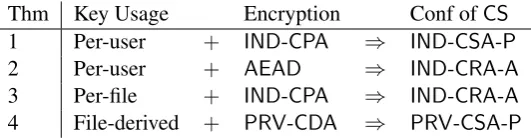
We now show four straightforward reductions, showing that the intuitive protocols that we expect to meet all security goals – strong encryption with random file identifiers – do in fact provide confidentiality. In Theorem 1 we show that if users encrypt using anIND-CPA-secure encryption scheme using their own key then the overall system isIND-CSA-Psecure (and thus also secure in the sense ofIND-CRA-Pand IND-CSA-A). By this we mean that the key generation procedure forCSoutputs a random key to each user (or in other words thatkgenruns the SKE’sKGalgorithm) andfkeyGen(F,uk)just outputsukfor all F. In Theorem 2 we show that this same construction, when implemented with an AEAD scheme, yields anIND-CRA-A-secure cloud storage system, our strongest notion. These theorems provide justification for the choices made in defining our adversarial capabilities. Theorem 3 considers the scenario in which a random symmetric key is created for each file, and perhaps surprisingly this construction meets the strongest IND-CRA-A notion of security even withIND-CPA-secure encryption. Finally Theorem 4 considers the secure deduplication setting with a reduction to PRV-CDA security of the underlying encryption: for this we need a modified security experiment (Fig. 13). For the results here and in the next section, if we are describing key usage for a specific symmetric-key encryption scheme (i.e. for a definedfkeyGen) then we use a subscriptSKEi, and for generic results (i.e. result holds for any scheme) we omit the suffix and useSKE. We summarize the results from this section in Fig. 9.
Thm Key Usage Encryption Conf ofCS
1 Per-user + IND-CPA ⇒ IND-CSA-P
2 Per-user + AEAD ⇒ IND-CRA-A
3 Per-file + IND-CPA ⇒ IND-CRA-A
4 File-derived + PRV-CDA ⇒ PRV-CSA-P
Figure 9:Summary of the results in this section.
4.2.1 Per-User Keys
Theorem 1. LetCS = (init,newu,store,retr,del) be a cloud storage protocol that uses a symmetric key encryption schemeSKE1 = (KG,E,D)as in Fig. 5, with per-user keys and at mostnhonest users.
For any adversaryA1againstIND-CSA-Pthere exists an adversaryB1such that
AdvINDCS,-ACSA1 -P≤n·Adv
Proof. We definen+ 1hybrid games G0,G1, . . . ,Gn corresponding to each of the honest users. The games all work likeExpINDCS,-ACSA-P, except in the behaviour of theirO.LRb andO.storeoracles. Since the reduction does not know useri’s per-user keyuk, it needs to call its ownOSKE.LRboracle when the adversary callsO.LRb orO.store. In the ith game, the O.LRb oracle will always useF1 for the firsti
users, and always useF0for the remaining users. InG0, theO.LRboracle will always behave as ifb= 0, while inGnit will always behave as ifb= 1. DefinePi=Pr[b0= 0inGi]. We get that
AdvINDCS,-ACSA1 -P =|P0−Pn| ≤ n
X
i=1
|Pi−1−Pi|.
In other words, we have a bound on the adversary’s advantage in terms of the difference of behaviour of consecutive games. We must now bound this difference.
B1,iplayingExpINDSKE-1CPA:
ST← ∅
b0 ← Aoracles
1
returnb0
O.store0(uid,F,id) : ifuid=uidithen
c← OSKE.LR(F,F) else
c←Eukuid(F)
ST←− {∪ (uid, c,id,0)} KTuid
∪
←− {(ukuid,id)}
O.LR0b(uid,F0,F1,id) :
ifuid∈/usersHthen
return⊥
ifuid=uidj, j < ithen
dostore(uid,F1,id)
else ifuid=uidj, j > ithen
dostore(uid,F0,id)
else
c← OSKE.LR(F0,F1)
ST←− {∪ (uid, c,id,0)} KTuid
∪
←− {(ukuid,id)}
Figure 10: ReductionB1,ifor proof of Theorem 1, where adversaryA1, playingExpCSIND,-ACSA1 -Phas access to
oracles = {O.newuC, O.newuH, O.store0, O.upl, O.del,O.LR0b, O.peek}. For queries to the non-specified oracles, the reduction performs the required operations exactly as defined in Fig. 7.
We use the reductionB1,iagainstIND-CPAdefined in Fig. 10. Our reduction simulates a left-right oracle forA1by always usingF1for the firsti−1users, always usingF0 for the lastn−i−1users
and using its own left-right oracle to encryptF0 orF1for theith user. By inspection, if the reduction’s
left-right oracle always encryptsF0, the execution proceeds exactly as inGi−1. If the left-right oracle
always encryptsF1, the execution proceeds exactly as inGi. It follows that
|Pi−1−Pi|=AdvINDSKE-1CPA,B1,i.
We have therefore constructedn+ 1IND-CPAadversaries. LettingB1be one of these adversaries
with maximal advantage, the claim follows.
Remark 1. The scheme described for this theorem is notIND-CRA-Asecure, even ifSKE1isIND-CCA2
secure. This is due to acut-and-pasteattack: an adversary can manipulateSTin such a way that it can callO.retron something it had previously added via anO.LRquery. See Appendix A for full details of this attack.
We now show that if the underlying SKE scheme is secure in the sense of AEAD, then a construction using this scheme withidas the associated data yields anIND-CRA-Acloud storage protocolCS.
Theorem 2. LetCS = (init,newu,store,retr,del) be a cloud storage protocol that uses a symmetric key encryption schemeAE2 = (KG,E,D)as in Fig. 5, with per-user keys (withAD =id) and at mostn
honest users. For any adversaryA2 againstIND-CRA-Athere exists an adversaryB2 such that
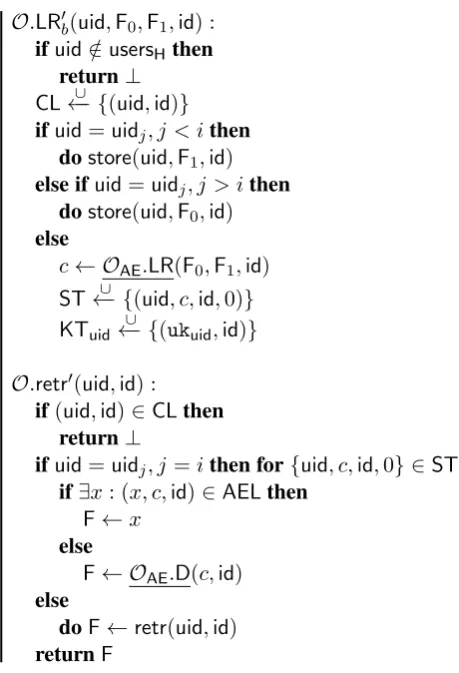
Proof. The proof follows the same approach as that of Theorem 1 except we now need to deal with the adversary’sO.retr,O.eraseandO.insertqueries. The latter two are straightforward: the reduction simply performs the actions according to Fig. 7. Whenever A2 makes an O.store call for uidi the reductionB2 must call its own O.LRon the same two values: this adds the resulting ciphertext to its forbidden list. To deal with this,B2needs to keep track of the(F,id, c)tuples that it would be disallowed from decrypting in the event of anO.retrquery byA2, it does this using the listAEL. The reduction is
detailed in Fig. 11.
B2,iplayingExpAEADAE
2 : ST,CL,AEL← ∅
b0 ← Aoracles
2
returnb0
O.store0(uid,F,id) : ifuid=uidithen
c← OAE.LR(F,F,id)
AEL←∪− {(F, c,id)}
else
c←Eukuid(F,id)
ST←− {∪ (uid, c,id,0)} KTuid
∪
←− {(ukuid,id)}
O.LR0b(uid,F0,F1,id) :
ifuid∈/usersHthen
return⊥ CL←− {∪ (uid,id)}
ifuid=uidj, j < ithen
dostore(uid,F1,id)
else ifuid=uidj, j > ithen
dostore(uid,F0,id)
else
c← OAE.LR(F0,F1,id)
ST←− {∪ (uid, c,id,0)} KTuid
∪
←− {(ukuid,id)}
O.retr0(uid,id) :
if(uid,id)∈CLthen return⊥
ifuid=uidj, j =ithen for{uid, c,id,0} ∈ST
if∃x: (x, c,id)∈AELthen
F←x else
F← OAE.D(c,id)
else
doF←retr(uid,id) returnF
Figure 11: ReductionB2,i for proof of Theorem 2, where adversary A2, playingExpCSIND,-ACRA2 -A has access
to oracles ={O.newuC,O.newuH,O.store0,O.upl,O.del,O.LRb,O.retr0,O.peek,O.erase,O.insert}. For
queries to the non-specified oracles, the reduction performs the required operations exactly as defined in Fig. 7.
4.2.2 Per-File Keys
When the file encryption keys are generated randomly for each file (fkeyGen ignores uk and selects uniformly at random from the keyspace usingKG), the adversary still has the ability to upload related files, which may help in distinguishing target files. Therefore we need to apply a reduction similar to that for proving multi-user security of encryption, for example using techniques similar to those of Bellare, Boldyreva and Micali [BBM00]. Here, however, the loss in the reduction is the number of adversarial calls to itsO.LR oracle, rather than the number of users. Perhaps surprisingly, even with anIND-CPA-secure encryption scheme, we get our strongest notion of security for the resulting cloud storage protocol.
B3,iplayingExpINDSKE-3CPA: ST← ∅
b0 ← Aoracles
3
returnb0
O.LR0b(uid,F0,F1,id) :
ifuid∈/usersHthen
return⊥
if#of queries< ithen dostore(uid,F1,id)
else if#of queries> ithen dostore(uid,F0,id)
else
c← OSKE.LR(F0,F1,id)
ST←− {∪ (uid, c,id,0)} KTuid
∪
←− {(ukuid,id)}
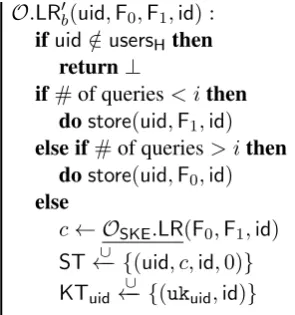
Figure 12: ReductionB3,ifor proof of Theorem 3 where adversaryA3, playingExpCSIND,-ACRA3 -A has access to
oracles={O.newuC,O.newuH,O.store,O.upl,O.del,O.LRb,O.retr,O.peek,O.erase,O.insert}. For queries
to the non-specified oracles, the reduction performs the required operations exactly as defined in Fig. 7.
IND-CRA-Athere exists an adversaryB3such that
AdvINDCS,-ACRA3 -A≤f·Adv
IND-CPA SKE3,B3
wheref is a bound on the number of calls to theO.LRb oracle by the adversary.
Proof. We definef+ 1hybrid games. The games all work likeExpINDCS,-ACRA-A, except in the behaviour of theirO.LRb oracle. In theith game, the oracle will always use F1 for the firstiqueries, and always
useF0 for the remaining queries. InG0, theO.LRboracle will always behave as ifb= 0, while inGf it will always behave as ifb= 1.
The proof now proceeds exactly as the proof of Theorem 1, using the reduction B3,ias defined in Fig. 12. In particular, since a random key is chosen forO.storeandO.LRb queries, the reduction can simulate all encryptions except those it needs to send to its ownO.LRb oracle. These values are added toCL so cannot be acquired via an O.retr query, so the reduction can adequately simulate all oracle queries. The claim follows.
Remark 2. Note that the reduction used in the proof of Theorem 3 never uses itsOSKE.Eoracle, and uses itsOSKE.LR oracle exactly once. This means that we could in principle use a one-time secure
symmetric cryptosystem, and still get security.
4.2.3 Deduplicating Systems using File-Derived Keys
A natural way for using SKE in deduplicating systems is to derive encryption keys from the files them-selves [DAB+02,BKR13]. Cloud storage schemes with this property cannot achieve the usual indistin-guishability notion because the adversary knows the possible files and therefore the possible encryption keys used.
For encryption schemes that derive encryption keys from the file itself (as defined in Section 2.2.2), the PRV-CDA notion of security asks an adversary to distinguish ciphertexts when files are sampled from some pre-chosen high-entropy probability space and then encrypted. The probability space must be independent of the encryption scheme to avoid pathological situations, hence pre-chosen. This security notion can be achieved by both deterministic [BKR13] and randomised schemes [BKR13,ABM+13].
Definition 7 (PRV-atk-csp Security for Cloud Storage). Let CS = (init,newu,store,retr,del) be a cloud storage scheme. Then thePRV-atk-cspadvantage for an adversaryA, message sourceMSand atk∈ {CSA,CRA},csp∈ {Z,P,A}againstCSis defined by
AdvPRVCS,MS-atk,A-csp= 2·
PrhExpCSPRV,MS-atk,A-csp= 1i−1
2
where experimentExpPRVCS,MS-atk,A-cspis given in Fig. 13.
Recall that due to Assumption 1, just as for the IND notions the adversary cannot callO.LRb or O.storewith any(uid,id)pair that it has called before. The relations betweenINDnotions from Fig. 8 and Appendix A follow through to thePRVsetting.
Theorem 4. LetCS= (init,newu,store,retr,del)be a cloud storage protocol that uses a symmetric key encryption schemeSKE= (KG,E,D)as in Fig. 5, with file-derived keys. For an adversaryA4 against
PRV-CSA-Pand message sourceMSthere exists an adversaryB4such that
AdvPRVCS,MS-CSA,A4-P ≤Adv
PRV-CDA SKE,MS,B4.
Proof. In the PRV-CDA experiment, parameterized by message source MS, the adversary receives a vector of encryptions of messages chosen from one of the source’s output vectors. In the syntax for the PRV-CDAgame (Fig. 2) the adversary is given the ciphertext vector resulting from encrypting one of the message vectors output byMS. This means that whenB4(playingPRV-CDA) runsA4andA4makes
itsO.LRquery,B4’s simulation of theO.storeoracle must store the ciphertexts it received from its own
challenger (under the user identities and handles provided byA4).
4.3 Deduplicating Schemes with non-trivialfkeyGenProcedures
The results so far in this section have only considered schemes for whichfkeyGenis an operation that can be run locally, without the need for communicating with other users, the server or third parties (i.e. lines 1-4 of Fig. 6)8. While our model (Fig. 5) can handle deduplicating schemes with complex fkeyGen protocols such as that of Liu et al. [LAP15a], Duan [Dua14] and Keelveedhi et al. (DupLESS) [KBR13], our security definitions do not fully capture them due to the ‘unnatural’ inputs to fkeyGenwhen it is ‘called’ bystore. In order to consider the confidentiality of such schemes within our model it is necessary to incorporate a simple extension: anO.fkeyGenoracle that the adversary can call on arbitrary inputs.
Our model is also easily extensible to the distributed storage context: the O.peek oracle, instead of returning the tuple{(uid, c,id,0/1)}, could take as input some indices that correspond to different
8
The threshold scheme of Stanek et al. [SSAK14] is a special case sincefkeyGenis run locally but the encryption algorithm is not a symmetric encryption scheme.
ExpPRVCS,MS-atk,A-csp:
init
flag←0
CL,usersC,usersH ← ∅
b←− {$ 0,1}
b0 ← Aoracles
returnb0 =? b
O.LRb(uid,id):
ifflag= 1 or∃uid∈uid:uid∈/ usersHthen
return⊥
(m0,m1, Z)←MS
fori= 1, . . . ,|mb|do store(uid[i],mb[i],id[i]) CL←− {∪ (uid[i],id[i])}
flag←1
B4playingExpPRVSKE,-MSCDA,B4 :
receive(c, Z)
ST← ∅
flag←0 b0 ← AO.LRb
4
returnb0
O.LRb(uid,id):
ifflag= 1then return⊥
else
fori= 1, . . . ,|c|do
ST←∪− {(uid[i],c[i],id[i]),0}
flag←1
Figure 14: ReductionB4for proof of Theorem 4. TheO.newuC,O.newuH,O.store,O.upl,O.delandO.peek
oracles are not listed, but are as defined in Fig. 7.
servers and return the information stored on that subset of the servers, if any, underuidandid. This would enable a rigorous analysis of schemes such as CDStore [LQLL16].
It is straightforward to create a variant of our genericINDexperiment for deterministic encryption: the adversary is not allowed to send the same file to O.LR or O.store. In particular, the experiment initializes an empty list, and on eachFor(F0,F1)query tostore, resp.O.LR, that value is added to the
list. If the adversary later attempts to performO.storeorO.LRwith a file already on that list, return⊥. Certainly any scheme that isIND-atk-cspis alsoD-IND-atk-cspfor some{atk,csp}, and furthermore D-IND-atk-csp⇒PRV-atk-csp.
Since Duan [Dua14] showed that the DupLESS system achieves D-IND$ (in the random oracle model), we would expect that DupLESS would meet strong security in our model. However if we assume that the adversary has a fkeyGen oracle as described above, DupLESS does not even meet D-IND-CSA-P. The attack is straightforward: The adversary calls its fkeyGen oracle on F0 to get
fkF0; then again for some distinct F1 to get fkF1; calls O.LRb(F0,F1) for some (uid, id) and does O.peek(uid,id) to receive the c thatFb is stored under. All that is left to do is to attempt to decrypt
c using the two keys it got fromfkeyGenearlier to get Fb, then output b. This indicates how weak a D-IND$notion is: in a realistic attack setting, it is trivial for an adversary that has (even only snapshot) access to the cloud’s storage to be able to distinguish ciphertexts.
5
Integrity
Once a user of a cloud storage system has decided to use encryption to ensure confidentiality of files, the user will also wish that integrity is retained for the ciphertexts sent to the CSP. One approach to this requirement is to use proofs of retrievability (PoR) [JJ07,SW13], where users embed some data in their files (ciphertexts) and periodically engage in some protocol with the CSP to check that the files have not been deleted or modified. We consider the simpler problem of ensuring that retrieved files are correct. Our approach is inspired by the ciphertext integrity notions from the cryptography literature. As before, we focus on generic results rather than concrete instantiations.
We formally define a notion of integrity of ciphertexts for cloud storage schemes, denotedINT-SC (INTegrity of Stored Ciphertexts). The experiment is given in Fig. 15. An adversary, in control of a number of users of the cloud storage schemeCS, wins the game by making a user retrieve a file that either the user hadpreviously deleted, or that the userdid not store in the first place. This of course rules out schemes for which a file hash is all that is required to indicate ownership of that file (Dropbox pre-2011 [MSL+11,DMM+12,vdL], content distribution networks, etc.): we will discuss later the meaning of ciphertext integrity in these deduplicating systems.
5.1 Defining Integrity for Cloud Storage
We use a second storage tableTrueSTto track all activities that the adversary makes the (notional) usersdo: store,retranddel. The otherSTtracks all of these activities in addition to the oracles mod-elling active server compromise: O.eraseandO.insert. In Section 5.2 we focus on actively corrupted servers manipulating the storage database: the adversary will always have access toO.peek, O.erase andO.insertand this corresponds toINT-SC-A. We will later consider integrity in client-side dedupli-cating systems: a scenario where an adversarial client (INT-SC-Z) is (inherently) given more power by the mechanism that saves communication bandwidth.
Note that in the description of O.retr0, the codeif{(uid,·,id,·)∈ST} 6= {(uid,·,id,·)∈TrueST} means that for fixeduidandid, if there exists an entry inSTand an entry inTrueSTsuch that the tuples are not exactly equal then this condition is met. This means that the ciphertext component or the deletion bit (or both) being different means that this condition is achieved.
Definition 8(INT-SC-cspfor Cloud Storage). LetCSbe a cloud storage system based on a symmetric cryptosystem as in Fig. 5, and letAbe an adversary. Then theINT-SC-cspadvantage for an adversary Aandcsp∈ {Z,P,A}againstCSis defined by
AdvINTCS,-ASC-csp=PrhExpINTCS,-ASC-csp= 1i,
where experimentsExpINTCS,-ASC-cspare defined in Fig. 15.
ExpINTCS,-ASC-csp:
b←0
ST← ∅ TrueST← ∅ Aoracles
returnb
O.del0(uid,id) : dodel(uid,id)
if(uid,·,id,0)∈TrueSTthen
TrueST←−∪ (uid,·,id,1)
O.store0(uid,F,id) : dostore(uid,F,id)
TrueST←− {∪ (uid, c,id,0)}, where
(uid, c,id,0)∈ST
O.retr0(uid,id) : doF←retr(uid,id)
if{(uid,·,id,·)∈ST} 6={(uid,·,id,·)∈TrueST}
andF6=⊥
thenb←1 returnF
Figure 15: The experiment definingINT-SC-cspfor cloud storage. The adversary has access to O.newuC, O.newuH,O.store0,O.upl,O.del0andO.retr0. Ifcsp=Pthen the adversary additionally has access toO.peek, and ifcsp = Athen the adversary additionally has access to O.erase andO.insert. The oracles that are not explicitly stated are as defined in Fig. 7.
Our definition of delin Fig. 5 firstly removes theKTentry and then updatesST if an applicable entry exists. This formulation makes it extremely difficult for an adversary to win theINT-SC-cspgame by retrieving a file it previously deleted since it has no ability to editKTentries. Ifdelwould only delete theKTentry after checking existence of aSTentry then this would give the adversary a trivial way to de-synchronizeTrueSTandST. We acknowledge that this technical issue is awkward but believe that this exposition gives the clearest possible definition of ciphertext integrity for cloud storage systems as we have defined them.
5.2 Achieving Integrity in Cloud Storage
We now show how to construct a cloud storage protocol that meets our strongestINT-SC-Anotion. The construction is straightforward: each user holds their own symmetric key and uses an encryption scheme that isINT-CTXTsecure during thestoreprocedure (line 2 from Fig. 6). For this we require the syntax for an encryption scheme that can handle associated data (see Section 2.2.4). Just as in Thm. 2 the
Theorem 5. LetCSbe a cloud storage system that uses a symmetric cryptosystemSKE5with per-user
keys, with at mostnusers, withAD=id, and letA5be an adversary against ciphertext integrity forCS. Then there exists an adversaryB5against ciphertext integrity forSKEsuch that
AdvINTCS,-ASC5-A ≤n·Adv
INT-CTXT SKE5,B5 .
Proof. Since each user’s key material is independent of every other user’s key material, it is sufficient to prove the result for a single user, since a standard hybrid argument will complete the argument, also incurring a factor n. So consider an adversary A5 in the experimentExpINTCS,A-SC-A with a single user. Based on this, we can construct an adversaryB5 against INT-CTXTby replacing the encryption and
decryption inO.storeandO.retr by calls to the encryption and decryption oracles in the INT-CTXT game. Suppose b is set to1 in the retrieve oracle. Since deletions are recorded in KTand therefore are correctly handled, it must be the case that the retrieve oracle has read and correctly decrypted a ciphertext that is different from the ciphertext stored by the store oracle. Since the identity is included in every ciphertext as associated data, and since (by assumption) the store oracle is never called twice with the same identity, it follows that the ciphertext that was correctly decrypted was not created by the store oracle under that identity. It then follows that the retrieve oracle has submitted a ciphertext to its decryption oracle that decrypted correctly, but was not returned by the encryption oracle with the same associated data. It follows thatB5has won theINT-CTXTgame.
Remark 3. The use ofidas associated data to tie ciphertexts to handles is certainly necessary here. If SKEthat uses per-user keys isIND-CCA2but does not useADthen the adversary can store some file for some corrupt client (Ewill useukthat is known to the adversary) under someuidandid, erase that entry fromST, insert a different ciphertextc0 ←Euk(F0)under the sameuidandid, then doO.retr(uid,id)to
win theINT-SC-Agame.
We now prove an intuitive theorem inspired by Bellare and Namprempre’sIND-CPA and INT-CTXT⇒ IND-CCA2result for symmetric encryption [BN00].
Theorem 6. LetCSbe a cloud storage system, and letA6be an adversary against indistinguishability
under a chosen retrieve attack with an actively compromised server (IND-CRA-A). Then there exist adversariesB6andC6 such that
AdvINDCS,-A6CRA-A ≤AdvINDCS,-B6CSA-P+AdvINTCS,-C6SC-A.
Proof. GameG0 is the originalIND-CRA-Agame. In GameG1, we modifyO.storeandO.delso that
they keep track of what is added toST. Likewise, we modifyO.retr so that when doing a retrieve, it first compares the contents of ST with its records of what ST should contain, as recorded by the modified store and delete oracles. If there is a mismatch between the actual contents ofST and the records, the modified retrieve oracle fails instead of retrieving the data. The modifications to the store and delete oracles are unobservable: the only case where the response of the modified retrieve oracle would differ from the response of the original retrieve oracle corresponds exactly to the case where an integrity adversary wins the INT-SC-Agame. If GameG1 can be distinguished from GameG0 with
advantage1, then we have an adversary againstINT-SC-Awhose success probability is equal to1.
In Game G2, we modify O.retr so that it no longer decrypts ciphertexts to get its responses, but
instead gets its responses from the data recorded by the modified store and delete oracles. In either game, the retrieve oracle will only respond if the stored data is unchanged, so by correctness, GameG2
cannot be distinguished from GameG1.
Finally, we can make an adversary againstIND-CSA-Awhose probability of guessingbcorrectly is exactly the same as the original adversary’s probability of guessingbcorrectly in GameG2. The claim
follows, since without a retrieve oracle, the adversary’s erase and insert oracles are useless.
5.3 Integrity in Deduplicating Schemes
For deterministic schemes such as convergent encryption (fk← H(F)) it is trivial for an adversary with active server compromise to create new ciphertexts that decrypt correctly. For this reason Bellare et al. (BKR) [BKR13] discussed tag consistency: their tags served a different purpose to our handles as their syntax assumes the server does not track the set of allowed users for each file (i.e. tag ownership is enough to retrieve). This assumption opens up systems to duplicate-faking attacks [SGLM08] in which a malicious client can find a tag collision for a target file, upload an ill-formed ciphertext under that tag, and stop genuine users from retrieving the target file. Our assumption on handles (Assumption 1) rules out this type of attack, so we must consider a modified definition of a cloud storage system to include an additional tagging algorithm. This formalism is given in Fig. 16.
Adeduplicating cloud storage schemeis a tupleDCS = (init,newu,store,retr,del)as before, but in addition toSKE= (KG,E,D)andfkeyGenwe also require aTGenalgorithm. We follow BKR and define theTGenalgorithm as acting on ciphertexts only:tag←TGen(c). This is without loss of gener-ality: theHCE1,HCE2andRCEschemes that they describe calculatetag←H(fk)to give a ciphertext formed as tag||Efk(F), then theTGen algorithm parses this value and outputstag. Again following
BKR we define adeduplicating encryption mechanismSKE.Dedup= (fkeyGen,E,D,TGen)that com-bines an SKE’s encryption and decryption algorithms with thefkeyGen andTGen procedures. BKR called this primitive anMLE, and their definition was for genericKG: for our purposes it is sufficient to only consider thefkeyGenalgorithm we have previously described since in the deduplicating scenario fkeyGen typically does not use any material that is unique to each user. This combined construction defines all the inputs to the wider cloud storage system: we write this asDCS[SKE.Dedup].
init
1.ST← ∅
newu(uid) 2.ukuid←kgen
3.KTuid ← ∅
4.returnukuid
del(uid,id)
5.KTuid
∪
←− {(⊥,id,tag)}
6.if∃ {uid,·,id,tag,0}inSTthen 7. ST←− {∪ (uid,−,id,tag,1)}
upl(uid, c,tag,id)
8.ST←− {∪ (uid, c,id,tag,0)}
store(uid,F,id)
9.fk←fkeyGen(F,ukuid)
10. c←Efk(F,id)
11.tag←TGen(c)
12.upl(uid, c,id,tag) 13.KTuid
∪
←− {(fk,id,tag)}
retr(uid,id)
14.if∃(uid,·,id,tag,1)∈ST or 15. ∃(⊥,id,tag)∈KTuidthen
16. return⊥
17.if∃(uid, c,id,tag,0)∈ST and 18. ∃(fk,id,tag)∈KTuidthen
19. F←Dfk(c,id)
19a. tag0←TGen(c)
19b. iftag0 6=tagthen
19c. return⊥tag
20. returnF
21.else
22. return⊥
Figure 16:Definition of a deduplicating cloud storage schemeDCS[SKE.Dedup].
(uid,id,tag)as inputs and checks its own storage for a tag match: if∃{·, c,·,tag,·} ∈STthenST←−∪ {(uid, c,id,tag,0)}. If a match is not found, the server sends a message, sometimes referred to as a deduplication signal[ABD+17], to the user to let them know that it is necessary for the ciphertext to be transmitted.
Lines 19a-19c in Fig. 16 represent an optional tag check that has a (possibly distinguishable) error symbol: this operation is employed by the HCE2and RCEschemes described by BKR. We will see shortly that using this check or not creates an important distinction in the integrity properties we achieve in our wider storage protocols.
We now reproduce BKR’s definitions of Tag Consistency (TC) and Strong Tag Consistency (STC) that are used to capture duplicate-faking attacks. ForTCit should be hard to create a pair(F, c0)such that the tags are the same but the ciphertexts decrypt to different files. STCasks that it is hard to create such a pair with the same tag but here the adversary wins even ifc0decrypts to⊥: if this property holds then it is hard to erase files stored by other users.
Definition 9. Let SKE.Dedup = (fkeyGen,E,D,TGen) be a deduplicating encryption mechanism. Then theTC/STCadvantage for an adversaryAagainstSKE.Dedupis
AdvTCSKE/STC.Dedup,A =PrhExpTCSKE/STC.Dedup,A= 1i
where experimentsExpTCSKE.Dedup,AandExpSTCSKE.Dedup,Aare given in Fig. 17.
ExpTCSKE.Dedup,A: (F, c0)← A
if(F=⊥)or(c0 =⊥)then return0
fk←fkeyGen(F,uk) c←Efk(F)
F0 ←Dfk(c0)
tag←TGen(c) tag0←TGen(c0)
if(tag=tag0)and(F6=F0)and(F0 6=⊥)then return1
else return0
ExpSTCSKE.Dedup,A: (F, c0)← A
if(F=⊥)or(c0 =⊥)then return0
fk←fkeyGen(F,uk) c←Efk(F)
F0 ←Dfk(c0)
tag←TGen(c) tag0←TGen(c0)
if(tag=tag0)and(F6=F0)then return1
else return0
Figure 17:Games definingTCandSTCadapted from BKR [BKR13].
The attacker considered by (S)TC is a malicious client that does not have any access to the server’s database, i.e.Zin our hierarchy. Recall that in ourINT-SC-Zgame the adversary has access to{O.newuC, O.newuH,O.store0, O.upl, O.del0,O.retr0}only. We note that this model is very similar to the chal-lenger defined in the (S)TC games.
We now consider the relationship between the (strong) tag consistency of the underlying deduplicat-ing encryption mechanism and the resultdeduplicat-ingDCSwhen the adversary is corrupted (INT-SC-A).
Remark 5. If DCS[SKE.Dedup] does not implement the tag check (lines 19a-19c in Fig. 16), then SKE.DedupbeingSTCdoes not necessarily imply thatDCSisINT-SC-A.