Static Consistency Checking for
Distributed Specifications
Christian Nentwich, Wolfgang Emmerich and Anthony Finkelstein
Department of Computer Science
University College London
Gower Street, London WC1E 6BT, UK
{
c.nentwich,w.emmerich,a.finkelstein
}
@cs.ucl.ac.uk
Abstract
Software engineers building a complex system make use of a number of informal and semi-formal notations. We describe a framework, xlinkit, for managing the consis-tency of development artifacts expressed in such notations. xlinkit supports distributed software engineering by provid-ing a distribution-transparent language for expressprovid-ing con-straints between specifications. It specifies a semantics for those constraints that permits the generation of hyperlinks between inconsistent elements. We give a formal semantics for link generation, and show how we expressed the rules of the UML Foundation/Core modules in our language. We outline how we implemented xlinkit as a light-weight web service using open standard technology and present the re-sults of an evaluation against several sizeable UML models provided by industrial partners.
1. Introduction
Mainstream software engineering makes use of informal to semi-formal notations for systems specifications, most prominently the UML. With systems growing in complexity and tight constraints on resources and expertise, distributed development often becomes a necessity.
The aim of this work is to support distributed software engineers in managing the consistency of their specifica-tions. Contrary to previous work on constraint checking, we adopt a tolerant approach to inconsistency, shifting the focus from preventing to detecting and pinpointing incon-sistent relationships.
We present a formal basis for checking the consistency and linking the elements of distributed, heterogeneous data in XML. We show how this can be applied to semi-formal software engineering content, most notably the UML. We outline a service, xlinkit, that has been developed to support
this approach and show evaluation results which demon-strate its practicability. xlinkit leverages open standards such as XML, XLink and XPath in order to bridge hetero-geneity problems and allow Internet scale distribution of de-velopment activities.
The key contributions of this paper are the adaptation of a simple first-order logic for expressing consistency rela-tionships of elements in XML documents, the formal spec-ification of a semantics that enables the generation of hy-perlinks between inconsistent elements, and a light-weight architecture for delivering this as a service via the Web.
We show in particular how we made use of our language to express the constraints of the UML Foundation/Core package and to write rules that relate UML documents to Z specifications. We present an evaluation of the performance of our implementation against several industrial size mod-els. xlinkit may be used athttp://www.xlinkit.com.
2. Background
The eXtensible Markup Language (XML) [3] has gained acceptance in the business and software development world as an open standard and as a mechanism for bridging data heterogeneity problems.
XML has simplified the creation of domain-specific markup languages. Software engineering is an obvious ap-plication area where many languages have been developed. Most importantly for the examples in this paper, the XML Metadata Interchange (XMI) [24] standard supports the storage of MOF [22]-compliant models in XML format, in particular it includes a DTD for the UML as an example application.
which identify the resources connected by the link. XLink greatly improves the linking facilities available for hyper-text authors over those available in HTML anchors: it can link more than two documents, links do not have to be in-side the documents being linked (out-of-line links) and link traversal behaviour can be specified. When combined with a language like XPath, XLink can be used at a fine-grain level to relate elements rather than simply documents.
3. Related work
In this section we give pointers to immediately related work. It must be appreciated that the problem of managing consistency and of expressing constraints is a fundamental problem and hence appears in different guises in a wide va-riety of fields, which cannot all be compared in this paper. Instead, we identify those areas of research that have had the most influence on us and those that bear significant sim-ilarity.
There is a substantial body of work on programming lan-guage environments, for example the Cornell Synthesizer Generator [25] and Gandalf [17]. These systems typically check the consistency of abstract syntax trees by evaluat-ing the static semantic rules of the underlyevaluat-ing programmevaluat-ing languages. What distinguishes our approach is that doc-uments can be distributed arbitrarily and checked without depending on a central repository. The emphasis here is also on detecting and pinpointing inconsistency rather than enforcing consistency. The tolerant approach to inconsis-tency that we employ is related to that explored in the area of knowledge based software engineering in [2].
Later work on software development environments such as ESF [26], IPSEN [19], and GOODSTEP [10] inte-grates tools for different languages and provides consis-tency checks that span across different documents. Most of the work on these environments has also assumed the existence of a centralised repository, which limits scalabil-ity and often requires commitment to a single vendor. We build on open standards such as XML and web transport protocols to obtain access to distributed resources in order to avoid these problems.
Research on federated – or distributed – databases has addressed the problem of managing constraints between heterogeneous, distributed databases. One approach [5] to this problem is to execute queries on remote databases whenever values have changed in order to check and re-store inter-database consistency. An immediate drawback of this approach is that constraints are localised, relating one database to other databases. It is thus not straight-forward to express the global constraints that we provide. Various protocols [16] for constraint checking in federated databases have been explored. Most work in the area as-sumes the existence of database access logic on each host.
In our scenario of documents on web servers, it cannot be assumed that the server will provide more than just support for streaming documents.
Again, most work in the area of federated databases dif-fers from our approach in that it attempts to prevent incon-sistency. Consequently, the focus is on preventing updates that introduce inconsistency rather than detecting and pin-pointing it.
More recent work on constraints in semi-structured data-bases [1] has more immediate relevance to our work. Con-straints on paths in semistructured databases are investi-gated in [4]. The paper proposes a restricted first order logic, similar to ours, for expressing constraints. While the authors claim that the restricted formulae are powerful enough to express a variety of constraints in a database con-text, the constraints necessary for software engineering, in particular the UML, exceed their power. Consequently, we allow more complex formulae, at the cost of making the im-plication problem for our formulae undecidable.
The Object Constraint Language [23] can be used to specify static constraints on UML models. OCL is more expressive than xlinkit, allowing the definition of functions and permitting the use of infinite sets such as the integers in constraints. On the other hand, it is much harder to find good diagnostics beyond true or false for the evaluation of such constraints. OCL also suffers the problem of being un-decidable and being specific to the UML – it cannot be used to specify constraints between heterogeneous notations.
The problem of verifying constraints on websites is cussed in [11] and applied in [12]. It is important to dis-tinguish between the goals of these approaches and our ap-proach: Our constraints check if a set of data is consistent, whereas the approaches in the paper check ifany instanceof a schema graph will satisfy the constraint. Since we wish to tolerate inconsistency to introduce flexibility and also have no power to change the standard schemas used by software engineering notations, we cannot adopt this approach but instead focus on detecting inconsistencies in instance docu-ments.
Recent work [27] on graph grammars [30] demonstrates their use in expressing UML class and sequence diagrams and specifying consistency relationships. In this approach specifications have to be translated into graph grammars. In addition, graph grammar systems typically make use of proprietary, centralised data structures, limiting their use-fulness in a distributed setting.
Consistency management has become a research area of its own [21, 13]. Several approaches have been presented for dealing with inconsistency in formal models. Inconsis-tency in state diagrams is explored in [8]. The approach differs from ours in that it locks itself into a particular spec-ification language (state diagrams) in order to allow more powerful constraints (temporal logic). Our focus is on pro-viding support for the vast number of developers that use heterogeneous collections of informal or semi-formal spec-ification languages.
Schematron [18] enables the specification of assertions about the structure of documents and uses XSLT to evalu-ate the assertions. Schematron is a widely used, lightweight approach to semantic document validation. It does how-ever not posses the expressive power of our language since, by using pure XPath expressions, it essentially builds on a boolean logic. It also does not provide support for checking inter-document relationships and does not generate links.
There is a substantial amount of work in the area of hy-pertext on automatic link generation [29]. Most approaches in this area focus on textual data, which by its nature ex-poses a minimal amount of semantics. Several information retrieval techniques such as similarity measures have been applied to link generation. Our approach makes use of the semantics exposed by the structure of XML and the rules in order to provide linkbases that are guaranteed to be mean-ingful.
Finally, our language and its implementation are the suc-cessors of previous prototype schemes [9, 20] and have been considerably improved with respect to expressiveness, by the introduction of first order logic, performance and the removal of link generation annotation.
4. Motivation
The Unified Modeling Language (UML) [23] is widely used in software development. It combines a graphical no-tation with a semi-formal language. This language can be used together with the notation to provide multiple views of a system.
The UML has a syntax, and models expressed in it have to obey certain static semantic constraints. If any of these constraints are violated, by definition, inconsistency is in-troduced into the model. Unfortunately, as a result of dis-tribution of development teams and process organisation, it is almost impossible for all constraints to be satisfied at any one time. For example, one constraint prescribes that if a class type is instantiated - e.g. in a sequence diagram - then that class type must have been defined - e.g. in a class di-agram. If a developer decides to model some interactions first in order to get a better idea of how the final system could work, the developer may deliberately decide to leave the model in an inconsistent state.
Most modeling tools that implement the UML offer some sort of consistency checking mechanism. More of-ten than not, these tools do not enforce the complete set of constraints in the UML standard [23]. Furthermore, UML models can be split using XMI as an interchange format and maintained in a distributed fashion, further complicating the issue.
Software development is often undertaken by distribu-ted teams who use a variety of tools and specification lan-guages. Interchange formats like XMI can help to allevi-ate problems of integration between tools that build on the same language, but offer little support otherwise. As an ex-ample, in a mission-critical system it may be necessary to introduce Z schemas corresponding to the elements in the UML model. If the Z specification lacks a schema for a cer-tain UML element, the combined model is inconsistent with respect to this regime.
5. Rule definition
We now define our rule language, which is used to assert consistency relationships between document elements.
It may be beneficial, for paedagogic reasons, to start with an example of the kind of relationship we are trying to express. Constraint 1 for associations in the UML Foun-dation/Core package, “The AssociationEnds must have a
unique name within the association” can be expressed
ab-stractly as ∀a(∀x ∈ a(∀y ∈ a(name(x) = name(y) →
x=y))), whereawill be assigned to the associations and
xandyrefer to the association ends inside the association. This rule can now be evaluated against a set of documents in order to establish their consistency status with respect to the rule.
We use the XPath language to build up sets of elements. In the following, we use a notation for XPath queries due to Wadler [28]: S[[p]]xselects all nodes matching patternp
withxas the context node - the context node becomes the relative root for the selection. For example,
S[[schemadef]]/z
selects allschemadefelements underneath thezelement, which is also the root of the document.
Having selected the elements we are going to relate, we can formally specify constraints between them. Figure 1 shows the abstract syntax for our language - a restricted form of first order logic that uses XPath to select sets. In particular, the language has been restricted to make it de-cidable – although the implication problem for the language is still undecidable – and, as will be seen later, efficient to evaluate. It can be seen from the language definition that
• No functions are present
rule ::= ∀var∈xpath(f ormula) f ormula ::= ∀var∈xpath(f ormula)|
∃var∈xpath(f ormula)|
f ormulaandf ormula|
f ormulaorf ormula|
f ormulaimpliesf ormula|
notf ormula|
xpath=xpath|
xpath6=xpath|
same var var
Figure 1. Rule language abstract syntax
• The model used for evaluation must be finite (since XPath sets are always finite)
Since this language is unable to handle infinite sets, its power is restricted. It will not be possible – without user-defined predicates – to express the constraint “for all ele-mentsx, the children ofxare prime numbers” since the lat-ter half of the formula would involve the integers. Neverthe-less, the language is still powerful enough, through the use of quantifiers, to permit the expression of powerful static semantic constraints.
As a simplified example of a formula in the language, we can express constraint 2 for classifiers in the UML standard,
“No Attributes may have the same name within a Classi-fier”. Let Cbe the set of classifiers. As a simplification, we assume that all classifiers only have attributes as subele-ments. We can write∀c∈C(∀a∈c(∀b∈c(S[[name]]a =
S[[name]]b →same(a, b)))), i.e. if two attributes have the same name as a subelement it follows that they are the same. This rule represents a triangular constraint that has to hold between a classifier and each pair of attributes contained within the classifier.
6. Rule checking
A particularly important contribution of our work is the generation of hyperlinks from rules as a meaningful diag-nostic for the consistency status of a set of documents. We will explain this link generation strategy by presenting the formal semantics of our language, interspersed with some examples. This semantics is completely transparent to the user writing the rules, who only cares about the quality of the generated links and the straightforward syntax.
A formula in our rule language expresses a desirable or undesirable combination of elements types contained within the document set. When such a formula is applied to actual
documents, elements will be found that either conform to it or violate it. Our strategy for highlighting the consistency status of a set of documents is to link together elements that satisfy rules with a consistent link and elements that violate rules with an inconsistent link.
A link consists of a set of locators. Each locator identi-fies the element it is pointing to. We now introduce some simplified formal notation for link representation: Let Σ
be our alphabet andS = Σ? be the set of strings overΣ.
Since a path expression is just a string, and a locator essen-tially consists of a path expression, the set of strings is also the set of locators. We define the set of sets of locators as
Locators =℘(S). The set of states a link can take is de-fined asC={Consistent, Inconsistent}and finally the set of consistency links isL=C×Locators.
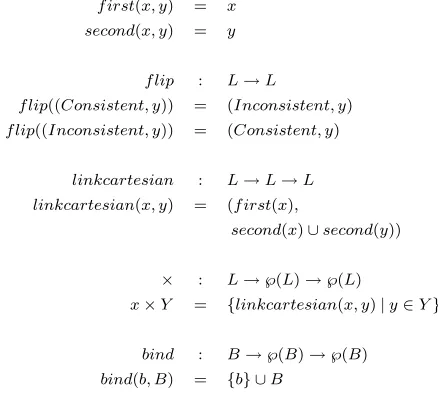
Before defining an evaluation strategy, we also need to introduce some auxiliary functions, shown in Figure 2: flip flips the consistency status of a link to its opposite.
link-cartesian takes two links, xand y, and produces a new link with the status of xand a set of locators consisting of the union of the sets of locators fromxandy. To pre-serve space, we introduce the infix operator×which takes a link and a set of links and produces a new set by applying
linkcartesian between the single link and every individual
link in the set. Finally, bind deals with variable bindings: a binding B = S ×S maps a variable name to a string uniquely identifying a node. bind can be used to introduce new variable bindings into a set of bindings.
f irst(x, y) = x second(x, y) = y
f lip : L→L
f lip((Consistent, y)) = (Inconsistent, y)
f lip((Inconsistent, y)) = (Consistent, y)
linkcartesian : L→L→L linkcartesian(x, y) = (f irst(x),
second(x)∪second(y))
× : L→℘(L)→℘(L)
x×Y = {linkcartesian(x, y)|y∈Y}
bind : B→℘(B)→℘(B)
bind(b, B) = {b} ∪B
Figure 2. Auxiliary functions
We will first define our evaluation function for therule
F : f ormula→boolean
F[[∀var∈xpath(f ormula)]]β = F[[f ormula]]bind((var,x1),β)∧. . .∧ F[[f ormula]]bind((var,xn),β)
|xi∈ S[[xpath]]/
F[[∃var∈xpath(f ormula)]]β = F[[f ormula]]bind((var,x
1),β)∨. . .∨ F[[f ormula]]bind((var,xn),β)
|xi∈ S[[xpath]]/
F[[f ormula1andf ormula2]]β = F[[f ormula1]]β∧ F[[f ormula2]]β
F[[f ormula1orf ormula2]]β = F[[f ormula1]]β∨ F[[f ormula2]]β
F[[f ormula1impliesf ormula2]]β = F[[f ormula1]]β→ F[[f ormula2]]β
F[[notf ormula]]β = ¬F[[f ormula]]β
F[[xpath1=xpath2]]β = S[[xpath1]] =S[[xpath2]]
F[[xpath16=xpath2]]β = S[[xpath1]]6=S[[xpath2]]
F[[same var1var2]]β = S[[var1]] =S[[var2]]
Figure 3. Rule language - truth value semantics
semantics of the variousf ormulaproductions. Our seman-tics will be supported by the standard first order logic truth evaluation semantics shown for completeness in Figure 3. We do not define a truth assignment for the top levelrule
non-terminal since we are not really interested in the overall truth of the formula - we are interested in link generation.
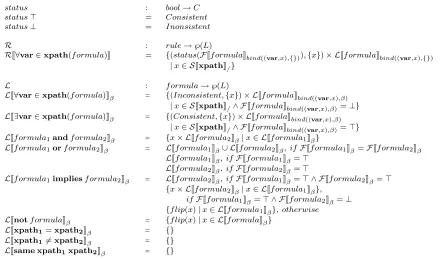
Figure 4 shows the complete link generation semantics for our language. The functionR : rule → ℘(L)takes a rule and returns a set of consistency links. Since a rule con-sists of a universal quantifier, the function will build a set of nodes using a path expression, assign the node in the set to the quantifier variable in turn and ask the subformula to re-turn a set of links. Depending on the truth value of the sub-formula for the current assignment, the function generates a consistent or inconsistent link by prepending its current variable assignment to all links returned by the subformula. The quantifiers in thef ormulaproductions behave sim-ilarly. Both the universal and existential quantifiers will first evaluate their XPath expression - which may now include references to variables bound to some node in a parent for-mula - and then bind each node in the resulting node set to their variable in turn, calling the subformula evaluation. As far as link generation is concerned, the existential quanti-fier generates consistent links if the subformula is true for the current assignment, prepending its own current node to the links returned by the subformula. The universal quanti-fier generates an inconsistent link every time a subformula is false, again prepending its current node to the links re-turned by the subformula.
We can demonstrate the behaviour of the quantifiers us-ing an example. Suppose we have a formula of the form
∀x ∈ X(∃y ∈ Y(x = y)). Suppose also that the setsX
andY consist of the elements shown in Table 1. We use the notationXi to address theith element in setX. The rule
evaluation will bind0a0toxand call the existential
quanti-fier’s evaluation function. Stepping through the destination set, the equality comparison returns false for the first entry, so the entry is ignored. On the second entry, it returns true. The existential quantifier generates a new link of the form
(Consistent,{Y2}). For the third entry, the subformula re-turns false so the link generated previously represents the whole set of links returned. The universal quantifier is now notified that the subformula has come out true for the cur-rent assignment. It thus prepends its curcur-rent nodeX1to all links returned by the subformula. The set of consistency links is now{(Consistent,{X1, Y2}).
X Y
‘a’ ‘c’ ‘b’ ‘a’ ‘c’ ‘f’
Table 1. Sample sets for rule evaluation
For nodeX2, the existential quantifier will not find any assignment that makes its subformula true. As a conse-quence, its truth value will be f alseand it will return an empty set of links. The universal quantifier will obtain this truth value and hence generate a new set of links - prepend-ing its current assignment to the empty set of links returned by the existential quantifier - {(Inconsistent,{X2})}. Evaluation of the third node will proceed similarly to that of the first node. The result is the union of all sets of links obtained by the universal quantifier:
{(Consistent,{X1, Y2}),
(Inconsistent,{X2}),
(Consistent,{X3, Y1})}
status : bool→C
status> = Consistent
status⊥ = Inonsistent
R : rule→℘(L)
R[[∀var∈xpath(f ormula)]] = {(status(F[[f ormula]]bind((var,x),{})),{x})× L[[f ormula]]bind((var,x),{})
|x∈ S[[xpath]]/}
L : f ormula→℘(L)
L[[∀var∈xpath(f ormula)]]β = {(Inconsistent,{x})× L[[f ormula]]bind((var,x),β)
|x∈ S[[xpath]]/∧ F[[f ormula]]bind((var,x),β)=⊥} L[[∃var∈xpath(f ormula)]]β = {(Consistent,{x})× L[[f ormula]]bind((var,x),β)
|x∈ S[[xpath]]/∧ F[[f ormula]]bind((var,x),β)=>}
L[[f ormula1andf ormula2]]β = {x× L[[f ormula2]]β|x∈ L[[f ormula1]]β}
L[[f ormula1orf ormula2]]β = L[[f ormula1]]β∪ L[[f ormula2]]β, ifF[[f ormula1]]β=F[[f ormula2]]β
L[[f ormula1]]β, ifF[[f ormula1]]β=> L[[f ormula2]]β, ifF[[f ormula2]]β=>
L[[f ormula1impliesf ormula2]]β = L[[f ormula2]]β, ifF[[f ormula1]]β=> ∧ F[[f ormula2]]β=>
{x× L[[f ormula2]]β|x∈ L[[f ormula1]]β},
ifF[[f ormula1]]β=> ∧ F[[f ormula2]]β=⊥ {f lip(x)|x∈ L[[f ormula1]]β}, otherwise L[[notf ormula]]β = {f lip(x)|x∈ L[[f ormula]]β}
L[[xpath1=xpath2]]β = {}
L[[xpath16=xpath2]]β = {}
L[[same xpath1xpath2]]β = {}
Figure 4. Rule language - link generation semantics
been linked using a consistent link. ForX2, we could not find a matching element and have thus created an inconsis-tent link. X2is inconsistent with the whole of the system rather than a particular element, so it stands alone.
Productions which contain only terminals, such as the definition of equals do not introduce new variables nor con-tain subformulae. Their linking semantics thus is to always return an empty set. We are left with the task of defining the behaviour of the logical connectives.
Because of space limitations we will concentrate on the and operator. Suppose we have a formula of the form
∀x∈X(∃y∈Y(x=y)∧ ∃z∈Y(x6=z))and are given the two setsXandY – note that we are not referring to the sets in Table 1 anymore. Assume thatxis currently bound toX1and we evaluate the existential quantifiers. Assume furthermore that for this binding the first existential quanti-fier returns the set of links
{(Consistent,{Y1}),(Consistent,{Y2})}
and the second existential quantifier returns
{(Consistent,{Y3}),(Consistent,{Y4})}
Intuitively, we would like our links to express that the current assignment of xis consistent with respect to both subformulae of the and operator at the same time. We achieve this by computing a ‘cartesian product’ between
the links produced by the subformulae: for each link in the first set of links and for each link in the second set of links, we generate a new link containing the union of locators of both links. The result returned by the and connective in the example is thus the set:
{(Consistent,{Y1, Y3}),(Consistent,{Y1, Y4})
(Consistent,{Y2, Y3}),(Consistent,{Y2, Y4})} This set will be passed back to the universal quantifier, which will generate the final set of links (for the current assignment ofx):
{(Consistent,{X1, Y1, Y3}),
(Consistent,{X1, Y1, Y4})
(Consistent,{X1, Y2, Y3})
(Consistent,{X1, Y2, Y4})}
The semantics for the remaining connectives were similarly derived to yield meaningful links. The whole semantics was implemented in Haskell and tested against simulation data structures to evaluate its usability.
i.e. it isO(nk)wherekis the maximum level of quantifier nesting. Though this exponential behaviour sounds prob-lematic, it is not a problem in practice. Most rules from the UML Core, which represent a complex scenario by our standards, require at most 3 levels of nesting. In addition, empirical results show that the evaluation is fast enough for the theoretical complexity to be ineffectual.
7. XML deployment
Our language depends on the ability to select sets of ele-ments for inclusion into checks and on an output format for the resulting links. In practice, we employ XPath to achieve the former and XLink for the latter. This makes it possi-ble to provide a consistency checking environment which is based entirely on open and extensible standards.
We provide an encoding of our entire rule language in XML. Using XML for writing rules allows users to use the same tool environment for editing that they would be using for processing their documents in XML format. In addition, since elements of the rules can be selected using XPath, it will be possible to write meta-rules that check other rules should the need arise. Figure 5 shows an example rule which states that we have to create a Z schema somewhere for each class in our UML model. The syntax of the XMI paths in the figure has been abbreviated for clarity.
<globalset id="$classes"
xpath="//Foundation.Core.Class[@xmi.id]"/> <globalset id="$stateschemas"
xpath="/z/schemadef[@purpose=’state’]"/>
<consistencyrule id="r1"> <description>
Every class in the UML model must have a state schema in a Z specification </description>
<forall var="c" in="$classes"> <exists var="s" in="$stateschemas">
<equal op1="$c/ModelElement.name/text()" op2="normalize-space($s/text()[1])"/> </exists>
</forall> </consistencyrule>
Figure 5. Example rule in XML
The rule will be parsed and checked by our implementa-tion. The resulting set of links will be stored in an XLink
linkbase, an example of which can be seen in Figure 6
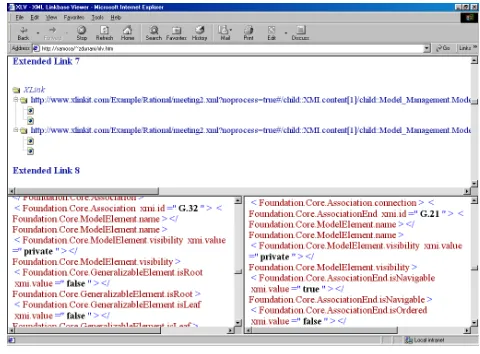
-the XMI paths have been abbreviated again. This file now contains the complete consistency status of the participating documents with respect to the set of rules that were checked. As they stand, the linkbases are not directly usable. We have developed several options for making the results of the consistency more accessible. The out-of-line links in the
<xlinkit:LinkBase
xmlns:xlinkit="http://www.xlinkit.com" docSet="file://DocumentSet.xml"
ruleSet="file://RuleSet.xml">
<xlinkit:ConsistencyLink
ruleid="zrules.xml#/id(’r1’)">
<xlinkit:State>consistent</xlinkit:State> <xlinkit:Locator
xlink:href="meeting2.xml#//Class[1]"/> <xlinkit:Locator
xlink:href="meetingz.xml#/z/schemadef[2]"/>
</xlinkit:ConsistencyLink>
</xlinkit:LinkBase>
Figure 6. Sample result linkbase
linkbases can be folded back into the files they are point-ing to. The processor makes local copies of the files before putting in the additional required elements. For example, the link shown in Figure 6 would cause one link to be in-serted into a copy of the UML model, pointing to the Z schema, and one link to be created into a copy of the Z schema, pointing to the UML model.
Figure 7. Interactive linkbase servlet
8. Document Management
We provide a general framework for managing the sub-mission of documents and rules to our check engine. It is infeasible to check every document against every rule and it is certainly not necessary to check every document every time. The aim of this framework is to provide a structured mechanism to select which rules are supposed to be applied to which documents.
<DocumentsSet name="UMLandZ"> <Description>
A couple of UML models and Z schemas </Description>
<Document href="catalogue.xml"/>
<Set href="Zschemas.xml"/> </DocumentsSet>
Figure 8. Sample document set
Figure 8 shows a document set. It includes aDocument element which directly adds a document into the set and a Setelement which includes a further document set. The latter can be used to form a hierarchy of document sets, per-haps representing a hierarchy of subsystems. At run-time, the hierarchy is flattened and all documents are loaded.
<RuleSet name="ZIFRule">
<Description>XMI vs. ZIF rules</Description>
<RuleFile href="zifrules.xml"
xpath="//consistencyrule[1]"/>
</RuleSet>
Figure 9. Sample rule set
Rules are treated similarly, they are stored in rule sets. Figure 9 shows a sample rule set. There is aRuleFile element for including a rule file directly and anxpath at-tribute for specifying precisely which rules to extract from that file. Although it is not shown in the figure, aSet el-ement can again be used to include further rule sets. The rule set mechanism can be used to select different rulesets depending on the developer’s area of interest and stages in the lifecycle.
9. Architecture
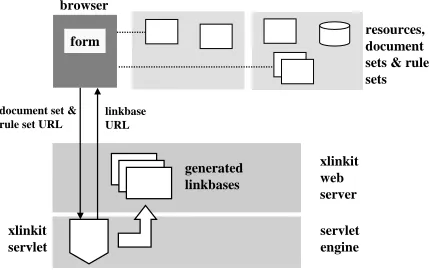
We have implemented our technology as an openly ac-cessible web service, Figure 10 shows its basic architecture. Users assemble their files in a document set and their rules in a rule set. They then type the URL of their sets into a
browser form and submit it to the web server, which invokes a servlet.
xlinkit web server
servlet engine
resources, document sets & rule sets
xlinkit servlet
generated linkbases browser
form
document set & rule set URL
linkbase URL
Figure 10. Web service architecture
The check engine executes the consistency rules and computes a set of links. These links are then stored locally in a linkbase with a unique identifier and a result page is generated which contains instructions for downloading or viewing the linkbase.
10. Evaluation
We have evaluated our implementation in several case studies. This section presents the results we obtained by checking the UML Core constraints against a set of sam-ple models: a small design model of a meeting scheduler, a medium size model taken from Rational Rose and19 in-dustrial size models provided by an investment bank.
We use the number of ModelElement objects contained in each model as a measure of scale since almost everything in the UML meta-model derives from ModelElement. Our small model contains93elements, the medium size model has610elements. The number of elements contained in the industrial models ranges from64to2834elements. In terms of file size, the models range from around100kilobytes to
6megabytes.
The rules that were checked are rules from the UML Foundation/Core package. We have expressed all but eight rules. Of those rules, some are enforced by the XMI DTD and do not have to be checked, some require transitive clo-sure, which we have implemented in the past [20] but not yet ported to our new implementation, and some cannot be checked because the required information is not exported by XMI.
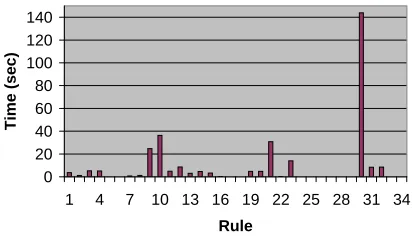
first discuss the results obtained by checking the UML Core constraints in each file individually. Figure 11 shows the total time in seconds taken by each rule for all files. The longest time taken to check all rules against any individual file was 2.38 minutes, for the largest file in the set. The most amount of RAM consumed was60megabytes, again for the largest file in the set.
0 20 40 60 80 100 120 140
1 4 7 10 13 16 19 22 25 28 31 34
Rule
Time (sec)
Figure 11. Rule totals for UML Core rules
We can observe several interesting properties from the figure. There is a large variance in the time taken by the different rules. This is due to two factors: Some rules apply to more files than others, for example almost every model has classes whereas few have association classes, i.e. the association class rules do not apply in many cases. Sec-ondly, the complexity of the XPath expressions in the rules varies greatly. Some expressions use straightforward tree paths whereas others require sophisticated functions like id lookup. This is a feature of the rather complex design of XMI. XPath selection is the single most expensive process in rule checking and hence the complexity of the path has the greatest impact - far greater than the complexity of the formula in terms of nested quantifiers!
In total, over all files,8101inconsistent links were gen-erated. Consistent link generation was turned off since we were only interested in finding inconsistencies. Although the number seems large given that the models were exported from a case tool it can be explained. Some of the mod-els included in the check were analysis or high-level design models, so they were incomplete with respect to definition of fundamental data types, had operation parameter types missing and similar problems.
11. Conclusion and Future work
We have presented the formal foundations of xlinkit, a generic technology for consistency checking and link
gen-eration, its deployment as an open, light-weight web service using XML, and its application to software engineering.
Our evaluation has demonstrated that we were able to ex-press the constraints of the UML Foundation/Core package as consistency rules and check those rules against sizeable UML models in a reasonable amount of time. Nevertheless, there are several problems that we could not address in this paper.
Once inconsistencies have been detected, the problem of resolution arises. Several questions have to be answered when dealing with inconsistency, for example: Which rules are more important than others? Similarly, which inconsis-tencies are more severe than others? Our ruleset mechanism may help to overcome these problems by allowing devel-opers to select different rule sets depending on their pref-erences. We are also considering process integration and automated techniques for dealing with inconsistencies.
Our current approach is static, meaning that it checks all documents against all rules in the rule set when a check is invoked. We have prototyped an incremental algorithm which performs a tree-diff operation between documents and computes a set of rules which need to be rechecked. We plan to integrate this algorithm into our web-based ar-chitecture and evaluate how it improves performance.
Our memory management strategy at the moment is to load all documents from a document set into memory as DOM trees in order to make them available for checking. This approach will not scale for the very large volumes of data typical in e-commerce applications, though less com-mon in software engineering. We will investigate options such as ordering our rules in order to minimise the amount of trees required in memory. Alternatively, it may be pos-sible to exploit the caching mechanisms of XML databases, which can provide DOM trees directly without parsing, to circumvent the problem.
12. Availability
We encourage experimentation and use of our work, which has already been taken up in business and financial applications, and by several research groups. An OSI certi-fied open source implementation1 is available, as is a free
web service with interactive examples, including those re-ferred to in this paper.
13. Acknowledgements
We would like to thank our students who produced the linkbase processor and the interactive linkbase viewer. We also gratefully acknowledge financial support from Zuhlke Engineering UK Ltd. for Christian Nentwich.
References
[1] S. Abiteboul. Querying Semi-Structured Data. In Proceed-ings of the 5th International Conference on Database The-ory, pages 1–18, 1997.
[2] R. Balzer. Tolerating Inconsistency. In Proceedings of the 13th International Conference on Software Engineering, pages 158–165, Austin, TX USA, May 1991. IEEE Com-puter Society Press.
[3] T. Bray, J. Paoli, C. M. Sperberg-McQueen, and E. Maler. Extensible Markup Language. Recommen-dation http://www.w3.org/TR/2000/REC-xml-20001006, World Wide Web Consortium, Oct. 2000.
[4] P. Buneman, W. Fan, and S. Weinstein. Path Constraints in Semistructured Databases. Journal of Computer and System Sciences, 61(2):146–193, 2000.
[5] S. Ceri and J. Widom. Managing Semantic Heterogeneity with Production Rules and Persistent Queues. In Proceed-ings of the 19th VLDB Conference, pages 108–119, Dublin, Ireland, 1993.
[6] J. Clark and S. DeRose. XML Path
Lan-guage (XPath) Version 1.0. Recommendation
http://www.w3.org/TR/1999/REC-xpath-19991116, World Wide Web Consortium, Nov. 1999.
[7] S. DeRose, E. Maler, and D. Orchard. XML Linking Language (XLink) Version 1.0. W3C Recommendation http://www.w3.org/TR/xlink/, World Wide Web Consor-tium, June 2001.
[8] S. Easterbrook and M. Chechik. A Framework for Multi-Valued Reasoning over Inconsistent Viewpoints. In Pro-ceedings of the 23rd International Conference on Software Engineering (ICSE), pages 411–420, Toronto, Canada, May 2001. ACM Press.
[9] E. Ellmer, W. Emmerich, A. Finkelstein, D. Smolko, and A. Zisman. Consistency Management of Distributed Docu-ments using XML and Related Technologies. Research Note 99-94, University College London, Dept. of Computer Sci-ence, 1999.
[10] W. Emmerich. GTSL — An Object-Oriented Language for Specification of Syntax Directed Tools. In Proc. of the 8th Int. Workshop on Software Specification and Design, pages 26–35. IEEE Computer Society Press, 1996.
[11] M. Fernandez, D. Florescu, A. Levy, and D. Suciu. Verifying Integrity Constraints on Web Sites. In Proceedings of the 16th International Joint Conference on Articial Intelligence, pages 614–619, 1999.
[12] M. Fernandez, D. Florescu, A. Levy, and D. Suciu. Declara-tive Specification of Web Sites with Strudel. VLDB Journal, 9(1):38–55, 2000.
[13] A. Finkelstein. A Foolish Consistency: Technical Chal-lenges in Consistency Management. In Proceedings of the 11th International Conference on Database and Ex-pert Systems Applications (DEXA), pages 1–5, London, UK, September 2000. Springer.
[14] A. Finkelstein, D. Gabbay, H. Hunter, J. Kramer, and B. Nu-seibeh. Inconsistency Handling in Multi-Perspective Spec-ifications. IEEE Transactions on Software Engineering, 20(8):569–578, 1994.
[15] A. Finkelstein, J. Kramer, B. Nuseibeh, L. Finkelstein, and M. Goedicke. Viewpoints: a framework for integrating multiple perspectives in system development. Int. Jour-nal of Software Engineering and Knowledge Engineering, 2(1):21–58, 1992.
[16] P. Grefen and J. Widom. Protocols for Integrity Constraint Checking in Federated Databases. Distributed and Parallel Databases, 5(4):327–355, 1997.
[17] A. N. Habermann and D. Notkin. Gandalf: Software De-velopment Environments. IEEE Transactions on Software Engineering, 12(12):1117–1127, 1986.
[18] R. Jelliffe. The Schematron Assertion Language 1.5. Tech-nical report, GeoTempo Inc., October 2000.
[19] M. Nagl, editor. Building Tightly Integrated Software Devel-opment Environments: The IPSEN Approach, volume 1170 of Lecture Notes in Computer Science. Springer Verlag, 1996.
[20] C. Nentwich, L. Capra, W. Emmerich, and A. Finkelstein. xlinkit: a Consistency Checking and Smart Link Genera-tion Service. Research Note RN/00/66, University College London, Dept. of Computer Science, 2000. Submitted for Publication.
[21] B. Nuseibeh, S. Easterbrook, and A. Russo. Leveraging Inconsistency in Software Development. IEEE Computer, 33(4):24–29, April 2000.
[22] Object Management Group. The Meta Object Facility. Ob-ject Management Group, 492 Old Connecticut Path, Fram-ingham, MA 01701, USA, 1997.
[23] Object Management Group. Unified Modeling Language Specification, March 2000.
[24] Object Management Group, 492 Old Connecticut Path, Framingham, MA 01701, USA. XML Metadata Interchange (XMI) Specification 1.1, Nov. 2000.
[25] T. W. Reps and T. Teitelbaum. The Synthesizer Generator. ACM SIGSOFT Software Engineering Notes, 9(3):42–48, 1984. Proc. of the ACM SIGSOFT/SIGPLAN Software En-gineering Symposium on Practical Software Development Environments, Pittsburgh, PA, USA.
[26] W. Sch¨afer and H. Weber. European Software Factory Plan – The ESF-Profile. In P. A. Ng and R. T. Yeh, editors, Modern Software Engineering – Foundations and current perspec-tives, chapter 22, pages 613–637. Van Nostrand Reinhold, NY, USA, 1989.
[27] A. Tsiolakis. Consistency Analysis of UML Class and Se-quence Diagrams based on Attributed Typed Graphs and their Transformation. Technical Report 2000/3, Technical University of Berlin, March 2000. ISSN 1436-9915. [28] P. Wadler. A formal semantics of patterns in XSLT. Markup
Technologies, December 1999.
[29] R. Wilkinson and A. Smeaton. Automatic Link Generation. ACM Computing Surveys, 31(4es), December 1999. Article No. 27.