Indistinguishability Obfuscation from
Functional Encryption for Simple Functions
Prabhanjan Ananth∗ Abhishek Jain† Amit Sahai ‡
Abstract
We show how to construct indistinguishability obfuscation (iO) for circuits from any non-compact functional encryption (FE) scheme with sub-exponential security against un-bounded collusions. We accomplish this by giving a generic transformation from any such FE scheme into a compact FE scheme. By composing this with the transformation from sub-exponentially secure compact FE toiO (Ananth and Jain [CRYPTO’15], Bitansky and Vaikuntanathan [FOCS’15]), we obtain our main result.
Our result provides a new pathway toiO.
We use our technique to identify a simple function family for FE that suffices for our general result. We show that the function familyFsimple is complete, where everyfsimple∈
Fsimpleconsists of three evaluations of a Weak PRF followed by finite operations. We believe
that this may be useful for realizingiO from weaker assumptions in the future.
∗
Center for Encrypted Functionalities and Department of Computer Science, [email protected] This work was partially supported by grant #360584 from the Simons Foundation.
†
Department of Computer Science, John Hopkins University. [email protected]. Research supported in part from a DARPA/ARL SAFEWARE award and NSF CNS-1414023.
‡
1
Introduction
Program obfuscation [Had00, BGI+01] concerns with the problem of making a computer pro-gram “unintelligible” while still preserving its functionality. While general-purpose propro-gram obfuscation remained an elusive goal for several decades, Garg et al [GGH+13b] changed this picture by providing the first candidate construction of indistinguishability obfuscation (iO). Since then, iO has found tremendous appeal in cryptography by enabling several advanced cryptographic goals such as deniable encryption [SW14], functional encryption [GGH+13b], round-optimal secure computation [GGHR14], digital watermarking [NW15,CHV15], time-lock puzzles [BGJ+15], and more.
While the research direction of using iO to build other cryptographic primitives has met much success, buildingiO itself from standard cryptographic assumptions has so far proven to be notoriously difficult. The security of candidateiO constructions in the works of [GGH+13b,
BGK+14, BR14, AGIS14, Zim15, SZ14, AB15] is only proven in generic models and lacks a reduction in the standard model. The recent works of Pass et al. [PST14] and Gentry et al. [GLSW15] provide the first standard model reductions based on different assumption on multi-linear maps (see [PST14] and [GLSW15] for the description of their respective assumptions).
However, all of these candidates rely on the same core cryptographic primitive, namely, multilinear maps [GGH13a, CLT13, GGH15, CLT15]. This situation is unsatisfactory in light of several recent attacks on [CHL+15,GHMS14,BWZ14,CLT14,CGH+15] on most multilinear maps candidates known so far.1
Very recently, the independent works of Ananth and Jain [AJ15] and Bitansky and Vaikun-tanathan [BV15a] presented a new direction for building iO. They give a transformation via functional encryption [SW05,BSW11], specifically transformingcompact public-key functional encryption (FE) forNC1 toiO for P/Poly. Very roughly, in a compact FE scheme, the running time of the encryption algorithm must only have a sublinear dependence on the size complexity of functions from the function family supported by the scheme. However, presently, the only known FE constructions that achieve this compactness property are based oniO [GGH+13b,Wat14]. As such, this approach, so far, has not yielded any newiO candidates.
1.1 This Work
In this work, we continue to explore this line of research. Our vision is to progressively reduce compact FE to weaker primitives, eventually culminating in its realization from standard cryp-tographic assumptions. While we do not know how to fully realize this vision yet, we make some progress in this work.
We focus on weakening the requirements on FE for building iO. In particular, we consider the following two goals: (a) While [AJ15,BV15a] require FE forNC1 to buildiO, we set out to identify the simplest, concrete function family for FE that suffices for buildingiO. (b) Further, we aim to remove the “compactness” requirement from FE for realizing iO. We now proceed to describe our results.
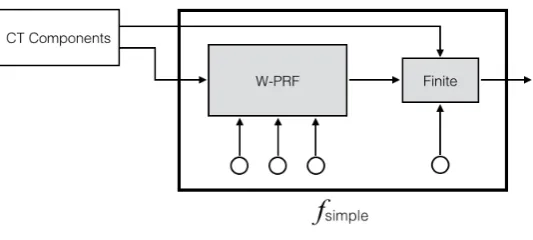
iO from FE for “simple” functions. We consider the function family Fsimple where every
fsimple ∈ Fsimple corresponds to three weak PRF evaluations followed by some simple, finite
operations. See Figure 1 for an illustration of fsimple and Figure 3 in Section 4 for a formal
description.
Our main result is that collusion-resistant FE forFsimpleis sufficient to obtainiO for P/Poly.
Figure 1A figure illustrating the functionalities for which keys are needed to obtainiO. The circles represent the constants found in the function key, that are fed to the components in boxes. The box labeled “Finite” represents a finite (constant) set of operations.
Theorem 1 (Informal) Public-key functional encryption for Fsimple with sub-exponential in-distinguishability security in the selective model against unbounded collusions implies indistin-guishability obfuscation for P/Poly.
We can, in fact, further simplify Fsimple such that each function inFsimple corresponds to a “local” evaluation of a polynomial-stretch PRG followed by some simple, finite operations.2
We stress that Theorem 1 holds even if the FE scheme is not compact. Therefore, in addition to simplifying the class of functions for FE required to obtain iO, we also remove the compactness requirement from FE.
Compact FE from Non-Compact Collusion-Resistant FE. The key step underlying the above result is an unconditional transformation from any (not necessarily compact) public-key FE for NC1 that is secure against unbounded collusions (w.r.t. selective indistinguishability security definition of [BSW11]) to a selective-secure compact public-key FE for NC1.3 The resulting scheme also inherits security against unbounded collusions. While our focus is on the public-key setting, our transformation also works in the secret-key setting. That is, if we start with a secret-key collusion-resistant FE scheme, then we obtain a secret-key compact FE scheme.
Our transformation relies on a specific form of randomized encodings [IK00,AIK04,AIK06] that we refer to as program-decomposable randomized encodings. By instantiating our trans-formation with a variant of the randomized encoding of Kilian [Kil88] (which we show satisfies the program-decomposability property) and then combining it with the compact FE to iO transformation of [AJ15,BV15a], we obtain Theorem 1.
Bootstrapping iO. As an application of Theorem 1, we prove a bootstrapping theorem for
iO. Specifically, we define a different function familyF, similar at a high level toFsimple. We then show thatiO forF implies iO for P/Poly. (See Appendix Afor a description ofF.)
Theorem 2 (Informal) Indistinguishability obfuscation for F with sub-exponential indistin-guishability security implies indistinindistin-guishability obfuscation for P/Poly.
Previously, [GIS+10,BCG+11,App14] established bootstrapping theorems for virtual black-box obfuscation [BGI+01]. The work of [GGH+13b] gave the first bootstrapping theorem for
2This approach only yields compact FE with bounded collusion-resistance, but it suffices for constructingiO. See Remark4in Section3for details.
iO, reducing iO for general functions to iO for NC1 assuming fully-homomorphic encryption. Subsequently, Canetti et al [CLTV15] showed a similar bootstrapping theorem assuming sub-exponentially secure puncturable PRFs computable inNC1. Recently, Bitansky et al. [BGL+15] established the first bootstrapping theorem for iO where obfuscating a circuit of size k allows the obfuscation of all circuits of size any polynomial in k. Our bootstrapping theorem can be viewed as an alternative proof to their result (in particular, our functionalityF is different from their work).
Concurrent Work. In a concurrent and independent work, [BV15b]4 show how to build iO from the GGHZ assumption [GGHZ14] on composite order multilinear maps (see [GGHZ14] for a formal description of their assumption). They obtain this result via a similar approach as in our work, namely, they show a transformation from non-compact collusion-resistant FE to compact FE.
While our focus is on simplifying the requirements on FE for building iO, we note that we can also use Theorem1to obtain this result by instantiating the non-compact FE scheme with the FE scheme of Garg et al [GGHZ14].
Other Related Work. Initial definitional works on FE [BSW11,O’N10] primarily considered the fully collusion-resistant setting where the adversary can obtain any polynomial number of decryption keys. However, FE for general circuits was also considered and achieved in the setting where the adversary can only obtain a single decryption key [SS10]. This was later generalized to the bounded-key setting [GVW12]. Both these schemes achieved non-compact FE. Goldwasser et al. [GKP+13] made partial progress towards realizing the goal of making such FE schemes
compact. They achieve a single-key FE scheme for single-bit-output functions, where the size of the ciphertexts depend only on the depth of the functions. Note however, that while none of these schemes require iO or multilinear maps, we do not currently know how to achieve iO starting with these works, due to the limitations discussed in this paragraph.
2
Preliminaries
Throughout the paper, we denote the security parameter by λ. We assume that the reader is familiar with basic cryptographic concepts.
Given a PPT sampling algorithm A, we usex←−$ Ato denote that x is the output ofAwhen the randomness is sampled from the uniform distribution.
2.1 Indistinguishability Obfuscation
Here we recall the notion of indistinguishability obfuscation (iO) that was defined by Barak et al. [BGI+01].
Definition 1 (Indistinguishability Obfuscator (iO)) A uniform PPT algorithmiOis called an indistinguishability obfuscator for a circuit class {Cλ}, whereCλ consists of circuitsC of the
form C:{0,1}λ → {0,1}, if the following holds:
• Completeness: For every λ∈N, every C ∈ Cλ, every input x∈ {0,1}λ (i.e., it belongs
to the input space ofC), we have that
Pr[C0(x) =C(x) : C0←iO(λ, C)] = 1.
4
• Indistinguishability: For any PPT distinguisher D, there exists a negligible function
negl(·)such that the following holds: for all sufficiently largeλ∈N, for all pairs of circuits
C0, C1∈ Cλ such that C0(x) =C1(x) for all inputs x, we have:
Pr[D(iO(λ, C0)) = 1]−Pr[D(iO(λ, C1)) = 1]
≤negl(λ)
2.2 Public-Key Functional Encryption
Syntax. Let X = {Xλ}λ∈N and Y = {Yλ}λ∈N be ensembles where each Xλ, Yλ are sets of
size, functions in λ. Let F ={Fλ}λ∈N be an ensemble where each Fλ is a finite collection of functions. Each function f ∈ Fλ takes as input a string x∈ Xλ and outputs f(x)∈ Yλ.
A public-key functional encryption (FE) schemeFEforFconsists of four algorithms (FE.Setup, FE.KeyGen,FE.Enc,FE.Dec):
• Setup. FE.Setup(1λ) is a PPT algorithm that takes as input a security parameter λand outputs a public key, (master) secret key pair (FE.pk,FE.msk).
• Key Generation. FE.KeyGen(FE.msk, f) is a PPT algorithm that takes as input a master secret keyFE.mskand a function f ∈ Fλ and outputs a functional key FE.skf.
• Encryption. FE.Enc(FE.pk, x) is a PPT algorithm that takes as input a public keyFE.pk
and a messagex∈ Xλ and outputs a ciphertextct.
• Decryption. FE.Dec(FE.skf,ct) is a deterministic algorithm that takes as input a func-tional key FE.skf and a ciphertextct and outputs a stringy∈ Yλ.
Correctness. There exists a negligible function negl(·) such that for all sufficiently large
λ∈N, for every message x∈ Xλ, and for every functionf ∈ Fλ,
Prhf(m)←FE.Dec(FE.KeyGen(FE.msk, f),FE.Enc(FE.pk, m))i≥1−negl(λ)
where (FE.pk,FE.msk) ←FE.Setup(1λ), and the probability is taken over the random coins of all algorithms.
Selective Security. We recall indistinguishability-based selective security for FE. This secu-rity notion is modeled as a game between the challenger and the adversary where the adversary can request functional keys and ciphertexts from the challenger. Specifically, the adversary can submit function queries f to the challenger and receive corresponding functional keys. It can also submit a message query of the form (x0, x1) and in response, the challenger encrypts
messagexb and sends the ciphertext back to the adversary. The adversary wins the game if she can guess bwith probability significantly greater than 1/2 and iff(x0) =f(x1) for all function
queriesf. The only constraint here is that the adversary has to declare the challenge messages at the beginning of the game itself.
Definition 2 (IND-secure FE) A public-key functional encryption schemeFE= (FE.Setup, FE.KeyGen,FE.Enc,FE.Dec) for a function family F is said to be qkey-selectively secure if for
any PPT adversary A, for all sufficiently largeλ∈N, the advantage ofA is
AdvFEA =
Pr[Expt FE
A(1λ,0) = 1]−Pr[ExptFEA (1λ,1) = 1]
≤negl(λ),
1. Challenge message query: A submits a message pair (x0, x1) to C.
2. The challenger C computes (FE.pk,FE.msk) ← FE.Setup(1λ) and sends FE.pk to the ad-versary. It then computesct=FE.Enc(FE.msk, xb) and sends ct to A.
3. Function queries: The following is repeated up toqkey times: Asubmits a function query
f ∈ Fλ toC. The challengerCcomputes the function keyFE.skf ←FE.KeyGen(FE.msk, f)
and sends it to A.
4. If there exists a function query f such that f(x0) 6= f(x1), then the output of the
ex-periment is ⊥. Otherwise, the output of the experiment is b0, where b0 is the output of
A.
Remark 1 (Selective-security against unbounded collusions) One can consider a strength-ening of the above definition where the adversary is allowed to make any unbounded polynomial number of function queries. We refer to this as selective security against unbounded collusions.
2.2.1 Compactness
We now recall the notion of compact FE from [AJ15]. In a compact FE scheme, the running time of the encryption algorithm only depends on the security parameter and the input message length. In particular, it is independent of the complexity of the function family supported by the FE scheme.
Definition 3 (Compact FE) Let p(·) be a polynomial. A selectively secure public-key FE scheme FE= (FE.Setup,FE.KeyGen,FE.Enc,FE.Dec), defined for an input space X ={Xλ} and
function space F = {Fλ} is said to be compact if for all λ ∈ N, the running time of the encryption algorithm FE.Enc, on input 1λ, FE.pk and a message x∈ Xλ, isp(λ, qkey,|x|).
Remark 2 (Sublinear dependence) As observed in [BV15a], a milder form of compact FE where the running time of the encryption algorithm is sublinear in the size of any f ∈ F is sufficient to obtain iO. For simplicity of exposition, however, we will use Definition 3 in this manuscript. Indeed, our main transformation presented in Section 3 holds for this stronger definition.
3
Compact FE from Collusion-Resistant FE
We give a generic transformation from any collusion-resistant FE scheme (CRFE) that is not
necessarily compact to a compact FE (CFE) scheme. We start by giving an overview of our approach in Section 3.1. Next, in Section 3.2 we define the notion of program decomposable randomized encodings that is used in our transformation. We then describe our transformation in Section3.3 followed by its security proof in Section 3.4
3.1 Overview
Towards that end, let us first recall some related results known in the literature and folklore. The works of [GVW12, ABSV15] show that dependence on the depth of the function can be removed generically by using any (efficient) randomized encoding [IK00,AIK04,AIK06]. Recall that a randomized encoding of any polynomial-sized circuit can be computed in only logarithmic depth. Given this observation, their transformation is simple: instead of issuing a key for a functionf, we issue a key for a function f0 wheref0 takes input x forf and computes an RE of (f, x). Indeed, this idea has been used extensively throughout cryptography (see [App11] for a survey).
Next, we note the folklore observation that dependence on the function output-size can also be removed generically if the underlying FE scheme is collusion-resistant. Very roughly, if a functionf has`-bit outputs, then the idea is to issue ` different keys Kf1, . . . , Kf`, where Kfi
corresponds to computing the ith bit of the output of f. Now, since each function key only corresponds to binary functions, the resulting scheme will not have output-size dependence.
Of course, in a non-compact FE scheme, the running time of the encryption algorithm may grow polynomially with thesizeof the function (in particular, the number of gates in the circuit representation of the function). As such, the above simple transformations do not suffice for our purpose.
Our Idea. Towards that end, our main idea is to further leverage collusion-resistance to achieve compactness generically. Very roughly, instead of issuing a key for a circuitC, our idea is to issue multiple keysKG1, . . . , KG` where each keyKGi corresponds to computing a “small component”
of C. From an efficiency viewpoint, we require that `is some fixed polynomial in the security parameter and for every i, the size of the circuit Gi computed by KGi is independent of |C|.
From a security viewpoint, intuitively, we want that given a key setKG1, . . . , KG`corresponding
to a circuit C and an encryption of a messagex, an evaluator should only learn C(x).
Put differently, on the one hand, we want to “decompose” the process of computing C(x) into ` different parts such that the size of each part is independent of|C|. At the same time, these parts should be “tied” together in such a manner that when put together, they reveal
C(x), and nothing else otherwise. A natural approach to achieve the efficiency requirement is to simply let Gi correspond to evaluating theith gate of C. Note, however, that this must be done in a manner that preserves the security of the FE.
Program-Decomposable Randomized Encodings. To address this problem, we once again turn to randomized encodings. Our idea is to use a specific form of RE that we refer to as
program decomposableRE (PD-RE). In a PD-RE scheme, the encoding process includes a “de-composition” process for programs5 that decomposes a circuitC into several parts C1, . . . , C`, where for every i, we have that |Ci|is independent of|C|. For every i, the encoding algorithm
Enc on input Ci and x outputs an encoding C[i, x. The decoding algorithm takes as input the tuple {C[i, x} and should output y = C(x). The efficiency requirement is that for every i,
|Enc| is independent of |C|. The security requirement, however, is still the same as in stan-dard RE: for anyC =C1, . . . , C` and input pair (x0, x1), the encodings (C\1, x0, . . . ,C\`, x0) and (C\1, x1, . . . ,C\`, x1) are computationally indistinguishable as long asC(x0) =C(x1).
We observe that many RE schemes from the literature directly yield PD-RE schemes. For example, Yao’s garbling technique [Yao86] yields a PD-RE scheme for general circuits. For any circuit C, Ci corresponds to its ith gate and Enc on input (Ci, x) corresponds to computing theith “garbled gate table.” Later, we also identify another PD-RE scheme by modifying the RE scheme of Kilian [Kil88] (which in turn uses Barrington’s theorem [Bar86]). This allows
us to identify a simple, concrete function family for collusion-resistant FE that suffices for our transformation. (See Section 4for details.)
Given such a PD-RE scheme, we obtain a compact FE construction as follows: a key for a circuitC consists of a key set{KGi}i∈`. For everyi, the functionGi associated with the keyKi
takes as input a messagexand computesEnc(Ci, x). Note that this is a randomized procedure, and that the randomness among different evaluations must be correlated. (We address this further below.) An evaluator who is given a key set{KGi}i∈`and an encryptionctofxcan now
first perform`FE decryptions ofct(one with each keyKi) to obtain a PD-RE (C[1, x, . . . ,C[`, x) of (C, x). Next, it can perform the RE decoding procedure to obtain C(x). From the security of PD-RE, we are guaranteed that the evaluator cannot learn anything else.
We remark that the “program decomposability” property of garbled circuits has been used in many cryptographic schemes in the past. To the best of our knowledge, the first such use is due to Beaver et al. [BMR90] who used garbled circuits to construct constant-round multiparty computation protocols. We note, however, that in their construction, they only use the fact that each gate table can be computed in constant depth; for our purposes, it is important that thesizeof each decomposed unit is independent of the total size of the circuit. This property of garbled circuits was recently used by Bitansky et al. [BGL+15] in their construction of succinct REs.
More Details. We now provide some more details of the above construction. First note that the program encoding procedure is a randomized functionality. To provide randomness to each invocation of the program encoding procedure Enc, as an initial “straw man” proposal, we consider the following: we can modify the encryption algorithm of FE scheme to additionally
encrypt a random key K for a weak pseudo-random function (PRF) along with the input
message x. The function Gi computed by the key KGi now consists of the following steps: on
input (K, x), it first evaluates K on a random tag hardwired in its description to obtain ri. Next, it computes and outputs Enc(Ci, x) using randomnessri.
We highlight a couple of problems with the above approach: first, we note that different invocations of program encoding procedure Enc of known PD-RE schemes critically use cor-relatedrandomness – intuitively, this use of correlated randomness is needed to make different parts of program decomposition “talk with each other” when decoding. We address this need for correlation by explicitly considering set systems that capture the necessary correlations, and incorporating this into our construction: we refer the reader to Section 3 for details. A more important problem is that we cannot directly rely upon the standard security of the underlying FE scheme to prove the security of the new scheme. This is because Enc is a randomized functionality whereas standard FE only considers deterministic functions. The recent work of [GJKS15] studies the problem of public-key FE for randomized functions; however, they give a specific construction using iO which is therefore not suitable for our purposes.6
To address this problem, we apply the “trapdoor circuits” technique of De Caro et al [CIJ+13]. Very roughly, we modify G
i such that it works in two modes: in the “honest” mode, it performs the same functionality as discussed above. In the “trapdoor” mode, it out-puts a fixed value hardwired in its description. Using this idea, in our proof, we can switch from honest computation ofEncito the PD-RE simulator. This step only relies on the security of the underlying PD-RE. Now, we can simply change the messagex0 in the ciphertext tox1 by
rely-ing upon the security of the underlyrely-ing FE scheme. Finally, we change Gi again to the honest mode, completing the proof. We remark that several recent works [GGHR14,BS15,ABSV15]) make a similar use of the trapdoor circuits technique in the context of FE.
6
3.2 Program Decomposable Randomized Encodings
Letx be a string of length `and letS be a subset of [`]. We define x|S to be the string that is obtained by concatenating all the bits ofx corresponding to positions inS. We refer to this as “x being restricted toS”.
Syntax. A Program Decomposable RE, defined for a function family F, consists of a tuple of algorithms (Decomp,PrgEnc,Dec) described below:
• Program Decomposition: Letfbe a function inFwith input length`inp. The deterministic
algorithm Decomp takes as input security parameter λ, a description of f and performs the following steps:
1. Compute a set of program componentsP= (P1, . . . , P`prg) representingf.
2. Generate two set systems S = {S1, . . . , S`prg} and I = {I1, . . . , I`prg}, where Si ⊆
[`R], Ii⊆[`inp] for all i∈[`prg], and `Ris a polynomial in (λ, `prg).
3. Output (P,S,I, `R).
• Program Encoding: LetP=P1, . . . , P`prgbe a program decomposition andx=x1, . . . , x`inp
be an input forP that we wish to encode. LetS ={S1, . . . , S`prg} andI ={I1, . . . , I`prg}
be two set systems with Si ⊆ [`R], Ii ⊆ [`inp]. Let r be a string of length `R chosen uniformly at random.
PrgEnc is a PPT algorithm that takes as input a program component Pi, string x|Ii,
random stringr|S
i and outputs an encodingPdi, x.
• Output Decoding: Dec is a deterministic polynomial-time algorithm that takes as input an encoding tuple
n
d
Pi, x
o
i∈[`prg]
and outputs a value y.
This completes the description of the algorithms of a program-decomposable RE. We now state our efficiency requirements and then formally define correctness and security of PD-RE.
Efficiency. On any input f, we require the output P = {Pi}i∈`prg,S = {Si}i∈`prg,I =
{Ii}i∈`prg
of the Decompalgorithm to be such that:
• For everyi∈[`prg],|Pi|=p(λ) wherep(·) is a fixed polynomial that is independent of|P|.
• Every set inSandI is of sizeq =q(λ), whereq(·) is a fixed polynomial that is independent of |P|.
A direct consequence of the above two properties is that the running time ofPrgEncist(λ), wheret(·) is a fixed polynomial that is independent of|P|.
Correctness. We say that a program decomposable RE (Decomp,PrgEnc,Dec) forFiscorrect
if for everyf ∈ F and inputx tof, we have the following quantity to be at leastnegl(λ):
Pr
h
Dec
PrgEnc
P1, x|I 1;r|S1
, . . . ,PrgEnc
P`prg, x|I`
prg;r|S`prg
=P(x)
i
where P,S =
S1, . . . , S`prg ,I=
I1, . . . , I`prg , `R
←Decomp(f), andris a string of length
Security. We say that a program decomposable RE (Decomp,PrgEnc,Dec) forF issecure if for every PPT adversary A, every f ∈ F and input pair (x0, x1) such that f(x0) =f(x1), we
have that:
Pr
h
AP\1, x0, . . . ,P\`
prg, x0
= 1i−PrhAP\1, x1, . . . ,P\`
prg, x1
= 1i
=negl(λ),
where \Pi, xb ← PrgEnc
Pi, xb|I
i;r|Si
,
P,S = S1, . . . , S`prg ,I =
I1, . . . , I`prg , `R
←
Decomp(f), andr is a random string of length`R.
3.3 Our Transformation: From CRFE to CFE
Let CRFE = (CRFE.Setup,CRFE.KeyGen,CRFE.Enc,CRFE.Dec) be any public-key FE scheme for a function family FCRFE that is selective-secure against unbounded collusions. We defer the description of FCRFE to later. Given CRFE, we construct a compact public-key FE scheme CFE= (CFE.Setup,CFE.KeyGen,CFE.Enc,CFE.Dec) for a function family F. The family Fλ =
{Fλ}λ∈N comprises of functions with input length λ. The associated message space is denoted
by X ={Xλ}λ, whereXλ ={0,1}λ. The resulting schemeCFEinherits the security properties of CRFE, namely, it achieves selective-security against unbounded collusions.
Our transformation uses the following additional tools:
• A program-decomposable RE schemePDRE= (PDRE.Decomp,PDRE.PrgEnc,PDRE.Dec) for the function familyF.
• Weak pseudorandom function7 familyPRF ={P RFK(·) :{0,1}λ → {0,1}} and a sym-metric encryption scheme Sym = (Sym.Setup,Sym.Enc,Sym.Dec). We assume that the ciphertexts produced bySymare pseudorandom.
We now describe the compact FE scheme scheme CFEbelow.
Setup CFE.Setup(1λ): On input security parameter λ, execute CRFE.Setup(1λ) to obtain (CRFE.MSK,CRFE.PK). Output the master secret keyCFE.MSK=CRFE.MSK and the public key CFE.PK=CRFE.PK.
Key GenerationCFE.KeyGen(CFE.MSK, f): On input a master secret keyCFE.MSK=CRFE.MSK
and a function f ∈ Fλ,
• ExecutePDRE.Decomp(f) to obtain (P,S,I, `R). ParseP= (P1, . . . , P`prg). • Pick tagstag1, . . . ,tag`R, wheretagi ∈ {0,1}λ with`
R= poly(`prg, λ). • ParseS as{S1, . . . , S`prg}. AssignTAGi = (tagk)k∈Si fori∈[`prg].
• Pick stringsCT1, . . . , CT`prg uniformly at random. (The length ofCTi will be clear later). • ExecuteCRFE.KeyGen(CRFE.MSK,Encode[Pi,TAGi, Ii, CTi]) withi∈[`prg] to obtainCRFE.ski.
The function Encode[·,·,·,·] is described in Figure 2.
OutputCFE.skf = CRFE.sk1, . . . ,CRFE.sk`prg
.
EncryptionCFE.Enc(CFE.PK, x): On input a public keyCFE.PK=CRFE.PKand a messagex, sample a PRF key K. ExecuteCRFE.Enc(CRFE.PK,(x, K,⊥,mode = 0)) to obtain CRFE.CT.
Encode[P,TAG, I, CT](x, K,Sym.K,mode)
Ifmode= 0:
• ParseTAGas tag1, . . . ,tagp
.
• Execute the weak pseudo-random functionP RFK(tagi) to get stringsri. Assignr=r1||· · · ||rp.
• ExecutePDRE.PrgEncP, x|I;rto obtain the encodingP, x. Outputd P, x.d
Ifmode= 1:
• ExecuteSym.Dec(Sym.K, CT) to obtainP, x. Outputd P, x.d
Figure 2
Output the ciphertextCFE.CTx=CRFE.CT.
Decryption CFE.Dec(CFE.skf,CFE.CTx): On input a ciphertext CFE.CTx = CRFE.CT and a functional key CFE.skf = (CRFE.sk1, . . . ,CRFE.sk`prg), execute the decryption algorithm
CRFE.Dec(CRFE.ski,CRFE.CT) to obtain Pdi, x. Execute PDRE.Dec
n d
Pi, x
o
i∈[`prg]
to obtain
y. Outputy.
This completes the description of the compact FE scheme.
Correctness. Observe that the output ofCRFE.Dec(CRFE.ski,CRFE.CT) is an encodingPdi, x.
These encodings are “valid”, meaning that they can be obtained by first running the
de-composition algorithm on f and then encoding the resulting decomposed program
compo-nents along with x. Therefore, by the correctness of PDRE, we have that the output of
PDRE.Dec
n
d
Pi, x
o
i∈`prg
is f(x).
Compactness. First observe that the run-time of CFE.Enc depends only on |x|, run-time of
CRFE.Encand λ. So it suffices for us to focus onCRFE.Enc. Since we make no assumptions on the compactness ofCRFE, it could very well be the case that the run-time ofCRFE.Encdepends polynomially on the size complexity of functions inFCRFE. Note, however, that the size of any Encode∈ FCRFE is simply a fixed polynomial in λsince it only involves weak PRF evaluations and computing PrgEnc, whose complexity is polynomial in λ. Summing up, we have that the run-time of CFE.Enc ispoly(λ,|x|), as required.
Security. We prove the following theorem in Section3.4:
Theorem 3 (Security of CFE) If CRFE is a public-key FE with selective-security against unbounded collusions,PDREis a secure PD-RE scheme andPRF is a weak PRF, we have that
CFEis a public-key compact FE with selective-security against unbounded collusions.
Remark 3 (Secret-key setting) The above transformation is presented in the public-key set-ting. It is easy to see that the same transformation also works in the secret-key setset-ting. Namely, if we start with a secret-key collusion-resistant FE scheme, we obtain a secret-key compact FE scheme.
of PRG can be computed in time independent of the stretch of PRG. Now, the ith program component can be encoded using (as randomness) the corresponding ith block in the output
of PRG. Also note that the generic symmetric-key encryption (used in mode 1) can also be instantiated with a one-time pad implemented using a standard PRG. This is because we only need one-time security of the hardwired ciphertext in our proof. Finally, we note that with this approach, the resulting scheme will not be collusion-resistant, although this does not affect the implication to iO.
Remark 5 (Bootstrapping theorem) If we choose weak PRFs in NC1 and suitably instan-tiate Program Decomposable RE (for ex., garbled circuits), Theorem 3 yields a bootstrapping mechanism for transforming a non-compact collusion-resistant FE for NC1 into a compact collusion-resistant FE for P/poly (assuming DDH or LWE). This is a generalization of the bootstrapping theorem of [ABSV15] which was (non-)compactness preserving.
3.4 Proof of Theorem 3
The main idea is to hardwire the output program encodings in the functional keys. After this, we can use the security of Program Decomposable RE to switch from one input to another. However, functional keys do not hide its associated function and hence to enable the hardwiring process, we use the trapdoor branch. We compute a symmetric encryption of the output en-coding. We then switch the mode in the message to now decrypt this (symmetric) ciphertext instead of executing the encoding procedure. Once this is done, we have the program encoding hardwired as desired. We now explain the technical details.
We define the advantage of a PPT adversaryA inHybridi.b to beAdvA,i.b.
∀ b∈ {0,1}, Hybrid1.b: This corresponds to the real experiment when the challenger uses the challenge bit b. That is, when the adversary submits a message pair (x0, x1), the challenger
encrypts the message xb as part of the challenge ciphertext. The hybrid outputs whatever the adversary outputs.
∀ b∈ {0,1}, Hybrid2.b: The output of the functional keys w.r.t the challenge ciphertext is hard-wired in their respective CT components.
At the beginning of the game, the challenger samples a symmetric key Sym.K by exe-cuting Sym.Setup. It answers challenge message query from the adversary as in the previ-ous hybrid. Denote the challenge ciphertext answered by the challenger to be CFE.CT∗ =
CFE.Enc(CFE.PK,(xb, K,0)).
Upon receiving a function query f, the challenger first executesPDRE.Decomp(f) to obtain (P,S,I, `R). It then picks the tags tag1, . . . ,tag`R uniformly at random with tagi ∈ {0,1}
λ.
Let the set family S (resp., I) be denoted by {S1, . . . , S`prg} (resp., {I1, . . . , I`prg}). For i =
1, . . . , `prg, it does the following:
1. Assigns TAGi = ∪k∈Si(tagk) for i∈ [`prg]. Alternately, denote TAGi = ( ˜tag1, . . . ,tag˜p),
wherep=|Si|.
2. Execute the weak pseudo-random function P RFKj(tagj) to get strings rj. Assign r =
r1||· · · ||rp.
3. ExecutePrgEnc(Pi,x|I
i;r) to obtain the encodingP[i,x, where x=xb. OutputP[i,x.
4. The challenger encrypts P[i,x by executing Sym.Enc(Sym.K,P[i,x) to obtain Sym.cti. It setsCTi =Sym.cti.
5. In the final step, it executesCRFE.KeyGen(CRFE.MSK,Encode[Pi,TAGi, Ii, CTi]) to obtain
The challenger then sends across the functional key CFE.skf = (CRFE.ski)i∈[`prg] to the
adver-sary. The challenger repeats the above process for every function query.
Lemma 1 Assuming the security of Sym, we have|AdvA,1.b−AdvA,2.b|≤negl(λ)for b∈ {0,1},
where negl is a negligible function.
∀ b∈ {0,1}, Hybrid3.b: The challenger changes the mode in the challenge ciphertext from
mode = 0 to mode = 1. That is, upon receiving the message query (x0, x1), the challenger
first samples the symmetric secret key Sym.K by executing Sym.Setup. It then computes the challenge ciphertextCFE.CT∗←CFE.Enc(CFE.PK,(⊥,⊥,Sym.K,mode= 1)). It sendsCFE.CT∗
to the adversary. The functional queries are answered as in the previous hybrid.
Lemma 2 Assuming the selective security of CRFE, we have |AdvA,2.b−AdvA,3.b|≤negl(λ) for b∈ {0,1}, where negl is a negligible function.
∀ b∈ {0,1}, Hybrid4.b: This hybrid is identical toHybrid2.bexcept that the randomness supplied to PDRE.PrgEnc is picked uniformly at random. Recall that the randomness in Hybrid2.b was generated by executing weak pseudorandom functions. More precisely, we pick a random string
r∈ {0,1}`R at random. replace Bullet 2 in Hybrid
2.b with the following.
2. Setr=r|S i.
As before, the output of this hybrid is the adversary’s output.
Lemma 3 Assuming the security ofPRF, we have|AdvA,3.b−AdvA,4.b|≤negl(λ)forb∈ {0,1},
where negl is a negligible function.
Lemma 4 Assuming the security of PDRE, we have|AdvA,4.0−AdvA,4.1|≤negl(λ), where negl
is a negligible function.
3.5 Proof of Theorem 3 cont’d: Proofs of Lemma 1,2,3,4
Proof of Lemma 1. We construct a reduction Bthat uses Ato break the security of Sym. The message query by the adversary is answered by B as in Hybrid1. The WhenB receives a function query of f, it first decomposes f into program components and then computes its encodings using the randomness derived from a weak PRF. This is performed as described in Hybrid2.b. We denote the resulting encodings to be P[i,x, for i ∈ [`prg], where x = xb. At this point, B submits {P[i,x}i∈[`prg] to the challenger of Sym. In return it receives the
ci-phertexts {CTi =Sym.cti}i∈[`prg]. Finally, B computes CRFE.ski ← CRFE.KeyGen(CRFE.MSK,
Encode[Pi,TAGi, Ii, CTi]) fori∈[`prg]. It then sendsCFE.skf ={CRFE.ski}i∈[`prg]to the
adver-sary.
If Sym’s challenger answers with a random string then we are in Hybrid1.b otherwise we are inHybrid2.b. Thus, the advantage ofBbreaking the security ofSymis|AdvA,1.b−AdvA,2.b|which is negligible inλ.
Proof of Lemma 2. We construct a reduction Bthat uses Ato break the security ofCRFE. When the reduction receives message query (x0, x1), it computes the following pairs of
messages:
e
y0 = (xb, K,⊥,0), ye1 = (⊥,⊥,Sym.K,1)
,
the challenge ciphertext, received from the challenger of CRFE, to A. When B receives a functional queryf, it computes the functions Gi=Encode[Pi,TAGi, Ii, CTi], for i∈[`prg] as in
Hybrid2.b (or Hybrid3.b). It then forwards the functionsG1, . . . , G`prg to the challenger ofCRFE.
Upon receiving{CRFE.ski}i∈[`prg]from the challenger,Bthen sendsCFE.skf ={CRFE.ski}i∈[`prg]
to the adversary.
We have to first argue that Bis a valid adversary in the game ofCRFE. To do this we argue that for every query Gi = Encode[Pi,TAGi, Ii, CTi] submitted by B, it holds that Gi(ye0) =
Gi(ye1). This is because we encrypt the output Gi(ye0) in CTi and the output of Gi(ye1) is the
decryption of CTi. Now that we have shown that B is a valid adversary, observe that if the challenger of CRFE uses ye0 to encrypt the challenge message then we are in Hybrid2.b and if it uses ye1 to encrypt the challenge message then we are in Hybrid3.b. Thus, the advantage of
B in breaking the security of CRFE is |AdvA,2.b−AdvA,3.b| which, by the security of CRFE, is negligible in λ.
Proof of Lemma 3. We construct a reduction B that usesA to break the security ofPRF.
Banswers the challenge message query as in the previous hybrid. Upon receiving a function query f, it first computes Decomp(f) as inHybrid3.b (orHybrid4.b). Let`prg be the number of
program components. The reduction then picks tags tag1, . . . ,tag`R at random from {0,1}λ, where `R is a polynomial in (`prg, λ). It then queries the PRF oracle to get the evaluations of
tagi for everyi∈[`R]. Denote byrthe concatenation of the bits obtained from the evaluations. Then,B proceeds as inHybrid3.b orHybrid4.b.
If the PRF oracle returned PRF evaluations then we are in Hybrid3.b otherwise we are in
Hybrid4.b. Thus, the advantage ofBbreaking the security ofPRF is|AdvA,3.b−AdvA,4.b|which by the security of PRF is negligible inλ.
Proof of Lemma 4. We construct a reductionBthat uses Ato break the security ofPDRE. We just focus on the case whenAmakes a single message and function query. The general case whenAmakes multiple message and function queries follows from a standard hybrid argument.
B handles the challenge message query (x0, x1) as inHybrid4.0 orHybrid4.1. Upon receiving
a function query f from A, it forwards this along with (x0, x1) to the challenger of PDRE. In
return it receives (P,S,I) and encodings {P[i,x}i∈[`prg]. It then uses these encodings and the
set systems to generate the functional key CFE.skf ={CRFE.ski}i∈[`prg]. This functional key is
then forwarded to the adversary.
We first remark that B is a valid adversary in the security game of PDRE. To show this, it suffices to argue that f(x0) = f(x1). This plainly follows from the fact that A is a valid
adversary in the game of CFE.
If the challenger of PDRE hands B the encodings of {P[i,x}i∈[`prg] where x = x0 then we
are in Hybrid4.0, else if x=x1 we are in Hybrid4.1. This translates to the fact thatB wins the
security game of PDREwith advantage|AdvA,4.0−AdvA,4.1|which, by the security ofPDREis
negligible in λ.
4
Instantiations of Program Decomposable RE
We describe two different instantiations of PD-RE: one based on based on Kilian’s RE for polynomial-size branching programs [Kil88,Bar86] and another based on Yao’s garbled circuits technique [Yao86]. The former instantiation helps us identify a simple function family Fsimple
NC1 randomized encodings. We show how to instantiate program-decomposable RE used in our transformation in Section 3 with a variant of Kilian’s RE [Kil88]. Since Kilian’s RE is described for polynomial-size branching programs, we start by first briefly recalling the notion of branching programs.
Kilian’s RE. We work over the symmetric group S5. A branching program with input length
`inp over S5 is represented by BP = (BP, χ), where BP =
(g01, g11), . . . ,(g`0
prg, g 1
`prg)
and
χ: [`prg]→[`inp]. Here, gbi ∈S5. The evaluation ofBP on inputx is
`prg Q
i=1
gixχ(i).
A randomized encoding of (BP, x) is justnrig xχ(i)
i r
−1
i+1 o
i∈[`prg], where r1, r`prg+1 =1S5 (the
identity in S5 is denoted by 1S5) and ri, ∀i ∈ [2, `prg], is sampled at random from S5. To
evaluate, just compute the product of all the group elements in the encoding. That is, the
evaluation is `prg
Q
i=1
rig xχ(i)
i r
−1
i+1. Note that this is same as evaluating BP on x.
Program-decomposable RE.We now describe how to derive a PD-RE scheme from Kilian’s RE. We refer to the resulting PD-RE scheme asPDREBP.
• Decomp: It takes as input a branching program BP = (BP, χ), where BP and χ are as defined above. It then assigns the program component Pi = (i, g0i, gi1). The final program is P={Pi}i∈[`prg]. The set systems are computed in the following manner: first,
construct a string r of length `R. This string comprises of blocks with Block1 = (⊥, r2),
Block`prg = (r`prg,⊥) and Blocki = (ri, ri+1) for i ∈ [2, `prg −1]. The set Si is set to
be all the positions in r corresponding to Blocki. The set systemS is set to{Si}i∈[`prg].
Similarly, the set Ii is set to be{χ(i)}. And the set systemI is just{Ii}i∈[`prg]. The final
output is (P,S,I, `R).
• PrgEnc: It takes as input Pi= (i, g0i, gi1), xχ(i);ri=r|S
i
. It then parses ri as (u, v).
There are three cases:
– Case 1. i= 1: It computes ˜g=gixχ(i)·v−1. It outputs Pdi, x= ˜g.
– Case 2. i=`prg: It computes ˜g=u·g
xχ(i)
i . It outputs Pdi, x= ˜g. – Case 3. i∈[2, `prg−1]: It computes ˜g=u·g
xχ(i)
i ·v−1. It outputs Pdi, x= ˜g.
This completes the description ofPrgEnc.
• Dec: It takes as input
d
Pi, x
i∈[`prg] and outputs
`prg Q
i=1 d
Pi, x.
The output distribution of the program encoding algorithm is identical to the output distribution of Killian’s RE.
We remark that the above PD-RE scheme can only be defined for NC1 circuits since the existence of poly-sized branching programs for P/poly is not known.
Compact FE from Collusion-Resistant FE for “Simple” Functions. We now describe a concrete function familyFsimple that suffices for our transformation in Section3.
Let BP be a polynomial-size branching program. LetBP= (BP, χ), where BP = ((g01, g11), . . . ,(g`0prg, g`1prg)). With respect to every element in the branching program BP, we define a 120×120 table (∵|S5|= 120).
• Case 1. i= 1: For b∈ {0,1}, we have Tablegb
i[u][v] =g
b i ·v−1.
• Case 2. i=`prg: Forb∈ {0,1}, we have Tablegb
i[u][v] =u·g
b i.
• Case 3. i∈[2, `prg−1]: For b∈ {0,1}, we have Tablegb
i[u][v] =u·g
b i ·v−1.
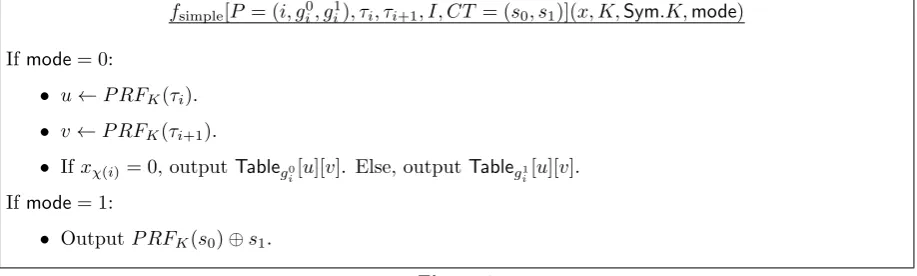
Function family Fsimple. Given, the function Table, we can now replace the generic function family FCRFE (consisting of functions Encode) used in our transformation in Section 3 with a simple function family Fsimple consisting of functions fsimple described in Figure 3. We replace
the generic encryption scheme used in Encodewith the concrete symmetric encryption scheme defined in [Gol09], where an encryption of a messagem is (s, P RFK(s)⊕m).
fsimple[P = (i, gi0, gi1), τi, τi+1, I, CT = (s0, s1)](x, K,Sym.K,mode)
Ifmode= 0:
• u←P RFK(τi). • v←P RFK(τi+1).
• Ifxχ(i)= 0, output Tableg0
i[u][v]. Else, outputTableg1i[u][v].
Ifmode= 1:
• OutputP RFK(s0)⊕s1.
Figure 3
By making the above modifications in our transformation, we obtain the following theorem:
Theorem 4 Let Fsimple be the function family described in Figure 3. A public-key FE scheme
for Fsimple with selective-security against unbounded collusions implies a compact FE scheme for NC1 with selective-security.
Garbled circuits. We show that Yao’s garbled circuits [Yao86] can be viewed as an instan-tiation of the Program Decomposable RE scheme we define in Section 3. Before we show this, we briefly recall the notion of garbled circuits. We first define an encoder that takes as input a circuitCand inputx. In the following description, we assume thatChas fan-in 2 and fan-out 1. The encoder then computes an encoding ofC(x) as follows. First, two wire keys are associated to every wire denoting bits 0 and 1.
1. A table of ciphertexts is then created for every gate in the circuit. To be more precise, there is a PPT algorithm GateGarb that takes as input a description of gateG, keys (K0a, K1a) corresponding to its first input wire wa, keys (K0b, K1b) corresponding to its first second
wire wb and keys (K0c, K1c) corresponding to its output wire wc of G. It then outputs a tableTG. We denote the randomness taken byGateGarbto be rG. It is important to note here that |rG|depends only on λ(and not on the size of C).
2. There is a deterministic procedure ChooseInp that chooses one of the input wire keys corresponding to the appropriate bit of x. That is, ChooseInp takes as input Wi, the description ofith input wire of C, along with its associated keys (Ki
0, K1i) and it outputs
the key Kxii.
So the final garbled circuit is{TG}G∈Gates(C),
Kxii i∈[|x|],whereGates(C) is a set of all gates inC.
• Decomp(C): It takes as input a circuit C. The program components are nothing but the
gates in C and its input wires. That is,P=n{PG=G}G∈Gates(C),{Pi}i∈[`inp] o
, wherePi
is the description ofithinput wire ofCand`inpis the input length ofC. We now deal with
computing the set systems. We first construct a stringr. This string is made up of blocks, one for every gate and every input wire ofC. A block corresponding to a gateG, denoted by BlockG, contains the wire keys of G’s input wires and its output wire. Furthermore,
BlockG also containsrG which is the randomness used by GateGarb to compute the table of ciphertexts corresponding toG. We note that two blocks corresponding to two different gates could contain same strings. For example, let the output wire ofGbe fed to the gate
G0 through the wirew. Then, both BlockG and BlockG0 contain wire keys ofw. A block
corresponding to theithinput wire keyw
i ofG, denoted byBlocki, contains the wire keys corresponding towi.
Let`R=|r|. The setSG⊆[`R] comprises of all the positions inr corresponding toBlockG -substring ofr. Further the set Si, associated to theith input wire of C, comprises of all the positions inr corresponding toBlocki-substring ofr. It then computes the set system
S =
n
{SG}G∈Gates(C),{Si}i∈[`inp] o
. On the other hand, Ii ={i} for alli∈[`inp]. The set
systemI is then set to be{Ii}i∈[`inp].
Finally, it outputs{PG}G∈Gates(C),S,I, `R
.
• PrgEnc(Pi, xi;ri =r|Si): It takes as input program component Pi, input bit xi and
ran-domness ri. IfPi is a gate, it does the following. It parses ri as a sequence of wire keys, denoted by K, and stringrG. It then executes GateGarb(Pi,K;rG) and the resulting TG is output. Else ifPi is an input wire key, it executesChooseInp(Pi, ri) to obtainKxii which
is then output.
• Dec{TG}G∈Gates(C),
Ki
xi i∈[`inp]
: It takes as input table of ciphertexts w.r.t to every
gateGin the circuit and input wire keysKxii. It then executes the garbled circuit decoding procedure to recover the output y.
5
Implications to
iO
Here we state the implications of our main result towards achieving general-purposeiO.
iO from Collusion-Resistant FE. We first recall the main result of [AJ15,BV15a]:
Theorem 5 ([AJ15, BV15a]) Public-key compact FE for NC1 with sub-exponential security in the selective model for a single key query implies iO for P/Poly.
Combining Theorem5 with our transformation from Section 3, we obtain the following:
Theorem 6 Public-key FE forNC1 with sub-exponential security in the selective model against unbounded collusions implies iOfor P/Poly.
Combining Theorem4 in Section4 with Theorem5, we obtain:
References
[AB15] Benny Applebaum and Zvika Brakerski. Obfuscating circuits via composite-order
graded encoding. InTCC, 2015.
[ABSV15] Prabhanjan Ananth, Zvika Brakerski, Gil Segev, and Vinod Vaikuntanathan. From selective to adaptive security in functional encryption. InCRYPTO, 2015.
[AGIS14] Prabhanjan Ananth, Divya Gupta, Yuval Ishai, and Amit Sahai. Optimizing obfus-cation: Avoiding barrington’s theorem. In Proceedings of the 2014 ACM SIGSAC Conference on Computer and Communications Security, pages 646–658. ACM, 2014.
[AIK04] Benny Applebaum, Yuval Ishai, and Eyal Kushilevitz. Cryptography in nc0. In
45th Symposium on Foundations of Computer Science (FOCS 2004), 17-19 October 2004, Rome, Italy, Proceedings, pages 166–175, 2004.
[AIK06] Benny Applebaum, Yuval Ishai, and Eyal Kushilevitz. Computationally
pri-vate randomizing polynomials and their applications. Computational Complexity, 15(2):115–162, 2006.
[AJ15] Prabhanjan Ananth and Abhishek Jain. Indistinguishability obfuscation from com-pact functional encryption. In CRYPTO, 2015.
[App11] Benny Applebaum. Randomly encoding functions: A new cryptographic paradigm
- (invited talk). InInformation Theoretic Security - 5th International Conference, ICITS 2011, Amsterdam, The Netherlands, May 21-24, 2011. Proceedings, pages 25–31, 2011.
[App14] Benny Applebaum. Bootstrapping obfuscators via fast pseudorandom functions.
InAdvances in Cryptology - ASIACRYPT 2014 - 20th International Conference on the Theory and Application of Cryptology and Information Security, Kaoshiung, Taiwan, R.O.C., December 7-11, 2014, Proceedings, Part II, pages 162–172, 2014.
[Bar86] David A. Mix Barrington. Bounded-width polynomial-size branching programs
recognize exactly those languages in nc1. InProceedings of the 18th Annual ACM Symposium on Theory of Computing, May 28-30, 1986, Berkeley, California, USA, pages 1–5, 1986.
[BCG+11] Nir Bitansky, Ran Canetti, Shafi Goldwasser, Shai Halevi, Yael Tauman Kalai, and Guy N. Rothblum. Program obfuscation with leaky hardware. In Advances in Cryptology - ASIACRYPT 2011 - 17th International Conference on the Theory and Application of Cryptology and Information Security, Seoul, South Korea, December 4-8, 2011. Proceedings, pages 722–739, 2011.
[BGJ+15] Nir Bitansky, Shafi Goldwasser, Abhishek Jain, Omer Paneth, Vinod Vaikun-tanathan, and Brent Waters. Time-lock puzzles from randomized encodings.IACR Cryptology ePrint Archive, 2015:514, 2015.
[BGK+14] Boaz Barak, Sanjam Garg, Yael Tauman Kalai, Omer Paneth, and Amit Sahai.
Protecting obfuscation against algebraic attacks. InAdvances in Cryptology - EU-ROCRYPT 2014 - 33rd Annual International Conference on the Theory and Ap-plications of Cryptographic Techniques, Copenhagen, Denmark, May 11-15, 2014. Proceedings, pages 221–238, 2014.
[BGL+15] Nir Bitansky, Sanjam Garg, Huijia Lin, Rafael Pass, and Siddartha Telang. Suc-cinct randomized encodings and their applications. InSTOC, 2015.
[BMR90] Donald Beaver, Silvio Micali, and Phillip Rogaway. The round complexity of secure protocols (extended abstract). InProceedings of the 22nd Annual ACM Symposium on Theory of Computing, May 13-17, 1990, Baltimore, Maryland, USA, pages 503– 513, 1990.
[BR14] Zvika Brakerski and Guy N. Rothblum. Virtual black-box obfuscation for all cir-cuits via generic graded encoding. In TCC, pages 1–25, 2014.
[BS15] Zvika Brakerski and Gil Segev. Function-private functional encryption in the
private-key setting. InTCC, 2015.
[BSW11] Dan Boneh, Amit Sahai, and Brent Waters. Functional encryption: Definitions
and challenges. In Theory of Cryptography, pages 253–273. Springer, 2011.
[BV15a] Nir Bitansky and Vinod Vaikuntanathan. Indistinguishability obfuscation from
functional encryption. InFOCS, 2015.
[BV15b] Nir Bitansky and Vinod Vaikuntanathan. Indistinguishability obfuscation from
functional encryption. Cryptology ePrint Archive, Report 2015/163, 2015. http: //eprint.iacr.org/.
[BWZ14] Dan Boneh, David J. Wu, and Joe Zimmerman. Immunizing multilinear maps
against zeroizing attacks. IACR Cryptology ePrint Archive, 2014:930, 2014. [CGH+15] Jean-S´ebastien Coron, Craig Gentry, Shai Halevi, Tancr`ede Lepoint, Hemanta K.
Maji, Eric Miles, Mariana Raykova, Amit Sahai, and Mehdi Tibouchi. Zeroizing without low-level zeroes: New MMAP attacks and their limitations. InCRYPTO, 2015.
[CHL+15] Jung Hee Cheon, Kyoohyung Han, Changmin Lee, Hansol Ryu, and Damien Stehl´e. Cryptanalysis of the multilinear map over the integers. In EUROCRYPT, 2015.
[CHV15] Aloni Cohen, Justin Holmgren, and Vinod Vaikuntanathan. Publicly verifiable
software watermarking. IACR Cryptology ePrint Archive, 2015:373, 2015.
[CLT13] Jean-S´ebastien Coron, Tancr`ede Lepoint, and Mehdi Tibouchi. Practical multi-linear maps over the integers. In Advances in Cryptology - CRYPTO 2013 - 33rd Annual Cryptology Conference, Santa Barbara, CA, USA, August 18-22, 2013. Proceedings, Part I, pages 476–493, 2013.
[CLT14] Jean-S´ebastien Coron, Tancr`ede Lepoint, and Mehdi Tibouchi. Cryptanalysis of two candidate fixes of multilinear maps over the integers. IACR Cryptology ePrint Archive, 2014:975, 2014.
[CLT15] Jean-S´ebastien Coron, Tancr`ede Lepoint, and Mehdi Tibouchi. New multilinear maps over the integers. In CRYPTO, 2015.
[CLTV15] Ran Canetti, Huijia Lin, Stefano Tessaro, and Vinod Vaikuntanathan. Obfuscation of probabilistic circuits and applications. InTheory of Cryptography - 12th Theory of Cryptography Conference, TCC 2015, Warsaw, Poland, March 23-25, 2015, Proceedings, Part II, pages 468–497, 2015.
[GGH13a] Sanjam Garg, Craig Gentry, and Shai Halevi. Candidate multilinear maps from
ideal lattices. In Thomas Johansson and Phong Q. Nguyen, editors, Advances in Cryptology - EUROCRYPT 2013, 32nd Annual International Conference on the Theory and Applications of Cryptographic Techniques, Athens, Greece, May 26-30, 2013. Proceedings, volume 7881 ofLecture Notes in Computer Science, pages 1–17. Springer, 2013.
[GGH+13b] Sanjam Garg, Craig Gentry, Shai Halevi, Mariana Raykova, Amit Sahai, and Brent
Waters. Candidate indistinguishability obfuscation and functional encryption for all circuits. In 54th Annual IEEE Symposium on Foundations of Computer Sci-ence, FOCS 2013, 26-29 October, 2013, Berkeley, CA, USA, pages 40–49. IEEE Computer Society, 2013.
[GGH15] Craig Gentry, Sergey Gorbunov, and Shai Halevi. Graph-induced multilinear maps from lattices. InTheory of Cryptography - 12th Theory of Cryptography Conference, TCC 2015, Warsaw, Poland, March 23-25, 2015, Proceedings, Part II, pages 498– 527, 2015.
[GGHR14] Sanjam Garg, Craig Gentry, Shai Halevi, and Mariana Raykova. Two-round
se-cure MPC from indistinguishability obfuscation. InTheory of Cryptography - 11th Theory of Cryptography Conference, TCC 2014, San Diego, CA, USA, February 24-26, 2014. Proceedings, pages 74–94, 2014.
[GGHZ14] Sanjam Garg, Craig Gentry, Shai Halevi, and Mark Zhandry. Fully secure func-tional encryption without obfuscation. IACR Cryptology ePrint Archive, 2014:666, 2014.
[GHMS14] Craig Gentry, Shai Halevi, Hemanta K. Maji, and Amit Sahai. Zeroizing
with-out zeroes: Cryptanalyzing multilinear maps withwith-out encodings of zero. IACR Cryptology ePrint Archive, 2014:929, 2014.
[GJKS15] Vipul Goyal, Abhishek Jain, Venkata Koppula, and Amit Sahai. Functional en-cryption for randomized functionalities. In Theory of Cryptography - 12th Theory of Cryptography Conference, TCC 2015, Warsaw, Poland, March 23-25, 2015, Proceedings, Part II, pages 325–351, 2015.
[GKP+13] Shafi Goldwasser, Yael Tauman Kalai, Raluca A. Popa, Vinod Vaikuntanathan, and Nickolai Zeldovich. Reusable garbled circuits and succinct functional encryp-tion. In Dan Boneh, Tim Roughgarden, and Joan Feigenbaum, editors,Symposium on Theory of Computing Conference, STOC’13, Palo Alto, CA, USA, June 1-4, 2013, pages 555–564. ACM, 2013.
[GLSW15] Craig Gentry, Allison B. Lewko, Amit Sahai, and Brent Waters. Indistinguishabil-ity obfuscation from the multilinear subgroup elimination assumption. In FOCS, 2015.
[Gol09] Oded Goldreich. Foundations of Cryptography: Volume 2, Basic Applications,
volume 2. Cambridge university press, 2009.
[GVW12] Sergey Gorbunov, Vinod Vaikuntanathan, and Hoeteck Wee. Functional encryption with bounded collusions via multi-party computation. InAdvances in Cryptology -CRYPTO 2012 - 32nd Annual Cryptology Conference, Santa Barbara, CA, USA, August 19-23, 2012. Proceedings, pages 162–179, 2012.
[Had00] Satoshi Hada. Zero-knowledge and code obfuscation. In Advances in Cryptology
- ASIACRYPT 2000, 6th International Conference on the Theory and Applica-tion of Cryptology and InformaApplica-tion Security, Kyoto, Japan, December 3-7, 2000, Proceedings, pages 443–457, 2000.
[IK00] Yuval Ishai and Eyal Kushilevitz. Randomizing polynomials: A new representation with applications to round-efficient secure computation. In41st Annual Symposium on Foundations of Computer Science, FOCS 2000, 12-14 November 2000, Redondo Beach, California, USA, pages 294–304, 2000.
[Kil88] Joe Kilian. Founding cryptography on oblivious transfer. In Proceedings of the 20th Annual ACM Symposium on Theory of Computing, May 2-4, 1988, Chicago, Illinois, USA, pages 20–31, 1988.
[KSY15] Ilan Komargodski, Gil Segev, and Eylon Yogev. Functional encryption for random-ized functionalities in the private-key setting from minimal assumptions. InTheory of Cryptography - 12th Theory of Cryptography Conference, TCC 2015, Warsaw, Poland, March 23-25, 2015, Proceedings, Part II, pages 352–377, 2015.
[NW15] Ryo Nishimaki and Daniel Wichs. Watermarking cryptographic programs against
arbitrary removal strategies. IACR Cryptology ePrint Archive, 2015:344, 2015.
[O’N10] Adam O’Neill. Definitional issues in functional encryption.IACR Cryptology ePrint Archive, 2010:556, 2010.
[SS10] Amit Sahai and Hakan Seyalioglu. Worry-free encryption: functional encryption with public keys. In Proceedings of the 17th ACM Conference on Computer and Communications Security, CCS 2010, Chicago, Illinois, USA, October 4-8, 2010, pages 463–472, 2010.
[SW05] Amit Sahai and Brent Waters. Fuzzy identity-based encryption. In Advances in
Cryptology - EUROCRYPT 2005, 24th Annual International Conference on the Theory and Applications of Cryptographic Techniques, Aarhus, Denmark, May 22-26, 2005, Proceedings, pages 457–473, 2005.
[SW14] Amit Sahai and Brent Waters. How to use indistinguishability obfuscation:
de-niable encryption, and more. In David B. Shmoys, editor, Symposium on Theory of Computing, STOC 2014, New York, NY, USA, May 31 - June 03, 2014, pages 475–484. ACM, 2014.
[SZ14] Amit Sahai and Mark Zhandry. Obfuscating low-rank matrix branching programs.
Technical report, Cryptology ePrint Archive, Report 2014/773, 2014. http://eprint. iacr. org, 2014.
[Wat14] Brent Waters. A punctured programming approach to adaptively secure functional encryption. In CRYPTO, 2014.
[Yao86] Andrew Chi-Chih Yao. How to generate and exchange secrets (extended abstract). In FOCS, pages 162–167, 1986.
[Zim15] Joe Zimmerman. How to obfuscate programs directly. In EUROCRYPT, 2015.
A
Bootstrapping Theorem for iO
In this section, we prove a bootstrapping theorem for iO. Concretely, we show how to construct FE for Fsimple from iO for function familyF. This, when combined with our main result yields iO for arbitrary circuits.
Prior works [GGH+13b, Wat14] present constructions of FE based on iO and additional well studied cryptographic assumptions. Of particular interest is the work of [Wat14] who show how to build FE based on iO and one-way functions. Using this work, we get a bootstrapping theorem for iO: from [Wat14], we have FE forFsimplefrom iO forF (whereF is described next) and then using the result on iO for P/poly from FE forFsimple, we achieve iO for P/poly from iO for F.
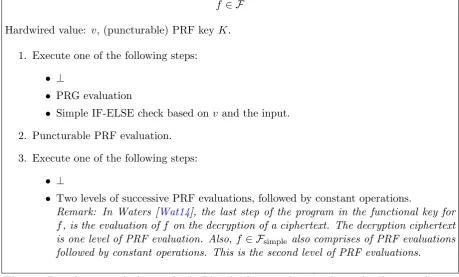
We describe the function family F in Figure 4 that is sufficient to obtain FE for Fsimple
via [Wat14]. In [Wat14], there are different functions that are obfuscated as part of the public key and the functional key whose description also change in the hybrids. We take all this into account while designing the template for all functions inFsimple. Furthermore, in the description of the obfuscated program as part of the functional key forf, we substitutef with the concrete functions in Fsimple.
We formally state the bootstrapping theorem below.
Theorem 8 For any circuit class C={C:{0,1}n→ {0,1}}, there exists an iO scheme forC
f ∈ F
Hardwired value: v, (puncturable) PRF keyK.
1. Execute one of the following steps:
• ⊥
• PRG evaluation
• Simple IF-ELSE check based onv and the input.
2. Puncturable PRF evaluation.
3. Execute one of the following steps:
• ⊥
• Two levels of successive PRF evaluations, followed by constant operations.
Remark: In Waters [Wat14], the last step of the program in the functional key for
f, is the evaluation off on the decryption of a ciphertext. The decryption ciphertext is one level of PRF evaluation. Also, f ∈ Fsimple also comprises of PRF evaluations
followed by constant operations. This is the second level of PRF evaluations.
Figure 4Every function in the function familyF has the above template. ⊥indicates that this particular step is empty.
A consequence of the above theorem is that for every (sufficiently large) input length n ∈ N, in order to obfuscate C ∈ P/poly it suffices to obfuscate a class of functions whose size is a