Journal of
RANGE MANAGEMENT Vozu~ZbeCZier
5
Range Management in the United States for the Next
One to Three Generations ______.____________________.__---.____---..._-__. _.______ Marion Clawson
Canada’s Rangeland Resources-A Look Ahead ___.__._______________ _____________ Alex Johnston
Price Elasticity of Demand for Beef and Range Improvement Decisions
John P. Workman, Sam L. King, and Jack F. Hooper
Problems in Commercial Hunting Systems: South Dakota and Texas Compared
Kieth E. Severson and F. Robert Gartner
Guidelines for Grazing Sheep on Rangelands Used by Big Game in Winter
Charles H. Jensen, Arthur D. Smith, and George W. Scatter
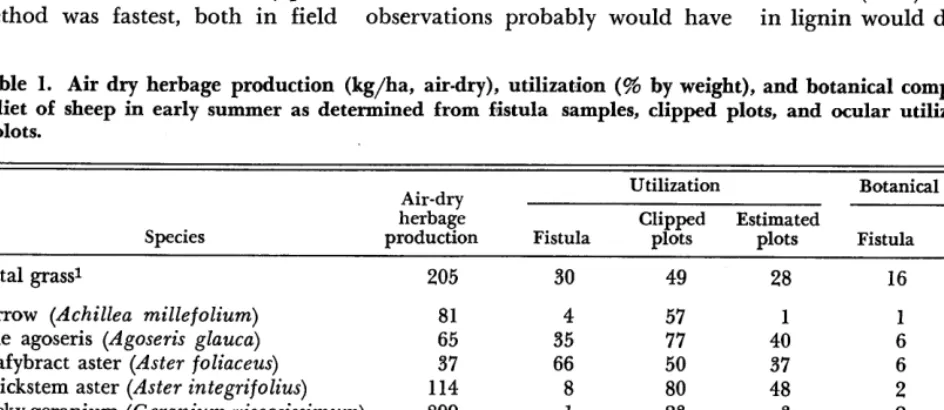
Three Methods for Determining Diet, Utilization, and Trampling Damage on Sheep Ranges ____ William A. Laycock, Hayle Buchanan, and William C. Krueger
Flushing of Range Ewes by Supplementation, Drylot Feeding, or
Grazing of Improved Pasture ____________ D. T. Torell, I. D. Hume, and W. C. Weir
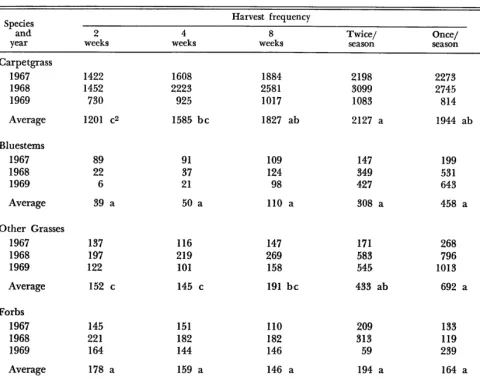
Production and Persistence of Common Carpetgrass sin Relation to
Site and Harvest Frequency ____________________---___---__----___-_----_____---.-- Gale L. Wolters
Some Factors Influencing
Three Range Grasses Tolerance to _____ Moisture Stress of Edward F. Schlatterer and M. Hironaka
Fate of Fertilizer Nitrogen Applied to a Northern
Great Plains Rangeland Ecosystem _____________ _.._ ______________.______..___.___.______.. J. F. Power
Influence of Repeated Annual Burning on a Medusahead Community
James A. Young, Raymond A. Evans, and John Robison
Energy Fixation and Precipitation-Use Efficiency in a Fertilized Rangeland Ecosystem of the Northern Great Plains ______ _.__ ----
J-
Ross Wight and A. L. BlackVegetation Changes as a Result of Soil Ripping on the
Rio Puerto in New Mexico ___.______.._____ __._.__ ____ Earl F. Aldon and George Garcia 381 328 333 338 342 346 352 357 360 364 367 372 376
Factors Affecting Germination, Emergence and Establishment
of Sand Bluestem ____________________________..____ J. Stubbendieck and Wayne G. McCully 383
Herbicide Interactions in Control of Sand Shinnery Oak _.____________________ C. J. Scifres 386
Salt Tolerance and Cation Interaction in Alkali Sacaton
at Germination __________._________________________._______________ S. Z. Hyder and Shamsa Yasmin 390
A Method for Measuring Soil Erosion and Deposition with Beta Particle
Attenuation _______.____________________________ A. William Alldredge and F. Ward Whicker 393
Estimating Forage Production from Shrub Ring Widths in Hot Creek Valley,
Nevada _______________________-____ J. Barry Davis, Paul T. Tuel.ler, and Allen D. Bruner 398
Technical Notes
Western Coneflower-A Noxious Species?
Arturo Florez, W. T. McDonough, and L. D. Balls 403
Electric Shears for Plot Harvesting ____________________________________________________ L. A. Daigger 404
Construction and Use of an Inexpensive Rain Gauge ________ Paul D. Ohlenbusch 405
Book Reviews _____________________-____________________________________________________________________________________________________ 406
Cover
Photo-s
ummer Range in Lostine Canyon,
Wallowa Mountains, Oregon.Range Management in the United States for
the Next One to Three Generations1
MARION CLAWSON
Resources for the Future, Washington, D.C.
It is difficult to project the longer run future with any assurance, whether one is concerned with rangeland or with any other natural resource. One has only to recall the great changes that the past one to three generations have brought in every aspect of our lives; he would be wise to assume that the next one to three generations will bring equally great changes. The recent past was not, and could not be, accurately foreseen at the begin- ning of any past period; and today we are uncertain about the nature of future changes, while at the same time assuming they will be very great.
Let us start by briefly recalling some attributes of life in the United States in 1900. In 1900, the total population of the United States was 76 million people; today it is over 200 million. In 1900, the gross na- tional product in current prices was about $20 billion, today in current prices it is about $1,000 billion, or apparently 50 times as much; even at constant prices it would be well over 10 times as much. In 1900 there were only 8,000 registered cars in all of the United States; today, there are over SO million. In 1900 there were no airplanes-the Wright brothers had not yet made their historic flight; today, there are 150,000 airplanes, some with wing span greater than the length of the first flight. In 1900, and long there- after, there were no space vehicles; today, we have landed several men on the moon, and brought them back safely. In 1900, there was no frozen food industry, no radio, no television, nor any of scores of other production and consumption tech-
l Presented at the 25th Annual Meet- ing of the Society for Range Manage- ment, February 4-11, 1972, Washing- ton, D.C.
nologies that we take for granted today. And the paid vacation was almost unknown-college professors and other teachers got “vacations,” but without pay; and the average work week was 60 hours, today it is about 40.
And one could go on and on, con- trasting the situation 70 years ago
with that of today. Americans today are more numerous, have higher incomes, are more mobile, travel far more, and have an enormous range of gadgets in their daily lives, com- pared with a few generations ago. In another 70 years, by 2040, there will almost surely be more people in the United States than now-how many more, depends upon our reproductive habits, but a population of at least 300 million is highly probable, 400 million not unlikely, more entirely possible. National income, in total and per capita, will almost surely be higher than now-very much higher, prob- ably. Our children and grandchil- dren may well choose to use much of their higher productivity per manhour by increasing their leisure rather than by increasing their con- sumption of goods, but we cannot be certain of this either. There is every reason to believe that our technology then will be more ad- vanced than now, in ways we do not now foresee. We live in a dy- namic and changing world, and the future is as exciting and as un- known for us as it was for our grandfathers.
Within the range livestock indus- try, these past 70 years have also seen vast changes. The national forests were only partly established in 1900, now they are fully so. In 1900, the grazing districts were un- known; now all the federal land suitable for grazing use is included within them. In 1900, a lot of what is now privately-owned range, espe-
328
cially on the Great Plains but else- where as well, was still public do- main, fast being transferred into private ownership. In 1900, there were 60 million cattle of all ages in the United States; today there are over 110 million head. The type of cattle has changed. In 1900, there had been no range survey, and the idea of managing grasslands and other natural ranges scarcely existed. In the intervening years, science has been applied to range management and to livestock pro- duction, with great results. Mar- kets for the range livestock have changed, in location and in type. One of the major changes over the past 70 years, and more particu- larly over the past decade, has been the rise in popular support for con- servation. There were great conser- vationists before 1900 and in that year, and there was some popular support. But the average man today gets onto the land and into the forests in a way that was undreamt of two generations ago. Threats to the environment have arisen from many sources, including some from our new technologies, and many new demands are being made upon our natural resources. Whereas use and management of land, forests, and water was once considered the sole prerogative of the owner, today many people who neither own nor directly use such resources neverthe- less have very definite ideas about how they should be managed. One can assume that such interest will increase in the future.
Range Management is Practical Ecology
FUTURE RANGE MANAGEMENT 329
tations of most range areas must be added some economic ones: range areas are, by and large, lands of low physical productivity. A range which yields a ton of harvestable air-dry forage per acre is tremen- dously productive; the average acre in grazing districts produces less than 100 pounds. Not only is the tonnage low, but these are rough- ages-valuable livestock feed, but not concentrated feed. Most range- land responds only modestly to added inputs of labor, capital, and management. Even if some range management practice can double output, this is still only a limited weight of forage per unit of land area. As a consequence, the rancher cannot afford to undertake expen- sive programs on most range. And, of course, such a low output per acre means that the plant growth can be harvested only by grazing ani- mals. This inevitably leads the rancher and the range manager into livestock operations, with all their specialized technical problems.
In thus stressing the practical ecology aspect of range manage- ment, I do not in the least suggest that all past rancher and specialist management of rangeland has been good ecology. As we all know, in altogether too many instances the ranges have been overgrazed, or grazed at improper seasons, or otherwise mismanaged, with conse- quent loss of productive plants and often with damage to the soil as well. Much of this mismanagement arose from lack of knowledge; some came from lack of control over land use-if one man’s cattle did not graze all the grass, someone else’s cattle did. My experience and re- search lead me to the conclusion that range managers as a whole have been neither better nor worse than crop farmers as a whole or than foresters as a whole. In the frontier era of American history, natural resources were relatively plentiful, capital and labor were generally scarce, and exploitation for immediate gain was economi- cally advantageous and some times necessary. Modern range manage-
ment has opened up many possi- bilities for achieving more output from rangeland today while at the same time maintaining or building up productivity for the future. The low point in conservation of crop- land, forests, and rangeland seems to have been the 1920s; since then there has been modest improvement for all three, though conditions are far from fully satisfactory today.
Rangeland management of the past was directed primarily toward the output of domestic livestock, Some, not primary, attention was given to game animals and water- shed effects. Chemicals were used to control unwanted plant species, or to control predators, or for other purposes. The pollution problems which draw so much attention today were often largely ignored. As we move into a new social and eco- nomic era, the ecological require- ments of range management have changed, and will change still more. But good range management can never ignore the economics of in- puts to the land, and outputs from it-whether the outputs be only beef, or include also various recrea- tional, aesthetic, and other values. These latter outputs are not infi- nitely valuable, one must consider what he gets for the expenditures he makes.
Projections of the Future
There is a continuum from the past to the present to the future; our only real guide to the future lies in our understanding of the past and present. We often do not understand the past, sometimes we even try to ignore it; our under- standing of the present world in which we live is often deficient-as participants, we are not good ob- servers. Our efforts to project the future are often severely inhibited by our preoccupation with the pres- ent-and with the present as we see it from our unavoidably rather re- stricted viewpoint. We usually find it difficult to imagine a future which differs greatly from the present; more commonly, we antic-
ipate modest changes of the present situation.
Though they may be difficult to foresee in general, and impossible to foresee in detail, yet the major innovations and changes of the fu- ture may dominate it. For instance, in 1900 it would have been impos- sible to foresee all the changes in sources and amounts of energy which would develop in the ensuing 70 years; as far as I know, no stu- dent of energy problems of that day foresaw anything remotely ap- proaching what has actually hap- pened. But a wild blue yonder guess about sources and uses of energy would almost surely have proven more accurate than a sober and modest extension of the situa- tion of 1900 and of recent trends to that date. Likewise today, we are caught up in many problems of energy production, transmission, and use, including many pollution problems. Most projections include a trend toward more and more energy, from sources now in use or on the horizon of use; but might the course of events be quite dif- ferent-some wholly new sources, or some actual reduction in energy use, or something else equally un- foreseen now? I do not know; I cannot imagine what the drastically new sources or uses might be; but I do know that in the past the un- foreseeable has often become the actual, and in the process made a mockery of sober calculations.
330
CLAWSON
Traditional Outputs of Rangeland As long as the sun shines and the rain falls, grass and other range for- age will grow; and I cannot imagine a world where some, if not all, that is harvestable will actually be used to produce domestic livestock and game animals. Beef, lamb, and wool are the traditional outputs of the range country, and I think it certain they will continue so. But there may be-indeed, it is highly likely that there will be-substantial changes in the way the range is managed, the amount of harvestable forage produced, the way the live- stock are operated, and the amount and kind of turnoff.
The Forest Service and the Eco- nomic Research Service have been engaged in a comprehensive study of rangeland possibilities--the For- est-Range Environmental Study, which comes down to FRES (some- one must have gotten a meritorious promotion for thinking up that one!). I shall not attempt to sum- marize its findings, which have been reported only preliminarily until now. But, in general, FRES shows that the rangeland of the United States could be made to produce a great deal more forage, which could be the basis for a much enlarged out- put of range livestock. To produce more, the rangelands would require considerable investment of capital and labor, as well as the conversion of some land from primarily forest to primarily range production, with consequent loss of needed forest products output. The production capabilities of range differ greatly according to site and vegetation characteristics; the precise combina- tion of inputs to achieve the poten- tial would likewise vary greatly.
The physical potentialities of rangeland, while important, are only part of the story; the markets for the output, and the economics of producing it, are equally impor- tant. On the market side, range- land is in a fairly strong position. The demand for beef (the principal range output) is strong and is likely to continue so; as their incomes rise, Americans consume more beef and
better grades of beef. One need only go to a supermarket today, to find best grades of beef selling for as much as $3 per pound, and to see people buying such expensive beef, to realize that the demand is indeed high. More people and more income per capita will surely add up to a much higher demand for beef in the future. This is not contradictory with the possibility of temporary or shortrun reductions in beef or cattle prices. For a great many farm commodities-wheat and potatoes, to use but two examples- demand is comparatively insensitive to income levels of consumers, and total consumption will not rise more than total population in- creases, and may rise less. Among the many farm commodities, beef is in a pretty good position to bene- fit from rising average per capita incomes.
Though great increases in phys- ical output of rangelands are possi- ble, will they be profitable? Here, one must remember again that rangelands produce a small phys- ical output per acre; one must be careful about spending more to increase forage yields than the in- creased forage is worth. Moreover, range people must remember that much beef is produced from farm pastures and crops; range is an im- portant area of origin for beef, but far from the only one. Great in- creases in physical output of farm pastures and croplands are also pos- sible; could they be achieved more cheaply than the same increases in output from the rangelands? I do not know, this is not the time or place for a detailed review of the economics of beef production, and I suspect that such a review would be inconclusive in any case. Only time will tell whether range or farm pasture can produce beef more cheaply in the future.
One of the major developments in beef production of the past two decades or so has been the rise of the very large feedlot, where many thousands of head of cattle are fed each year. Economies of scale in use of labor have been one major
factor leading to the development of such large feedlots, but various technological developments have also been a factor. It is generally agreed that such large feedlots can produce beef economically, but it is becoming apparent that the pol- lution arising out of such enter- prises must be controlled and that this will cost money, perhaps seri- ously reducing the relative econ- omies of such large operations. Can we possibly devise some way that cattle can be fed and fattened, while on the range, from feed pro- duced elsewhere, with the manure returned naturally to the land to its benefit, and all at a profitable rela- tion between cost and output? I confess, I do not know of any such development on the horizon, and I can see major economic problems in any such attempt. But. might it be possible to process common farm feed crops such as corn or sorghum into some form that could be dis- tributed over the range from air- planes, letting the cattle feed them- selves, eliminating the pollution problem, and the whole operation economically profitable? This is the type of wild dream, probably infeasible, but truly major in its consequences, that I was alluding to earlier. I leave it to you to poke the idea full of holes, or just possi- bly to make it practical.
FUTURE RANGE MANAGEMENT 331
on the average ranch or the average acre of rangeland. There surely is room for all the professional and technical knowledge and compe- tence the range management pro- fession possess or can acquire-not all the discoveries have been made yet, by any means!
Rangeland Uses of Growing Importance
To the traditional output of domestic livestock from rangeland must be added some other out- puts of recently growing impor- tance; I refer particularly to water- shed values, outdoor recreation, aesthetic values, and environmental concerns generally. In the past quarter century, these values have come very much to the fore, and we can expect, I think, a continued rise in their importance; range man- agement in the future will have to deal with such values increasingly.
The extensive rangelands of the United States obviously have consid- erable watershed, recreational, and aesthetic values; but they also have some limitations for these uses. The situation differs enormously for different range types. The high mountain meadows have an ex- tremely important watershed, recre- ation, and aesthetic function, to use but one example. Such lands will be in increasing demand for these outputs, often to the extent that traditional livestock production from such ranges must be materially modified or even eliminated. In contrast, much of the lower foot- hills in the West, with their pinion- juniper forage types, yield relatively little water but often produce a good deal of sediment in the streams and have only limited recreational values. Likewise, much of the Great Plains are not attractive to the or- dinary recreationist, nor are they located close to large population centers, hence their total recreation value is relatively low.
The rise in these demands for watershed, recreation, and aesthet- ics have raised many difficult ques- tions of rangeland management. How can one realistically measure
the value or the importance of these land uses, particularly since these outputs are not sold in the market? How can one measure the worth of these outputs, against the value of beef or other traditional outputs, when it comes to a choice between them? How can one measure the value of these outputs, as compared with the cost of the added inputs necessary to produce them? These are difficult questions, partly tech- nical, partly economic.
In the past two decades, the tools of economic analysis have gradually been brought to bear on some of these problems. I am proud that I have been able to play a role in such application of economic analy- sis to the problems of land man- agement, especially for these non- marketed outputs. I think that benefit-cost analysis, which includes all the benefits and all the costs, whether bought or sold in the mar- ket place, has much to contribute to the management of these re- sources. But most economic analy- sis has been deficient, even in strictly economic terms. It is not enough to know that the total value of all outputs, marketed and nonmar- keted, is greater then the cost of the inputs necessary to produce such outputs; one must go further, and ask: who bears these costs? who gets these benefits? do some groups bear the costs and others get the benefits? can the cost-bear- ing and the benefit-receiving be brought nearer into coincidence? by what institutional devices, if any, can more equitable arrangements for cost-bearing and value-sharing be developed? In practice, a great deal of the benefits of watershed management, recreation, aesthetics, and the like have been received by groups and individuals who pay little or nothing toward the costs. As long as some or all of these out- puts from rangeland are free, or nearly so, to the beneficiaries, then the demand for them will rise and will be, to some extent, irresponsi- ble. No output of rangeland, in- cluding water or aesthetic beauty, is free of cost to someone; unless
those who gain also bear some of the costs, rather directly, then they will urge land management prac- tices which they would not under- take if in fact they had to bear the costs.
It seems to me that range man- agers must be more alert to these relatively new demands on the rangeland than you have been in the past. We must recognize that times have changed since we older persons were young, that new values and new life styles have arisen, and that land and other resources must be managed in new ways. But we must insist that new land uses, how- ever strongly they may be urged by enthusiastic proponents, must be made to demonstrate their worth as compared with their cost and as compared with the uses they dis- place, and that some means must be found to pay the costs associated with these new uses, including the income foregone because of them.
Some Far-Out Future Possibilities for Rangeland
In addition to the traditional outputs of the range, and in addi- tion to some relatively new uses of growing importance, what far-out possibilities for the use of range might evolve, as we move into the Zlst century? Obviously, no one can know what such uses may be; perhaps we cannot even guess very intelligently; but, if my earlier state- ments are correct, it is to the far- out uses that one must look for really significant changes in the future. The difficulty is, what far- out possibilities really make sense? But let me cast caution to the winds, and conclude with a few speculations.
332 CLAWSON
livestock than the earnings of the ranch can possibly justify, as com- pared with other sources of invest- ment. Part of their income is psy- chic. Most such ranch owners do not scorn cash income from ranch operations, and they have a keen sense of how to manipulate the federal income tax laws to their advantage, but many of them would probably continue to operate the ranch even at a net cash loss (after taxes). In this regard, ranch-owning is akin to some forest landowning in the United States today; the usual economic returns are only a part of the reason for resource ownership and management.
How much further might this type of ranch ownership go, over the next several decades? What ef- fect will it have upon the use and conservation of rangeland? What effect will it have upon the com- mercial ranchers, those who try to make a living and a competitive return on their investment, from their ranch operations? These are not easy questions to answer, but range managers as a professional group should be aware of some of the possibilities in these directions.
How far, if at all, might the range country of the United States become the location for major fu- ture urban development? How far might New Towns be located in the Great Plains, the Intermountain country, or in the Southern range country? There is almost complete agreement among social scientists and planners that all net popula- tion growth in the future will be located in metropolitan areas. A metropolitan area, by definition, includes a major city of 50,000 or more population. While some cities smaller than 50,000 may increase in population, other small cities and open country will decrease in about the same proportion. There is a good deal of sentiment in the United States that there is some- thing undesirable about having a
large proportion of our total popu- lation living on a small proportion of our total land area. The evils and the problems of the cities are often used as an argument that population dispersal should be en- couraged. The range country is, by and large, thinly populated. Why not build some cities of modest size (say 100,000 to 200,000 population) in the range country, where the air is clean, the views are wonderful, and the highways are not crowded?
While the United States may well have some free-standing indepen- dent New Towns over the next several decades, the difficulties of building such towns are consider- able. Not only must they be reason- ably self-contained, as far as employ- ment and labor force are concerned, when they are completed, but they must also be in reasonable balance during their construction period. A New Town takes a lot of invest- ment before it begins to repay that investment; land assembly and land- holding during the long develop- ment period are also serious ob- stacles. By and large, the range country is not a likely place to put a New Town of 100,000 or more; many of the small cities in the range country have experienced consider- able difficulty in attaining an eco- nomic prosperity.
If some New Towns were built in the range country, their land area would be very small, in com- parison with the total range area; their direct impact upon rangeland would probably be small. But their indirect impacts might be large; the New Town would offer a type of urban contrast, relatively nearby, that might considerably affect ranch people. For instance, ranch owner- ship by urban people would be stim- ulated, if their city home were rea- sonably close to their ranch location.
Might the rangeland of the United States become the deposi- tory for a substantial part of the wastes of our industrial civiliza-
tion-a sort of garbage dump extra- ordinary? We are gradually begin- ning to realize that disposal of wastes or pollutants from industrial processes is not simple; nothing is ever really destroyed in a world where the law of the conservation of matter is still basic. We can transform the wastes into air or water pollutants, or we can bury them; and sometimes we can recycle them for another round of use. But we cannot really destroy them; they show up somewhere, in some form. Many of the complex chemicals from modern industry are partic- ularly hard to handle. Might we, as a Nation, locate some of our chemical industry plants in the closed watersheds of the Great Basin, where the pollutants could accumulate but not be inflicted on anyone else? Might some range areas become the sites for extensive landfills, to provide a home for the garbage of our Iarger cities? A pro- posal, to bury San Francisco’s gar- bage in a range area of northern California, was seriously considered only a few years ago; it was re- jected, not because infeasible, but because a cheaper site was found nearby. This idea that rangeland might become the garbage dump of the country will no doubt seem offensive to many range managers. I do not say it will happen; we may indeed develop recycling procedures
Canada’s Rangeland Resources-A
Look Ahead’
ALEX JOHNSTON
Range Ecologist, Research Station, Canada Department of Agriculture, Lethbridge, Alberta.
Highlight
Canada’s cattle population is ex- pected to increase from its present 13.7 million head to about 16.5 million head by 1980. About 5.3 million acres of additional pasture will be required to feed the extra cattle and most of it will come from land presently in grain. Range managers will be more con- cerned than formerly with cultivated pastures and hayland and the integra- tion of these with native range.
Canada is a very large country in terms of total area. But much of it is inhospitable to human settle- ment and unproductive of renew- able resources. Most of the popula- tion of 21.7 million live within one hundred miles of the International border. By the early 1980’s the population is expected to increase to about 28.0 million and disposa- ble income to rise about 70 percent. The per capita consumption of beef, now about 87 pounds, is expected to rise to 100 pounds by 1980 and to about 130 pounds by the end of the century. For various reasons, which include an advancing agricul- tural technology that is expected to accelerate, commodity surpluses, a growth in domestic food demand that is too slow to absorb surpluses, and rising self-sufficiency in less developed countries, farmers of the western prairies must reduce wheat acreage by about 10.0 million acres during the next few years. Present government policies are directed to the seeding of a large portion of this acreage to grass-legume mix- tures for livestock production. The Canadian dairy herd must be re- duced from its present 2.6 million cows to about 1.7 million by 1980 because of declining milk consump- tion and increased production per
l Presented at the 25th Annual Meet- ing of the Society for Range Manage- ment, February 4-11, 1972, Washing- ton D.C.
cow. Land and labor will become more costly (Task Force, 1969).
These are some of the forces that will affect the rangelands of Canada in the decades ahead.
Geographically, Canada can be divided into at least seven regions, each making its own distinctive contribution to the national scene. These are: the Atlantic Region; southern Quebec; southern On- tario; the Boreal Forest Complex; the Arctic Tundra; the Interior of British Columbia; and the Prairie Region (Warkentin, 1968) (Fig. 1).
The first six regions will be dis- cussed briefly and then, in more detail, the Prairie region in which almost all of the rangelands of Can- ada lie.
The Atlantic Region The Atlantic provinces of Canada have been for the last 100 years a region of emigration. Agriculture is based upon a narrow range of cool season crops and a limited amount of arable land. Acreage of improved land reached a peak in 1891 but, soon after, pastures and hayfields were allowed to revert to brush. The trend continues. Vari- ous efforts have been made to in- terest farmers in beef production but with indifferent success. For example, at least three schemes in- volving the practical raising of cat- tle or sheep by western ranch tech- niques have failed. The Canadian government developed an extensive pasture acreage on tidal marshlands but local farmers have shown little interest in the work. Agricultural research stations in the region have solved such problems as trace ele- ment deficiency, growing forage crops on bog lands and organic soils, increasing the productivity of pasture and hayland, and estab- lishing grazing systems for cattle or sheep. But the solutions seem to
333
have had little impact on the agri- culture of the region.
The raising of domestic livestock has been of minor importance in the Atlantic provinces since the American Civil War; sheep num- bers in Nova Scotia, for example, have declined steadily since 1872. The Atlantic provinces will have little or no effect on Canadian rangelands in the next 30 years.
Southern Quebec
Southern Quebec is a riverine province. The population is largely French-speaking, with a culture that was transplanted from France to North America over 300 years ago. Cattle were first introduced to southern Quebec in 1628 and an early agriculture, which was sec- ondary to the fur trade, was based on the growing of spring wheat, barley, and peas.
Agriculture in southern Quebec today is primarily dairy-oriented. Veal marketings run to over 400,000 head annually of which about 130,000 are exported to the east- ern United States. The dairy herd will drop from 1.0 million cows to about one-half that number by 1980. Provincial policies, in an ef- fort to diversify and expand agri- culture, are directed to the encour- agement of beef cattle production and to the feeding of dairy calves to heavier weights before slaughter. Western producers are watching these developments because about 40 percent of Alberta’s finished cat- tle are marketed in Montreal, which is located in southern Quebec.
Southern Ontario
334
.
JOHNSTON
FIG. 1. The geographic regions of Canada
In the early 1800’s wheat acreage increased in Ontario, as it had done earlier in New York state, but had later given way to dairying, live- stock production, and the growing of feed grains. In 186 1 the Amer- ican Civil War began. By then the prairies of Illinois had been broken and were producing wheat in suf- ficient quantity to supply the war- time needs of the northern United States and to export considerable quantities to Europe to pay for munitions. At the same time horses and cattle were much in demand; exports from Ontario to the United States consequently rose sharply. After the war, considerable diversi- fication of Ontario agriculture took place. Cheese-making, with a con- sequent increase in dairy cattle, pasture and hayland, assumed a position of importance. (Livestock and dairy products still account for nearly 60 percent of Ontario’s farm cash receipts. Southern Ontario, with Alberta, dominates beef pro- duction in Canada.)
The most striking change in the cropping pattern in recent years has been a rapid increase in corn pro- duction to a little over 1.0 million acres in 1971. It is expected that the acreage will increase and that much of the 2.0 million acres now
producing oats, hay, and pasture will be converted to corn. In a re- lated development, techniques have been worked out whereby a six-fold increase in production on rough or stony grazing lands is possible through the use of birdsfoot trefoil.
The dairy industry of southern Ontario, like that of southern Que- bec, is of some concern to western Canadian beef producers, and for a similar reason-the production of dairy beef. In Canada about 90 per- cent of the veal and about 30 per- cent of the beef produced comes from the dairy cattle, of which about 80 percent are raised in east- ern Canada. And about 20 percent of calves in Canada are surplus male dairy calves. In the past, most of these calves ended up as veal but the trend now is toward feeding calves and finishing them as beef. During the 1960’s beef cattle numbers in southern Ontario in- creased about 20 percent to 2.3 mil- lion head whereas dairy cattle de- creased about 12 percent to 895,000 head. These trends will continue. Pastures may be largely eliminated in the more intensive dairy and beef feeding regions of southern On- tario in the next two decades but will increase on rougher, stonier, and marginal lands of the nrovince.
Boreal Forest Complex
The Boreal Forest, which stretches across Canada in a broad arc from Newfoundland to the Yu- kon Territory, was a major source of furs during the 200-year fur trading period that began in the middle of the 17th century. Dur- ing this time the fur traders relied for their meat requirements on the pemmican provided by the buffalo of the southern grasslands.
The Boreal Forest Region is not attractive to agriculture. Winter comes early and stays late. Soils are thin or absent, and often organic, but with pockets of mineral soils. Agriculture has penetrated into the Boreal Forest complex only in the clay soils of the central regions of Quebec and Ontario. Agriculture in this “Clay Belt” is based upon a subsistence type of mixed farming with emphasis on dairy cattle where markets exist. Provincial govern- ment policies favor a shift to beef production in these regions also.
There has been some settlement along the southern edge of the Bo- real Forest complex where it adjoins the prairie-parkland of western Canada. The Peace River District of northwestern Alberta and north- eastern British Columbia might be looked on as a pocket of arable land within the Boreal Forest region. Agriculture in the Peace River Dis- trict is largely confined to grain and forage seed production. With a long winter feeding period, this district is unlikely to become an important beef producing region in the next 30 years.
The Boreal Forest Region has great recreational potential, partic- ularly for hunting, fishing, canoe- ing, and other outdoor sports. The region is absorbing, and will con- tinue to absorb, much recreational pressure from the prairie range- lands, from the densely settled re- gions of Ontario and Quebec, and from the northeastern part of the United States.
The Arctic Tundra
CANADA’S
RANGELAND
335
most distinctive and least known of the Canadian regions. Wild grazing animals, among them the muskox, are present in scattered areas. The muskox may have been approaching extinction when saved by full pro- tection under law in 19 17 and the creation of game ranges in 1927. Today the largest herds of muskox are on the northern islands and only scattered groups survive on the mainland. The main interest in muskox today arises from the pros- pects of domestication and their potential value for meat or wool. Barren ground caribou are found throughout the Arctic. Caribou herds numbered between 2.0 and 3.0 million head around 1900 but by 1950 excessive slaughter and de- struction of winter range by fire had reduced numbers to about 250,000 head. There are indica- tions now that their numbers may be on the increase.
A few small herds of domestic reindeer, about 6,000 head in all, are located on 25,000 square miles of range in the Mackenzie River Lowlands. The reindeer were in- troduced to the North West Terri- tories in the 1930’s for the purpose of making the Eskimo population of the region self-sufficient in meat, but the experiment seems to have been a failure because the people have not adjusted to the life of herders.
The future of the Arctic Region lies in its mineral wealth and energy resources. At present exploration is underway but development and ex- ploitation have hardly begun. Great damage is being done to the en- vironment of the region. Every major Arctic island and the Mac- kenzie River Lowland bears the marks of resource exploration, most of it in the search for oil. The territorial mainland within the Ca- nadian Shield, as well as Baffin Island, is spotted by mineral re- source activity (Muir, 197 1). The Hudson Bay Lowland is being in- vestigated for oil and gas. In the future the range manager will be vitally interested in the Arctic be-
cause of the great need for ecolog- ical repair.
In the next 30 years cities may develop in Canada’s Arctic, de- pending upon the extent of mineral and petroleum discoveries. The city dwellers will eat beef produced on the southern grasslands and even the native population will obtain decreasing amounts of food from the wild grazing animals. Large wilderness areas, possibly one or more National Parks will be set aside in the region in the next 10 or 20 years.
The Interior of British Columbia
The range livestock industry of the interior of British Columbia owes its start to the discovery of gold in the Cariboo in 1858. The first cattle were trailed in from the United States. Ranches were estab- lished and continued to flourish even after gold mining declined in the late 1860’s. Ranching was fur- ther stimulated by the completion of the Canadian transcontinental railway in the 1880’s. By 1900 all readily available range was being grazed and fencing was common. Overgrazing began to show in the form of lowered grazing capacity and in an increase in weedy species. And the resulting shortage of grassy range led to the increased use of timber range for summer grazing.
The region is characterized by a series of irregular plateaus sepa- rated by broad, deep valleys and interspersed in places by mountain ranges. Elevations vary from 600 feet in the valleys to 6,000 feet in the southernmost ranges. Precipita- tion throughout the region is low because of the “rain shadow” effect of the coastal mountains. Locally, at higher elevations precipitation is greater and temperatures are lower than in the valleys. Range vegeta- tion reflects this and changes from sparse grassland vegetation in the dry valleys through various kinds of forest at high elevations to alpine range above 6,000 feet.
Alpine range once was grazed by domestic sheep during a short sum- mer period but is being used in-
creasingly by cattle. In some areas, also, native ungulates are forced by changing range patterns and recrea- tional activities in the valleys to graze alpine vegetation excessively. Because alpine vegetation is limited in extent, it may be necessary to stop grazing domestic stock on it. Conflicts have developed, and there will be increasing recreational pres- sure on the zone.
There are about 530,000 head of cattle on British Columbia ranges. Grazing there must fit into a pat- tern of multiple land use that includes timber production, water- shed maintenance, wildlife pro tec- tion, and recreation development. Fire protection has reached a high state of efficiency and considerable invasion of grassy range by trees is occurring. Much of the invading tree growth is of no potential value as timber but the grazing resource is being reduced nevertheless. Re- seeding is not extensive and is con- fined mostly to the overgrazed ranges of the valley bottoms of the lower grassland zone. Recrea- tional use of the rangelands is im- portant and is increasing year by year. All-terrain vehicles, particu- larly snowmobiles, here as else- where, are an ecological disaster. Considerable rangeland is being purchased for summer homes by urban residents, many of the buyers coming from California. Elsewhere strip mining activity is destroying recreational areas and the winter range of wild ungulates.
Developments in the future will be like those of the immediate past-a slow but steady increase in cattle numbers, further decline in sheep numbers, intensification of agriculture in the valleys, increased recreational use, and further sub- division of ranches for summer homes. It is likely that rangeland use will be more closely regulated to permit of orderly multiple use.
The Prairie Region
336
JOHNSTON
tation associations include mixed prairie, fescue grassland, and park- land. Groves of aspen distinguish the parkland and white spruce, a characteristic tree of the boreal forest, increases northwards.
The range livestock industry of the Prairie Region was an exten- sion of that in the United States. During the 1870’s and early 1880’s livestock rolled in a flood from the ranges of Texas to the Bow River of Alberta and beyond. By the
1920’s cattle had reached the North Saskatchewan River; today there are herds far beyond it. Now there are about 7.0 million beef cattle in the Prairie Region, about half of them in Alberta. And in 1970, 44.0 million acres of native range, 4.4 million acres of bush range, 6.0 million acres of seeded pasture, and 6.2 million acres of hayland pro- vided feed for the 7.0 million beef cattle in the Prairie Region. About 12 percent of the grazing was ob- tained from stubble fields and crop residue.
Thus, two-thirds of Canada’s beef herd is located in the Prairie Re- gion, where only about one-fifth of the human population of the coun- try live. Traditionally, calves from the Prairies moved east to Ontario for fattening on corn and corn si- lage. But in the last few years there has been a major switch and the bulk of Prairie cattle are being fat- tened and killed on the Prairies, then shipped as carcasses to the eastern Canadian and West Coast markets.
The number of cattle on the prairies declined slightly between
1965 and 1968, after a period of depressed prices, but the overall trend has been upward. Most in- dications are that the trend will continue upward. For example, a recent study (Task Force, 1969) con- cluded that there was a potential market in the United States for 500,000 feeder cattle annually, all of which would be produced in the West.
Canadian ranchers tend to be suspicious of such conclusions and to feel that the national beef herd
should expand slowly and cau- tiously. They point out that when economic conditions warrant ex- pansion of the industry, then ex- pansion will occur. The economy under which Canadian producers operate is North American rather than Canadian. The U.S. beef herd is about ten times as large as the Canadian beef herd and costs of production both seem to be about the same. Therefore, the U.S. mar- ket strongly influences Canadian prices and trends.
Nevertheless, informed opinion is that the Canadian beef herd will expand (Hiscocks, 197 1). There- fore, despite the severe climatic limitations of Canada, there is a rising need for forage crop produc- tion. In 1951 forage crops in Can- ada totalled 21 million acres and rangeland about 54 milhon acres, compared to 26 million acres of for- age crops and 52 million acres of range in 1970. All of the expansion occurred in the Prairie Region where the area of forage crops rose from 6.0 million acres in 1951 to 13.0 million acres in 1970. The Prairie beef herd increased about 100 percent during the same period. By 1973 forage crops will account for about 15.0 million acres as a result of various federal and pro- vincial forage crop expansion pro- grams now underway that are de- signed to take land out of grain production.
The number of dairy cows in Canada reached a peak of 3.5 mil- lion head in the 1950’s but dropped to 2.6 million head by 197 1. Beef cow numbers rose from about 1.0 million head in 1951 to about 3.0 million in 1971. Total cattle num- bers in Canada, at 13.7 million head in 1971, declined in the Atlantic region during the previous 20 years, showed no clear trend in direction in Quebec, rose steadily in Ontario and British Columbia, and rose rapidly on the Prairies (Task Force, 1969).
Because of current and projected increases in consumption of red meat, the possibility of expanding export markets, and a change in the
size of the national dairy herd, the number of cattle in Canada is ex- pected to increase to about 16.5 million head by 1980, a one-fifth increase over the existing number. Also, the demand for forages will rise about 30 percent during the same period, an increase of about 5.3 million acres. Most of the in- crease in cattle numbers and for- age acreage will take place on the Prairies, and most of the forage acreage will come from land now in grain. The prairies will produce more beef because cattle provide the best alternative to wheat and feed grains. Eastern Canada will produce more beef cattle and less dairy cattle.
The implications for the range manager of the future are obvious. He will have to be more concerned than before with seeded pastures and hayland, and with integrating these with native range. Because much grain land will be going into grass, he will have to be concerned with such things as fencing and water development. The increased numbers of cattle will lead to in- creased pressure on native range and, hence, to such measures as the application of fertilizer in areas of adequate rainfall, reseeding of the better native range, and weed and brush control. In related develop- ments the number of feedlots will increase throughout Western Can- ada as ranchers seek to retain con- trol of their animals until finally sold as beef. Environmental con- siderations will have a marked in- fluence on the location and density of livestock operations, including feedlots. The disposal of animal wastes will be subject to stringent regulations.
The range manager will have fewer ranchers with whom to work, because the number of farms and ranches will decline substantially in the next couple of decades. Some will still be family operations but all will be profit-oriented busi- nesses. Mergers and consolidation will result in units large enough to afford the best management.
CANADA’S
RANGELAND
337
the 1980’s will have few direct ties to the land, he will have an ever increasing say in the administration and disposition of public land. Op- position by an increasingly hostile public will bring an end to such things as coyote poisoning cam- paigns. Grazing of cattle in the forest reserves and provincial parks of Alberta will end in the next 10 years. And while ranchers today assume that grazing on public lands is a right, the possibility exists that, in the future, this may become an unwarranted assumption.
Intensification of ranching opera- tions will lead to more breeding by artificial insemination. Organiza- tions that undertake artificial in- semination predict that 20 percent of the Prairie beef cow herd will be bred artificially in the 1980’s, compared to the present 5 per- cent. More attention will be paid to animal nutrition, especially as it relates to reproduction, to fall calving, and possibly to twinning. Researchers believe that by the 1980’s about 75 percent of Prairie beef cows will be cross-bred and that greater emphasis will be placed on animal genetics. Leading ranchers in western Canada are using com- puters now; an increase in com- puter-centered data processing sys- tems and management assistance plans can be expected in the future. In some areas of the livestock business of western Canada the trend toward intensification is not yet apparent. Few operators have become involved in environmental control and confinemen t rearing of sheep, a technique that may repre- sent the last hope for the survival of the sheep industry in western Canada. Still another development is the formation of farmer coopera- tives to market grain through live- stock, a development that will create an additional market for
tle and, hence, should
feeder cat- stimulate basic production.
There is considerable agitation in western Canada for the establish- ment of grassland wilderness areas and grassland parks. The most re-
cent proposal envisages the creation of a wild horse refuge in the foot- hills of western Alberta. If the de- mands are met some rangeland will no longer be available for grazing. Nevertheless, the range manager of the future will be much involved in recreation (Jackson, 1970). In western Canada loans and assist- ance are available to the farmer or rancher who wishes to attract pay- ing guests to his holdings. In Al- berta the trespass law likely will be changed soon to put the onus on the trespasser, rather than the land owner. It will be up to the tres- passer to determine who owns the land he intends to enter and to ob- tain permission to enter it. The new regulations will open the way to paid hunting or paid recreational use of wild lands. Needless to say, the impending regulations are being vigorously opposed by the urban sportsman who still regards the re- gion as an open frontier. But the hiker, the hunter, the photographer, and the seeker after space and soli- tude, soon will have to pay for the privilege of setting foot on the rancher’s land (Hedlin and Hedlin,
1971).
Paid hunting should resolve the hunter-rancher controversy. Every fall the rancher sees his rangeland invaded by an army of hunters. With them comes the possibility of fires, damage to fences, wounding and killing of livestock and disrup- tion of productive activities on the ranch. These occurrences, and the provision of forage for game ani- mals, are positive, measureable costs (Hedlin and Hedlin, 197 1). Changes in game laws and game manage- ment policies may be needed in support of the objective of paid hunting. The new regulations will apply to leased or Crown land, as well as to deeded land.
A related developmen .t of
to range managers is that of mineral exploitation. In western Canada concern
this primarily takes the strip mining for coal, a
form of practice that is already spoiling recreational and scenic areas along the foothills
of Alberta. Much of the winter range of bighorn sheep, goat, and Rocky Mountain caribou is being destroyed. Watershed values are being impaired. There is consider- able public opposition to the dam- age being done by resource exploi- tation and the controversy over it is destined to become much hotter in the future. The demands on range managers and workers in other disciplines for assistance in programs concerned with ecological repair will increase greatly.
A Land Use Planning Committee is at work in Alberta and we can expect to see rural zoning in the next 20 years. ‘Work of the commit- tee will be helped by the launching of the first Earth Resources Tech- nology Satellite, which will make available detailed pictures of the entire province taken at l&day in- tervals. These data will be used by the land resource administrator although it is difficult even to spec- ulate as to how the information will be used. And it appears possible that farmers and ranchers may be- come direct users of remote sensing photographs to detect diseased veg- etation, to determine range condi- tion, to locate springs and seeps for water development, and in other practical ways.
The year 1980 is only 8 years
338
artificial insemination, crossbreed- ing, and fall calving. New methods of increasing production from range and tame pasture will have become common. The rancher will have become involved in providing vari- ous recreational facilities that will contribute a significant percentage of his income. The range tech- nician will find himself deeply involved in ecological repair of damage caused by resource exploi- tation and an ever-increasing urban population.
WORKMAN
ET AL.
Literature Cited
HEDLIN, J. P., AND R. HEDLIN. 1971. Game policy needs in Alberta. Hed- lin, Menzies & Associates Ltd., To- ronto. Mimeo. 55 p.
HISCOCKS, G. 1971. Opportunities and constraints on forage crop uti- lization during the next ten years. Rep. Work Planning Meeting on Forage Crops in Canada. Res. Br., Can. Dep. Agr., Ottawa. p. 7-14. JACKSON, P. V. 1970. Montana range-
land resource program. Montana State Soil Conservation Committee,
Montana State University, Bozeman. 106 p.
MUIR, D. 1971. The environmental crisis in the Arctic. The Blue Jay 29: 172-178.
SLEN, S. B., AND M. A. CAMERON. 1969. Prospects and potentials in Canadian beef production. Can. J. Agr. Eco- nomics 17: 80-89.
TASK FORCE ON AGRICULTURE. 1969. Canadian agriculture in the seventies. Ch. 6. Livestock and poultry. p. 147-178. Queen’s Printer, Ottawa. WARKENTIN, J. (ed.) 1968. Canada:
A geographical interpretation. Methuen, Toronto. 608 p.
Price Elasticity of Demand for
Beef and Range Improvement
Decisions’*”
JOHN P. WORKMAN, SAM L. KINGS, AND JACK F. HOOPER
Assistant Professor of Range Resource Economics and Graduate Student, Department of Range Science, Utah University, Logan; and Vice-President, Oppenheimer
Industries, Kansas City, MO.
Highlight
In recent years many leaders in the cattle industry have advocated restraint in cattle numbers in order to improve the cattleman’s market position. During the same period, numerous articles have appeared in the Journal of Range Management recommending various range improvements as means of increasing beef output. There has been some question as to whether these two recommendations are con- tradictory. Since the rationality of the two recommenda- tions depends upon the price elasticity of demand for beef, regression analysis was used to estimate a demand function for beef. An elasticity coefficient of -0.67 was derived from this function and then employed in the construction of a payoff matrix in order to determine the correct action for the individual rancher to take with regard to cattle num- bers. The analysis indicates that increases ain cattle numbers by individual ranchers (through range improvements or other management tools) are economically sound goals. The study also suggests that cattle numbers at the industry level will likely contlinue to increase despite the recommen- dations of cattle industry leaders.
Range researchers have traditionally been con-
cerned with increasing livestock production on
l Received October 15, 1971.
2 The authors gratefully acknowledge reviews of the manu- script by colleagues Don D. Dwyer, Department of Range Science, and Darwin B. Nielsen, Department of Economics, Utah State University.
3 Currently Game Biologist, Utah Division of Wildlife Re- sources, Salt Lake City.