Private Top-
κ
Aggregation Protocols
?Myungsun Kim1, Abedelaziz Mohaisen2, Jung Hee Cheon3, and Yongdae Kim4
1
Department of Information Security University of Suwon
[email protected] 2 Verisign Labs, VA, USA
Department of Mathematical Sciences Seoul National University
4 Department of Electrical Engineering
Korea Advanced Institute of Science and Technology
Abstract. In this paper, we revisit the private top-κdata aggregation problem. First we formally define the problem’s security requirements as both data and user privacy goals. To achieve both goals, and to strike a balance between efficiency and functionality, we devise a novel cryptographic construction that comes in two schemes; a fully decentralized simple construction and its practical and semi-decentralized variant. Both schemes are provably secure in the semi-honest model. We analyze the computational and communi-cation complexities of our construction, and show that it is much more efficient than the existing protocols in the literature.
Keywords: Privacy-preservation, top-κitems, data privacy, user privacy
1
Introduction
Privacy has become a big concern in many applications of computing in various domains, and for various technical, technological, and ethical reasons. For example, privacy in collaborative data aggregation—an application that arises in sensor data [18] as well as Internet data aggregation and analysis [4]—has arisen for both maintaining users privacy and business secrecy; both ethical and technological reasons. Privacy when dealing with medical records arises due to both legisla-tions and ethical concerns [30]. Privacy in e-voting [21,10,24] arises due to the ethical essence of voting systems; users cast votes and their identities are to be kept private and unlinkable to their votes. In the vast majority of these applications, and despite great differences in the domains where such applications are applied, many commonalities exist among them in the way they operate. Such commonalities are seen in the underlying computing primitives utilized over the data generated by such applications. Thus, providing an overall privacy-preserving application would suffice by augmenting such primitives to be privacy-preserving as building blocks.
Of particular interest in many applications is the problem ofcomputing the top-κelementsin aprivate manner. While most of the aforementioned applications may require such primitive, a typical scenario of an application that is easy to explain, which involves such primitive, is network traffic distribution. In a typical scenario of this application, n network sensors need to jointly analyze the security alert broadcasted by different sources in order to find the top-κ suspect sites. In such an application, and without losing generality, each of such sensors—supposedly under control of different authorities—has a set of suspects and would like to collaboratively compute the top most frequent on each of these sets (sayκof them) without revealing the set of suspects to other sensors with whom she collaborates.
In this paper, we consider the problem of private top-κ computing, and introduce a con-struction and its formal security analysis. In the main protocol, our operation setting is fully
?
decentralizedamongnusers over non-partitioned data. For efficiency, we refrain from using secure multiparty computation, and construct an efficient private top-κ protocol which is both data-private and user-data-private. Our construction strikes a balance between the consumed resources and achieved security. It also satisfies both privacy requirements formalized as goals, thus out-performing existing literature. In the following, we start by formally defining the problem, then summarizing our results, and finally outlining the contribution and organization of this work.
1.1 Problem definition
Let there benusers denoted by ui,1≤i≤n, and each of them has a private (multi-)set Xi of cardinalityk. For simplicity, assume that the cardinality of each multiset is equal to each other. (We can efficiently handle the case where the cardinality of all multisets are different from each other by adding random elements.) There may exist one or more elements such thatαi,j=αi,j0 for somej6=j0.
Private Top-κ Aggregation problem: By the multiplicity of an element of a multiset we mean the number of times it appears in the multiset. Letκ∈N, and assumeκhas been implicitly predefined among all users. Then the problem at hand is defined as follows: Given nmultisets of cardinalityk, find a setZ ={α1, . . . , ακ} ⊂U=S
n
i=1Xi such that (i) for all elementsα∈U, ifαhas a multiplicity greater than or equal toκ, thenα∈Z, (ii) no polynomial-time algorithm can learn any element other than the output of a top-κprotocol, and (iii) no polynomial-time algorithm should know which output of the execution belongs to which user.
With such definition of the problem in mind, we now proceed to outline other possible approaches taken to solve this problem. One trivial and straightforward technique to solve the problem is to use a trusted third party (TTP). In such case, each user sends his private set to such TTP, which then performs the top-κaggregation task and reports the result back to each user. However, it is well known that finding such TTP is not always possible in many real-world applications. Moreover, even though it is feasible to provide TTP, compromising the TTP could lead to a complete privacy loss for all participating users.
We can also base a top-κprotocol on secure multiparty computation (SMC). SMC allows us to securely compute a function over private data such that users only learn the result of the function and nothing else. However, despite recent advances in their efficiency, SMC methods still require substantial computation and communication costs which make them impractical for real-world applications than mainly operate on large datasets.
A final approach is realizable using existing private set-operation protocols such as [22,28,19], especially multiset union protocols. These protocols securely compute all elements appearing in the union of input multisets at leastτ times. Here all of them demand a priori-knowledge of the threshold valueτ. However, such parameter depends on the data itself, and might not be available in advance. Furthermore, computing such parameter across different users while maintaining the privacy of the data at the side of every user is obviously a non-trivial task.
Remark 1 There have been many results in the literature with titles containing the term “top-κ”, which could confuse the reader as to the extent of the novelty of our work—examples of such literature include [29,31,33,34]. We stress that these protocols produce the greatestκelements in the union of the given sets (or multisets) in a private manner, and thus are different in their end results from our protocol. In particular, these schemes take as an input numerical-valued sets. For example, there is a secure method for finding theκ-th ranked element in multiple multisets by Aggarwal et al. [2]. Repeatedly applying this protocol we can efficiently find the biggestκelements in a distributed list. Hence our protocol is essentially different from these protocols.
1.2 Our Approach–Informal Descriptions
to solve this problem—see [21,10,12,24,16] and refer to [1] for a detailed exposition on the voting problem and related solutions.
The most non-trivial part of top-κ protocols is that we should satisfy two privacy require-ments, namely the data privacy and user-privacy, at the same time. First let us take a closer look at e-voting protocols. In e-voting protocols, each ballot is mixed with a shuffle scheme which plays a crucial role in removing linkability between voters and ballots, which would hint user privacy. In fact, in e-voting literature this notion is called unlinkability. In order to emphasize the difference with e-voting protocols, we use the term user privacy. Now assuming that each element in multisets is encrypted and shuffled as in e-voting protocols, all encrypted elements can be decrypted, especially in a threshold manner, while satisfying user privacy. However, all non-top-κelements also are revealed, which violates data privacy in our application. Thus we need a way to keep data privacy even when all encrypted elements were decrypted.
For this purpose we introduce an efficient function E that commutes with an underlying public-key encryption. More specifically, letEnc be a public-key encryption algorithm and Dec
be the corresponding decryption algorithm. We demand that
(i) for allsand for allpk, Es◦Encpk=Encpk◦Es
(ii) for all elementsα, given Decsk(Encpk(Es(α))) no algorithm can efficiently find αwithout a secret information s.
We call this notiondouble encryption.5 In conclusion, our main technique is to shuffle doubly encrypted elements by each user. We should notice that all shuffle algorithms used in e-voting protocols rely on the re-randomizable property of underlying homomorphic encryption (e.g. see [12,24,25,17,16]), but its re-randomization algorithm does not change the plaintexts of input ciphertexts. However, in our protocol a double encryption scheme will change the plaintexts of input ciphertexts, which is the main difference from existing shuffle algorithms. To this end, in the following we summarize our results and findings in this paper.
1.3 Summary of Our Results
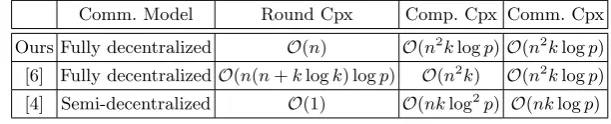
In this paper, we present a formal definition of private top-κ protocol and its security. Our operation setting isfully decentralizedamongnusers over non-partitioned data. For the efficiency of our protocol, we refrain from using secure multiparty computation and construct an efficient private top-κprotocol which is both data-private and user-private. Our construction strikes a real balance in the consumed resources and achieved security, and satisfies both privacy requirements. In particular, in its efficiency, our construction is comparable to the work in [4], which achieves its efficiency by giving up decentralized communication model, and in its security guarantees it is comparable to the work [6], which is secure but resources exhaustive. Our protocol on the other hand overcome the limitations and shortcomings of those protocols.
More specifically, our scheme does not requires a trusted party to set up the keys. Note that using Paillier cryptosystem [27] in a threshold manner demands some trusted setup. Moreover, our proposed protocol has several desirable features as follows:
(1) It hasO(n2k) computational complexity wherenis the number of users andkis the cardi-nality of each user’s set, assuming κ≤k.
(2) It hasO(n2k) communication complexity.
(3) It has a linear round complexity in the number of users.
In general, real-world applications has n much smaller than k, which further justifies the efficiency of our protocol. This is, our protocol is beneficial in such real-world applications where the number of participating users is small but the size of their multisets is large. It remains an important open problem to devise a protocol whose round complexity does not depend on the number of users. Then we could make our protocol haveO(nk) computation and communication complexity.
5
Organization. The rest of this paper is organized as follows. In Section 2, we discuss the related work with extensive analysis and comparison to our work. In Section 3, we outline the preliminaries required for understanding the rest of the paper, including double encryption, our formalism of top-κprotocol and its security, and cryptographic primitives used in the context of computing the top-κ. In Section 4, we introduce our construction that comes into two forms with different requirements and guarantees and meets data privacy and user privacy. In Section 5 we analyze the security and complexity of our work, by proving its security and showing its resources consumption requirements. Remarks on extending our protocol to be secure in the malicious model are in Section 6. Finally, we draw concluding remarks and point future work in Section 7.
2
Related Work
There has been plenty of work in the literature to solve the problem of private data aggregation. Such schemes can be classified under three schools of thoughts: fully centralized, fully decentral-ized, and semi-decentralized. While the centralized schemes assume the existence of a trusted third party (TTP), which makes such schemes of less interest from the cryptographic and practi-cal point of views—as such TTP is not immune to compromise and malicious behavior, the fully decentralized schemes utilize cryptographic primitives and protocols to replace the centralized TTP. On the other hand, semi-decentralized schemes try to bridge the functional and security gap between both of the aforementioned schools of thoughts. As they are of particular relevance to our work, in the following we elaborate on the two latter schools of thoughts: the decentralized and semi-decentralized private data aggregation protocols.
As we mentioned earlier, decentralized solutions to the problem try to replace the centralized TTP with cryptographic constructions, which comes in different forms leading to several direc-tions of research. One direction is based on SMC, as it is the case in [6]. However, at the core of that protocol’s drawbacks is its inefficiency: since it uses Yao’s garbled circuits [32], the compu-tational resources required for ordinary data sizes is overwhelmingly high. Furthermore, as the datasets become disjoint, the efficiency of such construction decreases sharply. In [6], Burkhart and Dimitropoulos—in what we consider to be the most relevant work to ours—have devised a construction in whichthe round complexity is linear to the number of bits in the data elements. However, due to using sketches to improve the efficiency of subprotocols, the aggregate results are probabilistic. Furthermore, while the work in [6] is efficient in terms of its computational complexity, this efficiency comes at the expense of high round complexity.
Although not addressing the same problem at hand, Kissner and Song [22] devised an over-threshold set union protocol—wherea threshold value τ should be given in advance—to find all elements appearing in the union of input multisets at least τ times. The protocol requires a priori knowledge of the threshold, although operates in a decentralized manner. We compare it to our work (in Section 5) as a classical related work.
The final school of thoughts to solving the problem uses semi-decentralized constructions and is represented by the recent work of Applebaum et al. in [4]. In that work, the authors aim to enhance the efficiency of fully-decentralized instantiations by adding new entities: proxy and database (DB). However the proxy and the DB are assumed to be semi-honest restricting the possibility of coalition between proxy and DB. This allows to obtain a constant round protocol. While the authors claim that both proxy and DB are expected to act as semi-honest, we disagree with the assumption and believe that this assumption is too strong both from a theoretical and a practical point of view. Furthermore, their scheme extensively relies on oblivious transfer (OT) [23], which is a very expensive public-key primitive since it may require two modular exponentiations per invocation, and run for each bit of the user’s data element. For efficiency, their scheme may use an efficient version of a standard OT [20], but whose security is in random oracle model [5].
Goldwasser-Micali encryption [14], but we assume that both encryption systems use the same size modulus.
Table 1.Summary and Comparison
Comm. Model Round Cpx Comp. Cpx Comm. Cpx
Ours Fully decentralized O(n) O(n2klogp)O(n2klogp)
[6] Fully decentralizedO(n(n+klogk) logp) O(n2
k) O(n2
klogp)
[4] Semi-decentralized O(1) O(nklog2p) O(nklogp)
3
Preliminaries
In this section, we present the background needed for understanding the technical details of the rest of this paper. The main part of this section is to formally define the security of top-κ protocols. We also present cryptographic tools used in our constructions in this paper.
Notation. Let us denoteF(α) for the multiplicity (also known as frequency) of an elementαin a multisetXandF(X) for the collection of multiplicities for all elements in the multisetX—here the multiplicityF(α) of an elementαrefers to how many times the element appears inX.
For n ∈N, [1, n] denotes the set{1, . . . , n}. If A is a probabilistic polynomial-time (PPT) machine, we usea←Ato denoteAwhich produces output according to its internal randomness. In particular, ifU is a set, thenr←−$ U is used to denote sampling from the uniform distribution on U. A functiong : N→ R is negligible if for every positive polynomial µ(·) there exists an integerL such thatg(η)<1/µ(η) for allη > L.
3.1 Definitions
Informally, a double encryption is a pair of encryption schemes E = (KG,Enc,Dec) and E = (G, E, D) such thatEnc(E(a)) =E(Enc(a)). We demand that an encryption schemeEbe deter-ministic. The reason is that we need to know a complete distribution of multisets while hiding their elements. See Appendix A for a formal definition of public-key cryptosystem and its stan-dard security definition.
Definition 1 (Double Encryption) LetE= (KG,Enc,Dec)be a public-key encryption scheme defined as in Definition 4 with a pair of keys(pk, sk)←KG(1λ)and a message space (resp., ci-phertext space)Mpk(resp.,Cpk). A pair(E,E)is called double encryptionif there exists a triple of polynomial-time computable functions,E= (G, E, D), that satisfies the following properties:
– A probabilistic functionG(1λ)takes as input a security parameterλ, and outputs(s, s0)such that for all s, s0 and for any m ∈ Mpk, m = Ds0(Es(m)). We demand that E and D be deterministic.
– Commutativity: For allpk, s and for allm∈Mpk,Encpk(Es(m)) =Es(Encpk(m))up to the randomness of Encpk(·).
– For all c←Enc(m),Es(m) =Decsk(Es(c)).
We give an instantiation of a double encryption scheme in the following example.
Example 1 Let p be a large prime of the form p = 2q+ 1, where q is also prime. Let Gq be a subgroup of Z×p of order q with a generator g. Then a standard CPA-secure ElGamal
encryption E = (KG,Enc,Dec) is defined as follows: Selectingx←−$ Zq,KG(1λ) outputs (pk, sk) where pk := (p, q, g, y = gx (mod p)) and sk := (p, q, g, x). Given a message m ∈
Gq, the encryption algorithmEnc outputsc= (gr, m·yr) for a randomnessr←−$ Zq. Given an ElGamal ciphertextc= (u, v), the decryption algorithmDeccomputesv·u−xusing the secret keyx. Now
– A probabilistic function G(1λ) outputs (s, s0)∈(Zq)2 such thatss0= 1 (mod q).
– Given a value α∈Gq, a deterministic functionE:Gq→Gq is given byα7→αs (mod p). – A deterministic functionDs0(β) computesβs
0
(mod p).
Then, (E,E) is adouble encryption:
– For all valuesm∈Gq,m= (ms)s 0
(mod p).
– For any message m∈ Gq, there exists a randomness r0 =rs such that
gr0,(ms)·yr0= ((gr)s,(myr)s).
– For any ElGamal ciphertextc= (u, v)∈(Gq)2, whereu=grandv=myr,ms=vs·(us)−x (mod p).
We use a standard definition of shuffle given by Nguyen et al. [25]; see details of the definition in [25, Def. 3 & Def. 4] and its extend version. As we mentioned before, our shuffle algorithm takes as input a list of ciphertexts, and outputs a list ofpermuted and doubly encrypted ciphertexts. Since a double encryption scheme leads to change the plaintexts of input ciphertexts, we need to devise proving the correctness of the shuffle.
Now we define top-κ protocol and give its algorithmic description. Throughout the paper, we useΣn to denote the set of all permutations on [1, n]. A private top-κprotocol consists of five computable (in polynomial time) algorithms, (Setup,DEncrypt, Shuffle, Aggregate,Reveal), over a double encryption (E,E), which are explained as follows:
(pk, sk, s, s0)←Setup(1λ): The setup algorithm takes as an input the security parameter λ, and outputs the public and secret parameters for doubly encrypting input ciphertexts, by invoking (pk, sk)←KG(1λ) and (s, s0)←G(1λ).
(Es(c1), . . . , Es(cn))←DEncrypt(pk, s, c1, . . . , cn): The algorithmDEncrypt takes as input sys-tem parameters (pk, s) and a list of ciphertexts (c1, . . . , cn), and produces a list of doubly encrypted ciphertexts (Es(c1), . . . , Es(cn)).
Es(cπ(1)), . . . , Es(cπ(n))
←Shuffle(π, Es(c1), . . . , Es(cn)): The algorithmShufflechooses a ran-dom permutationπ∈Σnand shuffles the doubly encrypted ciphertexts (Es(c1), . . . , Es(cn)), and then outputs the mixed list.
(Es(α1), . . . , Es(ακ))←Aggregate pk, sk, Es cπ(1)
, . . . , Es cπ(n)
: The algorithm Aggregate
takes as input a pair of keys (pk, sk) and a list of permuted, doubly encrypted cipher-texts, and for all i ∈ [1, n] computes Decsk Es cπ(i)
= Es απ(i)
. Finally it computes F Es απ(i)
, i∈[1, n] and outputs only the elements whose multiplicity is greater than or equal than κ. Here {Es(α1), . . . , Es(ακ)}=Es απ(i) F Es απ(i)
≥κ .
(α1, . . . , ακ)←Reveal(pk, s0, Es(α1), . . . , Es(ακ)): The algorithm Reveal outputs a set of the most frequent top-κelements by computingDs0(Es(αj)) for allj∈[1, κ].
In the next section, we will define the meaning of secure top-κprotocol. Then we describe cryptographic building blocks for constructing a secure top-κ protocol under proper crypto-graphic assumptions.
3.2 Security Definition
Ideal Functionality. Firstly, we define the ideal functionalityFtopkfor top-κprotocol as follows:
Definition 2 There are a set ofnusers,U ={ui}ni=1, a trusted partyT, and an ideal adversary
S controlling a set of corrupted users Υt={uij} t
j=1 for some t∈[0, n−1]. Let Xi={αi,j}kj=1i be a multiset of userui∈[1,n].6
(1) Each user ui sendsXi toT.
(2) T computes the following functionality, and returns the outputZl to eachul∈[1,n]:
Zl=
n
αi,j∈
[
i∈[1,n]Xi
F(αi,j)≥κ o
.
6
Data Privacy. Informally,data privacy requires that no user, or coalition of users, should learn anything about honest users’ inputs except what can be trivially derived from the output itself. We can easily derive the formal definition for data privacy in top-κ protocols following the standard privacy definition of existing protocols in the literature; an excellent reference on that is Goldreich’s textbook in [13]. More specifically, we use Definition 7.5.1 (resp., Definition 7.5.3) in [13] for the semi-honest model (resp. the malicious model). Roughly speaking, this is formalized by considering an ideal world whereT receives the inputs of the users and outputs the result of the defined functionality. We demand that in the real world application of the protocol–that is, one without theT–no user should learn more information than in the ideal world.
User Privacy. The remaining part to conclude our definitions is user privacy. LetZ ={α1, . . . , ακ} be an output of a top-κprotocol. Roughly speaking, no user or coalition of users should gain a non-negligible advantage in distinguishing, for allα∈Z, an honest userui such thatα∈Xi.
Definition 3 (User Privacy) Let Πκ,E,E be a top-κprotocol defined as in Section 3.1 over a
double encryption scheme(E,E)andA= (A1,A2)be an adversary.
Experiment Exptop-A κ(Πκ,E,E, λ)
(pk, sk, s, s0)←Setup(λ);
(state, Υt, m1, . . . , mn−t)← A1(pk, n, t)where Υt is a set of corruptedt users;
σ←−$ Σn and assignmσ(i) to each honest i-th userui6∈Υt;
(α1, . . . , ακ)←Πκ,E,E, whereA1 interacts with then−thonest users; (i, j)← A2(pk, m1, . . . , mn−t,state);
We define the advantage of an adversaryA, running in probabilistic polynomial time, as:
Advtop-A κ(Πκ,E,E, λ) =
Pr[σ(i) =j]− 1
n−t
.
A top-κprotocol is user-privateif the advantage AdvAtop-κ(Πκ,E,E, λ)is negligible in the security
parameterλ.
In conclusion, a top-κprotocolΠκ,E,Eover a double encryption (E,E) is said to be secureif
Πκ,E,Eis data-private and user-private.
3.3 Cryptographic Assumptions and Tools
In the following we outline the cryptographic tools and assumptions we use in our protocol. Let
G be a finite cyclic group of prime order q, and let g ∈ G be a generator. Given h ∈ G, the discrete logarithm problem requires us to compute x ∈ Zq such that gx = h. We denote this (unique) xby loggh. In particular groups G and for q large, it is assumed hard to computex, which is said to be the Discrete Logarithm (DL) assumption.
A stronger assumption is the Decisional Diffie-Hellman (DDH) assumption. Here, given
G, a generator g of G, and three elements a, b, c ∈ G, we are asked (informally) to decide whether there exist x, y such that a = gx, b = gy, and c = gxy. More formally, the DDH assumption states that the following two distributions are computationally indistinguishable:
{G, g, gx, gy, gxy} and{G, g, gx, gy, gz}wherex, y, z←−$ Zq.
We extensively use ElGamal encryption defined in Example 1. This ElGamal encryption scheme is defined and known to be secure against CPA attack in a DDH groupG; see Appendix A for the CPA security. In addition, we need an efficient scheme which works as follows: When each user holds a shared secret key si such that s =Q
n
i=1si, the scheme allows each user to have a shares0i satisfyings0=Qn
4
Our Construction
In this section, we describe our construction for computing the top-κ elements privately. We begin by considering a basic setting ofnusers, denoted by u1, . . . , un. LetXi ={αi,1, . . . , αi,k} for alli∈[1, n]. Each user ui has its private multiset Xi, and the users wish to jointly compute
α∈Sn
i=1Xi
F(α)≥κ . For simplicity, assume that all elements are in the proper message
domainMpk of an ElGamal encryption scheme, e.g., a finite cyclic subgroupGq ofZp in which the DDH assumption holds. For a multiset X={α1, . . . , αk}, we denote Xs as {αs1, . . . , α
s k} for somes∈Zq. With such notation in mind, we proceed to describe our construction.
4.1 Description
Letλbe a security parameter that will determine the size of groups. Letpbe aλ-bit prime such that for some prime q, p= 2q+ 1. LetGq be a finite cyclic subgroup ofZ×p whose order is q, and letgbe a generator of Gq. Our construction follows:
Setup(1λ) Each user agrees to a threshold ElGamal encryptionE with a public/private key pair (pk, sk), which are computed as follows. Defineparams:= (p, q, g,Gq). Each user selects
a valuexi $
←−Zq, computesyi=gxi, and setssk= (params, xi); the public key is then given
bypk:=params, y=Qn
i=1yi=g
P
i∈[1,n]xi (modp).7In addition, all users are distributed a share (si, s0i) such thats=
Qn
i=1si,s 0=Qn
i=1s 0
i, ands·s0= 1 (mod q).
DEncrypt LetI ={1, . . . , n} be a set of indices, and let the power function Esi(α) =α si
(mod p) which is deterministic.
1. Every userui encrypts his multisetXi as follows:
Encpk(Xi) ={Encpk(αi,1), . . . ,Encpk(αi,k)}
whereEncpk(αi,j) = (gri,j, α
i,j·yri,j) for some randomizerri,j∈Zq, and sendsEncpk(Xi) tou1.
2. Useru1 computes{Es1(Encpk(X1)), . . . , Es1(Encpk(Xn))}, which is denoted by Y0. Shuffle & DEncrypt Fori∈[1, n],uireceives vectorYi−1and computes a permuted,
dou-bly encrypted version Yias follows: 1. ui6=1computes
Esi(Yi−1) ={c1, . . . , cnk}
=
Esi Esi−1 · · ·Es1 απi−1(1)
· · ·
, . . . , Esi Esi−1 · · ·Es1 απi−1(nk)
· · · .
More precisely, hereαπi−1(`)=απi−1◦···◦π1(`) for all`∈[1, nk].
2. uichooses a random permutationπi∈Σnk, and appliesπito the list ofc`∈[1,nk]computed above; denote the result byYi.
3. ui sendsYi toui+1; the last userun sendsYn to all users.
Aggregate LetU=Sn
i=1Xi. Every user hasEs(Encpk(U)). 1. Every user participates in a group decryption and obtains
Es(U) =Es απ(1)
, . . . , Es απ(nk)
whereπ=πn◦ · · · ◦π1.
2. Every user computesZ={Es(α)∈Es(U)F(Es(α))≥κ}.
Reveal
1. For everyEs(α)∈Z, userui sends its share ofDs0
i(Es(α)) toui0.
2. After receiving all the shares, every useruicomputesα=Ds0(Es(α)), thereby recovering the top-κ,{α∈U|F(α)≥κ}.
7 Notice that in threshold decryption schemes, users generally produce shares of the decrypted element,
Efficiency. The advantage of the above protocol is multifold. First, compared to Kissner and Song’s protocol [22], our protocol provides the functionality of finding a threshold value and computing the “over threshold” at the same computation and communication cost—whereas they incur different and higher costs in [22]. Second, compared to the top-κprotocol described in [6], our protocol has a much better computational complexity. See details in Section 5.
In order to present a fair comparison between our proposed protocol and Applebaum et al.’s protocol [4] we devise our protocol for a semi-decentralized model in the next section. The other purpose of our modification is to reduce the round complexity to a constant.
4.2 Semi-Decentralized Construction
The most crucial drawback of our proposed protocol in the previous subsection is that it hasO(n) round complexity. To avoid this problem, Applebaum et al. introduced two semi-honest users: a proxy which shuffles a list of input ciphertexts, and adatabasewhich aggregates top-κelements. Applying the same technique to our protocol, we obtain a constant-round top-κ protocol. We briefly summarize the major changes in the following:
– Assume that there aren1 proxies andn2databases described as in [4].
– Each database engages in setting up a threshold ElGamal encryption and publishes a public key. Instead of users, all proxies are distributed secret shares (sl, s0l)l∈[1,n1] as above. – Each user computes a list of ElGamal ciphertexts and sends it to a proxy.
– Each proxy runs DEncryptandShufflealgorithms, and returns the result to all databases. – Databases perform a group decryption, find a list of encrypted top-κelements, and output
the list.
– Finally all proxies decrypt the encrypted top-κlist and return the top-κto all users.
Compared to [4], our protocol does not require OT operations between users and proxies, nor an extra encryption scheme. Recall that Applebaum et al.’s protocol requires ElGamal encryption and Goldwasser-Micali (GM) encryption: ElGamal encryption is used to encrypt elements in multisets and GM encryption is used to encrypt their multiplicity.
5
Evaluation
In this section, we provide security and complexity analyses of our construction. We first prove the correctness of our construction, so that every semi-honest user participating in the protocol learns the joint distribution of users’ multisets and the number of times each of the elements appears, with overwhelming probability. Furthermore, we show that our construction is secure and data of honest users are maintained private as long as the size of the coalition among semi-honest users is less thann.
5.1 Security Analysis
Theorem 1 (Correctness) In the private top-κ protocol in Section 4.1, every honest user learns the joint set distribution of all users’ private inputs, i.e., each element Es(α) such that α∈Sn
i=1Xi and the number of times it appears, with overwhelming probability.
Proof. Each player learns a randomly permuted joint multisetEs(U) =Es απ(1)
, . . . , Es απ(nk) . We know that |Us| =nk. Since π is a permutation, for each Es απ(`)
and for all ` ∈[1, nk], there exist a pair of the unique index`∗such that
`∗=π−1(`)
=π−1n (`)◦ · · · ◦π1−1(`).
Namely,Es απ(`)
Corollary 1 In the private top-κprotocol in Section 4.1, every honest user learns thetop-κin the union of private multisets with overwhelming probability.
Now we show that our protocol satisfies the privacy requirements in the semi-honest model. LetT be a trusted party in the ideal world which receives the private input multisetXiof sizek from userui fori∈[1, n], and then returns to every user the joint multiset distribution{F(α)} for allα∈Sn
i=1Xi.
Theorem 2 (Data Privacy) Assume that the threshold ElGamal encryptionE= (KG,Enc,Dec) is secure against CPA. In the private top-κ protocol in Section 4.1, any coalition of less than n semi-honest users learn no more information than would be given by using the same private inputs in the ideal-world model withT.
Proof. We assume that the ElGamal encryption scheme is CPA-secure, and so each user learns only
Encpk(X1), . . . ,Encpk(Xn) ;
Es1(Encpk(X1)), . . . , Es1(Encpk(X1)), . . . , Esi−1(Encpk(X1)), . . . , Esi−1(Encpk(Xn)); ..
.
Esi−1(· · ·Es1(Encpk(X1))· · ·), . . . , Esi−1(· · ·Es1(Encpk(Xn))· · ·)
during an execution. At the end of the protocol all users further know Es(Encpk(U)) where U=Sn
i=1Xi, and for someγ`∈[1,nk]∈Zq
Es(Encpk(U)) = {Es(Encpk(X1)), . . . , Es(Encpk(Xn))} = gγ1, α
π(1)
s
·yγ1, . . . , gγnk, α π(nk)
s
·yγnk.
Note that π is a composition of random permutations and is unknown to all users, as the maximum coalition size is smaller thann. That is, if there exists at least an honest user, then a composition of random permutations π =πn ◦ · · · ◦π1 is a random permutation because at least a permutation πi∈[1,n] is secure. What is more, note that s is uniformly distributed and unknown to all users for the same reason. Assis uniformly distributed for any user inputs andπ is random, no user or coalition can learn more than a set of re-randomized ElGamal encryptions. Assis uniformly distributed, a group decryption of ElGamal encryptions reveals no more than
{Es(α`)}`∈[1,nk] =Es n
[
i=1 Xi
!
=Es(U).
We know the fact thatF(α) =F(αs) for two multisetsX andEs(X)∈(Gq)k, for all s∈ Zq and for allα∈X. Hence we see that
F(Es(U)) =F Es n
[
i=1 Xi
!!
=F n
[
i=1 Xi
!
=F(U),
which can be derived from the output that would be returned byT in the ideal-world model.
Finally we show that our scheme guarantees user privacy. Intuitively, this proof ensures that even when n−1 users collude with each other in an arbitrary way they cannot identify their own elements from the joint multiset.
Proof. Assume that there is at least an honest user in the system, and that the threshold ElGamal encryptionE = (KG,Enc,Dec) is CPA-secure. After performing DEncrypt andShuffle
algorithms, every user obtains a collection of ElGamal encryptions{c1, . . . , cnk}. By the second assumption, the adversary cannot learn any further information except that which encryptions have been sent from which users. Running these algorithms, each user should raise the power of the received encryptions with his shared secretsi. Namely, each user holds the modified list of the encryptions,
{Esi(c1), Esi(c2), . . . , Esi(cnk)}.
Next the user should apply his private permutationπi to the list so that she gets changed into
Esi cπ(1)
, Esi cπ(2)
, . . . , Esi cπ(nk) .
At the end of running these algorithms, all users get a permuted and doubly encrypted list
Es cπ(1)
, Es cπ(2)
, . . . , Es cπ(nk)
where the permutationπ=πn◦ · · · ◦π1ands=Q n
i=1si. As there exists at least an honest user, even though alln−1 users collude with each othersis uniformly distributed and unknown to all users andπis a random permutation. This completes the proof of the claim.
Theorem 4 Assuming that the threshold ElGamal encryption is CPA-secure and the DL as-sumption holds, the proposed top-κprotocol is secure in the semi-honest model.
Proof. We complete the proof of security by Theorem 2 and Theorem 3.
5.2 Efficiency Analysis
The private top-κprotocol has not yet been implemented, but we give a detailed analysis of the running time and space requirements as follows. We base our protocol on ElGamal encryption and the power function with primes |p| = 1024,|q| = 160. To measure users’ computational loads, we count the number of exponentiations using a 1024-bit modulus.
Table 2.Complexity Analysis
Comp. Cpx (expo.) Comm. Cpx (bits) Rounds Cpx
Setup n nlogp 1
DEncrypt&Shuffle 4nk+ 2n2k 2(n−1)klogp+ 2n2klogp n Aggregate n2k 2n2klogp 1
Reveal nκ nκlogp n−1
In Table 2 we show a summary of the complexity result for our proposed protocol. The total computational complexity is dominated by DEncrypt and Shuffle algorthms. Putting the computational complexities together shows that total computation complexity isO(n2k) inO(n) rounds. The proposed protocol hasO(n2klogp) bits in total. We compare our protocol with the most relevant ones in the following. Note that Applebaum et al.’s scheme [4] runs in the semi-decentralized model. Since it is not fair to directly compare our protocol with Applebaum et al.’s protocol, we just present the computational complexity.
Comparison. We consider three existing protocols: one based on Kissner and Song (KS) pro-tocol [22], Burkhart and Dimitropoulos (BD) propro-tocol [6], and Applebaum et al. propro-tocol.
Based on KS protocol We first compare our scheme with a top-κprotocol that can be con-structed by using KS protocol. As mentioned above, since it does not provide a way for finding a threshold value τ, we do not know computational and communication complexity in computing τ. Assumingτ is given, their protocol hasO(n2k) computation complexity in
BD protocol In turn, we give a comparison with BD protocol. To our knowledge, it is the only fully decentralized top-κprotocol that does not use Yao’s garbled circuit evaluation. Their protocol utilizes two special-purpose sub-protocols–equalityandlessthan(see [9,26]), but in [7] as the authors pointed out, comparison of two shared secrets is very expensive and computational intensive. Thus, they use a computationally efficient version of the basic sub-protocols as follows: equality requires logp rounds and lessthan requires (2 logp+ 10) rounds. Their protocol consists of two key ingredients as follows:
– Finding a correct threshold valueτ: Requires (logk(2 logp+ 10) + logp+ 2 logp+ 10)nk rounds.
– Resolving collisions: Requires n(n2−1)logp+ 2(n−1) logp+ 10(n−1) rounds.
Note that BD protocol also should knowτas in KS protocol. Hence, the total round complex-ity is O(n(n+klogk) logp) where we set the size of hash tables by logkand the maximum size of unionUbynk.
With a few simple calculations, we can see that their protocol incurs 4n(n2−1)k+k(n−1) multiplications in Z×p.
Applebaum et al. protocol Let us use Op(·) to denote complexity using modulus prime p and ON(·) complexity using modulus composite N. Assume all elements are integers less thanpand the maximum multiplicity is less than log logp.
Their major computation-intensive parts are as follows:
– Interactive computation between Users and Proxy: First, users should run a protocol for oblivious evaluation of pseudorandom function by communicating with proxies, and then encrypt the result with ElGamal encryption. This requiresn(k(2 logp+2)+2k) exponen-tiations overZ×p. Further, users should encrypt the multiplicity of each element with GM encryption, which requiresnklog logpmultiplications overZ×N. Finally each user doubly encrypts their elements using ElGamal encryption. This requires 2nk exponentiations overZ×p.
– Aggregation by Database: The most computationally-intensive part is ElGamal and GM decryption. Since database receives two types of ElGamal ciphertexts, it performs 2nk exponentiations overZ×p. GM decryption requires 2nklog logpexponentiations overZ
× N. Therefore, the total computational complexity isOp(nklogp) +ON(nklog logp) in terms of the number of exponentiations.
6
Handling Malicious Users
Our protocol is secure in the semi-honest model. Although, we describe possible modifications to our top-κprotocol in order to provide security in the malicious adversary model and leave a realization of such protocol as a future work.
A general technique to prevent malicious behavior is to use zero-knowledge proofs. For ex-ample, in KS protocol whenever each user sends a public ciphertextEncpk(m), it should prove that it knows the corresponding plaintext m. First, there exist efficient zero-knowledge proofs of knowledge of discrete logarithms (PODL) in our setting [8]. In Setup algorithm each user proves that give a public-key share yi it knows the corresponding secret key xi using PODL. Each user proves in a zero-knowledge manner that given an ElGamal ciphertext it knows the corresponding message by zero-knowledge proof of knowledge of randomizers, which is also a standard technique. Furthermore, it seems that we can prove the correctness of shuffling a list of ElGamal ciphertexts by modifying Groth’s technique [15]. The challenging part is that in our protocolDEncryptalgorithm forces the plaintexts in the input ciphertexts to be changed. Hence, we should be careful in designing zero-knowledge proofs for correctness of a shuffle.
7
Conclusion
developed two protocols, with varying operation overhead, analyzed their security, and demon-strated their practicality and superiority (computational and security-wise) to other work in the literature.
In the near future, we will investigate two directions. First, as our constructions’ security is proven in the semi-honest model—which is rationalized by the application domain, we will investigate constructions that are provably secure in the malicious model, and their potential applications. Second, as the shuffling algorithm in our current construction requires sending messages among players in a relay manner, we will consider the practical and security aspects of a construction that relies on sending such messages in a broadcast manner.
References
1. B. Adida. Advances in cryptographic voting systems. PhD thesis, Massachusetts Institute of Tech-nology, 2006. 3
2. G. Aggarwal, N. Mishra, and B. Pinkas. Secure computation of thekth-ranked element. In C. Cachin and J. Camenisch, editors,Advances in Cryptology-EuroCrypt, LNCS 3027, pages 40–55, 2004. 2 3. J. Algesheimer, J. Camenisch, and V. Shoup. Efficient computation modulo a shared secret with
application to the generation of shared safe-prime products. In M. Yung, editor, Advances in Cryptology-Crypto, LNCS 2442, pages 417–432, 2002. 7
4. B. Applebaum, H. Ringberg, M. Freedman, M. Caesar, and J. Rexford. Collaborative, privacy-preserving sata aggregation at scale. In M. Atallah and N. Hopper, editors, Privacy Enhancing Technologies, LNCS 6205, pages 56–74, 2010. 1, 3, 4, 5, 9, 11
5. M. Bellare and P. Rogaway. Random oracles are practical: a paradigm for designing efficient proto-cols. In D. Denning, R. Pyle, R. Ganesan, R. Sandhu, and V. Ashby, editors,ACM Conference on Computer and Communications Security, pages 62–73, 1993. 4
6. M. Burkhart and X. Dimitropoulos. Fast privacy-preserving top-k queries using secret sharing. In
International Conference on Computer Communications and Networks (ICCCN), 2010. 3, 4, 5, 9, 11
7. M. Burkhart, M. Strasser, D. Many, and X. Dimitropoulos. SEPIA: Privacy-preserving aggregation of multi-domain network events and statistics. In USENIX Security Symposium, pages 223–240, 2010. 12
8. J. Camenisch. Proof systems for general statements about discrete logarithms. Technical Report TR 260, Dept. of Computer Science, ETH Zurich, 1997. 12
9. I. Damg˚ard, M. Fitzi, E. Kiltz, J. B. Nielsen, and T. Toft. Unconditionally secure constant-rounds multi-party computation for equality, comparison, bits and exponentiation. In S. Halevi and T. Ra-bin, editors,TCC, LNCS 3876, pages 285–304, 2006. 12
10. Y. Desmedt and K. Kurosawa. How to break a practical mix and design a new one. In B. Preneel, editor,Advances in Cryptology-EuroCrypt, LNCS 1807, pages 557–572, 2000. 1, 3
11. T. El Gamal. A public key cryptosystem and a signature scheme based on discrete logarithms. In G. R. Blakely and D. Chaum, editors,Advances in Cryptology-Crypto, LNCS 196, pages 10–18, 1984. 4
12. J. Furukawa and K. Sako. An efficient scheme for proving a shuffle. In J. Kilian, editor,Advances in Cryptology-Crypto, LNCS 2139, pages 368–387, 2001. 3
13. O. Goldreich. The foundations of cryptography, volume 2. Cambridge University Press, 2004. 7 14. S. Goldwasser and S. Micali. Probabilistic encryption. J. Comput. Syst. Sci., 28(2):270–299, 1984.
5, 14
15. J. Groth. A verifiable secret shuffle of homomorphic encryptions. In Y. Desmedt, editor,Public Key Cryptography, LNCS 2567, pages 145–160, 2003. 12
16. J. Groth. A verifiable secret shuffle of homomorphic encryptions.Journal of Cryptology, 23(4):546– 579, 2010. 3
17. J. Groth and S. Lu. Verifiable shuffle of large size ciphertexts. In T. Okamoto and X. Wang, editors,
Public Key Cryptography, LNCS 4450, pages 377–392, 2007. 3
18. W. He, X. Liu, H. Nguyen, K. Nahrstedt, and T. F. Abdelzaher. PDA: Privacy-preserving data aggregation in wireless sensor networks. InINFOCOM, pages 2045–2053. IEEE, 2007. 1
19. J. Hong, J. W. Kim, J. Kim, K. Park, and J. H. Cheon. Constant-round privacy preserving multiset union. InCryptology ePrint Archive, 2011/138, 2011. 2
21. M. Jakobsson. A practical mix. In K. Nyberg, editor,Advances in Cryptology-EuroCrypt, LNCS 1403, pages 448–461, 1998. 1, 3
22. L. Kissner and D. Song. Privacy-preserving set operations. In V. Shoup, editor, Advances in Cryptology-Crypto, LNCS 3621, pages 241–257, 2005. 2, 4, 9, 11
23. M. Naor and B. Pinkas. Oblivious transfer with adaptive queries. In M. Wiener, editor,Advances in Cryptology-Crypto, LNCS 1666, pages 573–590, 1999. 4
24. C. Neff. A verifiable secret shuffle and its application to e-voting. InACM Conference on Computer and Communications Security, pages 116–125, 2001. 1, 3
25. L. Nguyen, R. Safavi-Naini, and K. Kurosawa. Verifiable shuffles: A formal model and a Paillier-based efficient construction with provable security. In M. Jakobsson, M. Yung, and J. Zhou, editors,
ACNS, LNCS 3089, pages 61–75, 2004. 3, 6
26. T. Nishide and K. Ohta. Multiparty computation for interval, equality, and comparison without bit-decomposition protocol. In T. Okamoto and X. Wang, editors,Public Key Cryptography, LNCS 4450, pages 343–360, 2007. 12
27. P. Paillier. Public-key cryptosystems based on composite degree residuosity classes. In J. Stern, editor,Advances in Cryptology-EuroCrypt, LNCS 1592, pages 223–238, 1999. 3
28. Y. Sang and H. Shen. Efficient and secure protocols for privacy-preserving set operations. ACM Transactions on Information and System Security (TISSEC), 13(1):9:1–9:35, 2009. 2
29. J. Vaidya and C. Clifton. Privacy-preserving top-kqueries. InICDE, pages 545–546, 2005. 2 30. Vijay S. Iyengar. Transforming data to satisfy privacy constraints. InKDD, pages 279–288, 2002. 1 31. L. Xiong, S. Chitti, and L. Liu. Topk queries across multiple private databases. In International
Conference on Distributed Computing Systems (ICDCS), pages 145–154, 2005. 2 32. A. Yao. Protocols for secure computations. InFOCS, pages 160–164, 1982. 4
33. R. Zhang, J. Shi, Y. Liu, and Y. Zhang. Verifiable fine-grained top-k queries in tiered sensor networks. InINFOCOM, pages 2633–2641, 2010. 2
34. R. Zhang, Y. Zhang, and C. Zhang. Secure top-k query processing via untrusted location-based service providers. InINFOCOM, pages 1170–1178, 2012. 2
A
Basic Definitions
We first give a formal definition of a public key cryptosystem and then its standard security definition.
We shall write
Pr[x1 $
←−X1, x2 $
←−X2(x1), . . . , xn $
←−Xn(x1, . . . , xn−1) :ϕ(x1, . . . , xn)]
to denote the probability that whenx1is drawn from a certain distributionX1, andx2is drawn from a certain distributionX2(x1), possibly depending on the particular choice ofx1, and so on, all the way toxn, the predicateϕ(x1, . . . , xn) is true.
Definition 4 A public-key cryptosystemE is a 3-tuple of PPT algorithms (KG,Enc,Dec)such that
(1) The key generation algorithmKGtakes as input the security parameterλand outputs a pair of keys (pk, sk). For given pk, the message space Mpk and the randomness space Rpk are uniquely determined.
(2) The encryption algorithm Enc takes as input a public key pk and a message m ∈ Mpk, and outputs a ciphertext c∈Cpk where Cpk is a finite set of ciphertexts. We write this as c←−Encpk(m). We sometimes writeEncpk(m)asEncpk(m, r)when the randomnessr∈Rpk used by Enc needs to be emphasized. .
(3) The decryption algorithmDectakes as input a private keyskand a ciphertextc, and outputs a messagem or a special symbol⊥which means failure.
Definition 5 ([14]) A public-key cryptosystem E = (KG,Enc,Dec) with a security parameter λ is called to be semantically secure (IND-CPA secure) if after the standard CPA game being played with any PPT adversary A= (A1,A2), the advantage Adv
cpa
E,A(λ), formally defined as
Pr b,r
"
(pk, sk)←−KG(λ),(state, m0, m1)←− A1(pk), c=Encpk(mb;r) :b←− A2(state, m0, m1, c)
#
−1
2
,
is negligible in λfor all sufficiently largeλ.
In the experiment above, when we allow A1 to query the decryption oracle, if the advantage