Ames Laboratory Publications
Ames Laboratory
11-11-2011
Chemically Mediated Quantum Criticality in
NbFe2
Aftab Alam
Ames LaboratoryDuane D. Johnson
Iowa State University, [email protected]
Follow this and additional works at:
http://lib.dr.iastate.edu/ameslab_pubs
Part of the
Condensed Matter Physics Commons
,
Engineering Physics Commons
, and the
Materials Science and Engineering Commons
The complete bibliographic information for this item can be found at
http://lib.dr.iastate.edu/
ameslab_pubs/284
. For information on how to cite this item, please visit
http://lib.dr.iastate.edu/
howtocite.html
.
Abstract
Laves-phase Nb1+cFe2−c is a rare itinerant intermetallic compound exhibiting magnetic quantum criticality at ccr∼1.5%Nb excess; its origin, and how alloying mediates it, remains an enigma. For NbFe2, we show that an unconventional band critical point above the Fermi level EF explains most observations and that chemical alloying mediates access to this unconventional band critical point by an increase in EF with decreasing electrons (increasing %Nb), counter to rigid-band concepts. We calculate that EF enters the unconventional band critical point region for ccr>1.5%Nb and by 1.74%Nb there is no Nb site-occupation preference between symmetry-distinct Fe sites, i.e., no electron-hopping disorder, making resistivity near constant as observed. At larger Nb (Fe) excess, the ferromagnetic Stoner criterion is satisfied.
Keywords
Materials Science and Engineering
Disciplines
Condensed Matter Physics | Engineering Physics | Materials Science and Engineering
Comments
This article is from Phys. Rev. Lett.107, 206401 (2011), doi:10.1103/PhysRevLett.107.206401. Posted with permission.
Chemically Mediated Quantum Criticality in
NbFe
2Aftab Alam1,*and D. D. Johnson1,2,†
1Division of Materials Science and Engineering, Ames Laboratory, Ames, Iowa 50011, USA
2Department of Materials Science and Engineering, Iowa State University, Ames, Iowa 50011, USA
(Received 9 February 2011; revised manuscript received 13 September 2011; published 9 November 2011) Laves-phase Nb1þcFe2c is a rare itinerant intermetallic compound exhibiting magnetic quantum
criticality at ccr1:5%Nb excess; its origin, and how alloying mediates it, remains an enigma. For
NbFe2, we show that an unconventional band critical point above the Fermi level EF explains most
observations and that chemical alloying mediates access to this unconventional band critical point by an increase inEFwith decreasing electrons (increasing %Nb), counter to rigid-band concepts. We calculate thatEFenters the unconventional band critical point region forccr>1:5%Nband by1:74%Nbthere is no Nb site-occupation preference between symmetry-distinct Fe sites, i.e., no electron-hopping disorder, making resistivity near constant as observed. At larger Nb (Fe) excess, the ferromagnetic Stoner criterion is satisfied.
DOI:10.1103/PhysRevLett.107.206401 PACS numbers: 71.20.Lp, 75.10.Lp, 75.45.+j
Quantum criticality emerges from collective low-energy excitations leading to a second-order phase transition at zero temperature (T) [1]. In the study of
correlated-electron materials, e.g., high-T superconductors and
heavy-fermion compounds, understanding such a critical phenomenon remains a principal challenge, and locating any existing quantum critical points (QCPs) is difficult. Near these QCPs, quantum fluctuations (rather than ther-mal fluctuations) are observed to give rise to exotic effects, e.g., non-Fermi-liquid behavior [2]. In intermetallic com-pounds, the situation appears simpler, where, by varying nonthermal order parameters, such as applied pressure, external magnetic field, or chemical doping, various phases near a QCP can be accessed, i.e., ferromagnetic (FM),
antiferromagnetic (AFM), and paramagnetic states.
Importantly, strong electron-electron interactions are not required for an alloy to show correlated behavior, as now
confirmed in Fe-As compounds [3]. The Laves phase of
Nb1þcFe2c is one important example and featured in recent reviews of quantum criticality in weak magnets [4]. At stoichiometry the susceptibility exhibits Curie-Weiss behavior down to a spin-density wave (SDW) tran-sition atTsdw’10 K, whereas at1:5%Nbexcess a QCP is observed where the SDW collapses and non-Fermi-liquid behavior occurs [5,6]. For larger Nb excess (c >0, hole doping) or Fe excess (c <0, electron doping), a FM transition is always observed [5,6]. Indeed, the sensi-tivity of the magnetic state to Nb deficiency has long been known [7,8].
Although well characterized experimentally, our under-standing of the properties ofNb1þcFe2c is lacking, espe-cially how chemical disorder affects the magnetic transitions and QCP (and the FM onset at larger dopings). Recent theoretical work studied the electronic properties of
NbFe2[9] but did not address the critical chemical effects.
Of course, including properly the effects of disorder in
these class of systems, specifically at such a small doping (c), is a considerable challenge. Attempting to address doping, recent studies use the virtual crystal approximation [10] or supercells (ordered array of dopants) [11], having severe shortcomings, as we discuss.
In metals low-energy excitations lie at or near the Fermi surface (FS), and, thus, some unique spectral feature at or near EF is typically required to drive a transition, as with FS nesting [12,13] or van Hove band critical points [14] types of ordering [15,16]. Such FS features have been rarely identified as the origin of quantum criticality. We detail how an unconventional band critical point (UBCP), i.e., an accidental saddle-point dispersion, above EF is responsible for the QC behavior in metallic Nb1þcFe2c.
We show that chemical disorder mediates, via d-state
hybridization, access to this UBCP even with fewer elec-trons for increasing %Nb, which the rigid-band or virtual crystal approximation cannot describe, effects well known in alloy theory.
We use an all-electron, Korringa-Kohn-Rostoker
(Green’s function) electronic-structure method and the coherent-potential approximation [17] to calculate the electronic dispersion, density of states, total energies, and doping site preferences inNb1þcFe2c. See Ref. [18] for details and examples for (dis)ordered alloys. In agreement with experiment, we calculated ccr ‘‘onset’’ at 1.5%Nb,
and, at 1.74%Nb, when EF lies exactly at the UBCP, we
find that Nb has no site-occupation preference between the two symmetry-distinct Fe sites, favoring a homogeneous solute distribution and no electron-hopping disorder, sug-gesting a near constant resistivity. We find competing FM and AFM states, as observed, that are associated with the competing wave vectors from the UBCP. We show that the FM Stoner criterion inNb1þcFe2cis obeyed for larger Nb (or Fe) excess. If the UBCPs are removed from considera-tion, none of these results hold. We conclude that the QCP
PRL107,206401 (2011) P H Y S I C A L R E V I E W L E T T E R S 11 NOVEMBER 2011week ending
occurs via chemical-disorder-mediated access to the
UBCP aboveEF.
To understand chemical disorder effects, we first need to appreciate the structure ofNbFe2, which crystallizes in a
C14hexagonal Laves phase with space groupP63=mmc
(no. 194). In terms of crystallography, NbFe2
Nb4Feð2
aÞ
2 Fe
ð6hÞ
6 with a 12-atom unit cell:Feð6hÞsites form
two kagome networks (?to thecaxis) separated byFeð2aÞ sites in a hexagonal sublattice, and Nb atoms occupy the interstices; see Figs.1(a)and1(b). The Wykoff positions (without inversion) are Nb at 4fð13;23; xÞ, Feð2aÞ at
2að0;0;0Þ, andFeð6hÞat 6hðy;2y;34Þ. Calculations are
per-formed with measured [5] structural parameters a¼
4:8401 Aandc¼7:8963 Aand internal coordinatesx¼
0:0629 and y¼0:1697. Using the
Korringa-Kohn-Rostoker coherent-potential approximation, we may study the effect of (in)homogeneous solute distributions. Disorder with antisite Nb on one or both Fe sublattices is written as Nb4ðFeð12aÞcð2aÞNbðc2ð2aaÞÞÞ2ðFeð16hcÞð6hÞNbðc6ð6hhÞÞÞ6, or Nb4ðFe1cNbcÞ8 for the homogeneous case.
To identify critical electronic features and chemical disorder effects, we detail the dispersionðk; EÞand den-sity of states (DOS). Korringa-Kohn-Rostoker uses constant-E matrix inversion to get ðfkg; EÞ, rather than constant-kdiagonalization to get eigenvaluesðk;fEgÞ. To handle (dis)ordered cases, we calculate the Bloch spectral function [13]ABðk; EÞon a grid of323224kpoints to project the dispersion. For ordered cases, ABðk; EÞ
yields ðEðk; EÞÞ, i.e., bands; otherwise, it exhibits disorder-induced spectral broadening in E and k, related to the finite electron scattering length.
We now show that thecdependence tied to the observed quantum criticality arises from theNbFe2dispersion above EF. Our bands in Fig. 1(c) agree with those from full-potential methods [9]. The bands crossing EF along -M
arise mainly from Feð6hÞ t2g orbitals and lead to
saddle-point dispersion slightly (6.6 meV) above EF
with an unusual flat dispersive region (UBCP) [Figs. 1(c)
and2(b)]. These UBCPs nearEF are not a result of
sym-metry but arise from accidental band crossings.
Experimentally, Crook and Cywinski [19] inferred that
the Feð6hÞ t2g orbitals in the kagome nets play a critical role in the competing magnetic order associated with the quantum phase transition. The Nb1þcFe2c phase diagram [5] shows the QCP onset at ambient pressure at
ccr1:5%Nb(hole-doped) and extends toc’2:0%, with FM at larger doping. For a metal, only low-energy excita-tions nearEFcan be relevant for such low-Ttransitions. By small tuning of a nonthermal order parameter, i.e., c, the unusual quantum phase transition behavior is observed and can be explained if these UBCPs are accessed.
For homogeneous doping, we find a chemical-disorder-mediated increase ofEFðcÞversus %Nb excess, or decreas-ing electron-per-atom (e=a) ratio [Fig. 2(a)]. Counter to
rigid-band concepts,EF rises to UBCP and due to Fe-Nb
(bond or antibond) alloying hybridization in kagome nets
Fe bands shift lower, but bands from the pure Nb layer remain unaffected [Fig. 2(a), inset]. (An ordered array of impurities exaggerates the effect—see below—showing that disorder plays a key role.) At 1.74%Nb excess,
UBCP lay at EF a 6.6 meV shift due to alloying and
disorder (finite lifetime) effects; see Fig. 2(b). The
6.6 meV (or 77 K) sets the maximum temperature, as observed, for these effects to occur on stoichiometry. The dispersion and disorder-induced widths along-Mfor0 cccpacr [Fig.2(b)] estimate the QC range. By 1.65%,EF
enters the spectral tails, giving zero-energy excitations into
the anomalous dispersion; EF is maximally aligned with
the UBCP by 1.74% (giving a Lifshitz-type transition; see below) and exits by 2%, where FM is observed. We con-clude that the QCP occurs from alloying or disorder-mediated access to the UBCP inherent inNbFe2dispersion
aboveEF, detailed more below.
-0.5 -0.25 0.0 0.25 0.5 Energy (eV) M K (b) (a) (c)
FIG. 1 (color online). (a) Laves unit cell. (b)Feð6hÞsites form
two kagome nets, with Nb (gray),Feð2aÞ(red), andFeð6hÞ(blue),
with higher (lower) planes shaded. (c)NbFe2bands (EFat 0 eV).
The highlighted box shows an UBCP aboveEF.
6.960 6.962 6.964 6.966 6.968 6.970 e/a 0 5 10 15 20 25
E (c) - E (0) (meV)
c = 1.575%
F
F
c = 2.025%
c = 1.786%
c = 1.74%
c = 1.65%
c = 1.5%
Nb (Fe Nb )4 1-c c8
-0.1 -0.05 0.0 0.05 0.1 c=0.0% c=1.74% E M F Energy (eV) Nb-bands Nb-bands -0.01 -0.005 0.00 0.005 0.01 EF Energy (eV)
(along -M) ki c=0.0% kf c=1.74% c=1.65% Dispersion (a) (b)
FIG. 2 (color online). (a)EFðcÞshift due to %Nb excess vs
e=aforNb4ðFe1cNbcÞ8.EF lies at UBCPs atccr¼1:74%but
enters spectral tails at 1.65%. Inset (a) shows (un)doped
Amax
B ðk; EÞ along -M, and (b) expands around UBCPs (bars
are spectral widths due to disorder broadening).
[image:4.612.318.557.514.654.2] [image:4.612.55.299.532.665.2]We have performed supercell calculations to illustrate how sensitiveEFðcÞis to approximations used to address chemical effects, which ignore disorder. Supercells are numerically costly due to large cells needed with decreas-ing %Nb. We performed calculations at two concentrations with cells constructed by substituting a Nb atom for one Fe
atom in a 221 (6.25%Nb excess) and a 222
(3.125%Nb excess) supercell. The supercells also yield a
EFðcÞ increase, relative to c¼0%, of 117.1 and
281.3 meV for 3.125% and 6.25%Nb excess, respectively. The coherent-potential approximation shifts are 65.4 and 158.1 meV, respectively, which lie on the curve in Fig.2(a)
at smallere=a. So, supercells do not provide the correct occupancy probability nor hybridization across the ka-gome net, missing the key disorder effects. Nonetheless, supercell results do reinforce the fact that rigid-band or virtual crystal approximation concepts are invalid, missing the critical alloying and disorder effects.
Figure3compares the DOS forNb1þcFe2catccrto 0%,
which is similar to full-potential results [9,11]. Disorder broadening forc >0%is evident.EFlies near a precipice of a DOS depression, which plays a role in forming
a SDW state at c¼0%. nðEFÞ is 3.59 states ½eV
formula unitðf.u.Þ1 forNbFe
2. Notably, for NbFe2,
un-like conventional band critical points [14], thesaddle-point
dispersion at k’s associated with the UBCP is (beyond)
cubic (k /k3x) in one direction and quadratic in the or-thogonal ðky; kzÞ plane, yielding a chemically mediated peak in nðEFÞ when EF and UBCP are aligned (Fig. 3,
inset). From Stoner theory with interaction parameter I
[20], a FM instability occurs ifnðEFÞI >1. For pure Fed
electrons, I was reported [21] between 0.7 and 0:9 eV.
From susceptibility data for NbFe2, the Stoner factor
½1nðEFÞI1 was estimated [5] at100. Our calculated IforNb1þcFe2cis almost constant versusc(0:88I
0:9), but nðEFÞ increases with doping, increasing nðEFÞI; e.g., nðEFÞ for 1.74%Nb increases to 3.90
statesðeV f:u:Þ1. Stoner’s criterion is satisfied beyond
2%Nb, as observed, and discussed more below.
Lifshitz transitions are mediated by FS topology changes (e.g., collapse of the FS neck or loss of pockets). An unconventional Lifshitz transition emerging near a
marginal QCP was proposed in ZrZn2 [22]. Such a
zero-temperature, pressure-induced transition is also asso-ciated with access to an UBCP by an increase in EF. The FS topology changes are reflected in a maximum innðEFÞ
at the Lifshitz point, as we found for hole doping inNbFe2
at ccr¼1:74%(Fig. 3, inset). Not only the topology but the FS volume is strongly dependent on doping, inNbFe2
enhanced with hole doping and also observed in a hole-dopedBa0:3K0:7Fe2As2 [23].
To explore beyond the QCP, we studied doping in the Fe-and Nb-rich parts of the phase diagram. The DOS (atom-and impurity-projected) for 3.125% Nb- (atom-and Fe-rich
Nb1þcFe2cis shown in Fig.4. The Nb-rich (hole-doped)
nðEFÞincreases to 4.66 statesðeV f:u:Þ1. Fe-rich
(electron-doped) alloys behave opposite to what is expected from rigid-band theory; i.e., with electron doping,nðEFÞrises to
4.75 statesðeV f:u:Þ1, which is mainly due to Fe-impurity DOS originating from Nb layers—see Fig.4(lower panel). These values of Nb-rich and Fe-richnðEFÞsatisfy the FM
Stoner criterion, as observed [5].
We have also studied how the nature of the UBCP (or QCP) is affected by inhomogeneous Nb doping on the two Fe sublattices. We find that, if onlyFeð6hÞsites are doped, the UBCP lies at EF whencðcr6hÞ¼2:34%, for an average cav
cr ¼2:34% ð6=8Þ ¼1:75%. For the Feð6hÞ-only case,
dispersion is similar to the homogeneous case as in Fig. 1(c), because mainly Feð6hÞ t2g orbitals within the kagome sheets are involved. In contrast, if onlyFeð2aÞsites are doped, the UBCP lies at EF whencðcr2aÞ¼8:7%, i.e.,
cav
cr ¼8:7% ð2=8Þ ¼2:02%. The shift ofEF relative to
dispersion in this case arises due to hybridization ofFeð2aÞ
states indirectly with Feð6hÞ states. Dispersion with
Feð2aÞ-only doping shows an increased slope of the
UBCP compared to the other cases, changing the character
andcdependence of the response.
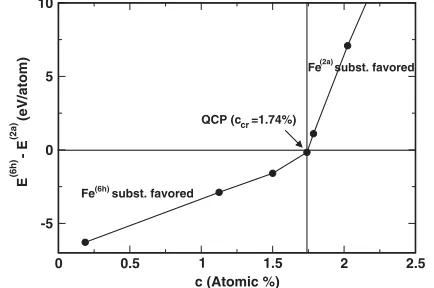
In Fig. 5, we report Nb site-preference energy
differ-ences (Eð6hÞEð2aÞ) versus %Nb excess in
-8 -6 -4 -2 0 2 4
E - E (eV) 0 4 8 12 16 c=0.0% c=1.74% F
DOS (States (eV.FU) )
-1 E
F
-50 -25 0 25 50
E - E (meV)
3.0 3.2 3.4 3.6 3.8 4.0 F DOS
Ec=1.74%F
FIG. 3 (color online). Nonmagnetic DOS per formula unit relative to EF for Nb1þcFe2c at ccr¼0 and 1.74%. Inset:
DOS atccraroundEF(the vertical dashed line isEFatc¼0%).
0 4 8 12
-8 -6 -4 -2 0 2 4
E - E (eV) 0
4 8
3.125% Nb-rich
F
DOS ( States (eV. FU) )
-1 3.125% Fe-rich Total Fe Impu rity Nb
FIG. 4 (color online). Nonmagnetic DOS relative to EF for 3.125% Nb-rich (top) and 3.125% Fe-rich (bottom).
PRL107,206401 (2011) P H Y S I C A L R E V I E W L E T T E R S 11 NOVEMBER 2011week ending
[image:5.612.326.560.470.686.2] [image:5.612.77.278.590.674.2]Nb4ðFeð12aÞcð2aÞNbcð2ð2aaÞÞÞ2ðFe1ð6hÞcð6hÞNbðc6ð6hhÞÞÞ6, where EðÞ is the
total energy when only theFeðÞsites are doped. Atccpa cr ¼ 1:74%, where the UBCP lies atEF, there is no energetically favored site occupancy and, therefore, no electron-hopping disorder effects, explaining the observed extremely slow variation ofversus doping [5]. With no site preference, a homogeneous solute distribution is favored, further sup-porting our focus on this case. These results shed light on the microscopic phenomenon occurring at or near the
QCP: The alignment of EF with the UBCP at 1.74%
provides the maximum response concomitant with no electron-hopping disorder and instability to both AFM and FM fluctuations.
We now explore the stability of competing magnetic phases. Out of several small-cell, magnetic configurations inNbFe2, we found an AFM state energetically favored by
10:45 m eV=atom over the nonmagnetic state, where local moments on the Feð2aÞ and Feð6hÞ sites are aligned antiparallel with values of0:69B and0:98B,
respec-tively, and the Nb has an induced moment of 0:14B
aligned with the Feð2aÞ site. The same ground state was found in other calculations [9,11]. The phase diagram indicates a SDW state for NbFe2 with a highly itinerant
nature (as for iron arsenides [3]), which competes with nearby FM states. The itineracy of magnetism is clear from the spin density on Fe sites (see [24]), while carrier density peaks atccr(Fig.3, inset).
To connect to scattering experiments, the UBCPsðkÞ
exhibit zero-velocity quasiparticles nearEF at
symmetry-equivalent, nonspecial k points Q0ð1;0Þ and
Q0½12;ðpffiffiffi3=2Þ, where Q0 0:25in units of the-M
caliper in Fig. 1(c). These Q’s remain relevant for off-stoichiometric alloys. The susceptibility, i.e.,
ðqÞ ¼X
k
½fðkÞ fðkþqÞ½kþqk1; (1)
can exhibit an enhanced response due to a convolution of (un)occupied states near EF, as for FS nesting [12,13].
Albeit weaker, it can occur from saddle-point topology, too. From the small caliper of the flat part of the UBCP, i.e.,
0:055ð2=aÞ, we estimate ajqjof 0:07 A1 close to the
0:05 A1estimated from the experiment [6].
Thus, from our direct calculations or estimated ðqÞ
features, paramagnetic, FM, and SDW (AFM) states com-pete near the QCP, until overwhelmed by a Stoner insta-bility at largerjcj, shown above. Such competing magnetic behavior is observed [6] near the QCP, where the low-T
resistivity [ðTÞ T] exponentvaries between3=2and
5=3, giving unusual non-Fermi-liquid behavior.
Quantifying the anomalous response further requires
ðq; c; !Þ, which is beyond the present scope. But the change in!¼0susceptibility,ðQ; !¼0Þ, yields the change in the DOS atEF, i.e.,nðEFÞ, and, if large, a FM
instability. Neal, Ylvisaker, and Pickett have extended the
Moriya ðq; c¼0; !Þ theory to account for UBCPs,
which yields an anomalous frequency response and com-peting FM and SDW states [25], agreeing with our direct calculations.
In summary, we have identified an accidental Fermi-surface (nonideal saddle-point) dispersion as the origin for observed behavior associated with the quantum critical-ity inNb1þcFe2c. We find that Nb (hole) doping accesses unconventional band critical points inNbFe2 that provide
the necessary low-energy excitations for a (Lifshitz-type) transition. This origin explains most of the observed doping behavior in this QC intermetallic compound, specifically, (i) onset ofccr%Nb excess for the QCP; (ii) almost constant resistivity versus c, (iii) competing magnetic states and temperature scale, (iv) observed SDW wave vectors, and, finally, (v) the stable FM states at large hole or electron doping (>2%). To explore the nature of the QC transition further, these electronic and chemical features can be in-corporated into a model Hamiltonian, but they would not have been discovered without the full dispersion and chemical alloying effects detailed here.
This work was funded by the U.S. Department of Energy
BES-DMSE (DE-FG02-03ER46026) and Ames
Laboratory (DE-AC02-07CH11358), operated by Iowa State University. We thank W. Pickett for suggesting this problem.
†
[1] S. Sachdev,Science288, 475 (2000).
[2] H. v. Lo¨hneysenet al.,Rev. Mod. Phys.79, 1015 (2007). [3] D. K. Prattet al.,Phys. Rev. Lett.106, 257001 (2011). [4] A. J. Schofield, Phys. Status Solidi B 247, 563 (2010);
W. J. Duncanet al.,Phys. Status Solidi B247, 544 (2010). [5] M. Brandoet al.,Phys. Rev. Lett.101, 026401 (2008). [6] D. Moroni-Klementowiczet al.,Phys. Rev. B79, 224410
(2009).
0 0.5 1 1.5 2 2.5
c (Atomic %) -5
0 5 10
E - E (eV/atom)
(6h)
(2a)
Fe subst. favored
Fe subst. favored
(6h)
(2a)
[image:6.612.66.283.49.193.2]QCP (c =1.74%)cr
FIG. 5. Nb site-preference energy difference (Eð6hÞEð2aÞ)
versus %Nb excess inNb4ðFe1cNbcÞ8.EðÞ is the total energy
when only theFeðÞsites are doped. Atc
cr¼1:74%, no Fe site is
favored, i.e., homogeneous solute distribution.
[7] M. Shiga and Y. Nakamura,J. Phys. Soc. Jpn. 56, 4040 (1987).
[8] Y. Yamada and A. Sakata, J. Phys. Soc. Jpn. 57, 46 (1988).
[9] A. Subedi and D. J. Singh, Phys. Rev. B 81, 024422 (2010).
[10] D. J. Singh,Phys. Rev. B78, 094511 (2008).
[11] D. A. Tompsett, R. J. Needs, F. M. Grosche, and G. G. Lonzarich,Phys. Rev. B82, 155137 (2010).
[12] S. C. Moss,Phys. Rev. Lett.22, 1108 (1969).
[13] B. L. Gyo¨rffy and G. M. Stocks,Phys. Rev. Lett.50, 374 (1983).
[14] L. van Hove,Phys. Rev.89, 1189 (1953).
[15] J. F. Clarket al.,Phys. Rev. Lett.74, 3225 (1995). [16] J. D. Althoff, D. D. Johnson, and F. J. Pinski, Phys. Rev.
Lett.74, 138 (1995).
[17] D. D. Johnson et al., Phys. Rev. Lett. 56, 2088 (1986);
Phys. Rev. B41, 9701 (1990).
[18] Aftab Alam and D. D. Johnson,Phys. Rev. B80, 125123 (2009); Aftab Alam, Brent Kraczek, and D. D. Johnson,
Phys. Rev. B82, 024435 (2010).
[19] M. R. Crook and R. Cywinski,Hyperfine Interact.85, 203 (1994).
[20] E. Stoner,Proc. R. Soc. A169, 339 (1939).
[21] O. K. Andersenet al.,Physica (Amsterdam)86–88B+C, 249 (1977).
[22] Masatoshi Imada et al., J. Phys. Condens. Matter 22, 164206 (2010); Y. Yamaji et al., J. Phys. Soc. Jpn. 76, 063702 (2007).
[23] K. Nakayamaet al.,Phys. Rev. B83, 020501(R) (2011). [24] See Supplemental Material at http://link.aps.org/ supplemental/10.1103/PhysRevLett.107.206401 for details of the charge and spin densities showing the magnetism is itinerant.
[25] B. P. Neal, E. R. Ylvisaker, and W. E. Pickett,Phys. Rev. B
84, 085133 (2011).
PRL107,206401 (2011) P H Y S I C A L R E V I E W L E T T E R S 11 NOVEMBER 2011week ending