An extended abstract of this paper is published in the proceedings of the 3rd International Workshop on Security in Cloud Computing—SCC@AsiaCCS 2015. This is the full version.
Entangled Cloud Storage
Giuseppe Ateniese∗1, ¨Ozg¨ur Dagdelen†2, Ivan Damg˚ard‡3, and Daniele Venturi§4
1Sapienza University of Rome, Department of Computer Science 2bridgingIT
3Aarhus University, Department of Computer Science 4Sapienza University of Rome, Department of Computer Science
March 10, 2016
Abstract
Entangled cloud storage (Aspneset al., ESORICS 2004) enables a set of clients to “entangle” their files into a singleclewto be stored by a (potentially malicious) cloud provider. The entan-glement makes it impossible to modify or delete significant part of the clew without affectingall files encoded in the clew. A clew keeps the files in it private but still lets each client recover his own data by interacting with the cloud provider; no cooperation from other clients is needed. At the same time, the cloud provider is discouraged from altering or overwriting any significant part of the clew as this will imply that none of the clients can recover their files.
We put forward the first simulation-based security definition for entangled cloud storage, in the framework ofuniversal composability(Canetti, FOCS 2001). We then construct a protocol satisfying our security definition, relying on an entangled encoding scheme based on privacy-preserving polynomial interpolation; entangled encodings were originally proposed by Aspnes et al. as useful tools for the purpose of data entanglement. As a contribution of independent interest we revisit the security notions for entangled encodings, putting forward stronger defi-nitions than previous work (that for instance did not consider collusion between clients and the cloud provider).
Protocols for entangled cloud storage find application in the cloud setting, where clients store their files on a remote server and need to be ensured that the cloud provider will not modify or delete their data illegitimately. Current solutions, e.g., based on Provable Data Possession and Proof of Retrievability, require the server to be challenged regularly to provide evidence that the clients’ files are storedat a given time. Entangled cloud storage provides an alternative approach where any single client operates implicitly on behalf of all others, i.e., as long as one client’s files are intact, the entire remote database continues to be safe and unblemished.
∗
Acknowledges funding from the European Union’s Horizon 2020 research and innovation programme under grant agreement No 644666.
†
Work done while at Technische Universit¨at Darmstadt. ‡
Supported from the Danish National Research Foundation, the National Science Foundation of China (under the grant 61061130540), and also from the CFEM research center.
§
Contents
1 Introduction 1
1.1 Our Contributions . . . 3 1.2 Other Related Work . . . 5 1.3 Paper Organization . . . 5
2 Preliminaries 6
2.1 Notation . . . 6 2.2 The UC Framework . . . 6 2.3 Succinct argument systems . . . 8 2.4 Somewhat Homomorphic
Encryp-tion . . . 8 2.5 Collision Resistant Hashing . . . 9 2.6 Pseudorandom Generators . . . . 10
3 Entangled Encoding Schemes 10
3.1 Security Properties . . . 10 3.2 A Code based on Polynomials . . 11
3.3 Proof of Theorem 2 . . . 12
4 Entangled Storage of Data 14
4.1 The Memory Functionality . . . 15 4.2 Ideal Implementation of Data
En-tanglement . . . 16
5 A Protocol for Data Entanglement 17
6 Discussion and Open Problems 22
6.1 Comparison to PDP/POR . . . . 22 6.2 Alternative Solutions . . . 22 6.3 Efficiency Considerations . . . . 23 6.4 Open Problems . . . 23
A A Protocol for Realizing Imem∗ 26
B Secure Polynomial Evaluation 28
1
Introduction
Background. Due to the constantly increasing need of computing resources, and to the advances in networking technologies, modern IT organizations nowadays are prompted to outsource their storage and computing needs. This paradigm shift—often known as “cloud computing”—allows for applications from a server to be executed and managed through a client’s web browser, with no installed client version of an application required. Cloud computing includes different types of services, the most prominent known under the name ofInfrastructure as a Service(IaaS),Platform as a service (PaaS), and Software as a Service (SaaS). In rough terms, a solution at the SaaS level allows a customer (e.g., the end-user) to make use of a service provider’s computing, storage or networking infrastructure. A solution at the PaaS level, instead, allows a customer (e.g., a programmer or a software developer) to exploit pre-configured software environments and tools. Finally, a solution at the IaaS level allows a customer (e.g., a service provider) to acquire physical resources such as storage units, network devices and virtual machines.1
Cloud infrastructures can belong to one of two categories: publicandprivateclouds. In a private cloud, the infrastructure is managed and owned by the customer and located in the customer’s region of control. In a public cloud, on the contrary, the infrastructure is owned and managed by a cloud service provider and is located in the cloud service provider’s region of control. The latter scenario poses serious security issues, due to the fact that a malicious cloud provider could misbehave putting the confidentiality of a customer data at edge.
based on public clouds (e.g., via Microsoft’s Azure or Amazon’s S3). Outsourcing data storage provides customers with several benefits. In particular, by moving their data to the cloud, customers can avoid the costs of building and maintaining a private storage infrastructure; this results in improved availability (as data is accessible from anywhere) and reliability (as, e.g., customers don’t need to take care of backups) at lower costs.
While the benefits of using a public cloud infrastructure are clear, companies and organizations (especially enterprises and government organizations) are still reluctant to outsource their storage needs. Files may contain sensitive information and cloud providers can misbehave. While encryp-tion can help in this case, it is utterly powerless to prevent data corrupencryp-tion, whether intenencryp-tional or caused by a malfunction. Indeed, it is reasonable to pose the following questions: How can we be certain the cloud provider is storing the entire file intact? What if rarely-accessed files are altered? What if the storage service provider experiences Byzantine failures and tries to hide data errors from the clients? Can we detect these changes and catch a misbehaving provider?
PDP/POR. It turns out that the questions above have been studied extensively in the last few years. Proof-of-storage schemes allow clients to verify that their remote files are still pristine even though they do not possess any local copy of these files. Two basic approaches have emerged: Provable Data Possession (PDP), introduced by Ateniese et al. [2], and Proof of Retrievability (POR), independently introduced by Juels and Kaliski [26] (building on a prior work by Naor and Rothblum [30]). They were later extended in several ways in [33, 5, 19, 4, 41, 12, 35, 20]. In a PDP scheme, file blocks are signed by the clients via authentication tags. During an audit, the remote server is challenged and proves possession of randomly picked file blocks by returning a short proof of possession. The key point is that the response from the server is essentially constant, thanks to the homomorphic property of authentication tags that makes themcompressibleto fit into a short string. Any data alteration or deletion will be detected with high probability. In POR, in addition, error correction codes are included along with remote file blocks. Now, the server provides a proof that the entire file could potentially be recovered in case of hitches.
Data entanglement. The main shortcoming of proof-of-storage schemes is that a successful run of an audit provides evidence about the integrity of a remote file only at a given time. As a consequence, all users must challenge the storage server regularly to make sure their files are still intact.
An alternative approach has been proposed by Aspneset al.[1], under the name ofdata entan-glement.2 The main idea is to make altering or deleting files extremely inconvenient for the cloud provider. To achieve this feature, the authors of [1] considered a setting where many clients encode all their files into a single digital clew3 c, that can be used as a representation of all files and be stored on remote and untrusted servers. The goal is to ensure that any significant change to c is likely to disrupt the content of all files.
Unfortunately, the original model of [1] suffers from an important shortcoming: The entan-glement is created by a trusted authority, and files can only be retrieved through the trusted
2
“Entanglement” usually refers to a physical interaction between two particles at the quantum level: Even if separated, the particles are in a quantum superposition until a measurement is made, in which case both particles assume definitive and correlated states. Analogously, two entangled files are somehow linked together: A file that is intact implies the other must also be intact. Any single change to one file, destroys the other.
authority. Although the assumption of a trusted party significantly simplifies the task of designing (and analyzing) protocols for data entanglement, it also makes such protocols not suitable for cloud computing.
1.1 Our Contributions
The main contribution of this paper is to overcome the above limitation. In particular, we propose the first simulation-based definition of security for data entanglement as well as protocols satisfying our definition without the need for a trusted party. More in detail, our results and techniques are outlined below.
Entangled encodings. Entangled encoding schemes were introduced by [1] as useful tools for the purpose of data entanglement. As a first contribution, we revisit the notion of entangled encodings putting forward stronger definitions w.r.t. previous work (see below for a comparison). In our language, an entangled encoding consists of an algorithm Encode that takes as input n stringsf1, . . . , fn (together with a certain amount of randomnessr1, . . . , rn), and outputs a single
codewordcwhich “entangles” all the input strings. The encoding is efficiently decodable, i.e., there exists an efficient algorithm Decode that takes as input (c, ri, i) and outputs the file fi together
with a verification valueξ. Since onlyri is required to retrieve fi (we don’t needrj, j6=i), we refer
to this as “local decodability”. The verification value is a fixed function of the encoded string and the randomness.
In addition, the encoding satisfies two main security properties. First off, it is private in the sense that even if an adversary already knows a subset of the input strings and randomness used to encode them, the resulting encoding reveals no additional information about any of the other input strings other than what can be derived from the knowledge of this subset. Second, it is all-or-nothingin the sense that whenever an adversary has “large” uncertainty aboutc(i.e., a number of bits linear in the security parameter), he cannot design a function that will answer any decoding query correctly. See Section 3 for a precise definition.
We remark that our definitions are stronger than the one considered in [1]. First, [1] did not considered privacy as an explicit property of entangled encodings. Second, and more importantly, our definition of all-or-nothing integrity is more general in that for instance it allows the adversary to known a subset of the input strings and randomness; in the cloud storage setting this will allow to model arbitrary collusion between clients and a malicious cloud provider.
We additionally provide a concrete instantiation of an entangled encoding scheme based on polynomials over a finite field F.4 (A similar instantiation was also considered in [1].) Here, the encoding of a stringfi is generated by choosing a random pair of elements (si, xi)∈F2 and defining
a point (xi, yi =fi+si). The entanglement of (f1, . . . , fn) consists of the unique polynomialc(·) of
degree n−1 interpolating all of (xi, yi). In Section 3 we show that, if the field F is large enough,
this encoding satisfies the all-or-nothing integrity property for a proper choice of the parameters. The latter holds even in case the adversary is computationally unbounded.
Simulation-based security. Next, we propose a simulation-based definition of security for en-tangled storage in the cloud setting, in the model of universal composability [11] (UC). In the UC
4
paradigm, security of a cryptographic protocol is defined by comparing an execution in the real world, where the scheme is deployed, with an execution in an ideal world, where all the clients give their inputs to a trusted party which then computes the output for them.
Roughly, the ideal functionality IESSthat we introduce captures the following security require-ments (see also the discussion in Section 4).
• Privacy of entanglement: The entanglement process does not leak information on the file fi
of clientPi, neither to other (possibly malicious) clients nor to the (possibly malicious) server;
• Privacy of recovery: At the end of each recovery procedure, the confidentiality of all files is still preserved;
• All-or-nothing integrity: A malicious server (possibly colluding with some of the clients) overwriting a significant part of the entanglement is not able to answer recovery queries from any of the clients.
Intuitively, the last property says that the probability that a cloud provider answers correctly a recovery query for some file is roughly the same for all files which are part of the entanglement: such probability is either one (in case the server did not modify the clew), or negligibly close to zero (in case the entanglement was modified).
We choose to prove security in the UC model as this gives strong composition guarantees. However, some technical difficulties arise as a result. First, we face the problem that if the server is corrupt it may choose to overwrite the encoding we give it with something else, and so we may enter a state where the server’s uncertainty about the encoding is so large that no request can be answered. Now, in any simulation based definition, the simulator must clearly know whether we are in a such a state. But since the server is corrupt we do not know how it stores data and therefore it is not clear how the simulator could efficiently compute the server’s uncertainty about the encoding. In the UC model it is even impossible because the data could be stored in the state of the environment which is not accessible to the simulator.
We solve this problem by introducing a “memory module” in the form of an ideal functionality, and we store the encoded data only inside this functionality. This means that the encoding can only be accessed via commands we define. In particular, data cannot be taken out of the functionality and can only be overwritten by issuing an explicit command. This solves the simulator’s problem we just mentioned. A corrupt server is allowed, however, to specify how it wants to handle retrieval requests by giving a (possibly adversarial) machine to the functionality, who then will let it execute the retrieval on behalf of the server.
We emphasise that this memory functionality is not something we hope to implement using simpler tools, it should be thought of as a model of an adversary that stores the encoded data only in one particular location and will explicitly overwrite that location if it wants to use it for something else.
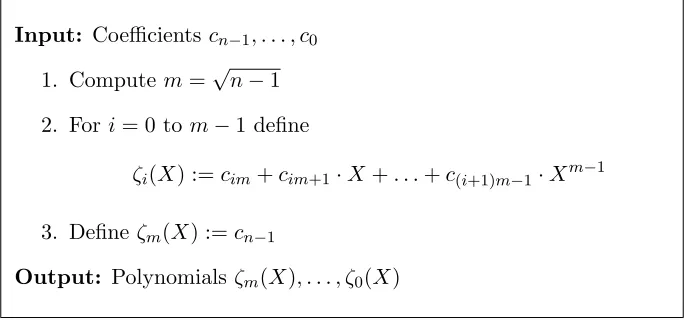
A protocol realizing IESS. Finally, in Section 5, we design a protocol implementing our ideal functionality for entangled storage. The scheme relies on the entangled encoding scheme based on polynomials in a finite field F described above, and on a somewhat homomorphic encryption scheme with message space equal to F. Each client has a file fi (represented as a field element
in F), samples (si, xi) ← F2, defines (xi, yi = fi +si), and keeps a hash θi of the original file.
of the polynomial c(·) of minimum degree interpolating all of (xi, yi). This can be done by using
standard techniques relying on linear secret sharing (see A). The polynomial c(·) is stored in the ideal functionality for the memory module, which can be accessed by the server.
Whenever a client wants to recover its own file, it forwards to the server a ciphertext e cor-responding to an encryption of xi. The server returns an encryption of c(xi), computed trough
the ciphertexteand using the homomorphic properties of the encryption scheme, together with a proof that the computation was performed correctly. The client can verify the proof, decrypt the received ciphertext in order to obtain yi and thus fi = yi−si, and check that the hash value θi
matches.
Our final protocol is a bit more involved, as clients are not allowed to store the entire (xi, si)
(otherwise they could just store the filefi in the first place); however this can be easily solved by
having the client store only the seed σi of a pseudo-random generatorG(·), and recover (xi, si) as
the output ofG(σi).
1.2 Other Related Work
Below we review previous work on PDP/POR and data entanglement. We refer the reader to Section 6 for a more extensive discussion and a comparison between the two approaches.
PDP/POR. As we mentioned in the introduction, PDP/POR have witnessed a surge of interest among researchers that have adapted and extended the original schemes to work for new scenarios. In particular, PDP and POR were extended to work on dynamic data where the data owner can modify the original database stored remotely.
PDP was also adapted to work with multiple cloud providers, or with providers that keep multiple copies of the same file. In general, a proof of integrity may leak information about the file. PDP has recently been extended to provide complete privacy-preserving integrity checking, i.e., a PDP proof does not reveal information about the file content. We refer the reader, e.g., to [42, 36, 7] for extensive surveys on the subject.
Entanglement of data. Apart from the already mentioned work by Aspenset al.[1], data entan-glement also appears in the context of censorship-resistant publishing systems; see, e.g., Dagster [38] and Tangler [39].
The notion of all-or-nothing integrity is inspired by the all-or-nothing transform introduced by Rivestet al. [32], and later generalized in [18]. The standard definition of all-or-nothing transform requires that it should be hard to reconstruct a message if not all the bits of its encoding are known.
Publication note. A preliminary version of this paper appeared as [3]. This is the full version of that paper, containing additional material—in particular all details about modelling and securely realizing data entanglement in the UC framework—and significantly revised proofs.
1.3 Paper Organization
storage, and the memory module functionality that is needed in order to prove security in the UC framework. Section 5 contains the description of our protocol for data entanglement and its security proof.
We refer the reader to Section 6 for a more extensive discussion on the efficiency of our protocol, for a comparison between the approaches of data entanglement and PDP/PoR, and for a list of open problems related to our work.
2
Preliminaries
2.1 Notation
Given an integer n, we let [n] ={1, . . . , n}. If n∈R, we writedne for the smallest integer greater thann. If x is a string, we denote its length by|x|; ifX is a set,|X | is the number of elements in
X. Whenxis chosen randomly inX, we writex← X$ . WhenAis an algorithm, we writey←A(x) to denote a run ofAon inputx and outputy; if Ais randomized, theny is a random variable and
A(x;ω) denotes a run ofAon input x and random coinsω.
Throughout the paper, we denote the security parameter by k. A functionnegl(k) is negligible ink (or just negligible) if it decreases faster than the inverse of every polynomial ink. A machine is said to be probabilistic polynomial time (PPT) if it is randomized, and its number of steps is polynomial in the security parameter.
Let X = {Xk}k∈N and Y = {Yk}k∈N be two distribution ensembles. We say X and Y are -computationally indistinguishable if for every polynomial time distinguisher A there exists a function such that |P(A(X) = 1)−P(A(Y) = 1)| ≤(k). If (k) is negligible, we simply say X and Y are (computationally) indistinguishable (and we write X≈Y).
The statistical distance of two distributions X, Y is defined as SD(X, Y) = Pa|P(X =a)−
P(Y =a)|. The min-entropy of a random variable X is H∞(X) =−log maxxP(X=x).
2.2 The UC Framework
We briefly review the framework of universal composability (UC) [11]. Let φ : ({0,1}∗)n →
({0,1}∗)n be a functionality, where φi(x1, . . . , xn) denotes the i-th element of φ(x1, . . . , xn) for
i∈[n]. The input-output behavior of φis denoted (x1, . . . , xn)7→(y1, . . . , yn).
Consider a protocolπrun by a set of partiesP1, . . . , Pn(where each partyPiholds inputxi), for
computing φ(x1, . . . , xn). In order to define security of π, we introduce an ideal process involving
an incorruptible “trusted party” that is programmed to capture the desired requirements from the task at hand. Roughly, we say that a protocol for φ is secure if it “emulates” the ideal process. Details follow.
The process of executing protocol π (run by partiesP1, . . . , Pn) with some adversary Aand an
environment machine Z with input z is defined as follows. All parties have a security parameter k∈N and are polynomial ink. The execution consists of a sequence of activations, where in each
activation a single participant (eitherZ,AorPi) is activated. The activated participant reads
in-formation from its input and incoming communication tapes, executes its code, and possibly writes information on its outgoing communication tapes and output tapes. In addition, the environment can write information on the input tapes of the parties, and read their output tapes. The adversary can read messages on the outgoing message tapes of the parties and deliver them by copying them to the incoming message tapes of the recipient parties. The adversary can also corrupt parties, with the usual consequences that it learns the internal information known to the corrupt party and that, from now on, it controls that party.
Let REALπ,A(z),Z(k,(x1, . . . , xn)) denote the random variable corresponding to the output of
environmentZ when interacting with adversaryAand parties running protocol π (holding inputs x1, . . . , xn), on input security parameter k, advice z and uniformly chosen random coins for all
entities.
The ideal execution. The ideal process for the computation ofφinvolves a set of dummy parties P1, . . . , Pn, an ideal adversarySIM(a.k.a. the simulator), an environment machine Z with input
z, and an ideal functionality I (also modeled as an ITM). The ideal functionality simply receives all inputs by P1, . . . , Pn and returns to the parties their respective outputs φi(x1, . . . , xn). The
ideal adversarySIMproceeds as in the real execution, except that it has no access to the contents of the messages sent between I and the parties. In particular, SIM is responsible for delivering messages from I to the parties. It can also corrupt parties, learn the information they know, and control their future activities.
LetIDEALI,SIM(z),Z(k,(x1, . . . , xn)) denote the random variable corresponding to the output
of environmentZwhen interacting with adversarySIM, dummy partiesP1, . . . , Pn(holding inputs
x1, . . . , xn), and ideal functionalityI, on input security parameterk, advicezand uniformly chosen
random coins for all entities.
Securely realizing an ideal functionality. We can now define universally composable (UC) security, following [11].
Definition 1. Let n ∈ N. Let I be an ideal functionality for φ : ({0,1}∗)n → ({0,1}∗)n and let
π be an n-party protocol. We say that π securely realizes I if for any adversary A there exists an ideal adversary SIM such that for any environmentZ, any tuple of inputs (x1, . . . , xn), we have
IDEALI,SIM(z),Z(k,(x1, . . . , xn)) k∈
N,z∈{0,1}∗≈
REALπ,A(z),Z(k,(x1, . . . , xn)) k∈
N,z∈{0,1}∗.
In this paper we only allow static corruptions, that is, adversaries determine the parties to corrupt at the beginning of the protocol execution. The adversary is called passive if it follows faithfully the protocol specifications but can save intermediate computations; on the other hand an active adversary can behave arbitrarily during a protocol execution. Security of a protocol is sometimes defined with respect to anadversary structure ∆, i.e., a monotone5 set of subsets of the players, where the adversary may corrupt the players of one set in ∆. When this is the case, we say that π ∆-securely realizes a given functionality.
5
The composition theorem. The above notion of security allows a modular design of protocols, where security of each protocol is preserved regardless of the environment where that protocol is executed. In order to state the composition theorem, we sketch the so-calledI-hybrid model, where a real-life protocol is augmented with an ideal functionality. This model is identical to the above real execution, with the following additions. On top of sending messages to each other, the parties may send messages to and receive messages from an unbounded number of copies ofI. (Each copy is identified via a unique session identifier, chosen by the protocol run by the parties.)
The communication between the parties and each one of the copies ofImimics the ideal process. That is, once a party sends a message to some copy ofI, that copy is immediately activated and reads that message of the party’s tape. Furthermore, although the adversary in the hybrid model is responsible for delivering the messages from the copies ofI to the parties, it does not have access to the contents of these messages. It is stressed that the environment does not have direct access to the copies ofI.
Letπbe a protocol in theI0-hybrid model and letπ0 be a protocol UC-realizingI0. Consider the composed protocol ππ0, where each call to the ideal functionality I0 is replaced with an execution of protocol π0.
Theorem 1 ([11]). Let I, I0 be ideal functionalities. Let π be an n-party protocol that securely realizes I in the I0-hybrid model and let π0 be an n-party protocol that securely realizes I0. Then protocol ππ0 securely realizes I.
2.3 Succinct argument systems
LetR⊂ {0,1}∗×{0,1}∗be a polynomial-time relation with languageLR={x:∃w s.t. (x, w)∈R}.
A succinct argument system (P,V) forL∈NP is a pair of probabilistic polynomial-time machines such that the following properties are satisfied: (i) (succinctness) the total length of all messages exchanged during an execution of (P,V) is only polylogarithmic in the instance and witness sizes; (ii) (completeness) for anyx∈Lwe have that (P(w),V)(x) outputs 1 with overwhelming probabil-ity; (iii) (argument of knowledge) for anyx6∈Land any computationally bounded proverP∗ such that (P∗,V)(x) outputs 1 there exists a polynomial time extractorEX TP∗ outputting a witnessw that satisfies (x, w)∈R with overwhelming probability. See for instance [40, 8].
Succinct interactive argument systems for NP exists in 4 rounds based on the PCP theo-rem, under the assumption that collision-resistant function ensembles exists [27, 40]. Succinct non-interactive argument systems, also called SNARGs, are impossible under any falsifiable cryp-tographic assumption [24] but are known to exists in the random-oracle model [28] or under non-falsifiable cryptographic assumptions [8].
2.4 Somewhat Homomorphic Encryption
A homomorphic (public-key) encryption scheme is a collection of the following algorithms HE = (Gen,Enc,Dec,Eval), defined below.
Key Generation. Upon input a security parameter 1k, algorithmGenoutputs a secret and public key (sk,pk) and an evaluation keyevk.
Encryption. Upon input a public keypk and a messageµ, algorithmEnc outputs a ciphertexte.
Evaluation. Upon input an evaluation key evk, a function c : {0,1}∗ → {0,1}∗ and a set of n ciphertextse1, . . . , en, algorithm Evaloutputs a ciphertext ec.
Definition 2 (CPA security). A homomorphic scheme HE is CPA-secure if for any probabilistic polynomial time algorithm A it holds that
|Pr(A(pk,evk,Encpk(µ0)) = 1)−Pr(A(pk,evk,Encpk(µ1)) = 1)| ≤negl(k),
where (pk,evk,sk)←Gen(1k), and (µ0, µ1)← A(1k,pk) is such that |µ0|=|µ1|.
Sometimes we also refer to the “real” or “random” variant of CPA-security, where A has to distinguish the encryption of a known messageµfrom the encryption of a random unrelated message µ0. The two notions are equivalent up-to a constant factor in security.
Definition 3 (C-homomorphism). Let C = {Ck}k∈N be a class of functions (together with their
respective representations). A schemeHEisC-homomorphic if for any sequence of functionsck∈ Ck
and respective inputs µ1, . . . , µn, where n=n(k), it holds that
Pr(Decsk(Evalevk(c, e1, . . . , en))=6 c(µ1, . . . , µn)) =negl(k),
where the probability is taken over the random choice of(pk,evk,sk)←Gen(1k)andei←Encpk(µi).
Note that the standard properties of additive or multiplicative homomorphism, satisfied for instance by RSA, Paillier, or ElGamal, are captured when the class C contains only addition or multiplication, respectively.
An homomorphic encryption scheme is said to be compact if the output length of Evalevk(·)
is bounded by a polynomial in k (regardless of the function c and of the number of inputs). An encryption scheme is fully-homomorphic when it is both compact and homomorphic with respect to the class C of all arithmetic circuits over a finite field F (thus both addition and multiplication overF).
A somewhat homomorphic encryption (SHE) scheme allows to compute functions c(·) of “low degree” and it is used as a subroutine of fully homomorphic encryption [23] (applying a “bootstrap-ping” or re-linearization technique of [10, 9] to perform an unbounded number of operations). We use SHE in our schemes since it is significantly faster than FHE.
2.5 Collision Resistant Hashing
We recall what it means for a family of hash functions to be collision resistant. Let`, `0 :N→Nbe
such that`(k)> `0(k), and let I ⊆ {0,1}∗. A function family{Hι}ι∈I is called a collision-resistant
hash family if the following holds.
• There exists a probabilistic polynomial time algorithm IGen that on input 1k outputs ι∈I,
indexing a function Hι mapping from `(k) bits to `0(k) bits.
• There exists a deterministic polynomial time algorithm that on inputx ∈ {0,1}` and ι∈I,
outputsHι(x).
• For all probabilistic polynomial time adversaries Bwe have that
P
Hι(x) =Hι(x0) : (x, x0)← B(1k, ι);ι←IGen(1k)
2.6 Pseudorandom Generators
We recall the definition of a pseudorandom generator. LetG:{0,1}k → {0,1}`(k)be a deterministic function, where`(k)> k. We say thatGis a secure PRG if there exists a polynomial time algorithm that givenσ∈ {0,1}koutputsG(σ), and moreover for all probabilistic polynomial time adversaries
B we have:
P
B(G(σ)) = 1 :σ← {0,1}k−
P B(U`(k)) = 1
≤negl(k), whereU`(k) is uniform over {0,1}`(k).
3
Entangled Encoding Schemes
In this section, we revisit the notion of an entangled encoding scheme and show a construction based on polynomial interpolation. Intuitively, an entangled encoding scheme encodes an arbitrary number of input strings f1, . . . , fn into a single output string using random strings r1, . . . , rn (one
for each input string). We assume that all input strings have the same length `.6 The following definition captures an entangled encoding scheme formally.
Definition 4 (Entangled Encoding Scheme). An entangled encoding scheme is a triplet of algo-rithms (Setup,Encode,Decode) defined as follows.
Setup. Setup is a probabilistic algorithm which, on input a security parameter k, the number of strings to encoden, and the length parameter `, outputs public parameters (F,R,C). We call
F the input space, Rthe randomness space and C the entanglement space.
Encoding. Encode is a deterministic algorithm which, on input strings f1, . . . , fn ∈ F and
auxiliary inputsr1, . . . , rn∈ R, outputs an encoding c∈ C.
(Local) Decoding. Decode is a deterministic algorithm which, on input an encoding c∈ C and input ri ∈ R together with index i, outputs string fi ∈ F and a verification value ξ. This
value must be a fixed function ξ(fi, ri) of the file and the randomness.
Correctness of decoding requires that for all security parameterkand length`, public parameters (F,R,C) ← Setup(1k, n, `), input strings f1, . . . , fn ∈ F and auxiliary inputs r1, . . . , rn ∈ R, we
have (fi, ξ(fi, ri)) =Decode(Encode(f1, . . . , fn;r1, . . . , rn), ri, i) for all i∈[n].
3.1 Security Properties
We let Fi and Ri for i = 1, . . . , n be random variables representing the choice of fi and ri,
re-spectively. We make no assumption on the distributions ofFi and Ri, but note that of course the
distribution ofRi will be fixed by the encoding scheme. We let F−i (resp.f−i) denote the set of all
variables (resp. values) except Fi (resp. fi). Similar notation is used for Ri and ri. An entangled
encoding scheme satisfies two main security properties.
Privacy: Even if an adversary already knows a subset of the input strings and randomness used to encode them, the resulting encoding reveals no additional information about any of the 6
other input strings other than what can be derived by the knowledge of this subset. More precisely, let U denote some arbitrary subset of the pairs (Fj, Rj)j=1...n, and let C be the
encoding corresponding to all elements, i.e., C = Encode(F1, . . . , Fn;R1, . . . , Rn). Let V be
the set of Fi not included in U, i.e., V = F−U. An entangled encoding scheme is private
if, for all u ∈ U and all c∈ C, the distribution DV|U of the random variable V when given U = u is statistically close to the distribution DV|U C of the random variable V when given
(U =u, C =c), i.e., SD(DV|U,D0V|U C)≤negl(k).
All-Or-Nothing Integrity: Roughly speaking, if an adversary has a large amount of uncertainty about the encoding C = Encode(F1, . . . , Fn;R1, . . . , Rn), he cannot design a function that
will answer decoding queries correctly. More precisely, letU be defined as under privacy, and define a random variableCU0 that is obtained by applying an arbitrary (possibly probabilistic) function g(·) to U and C. Now the adversary plays the following game: he is given that CU0 =c0 for any valuec0 and then specifies a functionDecodeAdv. We say that the adversary
wins at position i if Fi is not included in U and DecodeAdv(Ri, i) = Decode(C, Ri, i). The
encoding has (α, β)-all-or-nothing integrity ifH∞(C|CU0 =c0)≥αimplies that for eachi, the
adversary wins at position iwith probability at most β. In particular, in order to win, the adversary’s function must output both the correct file and verification value.
Definition 5((α, β)-All-or-Nothing Integrity). We say that an entangled encoding scheme (Setup, Encode,Decode)has(α, β)-all-or-nothing integrity if for all (possibly unbounded) adversariesA, for all subsets U ⊂ {(Fj, Rj)}j=1...n, for all (possibly unbounded) functionsg(·) and for alli∈[n]\ {j:
(Fj, Rj)∈U}, we have that
P
DecodeAdv(Ri, i) =Decode(C, Ri, i) :
(F,R,C)←Setup(1k, n, `),
C=Encode(F1, . . . , Fn;R1, . . . , Rn),
CU0 =g(C, U),DecodeAdv ← A(CU0 )
≤β,
whenever H∞(C|CU0 = c0) ≥ α (where the probability is taken over the choices of the random
variables Fi, Ri and the coin tosses of A).
Note thatβ in the definition of all-or-nothing integrity will typically depend on bothα and the security parameter k, and we would like thatβ is negligible in k, if α is large enough. We cannot ask for more than this, since if α is small, the adversary can guess the correct encoding and win with large probability.
3.2 A Code based on Polynomials
We now design an encoding scheme that has the properties we are after. As a first attempt, we consider the following. We choose a finite fieldF, say of characteristic 2, large enough that we can represent values of Fi as field elements. We then choosex1, . . . , xn uniformly in Fand define the
encoding to be c, where c is the polynomial of degree at most n−1 such that c(xi) = fi for all
Privacy, however, is not quite satisfied: we are given the polynomial c and we want to know how much this tells us about c(xi) where xi is uniformly chosen. Note that it does not matter if
we are given xj forj 6=i, since all xj are independent. We answer this question by the following
lemma:
Lemma 1. Given a non-constant polynomialc of degree at mostn, the distribution ofc(R), where
R is uniform in F, has min-entropy at least log|F| −log(n).
Proof. The most likely value of c(R) is the value y for which c−1(y) is of maximal size. This is equivalent to asking for the number of roots in c(X)−y which is at mostn, sincec(X)−y is not 0 and has degree at most n. Hence P(c(R) = y) ≤ n/|F|, and the lemma follows by definition of
min-entropy.
It is reasonable to assume that cwill not be constant, but even so, we see that the distribution of c(R) is not uniform as we would like, but only close (if n |F|). In some applications, a loss of logn bits in entropy may be acceptable, but it is also easy to fix this by simply one-time pad encrypting the actual data before they are encoded. This leads to the final definition of our encoding scheme:
Setup: Given as input the length`of the ndata items to be encoded and the security parameter k, defineF =F=GF(2max(`,3k+logn+log logn)),R=F2 and C=Fn.
Encoding: Givenf1, . . . , fnto encode, choosexi, si ∈Funiformly (and independently) at random,
and set ri = (xi, si); in case xi = xj for some index i 6= j output a special symbol ⊥ and
abort. Otherwise, define Encode(f1, . . . , fn;r1, . . . , rn) =c to be the polynomial of degree at
mostn−1 such thatc(xi) =fi+si fori= 1, . . . , n.
Decoding: We define Decode(c, ri, i) =Decode(c,(xi, si), i) = (c(xi)−si, c(xi)).
It is trivial to see that Decoding outputs the correct file. The verification value is c(xi) = fi+si
thus it is indeed a function of the file and the randomness, as required by the definition. The encoding is also easily seen to be private: In fact, by the uniformly random choice ofsi, given any
subsetU of (Fj, Rj)j=1...n the encodingC does not reveal any additional information onV =F−U.
For all-or-nothing integrity, we have the theorem below. Its conclusion may seem a bit complicated at first, but in fact, reflects in a natural way that the adversary has two obvious strategies when playing the game from the definition: he can try to guess the correct encoding, which succeeds with probability exponentially small in α, or he can try to guess the correct field element that is computed at the end of the game (by making his function constant). However, the latter strategy succeeds with probability exponentially small in|F|. The theorem says that, up to constant factor losses in the exponent, these are the only options open to the adversary.
Theorem 2. The above encoding scheme has (α, max(2−k+2,2−(α−3)/2))-all-or-nothing integrity.
3.3 Proof of Theorem 2
Before coming to the theorem, we need the following lemma.
Lemma 2. Let U, CU0 be as in the definition of all-or-nothing integrity and suppose the pair (Fi, Ri) = (Fi,(Xi, Si))is not included inU. Then for the encoding scheme defined above, and for
Proof. Suppose first that we are given values for allFj, Rj wherej6=i and also forC and Fi, i.e.,
we are given the polynomialc, allfj and all (xj, sj), except (xi, si). LetV be a variable representing
all this. Before a value of V is given, xi, si are uniformly random and independent of thefj’s and
of the (xj, sj) where j6=i. It follows that when we are given a value ofV, the only new constraint
this introduces is thatc(xi) =si+fi must hold. Now, ifcis constant, this gives no information at
all aboutxi, so assumec is not constant. Then for each valuesi, it must be the case that xi is in a
set consisting of at mostnelements, sincechas degree at mostn−1. Therefore we can specify the distribution of xi induced by this as follows. The set of all xi is split into at least|F|/n subsets.
Each subset is equally likely (since si is uniform a priori), and the elements inside each subset are
equally likely (since xi is uniform a priori). Each subset is, therefore, assigned probability at most
n/|F|, and thus, also the largest probability we can assign to anxi value (if the subset has size 1).
Therefore, the conditional min-entropy ofXi is at least log|F| −logn.
Now observe that the variableCU0 can be obtained by processingV using a (possibly randomized) function. If we assume that a value of CU0 is given, the conditional min-entropy of Xi is at least
as large as when V is given. This actually requires an argument, since it is not the case in general that the min-entropy does not decrease if we are given less information. In our case, however, if we are given U = u, the resulting distribution of Xi will be a weighted average computed over
the distributions of Xi given values of V that map to U = u. But all these distributions have
min-entropy at least log|F| −logn and hence so does any weighted average.
We assume that the distribution D of the polynomialc in the view of the adversary has min-entropy at least α, so that the maximal probability occurring in the distribution is at most 2−α. The adversary now submits his function DecodeAdv, and he wins if (fi, c(xi)) = DecodeAdv(xi, si)
for an arbitrary but fixedi∈[n]. We want to bound the adversary’s advantage.
In particular, the adversary’s function must output the correct value of c(xi), so we may as
well bound the probabilitythatg(xi) =c(xi) for a functiong chosen by the adversary, wherecis
chosen according toD andxi has large min-entropy as shown in Lemma 2 above.
Let c be the probability that g(xi) = c(xi) for a fixed c, then = Pcqcc where qc is the
probability assigned tocbyD. A standard argument shows thatP(c≥/2)≥/2 since otherwise
the average P
cqcc would be smaller than .
Consider now the distribution D0 which is D restricted to the c’s for which c ≥ /2. The
maximal probability in this new distribution is clearly at most 2−α+1/. It follows that D0 assigns non-zero probability to at least 2α−1 polynomials. We now define C0 be a subset of these polyno-mials. There are two cases: 1) if 2α−1 ≤ p3
|F|/n, we set C0 to be all the 2α−1 polynomials in question; 2) otherwise, we set C0 to be an arbitrary subset of p3
|F|/npolynomials.
We now define a modified game, which is the same as the original, except that the polynomialc is chosen uniformly fromC0. By construction, we know that the adversary can win with probability /2 by submitting the functiong.
Now define, for ci, cj ∈ C0, the set Xij ={x ∈ F|ci(x) =cj(x)}. And let X =∪i,jXij. Since
all polynomials in C0 have degree at most n−1, it follows that |X | ≤ n|C0|2. Note that ifx 6∈ X, thenc(x) is different for every c∈ C0 and one needs to guess c to guessc(x). We can now directly bound the probability we are interested in:
P(g(x) =c(x)) = P(g(x) =c(x)|x∈ X)·P(x∈ X) +P(g(x) =c(x)|x6∈ X)·P(x6∈ X)
≤ P(x∈ X) +P(g(x) =c(x)|x6∈ X)≤
|C0|2nlogn
|F| +
1
Functionality Imem
The functionality Imem is parameterized by the security parameter k, entanglement size n and a sharing scheme (Share,Reconstruct). The interaction with an ordered set of (possibly corrupt) clients P1, . . . , Pn, a (possibly corrupt) server S, an (incorruptible) observer OBS,
and ideal adversarySIMis enabled via the following queries:
• On input (Store, i, si) fromPi (wheresi ∈ {0,1}∗), record (i, si). Ignore any subsequent
query (Store, i,∗,∗) from Pi. If there are already n recorded tuples, send Done to all
clients, to S and to SIM. Mark session as Active; definec =Reconstruct(s1, . . . , sn),
and K =∅.
• On input (Overwrite,{ij}j∈[t]) from SIM(where t≤log|C|), check that the session is Active (if not ignore the input). Set c[ij] = 0 for all j ∈ [t] and K ← K ∪ {ij}j∈[t]. If
|K| ≥k, send (Overwrite) to OBS.
• On input (Read,M, i) from S or SIM (where M is a read-only Turing machine and i∈[n]), check that the session is Activeand eitherPi orS are honest (if not ignore the
input). Send M(c) to Pi.
Figure 1: The basic memory functionalityImem
where the last inequality follows from Lemma 2. Since we already know that there is a way for the adversary to win with probability /2, we have /2≤ |C0|2|nFlog| n+|C10|. In case 1), this implies ≤2−(α−3)/2, in case 2) we get≤2−k+3. The theorem follows.
4
Entangled Storage of Data
In this section we present our model for entangled storage in the cloud setting. At a very intuitive level consider the following natural way to specify an ideal functionalityIESScapturing the security properties we want: it will receive data from all players, and will return data to honest players on request. If the server is corrupt it will ask the adversary (the simulator in the ideal process) if a request should be answered (since in real life a corrupt server could just refuse to play). However, if
IESSever gets an “overwrite” command it will refuse to answer any requests. The hope would then be to implement such a functionality using an entangled encoding scheme, as the AONI property ensures that whenever there is enough uncertainty (in the information theoretic sense) about the encoding, a corrupt server cannot design a function that will answer decoding queries correctly.
However, technical difficulties arise due to the fact that the simulator should know when the uncertainty about the encoding is high enough. This requires the simulator to estimate the adver-sary’s uncertainty about the encoding, which is not necessarily easy to compute (e.g., the adversary could store the encoding in some unintelligible format). To deal with this problem, we introduce another functionality (which we call the memory functionality, see Section 4.1) modeling how data is stored in the cloud, and how the server can access the stored data.
Functionality I∗ mem
The functionality Imem is parameterized by the security parameter k, entanglement size n and an entangled encoding scheme (Encode,Decode) with file space F, randomness spaceR, and entanglement space C. The interaction with an ordered set of (possibly corrupt) clients P1, . . . , Pn, a (possibly corrupt) serverS, an (incorruptible) observerOBS, and ideal adversary
SIMis enabled via the following queries:
• On input (Store, i, fi, ri) from Pi (where fi ∈ F and ri ∈ R), record (i, fi, ri).
Ig-nore any subsequent query (Store, i,∗,∗) from Pi. If there are already n recorded
tuples, send Done to all clients, to S and to SIM. Mark session as Active; define c←Encode(f1, . . . , fn;r1, . . . , rn), andK =∅.
• On input (Overwrite,{ij}j∈[t]) from SIM(where t≤log|C|), check that the session is Active (if not ignore the input). Set c[ij] = 0 for all j ∈ [t] and K ← K ∪ {ij}j∈[t]. If
|K| ≥k, send (Overwrite) to OBS.
• On input (Read,M, i) from S or SIM (where M is a read-only Turing machine and i∈[n]), check that the session is Activeand eitherPi orS are honest (if not ignore the
input). Send M(c) to Pi.
Figure 2: The augmented memory functionality Imem∗
from different players are stored separately (no entanglement) can be shown to implement IESS. The issue is that if the adversary overwrites data from just one player, say P1, the simulator can “cheat” and not send an overwrite command to IESS. Later, ifP1 requests data, the simulator can instructIESS to not answer the request. Now the request it fails in both the real and in the ideal process, and everything seems fine to the environment.
We therefore need to add something that will force a simulator to send overwrite as soon as too much data is overwritten. We do this by introducing an additional incorruptible player called theobserver. In the real process, when the memory functionality has been asked to overwrite too much data, it will send “overwrite” to the observer, who outputs this (to the environment). We also augmentIESSsuch that when it receives an overwrite command, it will send “overwrite” to the observer. Now note that in the real process, when too much data is overwritten, the environment will always receive “overwrite” from the observer. Hence whenever the ideal process gets into a similar state, the simulator must send an overwrite command toIESS: this is the only way to make the observer output “overwrite” and if he does not, the environment can trivially distinguish.
The functionality for data entanglement in the cloud is presented in Section 4.2. We emphasize that a real application of our protocol does not need to include an observer (as he takes no active part in the protocol). He is only there to make our security definition capture exactly what we want.
4.1 The Memory Functionality
server direct access to the data since then he might store it elsewhere encoded in some form we cannot recognize, and then he may have full information on the data even if he overwrites the original memory.
RoughlyImem allows a set of parties to store a piece of information in the cloud. For technical reasons this information is interpreted in the form of “shares” that are then combined inside the functionality to define the actual storage c ∈ C.7 We use the term “share” informally here, and refer the reader to Appendix A for a formal definition.
The simulator can access the data stored inside the memory functionality in two ways: (i) by computing any function of the data and forwarding the output to some party; (ii) by explicitly forgetting (part of) the data stored inside the functionality. Looking ahead, the first type of interaction will allow the server to answer recovery queries from the clients.8 The second type of interaction corresponds to the fact that overwriting data is an explicit action by the server. This way, the adversarial behavior in the retrieval protocol is decided based only on what Imem stores, and data can only be forgotten by explicit commands from the adversary.
As explained at the beginning of this section, we also need to introduce an additional incorrupt-ible player called the observer. He takes no input and does not take part in the real protocol. But whenImemoverwrites the data, it sends “overwrite” to the observer, who then outputs “overwrite” to the environment.
The augmented memory functionality. We also define an “augmented” memory functionality
I∗
mem, which will allow for a more modular description of our main construction (see Section 5). The functionalityImem∗ is conceptually very similar toImem, but instead of being parametrized by a sharing scheme is parametrized by an entangled encoding scheme. The main difference is that now clients are allowed to send the actual files and the randomness, and the functionality defines c∈ C to be an encoding of all files using the given randomness.
The augmented memory functionality is presented in Figure 2. In Appendix A, we show that
I∗
mem can be securely realized (for the entangled encoding based on polynomials, see Section 3) from the more basic functionality Imem, and a suitable sharing scheme over a finite field.
4.2 Ideal Implementation of Data Entanglement
For reasons of clarity, we define data entanglement for clients each holding only a single file fi of
length`. However, all our definitions and constructions can be easily extended to cover an arbitrary number of files (of arbitrary length) for each party by either encoding multiple files into a single one or by allowing to put in as many files as desired. The functionality IESS is shown in Figure 3. Below, we give a high level overview of the security properties captured byIESS.
The functionality runs with a set of clientsP1, . . . , Pn(willing to entangle their files), a serverS,
ideal adversary SIMand observer OBS. The entanglement process consists simply in the clients handling their file fi to the functionality: at the end of this process the server learns nothing, and
each of the clients does not learn anything about the other clients’ files. In other words, each party 7This is because the real protocol allows clients to securely compute “shares” of the entanglement, but they are not allowed to recover the entanglement itself from the shares as otherwise malicious clients would learn the encoding (and so would do a colluding malicious server, making the memory functionality useless).
8
Functionality IESS
The functionalityIESS is parameterized by the security parameterk, entanglement sizenand file spaceF. Initialize boolean badas false. The interaction with an ordered set of (possibly corrupt) clients P1, . . . , Pn, a (possibly corrupt) server S, an (incorruptible) observer OBS,
and ideal adversarySIMis enabled via the following queries:
• On input (Entangle, i, fi) fromPi (wherefi ∈ F), record (Pi, fi). Ignore any subsequent
query (Entangle, i,∗) fromPi. If there are already n recorded tuples, send Entangled
to all clients, to S, and to SIM. Mark session asEntangled.
• On input (Overwrite) from SIM, set badtotrue and forward (Overwrite) to OBS.
• On input (Recover, i) from Pi, check if session is Entangled. If not ignore the input.
Otherwise, record (Pending, i) and send (Recover, i) to S andSIM.
On input (Recover, S, i) from S or SIM, check if session is Entangled and record (Pending, i) exists. If not, ignore the input. Otherwise:
– If S and Pi are both corrupt ignore the input.
– IfPiis corrupt andS is honest, hand (Cheat, i) toSIM. Upon input (Cheat, i, fi0)
from SIM, output fi0 toPi.
– If S is corrupt and Pi is honest, in case bad is true output ⊥ to Pi. Otherwise
hand (Cheat, S) toSIM. Upon input (Cheat, S,deliver∈ {yes,no}) fromSIM, if
deliver=yes outputfi toPi and if deliver=nooutput⊥toPi.
– If S and Pi are both honest, outputfi toPi.
Delete record (Pending, i).
Figure 3: Ideal functionalityIESS for entangled storage
only learns that the session is “entangled”, but nothing beyond that (in this sense the entanglement process is private).
At any point in time the adversary can decide to cheat and “forget” or alter part of the clients’ data; this is captured by the (Overwrite) command. Whenever this happens, the functionality outputs (Overwrite) to the observer that then writes it on its own output tape.
Furthermore, client Pi can ask the functionality to recover fi. In case the adversary allows
this, the functionality first checks whether the (Overwrite) command was never issued: If this is the case, it gives file fi0 (where fi0 = fi if the server is not corrupt) to Pi and outputs nothing to
S (in this sense the recovery process is private); otherwise it outputs ⊥ to Pi (this captures the
all-or-nothing integrity property).
5
A Protocol for Data Entanglement
IESS in the I∗
mem-hybrid model. Then, in Appendix A, we build a protocol π0 securely realizing
I∗
mem in the Imem-hybrid model. It follows by the composition theorem (cf. Theorem 1) that ππ 0
securely realizes IESS in theImem-hybrid model.
The main protocol. Our protocol for entangled storage relies on the following building blocks:
• The entangled encoding scheme (Setup,Encode,Decode) based on polynomials over a finite fieldF=GF(2max(`,3k+logn+log logn)) (see Section 3). The functionalityImem∗ will be param-eterized by this encoding.
• A somewhat homomorphic encryptionHE= (Gen,Enc,Dec,Eval) scheme with message space
F, that is able to perform up tonmultiplications and an arbitrarily large number of additions.
• An interactive argument of knowledge (P,V) for the followingNP-language:
L={(evk, e, e∗) : ∃c∗(·) s.t. e∗=Evalevk(c∗(·), e)}, (1)
where the function c(·) is a polynomial of degree n∈N with coefficients inF.
We implicitly assume that there exists an efficient mapping to encode binary strings of length`as elements inF.
We start with an informal description of the protocol. In the first step each client stores inImem∗
its own filefi together with the randomnessri = (si, xi) needed to generate the entanglement. To
recover fi, each client sends an encryption of xi to the server using a somewhat homomorphic
encryption scheme (see Section 2.4); the server can thus compute an encryption of c(xi)
homo-morphically and forward it to the client, together with the a proof that the computation was done correctly.9 The client verifies the proof and, after decryption, recovers fi=c(xi)−si.
The actual protocol is slightly different than this in that, in order to have each client only keep a short state, the randomnessri is computed using a PRG such that each client can just store the
seed and recover ri at any time. Moreover each client has to also store a hash value of the file, in
order to verify that the retrieved file is the correct one. (Note that a successful verification of the proof is not sufficient for this, as it only ensures that the answer from the server was computed correctly with respect tosome polynomial.) A detailed description of protocolπ follows:
Parameters Generation. Let F be a finite field. Upon input a security parameter k ∈ N, the
number of clients n and the length parameter `, output a value ι ← IGen(1k) indexing a hash function Hι with input space {0,1}`, and (F =F,R =F2,C =Fn) ←Setup(1k, n, `).
Furthermore, provide each clientPi with secret parameters (σi,ski). Here,σi is the seed for a
(publicly available) pseudo-random generatorG :{0,1}k → {0,1}2max(`,3k+logn+log logn) and (pki,ski,evki)←Gen(1k) are the public/secret/evaluation keys of a somewhat homomorphic
encryption schemeHE = (Enc,Dec,Eval) with message space F.
Entanglement. Each client Pi defines G(σi) := (si, xi) ∈ F2 and sends (Store, i, fi,(si, xi)) to
I∗
mem. Note that, as a consequence, Imem∗ now holdsc=Encode(f1, . . . , fn;r1, . . . , rn) where
ri = (si, xi). Recall that the entanglement corresponds to the coefficientsc = (c0, . . . , cn−1) of the polynomialc(X) (of minimum degree) interpolating all points (xi, fi+si). The clients
store the seed σi, and a hash valueθi=Hι(fi).
9Recall that the server does not have direct access to the data, so the above computation is performed by issuing commands toI∗
Recovery. To retrieve fi, client Pi first computes (si, xi) = G(σi) and then interacts with the
serverS as follows:
1. Pi computes e←Encpki(xi) and sends it to S.
2. S sends (Read,M, i) to Imem∗ , where the Turing machine Mrunse∗ =Evalevki(c(·), e). 3. Let (P,V) be an interactive argument of knowledge for the language of Eq. (1). The
serverSplays the role of the prover and clientPi that of the verifier; if (P(c(·)),V)(evki,
e, e∗) = 0 the client outputs⊥.10 4. Pi computes c(xi) =Decski(e
∗) and outputs f
i =c(xi)−si if and only if Hι(fi) =θi.
In Appendix B we discuss several variant of the above protocolπ, leading to different efficiency trade-offs. We prove the following result.
Theorem 3. Assuming the PRG is secure, the hash function is collision resistant, HE is CPA-secure, and(P,V)is simulation-extractable, the above protocol πsecurely realizesIESSin the Imem∗ -hybrid model.
Proof. Since the adversary is static, the set of corrupt parties is fixed once and for all at the beginning of the execution; we denote this set by ∆. Our goal is to show that for all adversaries
A corrupting parties in a real execution of π, there exists a simulator SIM interacting with the ideal functionalityIESS, such that for all environments Z and all inputsf1, . . . , fn∈F,
{IDEALIESS,SIM(z),Z(k,(f1, . . . , fn))}k∈N,z∈{0,1}∗ ≈ {REALπ,A(z),Z(k,(f1, . . . , fn)}k∈N,z∈{0,1}∗.
The simulatorSIM, with access to A, is described below.
1. Upon input security parameter k, secret values (fi, σi,ski) (for alli∈[n] such that Pi ∈∆),
public values (pki,evki)i∈[n], and auxiliary input z, the simulator invokes Aon these inputs. 2. Every input value that SIM receives from Z externally is written into the adversary A’s input tape (as if coming fromA’s environment). Every output value written by SIMon its output tape is copied to A’s own output tape (to be read by the externalZ).
3. Upon receiving (Store, i, fi0, ri0) fromPi ∈∆ (whereri0 is a pair (s0i, x0i)∈F2), issue (Entangle,
i, fi0). After receiving messageEntangled from IESS, returnDone toPi.
4. Sample (fi0, s0i, xi0) ← F3 and define y0i = fi0 +s0i for all i ∈ [n] such that Pi 6∈ ∆.
Emu-late the ideal functionality I∗
mem by computing the polynomial c ∈ F[X] of minimal degree interpolating (x0i, yi0)i∈[n]; let K=∅.
5. Upon receiving (Overwrite,{ij}j∈[t]) from A, set c[ij] = 0 and updateK ← K ∪ {ij}j∈[t]. In case |K| ≥k, send (Overwrite) to IESS.
6. Whenever the adversary forwards a ciphertext e on behalf of a corrupt player Pi ∈∆, send
(Recover, i) to IESS and receive back (Recover, i). Then, in caseS 6∈∆, act as follows:
10Note that the above requires one suitable (Read,M, i) command fromStoI∗
memfor each message from the prover to the verifier in (P(c(·)),V)(evki, e, e∗); this is because the witnessc(·) is stored insideI∗
(a) Send (Recover, S, i) to IESS and receive back message (Cheat, i). Run x0i = Decski(e), definefi0 =c(x0i)−s0i and send (Cheat, i, fi0) to IESS.
(b) Simulate the ciphertexte∗ =Evalevki(c(·), e) and play the role of the prover in (P(c(·)),
V)(evki, e, e∗) (with Pi being the verifier).
7. Upon receiving (Recover, i) from IESS (for i∈ [n] such that Pi 6∈ ∆), in case S ∈ ∆ act as
follows:
(a) Simulate the ciphertext e←Encpki(x 0
i) for the previously chosen valuex
0
i.
(b) Wait for the next (Read,M∗, i) command fromA(if any) and forward (Recover, S, i) to
IESS. Upon input (Cheat, S) fromIESS, play the role of the verifier in (P(c(·)),V)(evki, e,
M∗(c)) (with S being the prover).
(c) In case the above check passes and the proof is verified correctly, issue (Cheat, S,yes), and otherwise issue (Cheat, S,no).
8. Output whateverA does.
We consider a series of intermediate hybrid experiments, to show that the ideal output and the real output are computationally close. A description of the hybrids follow.
Hybrid HYB1(k,(f1, . . . , fn)). We replaceSIMbySIM1 which knows the real inputsfi of the
honest clients and uses these values to define the polynomial c in step 4. From the privacy property of the entangled encoding scheme, we get thatIDEALIESS,SIM(z),Z(k,(f1, . . . , fn)) and HYB1(k,(f1, . . . , fn)) are statistically close.
Hybrid HYB2(k,(f1, . . . , fn)). We replaceSIM1 bySIM2 which instead of sending an
encryp-tion ofx0i in step 7a, defines e←Encpki(x 00
i) for a random x
00
i ←F.
We argue that if one could distinguish between the distribution ofHYB1(k,(f1, . . . , fn)) and
HYB2(k,(f1, . . . , fn)), then we could define an adversary B breaking semantic security of
HE. Adversary B receives the target public key (pk∗,evk∗) for HE and behaves exactly as
SIM1 with the difference that it sets (pk
i,evki) = (pk∗,evk∗). The challenge is set to the
valuex0i chosen bySIMin step 4; denote withethe corresponding ciphertext, which is either an encryption of x0i or an encryption of a randomly chosenx00i. ThenB uses ein step 7a to simulate the ciphertext sent from Pi toS.
Now, if the distinguisher guesses to be inHYB1(k,(f1, . . . , fn)), the adversary guesses thate
must be an encryption ofx0i (i.e., output “real”), and otherwise if the distinguisher guesses to be inHYB2(k,(f1, . . . , fn)), the adversary guesses that the challenge ciphertext must encrypt
an independent value (i.e., output “random”). Thus, semantic security of HE implies that the two hybrids are computationally indistinguishable.
Hybrid HYB3(k,(f1, . . . , fn)). We replace SIM2 by SIM3 which on step 5 does not send
(Overwrite) toIESS, but instead continues to answer recovery queries from Pi ∈∆ as done
by SIM in step 7. Notice that in HYB2, once the flag bad is set, the ideal functionality would answer all such queries with⊥.
Let Bad2,3 be the following event: The event becomes true whenever an honest client Pi
|K| ≥ k (i.e., the flag bad was already set in the previous hybrid). Clearly, conditioned on
Bad2,3 not happening, we have that HYB2(k,(f1, . . . , fn)) and HYB3(k,(f1, . . . , fn)) are
identically distributed; next we argue that Bad2,3 happens with probability exponentially small in k, which implies that the two hybrids are indistinguishable.
We rely here on the fact that, for F= GF(2max(`,3k+logn+log logn)), our entangled encoding scheme of Section 3 has (k,√8·2−k/2)-all-or-nothing integrity. In particular, any adversarial strategy provoking event Bad2,3 with probability ≥
√
8·2−k/2 starting from a polynomial where at least kbits have been overwritten, can be used to break the all-or-nothing integrity property of the encoding scheme. In the reduction, an adversary attacking the all-or-nothing integrity property of (Setup,Encode,Decode) would simply behave asSIM3 and, after Pi is
done with verifying the proof and recovering its file, run the extractor EX TP to obtain a witnessc∗(·). Then SIM3 setsDecode
Adv := (c∗(·)−s0i, c∗(·)).
Clearly, in caseBad2,3 happens, we obtain that the reduction above breaks the all-or-nothing integrity of the encoding scheme provided that the extractor does not fail to extract a valid witness (which will happen with negligible probability by simulation extractability). Thus, by Theorem 2, we get that P(Bad2,3)≤
√
8·2−k/2.11
Hybrid HYB4(k,(f1, . . . , fn)). We replaceSIM3 bySIM4, which answers recovery queries
dif-ferently in case S is corrupt. Namely, on step 7 SIM4 does not send (Cheat, S,deliver) to IESS, but instead computes the answer to a recovery query from honest Pi as fi0 =
c(x0i)−s0i wherec(·) is the emulated polynomial used bySIM. The only difference between
HYB3(k,(f1, . . . , fn)) andHYB4(k,(f1, . . . , fn)) is that in the former the ideal functionality
would always answer queries where (Cheat, S,yes) was sent with the correct value fi.
LetBad3,4 be the event that Pi accepts the output of a recovery query in HYB4(k,(f1, . . . ,
fn)) and fi0 6= fi; clearly the distribution of HYB3(k,(f1, . . . , fn)) and the distribution of
HYB4(k,(f1, . . . , fn)) conditioned onBad3,4 not happening are identical. It is easy to verify that the probability of Bad3,4 is negligible, otherwise one could break collision resistance of Hι(·). The reduction is straightforward and is therefore omitted.
Hybrid HYB5(k,(f1, . . . , fn)). We replace SIM4 with SIM5, that computes again the
cipher-text in step 7a by encrypting the right value x0i. Semantic security of HE implies that
HYB4(k,(f1, . . . , fn)) and HYB5(k,(f1, . . . , fn)) are computationally close. The proof is
analogous to an above argument, and is therefore omitted.
Hybrid HYB6(k,(f1, . . . , fn)). We replace SIM5 by SIM6 which chooses the points (xi, yi) of
the honest players as in the real protocol, i.e. it defines yi =fi+si forG(σi) = (si, xi). We
claim that any probabilistic polynomial-time distinguisher between the two hybrids can be turned into another distinguisher breaking pseudo-randomness ofG(·).
The distinguisher is given access to an oracle returning stringsv∈ {0,1}2max(`,3k+logn+log logn), with the promise that they are either uniformly distributed or computed throughG(·). Hence, the distinguisher interprets vi as an element in F2, parses vi as vi = (si, xi) and uses these
values together with files fi to define the emulated polynomial c in step 4. Now, when the
vi’s are uniform, the distribution is the same as in HYB5(k,(f1, . . . , fn)), whereas when
vi = G(σi) the distribution is the same as in hybrid HYB6(k,(f1, . . . , fn)). Thus, given a
distinguisher between the two hybrids we can break the pseudo-randomness ofG(·).
It is easy to see that the output distribution of the last hybrid experiment is identical to the distribu-tion resulting from a real execudistribu-tion of the protocol. We have thus showed that the random variables
IDEALIESS,SIM(z)(k,(f1, . . . , fn)) and REALESS,A(z)(k,(f1, . . . , fn)) are computationally close, as desired.
6
Discussion and Open Problems
We conclude with a discussion of some issues inherent to entangled cloud storage, and with a list of open problems and interesting directions for future research.
6.1 Comparison to PDP/POR
One might ask how data entanglement relates to the approach based on PDP/POR. We make a few observations in this respect below:
1. As in PDP/POR, the cloud provider is strongly discouraged from misbehaving. In addition, any single client implicitly operates on behalf of all clients in the sense that the client, while inspecting the soundness of his own files, implicitly checks for the integrity of the files of all other users. Thus, the disincentive to misbehave in entangled cloud storage is stronger than in PDP/POR since a dishonest cloud provider will likely be prosecuted by all users rather than only by the affected ones.
2. From a practical perspective, users within entangled cloud storage do not have to keep con-stantly querying the cloud provider with proof-of-storage challenges as in PDP/POR schemes. No user has to explicitly request a file to check for its integrity. As long as other clients are able to retrieve their own files, everybody else in the system will be ensured that their files are intact.
3. Whenever a client fails to recover a file, it could be because the server deleted or modified it or is simply refusing to hand it over. A dishonest client could in principle frame the cloud provider by falsely claiming his files are unrecoverable. Fortunately, though, any other client can establish the truth and expose the villain by successfully retrieving any of his own files. This property cannot be realized within existing PDP/POR schemes where the cloud provider is always susceptible to blackmail.
The advantages described above come at a price: Users must coordinate and run an expensive procedure to build the entanglement. Much more work must be undertaken to improve the efficiency of our solutions and render them practical.
6.2 Alternative Solutions