An Offline Dictionary Attack against a
Three-Party Key Exchange Protocol
Junghyun Nam
∗, Kim-Kwang Raymond Choo
∗∗, Juryon Paik
∗∗∗,
Dongho Won
∗∗∗∗Department of Computer Engineering, Konkuk University,
322 Danwol-dong, Chungju-si, Chungcheongbuk-do 380-701, Korea
∗∗Information Assurance Research Group, Advanced Computing Research Centre,
University of South Australia, Mawson Lakes, SA 5095, Australia
∗∗∗Department of Computer Engineering, Sungkyunkwan University,
300 Cheoncheon-dong, Jangan-gu, Suwon-si, Gyeonggi-do 440-746, Korea
[email protected], [email protected]
Abstract
Despite all the research efforts made so far, the design of protocols for password-authenticated key exchange (PAKE) still remains a non-trivial task. One of the major challenges in designing such protocols is to protect low-entropy passwords from the notoriousdictionary attacks. In this work, we revisit Abdalla and Pointcheval’s three-party PAKE protocol presented in Financial Cryptography 2005, and demonstrate that the protocol is vulnerable to an off-line dictionary attack whereby a malicious client can find out the passwords of other clients.
Keywords : Password-authenticated key exchange (PAKE), three-party key exchange, password, dictionary attack.
1
Introduction
Unlike high-entropy cryptographic keys, passwords are drawn from a relatively small space like a dictionary, and are easy for humans to remember and use. Eventually, it is this advantage that password-based authentication has come to be widely used in today’s computing environments. Bellovin and Merritt [6] was the first to consider how two parties, who only share a password, establish a common session key over a public network which might be fully controlled by an adversary. Due to the practical significance of password-based authentication, this initial work has been followed by a large number of password-authenticated key exchange (PAKE) protocols [5, 4, 9, 10].
attacker to verify password guesses in an off-line manner using an automated program. Hence, off-line dictionary attacks are much more powerful and practi-cal than on-line dictionary attacks, and must be prevented. The concern about off-line dictionary attacks is significantly increased in the three-party setting. In contrast to the two-party setting where the two parties are assumed to share the same password, the three-party setting assumes that each party, called a client, does not share any password with other clients, but holds their individ-ual password which is shared only with a trusted authentication server. This means that three-party PAKE protocols should be designed to be secure even against attacks by a malicious insider who is a legitimate protocol participant [2, 14, 15].
In Financial Cryptography 2005, Abdalla and Pointcheval proposed a simple three-party PAKE protocol [3] which we denote by AP-3PAKE. Compared with the protocol of [2], the AP-3PAKE protocol is very efficient both in terms of computation and communication complexities. Moreover, unlike the protocols of [11, 14, 15], AP-3PAKE requires no use of cryptographic keys like server’s public/private keys, allowing clients to manage only their passwords. Although the claimed proof of security for AP-3PAKE was found to be invalid [13], there have been so far no known offline dictionary attacks against the protocol. In this paper, we present a previously unpublished off-line dictionary attack against the AP-3PAKE protocol. Our dictionary attack can be viewed as an insider attack since it is mounted by one protocol participant against (the password of) the other participant. By identifying the vulnerability, we hope that similar structural mistakes can be avoided in the future design of three-party PAKE protocols.
2
A Review of the AP-3PAKE Protocol
This section revisits the AP-3PAKE protocol, Abdalla and Pointcheval’s three-party PAKE protocol [3]. The protocol participants consist of a single serverS
and two clients Aand B. The clients Aand B wish to establish a session key between them while the serverSexists to provide the clients with authentication services. Let pwA andpwB be the passwords of A and B, respectively. Each
client’s password is assumed to be shared with the authentication serverS via a secure channel. The followings are the public system parameters used in the protocol.
• A finite cyclic groupGof prime orderq and a random generatorg of the groupG.
• A hash functionH modeled as a random oracle. The outputs of H are
κ-bit strings, where κis a security parameter representing the length of session keys.
• Two hash functionsG1and G2 modeled as random oracles. The outputs ofG1 andG2 are the elements of the cyclic groupG.
A S B
(pwA) (pwA, pwB) (pwB)
x∈Zq, X =gx y∈Zq, Y =gy
pwA,1=G1(A, B, pwA) pwB,1=G1(A, B, pwB)
X∗=X·pwA,
1 Y∗=Y ·pwB,1
pwA,1=G1(A, B, pwA)
pwB,1=G1(A, B, pwB)
X =X∗/pwA,
1
Y =Y∗/pwB,
1
z∈Zq, R∈ {0,1}γ
X =Xz, Y =Yz
pwA,2=G2(A, B, R, pwA, X∗)
pwB,2=G2(A, B, R, pwB, Y∗)
X∗=X·pwB,2
Y∗=Y ·pwA,2
pwA,2=G2(A, B, R, pwA, X∗) pwB,2=G2(A, B, R, pwB, Y∗)
Y =Y∗/pwA,2 X =X∗/pwB,2
K=Yx K=Xy
T =RkX∗kY∗kX∗kY∗ T =RkX∗kY∗kX∗kY∗
SK=H(AkBkSkTkK) SK=H(AkBkSkTkK)
X∗ Y∗
R, Y∗, X∗, Y∗ R, X∗, X∗, Y∗
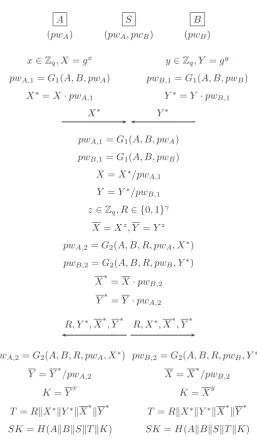
Figure 1: Abdalla and Pointcheval’s three-party PAKE protocol
1. Client A chooses a random x ∈Zq and computesX =gx and pwA,1 = G1(A, B, pwA).1 Then AcomputesX∗ =X·pwA,1 and sends X∗ to the
serverS.
2. Similarly, client B chooses a random y ∈Zq and computes Y =gy and
pwB,1=G1(A, B, pwB). ThenB computesY∗=Y ·pwB,1 and sendsY∗
1In the protocol description of [3], the identities of the clients were incorrectly
omitted from the input of the hash functions G1 and G2. Abdalla and Pointcheval
toS.
3. Upon receivingX∗ andY∗,S first recoversX and Y by computingX =
X∗/G1(A, B, pwA) andY =Y∗/G1(A, B, pwB). Next,Sselects a random
element z ∈ Zq and a random string R ∈ {0,1}γ, where γ is a security
parameter which determines the bit-length ofR. S then computes
X = Xz, Y = Yz,
pwA,2 = G2(A, B, R, pwA, X∗),
pwB,2 = G2(A, B, R, pwB, Y∗),
X∗ = X·pwB,2,
Y∗ = Y ·pwA,2,
and sends⟨R, Y∗, X∗, Y∗⟩and⟨R, X∗, X∗, Y∗⟩toAandB, respectively.
4. After receiving⟨R, Y∗, X∗, Y∗⟩from S,Acomputes
pwA,2 = G2(A, B, R, pwA, X∗),
Y =
( Y∗ pwA,2
) ,
K = Yx.
ThenA defines the transcript T =R∥X∗∥Y∗∥X∗∥Y∗ and computes the session keySK=H(A∥B∥S∥T∥K).
5. With⟨R, X∗, X∗, Y∗⟩received fromS,B computes
pwB,2 = G2(A, B, R, pwB, Y∗),
X =
( X∗ pwB,2
) ,
K = Xy.
ThenB defines the transcriptT =R∥X∗∥Y∗∥X∗∥Y∗ and computes the session keySK=H(A∥B∥S∥T∥K).
The correctness of AP-3PAKE can be easily verified fromK=Yx=Xy=gxyz.
Figure 1 shows a high-level depiction of AP-3PAKE.
3
An Off-Line Dictionary Attack against
AP-3PAKE
We here show that AP-3PAKE is not secure against an off-line dictionary attack in the presence of a malicious client.
Our attack exploits the fact that, once the session keySK has been estab-lished, the clients A and B will exchange their subsequent messages that are generated using the key SK. Let msgSK be the first such message. Without
loss of generality and for simplicity, we assume that it is the clientA who gen-erates/sends msgSK. Then, our off-line dictionary attack can be mounted by
B against A’s password. (We note, however, that our attack also works even when msgSK is generated/sent byB. In this case, the attack can be mounted
byAagainstB’s password.) The attack proceeds as follows:
Step 1. The attackerB runs the protocol with the clientA and the serverS. In this run, everything proceeds as specified by the protocol, except that:
B replaces the message ⟨R, Y∗, X∗, Y∗⟩ from S toA with the forged message ⟨R, Y∗, X∗,Ye∗⟩, whereYe∗=Y∗·Y.
As a result of the replacement,A will compute its session key as SK =
H(A∥B∥S∥Te∥Ke), whereTe=R∥X∗∥Y∗∥X∗∥Ye∗ and
e
K=( eY
∗
pwA,2 )x
=
(Y∗· Y pwA,2
)x
=
(Y ·pw
A,2·Y pwA,2
)x
= (Y ·Y)x =gxyz·gxy.
Step 2. Now sinceAhas computed its session keySK,Awill generatemsgSK
using the keySK in one of the following three scenarios:
• Key Confirmation: If key confirmation is required,A will send a
confirmation messagecf rmcomputed as a function ofSK. Assume, without affecting our result, that the well-known technique of [5, 7] is used for key confirmation. Then cf rm is computed as cf rm =
H(SK∥v) for some known valuev. In this case,msgSK =cf rm.
• Message Authentication: A typical usage of session keys is to
authenticate subsequent messages. Let m be a message to be sent fromAtoB. Ifmhas to be authenticated,Awill generate a message authentication code (MAC) σ for the message m under the session key SK by running a MAC generation algorithm M ac (i.e., σ =
M ac(SK, m)), and then will send the message/MAC pair mT ag = (m, σ) toB. In this case, msgSK=mT ag.
• Message Encryption: Another typical usage of session keys is to
encrypt subsequent messages. Suppose thatAhas to send a message
m in an encrypted form. Then, A is likely to run a symmetric en-cryption algorithm Enc with key SK and input message m to get back a ciphertext cprt (i.e., cprt = Enc(SK, m)). The ciphertext
Once in possession ofmsgSK∈ {cf rm, mT ag, cprt}, the attackerBaborts
the protocol session alleging that session-key computation has failed due to an unexpected error.
Step 3. Using the message ⟨R, X∗, X∗, Y∗⟩received fromS,B computes
K=
( X∗ pwB,2
)y
=gxyz.
Step 4. Next,Bmakes a guesspw′Afor the passwordpwAand computesX′=
X∗/G1(A, B, pw′A), Ke′ =K·X′y, andSK′ =H(A∥B∥S∥Te∥Ke′) with Te
defined as above. Bthen performs one of the following three computations depending on the type ofmsgSK:
cf rm′ =H(SK′∥v) ifmsgSK=cf rm,
σ′ =M ac(SK′, m) ifmsgSK=mT ag,
m′ =Dec(SK′, cprt) ifmsgSK=cprt.
Here,Decis the symmetric decryption algorithm associated withEnc.
Step 5. Now, B verifies the correctness of pw′A by checking the appropriate one of the following conditions:
cf rm′ =? cf rm ifmsgSK =cf rm,
σ′=? σ ifmsgSK =mT ag,
Ism′ meaningful? ifmsgSK =cprt.
Notice that ifpw′AandpwAare equal, then the conditions ought to be
sat-isfied. Although verifying the third condition “Ism′ meaningful?” takes longer than verifying the first/second conditions, it can still be done au-tomatically by a computer program and can be substantially speed up by tuning the condition.
Step 6. B repeats Steps 4 and 5 until a correct password is found.
The attack above is an off-line dictionary attack since the steps for verifying password guesses can be performed in an off-line manner by an automated computer program.
References
[1] Abdalla M., Bresson E., Chevassut O., and Pointcheval D., Password-Based Group Key Exchange in a Constant Number of Rounds, In PKC 2006, LNCS 3958, 427–442, 2006.
[3] Abdalla M. and Pointcheval D., Interactive Diffie-Hellman Assumptions with Applications to Password-Based Authentication, In FC 2005, LNCS 3570, 341–356, 2005.
[4] Abdalla M. and Pointcheval D., Simple Password-Based Encrypted Key Exchange Protocols, In CT-RSA 2005, LNCS 3376, 191–208, 2005.
[5] Bellare M., Pointcheval D., and Rogaway P., Authenticated Key Exchange Secure against Dictionary Attacks, In EUROCRYPT 2000, LNCS 1807, 139–155, 2000.
[6] Bellovin S. and Merritt M., Encrypted Key Exchange: Password-Based Protocols Secure against Dictionary Attacks, In 1992 IEEE Symposium on Research in Security and Privacy, 72–84, 1992.
[7] Bresson E., Chevassut O., Pointcheval D., and Quisquater J., Provably Au-thenticated Group Diffie-Hellman Key Exchange, In 8th ACM Conference on Computer and Communications Security, 255–264, 2001.
[8] Coron J., Patarin J., and Seurin Y., The Random Oracle Model and the Ideal Cipher Model are Equivalent, In CRYPTO 2008, LNCS 5157, 1–20, 2008.
[9] Katz J., Ostrovsky R., and Yung M., Efficient and Secure Authenticated Key Exchange using Weak Passwords,Journal of the ACM, 57(2009), 78– 116.
[10] Katz J. and Vaikuntanathan V., Round-Optimal Password-Based Authen-ticated Key Exchange, In TCC 2011, LNCS 6597, 293–310, 2011.
[11] Lin C., Sun H., and Hwang T., Three-Party Encrypted Key Exchange: Attacks and a Solution, ACM SIGOPS Operating Systems Review, 34(4)(2000), 12–20.
[12] Nam J., Paik J., Kang H., Kim U., and Won D., An Off-Line Dictionary Attack on a Simple Three-Party Key Exchange Protocol,IEEE Communi-cations Letters, 13(3)(2009), 205–207.
[13] Szydlo M., A Note on Chosen-Basis Decisional Diffie-Hellman Assumptions, In FC 2006, LNCS 4107, 166–170, 2006.
[14] Yoneyama K., Efficient and Strongly Secure Password-Based Server Aided Key Exchange, In INDOCRYPT 2008, LNCS 5365, 172–184, 2008.