UDC: 539.217.1:519.863
Optimization Design for Graded Porous Tubular Structures
Z.W. Wang1, C.Y. Tang2, C.P. Tsui3, B. Gao4
1 Department of Process Equipment and Control Engineering, Dalian University of Technology, Dalian, P.R. China
2,3 Department of Industrial and Systems Engineering, The Hong Kong Polytechnic University, Hong Kong, P.R. China
[email protected] (corresponding author); [email protected];
4 Prosthodontics Department of Stamatological College, The Fourth Military Medical Hospital, Xi’an, P.R. China
Abstract
Many natural and advanced biomedical materials are functionally graded porous architectures. Recently, studies on these graded porous structures have been attracted lots of research attentions due to their outstanding strength-to-weight performance. It has been a challenge to analyze this kind of structures mechanically due to the gradation in physical properties within the material. In this article, an optimization technique, which was incorporated with a finite element model, is proposed to design graded porous tubular structures for maximizing their bending strength. The gradation of the physical property of a tubular structure was described mathematically by parametric functions. A parametric finite element model was constructed to mimic the flexural response of a graded porous tubular structure using the finite element code ANSYS. With the concept of damage mechanics, an optimization procedure developed for maximizing the flexural strength and at the same time minimizing the weight was integrated with the finite element code using the ANSYS parametric design language. Using a case example, the effectiveness of the proposed technique was demonstrated. This study provides a method for designing graded porous structures and also contributes to better understanding of functionally graded porous materials.
Keywords: Graded porous; Optimization; Finite element
1. Introduction
resulting in corresponding changes in the material properties. Their mechanical behaviors have been studied extensively in recent years (Erdogan 1995, Tang et al. 2006, Tang et al. 2007, Wang and Mai 2005, Jin and Batra 1998).
Functionally graded tubular structural members are being increasingly used for space, biomechanical and aeronautical applications because hollow members have high strength and rigidity especially in bending or torsion, and mechanical analysis of functionally graded tubular structural members has been recently an important research topic (Iesan and Scalia 2007, Singh et al. 2006, Elmaimouni 2005, Hematiyan and Doostfatemeh 2007, Arghavan and Hematiyan 2008). In the material of a graded tubular structure, there are pores densely distributed in the core region and sparsely distributed in the near the outer surface region with the porosity change along the radial direction. The porosity reduces both the strength and the density of the material. Therefore, the material structure is constructed in such a way that strength is provided only where it is needed (Low and Che 2006). Intelligent design of functionally graded tubular structures can perform outstanding mechanical properties. Due to heterogeneous nature of the problem, conventional methods in structural design may not be able to provide an optimal solution.
Elmaimouni et al. (Elmaimouni et al. 2005) investigated the wave propagation in hollow infinite FGM cylinders made up of macroscopically inhomogeneous composite materials, wherein the mechanical properties vary continuously from one surface to the other. Andertova et al. (Andertova et al. 2007) investigated the preparation of bio-inert alumina ceramics with gradient of porosity by slip casting to the porous molds, and obtained the physical and mechanical properties of one-component with layers of variable controlled porosity. Valeria et al. (Valeria et al. 2009) presented the effect of porosity on the elastic properties of porcelainized stoneware tiles by a multi-layer model based on the finite element simulation. Zhang et al. (Zhang et al. 2000) carried out a series of static indentation and impact tests at different speeds to study the deformation behavior and damage resistance of reformed bamboo/aluminum laminate composites. Iesan and Scalia (Iesan and Scalia 2007) investigated the problem of extension and bending of functionally graded porous elastic cylinders using the linear theory of isotropic elastic materials. Arghavan and Hematiyan (Arghavan and Hematiyan 2008) performed a mechanical analysis on functionally graded tubular structures of arbitrary shape using finite element method. In their study, the effect of varying thickness and volume fraction of the constituent phases were also investigated.
Markworth et al. (Markworth and Saunders 1995) and Hedia et al. (Hedia and Malmound 2004) developed a simple model for optimizing the composition of a metal/ceramic functionally graded material for either maximizing or minimizing the heat flow through the material. Nadeau et al. (Nadeau and Ferrari 1999) reported the microstructural optimization of a layer which is free of tractions, transversely isotropic, infinite and subjected to a prescribed thermal gradient. In their reports, a reproduction-algorithms-based finite element method is presented for optimizing the porous distribution function with layers of variable controlled porosity, wherein the evolution of stresses of functionally graded porous tubular structure members is constrained in a certain range.
2. Computational modeling and optimization
Many natural materials are designed intelligently. Scientists and engineers have been trying to mimic the design of these materials to synthesize advanced aerospace structures and biomedical materials. Bamboo is a typical example of graded porous natural material and is in form of a tubular structure. It has an interesting microstructure and a macrostructure with hierarchical features which contribute to its structural integrity. Specifically, bamboo consists of long and parallel cellulose fibers embedded in a ligneous matrix. The density of the fibers in the cross-section of a bamboo shell varies along its thickness (Zhang et al. 2000, Iyer 2002, Li 2004). Bamboo, moreover, has functional gradient properties in which there is a distribution of Young’s modulus across the stem cross-section.
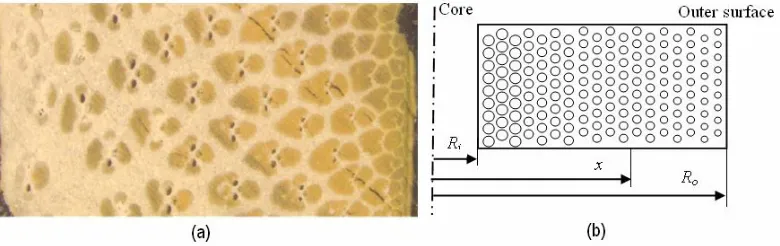
To illustrate the optimization method proposed in this paper, bamboo was chosen as a case example of a functionally graded porous structural member. The method can also be used for designing other man-made graded porous structures such as implants for bone repair. Fig.1 (a) shows the cross-section of a bamboo stem which is adopted from Reference (Li 2004). It can be seen the size of the vascular bundle is large and denser in the outermost layer but smaller and sparser in the inner layer, thus the outermost layer has significantly higher mechanical strength than the inner layers. Fig.1 (b) is an idealized model for representing the porosity distribution. In this model, Ri and Ro denote the inner radius and the outer radius, respectively, and x denotes the distance from the centreline of the tubular structural member. These pores were assumed to vary in the direction of the thickness according to an unknown radial variation law.
Fig. 1. (a) Cross-section of a bamboo stem (Magnification 10X) adopted with permission from Ref (Li 2004); and (b) a model of the graded porous material.
The physical and mechanical properties of a tubular structural member are strongly dependent on its porosity distribution (Low and Che 2006). Pores are generally densely distributed in the inner region and sparsely distributed in the outer region and the porosity ratio may be written as a function of x:
( ) ( o )
o i
R x
f x
R R
α − =
− for Ri < x < Ro (1)
where α is the power index of relative radius ratio, f(x) is the function of porosity ratio of the tubular structural member.
Fig. 2. Curves of porosity ratio of graded porous structures with different values of α.
The density of the structural material at x may be expressed by
0
( )x (1 f x( ))β
ρ =ρ − (2)
where ρo is the density of the outermost layer of the tubular structural member and β is the power index.
Similarly, Young’s modulus of the graded porous tubular structural member at x may be expressed by
0
( ) (1 ( ))
E x =E − f x γ
(3) where E0 is Young’s modulus of the outermost layer of the tubular structural member and γ is
the power index.
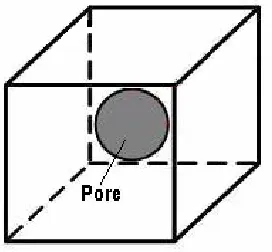
Fig. 3. The pore is considered as a kind of damage to the material.
According to the theory of damage mechanics, the damage variable D can be defined as a function of porosity ratio p as below.
(
f(x))
D(p) DD= = (4)
in which p= f x( ).
Moreover, the damage effective Young’s modulus E and the damage effective stress σ
may be written as follows.
( )
E E p E E
~ 1 ~ ~
− = =
σ
σ (5)
where E and σ are the intact Young’s modulus and the stress without damage, respectively. Some natural materials, like bone and bamboo, possess the characteristics of a graded porous tubular structure. These structures are usually characterized by not only the presence of compositional or other gradients but also the sophisticated mechanical behavior of the FGM components in comparison with conventional materials (Low and Che 2006). They are shaped in such a special manner that strength is provided only where it is needed. The porosity of these functionally graded tubular structures provides evolutional mechanical properties (Berezovski et al. 2003, Pender et al. 2001, Suresh and Mortensen, 1998). The mechanical strength is determined by the porosity and the manner in which the porosity is structured.
By making use of the possibilities inherent in the FGMs coupling with the concept of damage mechanics, the materials can be improved with creation of new functions. On the other hand, some analytical and computational studies (Berezovski et al. 2003) on the effective stresses in FGMs subjected to an applied load show that the utilization of an optimized graded interface between two dissimilar layers can reduce stress significantly.
The evolution stress of a natural material may be taken as the damage effective stress. It may be written as
( ) ( ) /( i )
o i
x R
x x
R R
λ α
σ =σ −
−
(6)
To maximize the load bearing ability, it is targeted to design a structure in which the material is loaded with uniform damage effective stress. Therefore, the optimization objective is to maintain the evolution stress being constant in the cross-section of a functionally graded porous tubular structural member, i.e.
f
( ) constant <x
σ = σ
where σf is the fracture strength of the tubular structural member.
The objective function can be expressed as
1
f
min(Error ( ( ) ( )))
. . ( ) 0 10 0 10 0 10 n s s i n i
S t n
σ σ σ σ α γ λ = = − < < ≤ < ≤ < ≤
∑
(7) where n represents the number of layers in the cross-section of the tubular structure member,( )
s n
σ is the von Mises stress in the nth layer, and ( )
s i
σ is the von Mises stress in the ith layer, and σ( )n is the evolution stress in the nth layer. The computation is reiterated until the magnitude of error of the objective function is minimized.
In general, the porosity and the density as well as Young’s modulus and the porosity ratio are related. It is further proposed that
ξ
η
β α γ α
=
= (8)
where ξ and η are the coefficients of the β and γ , respectively. The values of ξ and η are taken as 1 and 0, respectively.
It is a double-variable single objective optimization problem. A special optimization procedure was developed by writing a sub-program using the ANSYS parametric design language. The solution has been achieved when the error of the objective function becomes the smallest. As there are only two unknown parameters, the zero order optimization method of ANSYS has been adopted. The optimization algorithm can only find a local minimum within a specified tolerance. Whether that local minimum is the global minimum is generally unknown. For this reason, a given optimization should be initiated from a number of different starting points.
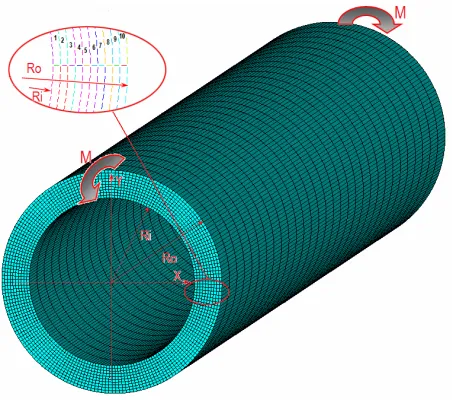
Fig. 4. Multilayered finite element model of the tubular structural member.
The finite element model for the tubular structural member was constructed by using 8-node hexahedral brick elements and a pair of bending moments M was applied to the two ends of the model. As an illustrative example for studying the flexural strength of a tubular structural member, an isotropic linear elastic material model is used. An anisotropic analysis may be required for a combined bending and torsion case.
3. Results and discussion
Table 1. Iterative process for optimizing the porosity ratio.
0 <α < 1
α 0.01 0.85 0.39 0.54 0.75 0.79 0.79 0.87 0.8169 0.8169 0.8179
λ -0.01 -0.69 -1.04 -0.93 -0.70 -1.41 -1.20 -1.33 -1.218 -1.229 -1.218
( )n
σ 243 66.18 1087 165.0 69.8 83.57 72.57 65.55 69.49 69.86 69.29 Error 1560 117.26 1925.9 230.1 112.82 73.07 66.9 71.02 63.27 62.98 63.46
1 <α< 10
α 1.01 8.62 4.49 5.84 1.13 1.48 1.66 1.20 1.50 1.48
λ 0.01 0.46 0.69 0.62 0.12 0.089 0.097 0.076 0.107 0.103
( )n
σ 61.78 6863 6740 11034 59.24 59.89 65.53 58.13 61.42 60.62 Error 111.3 11616 11786 18111 73.38 9.15 43.55 59.37 15.21 10.85
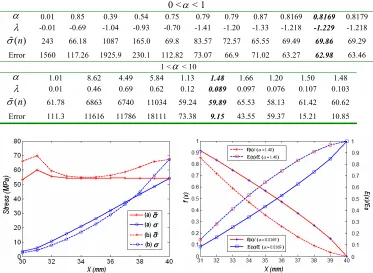
The optimization procedure is found to be efficient since the optimal solution can be obtained in a few iterative steps. Table 1 lists the computation results. For part (i), 0 <
α
< 1, the optimal values of α and λ are found to be 0.8169 and -1.229 respectively through eleven iterative steps. For part (ii), 1 <α
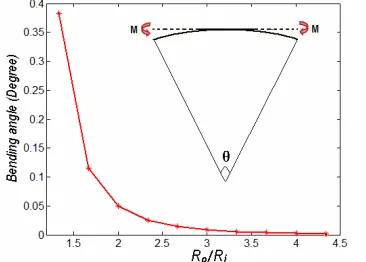
< 10, the optimal values of αand λ are found to be 1.48 and 0.089 respectively also through ten iterative steps. Fig.5 shows the distributions of the evolution stress and the conventional bending stress. It can be observed that the optimization results of the two parts are quite similar. However, the error and the stress of part (i) were greater than those of part (ii). The conventional bending stress of the outermost layer was much greater than that of the inner layer, but the evolution stress was almost constant in any layer. It may imply that the evolution performance of natural functionally graded porous materials, like bamboo or bone, the strength of which is provided only where it is needed. The damage effective stress may be a mechanical stimulus for evolution and micro-damage may stimulate growth of living cells. Fig.6 shows the distributions of the porosity ratio and Young’s modulus based on the optimization results. The porosity ratio decreases and Young’s modulus increases with the increase in the radius of the tubular structure.Under pure bending, the bending radius of curvature R of a tubular structural member may be written as R = L/θ , where L is the length of the structural member and θ is the bending angle. Fig.7 shows the change in θ due to different values of Ro/Ri. The smaller the bending angle, the larger is the flexural strength of the structural member. Therefore, the bending
Fig. 5. Variation of σ and σ along the radial direction of the tubular structural member.
strength-to-weight Sb is often used as the performance index of a structural member (Ashby 2005),i.e.
b R S
ρ
= (9)
in which
1 1
( ) ( )
n n
w
i i i
i i
m
V V
V
ρ ρ
= =
= =
∑
∑
(10)ρdenotes the mean density of tubular structural member, mw is the total mass of the tubular structural member, V is the total volume of the tubular structural member, ρi is the density of the ith layer of the tubular structural member, and Vi is the volume of the ith layer of the tubular structural member.
Fig.8 shows the strength-to-weight ratio Sb under different porosity distributions. Whenα =0, the tubular structural member is homogeneous having a constant Young’s modulus being equal to the average value for the case α =1.48. It can be seen that the graded porous designs often exhibit better mechanical performance in terms of the strength-to-weight ratio. The strength-to-weight ratio also increases with the porosity ratio. However, when α =0.48, the strength-to-weight ratio of the graded porous tubular structural member will be worse than that of a uniform structure member. It may be the result of weakened mechanical performance due to excessive porosity.
4. Conclusions
Based on the concept of damage mechanics and the parametric finite element modeling technique, a multi-variables single objective optimization method has been proposed for designing graded porous tubular structural members in this study. By running a case example, the method has been found to be efficient in arriving at the optimal solution in a few iterations. With appropriate modification, the proposed method may be used for designing other kinds of graded porous structures or materials. Moreover, this study also paves the way for future biomechanical analysis of graded porous natural materials.
Acknowledgement
The authors would like to thank the substantial support from the Research Grants Council of Hong Kong Special Administrative Region, China (PolyU 5273/07E).
References
Andertova J., Tlaskal R., Maryska M., Havrda J., Functional gradient alumina ceramic materials-Heat treatment, J. Eur. Ceram. Soc., 27, 1325-1331, 2007.
Arghavan S., Hematiyan M.R., Torsion of functionally graded hollow tubes, Eur. J. Mech. A Solids, doi:10.1016/j.euromechsol.2008.07.009.
Ashby M.F., Materials selection in mechanical design (3rd), Butterworth-Heinmann, Oxford, London, 2005.
Berezovski A., Engelbrecht J., Maugin G.A., Numerical simulation of two-dimensional wave propagation in functionally graded materials, Eur. J. Mech. A/Solids, 22,257-265, 2003. Elmaimouni L., Lefebvre J.E., Zhang V., Gryba T., Guided waves in radially graded cylinders:
a polynomial approach, NDT&E Int., 38, 344-353, 2005.
Erdogan F., Fracture mechanics of functionally graded materials, Compos. Engng., 5, 753-770, 1995.
Hedia H.S., Malmound N.A., Design optimization of functionally graded dental bone, J. Biomed. Master. Eng., 14,133-143, 2004.
Hematiyan M.R., Doostfatemeh A., Torsion of moderately thick hollow tubes with polygonal shapes, Mech. Res. Comm., 34, 528-537, 2007.
Iesan D., Scalia A., On the Deformation of functionally graded porous elastic cylinders, J. Elast., 87, 147-159, 2007.
Iyer S., Guidelines for building bamboo-reinforced masonry in earthquake-prone areas in India, Thesis, California: University of Southern California, 2002.
Jin Z.H., Batra R.C., R-curve and strength behavior of a functionally graded material, Mate. Sci. Engng., A242, 70-76, 1998.
Koizumi M., The concept of functionally gradient materials. Ceram, Trans, 34,3-10,1993. Li X.B., Physical, Chemical, and mechanical properties of bamboo and its utilization potential
for fiberboard manufacturing, Thesis, Louisiana: Louisiana State University, 2004.
Low I.M., Che Z.Y., Mapping the structure, composition and mechanical properties of bamboo, J. Mater. Res., 21(8), 1969-1976, 2006.
Markworth A.J., Saunders J.H., A model of structure optimization for a functionally graded material, Mater. Lett., 22, 103-107, 1995.
Nadeau J.C., Ferrari M.., Micro-structural optimization of a functionally graded transversely isotropic layer, Mech. Mater., 31, 637-651,1999.
Pender, D.C., Padture, N.P., Giannakopoulos A.E., Suresh S., Gradients in elastic modulus for improved contact-damage resistance. Part 1: the silicon nitride-oxynitride glass system. Acta Mater, 49,3255-3262,2001.
Singh B.M., Rokne J., Dhaliwal R.S., Torsional vibrations of functionally graded finite cylinders, Meccanica, 41, 459-470, 2006.
Suresh, S., Mortensen, A., Fundamentals of Functionally Graded Materials, The Institute of Materials, London, 1998.
Tang C.Y., Guo Y.Q., Tsui C.P. Gao B., Multi-scale finite element analysis on biomechanical response of functionally graded dental implant / mandible system, J. Serbian Soc. Comp. Mech. 1, 164-173, 2007.
Tsui C.P., Tang C.Y., Fan J.P., Xie X.L., Prediction for initiation of debonding damage and tensile stress-strain relation of glass-bead-filled modified polyphenylene oxide, Int. J. Mech. Sci., 46,1659-1674,2004.
Valeria C., Leonardo E., Elisa R., Antonella S., Antonella T., Effect of porosity on the elastic properties of porcelainized stoneware tiles by a multi-layered model, Ceram. Int., 35, 205-211, 2009.
Wang B.L., Mai Y.W., A periodic array of cracks in functional graded materials subjected to thermo-mechanical loading, Int. J. Engng. Sci., 43, 432-446, 2005.
Yamanouchi M., Koizumi M., Hirai T., Shiota I., Proceedings of first international symposium on functionally gradient materials, Japan, 1990.