1
The AMSU-based Hydrological Bundle Climate Data Record –
Description and Comparison with Other Data Sets
Ralph R. Ferraro
1, Brian Nelson
2, Tom Smith
1, Olivier P. Prat
3Abstract
Passive microwave measurements have been available on satellites dating back to the 1970s on research satellites flown by the National Aeronautics and Space Administration (NASA). Since then, several other sensors have been flown to retrieve hydrological products for both operational weather applications (e.g., the Special Sensor Microwave/Imager–SSM/I; the Advanced Microwave Sounding Unit–AMSU) and climate applications (e.g., the Advanced Microwave Scanning Radiometer–AMSR; the Tropical Rainfall Measurement Mission Microwave Imager–TMI; the Global Precipitation Mission Microwave Imager–GMI).
Here the focus is on measurements from the AMSU-A, AMSU-B and Microwave Humidity Sounder (MHS). These sensors have been in operation since 1998 with the launch of NOAA-15, and are also on board NOAA-16, -17, -18, -19 and the MetOp-A and -B satellites. A data set called the “Hydrological Bundle” is a Climate Data Record (CDR) that utilizes brightness temperatures from Fundamental CDRs to generate Thematic CDRs (TCDR). The TCDR’s include: Total Precipitable Water (TPW), Cloud Liquid Water (CLW), Sea-Ice concentration (SIC), Land surface temperature (LST), Land surface emissivity (LSE) for 23, 31, 50 GHz, rain rate (RR), snow cover (SC), ice water path (IWP), and snow water equivalent (SWE).
The TCDR’s are shown to be in general good agreement with similar products from other sources such as the Global Precipitation Climatology Project (GPCP) and the Modern-Era Retrospective Analysis for Research and Applications (MERRA-2). Because of the careful intercalibration of the FCDR’s, little bias is found among the different TCDR’s produced from individual NOAA and MetOp satellites, except for normal diurnal cycle differences.
KEYWORDS – Remote Sensing; Climate Data Record; Passive Microwave; Hydrology
1
NOAA/NESDIS/Center for Satellite Applications and Research (STAR), 5825 University Research Court, Suite 4001, College Park, MD, 20740, USA; [email protected]; [email protected]
2
NOAA/NESDIS/National Center for Environmental Information (NCEI), 151 Patton Ave., Asheville, NC, 28801, USA; [email protected]; 3 Cooperative Institute for Climate and Satellites, North Carolina State University, and NOAA/National Centers for Environmental Information, 151 Patton Ave., Asheville, NC, 28801, USA [email protected]
2 1. Introduction
The Earth’s hydrological cycle is perhaps the most important physical process for sustaining life on the planet. However, capturing the quantitative details of it on a global scale is a challenge, in particular, because of sparse sampling. Satellite measurement, in particular those from low-earth orbiting satellites that provide global coverage, have proven to be vital in contributing information on several key parameters unattainable from surface observations.
Passive microwave measurements have been available on satellites from the 1970s, on research satellites flown by the National Aeronautics and Space Administration (NASA). Early instruments included the Electrically Scanning Microwave Radiometer (ESMR) and Scanning Multichannel Microwave Radiometer (SMMR) instruments. Data from those instruments allowed construction of the first global climatologies of sea-ice, snow cover, water vapor and rainfall [1-2]. Since then, several other sensors have been flown to retrieve hydrological products for both operational weather applications (e.g., the Special Sensor Microwave/Imager–SSM/I; the Advanced Microwave Sounding Unit– AMSU) and climate applications (e.g., the Advanced Microwave Scanning Radiometer– AMSR; the Tropical Rainfall Measurement Mission Microwave Imager–TMI; the Global Precipitation Mission Microwave Imager–GMI).
In this paper, the focus will be on the measurements from the AMSU-A, AMSU-B and Microwave Humidity Sounder (MHS). These sensors have been in operation since 1998 with the launch of NOAA-15, and are also on NOAA-16, -17, -18, -19 and the MetOp-A and –B satellites. A data set called the “Hydrological Bundle” is a Climate Data Record (CDR) that utilizes brightness temperatures from Fundamental CDRs (FCDR) to generate Thematic CDRs (TCDR) [3-4]. The TCDRs are generated using the Microwave Surface and Precipitation Products System (MSPPS) package, and produces a set of products including: Total Precipitable Water (TPW), Cloud Liquid Water (CLW), Sea-Ice concentration (SIC), Land surface temperature (LST), Land surface emissivity (LSE) for 23, 31, 50 GHz, rain rate (RR), snow cover (SC), ice water path (IWP), and snow water equivalent (SWE) [5]. More details, including the Climate Algorithm Theoretical Basis Document (C-ATBD), can be found in the documentation of the CDR at: https://www.ncdc.noaa.gov/cdr/atmospheric/hydrological-properties.
3
This paper is organized as follows: section 2 gives the data-set descriptions, section 3 provides some comparisons with comparable data sets, and section 4 offers conclusions and recommendations.
2. Materials and Methods
(a) Hydrological Bundle CDR (HBC)
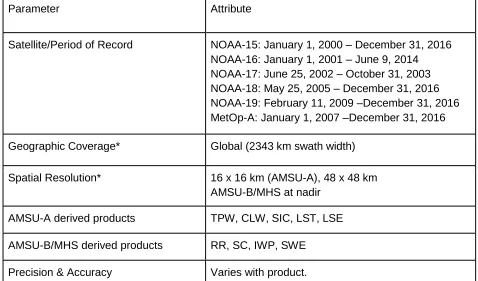
The Advanced Microwave Sounding Unit-A and -B (AMSU-A/B) and Microwave Humidity Sounder (MHS) are cross-track scanning sensors designed to measure earth scene radiances; its primary design function is to provide temperature (AMSU-A) and water vapor (AMSU-B/MHS) profiling of the atmosphere. AMSU-A/B was first flown on the NOAA-15 satellite (beginning July 1998). The most complete references to the sensor can be found in [6-7]. Table 1 shows the instrument characteristics for AMSU-A/B MHS level 2 data.
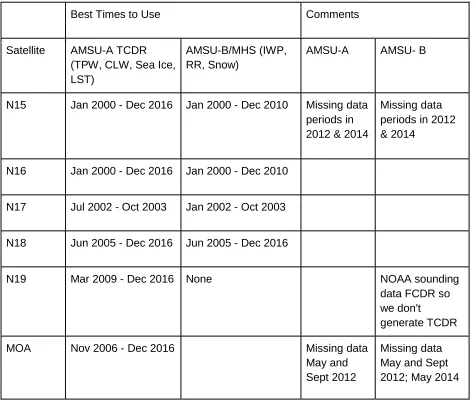
The HBC data period of record begins in 2000 with monthly updates. It contains a 48km (AMSU-A) and 16km (AMSU-B/MHS) nadir global resolution. The period of record for the Hydrological Bundle CDR is 2000-2015 and will be routinely expanded throughout the lifespan of the satellites. Table 2 lists when data are most reliable. One caveat is that the FCDRs must be of sufficient quality, especially as sensors degrade over time. As of 2016, TCDRs are only generated for NOAA-18, NOAA-19 and MetOp-A. It should be noted that CDRs are feasible for MetOp-B and MetOp-C (2018 launch), however, these two satellites are not part of the original Hydrological Bundle. Figure 1 provides information on the equatorial crossing times of NOAA and MetOp satellites.
The AMSU sensor package is being replaced with the Advanced Technology Microwave Sounder (ATMS), the first of which was flown on the S-NPP satellite (from 2012) and most recently, NOAA-20 (from November 2017). Although beyond the scope of this project, the HBC could be expanded to include ATMS, which provides the CDR the opportunity to expand the period of record. In addition these data provide an opportunity to develop CDRs that can contribute to other satellite time series with similar capabilities.
4
Figure 1), (2) the high frequencies (89 GHz and higher) of AMSU A/B and MHS make possible records with a higher resolution for some products compared to the other microwave-based products (e.g., SSMI), as well as offer the ability to sense other features such as IWP and the vertical extent of precipitation, and (3) the CDR provides information on hard to find variables of snow cover, ice water, sea ice and snow cover across the globe.
(b) GPCP Product
The Global Precipitation Climatology Project (GPCP) has a suite of products spanning various time and space scales [11-12]. The GPCP monthly product, starting in 1979, is considered the best globally based precipitation product for climate studies and is used extensively in climate assessments. The GPCP daily product provides globally complete precipitation estimates at a spatial resolution of one degree spatial grid daily from October 1996 to the present. It is a merged satellite (infrared and microwave) and in-situ product and is one of the CDRs maintained at NOAA/NCEI.
(c) MERRA-2 Reanalysis
The Modern-Era Retrospective Analysis for Research and Applications, Version 2 (MERRA-2) is a NASA Reanalysis that produces full fields of atmospheric variables beginning 1980 [13]. Reanalysis has the advantage of being able to simultaneously analyze the available observations in a dynamically-consistent way by assimilating them into a dynamic model. The MERRA-2 reanalysis is for a period that includes dense sampling by satellites and therefore can be expected to give a reliable representation of the atmosphere for its analysis period [14]. The analysis attempts to minimizes spurious variations related to inhomogeneous observations, but there are still uncertainties related to changes in the observing system over the analysis period. In this study, MERRA-2 atmospheric fields are compared to satellite fields to show their overall consistency. It should be noted that AMSU-A channels 1, 2, 3 and 15 are not used in MERRA-2. Thus, the comparisons with the TCDRs of total precipitable water and land surface temperature are independent.
(d) CMORPH
5
measurements. For the comparison with HBC, we use the gauge adjusted CMORPH (i.e., CMORPH-CDR). For details regarding the CMORPH-CDR algorithm and the products generated see [16]. Please note that CMORPH-CDR is currently being transitioned to NOAA/NCEI operations and will be available to the public by the end of 2018.
(e) PERSIANN
Similar to the two precipitation Climate Data Records mentioned above(GPCP and CMORPH), we also use precipitation estimates from The Precipitation Estimation from Remotely Sensed Information using Artificial Neural Networks, PERSIANN-CDR [17]. The PERSIANN-CDR combines IR satellite precipitation estimates and bias correction from in-situ data through GPCP and provides daily/0.25ºx0.25º precipitation estimates for the domain 60°S-60°N. The PERSIANN-CDR is available from 1983 to present. The aforementioned reference provides details about product. The CDR precipitation products can be accessed via the CDR portal: https://www.ncdc.noaa.gov/cdr.
(f) IMS Snow and Ice
NOAA’s Interactive Multisensor Snow and Ice Mapping System (IMS) uses a combination of geostationary and polar orbiting satellites in the visible, infrared and microwave spectrums, as well as a human analyst making a final decision on the snow and ice cover [18]. It is a daily product and maps snow and ice extent over the Northern Hemisphere in 1, 4 and 24 km using a polar-stereographic projection. Although it is primarily used for weather analysis and forecasting, including use in determining the surface state in numerical weather prediction models, it can serve as a validation standard for other snow and ice products like the HBC.
3. Results
In this section, the general attributes of the HBC are evaluated through comparisons with other well-known data sets, such as satellite derived products and model reanalysis. The primary purpose is to show where they are similar and different, and point out features that may be anomalous. In many instances, data from 2008 is used simply as a representative time period from the 16 year data set.
6 (a) Advantages and Disadvantages of the Hydrological Bundle
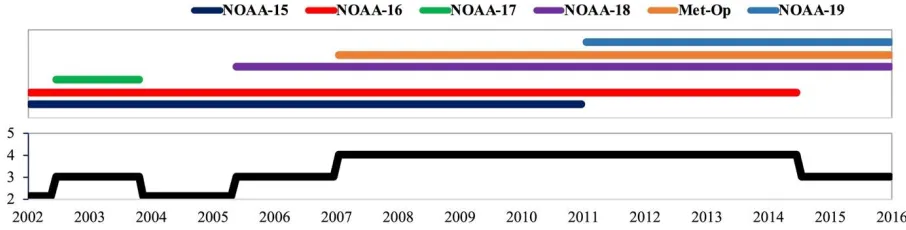
Some advantages of the HBC are that the AMSU/MHS microwave scan geometry offers a wider swath width than other microwave sensors such as the SSM/I, and thus there are fewer orbital gaps and better coverage at the poles. In addition, the microwave sounder offers a complement of a surface and atmospheric channels for both temperature and moisture. Finally, multiple satellites offer better diurnal-cycle sampling as shown in Figure 2; after 2000 there are at least two satellites available and up to four satellites from January 2007 to June 2014. The temporal sampling is roughly 4 hours apart, allowing reasonable sampling of the diurnal cycle.
The disadvantages of the HBC are due to the microwave sounder cross track scan geometry; the Earth incidence angle varies which makes retrievals more difficult because of changes in atmospheric attenuation, surface emissivity and lack of dual polarization. Also, although there is a wider swath width as compared to microwave imagers, the last few observations along the scan are approximately twice as large as at nadir, potentially providing degraded TCDR retrieval for small scale phenomena like precipitation.
(b) Precipitation
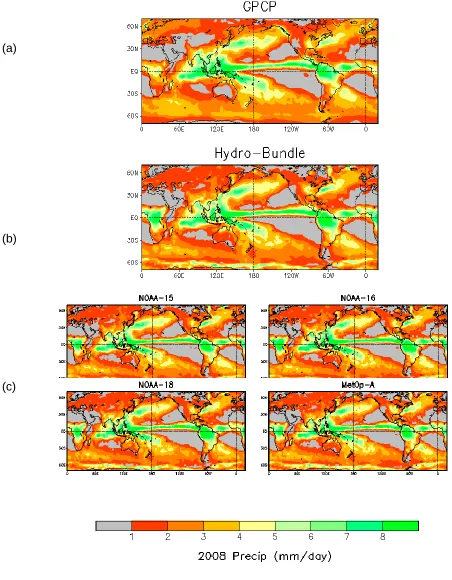
An examination of the annual precipitation averages for 2008 show good agreement between HBC (all available satellites) and GPCP (Figure 3). Patterns of precipitation associated with the major precipitation belts across the globe match well, e.g., the intertropical convergence zone (ITCZ), south pacific convergence zone (SPCZ), mid-latitude ocean storm tracks, etc. There are some significant differences in magnitudes, most notably higher magnitudes over tropical land regions in the HBC. This is a known bias with passive microwave land retrieval algorithms [19]. A further breakdown by satellite shows no significant differences on the annual average for 2008, however, subtle features are noted in some land regions, presumably due to diurnal cycle differences.
7
comparison satellite products are close over ocean is expected due to the fact that both PERSIANN and CMORPH use GPCP for calibration. For the period (2010-2013), differences are less important and HBC compares well with other estimates while displaying a lower annual average again for the later years (2014-2015). Over land, the differences are more pronounced. Precipitation estimates from HBC are close to GPCP and PERSIANN until 2010, but tend to be larger after 2010 and up to 2014. The differences observed are likely due to satellite intercalibration issues. We remind the reader that HBC is a satellite only-product and therefore, differences are expected with bias-adjusted satellite quantitative precipitation estimate (QPE). It is interesting to notice that while GPCP and PERSIANN remain close over land due to the fact that PERSIANN uses GPCP for calibration, CMORPH, that uses in-situ data for calibration over land, displays a lower average than the two other products. This indicates that even bias-adjusted products can have differences on the same order as the differences observed between the HBC and the bias-adjusted satellite QPEs (GPCP, PERSIANN, CMORPH). For all areas 50°N-50°S comparisons are closer because land and ocean biases compensate each other (Fig. 4c). Important differences remain for 2010-2013, with a higher annual average rainfall indicated by HBC; some of this may be attributed to insufficient calibration information for the NOAA-16 satellite during the latter stages of its operation. Future versions of the HBC will account for this problematic data period. Finally, for the tropics (23°N-23°S), all products indicate quantitatively comparable values for the average annual rainfall, with HBC alternatively lower (earlier period: 2002-2004) and higher (later period: 2010-2013) than the other satellite products, although for the remaining years, HBC remains between the range of the three other gauge-corrected products (Fig. 4d).
(b) Total Precipitable Water (TPW)
The TPW comparisons against MERRA-2 (Figure 5) are similar to the precipitation comparisons in the sense that they are most alike in the mid and low latitudes, while the satellite estimate is higher over high latitudes. Note that the HBC TPW is for ocean only.
Features associated with the major circulation features are depicted similarly by both products, such as the maximums associated with the ITCZ and SPCZ and the minimums in the subsidence zones that are found on the western zones off of many of the continental regions (e.g., North and South America and Africa). Breakdowns by each satellite show virtually no differences, as might be expected for TPW which has very little diurnal variability.
8
extremely similar for all satellites. As a testimony to the intercalibration within the FCDR’s for AMSU-A which is used in the TCDR for TPW, there is consistency between all of the satellites shown in Figure 6.
(c) Land Surface Temperature (LST)
For land surface temperature (Figure 7), the overall patterns between the HBC and MERRA-2 are very similar. However, the satellite estimate is cooler over high-altitude cool locations, including Antarctica, Greenland, and the Himalayas, which may be attributed to improper handling of the highly variable surface emissivity over these complex surfaces. The satellite estimates also tend to be cooler over much of the high latitude Northern Hemisphere land. MERRA-2 estimates are slightly cooler over much of the tropics. There are subtle differences between the four different satellites shown and these are most likely explained by the overpass times of the different satellites (refer to Figure 1). For example, NOAA-18 shows a broader area of higher temperatures in the tropical regions and this is because the satellite observed these regions around 1400 local time, near the maximum diurnal cycle (as compared to the other satellites in 2008).
A closer look at the variations within the entire time series is shown in Figure 8. All give the same LST annual cycle, but there are differences in the average and amplitude. Although the HBC inputs all have similar amplitudes, the MetOp satellite is warmest and NOAA-16 is coolest, likely due to the sampling time of the day. The MERRA-2 reanalysis estimate has smaller amplitude than the satellite estimates, perhaps because the satellite estimates are based on surface radiation while the reanalysis estimate is from a near-surface model level.
(d) Ice and Snow Cover
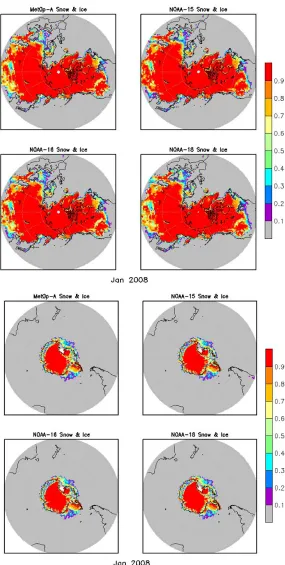
Satellite estimates of combined snow and ice fraction are shown for January 2008 (Figure 9) and July 2008 (Figure 10). The different satellite estimates for these months are nearly the same. Comparison of January and July shows the annual cycle of ice concentration and fractional snow cover. The greatest seasonal variation is over the Northern Hemisphere, where the larger land area shows great contrast from the cool to warm month, and where the polar ocean also indicates large changes in ice concentration.
9
or ice is computed. Then the monthly fraction of each is computed for 1999 to 2017. Maps for Jan and Jul 2008 are shown for comparison to the various satellite map estimates for Jan and Jul 2008. The IMS land snow-cover maps are similar to the satellite estimates. However, the IMS sea-ice fractional estimate is systematically higher than the satellite estimates in the warm season, when the IMS estimate tends to be near 1 in many areas. Some of the lower fraction in the satellite estimates may be due to interpretation of fresh-water ice ponds on top of the ice as open water, lowering the fraction estimate, whereas the IMS, with a human analyst making a final decision, is able to delineate these regions by using other satellite products such as visible imagery.
A final comparison of the snow and ice is a time series over the 16 year period. These are shown in Figure 11, where each individual satellite (top) and the IMS (bottom) are shown. The satellite estimates are extremely consistent among themselves and from year to year. On the other hand, the IMS shows variations between minimum and maximum for some years.
Conclusions
The AMSU/MHS Hyrological Bundle TCDR provides vital information on several key variables, including precipitation, water vapor, snow cover and sea-ice, which are critical components of the Earth’s Hydrological cycle. There are several important attributes of the HBC that make it unique from other similar data sets. First, the majority of this sixteen year data sets contains measurements from different times of the day, and therefore the diurnal cycle can be captured. This is because the NOAA and MetOp satellites are critical components of the global passive microwave constellation, and by design, are operated as a three satellite configuration making measurements approximately four hours apart. Secondly, as we have demonstrated in this paper, the HBC product quality is comparable to other data sets that have been derived from satellites, in-situ data, dynamic reanalyses, or their combinations. Finally, the HBC is one of the few satellite TCDRs that are part of NOAA’s/NCEI’s operational production suite, thereby adhering to the strict standards of NOAA’s CDR program and transition to operation procedures. Their production is therefore transparent in nature and reproducible by other groups because all of the methodologies employed are properly documented.
10
(ATMS) on board the NOAA/JPSS satellites and the Microwave Sounder (MWS) on board the EUMETSAT polar system Second Generation (EPS-SG).
Author Contributions: R.F. is currently the principal investigator for the HBC and lead the writing of the paper. B.N. is currently the NOAA archive focal point for the HBC conceived of the contribution of this paper to the Remote Sensing special issue. T.S. and O.P. generated the majority of the figures and contributed to the analysis of the products. All authors discussed the results presented in this paper.
Funding: The majority of the funding for this project has been provided by the NOAA Center for Environmental Information.
Acknowledgements and disclaimer: We would like to thank the efforts of H. Meng, W. Yang, I. Moradi, J. Beauchamp and Y. You of NOAA and the NOAA Cooperative Institute for Climate and Satellites (CICS) at the University of Maryland for the generation of the CDR’s. We also want to thank H-T. Lee, also of CICS, for supplying Figure 1.
Conflict of Interest: The authors declare no conflict of interest. The views, opinions, and findings contained in this report are those of the author(s) and should not be construed as an official National Oceanic and Atmospheric Administration or U.S. Government position, policy, or decision.
References
1. Wilheit, T. T., A. T. C. Chang, M. S. V. Rao, E. B. Rodgers, and J. S. Theon. A satellite technique for quantitatively mapping rainfall rates over the ocean. J. Appl. Meteor., 1977, 16, 551–560.
2. Wilheit, T.T.; Chang, A.T.C. An algorithm for retrieval of ocean surface and atmospheric parameters from the observations of the scanning multichannel microwave radiometer. Radio Sci., 1980,15, 525–544.
3. Yang, W, H. Meng, R. Ferraro, I. Moradi, and C. Divaraj. Cross scan asymmetry of AMSU-A window channels: characterization, correction and verification. IEEE Trans. on Geo. Rem. Sens., 2013, 51, 1514 – 1530.
4. Moradi, I., S. Buehler, V. John, A. Reale and R. Ferraro. Evaluating instrumental inhomogeneities in global radiosonde upper tropospheric humidity data using microwave satellite data. IEEE Trans. Geo. Rem. Sens., 2013, 51, 3615 – 3624.
5. Ferraro, R.R., F. Weng, N. Grody, L. Zhao, H. Meng, C. Kongoli, P. Pellegrino, S. Qiu and C. Dean. NOAA operational hydrological products derived from the AMSU.
11
6. Kidwell, K.B. NOAA Polar Orbiter Data User’s Guide, available at
http://www.ncdc.noaa.gov/oa/pod-guide/ncdc/docs/podug/index.htm. 1998.
7. Robel, J. NOAA KLM User’s Guide, available at
http://www.ncdc.noaa.gov/oa/pod-guide/ncdc/docs/podug/index.htm. 2009.
8. Ferraro, R.R., F. Weng, N.C. Grody, and A. Basist. An eight year (1987-94) climatology of rainfall, clouds, water vapor, snowcover, and sea-ice derived from SSM/I measurements. Bull. of Amer. Meteor. Soc., 1996, 77, 894-905.
9. Sapiano, M. R. P., Berg, W. K., McKague, D. S., & Kummerow, C. D. (2013). Toward an intercalibrated fundamental climate data record of the SSM/I sensors.
IEEE Trans. on Geo. Rem. Sens., 2013, 51, 1492-1503.
10. Vila, D., R. Ferraro, C. Hernandez and H. Semunegus. The performance of hydrological monthly products using SSM/I – SSMI/S sensors. J. Hydromet., 2013, 14, 266 – 274.
11. Huffman, G. J., R. F. Adler, M. Morrissey, D. Bolvin, S. Curtis, R. Joyce, B. McGavock, and J. Susskind. Global precipitation at one-degree daily resolution from multi-satellite observations, J. Hydrometeor., 2001, 2, 36-50.
12. Schneider, U., A. Becker, P. Finger, A. Meyer-Christoffer, M. Ziese and B. Rudolf. GPCC’s new land surface precipitation climatology based on quality-controlled in situ data and its role in quantifying the global water cycle, Theor. Appl. Climatol., 2014, 115, 15-40.
13. Gelaro, R., W. McCarty, M.J. Suárez, R. Todling, A. Molod, L. Takacs, C.A. Randles, A. Darmenov, M.G. Bosilovich, R. Reichle, K. Wargan, L. Coy, R. Cullather, C. Draper, S. Akella, V. Buchard, A. Conaty, A.M. da Silva, W. Gu, G.-K. Kim, R. Koster, R. Lucchesi, D. Merkova, J.E. Nielsen, G. Partyka, S. Pawson, W. Putman, M. Rienecker, S.D. Schubert, M. Sienkiewicz, and B. Zhao. The Modern-Era Retrospective Analysis for Research and Applications, Version 2 (MERRA-2). J. Climate, 2017, 30, 5419-5454.
14. Bosilovich, M.G., F.R. Robertson, L. Takacs, A. Molod, and D. Mocko. Atmospheric water balance and variability in the MERRA-2 Reanalysis. J. Climate, 2007, 30, 1177-1196.
15. Joyce, R., J. Janowiak, P. Arkin, and P. Xie. CMORPH: A method that produces global precipitation estimates from passive microwave and infrared data at high spatial and temporal resolution. J. Hydrometeorol., 2004, 5, 487-503.
16. Xie, P., R. Joyce, S. Wu, S.-H. Yoo, Y. Yarosh, F. Sun, and R. Lin. Reprocessed, bias-corrected CMORPH global high-resolution precipitation estimates from 1998. J. Hydrometeorol., 2017, 18, 1617-1641.
12
18. Ramsay, B.H. The interactive multisensor snow and ice mapping system.
Hydrological Processes, 1998, 12, 1537-1546.
13 Tables
Table 1: AMSU-A/B/MHS L2 product attributes. Products listed include Total
Precipitable Water (TPW), Cloud Liquid Water (CLW), Sea-Ice concentration (SIC), Land surface temperature (LST), Land surface emissivity (LSE), rain rate (RR), snow cover (SC), ice water path (IWP), and snow water equivalent (SWE)
Parameter Attribute
Satellite/Period of Record NOAA-15: January 1, 2000 – December 31, 2016 NOAA-16: January 1, 2001 – June 9, 2014 NOAA-17: June 25, 2002 – October 31, 2003 NOAA-18: May 25, 2005 – December 31, 2016 NOAA-19: February 11, 2009 –December 31, 2016 MetOp-A: January 1, 2007 –December 31, 2016
Geographic Coverage* Global (2343 km swath width)
Spatial Resolution* 16 x 16 km (AMSU-A), 48 x 48 km AMSU-B/MHS at nadir
AMSU-A derived products TPW, CLW, SIC, LST, LSE
AMSU-B/MHS derived products RR, SC, IWP, SWE
14 Table 2: List of best times to use the various satellite products.
Best Times to Use Comments
Satellite AMSU-A TCDR (TPW, CLW, Sea Ice, LST)
AMSU-B/MHS (IWP, RR, Snow)
AMSU-A AMSU- B
N15 Jan 2000 - Dec 2016 Jan 2000 - Dec 2010 Missing data periods in 2012 & 2014
Missing data periods in 2012 & 2014
N16 Jan 2000 - Dec 2016 Jan 2000 - Dec 2010
N17 Jul 2002 - Oct 2003 Jan 2002 - Oct 2003
N18 Jun 2005 - Dec 2016 Jun 2005 - Dec 2016
N19 Mar 2009 - Dec 2016 None NOAA sounding
data FCDR so we don't
generate TCDR
MOA Nov 2006 - Dec 2016 Missing data
May and Sept 2012
15
Table 3: AMSU-A/B/MHS L2 suite of products
Products Units Surface Type
Total Precipitable Water (TPW) Mm Ocean
Cloud Liquid Water (CLW) Mm Ocean
Cloud Liquid Water Frequency (CLF) % Ocean
Rain Rate (RR) Mm/hr Land and Ocean
Rain Frequency % Land and Ocean
Ice Water Path (IWP) Mm Land and Ocean
Ice Water Path Frequency (IWF) % Land and Ocean
Snow Cover Yes/No Land
Surface Temperature K Land
16 Figures
Figure 1: Local time of ascending node for NOAA and MetOp satellites from 1979 through 2016. The number represents the satellite name (e.g., 5= NOAA-5; 19=NOAA-19; 20=MetOp-A and 21=MetOp-B). The period of the HBC is shaded in yellow.
17
(a)
(b)
(c)
18
19
20
Figure 6: Time series of monthly mean TPW (mm) for each satellite in the HBC and MERRA-2 for the band between 60°S – 60°N.
21
22
23
24
25
26