Elena Dubrova1, Mats N¨aslund2, G¨oran Selander2, and Fredrik Lindqvist2
1 Royal Institute of Technology, Electrum 229, 164 40 Stockholm, Sweden
2
Ericsson Research, Ericsson, F¨ar¨ogatan 6, 164 80 Stockholm, Sweden {mats.naslund,goran.selander,fredrik.lindqvist}@ericsson.com
Abstract. Low-cost resource-constrained devices can allocate very lim-ited resources for implementing security. At the same time, they still re-quire some level of protection. In this paper, we present a lightweight mes-sage authentication scheme based on Cyclic Redundancy Check (CRC). The presented CRC inherits the implementation simplicity of the conven-tional CRC checksum except that the LFSR implementing its encoding and decoding is made re-programmable. Similarly to previously proposed cryptographic CRCs, it detects both random and malicious errors with-out increasing bandwidth. The main difference from previous approaches is that we use arbitrary instead of irreducible generator polynomials. This eliminates the need for irreducibility tests. We provide a detailed quan-titative analysis of the achieved security as a function of message and CRC sizes. The results show that the presented scheme is particularly suitable for the authentication of short messages.
Keywords: Hash function; message authentication; data integrity pro-tection; CRC; error-detection.
1
Introduction
A rapid growth ofInternet-of-Things(IoT) applications that use cellular network infrastructure is expected in the coming years. Home appliances, meters, sensors, are vehicles will be accessible and controlled via local networks or the Internet, opening an entirely new range of services designed to be appealing to users. The number of wirelessly connected devices is expected to grow to 50 billions by the year 2020 [1].
network. The first proven cyberattack involving ”smart” household appliances has been already reported [3]. The attack surface of future IoT with billions of connected devices will be enormous.
In addition to a larger attack surface, the return value for performing an attack grows. The assets accessible via tomorrow’s networks are expected to be much greater than the ones available today, increasing incentive for cyber crimi-nals and underground economies. As processing power and connectivity become cheaper, the cost of performing an attack drops, making it easier for adversaries of all types to penetrate networks. Considering the possible consequences of an attack on safety-critical applications such as automotive, industrial control, mil-itary and health, the damage caused by an individual actor may not be limited to a business or reputation, but could have a severe impact on public safety, national economy, and/or national security.
Low-cost end-point IoT devices will require utmost efficiency in the use of communication, computing, storage and energy resources. A typical IoT device is likely to spend most of its ”life” in a sleep mode. It will get activated at periodic intervals, transmit a small amount of data and then shut down again. To satisfy extreme limitations of resource-constrained devices, lightweight cryptographic methods are required. It seems also beneficial to combine coding and crypto-graphic techniques, e.g. error detection and data integrity protection, since this may potentially reduce bandwidth and implementation cost.
Clearly, data integrity protection can be implemented by using some n-bit message authentication code, e.g. keyed Hash Message Authentication Code (HMAC) [4] or Cipher Block Chaining Message Authentication Code (CBC-MAC) [5],on the topof an error detection code, e.g. n-bit Cyclic Redundancy Check (CRC) [6]. However, such approach expands the message by n bits and requires a separate encoding/decoding engine which is more complex than the CRC encoding/decoding engine. On the other hand, if we simplyreplace an n-bit CRC with an n-bit HMAC or CBC-MAC, then we cannot guarantee the detection of the same type of random errors as the CRC. For example, the de-tection ofn-bit burst errors3 cannot be guaranteed. This may have a negative impact on the reliability of communication link. Only if we make the conven-tional CRC cryptographically secure, we can assure a certain level of security without sacrificing reliability.
The latter motivated the development of cryptographically secure CRC check-sums. The core idea is to make the CRC generator polynomial variable and secret. The CRC presented by Krawczyk [7] is based on random irreducible gen-erator polynomials. The approach described in [8] uses a product of random irreducible polynomials. The CRC proposed in [9] uses generator polynomials of type (1 +x)p(x), wherep(x) is a random primitive polynomial. In all three cases, testing for irreducibility or primitivity is required, which is either time or mem-ory consuming. Selecting a random irreducible polynomial of degreen requires either randomly selecting a polynomial of degree n (O(n) time) and running a test for irreducibility (Ω(n3) time [10]), or randomly selecting a polynomial of
3
degreenfrom a database of irreducible polynomials of degree n(roughly 2n/n
space).
In this paper, we propose cryptographically secure CRC based on arbitrary random generator polynomials, with no requirements on irreducibility. We pro-vide a detailed quantitative analysis of the achieved security as a function of message and CRC sizes. To our best knowledge, no security analysis for the general case of reducible polynomials has been made so far. This might be due the fact that the evaluation involves estimating the maximum number of re-ducible polynomials which can be constructed from any multiset of irrere-ducible polynomials of a given size, which is a non-trivial task.
The paper is organized as follows. Section 2 summarizes basic notation and definitions used in the paper. Section 3 gives a background on CRC codes. Sec-tion 4 describes previous work. In SecSec-tion 5, we introduce two new families of cryptographically secure CRC hash functions. Section 6 analyses error-detecting capabilities of hash families. In Section 7, we present the security analysis of hash families. Section 8 shows experimental results. Section 9 concludes the paper.
2
Preliminaries
In this section we describe properties of hash functions which are required for the proof of the main result.
Throughout the paper, we associate each binary stringL∈ {0,1}l
represent-ing an l-bit message with a polynomial L(x) over the Galois Field of the order 2, GF(2), so that the coefficients of L(x) correspond to the bits ofL. We use deg(L(x)) to denote the degree of the polynomialL(x).
Definition 1. [7] A family of hash functionsH is⊕-linear if, for all messages L1 andL2 and for allh∈H, we have
h(L1⊕L2) =h(L1)⊕h(L2),
where”⊕” is the bitwise exclusive-OR (XOR).
Definition 2. [7] A family of hash functions H is -balanced if, for any non-zerol-bit messageL and for anyl-bit string a,
∀h∈H,Pr[h(L) =a]≤,
where the probability is taken overhchosen uniformly at random from the family H.
Theorem 1. [7] A necessary and sufficient condition for a familyH of hash functions to be-opt-secure is that
∀L16=L2,∀a∈ {0,1}l,∀h∈H,Pr[h(L1)⊕h(L2) =a]≤.
Theorem 2. [7] If H is⊕-linear, then H is-opt-secure if and only ifH is -balanced.
3
Cyclic Redundancy Check
A Cyclic Redundancy Check (CRC) is widely used for protecting data com-munication or storage against random errors [6]. Many wireless comcom-munication standards use CRC. For example, IEEE 802.15.4 standard uses 16-bit CRC [11], LTE uses 24-bit CRC [12], and GSM uses 40-bit CRC [13].
To performn-bit CRC encoding, a message polynomial,L(x), is multiplied by xn and then divided modulo a generator polynomial g(x) of degree n. The
coefficients of the resulting polynomial
r(x) =L(x)·xn mod g(x)
represent the check bits of the CRC. These check bits are added toL(x)·xn to
get the resulting CRC codewordL(x)·xn+r(x).
The CRC decoding is usually done by dividing the received message polyno-mial modulo the generator polynopolyno-mialg(x) and comparing the coefficients of the resulting remainder to the received CRC check bits. A disagreement indicates an error. It is well-known that if an irreducible generator polynomial of degree n is used as a generator polynomial, then the resulting CRC detects all burst errors of lengthnor less [14].
The CRC encoding and decoding can be efficiently implemented using a Linear Feedback Shift Register (LFSR) [15] having g(x) as its connection poly-nomial. There are many efficient techniques for speeding up the computation of CRC [16].
Traditional CRCs are good at detecting random errors. However, they are not suitable for detecting malicious errors. An adversary who knows the generator polynomial g(x) may simply substitute the original message L(x) by another messageL0(x), encodeL0(x) as usual into the codewordL0(x)·xn+r(x), where r(x) =L0(x)·xnmod g(x), and then submit the resulting codeword. The receiver will not be able to distinguish the codewordL0(x)·xn+r(x) from the codeword received from a legitimate sender.
4
Related Work
outputs an authentication tag. The tag protects both, message data integrity and message authenticity. It allows legitimate users, who possess the secret key, to detect any changes in the message content.
Security of several types of MACs, including HMAC [18], CBC-MAC [5] and XOR-MAC [19], have been quantitative analyzed.
Unconditionally secure message authentication codes were introduced by Gilbert et al. [20] and their theoretical basis was developed by Simmons [21].
Carter and Wegman [22] were first to show that hash functions can be combined with one-time pads to construct strong authentication algorithms. Their approach was further developed by Brassared [23], Desmedt [24] and Krawczyk [7].
Stinson [25] has introduced the notion of ”almost strongly universal hash fam-ilies” which helped to considerably reduce the key size of unconditionally secure MACs. For more details on universal hashing, see his fundamental paper [26]. Black et al. have shown that universal hash families can be applied to construct efficient computationally secure MACs, e.g. UMAC [27]. Computationally secure MACs are used in 3G wireless communication.
Various techniques for cryptographic checksums and MACs based on stream ciphers have been proposed, including Lai et. al. [28], Taylor [29], Johansson [30] and [31]. In these techniques, a new hash function from a hash family is produced for every message by using the pseudo-random generator of a stream cipher. In the scheme presented in this paper, as well as in the method of Krawczyk [7], the same hash function can be re-used for multiple messages. Only the random pad which is used for the encryption of the hash values needs to be updated for each message.
Rabin [32] was first to use CRCs in the cryptographic context for the fin-gerprinting of information. However, in his scheme the modular division by the generator polynomial is applied directly to a message, without shifting the mes-sagenbit positions left first. As a result, Rabin’s scheme is non-secure for mes-sage authentication even if the fingerprint is encrypted using a perfect one-time pad [7]. For example, if some of the least significant bits of the message together with the corresponding bits of the encrypted authentication tag are flipped, the change will not go undetected by the fingerprint.
Krawczyk [7] has proved that the inclusion of the n-bit shift into Rabin’s scheme [32] makes the scheme secure for message authentication provided that tag is encrypted using a one-time pad. He has shown that the probability of breaking the resulting an authentication scheme is ≤ l+n
2n−1, where n is CRC length andl is message length.
In [8] Krawczyk’s approach has been extended to the case when a product of kirreducible polynomials is used to generate the CRC. The collision probability of such an authentication scheme is≤ (l2+nn−)kk.
In [9] generator polynomials of type (1 +x)p(x), where p(x) is a primitive polynomial, are used to generate the CRC. Such CRCs are able to detect all double-bit errors in a message, which is of importance for systems using Turbo codes, including LTE. The collision probability in this case is≤l+n−1
Apart from CRC, other error detecting/correcting codes have also been pro-posed for message authentication. MACs based on BCH and Reed-Solomon error-correcting codes have been presented in [33]. Approximate MACs, intended to tolerate a small number of errors in a message, have been introduced in [34] and [35].
5
Two families of cryptographically secure CRC hash
functions
In this section, we define two new families of cryptographically secure CRC-based hash functions.
Definition 4 (Family HRl,n). For any messageL of binary length l and for
each polynomial g(x)of degree n overGF(2), a hash functionhg(L)is defined
as the 0/1 coefficients of the polynomial
hg(L) =L(x)·xn mod g(x).
The HRl,n family consists of the set of all hash functions hg(L).
Since each polynomial of degree n over GF(2) defines one member of the familyHRl,n and there are 2n polynomials of degreenover GF(2), the size of
the family HRl,n is 2n.
The can be used for
To authenticate a messageLusing the hash function familyHRl,n, a sender
computes the authentication tagtas described next, appendsttoL, and trans-mits the message and the appended tag. A receiver authenticates a received mes-sage L0(x) (potentially different from L(x)) by re-computing the tag for L0(x) and comparing the received and the re-computed tags. A disagreement implies an error.
An authentication tagtis computed as
t=hg(L)⊕s,
where the selection of the generator polynomialg(x) for the hash functionhg(L)
and the padsis made pseudo-randomly from the set of all possible polynomials of degree n over GF(2) and the set of all binary n-tuples, respectively, based on a shared secret known to sender and receiver. The shared secret can be established, for example, by public key techniques or symmetric techniques using the traditional methods [36].
The addition of the random padsis required to prevent the injection of all-0 messages by an attacker. Withouts, CRC of an all-0 message is 0 independently of g(x). The reader familiar with e.g. the UIA2 MAC of the 3G standard will recognize this type of construction. In that case,sis generated by the SNOW3G stream cipher [37].
because, as we show in the next section, CRCs based on such polynomials detect the same type of burst errors as CRCs based on irreducible polynomials.
Definition 5 (FamilyHRCl,n). For any binary messageLof lengthl and for
each polynomial q(x) of degree n overGF(2)with a non-zero constant term, a hash functionhq(L)is defined as the 0/1 coefficients of the polynomial
hq(L) =L(x)·xn mod q(x).
The HRCl,n family consists of the set of all hash functions hq(L).
Since each polynomial of degreenoverGF(2) with a non-zero constant term defines one member of the family HRCl,n and there are 2n−1 polynomials of
degreenoverGF(2) which have a non-zero constant term, the size of the family HRCl,nis 2n−1.
Similarly to the familyHRl,n, the authentication tag for the familyHRCl,n
is computed as
t=hq(L)⊕s,
wheresis a pseudo-random pad of lengthn.
The computation of CRCs defined above is based on the same operation of polynomial modular division as the traditional CRCs except that, in our case, the generator polynomial is changed periodically to appear random to an adversary. In general, it is sufficient to update the generator polynomial at the beginning of each session and keep it fixed for all messages. The pads, however, has to be changed for each message.
The implementation of CRC encoding and decoding in hardware is very sim-ple and efficient. The operation of polynomial modular division inGF(2) can be realized using an n-bit LFSR with taps defined by the generator polynomial of degreen. Since the same operation is used for traditional CRCs, there are many references regarding the implementation, e.g. [6,38,39]. A difference is that in the traditional CRC the generator polynomial is fixed and the LFSR implementing the encoding/decoding usually has the taps hardwired into the circuit. A crypto-graphic CRC requires an LFSR with re-programmable connections. Techniques for implementing such LFSRs are known because non-cryptographic CRC im-plementations which need to support different CRC standards with different generator polynomials also use re-programmable LFSRs [40].
It is important to point out that restricting arbitrary polynomials to arbitrary polynomials with non-zero constant terms does not complicate the implementa-tion of CRC in any way. The only difference is that, for polynomials with non-zero constant terms, the LFSR connection corresponding to the constant-one term of the polynomial should be made fixed rather than programmable.
6
Analysis of Error-Detecting Capabilities
a cryptographically secure CRC based on an arbitrary generator polynomial of degreenwith a non-zero constant term detects the same type of errors.
Theorem 3. A CRC based on an arbitrary generator polynomial of degreen >1 with a non-zero constant term detects the same type of burst errors as a CRC based on an irreducible generator polynomial of degreen.
Proof: Let L be an l-bit message and let the CRC check bits be computed according to the Definition 5 using the generator polynomial q(x) of degree n. Anyk-bit burst errore, 0< k≤n, can be described by a polynomial of type
e(x) =xj·f(x) (1)
where
f(x) =xk−i−1+xk−i−2+. . .+x+ 1, fori∈ {0,1, . . . , k−1}andj∈ {0,1, . . . , l+i}.
The erroreis not detected by the CRC if and only ife(x) is evenly divisible by the generator polynomial q(x). Sinceq(x) has a non-zero constant term and the polynomialxj in (1) does not have a non-zero constant term (except for the
casej= 0),q(x) cannot evenly dividexj. So,e(x) is evenly divisible by q(x) if
and only if f(x) is evenly divisible byq(x). However, this is not possible since the degree off(x) is at least by 1 smaller than the degree ofq(x),n. Therefore, a CRC based on a generator polynomial of degree n with a non-zero constant term detects all burst errors on lengthnor less.
2
Theorem 3 shows that, from the point of view of correcting random burst errors, no advantages are lost if an irreducible polynomial is replaced by an arbitrary polynomial with a non-zero constant term.
7
Security Analysis
In this section, we analyze the security of the new families of hash functions. We assume a typical setting in which the sender and the receiver transmit messages over an unsecure channel where messages can be maliciously modified [36]. The sender and the receiver share a secret key which is unknown to the adversary.
7.1 Quantifying collision probability
In order to quantify the probability that an adversary can succeed to break the authentication based on the hash functions familyHRl,n, we first introduce
some definitions.
LetP be a multiset of irreducible polynomials overGF(2). In a multiset, the same element may repeat more than once. Bymult(p) we denote the number of occurrences of a polynomialpinP. Bysize(P) we denote be the sum of degrees of all elements ofP. For example, forP ={x, x, x+ 1, x2+x+ 1},size(P) = 5. LetN(n;P) denote the number of distinct polynomials of degreenwhich can be constructed from the elements ofP.N(0;P) is defined to be 1 for anyP. Since each polynomial has a unique factorization into irreducible polynomials,N(n;P) can be computed by counting the number of distinct combinations of elements ofP whose degrees sum up ton. We return to this problem in Section 7.2.
For a givenn, letPmax be a multiset of irreducible polynomials such that
N(n;Pmax)≥N(n;P)
for any other multisetP withsize(P) =size(Pmax).
The following Theorem quantifies the probability that an adversary can suc-ceed to break the authentication based on the hash functions familyHRl,n.
Theorem 4. For any values of n andl, the family of hash functions HRl,n is
1-opt-secure for
1≤
N(n;Pmax)
2n , (2)
wheresize(Pmax) =n+l.
Proof:A family of hash functions is-opt-secure if it is⊕-linear and-balanced. The family of hash functionsHRl,n is⊕-linear because for all messages L1 and L2 and for allhg∈HRl,n, we havehg(L1⊕L2) =hg(L1)⊕h(L2).
To show that the familyHRl,n is also -balanced, we observe that, on one
hand, for any polynomialg(x) of degreenover GF(2), any non-zero messageLof lengthland any stringaof lengthn,hg(L) =aif and only ifL(x)·xnmod g(x) =
a(x). On the other hand,L(x)·xn mod g(x) =a(x) if and only ifg(x) divides
L(x)·xn−a(x).
Let f(x) = L(x)·xn −a(x). Obviously, f(x) is a non-zero polynomial of
degree less than or equal to l+n, andg(x) is a polynomial of degree n which divides f(x). On one hand, there are at mostN(n;Pmax) hash functions in the
familyHRl,nthat mapLintoa, becauseN(n;Pmax) is the maximum number of
distinct polynomials of degreenwhich can be constructed from the irreducible factors of any polynomial of degree n+l. On the other hand, the familyHRl,n
consists of 2n elements (the number of polynomials of degree n over GF(2)). Therefore
Pr[hg(L) =a]≤
N(n;Pmax)
2n .
In a similar way we can quantify the probability that an adversary can suc-ceed to break the authentication based on the hash functions familyHRCl,n.
LetP∗be a multiset of irreducible polynomials with a non-zero constant term overGF(2). For a givenn, letPmax∗ be a multiset of irreducible polynomials with
a non-zero constant term such that
N(n;Pmax∗ )≥N(n;P∗)
for any other multisetP∗ withsize(P∗) =size(Pmax∗ ).
Theorem 5. For any values ofnandl, the family of hash functions HRCl,nis
2-opt-secure for
2≤
N(n;Pmax∗ )
2n−1 , (3)
wheresize(Pmax∗ ) =n+l.
Proof:Similar to the proof of Theorem 4.
In the following sections, we show how to computeN(n;Pmax) andN(n;Pmax∗ ).
7.2 Number of polynomials which can be constructed from a given set of irreducible polynomials
LetIi be the number of distinct irreducible polynomials of degreeioverGF(2).
It is well-known how to computeIi [41].
Letpi,j be jth irreducible polynomial of degree i, for all j ∈ {1,2, ...., Ii}.
Note that for our purpose we only need to enumerate all irreducible polynomials of a given degree. The order in which they are assigned the index j does not matter. So, whether we assignp1,1 =xandp1,2=x+ 1 or vice versa does not change the presented results.
As we mentioned in the previous section, for a givennand a given multiset of irreducible polynomials P, the number of distinct polynomials of degree n which can be constructed from the elements ofP,N(n;P), can be computed by counting the number of distinct combinations of elements of P whose degrees sum up ton.
As an example, consider a multisetP with contains five copies of the poly-nomialp1,1=x, five copies of the polynomialp1,2=x+ 1 and two copies of the polynomialp2,1=x2+x+1. Letn= 5. Then, the following set of 12 polynomials can be constructed from the elements ofP:
x5, x4(x+ 1), x3(x+ 1)2, x2(x+ 1)3, x(x+ 1)4,(x+ 1)5
x3(x2+x+ 1), x2(x+ 1)(x2+x+ 1), x(x+ 1)2(x2+x+ 1),(x+ 1)3(x2+x+ 1) x(x2+x+ 1)2,(x+ 1)(x2+x+ 1)2.
So,N(5;P) = 12.
Next, we show that N(n;P) can be computed using a recurrence relation given by the following Lemma. Let deg(p) denote the degree of a polynomial p. It is obvious that elements pwith mult(p) >b n
deg(p)c do not contribute to the new polynomials of degree n. For this reason the indexmin the Lemma is limited by b n
Lemma 1. For any multiset of irreducible polynomialsP, any irreducible poly-nomial p6∈P of degree deg(p)≤n, and any m such that1 ≤m≤ b n
deg(p)c, it holds that
N(n;P∪ {pm}) =
m
X
i=0
N(n−i·deg(p);P),
where{pm} denotes a multiset containingm elementsp.
Proof:By induction onm.
1. Base case: m= 1. We need to prove that
N(n;P∪ {p}) =N(n;P) +N(n−deg(p);P).
By subtracting N(n;P) from both sides we get
N(n;P∪ {p})−N(n;P) =N(n−deg(p);P).
The left-hand side is the difference between the number of distinct polynomials of degree n which can be constructed from the elements of P ∪ {p} and the number of distinct polynomials of degree nwhich can be constructed from the elements ofP. This difference is equal to the number of distinct polynomials of degreenwhich containpas a factor with the multiplicity exactly one. Removing factorpfrom each of such polynomials yield all possible distinct polynomials of degree n−deg(p) which can be constructed from the elements of P, i.e. the right-hand side N(n−deg(p);P).
2. Inductive step: Assume the statement holds form. Next we prove that it holds form+ 1, i.e. that
N(n;P∪ {pm+1}) =
m+1
X
i=0
N(n−i·deg(p);P)
=N(n;P∪ {pm}) +N(n−(m+ 1)·deg(p);P)
where 1≤m+ 1≤ b n deg(p)c.
By subtractingN(n;P∪ {pm}) from both sides we get
N(n;P∪ {pm+1})−N(n;P∪ {pm}) =N(n−(m+ 1)·deg(p);P).
The left-hand side is the difference between the number of distinct polynomials of degreenwhich can be constructed from the elements ofP∪ {pm+1}and the number of distinct polynomials of degree nwhich can be constructed from the elements of P ∪ {pm}. The former accounts for factorizations which containp
2
Next, we derive a general formula forN(n;P). In the derivations below we denote byPda multiset of irreducible polynomials in which the maximum degree
of elements is d. To unify the notation, we allow multiplicity of elements of P to be 0. In this way, any Pd can be uniquely represented by the vector of
multiplicities of its elements
(m1,1, . . . , m1,I1, m2,1, . . . , m2,I2, . . . , md,1, . . . , md,Id),
wheremi,j =mult(pi,j) for alli∈ {1,2, . . . , d}andj∈ {1,2, ...., Ii}.
There are two irreducible polynomials of degree 1. It is easy to see that
N(n;P1) =
min(m1,1, n) +min(m1,2, n)−n+ 1,ifm1,1+m1,2≥n
0, otherwise
There is only one irreducible polynomial of degree 2. From Lemma 1, we can conclude that
N(n;P2) =N(n;P1)+N(n−2;P1)+N(n−4;P1)+. . .+N(n−2·min(m2,1,b n 2c);P1) or
N(n;P2) =
min(m2,1,bn2c)
X
i2,1=0
N(n−2i2,1;P1)
It is straightforward to extend the derivations above to the following result.
Theorem 6. Ford= 1
N(n;P1) =
min(m1,1, n) +min(m1,2, n)−n+ 1,if m1,1+m1,2≥n
0, otherwise
and ford >1
N(n;Pd) =
Ad,1
X
id,1=0
Ad,2
X
id,2=0 . . .
Ad,Id
X
id,Id=0 . . .
A2,1
X
i2,1=0 N(n−
d X h=2 Ih X j=1
ih,j;P1) (4)
where
Ad,1=min(bndc, md,1) Ad,2=min(b
n−d·id,1
d c, md,2)
. . .
Ad,Id=min(b
n−d Id−1
X
j=1 id,j
d c, md,Id)
. . .
whereS(d:i) =
d
X
r=i
r·
Ir X
j=1 ir,j
.
All the results derived above also apply to the case ofP∗ being a multiset of irreducible polynomials with non-zero constant term except that, in Theorem 6, N(n;P1∗) reduces to
N(n;P1∗) =
1,ifm1,2≥n 0,otherwise.
7.3 Computing maximum N(n;P)
Theorem 6 shows us how to compute N(n;P) for a givenn and P. However, we do not know how to select a multiset of irreducible polynomials P which maximizes N(n;P) for a given n and size(P), i.e. how to get Pmax. In this
section we derive some properties ofPmax which help us to compute it.
Property 1. For anyn >0, there existPmaxsuch that an irreducible polynomial
pi withdeg(pi) =i is contained inPmax only if each irreducible polynomialpj
withdeg(pj) =j, 1≤j < i, is contained inPmax at least once.
Proof:Suppose that pi ∈ Pmax andpj 6∈ Pmax fore somej < i. Then we can
replacePmax byP0 such that
P0= (Pmax− {pi}mult(pi))∪ {pj}mult(pi)∪ {pi−j}mult(pi)
where pi−j is any irreducible polynomial of degreei−j. Obviously, size(P0) =
size(Pmax). Furthermore, for any polynomial of degreenconstructed from the
elements of Pmax which containspki as a factor, we can replace pki bypkj ·pki−j,
for any 1 ≤ k ≤ mult(pi). Since pkj 6∈ Pmax, this implies that N(n;P0) ≥
N(n;Pmax).
2
ForPmaxsatisfying the condition of Property 1, we can derive a rough upper
bound on the maximum degree of polynomials contained inPmax by computing
the smallest integerdsatisfying
size(Pmax)≤I1+ 2I2+ 3I3+. . .+dId. (5)
We can reduce the search space for Pmax by first deriving an upper bound
ond using (5) and then removing from the consideration multisetsP in which do not satisfying the condition of Property 1. We also can take into account that the order of elements of the same degree in a multiset does not matter.
As an example, suppose thatn= 2 andsize(P) = 4. From 4≤2 + 2·1 we getd= 2. There are four possible candidates intoPmaxdefined by the following
vectors of multiplicities (m1,1, m1,2, m2,1):
(2,2,0),(2,0,1),(0,2,1),(1,1,1).
Recall that elements pwith mult(p) >b n
deg(p)cdo not contribute to new con-structions of polynomials of degreen, therefore vectors (4,0,0), (0,4,0), (3,1,0), (1,3,0), and (0,0,2) are not included in the list.
By applying Properties 1 and 2, we can reduce the set of candidates into Pmaxto two:
(2,2,0),(1,1,1).
Now by using Theorem 6 we can computeN(2;P1) = 3 forP1={p1,1, p1,1, p1,2, p1,2}andN(2;P2) = 2 forP2={p1,1, p1,2, p2,1}. We can see thatPmax=P1.
Finally, in order to computeN(n;P) for large nandsize(P), Lemma 1 can be used to decompose the problem into two smaller sub-problems. The decom-position can be recursively applied until the problem size is sufficiently reduced.
8
Experimental results
Using the approach described above, we computedN(n;Pmax) andN(n;Pmax∗ )
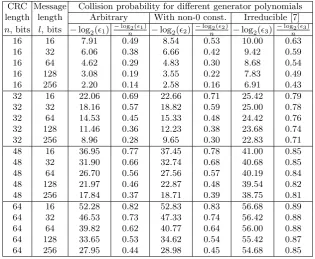
for CRC lengthsn= 16,32,48 and 64 bits and message lengthsl= 16,32,64,128 and 256 bits. The resulting upper bounds 1 and 2 on collision probabilities, computed using equations (2) and (3), are shown in Table 1 in the logarithmic form −log2(i). The 7th column shows the upper bound3 on collision proba-bility of the cryptographically secure CRC of Krawczyk [7]. Columns 4, 6 and 8 show the fraction −log2(i)
n reflecting the efficiency of i with respect to the
optimum collision probability 1/2n, fori∈ {1,2,3}.
We can see from the table that the case of polynomials with a non-zero constant terms (column 5) has a smaller collision probability compared to the case of arbitrary polynomials (column 3). For example, forn= 32 andm= 256, 2= 1/29.65while1= 1/28.96, so2< 1. Since the former case is also preferable from the point of view of correcting random burst errors (see Theorem 3), the familyHRCl,n seems more useful than the familyHRl,n.
We can also see that the presented method is particularly suitable for the au-thentication of short messages. As the message size grows, its the collision prob-ability grows much sharper compared to the collision probprob-ability of Krawczyk’s CRC [7]. Short messages (a few bytes to a few tens of bytes) are expected to be dominant in IoT applications. Since the presented method provides some level of protection almost for free, it method might be quite useful for low-cost resource-constrained IoT devices which can allocate very limited resources for implementing security.
CRC Message Collision probability for different generator polynomials length length Arbitrary With non-0 const. Irreducible [7]
n, bits l, bits −log2(1) −logn2(1) −log2(2) −logn2(2) −log2(3) −logn2(3) 16 16 7.91 0.49 8.54 0.53 10.00 0.63
16 32 6.06 0.38 6.66 0.42 9.42 0.59
16 64 4.62 0.29 4.83 0.30 8.68 0.54
16 128 3.08 0.19 3.55 0.22 7.83 0.49 16 256 2.20 0.14 2.58 0.16 6.91 0.43 32 16 22.06 0.69 22.66 0.71 25.42 0.79 32 32 18.16 0.57 18.82 0.59 25.00 0.78 32 64 14.53 0.45 15.33 0.48 24.42 0.76 32 128 11.46 0.36 12.23 0.38 23.68 0.74 32 256 8.96 0.28 9.65 0.30 22.83 0.71 48 16 36.95 0.77 37.45 0.78 41.00 0.85 48 32 31.90 0.66 32.74 0.68 40.68 0.85 48 64 26.70 0.56 27.56 0.57 40.19 0.84 48 128 21.97 0.46 22.87 0.48 39.54 0.82 48 256 17.84 0.37 18.71 0.39 38.75 0.81 64 16 52.28 0.82 52.83 0.83 56.68 0.89 64 32 46.53 0.73 47.33 0.74 56.42 0.88 64 64 39.82 0.62 40.77 0.64 56.00 0.88 64 128 33.65 0.53 34.62 0.54 55.42 0.87 64 256 27.95 0.44 28.98 0.45 54.68 0.85
authentication code can be at the application layer. A good strategy might be to combine these two fields into one at the media access control layer and use the presented method for the protection against both types of errors.
9
Conclusion
In this paper, we introduced two new families of cryptographically secure hash functions based on CRCs. Similarly to previously proposed cryptographically secure CRC-based hash families, the presented ones enable combining the detec-tion of random and malicious errors without increasing bandwidth. They detect the same type of burst errors as cryptographically non-secure CRCs based on irreducible generator polynomials. They retain most of the encoding and decod-ing implementation simplicity of cryptographically non-secure CRCs except that the LFSR implementing the division modulo generator polynomial needs to have programmable feedback connections.
The main advantage of the proposed CRCs is that the irreducibility testing, which is either time or memory consuming, can be omitted. It takes onlyO(n) time to generate a random polynomial of degree n. In contract, its takesΩ(n3) time to generate a random irreducible polynomial of degreen.
However, using arbitrary polynomials as generator polynomials for the CRC gives an adversary a higher chance of braking authentication. We provide a detailed quantitative analysis of the achieved security as a function of message and CRC sizes and show that the presented authentication scheme might be useful for low-cost resource-constrained devices.
10
Acknowledgements
The first author was supported by the research grant No SM14-0016 from the Swedish Foundation for Strategic Research.
References
1. Ericsson, “More that 50 billions connected devices,” 2012. www.ericsson.com/res/ docs/whitepapers/wp-50-billions.pdf.
2. Center for Strategic and International Studies, “Net losses: Estimating the global cost of cybercrime,” June 2014. https://www.mcafee.com/mx/resources/ reports/rp-economic-impact-cybercrime2.pdf.
3. Proofpoint, “Proofpoint uncovers Internet of Things (IoT) cyberattack,” January 2014. https://www.proofpoint.com/us/ proofpoint-uncovers-internet-of-things-iot-cyberattack.
4. M. Bellare, R. Canetti, and H. Krawczyk, “Keying hash functions for message au-thentication,” inAdvances in Cryptology - CRYPTO 96(N. Koblitz, ed.), vol. 1109 ofLecture Notes in Computer Science, pp. 1–15, Springer Berlin Heidelberg, 1996. 5. M. Bellare, J. Kilian, and P. Rogaway, “The security of cipher block chaining,” in
6. T.-B. Pei and C. Zukowski, “High-speed parallel CRC circuits in VLSI,” IEEE Transactions on Communications, vol. 40, pp. 653 –657, Apr. 1992.
7. H. Krawczyk, “LFSR-based hashing and authentication,” inProceedings of the 14th Annual International Cryptology Conference on Advances in Cryptology, CRYPTO ’94, (London, UK, UK), pp. 129–139, Springer-Verlag, 1994.
8. E. Dubrova, M. Naslund, G. Selander, and F. Lindqvist, “Cryptographically secure crc for lightweight message authentication,” Tech. Rep. 2015/035, January 2015. Cryptology ePrint Archive.
9. E. Dubrova, M. Naslund, and G. Selander, “CRC-based message authentication for 5G mobile technology,” inProceedings of 1st IEEE International Workshop on 5G Security, August 2015.
10. S. Gao and D. Panario, “Tests and constructions of irreducible polynomials over finite fields,” in Foundations of Computational Mathematics(F. Cucker and M. Shub, eds.), pp. 346–361, Springer Berlin Heidelberg, 1997.
11. IEEE Std 802.15.4-2011, “IEEE standard for local and metropolitan area net-works - part 15.4: Low-rate wireless personal area netnet-works (LR-WPANs),” 2011. standards.ieee.org/getieee802/download/802.15.4-2011.pdf.
12. 3GPP TS 36.212, “3gpp technical specifications 36.212, multiplexing and channel coding (release 8),” 2008. http://www.qtc.jp/3GPP/Specs/36212-830.pdf. 13. ETSI TS 100 909, “Digital cellular telecommunications system (Phase 2+);
Channel coding,” 2005. http://www.etsi.org/deliver/etsi ts/100900 100999/ 100909/08.09.00 60/ts 100909v080900p.pdf.
14. W. Peterson and D. Brown, “Cyclic codes for error detection,”Proceedings of the IRE, vol. 49, pp. 228 –235, Jan. 1961.
15. S. Golomb,Shift Register Sequences. Aegean Park Press, 1982.
16. E. Stavinov, “A practical parallel CRC generation method,” Feature Article, pp. 38–45, Jan. 2010.
17. G. Simmons, “A survey of information authentication,”Proceedings of the IEEE, vol. 76, pp. 603–620, May 1988.
18. M. Bellare, R. Canetti, and H. Krawczyk, “Keying hash functions for message au-thentication,” inProceedings of the 16th Annual International Cryptology Confer-ence on Advances in Cryptology, CRYPTO ’96, (London, UK), pp. 1–15, Springer-Verlag, 1996.
19. M. Bellare, R. Gu´erin, and P. Rogaway, “Xor macs: New methods for message authentication using finite pseudorandom functions,” in Proceedings of the 15th Annual International Cryptology Conference on Advances in Cryptology, CRYPTO ’95, (London, UK, UK), pp. 15–28, Springer-Verlag, 1995.
20. E. N. Gilbert, F. J. MacWilliams, and N. J. A. Sloane, “Codes which detect de-ception,”Bell System Technical Journal, vol. 53, no. 3, pp. 405–424, 1974. 21. G. J. Simmons, “Authentication theory/coding theory,” in Proceedings of
CRYPTO 84 on Advances in Cryptology, (New York, NY, USA), pp. 411–431, Springer-Verlag New York, Inc., 1985.
22. M. N. Wegman and J. Carter, “New hash functions and their use in authentication and set equality,”Journal of Computer and System Sciences, vol. 22, no. 3, pp. 265 – 279, 1981.
23. G. Brassard, “On computationally secure authentication tags requiring short secret shared keys,” inAdvances in Cryptology(D. Chaum, R. Rivest, and A. Sherman, eds.), pp. 79–86, Springer US, 1983.
(H. C. Williams, ed.), vol. 218 ofLecture Notes in Computer Science, pp. 42–55, Springer Berlin Heidelberg, 1986.
25. D. R. Stinson, “Universal hashing and authentication codes,”Des. Codes Cryptog-raphy, vol. 4, pp. 369–380, Oct. 1994.
26. D. R. Stinson, “On the connections between universal hashing, combinatorial de-signs and error-correcting codes,” inIn Proc. Congressus Numerantium 114, pp. 7– 27, 1996.
27. J. Black, S. Halevi, H. Krawczyk, T. Krovetz, and P. Rogaway, “Umac: Fast and secure message authentication,” in Proceedings of the 19th Annual International Cryptology Conference on Advances in Cryptology, CRYPTO ’99, (London, UK, UK), pp. 216–233, Springer-Verlag, 1999.
28. X. Lai, R. Rueppel, and J. Woollven, “A fast cryptographic checksum algorithm based on stream ciphers,” inAdvances in Cryptology AUSCRYPT ’92(J. Seberry and Y. Zheng, eds.), vol. 718 ofLecture Notes in Computer Science, pp. 339–348, Springer Berlin Heidelberg, 1993.
29. R. Taylor, “An integrity check value algorithm for stream ciphers,” inProceedings of the 13th Annual International Cryptology Conference on Advances in Cryptology, CRYPTO ’93, (London, UK, UK), pp. 40–48, Springer-Verlag, 1994.
30. T. Johansson, “A shift register construction of unconditionally secure authentica-tion codes,”Designs, Codes and Cryptography, vol. 4, no. 1, pp. 69–81, 1994. 31. M. Agren, M. Hell, T. Johansson, and W. Meier, “Grain-128a: A new version
of grain-128 with optional authentication,” Int. J. Wire. Mob. Comput., vol. 5, pp. 48–59, Dec. 2011.
32. M. Rabin, “Fingerprinting by random polynomials,” Tech. Rep. TR-15-81, Center for Research in Computing Technology, Harvard Univ., Cambridge, Mass, 1981. 33. C. C. Y. Lam, G. Gong, and S. A. Vanstone, “Message authentication codes with
error correcting capabilities,” in Proceedings of the 4th International Conference on Information and Communications Security, ICICS ’02, (London, UK, UK), pp. 354–366, Springer-Verlag, 2002.
34. R. Ge, G. Arce, and G. Di Crescenzo, “Approximate message authentication codes for n-ary alphabets,”Information Forensics and Security, IEEE Transactions on, vol. 1, pp. 56–67, March 2006.
35. O. Ur-Rehman, N. Zivic, S. Tabatabaei, and C. Ruland, “Error correcting and weighted noise tolerant message authentication codes,” in Signal Processing and Communication Systems (ICSPCS), 2011 5th International Conference on, pp. 1– 8, Dec 2011.
36. D. Stinson,Cryptography Theorey and Practice. Chapman & Hall/CRC, 3rd edi-tion, 2006.
37. ETSI SAGE 3GPP.
38. G. Griffiths and G. C. Stones, “The tea-leaf reader algorithm: an efficient imple-mentation of CRC-16 and CRC-32,”Commun. ACM, vol. 30, pp. 617–620, July 1987.
39. M. Braun, J. Friedrich, T. Grun, and J. Lembert, “Parallel CRC computation in FPGAs,” in Field-Programmable Logic Smart Applications, New Paradigms and Compilers (R. Hartenstein and M. Glesner, eds.), vol. 1142 of Lecture Notes in Computer Science, pp. 156–165, Springer Berlin / Heidelberg, 1996.
40. J. Birch, L. G. Christensen, and M. Skov, “A programmable 800 mbit/s crc check/-generator unit for lans and mans,”Comput. Netw. ISDN Syst., vol. 24, pp. 109–118, Apr. 1992.