MEMS Accelerometer Based 3D Mouse and
Handwritten Digits Recognition System
SandhyaV.More1, Apurva R.Sorte2, Punam P.Lute3, Shraddha G.Nandeshwar4,
Roshan K.Kinhekar5, Pankaj P.Sorde6
Assistant Professor, Dept. of ECE, DBACER College, Nagpur, India1
Student, Dept. of ECE, DBACER College, Nagpur, India2
Student, Dept. of ECE, DBACER College, Nagpur, India3
Student, Dept. of ECE, DBACER College, Nagpur, India4
Student, Dept. of ECE, DBACER College, Nagpur, India5
Student, Dept. of ECE, DBACER College, Nagpur, India6
ABSTRACT:In this paper an accelerometer-based 3D mouse for handwritten digit recognition is discussed. The hardware module consists of a tri-axial MEMS accelerometer, PIC microcontroller, and zigbee wireless module for sensing and collecting accelerations of handwriting and hand gesture trajectories. The accelerations of hand motions measured by MEMS accelerometer are transmitted wirelessly to the Computer. This system operates in two modes: i) as a 3D mouse, ii) as handwritten recognition for identifying the digits. It can be treated as the new age input device. This device is more natural in its feel and provides the user with efficient ease of use.
KEYWORDS:Gesture recognition, handwritten recognition, MATLAB, MEMS accelerometer, zigbee wireless module,PIC microcontroller.
I.INTRODUCTION
The increase in human-computer interactions in daily lives has made user interaction technology progressively more important. The expansion of human-computer interaction technologies in Electronic circuits has been greatly reduced the weight and dimension consumer electronics products such as smart mobile phones and handheld computers. Recently, an attractive alternative, a conveyable and compact embedded system with inertial sensors, has been projected to sense the activities of human hand and to capture hand motion trajectory information from accelerations. Recognition technology provides a way to communicate between the human and the computers in order to record information and also provide authentication for the user with the specific digit recognition.Recognition technology provides away to communicate between the human and the computers in order to record information and also provide authentication for the user with the specific character and digit recognition. This Recognition can be done by two methods: 1.Offline recognition and 2.Online recognition. Offline recognition is referred to as the ability of the computer to receive and interpret intelligible handwritten input from sources such as photographs by optical scanning, paper documents, also referred to as intelligent word recognition. Several researchers [1]-[4] have find the solution for the gesture recognition with accurate recognition rates.
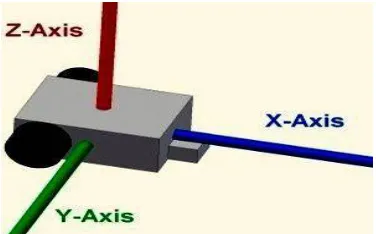
Fig. 1 sensing direction of the tri-axial MEMS accelerometer.
In this paper, we proposed the portable embedded device consists of tri-axial accelerometer,
microcontroller(PIC16F87) and zigbee wireless communication module. The acceleration signals measured from the MEMS accelerometer are transmitted to the computer via the zigbee wireless module. Users can utilize this portable device to write digits and make hand gestures. The handwritten recognition procedure is composed of acceleration acquisition, signal pre-processing, feature generation, feature selection, and feature extraction. The acceleration signal pre-processing procedure consists of a moving average filter, a high-pass filter, calibration, and normalization.
II.PRINCIPLE
In this section, MEMS accelerometer measures the acceleration of the signal in three co-ordinates such as x-axis, y-axis, and z-axis. These co-ordinates are display on LCD using PIC microcontroller. The measured acceleration signals of the hand motion are recognized using the Integrated Development Environment (IDE) which was developed using MATLAB. The gesture generated by the accelerometer based device is verified with the user database and thus in turn provides static authentication for the systems. The system is non-specific user authentication and gesture recognition system, so it can be widely applicable to the global networks with the accuracy of 95%.
III.RELATED WORK
MEMS accelerometer measures the acceleration of the signal in three co-ordinates such as x-axis, y-axis, and z-axis. To capture the hand motions online, the general MEMS sensor which can be operated without any external reference and limitation in working conditions is used. However, motion recognition is comparatively tough for different users since they have different styles and speeds to generate various motion trajectories. Thus, several researchers have tried to avoid this type of problem for increasing the accuracy of handwriting recognition systems [3]. By manipulating the acceleration signals and angular velocities of sensors, several researchers have reduced the error of handwriting trajectory reconstruction [4], [5] Yang et al. [6] proposed a digital pen to track motions in three dimension space by MEMS accelerometer and gyroscopes to improve the recognition accuracy by introducing the efficient acceleration error compensation algorithm which is based on zero velocity compensation. Luo et al. [7] proposed an extended kalman filter with magnetometers to compensate the orientation of the MEMS motion sensor based digital writing device. If the orientation of the instrument was estimated precisely, the motion trajectories of the digital writing instrument were reconstructed accurately [3].
98.75% gesture recognition rate.
IV.HARDWARE DESIGN AND DESCRIPTION OF PORTABLE DEVICE
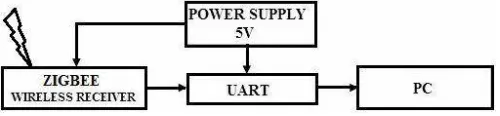
The portable device consists of a tri-axial accelerometer (MMA7361L), a microcontroller (PIC16F877A with 10-bit A/D converter) and the wireless transceiver (Zigbee).The tri-axial MEMS accelerometer measures the acceleration signals generated by a user’s hand motions. Themicrocontroller (PIC16F877A) collects the analogue acceleration signals from the accelerometer and converts analogue signals to digital signals via the A/D converter in-built in the microcontroller (PIC16F877A). The wireless zigbee transceiver transmits the digital acceleration signals wirelessly to the computer.Acceleration values of MEMS accelerometer can be positive, negative or zero. So, the output voltage has a zero bias output. The block diagram of transmitting module is shown in Fig. 2.Transmitting module divided in different unit such as power supply unit, microcontroller unit, LCD (16*2) display unit, MEMS accelerometer and wireless transmitting unit. The block diagram of receiving module is shown in Fig. 3.Receiving module is an integration of power supply, wireless receiving unit, MAX 232, USB connecter.
Fig. 2 Block diagram of transmitting module.
Fig. 3 Block diagram of receiving module
In transmitting part, MEMS accelerometer can be used to get the movement of user wrist to move cursor of mouse. Microcontroller (PIC16F877A) is used to control the display on LCD and also connected with zigbee wireless transmitter at 2.4-GHz transmission band with 1-Mb/s transmission rate. Microcontroller (PIC16F877A) integrates a high-performance 10-bit A/D converter and 8-b microcontroller unit on a signal chip. LCD is used to display co-ordinate x-axis, y-axis and z-axis. The zigbee wireless transmitter is used for transmit the signal to the zigbee wireless receiver which receive the signal send by transmitter and then this signal is applied to MAX232.An UART, universal asynchronous receiver / transmitter is responsible for performing the main task in serial communications with personal computers. UART contributes MAX232 IC and RS232 serial cable. The MAX232 is an integrated circuit that converts signals from an RS232 serial port to signals suitable for use in TTL compatible digital logic circuits.MAX232 is connected with PC through USB port. In PC, Graphical user interface application is developed which is use to operate the mouse in response to the accelerometer tilt. The overall power consumption of the portable device is 30 mA at 3.7 V.
V. MEMS ACCELEROMETER BASED SYSTEM PROCESS
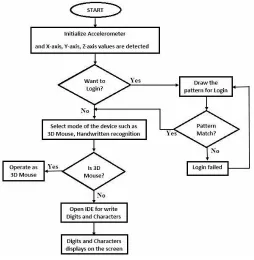
The entire process of MEMS accelerometer based system is explained below in detail by step by step process. The Step 1: Initialize accelerometer and upon the movement of the accelerometer it provides various tilt angles in X-axis, Y-axis and Z-axis respectively. These values can be zero, positive or negative.
Step 3: If the Password matches with the stored password, then system logins successfully .If the password does not matches then system login will be failed and tried to login again.
Step 4: Once login into the system, select the mode to operate either as 3D mouse or handwritten recognition mode. Step 5: If the mode selected is 3D-mouse, then accelerometer based system will function as a mouse.
Step 6: If the mode selected is Handwritten Recognition, then open the IDE for recognize handwritten digits. Step 7: handwritten digits will be displayed on the IDE.
Fig. 4 Flowchart of MEMS accelerometer based system process
VI.EXPERIMENTAL RESULTS
MEMS accelerometer measures the acceleration of the signal in three co-ordinates such as x-axis, y-axis, and z-axis. An accelerometer based portable device can also be used as mouse by selecting the mouse mode in the system. The each and specific gesture of the accelerometer based mouse is used to recognize the specific mouse functions. The table I shows, the respective gestures used for doing the specific mouse function in the computer. User can control the movement of cursor such as up, down, left, right by using an accelerometer based device.Fig. 6 shows the IDE developed using MATLAB for 3D mouse. Fig.5shows the gestures used for generating the handwritten digits. Handwritten recognition Integrated Development Environment (IDE) is used to recognize the handwritten digits and characters.Fig.7shows the handwritten Recognition IDE developed using MATLAB.
Fig. 7 Handwritten recognition IDE
VII.CONCLUSION
The development of the MEMS accelerometer based portable device is used to generate desired commands by hand motions to control electronic devices without any space limitations. The acceleration made by the hand motion is measured by the MEMS accelerometer is wirelessly transmitted to the computer by using zigbee wireless module. MEMS accelerometer based portable device is used to control mouse cursor of computer. This device is used for handwritten digits recognition by using MATLAB. The overall recognition rate of the hand written digits is calculated as 98.50%.Thus the results give us satisfaction in recognizing handwritten digits at low cost. Also the usage of simple sensor for the process of authentication using the same MEMS accelerometer based device helps for simple, accurate and efficient way of verification. MEMS accelerometer based recognition system provides an efficient and strong password protection.
REFERENCES
[1] Jeen-Shing Wang, Member and Fang-Chen Chuang, “An Accelerometer-Based Digital Pen With a Trajectory Recognition Algorithm for Handwritten Digit and Gesture Recognition”,IEEE transactions on Industrial Electronics, Vol. 59, No. 7, July 2012.
[2] Ruize Xu, Shengli Zhou, Li, W.J.,”MEMS accelerometer based non-specific-User Hand gesture recognitition”,IEEE Sensors Council, Vol. 12, May 2012.
[3] Zhuxin Dong, Wejinya U.C. and Li W., “An Optical-Tracking Calibration Method for MEMS-Based Digital Writing Instrument”, IEEE Sensors Journal, pp. 1543-1551, 2010.
[4] Jong Koo Oh, Sung-Jung Cho, Won-Chul Bang , Wook Chang , Eunseok Choi , Jing Yang , Joonkee Cho and Dong Yoon Kim, “Inertial sensor based recognition of 3-D characters gestures with an ensemble of classifiers”, Proceedings of the IEEE ninth International Workshop, pp. 112-117,2004.
[5] Jing Yang, Wook Chang, Won-Chul Bang, Eun-Seok Choi, Kyoung-Ho Kang, Sung-Jung Cho and Dong-Yoon Kim, “Analysis and compensation of errors in the input device based on inertial sensors”, Proceedings of the IEEE International Conference on Information Technology, pp. 790-796, 2004.
[6] YilunLuo, Chi Chiu Tsang, Guanglie Zhang, Zhuxin Dong, Guangyi Shi, Sze Yin Kwok, Li W., Leong P.H.W. and Ming Yiu Wong, “An Attitude Compensation Technique for a MEMS Motion Sensor Based Digital Writing Instrument”, Proceedings of the IEEE International Conference on Nano/Micro Engineered and Molecular Systems, pp. 909-914, 2006.