ISSN 2348 – 7968
Face Recognition In Lightening Conditions Using
Different Classifiers
Abstract
Human face detection and recognition has most influential area of image processing and analysis. It is one of the most manifold techniques used to distinguish an individual. There are major two challenges, Pose and Illumination among the various factors that impacts on face recognition technique. The key objective of this paper is to develop a system which provides more precise face recognition system and recognizes the identity of a person with accuracy. The proposed system basically consists of two phases, image illumination and classification. Image illumination enhances the quality of image for post phase of face recognition. Pose variations diminish the performance of human face recognition. Feature Extraction is the technique used to improve the performance and Dimensionality using Face Component Analysis and Discriminant Analysis.We propose a novel approach for face recognition under pose invariant and ambient illumination condition. Moreover, there will be no limitation on the invariant pose conditions. In the classification phase, images that were not considered in a training set, which can considered for testing. In order to train during the face recognition various classifiers such as Naive Bayes Classifier and SVM (Support Vector Machine) algorithms are used to classify the images and analyze face Recognition Rate.
Keywords : illumination,pose invariant ,Support Vector Machine,Naive Bayes Classifier, Training Sets, Testing Set.
1.Introduction
Face recognition has pulled in bunches of consideration and its investigation has slash cleave swollen by not only designers yet mutually neuroscientists, since its numerous potential applications in portable workstation vision correspondence and programmed framework. in particular, face recognition can be critical neighbourhood of face recognition as an after effect of the activity of programmed face recognition. Be that as it may, confront discovery is not simple as a consequences of its scores of varieties of picture look, it brought on by reason variety in lighting up
condition and diverse highlights of face. Various late systems like biometric based applications, the key class of specific things is object face [12],[13]. Enrollment of facial yield data with a face model is mazingly key in face recognition, facial kind examination, division and marking of facial components, facial locale recovery, incomplete face coordinating, and relighting[15] .Performance absolutely varies with reason and lighting varieties, however the precision in execution has been enhanced altogether underneath frontal cause and best lighting conditions [1].
Additional elements like picture quality and impediment to boot support face recognition mistakes [2]. To start with, it needs coordinating facial characters notwithstanding changes in lighting and perspective and therefore needs technique personality instead of clear picture coordinating [3]. Another inborn drawback of all comprehensive methodologies is their conviction to the job databases since information identifying with the face segregation are in segregated by machine gaining from the face tests [16]. An agent work learning is urgent, which, be that as it may, ii is hard to get in various applications [4].
PCA based basically confront recognition method we've a slant to ascertain the eigenvectors and eigenvalues of the difference lattice of the livelihood information. In the event that this framework is monstrous, computation of eigenvectors gets to be horrendously extreme. Consequently on redress this downside we are going to utilize the deterioration of the fluctuation grid [4].Central half Analysis has been turned out to be relate degree prudent face recognition approach. Nonetheless, regular PCA based basically approach may experience the ill effects of 2 restrictions, to be specific, poor Discriminatory force and substantial system of Load. It’s given that PCA offers a terribly sensible outline of the specific face [5].
Mahima Verma1,Rohit Raja2,Yamini Chohan
M.E(Scholar), Computer Technology and Application, SSTC,SSGI CSVTU Bhilai, India 1
Associate Professor, Computer Science and Engineering, SSTC,SSGI,FET CSVTU Bhilai, India 2
There’s entirely unexpected famous method, Discriminant Analysis that may be a managed calculation and this methodology comes the face footage on the bearings ideal for separation. be that as it may the physicist face is healthier as a consequences of it accommodates the malleability to be told partner degreed later recognize new faces in partner degree unattended way. Bolster vector machines unit managed learning models with related learning calculations that dissect information and recognize examples, utilized for order and variable analysis [6],[7],[14]. Given a group of business samples, every checked as bliss to one of two classes, bolster vector machine instructing project assembles a model that allocates new illustrations into one classification or the option, making it a non-probabilistic parallel direct classifier[19],[20]. SVM model may well be a legitimization of the cases in light of the fact that it arrange the focuses and guide the focuses to particular space so as that the examples of the different classifications unit which is part by a specialty of clear worth. we have a tendency to separation our arranged framework in 2 fundamental classes face and non-confront. all innocent man of science classifiers expect that the estimation of a specific highlight is independent of the estimation of the inverse highlight, given the class variable[8][17],[18]. we have a tendency to propose our framework upheld four choices red , blue, unpracticed values and diameter[21],[22]. Bolstered closeness list it'll order the check learning and gives machine impression of class[23],[24],[25].
Albeit a few face recognition systems has been existed, there is still numerous issues that cause by lightning and enlightenment variety. amid this paper we proposed invariant posture and encompassing light strategy and tend to added to a remarkable methodology for face recognition with totally diverse classifiers to understand the higher recognition rate and to beat the higher than specified issues. The depiction of this paper is proceed as takes after with Section 2 definite writing overview of different systems of face recognition. In Section 3 we presents the issue explanation of the paper. Segment 4 presents Methodology of the arranged work Section 5 introduces the Result and investigation that delineates the Experimental results. At that point the Section 6 gives the Conclusion and future work, Finally the paper closes with the Section 7 References.
2.Literature Survey
Numerous past face recognition methodologies are concentrated on in this segment to comprehend the different strategies of past calculations. Some of
these calculations are focus on essential brightening and others in face recognition. In 2006 Face Recognition Robust to Head Pose from one specimen Image[1]. Ting Shan, Brian C Lovl, and Shaokang Chen presents paper which contains Face Model and Rotation Model which are utilized to distinguish facial highlights and blend reasonable frontal face pictures.
In 2010 Evaluation of Face Recognition Techniques [2]Bo DengshengZhangbHuiLiuaShixinSunaKeLic In this paper, they connected and examined SIFT strategy on face recognition, and contrasted it and the reported face recognition courses in the writing .PCA tests were dispensed on significant face database .This examination paper conjointly demonstrate out some particular weaknesses of excellent trial system to recognize confronts and enhance them, however as indicated by time multifaceted nature it take more execution time as contrast with PCA.
In 2011 Facerecognition taking into account the multi-scale neighbourhood picture structures [3]. Cong Geng and XudongJiang .They proposes a structure of face recognition bolstered the multi-scale local structures of the face picture. while some fundamental devices amid this system are hereditary from the SIFT algorithmic guideline, this work explores and adds to all or any significant ventures inside the highlight extraction and picture coordinating. Results demonstrate that the arranged system beats SIFT and a couple of all-encompassing ways to deal with face recognition. This methodology is extremely proficient for general pictures however not suitable for enlightened pictures.
In September 2013 A Novel Approach to Face Recognition with Pose and Illumination Variation utilizing Support Vector Machine as classifier [5]. R .RajaLakshmi, M.K. Jeyakumar introduced the Paper on execute a robotized machine upheld face Recognition framework that perceives well the character of an individual in the pictures that were not utilized as a part of the Testing Phase that is an instatement and preparing by illustrative example of pictures continue an Evaluation Phase however precision of this methodology ailing in assessment stage. They have confirmed their outcomes just with bolster vector machine [9],[10],[11].
ISSN 2348 – 7968
of face recognition. Make varieties lessen the execution of outside body part recognition. Highlight Extraction is that the procedure won’t to enhance the execution. we have a tendency to propose a totally extraordinary methodology for face recognition underneath make invariant and close light conditions,. in addition, there'll be no confinement on the invariant make conditions. Inside the characterization part, pictures that weren't thought-about in an exceptionally preparing set, that example pictures will be mull over in testing set. in order to mentor all through the face recognition changed classifiers like Naive Thomas Bayes Classifier and SVM calculations territory unit wont to characterize the photos and examine face Recognition Rate
3.Problem Statement
As we survey literature about pose invariant illumination and various face recognition approaches,they are not so efficient. They provide less range of options like performance base metrics,less frequency of feature extraction and setback of misrecognition.The actual problem arises when same image have variant poses and improper illumination. Face Misrecognition occurs because of mismatching of different portions of an image and less amount of features extraction. In this consequence images were not trained properly from various aspects also cause performance degradation in face recognition.
4.Proposed Methodology
In this Paper first part consist image illumination, lightening and enhance the image quality for better visualization. In this part we also consider the variant pose images of same individual for further classification.After that second part of this classification and face recognition has completed in two steps:
1. Training Phase of data
2. Testing Phase of data
Training Phase basically begin with Compute the various shape parameter of particular image. Then it estimate illumination coefficient and feature based texture information using illumination representation of image. After that Reconstructed Model serves as basic model in order to obtain the basis information of each object for different poses of single image. After that feature extraction can be done and based on features classification can be done.
In testing phase we tested our approach with two classifiers in order to classify the test images. Those classifiers are Support vector machine and Bayes classifiers. Each of them used red , blue, green and diameter these four features to classify the images.It Recognize the Face for which there is weighted range combination of basis train images which is the closest to the test face image.We have completed series of experiments1 on approximately plenty of images from the various database.We achieve high recognition rates for image under the broad range of illumination condition and lightening..
Processed Images
Segmentation Phase
Feature Extraction Phase
Feature Extraction for classification purpose
Bayes classifier
Support Vector Machine Database
Training phase
Testing Phase Images
Illumination
Variant pose
P
d
Fig .1.Flow Diagram of pose invariant for face recognition
These algorithms given below explain the steps which are followed by illumination and face recognition system.
Algorithm 1:Image Illumination
Step 1. Read all the source and target images.
Step 2. Divide all the target image into equal blocks that is called as framing of images.
Step 3. For each block with respect to source image ,calculate the global intensity differences.
Algorithm 2:Varient pose registration For each block with respect to source image:
Step 1. Compute the common points of block of particular target images and source images common points are evaluated.
Step 2. For both common points are correlation establishment.
Step 3. Best matching points are obtained and set range for classifiers.
Algorithm 3: Training phase of data For each source image:
Step 1. Compute the shape and feature parameter of particular image.
Step 2. Estimate illumination coefficient and texture information using gabor filter.
Step 3. Features are extracted using Linear Discriminant
Analysis and principle Component Analysis.
Step 4. Extracted features saved for testing phase of face recognition.
Algorithm 4:Testing Phase For source image :
Step 1. Compute against classifier training set.
Step 2. Estimate similarity coefficient and class information using classifier.
Step 3. All Source image features are verified against the particular class.
Step 4. Image is recognized based on class and features.
4.1 Mathematical Formulation:
4.1.1 Estimation of global intensity
For calculating the intensity distinction, gray scale and image gradient has been calculated. The linear equation control of a particular gray scale digital image is performed using below formula.
IN= (I-Imin) newImax –newImin+ newImin (1)
Imax -Imin
Example, if the particular intensity range of source image is 75 to 160 and the desired range is 0 to 255. Illumination can be calculated by
i(x, y) = r(a, h)e(x, y) (2)
4.1.2 Linear Discriminant Analysis
The major aim of linear discriminant analysis is to find the subspace that is able to discriminates different face classes by maximize the values between class scalar, while minimizing the within-class scalar values.
∑ ∑ ∈ (3)
∑ (4)
(5)
and are the class coefficient and within class scalar matrices of training data and ‘a ‘is LDA coefficient.
4.1.3 Principal Component Analysis
PCA is a technique, which consist Maximum Expression Feature (MEF) extraction and experimentally used for data reconstruction and reduction. The desired classis label as can be obtained by min membership function in the equation.
(6)
ISSN 2348 – 7968
We have implemented novel pose invariant for face recognition and lightening conditions using different classifiers. In the first phase of proposed system, illumination and lightening has been performed we also consider various pose of single individual. For the testing purposes we are presenting few images from our dataset.
A (original). B (original)
Gfa
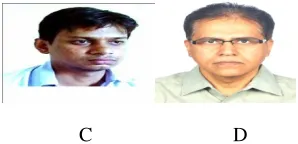
C (original) D(original)
Fig.2.Few images from dataset.
A B
C D
Fig.3.Lightning effect on source images
A B
C D
Fig.4.Test images from dataset after illumination.
Fig.4 shows the illumination phase over we generated illuminated images with different pose. Results show better visibility and lightening.
Fig.5.Training data with illuminated images.
Fig.5. shows illuminated images has taken as training data set for naïve bayes classifier.
Fig.6.Testing data against trained data
Fig.7. Feature extraction of images.
Fig.7. presents class which is same but variant features due to different pose.
Fig.8. Matching similarity index and features .
Fig.8. presents details of image testing which is different from fig.7. but result shows human perception class and machine perception class is same , this concludes the our system is trained against the various test data.
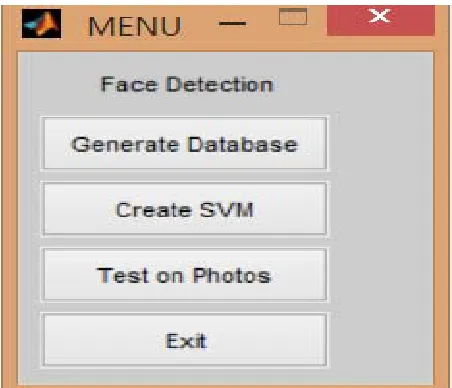
Fig. 9. Face detection and recognition using svm.
Figure 8 contains generation of image database then creation of svm and images training have to be done. After training phase completed, we begin with testing the target datasets against the trained data has been completed.
Fig 9 support vector creation and total execution time.
Fig.10.Face detection using svm for image a in dataset.
Fig.10. shows the face detection using the svm .green part shows the face area.
Fig.11.Face area of fig.10 image.
ISSN 2348 – 7968
Fig.12. Final face detection using svm
Figure 12 shows how svm classifier is used to detect the face and and non face part image . images has been tested againsted the training data .
6.Conclusion and future work
We proposed pose invariant for face recognition and lightening conditions using naïve bayes classifier and support vector machine classifier. in first phase we performed illumination and lightening of images , we also carried out experiment with different pose of similar images in order to extract feature . In second phase we trained our date sets using classifiers based on features we extracted earlier. After that we performed test on several images against trained data sets. Bayes classifier provides the classes according to trained data and when the target image is tested against source image it show human perception and machine perception of outcome which is same for our test cases ensures the correct classification and face recognition. In support vector machine try to classify between non faces and face which are two classes.It successfully detect the face in very less execution time.so we can conclude that our approach is well suited for large scale face recognition systems.
TABLE1: Percentage improvement over SVM
SVM SVM improvement
Enrichment Micro Macro Micro Macro Baseline 0.868 0.865
A1 0.784 0.768 - 9.68% -11.21%
A2 0.770 0.757 -11.29% -12.49% A3 0.843 0.830 -2.88% -4.05%
TABLE2: Percentage improvement over Naïve Bayes
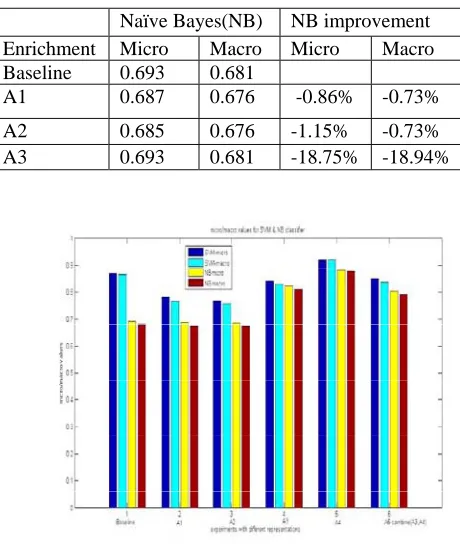
Naïve Bayes(NB) NB improvement Enrichment Micro Macro Micro Macro Baseline 0.693 0.681
A1 0.687 0.676 -0.86% -0.73%
A2 0.685 0.676 -1.15% -0.73% A3 0.693 0.681 -18.75% -18.94%
Fig.13. Graphical Representation of experimental results.
In future we can take more classifiers such as artificial neural network and k near neighbourhood classifier and compare the results among them .we would like to work with real time webcam camera based face recognition system.
7.References
[1]. Ting Shan†, Brian C. Lovell†, and Shaokang Chen. ”FACE RECOGNITION ROBUST TO HEAD POSE FROM ONE SAMPLE IMAGE ” 18th International Conference on Pattern Recognition 2006
[2] ]. Bo Dai DengshengZhangbHuiLiuaShixinSunaKeLic,”EVALUATI
ON OF FACE RECOGNITION TECHNIQUES”, SPIE Digital Library on 24 Jan 2010
[3] Cong Geng ,XudongJiang .”FACE RECOGNITION BASED ON THE MULTI-SCALE LOCAL IMAGE STRUCTURES”, Elsevier Ltd 24 March 2011.
[4]Lei Zhang and Dimitris Samaras “POSE INVARIANT FACE RECOGNITION UNDER ARBITRARY UNKNOWN LIGHTING USING SPHERICAL HARMONICS”, ”,Lecture Notes in Computer Science Volume 3087, 2012
AND ILLUMINATION VARIATION USING SUPPORT VECTOR MACHINE AS CLASSIFIER”, International Journal of Innovative Technology and Exploring Engineering (IJITEE) ISSN: 2278-3075, Volume-3, Issue-4, September 2013.
[6].JianxinWu ,”EFFICIENT HIK SVM LEARNING FOR IMAGE CLASSIFICATION”, IEEE TRANSACTIONS ON IMAGE PROCESSING, VOL. 21, NO. 10, OCTOBER 2012
[7].Bohyung Han, Member, IEEE, and Larry S. Davis, Fellow, IEEE,"DENSITY-BASED MULTIFEATURE BACKGROUND SUBTRACTION WITH SUPPORT VECTOR MACHINE" IeeeTransactions On Pattern Analysis And Machine Intelligence, Vol. 34,
No. 5, May 2012
[8].SonalAthavale,NeelabhSao,"CLASSIFICATION ON MOVING OBJEC TRAJECTORIES",International Journal of Advanced Technology & Engineering Research (IJATER) ISSN NO: 2250-3536 VOLUME 2, ISSUE 2, MAY 2012
[9].R.Muralidharan, Dr.C.Chandrasekar,"OBJECT RECOGNITIONUSING SVM-KNN BASED ON GEOMETRIC MOMENTINVARIANT",International Journal of Computer Trends and Technology- July to Aug 2011
[10]Francesca Bovolo, Lorenzo Bruzzone, and Lorenzo Carlin, Member,IEEE “A NOVEL TECHNIQUE FOR SUBPIXEL IMAGE CLASSIFICATION BASED ON SUPPORT VECTOR MACHINEIEEE TRANSACTIONS ON IMAGE PROCESSING”, VOL. 19, NO.
11, NOVEMBER 2010
[11].XiaohongYu, and HongLiuHuangshan, “IMAGE SEMANTICCLASSIFICATION USING SVM IN IMAGE RETRIEVAL” P. R.China, 26-28,Dec. 2009
[12].SwantjeJohnsen and Ashley Tews "REAL-TIME OBJECT TRACKING AND CLASSIFICATION USING A STATIC CAMERA”"15 Proceedings of the IEEE ICRA 2009.
[13].Adnan Khashman,"AUTOMATIC DETECTION, EXTRACTION AND RECOGNITION OF MOVING OBJECTS" International Journal of Systems Applications, Engineering & Development Issue 1, Volume2, 2008
[14]Frank Moosmann, Eric Nowak,FredericJurie, "RANDOMIZED CLUSTERING FORESTS FOR IMAGE CLASSIFICATION" IeeeTransactions On Pattern Analysis And Machine Intelligence, Vol. 30,No. 9, September 2008
[15].Zailiang Pan and Chong WahNgo, “MOVING-OBJECT DETECTION, ASSOCIATION, AND
SELECTION IN HOME VIDEOS”. IEEE Transactions On Multimedia, Vol. 9, No. 2, February2007
[16].Alexia Briassouli and NarendraAhuja, "EXTRACTION AND ANALYSIS OF MULTIPLE PERIODIC MOTIONS IN VIDEO SEQUENCE."Ieee Transactions On Pattern Analysis And Machine Intelligence, Vol. 29, NO. 7, JULY 2007
[17]Jing Li, Nigel Allinson, Member, IEEE, Dacheng Tao, and Xuelong Li, Member, IEEE "MULTITRAINING SUPPORT VECTOR MACHINE FOR IMAGE RETRIEVAL"IEEE TRANSACTIONS ON IMAGE PROCESSING, VOL. 15, NO. 11, NOVEMBER 2006
[18] D. Lu And Q. Weng, “A SURVEY OF IMAGE CLASSIFICATION METHODS AND TECHNIQUES FOR IMPROVING CLASSIFICATION PERFORMANCE” International Journal of Remote Sensing Vol. 28, No. 5, 10 March 2007
Bio-data of the authors
First Author Mahima Verma is pursuing master of engineering in Computer technology and Applications from SSTC, SSGI , CSVTU University,Bhilai (Chhattisgarh) and completed Bachelor of engineering from Govt. engineering CollegeRaipur in 2007-2011 session from Raipur,Chhattisgarh(India)
Second Author Rohit Raja is working as Associate professor at SSTC, SSGI ,FET CSVTU University,Bhilai Chhattisgarh,India.He has received B.E, M.E degree in Computer Science and Engineering and pursuing Ph.D from CVRAMAN University. His main research interest includes Face recognition and Identification,Digital Image Processing ,Signal Processing and Networking.