ISSN 2348 – 7968
Secure Multi-Attribute Decision Making Algorithm
Using Large attribute Dataset
Dr.G.V.Ramesh Babu1 and Prof.M.Padmavathamma2
1
Department of computer science, Sri Venkateswara University, Tirupati, Andhra Pradesh, India.
2
Department of computer science, Sri Venkateswara University, Tirupati, Andhra Pradesh, India.
Abstract
In this paper we have discussed about various decision making algorithms used on large datasets to make effective decisions to client in selecting best tourist place or best car to purchase etc. based on multiple attributes. In this competitive world not only system should make decisions but also decision should be secured. So in this article we have proposed a threshold Secure Multi-Attribute Decision Making Algorithm which allows not only make decisions effectively the decision is secured which only client and stakeholder in scenario will be known thus securing not only client data but also companies competency with others is also secured. In this algorithm decision making tree and privacy preserving security algorithm is combined and results are generated.
Keywords: - Decision making, security, dataset, multi-attribute, decision trees, secure decision.
1. Introduction
The increase in volume of data requires automatic way of extracting, transforming data when needed to get useful information. With the use of data mining techniques it is possible to extract interesting and useful knowledge, helpful for Decision making system to make an effective decision enriched by knowledge acquired by careful processing of data [1]. Large data generator corporations and also clients find difficulty coming to best decision for their requirements, so it is necessary to have a forceful decision making system which is the main aim of this research paper.
Information technologies are being increasingly implemented in healthcare or in insurance organizations in order to respond to the needs of doctors or customers of insurance companies to make decisions perceptively. Data mining tools
can be very useful to control limitations of people such as subjectivity or error due to fatigue, and to provide indications for the decision-making processes [2]. The essence of data mining lies in the identification of
relations, frameworks and models with algorithmic support which provide support for predictions and decision making process for selecting the best car to buy and the best bank to take the loan , at customers choice. These models can be called predictive, and they are being integrated into information systems of hospitals and insurance companies as models for decision making, reducing the subjectivity and time complexity in accomplishment of decisions. In addition, to its implementation, information technology in hospital and insurance company’s information enables comprehensive management of health insurance knowledge and its secure exchange between recipients and providers of healthcare services. Extensive use of information technology enables the elimination of complex task of manual data extraction from charts or from specialized questionnaires. Mining of data directly from electronic records of insurance companies and hospitals will help user to make decisions accurately in lesser time, which minimizes time of searching or finding the information about the health insurances or hospitals suitable. Retrieval/processing of information with the help of computers can help the quality of decision making and avoiding human errors. When there is a large volume of data that needs to be classified, decision making accurately by people is an issue. [3].
To a large extent decision making depends on Data mining which represents the process of analyzing raw data with the help of computer and extraction of their meaning. It is often defined as
ISSN 2348 – 7968
discerning previously unknown and potentially useful information from large volume of (unstructured) data [4]. Various techniques of data mining and classification helps in making decisions, regarding customer tendencies from his view depends on data set patterns from a database of historical information about selections [5][6].
2. Literature Study
The important aspects of decision-making processes in operation of users, in terms of improving the collaboration between companies and clients is the key factor in making financial success of both the sides and this is because the transfer of massive data between the companies clients can only be effectively managed by means of sophisticated computer algorithms [7, 8]. A decision making process is one of the most important and complicated human activity. The influence of decision making will effective client business in various ways like enabling client in selecting best insurance policy, best car and optimum policy suitable for his requirements. Unfortunately, decision making algorithms can be defined only for some kinds of (simple) management problems. In more complex cases, an "optimal" or "universal" algorithm for decision making does not exist, even though classy artificial intelligence tools have increasingly been applied. Due to above stated reasons the possibility of construction of an automated decision making process is limited [9, 10, 11]. Therefore, decision making processes, particularly in any sector, requires a sophisticated decision making system with suitable decision making algorithm based on real world facts. Whilst complex computer science mechanisms, including data-base models and artificial intelligence machinery used by the actuaries constitute the "brain" in the prediction world environment at the top management level of a large insurance company [3], the "heart" of a massive data circulation system between the brokers and the insurance company at its medium management level is the Microsoft Excel environment overwhelmingly operated and commonly used by the brokers to make what if
analysis in a limited manner. In fact, in their everyday influx of customers, brokers could not admit any other, more complex programming environment, so it is necessary to develop a system which will provide effective decisions which uses an efficient algorithm.
Handling massive amounts of policy-related data at the medium management level has posed significant challenges for the corporates [12, 13]. Similarly in the case of customers opting for purchasing a car faces complexity in selecting an optimal car among huge number of companies which in turn provides large number of price bands or models at different features. So by considering clients requirements which consists of variables such as color, seating capacity, speed, mileage etc., acts as inputs which are subjected to different processing and analytics , resulting in information outputs that in turn served for decision making resolutions to get an optimum decisions is the task in hand which we have given solution.
An input to a decision making system in case of Insurance policy selection is a policy-related, massive data coming both from the insurance company management and, in particular, the collaborating brokers or client’s status. In the former case, data includes monthly, raw (invalidated) policies' details such as their numbers, the assigned premiums (new and renewed ones), losses, expiry dates, and possible policy cancellation notifications, without divisions to particular brokers and their campaigns (business branches) . In the latter case, each campaign-assigned broker provides (only once) on-line data concerning newly-written policies, in terms of their numbers, booked premiums, and expiry dates on time. Since there are hundreds of brokers handling variety of policies, the raw data can be biased with numerous liabilities, sometimes leads to financially detrimental errors. Due to these
reasons it is need an automated and secure decision making algorithms in health insurance industry to provide an ideal solution in minimum time [14].
ISSN 2348 – 7968
The following algorithms are in practice for making decisions about purchasing a car or insurance policy or opting for best hotel by insurer/client in the case of decisions [9, 5]. These algorithms exhibit several inherent advantageous features and drawbacks.
2.1 Decision support system as feedback-feed forward control system
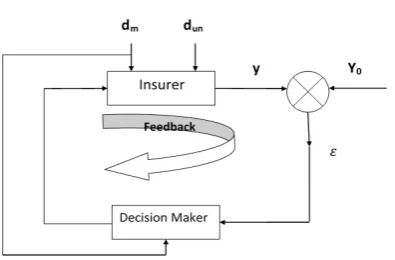
Management and control are quite similar notions, even though they have been grown on different application fields. Here we consider system being used in selecting insurance policy. Making decisions for the purpose of (broadly understood) management is a sort of computation of control decisions by a controller. Both management decisions and control decisions are typically executed in a feedback, or closed-loop system, hopefully supplemented with feed forward paths arranged on measurable/countable disturbances acting upon the management/control plant. Fig. 1 presents a feedback-feed forward decision making system at the medium management level of the plant, which is an insurer (insurance company + broker). The system is arranged in a control-like fashion, with specifying the system variables as follows:
a control/management decision nu-vector u(k) feeding the plant, where k is the discrete time, with the sampling interval equal to the company's reporting period (at the medium management level), that is one month,
controlled output ny-vector y(k) from the plant,
output reference (or set point) y0(k),
error =y0(k)-y(k) between the reference and controlled output,
measurable/countable disturbance nd-vector
dm(k),
Un-measurable/uncountable disturbance dun.
Fig. 1 Feedback-feed forward control/management system
Elements of a control/management decision vector u(k) constitute the corrective decisions onto underperforming brokers:
shifting the broker(s) to some more suitable campaigns,
recommending additional training sessions to the broker(s),
suspending the existing business arrangements with the broker(s),
disconnecting the existing business arrangements with the broker(s).
Now, the size of the vector u(k) is nu=4. It is important however that an actual control decision vector is always of a lower size, e.g. 3 or even 1. This is because, typically, not all the "rectifying" control means for underperforming broker(s) are simultaneously applied. Moreover, there are often situations that there are no underperforming brokers during monthly reporting periods (corresponding to nu=0), so the control decision is "no change indecision". The company's decision making process at the medium management level is subject to a number of un-measurable/uncountable disturbances
dun(k) related with altering financial situation of the company and its environment on the one hand, and a market-sensitive tissue of customers on the other. However, the main source of the disturbances is just the massive policy-related data itself. With hundreds of brokers operating on thousands of policies, the data transferred between the brokers and management and vice versa is inevitably prone to human-originated errors. The sources of those errors are specified and commented in the sequel. Elimination of
ISSN 2348 – 7968
those errors by an automated data processing system is a challenging goal of this work.
The control/management task of the decision maker of Fig.1 is to produce decisions u(k) in order to keep the error as close to zero as possible. We have shown above that even precise specification of the control input u(k), controlled output y(k) and measurable/countable disturbance dm(k), in terms of determining both sizes of the vectors and their specific elements, is hardly possible here because of the very uncertain and unclear matter of the medium level management environment. Unfortunately, the problem is empowered by the inability to precisely define the set point values for the output reference y0(k). In fact, it is not possible to precisely demand for a reference value of e.g.WLR; it should be as low as possible, but the practice is that in some critical cases it would be satisfied when, temporarily, this value is equal to even 100% and it does not increase. Quite similar is with the reference values for total premiums, which clearly do not exist. From business perspective the values should be as high as possible, but in some exceptional situations it might be acceptable when the premiums fall down provided that losses get lower.
In general, a control/management law could be as follows
Where ufb(k) and uff(k) are the feedback and feed forward components of the control vector u(k) and and are certain (vector) functions which, in the classical control framework, could be obtained on a basis e.g. of some control performance criterion. However, with the above issues of time-varying sizes of the vectors y(k) and dm(k) (and their elements sometimes overlapping), in addition to a blurry determination of the reference components y0(k), a formulation and solution of any optimization problem is, most likely, unfeasible, except perhaps of some trivial, in fact unreal situations. All the above is intended to demonstrate that it is
most likely impossible to construct an automated
expert decision maker that could effectively do the control/management job as theoretically required in Fig. 1. The extremely complex matter of a decision making process at the medium management level of a large insurance company can only be, most likely, implemented in the advisory, decision support mode, the solution being overwhelmingly accepted in the management practice. In fact, there is no example world-wide that such an automated decision-making system has been implemented. An extremely simple example of a fuzzy-like realization of the decision-making process by a human expert is: if “written loss ratio (WLR) in %, for new and renewed policies, per broker, for the current year to date” is “low” or “low enough” and “total premiums in $, for new and renewed policies, per broker, for the current year to date” are “high” or “high enough” then "no change indecision". Even if the fuzzy-like reasoning [15] could be attractive in possible development of an automated decision making process at the medium management level in a large insurance company, it has still never been implemented in such a company world-wide. One reason is that, with a poor performance of a manual data processing system supporting the decision making process, a human expert could not be quite sure if those “low enough” or “high enough” quantifiers were not falsified. And without them, the above expert, fuzzy reasoning example would be too trivial in the insurance practice.
2.2. Location of Automated Data Processing System (ADPS)
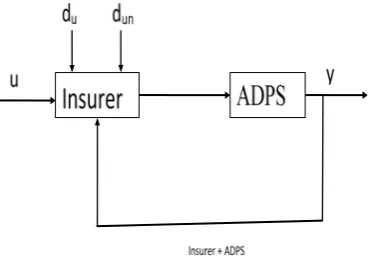
The invention constituting the subject of this dissertation is an Automated Data Processing System (ADPS) whose location in the feedback-feed forward control/management system of Fig.4.1 is shown in Fig. 2. The system collects massive data from the insurer that is the insurance company and brokers, and performs a series of analytical, Excel-based data validation procedures followed by error correction supporting schemes and presentation of reports on summary of the results (incorporated in the
ISSN 2348 – 7968
output y(k)). Consequently, the quality of the output y(k), supplied from ADPS to the Decision Maker, is very high as compared to that for manual processing, both in terms of the accuracy and speed of processing. As for ADPS itself, it is composed of a number of Excel implemented formulae representing both feedback (closed-loop) and feed forward (open (closed-loop) operations on data.
Fig. 2. Arrangement for Automated Data Processing System (ADPS)
2.2.1. ADPS – System Interworking’s
In order to monitor the effectiveness of targeted marketing, it is desirable to analyze the performance or profitability of the policies generated using the marketing and sales application. Policy data is stored in the policy administration system that is separate from the marketing and sales application executed on the web server. The policy data includes, but is not limited to, policy renewal data, policy premium data, claim data and policy termination data. By combining the policy data with the marketing and sales data, the performance of the policies generated as a result of such campaigns can be measured. The policy performance can be summarized by broker, by campaign, by year, etc.
ADPS model givens an example of application of analytical methodology for automated data processing through Excel, which is used to analyse data to make decisions based on What If conditions. Though ADPS model is simple but cannot handle multiple data sets with different
classifications which is used for obtaining optimum decision.
2.3. ID3 and C4.5 Techniques
The basic Decision making algorithm ID3 was used for tasks such as learning good game playing strategies for chess end games. Since then ID3 has been applied to a wide variety of problems in both academia and industry. ID3 picks predictors and their splitting values based on the gain in information that the split or splits provide. Gain represents the difference between the amount of information that is needed to correctly make a prediction before a split is made and after the split has been made. If the amount of information required is much lower after the split is made then that split has decreased the disorder of the original single segment. Gain is defined as the difference between the entropy of the original segment and the accumulated entropies of the resulting split segments. ID3 is suitable for simple data sets with less attributes which may not suitable for current big data sets available [16].
ID3 was later enhanced in the version called C4.5. C4.5 improves on ID3 in several important areas such as predictors with missing values can still be used, predictors with continuous values can be used, pruning is introduced, rule derivation. Even C4.5 cannot address problem of multiple attributes analysis in terms of decision making and preserving decision securely.
2.4 CART Decision making technique
CART stands for Classification and Regression Trees and is a data exploration and prediction algorithm developed by Leo Breiman et.al. CART technique performs validation of the model and the discovery of the optimally general model. CART accomplishes this by building a very complex tree and then pruning it back to the optimally general tree based on the results of cross validation or test set validation. The tree is pruned back based on the performance of the various pruned version of the tree on the test set data. The most complex tree rarely fares the best on the held aside data as it has been over fitted to the training data.
ISSN 2348 – 7968
The CART algorithm is relatively robust with respect to missing data. If the value is missing for a particular predictor in a particular record that record will not be used in making the determination of the optimal split when the tree is being built. In effect CART will utilizes as much information as it has on hand in order to make the decision for picking the best possible split. When CART is being used to predict on new data, missing values can be handled via surrogates. Surrogates are split values and predictors that mimic the actual split in the tree and can be used when the data for the preferred predictor is missing. This technique concentrates on making decision on missing values in data sets on a limited data sets but at the expense of performance as it is statistical based method, and does not addressed any decision making on multiple attribute data sets and how they can be retrieved without error[16]. The above generalized algorithms do not meet the requirements of the client for minimum data set with small no of attributes for effective decision making, under these situations, we have provided an effective decision making algorithm, which will fulfill the optimum needs of the client. To improve the performance of larger data sets for decision making with large no of policies and insurance companies. So, to overcome above limitations we have proposed Multi-Attribute Secure Decision Making Algorithm. Moreover, security is major concern to maintain integrity for the benefit of insurer which is appropriate for my present study
3. Proposed Secure Decision Making
Algorithm
Threshold Multi-attribute Secure Decision making algorithm (MASDMA) which provides secured decision making solutions in designing and development of protocols to provide a fair and non-repudiation services to safeguard the transactions in selecting health Insurance Policy or selecting an best hotel at tourist place.
In this paper we have taken health care organizations which implements various types of automated medical record systems which support quick access of Clients record, patient
history etc., but does not provide any decision making system which provides suggestions in selecting Insurance schemes, hospital based on E-Knowledge regarding health care, also security regarding decisions, protocols used during transactions .
3.1 Threshold Multi Attribute Secure Decision Making Algorithm (MASDMA)
The MASDMA algorithm works in three phases such as
1. AttributeKeyGeneration: In this phase the public key and private keys are generated which is used to secure the decision.
2. EHDMA (E-Health decision making algorithm): It returns the decision in encrypted format
3. Decrypt Decision: Decrypts the decision generated in phase-2 by algorithm.
MASDMA(P:data,T table of Attributes for objects)
1. Begin
2. Call AttribKeyGeneration(P); 3. EIHD=Call EHDMA(P,T,D) ED:
encrypted Decision, D-default Attribute ie.. root)
4. Call Decrypt Decision(EIHD) 5. End
In phase-1 the following algorithm generates keys for encryption and decryption of data or decision from which the client chooses insurance plan or hospital based on attributes like income, place, number of dependents etc., in data set of client. As there is a possibility of modification of decision by client by a competent authority we ensure security by generating private and public keys in phase-1 which can used by third party or client to view his decision with precision.
3.1.1 Attribute Key Generation(P) (Generates keys in Phase-1)
1. Generate two random large prime numbers p, q with equal size (n/2) bits.
2. Compute n = p * q and Eu = (p-1) (q-1).
ISSN 2348 – 7968
3. Compute e value such that gcd (e, Eu) = 1 and 1< e <Eu.
4. Compute d value such that d = e-1 mod (Eu). 5. Select a Random integer ‘f selective field attribute with range h.
6. select the particular attributes values like (Income,Tax_ Benefit, Age, Dependents, Occupation) from P to Compute pf = πk-l
i=1 pi;
where i=1,2,……. , k-1 fields as selected by Client concatenate pf add into the in middle of the d as
i) Find the length of d and divide the d into two half’s as fd and sd.
ii) pf is concatenate to the first half ( fd + pf) and the result concatenate to second half sd as fnld=(fd + pf + sd).
iii) d = fnld
7.Public key is (h, e, n) and private key is ( x, d); MASDMA performs two tasks in Phase-2, in first task focuses on providing an effective decision as current competitive world there are number of companies which provides insurance with various policies but the selection of policy is the major problem for the client and the second task is to hide the decision of client from other competitors from modification by encrypting it with cryptographic algorithm which uses key generated in phase-1 based on selective fields to secure decision.
3.1.2. Phase-2
3.1.2.1 (Task-1) to generate an effective decision for client.
EHDMA: (Decision Making Algorithm)
1. create a node N;(N= Insurance data record/Policy data record)
2. if P[i] (sample training data) are all of the same class(Insurance Scheme/Hospital) then
2.1 EIHD=Encrypt(N) ; where the N is the final decision
2.2 Return EIHD(decision); 3. if P[i] is Null then
3.1 N= Best Insurance/Hospital with default decision(majority selection) 3.2 EIHD=Encrypt(N)
3.3 Return EIHD(decision);
4. Select test-attribute, the attribute among attribute-list with the highest Information gain; by using Entropy 5. Label node N with test-attribute
(i.e.,Income,Tax_Exemption etc..) 6. for each known value P[i] of
test-attribute;
7. Construct a branch from node N for the condition test-attribute = P[i];
8. Let Si be the set of samples (subset of
P[i]) in samples for which test-attribute =P[i];
9. If Si is empty then
9.1.1 N= Best Insurance/Hospital with default decision (majority decision chosen by Clients already)
9.1.2 EIHD=Encrypt (N)
9.1.3 Return EIHD (decision); else
9.2 attach the node returned b as null decision
3.1.2.2 (Task-2) to encrypt the decision of client for decision integrity (Encryption Process) The Sender or in this case Third party which provides the service does the following:
1. Obtain the recipient public key (h, e, n) 2. Select a Random integer f ,h (where f is starting field and h is the range 1…fn)
3. calculate x= ( fh)e mod (n);
4. Message will be represented as positive integer m < n.
5. Encrypt the message Dm with the public key (e, n) like
EHICd = Dme mod (n) + fh.
6. Sends Encrypted decision Cd regarding
Insurance Scheme/Hospital Selection EHICd to recipient.
In Phase-3 to view his decision client should use his private key to view his decision which is in encrypted format by decrypting it which is given below.
ISSN 2348 – 7968
3.1.3 Phase-3 Decryption Process(Views clients decision)
To view the decision Client does the Following: 1. Uses the private key (x, d) to decrypt
the Decision EHICd as follows
2. Before going to decryption process, the x will be decrypted as y = xdmod (n)
3. Now finally decrypt the Cipher text as PCD=(EHICd)d mod (n) - y to the
clients decision PCD.
4. Test Results for Proposed Multi
Attribute Secure Decision Making
Algorithm
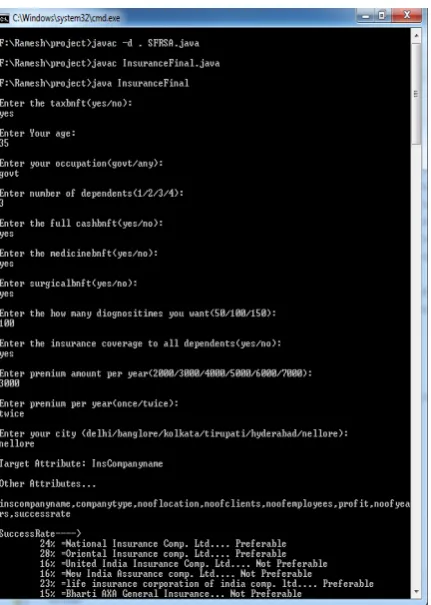
Fig 3 Showing possible decisions for client due to MASDMA algorithm and
Keys generation as given in Phase-1
The MASDMA algorithm is applied on Health Insurance Dataset which consists of input from the user as taxbenft, age, occupation, dependents, surgical-benft, medical-benft etc and considers the hospital attributes and calculates the entropy value on sample records.
Fig 4 Showing results of MASDMA algorithm for sample data of Client for selection of Insurance in Phase-2
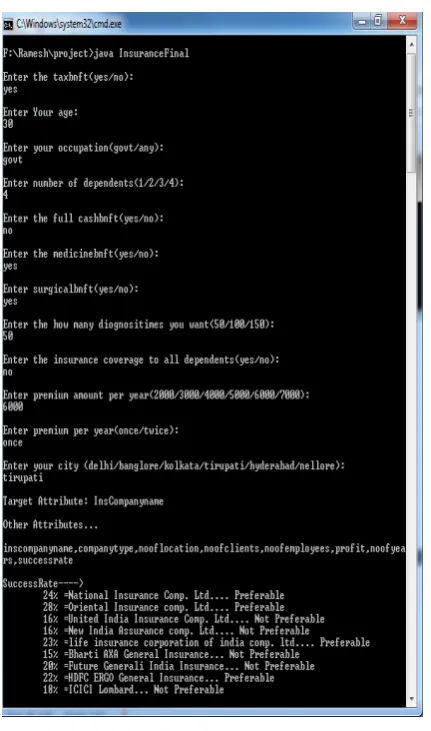
Output 2:
Fig 5 Showing possible decisions for client due to MASDMA algorithm and keys generation as given in Phase-
ISSN 2348 – 7968
Fig 6 Showing results of MASDMA algorithm for sample data of Client for selection of Insurance for Client-2 in
Phase-2
The above results show the proposed MASDMA can be used in Health Insurance sector which will secure privacy of decisions regarding Clients of Insurance companies and hospitals when Third party is involved in providing health insurance services.
5. Conclusion
In this paper, decision making and its importance is discussed with examples which show how it can be used in Health insurance sector. Large datasets which are maintained by insurance companies, railways, banks, factories should generate a valuable decision which may depend upon more than one attribute. Not only the decisions but also client’s decision should be secured from viewing by other competitors. So to
address above problems in this paper, it is proposed that the Threshold Multi Attribute Secure Decision Making Algorithm (MASDMA) and implemented in Java. The proposed MASDMA algorithm is verified with sample data sets and results are generated.
References
[1]
Gashti H. H., Namazig G., Esnghi A., Jamali M., Parnoosh A.,” Effects of Automation on Improving the Manager's Decision Making”, Universal Journal of Management and Social Science, Vol. 3, No. 6, June 2013. [2] Eapen, A. G. (2004). “Application of
Data mining in Medical Applications”. Ontario, Canada, 2004: University of Waterloo.
[3] Boris Milovic, Milan Milovic, ”Prediction and Decision making in Health care using Data Mining”, International Journal of Public Health Sciences(IJPHS), Vol 1 No.2 PP 69-78.December 2012,
[4] Boyd, c., Foo, E. (1998) "Off-line Fair Payment Protocol Using Convertible Signatures", Advances in Cryptology-ASIACRYPT '98, LNCS; Springer-Verlag,Berlin, Gennany, Vol. 1514, pp271-285
[5] Phani Ramesh C, Prof. M. Padmavathamma, “Secure Decision Making Algorithm In B2B Scenario”, International Journal of Engineering Research & Technology (IJERT) Vol. 1 Issue 10, December, 2012
[6] Boirefillergroup.com. (2010), “Data Mining Methodology”. Retrieved 06 12, 2012, from Boire-Filler Group:
http://www.boirefillergroup.com/
methodology.php[online]
[7] Bushinak, H., AbdelGaber, S., & AlSharif, F. K. (2011). “Recognizing The Electronic Medical Record Data From Unstructured Medical Data Using Visual Text Mining Techniques”, (IJCSIS) International Journal of Computer Science and Information Security, Vol. 9, No. 6, 25-35.
[8] Candelieri, A., Dolce, G., Riganello, F., & Sannita, W. G. (2011). “Data Mining in Neurology”. In Knowledge-
ISSN 2348 – 7968
Oriented Applications in Data Mining, (pp. 261-276). InTech.
[9] Davenport T. H., Harris J. G., “Lesson for Successful Automated Decision Making from the Insurance Industry”, research note, Accenture Institute for High Performance Business, New York, Nowember 2004.
[10] Eapen, A. G. (2004). “Application of Data mining in Medical Applications”. Ontario, Canada, 2004: University of Waterloo.
[11] Gashti H. H., Namazig G., Esnghi A., Jamali M., Parnoosh A.,” Effects of Automation on Improving the Manager's Decision Making”, Universal Journal of Management and Social Science, Vol. 3, No. 6, June 2013. [12] Jaijit Bhattacharya et.al, “Protecting
Privacy of Health Information through Privacy Broker”, Proceedings of the 39th Hawaii International Conference on System Sciences – 2006, IEEE [13] Kohonen T. “Self-Organization and
Associative Memory,” Springer-Verlag, New York, 1989.
[14] Nana Yaw Asabere,”An Underwriting Expert system advisor for Insurance Policies”, International journal of computer science and telecommunications, Vol-3,Dec 2012.
[15] Lu-Chou Huanga, et.al. “Privacy Preservation and Information Security Protection For Patient’s Portable Electronic Health Records”, Computers in Biology and Medicine 39 (2009) 743 – 750, Elsevier
[16]
http://www.thearling.com/text/dmtechni ques/dmtechniques.htm,”An Over-view of Data Mining Techniques”
Authors:
Dr. G.V. Ramesh Babu is working as Assit. Proffessor, Dept. of Computer Science, Sri Venkateswara University, Tirupati, A.P. India. He completed Ph.D, in 2015, M.Tech(Software Engineering) in 2005, Master of Computer Applications in 1997. He has 15 years of teaching experience. He presented Papers and attended national & international conferences in India and around Asia. His areas of interest are
Network Security, Ecommerce, Data Mining and Mobile Computing.
Prof.M.Padmavathamma, Head of the Department, Dept.of Computer Science, S.V.University, tirupati. She is an eminent professor and awarded nearly 15 Ph.D and 11 M.Phil., under her supervision. She got Best Teachers Award in 2014 from Govt of Andhra Pradesh, India. She delivered various keynote addresses on Network Security & Cryptography at various locations like Kuwait, China, Mauritius , Malaysia, and Singapore .She is an editorial member and reviewer for various well-known journals. Her area of research includes Network Security, Privacy Preserving Data mining, Cloud Computing, Artificial Intelligence and Image Processing.