Identifying persuasive public health messages to change community knowledge and attitudes about bulimia nervosa
Siân A. McLean1*, Susan J. Paxton1,
Robin Massey1, Phillipa J. Hay2, Jonathan M. Mond3,
Bryan Rodgers4
1 School of Psychology and Public Health, La Trobe University, Melbourne, Victoria, Australia;
2Centre for Health Research, School of Medicine, University of Western Sydney, Sydney, Australia.
3Department of Psychology, Macquarie University, Sydney, Australia
4Australian Demographic & Social Research Institute, Australian National University, Canberra, ACT, Australia.
*Author for correspondence Ms Siân McLean
School of Psychology and Public Health, La Trobe University, Melbourne, Victoria, Australia, 3086
e) [email protected] p) +61 3 9479 2949
Abstract
Addressing stigma through social marketing campaigns has the potential to enhance currently low rates of treatment seeking and improve well-being of individuals with the eating disorder bulimia nervosa. This study aimed to evaluate the persuasiveness of health messages
designed to reduce stigma and improve mental health literacy about this disorder. A community sample of 1,936 adults (48.2% male; 51.8% female) from Victoria, Australia, provided self-report information on knowledge and stigma about bulimia nervosa, and ratings of persuasiveness of nine brief health messages on dimensions of convincingness and
likelihood of changing attitudes. Messages were rated as moderately-to-very convincing and a little-to-moderately likely to change attitudes towards bulimia nervosa. The most persuasive messages were those that emphasised that bulimia nervosa is a serious mental illness and is not attributable to personal failings. Higher ratings of convincingness were associated with being female, having more knowledge about bulimia nervosa, and lower levels of stigma about bulimia nervosa. Higher ratings for likelihood of changing attitudes were associated with being female and with ratings of convincingness of the corresponding message. This study provides direction for persuasive content to be included in social marketing campaigns to reduce stigma towards bulimia nervosa.
The negative impact of poor community knowledge and stigmatizing attitudes about mental illness on treatment seeking and well-being in individuals suffering from mental health problems has been well documented (Clement et al., 2015; Evans-Lacko, Brohan, Mojtabai, & Thornicroft, 2012; Mackenzie, Erickson, Deane, & Wright, 2014). Individuals affected by bulimia nervosa (BN) are no exception (Hepworth & Paxton, 2007). Bulimia nervosa, an eating disorder characterised by regular episodes of binge eating and the regular use of extreme weight-control behaviours, is associated with severe psychological and physical consequences and poor quality of life (DeJong et al., 2013; Stice, Marti, & Rohde, 2013). It affects about 1.5% and 0.5% of women and men respectively and its prevalence may be increasing (Hay, Mond, Buttner, & Darby, 2008; Hudson, Hiripi, Pope, & Kessler, 2007). Although treatments for BN have been shown to be beneficial (Hay, Bacaltchuk, Stefano, & Kashyap, 2009), appropriate treatment seeking is low (Fursland & Watson, 2014; Hart, Granillo, Jorm, & Paxton, 2011). Barriers to seeking help for BN include lack of knowledge about treatment options, attitudinal barriers related to fear of stigmatisation and shame, and structural barriers such as cost (Hepworth & Paxton, 2007) Improving community knowledge and attitudes about BN may therefore be valuable in increasing help-seeking.
Community samples have moderate levels of knowledge about symptoms of BN but recognition is lower if the symptoms described do not include self-induced vomiting
new hobbies, taking vitamins and minerals, and alternative therapies (Mond, Hay, et al., 2004). Further, antidepressant medication which has been shown to improve bulimic
symptoms (Bacaltchuk & Hay, 2003) was endorsed as helpful by only 35.7% of a community sample (Mond, Hay, et al., 2004).
Stigmatizing attitudes regarding individuals with BN are widespread and include beliefs that BN is not serious, that individuals with BN cannot be trusted and ideally would be kept at a social distance (McLean et al., 2014; Mond & Arrighi, 2011). The most widely held stigmatizing attitude is that people with BN are personally responsible for their disorder (Ebneter & Latner, 2013; McLean et al., 2014; Roehrig & McLean, 2010; Wingfield, Kelly, Serdar, Shivy, & Mazzeo, 2011). This attitude is reflected in beliefs that individuals with BN should stop obsessing about their appearance; work on their self-control; “get over it”; and that BN is a form of attention seeking (McLean et al., 2014). These views have been endorsed by about 30% of an adult sample (McLean et al., 2014). However, greater knowledge about BN has been shown to be associated with lower stigmatising beliefs, suggesting that improving understanding about BN in the community may reduce stigma (Rodgers et al.). Gender differences have also been observed such that males hold more stigmatizing beliefs about mental illness in general (Corrigan & Watson, 2007) and eating disorders and BN in particular (McLean et al., 2014; Mond & Arrighi, 2011).
In light of poor knowledge about treatment options for BN and the concerning levels of stigmatizing attitudes about individuals with BN, authors have concluded that community interventions could reduce stigma and increase treatment seeking (Ebneter, Latner, &
O'Brien, 2011). Three broad approaches have been identified; education, contact, and protest (Corrigan et al., 2001) that may be used separately or in combination (Knaak, Modgill, & Patten, 2014). Direct contact as well as indirect or virtual contact such as a filmed
(Clement et al., 2012). In addition, protest against stigmatization of people with mental illness can be highly visible (Corrigan, 2011). However, education through social marketing, with or without virtual social contact, is a practical way to reach a large number of people (Corrigan, 2011; Knaak et al., 2014). Education has been found to be helpful in improving knowledge and stigma related to depression (beyondblue, 2012) and mental health problems generally (Henderson et al., 2012; Thornicroft, Wyllie, Thornicroft, & Mehta, 2014).
We developed nine brief social marketing messages to counter the gaps in knowledge and stigmatizing attitudes about people with BN described above. Guided by the Elaboration Likelihood Model (Petty & Cacioppo, 1986) of persuasive communication that highlights the importance of believability of messages, we evaluated each message with items assessing the extent to which participants believed a message was both convincing and likely to change community attitudes. Thus, the overall aims of the study were to evaluate ratings of brief messages to increase knowledge about and counteract stigma towards BN and to identify predictors of highly rated messages in a large adult, Australian, community sample. We hypothesized that, as all messages were designed to counteract specific stigmatizing attitudes about BN or gaps in knowledge that had been identified in the literature, all messages would be rated at least moderately convincing and moderately likely to change community attitudes. However, given widespread community beliefs that people with BN are personally
responsible for their illness, we hypothesized that messages rated the most convincing and most likely to change attitudes would be those that increased appreciation of BN as a serious mental illness that is not attributable to personal failings. We hypothesized that after
controlling for age and gender effects, participants with lower knowledge and higher stigmatising attitudes towards BN would be less responsive to persuasive messages as the messages were more likely to be at odds with their existing attitudes. Finally, in light of the importance of believability of communication for changing attitudes, we hypothesised that ratings of message convincingness would be positively related to ratings of likelihood of changing attitudes.
Method
Participants
Although the response rate was low, it was commensurate with rates achieved for mail surveys for eating disorders in previous research (Mond, Rodgers, Hay, Owen, & Beumont, 2004; Striegel-Moore et al., 2009). Following exclusion for incomplete data (n = 42) and repetitive responses (n = 126) indicative of systematic response styles (see Data analysis), the final sample for analyses was 1,936 (48.2% male; 51.8% female). Participants were 18-67 years (Mage = 44.4, SD = 13.1). They were recruited from a random sample obtained from the Australian Electoral Roll. Detailed sample characteristics have been described previously (McLean et al., 2014). Briefly, distributions of age, gender, and socio-economic status were consistent with the population from which they were sampled.
Measures
Participants provided information on their age, gender, marital status, racial group, educational attainment, employment status, and household income bracket.
Ratings of persuasiveness of health messages
Nine commonly held misconceptions or stigmatizing attitudes about BN were identified from previous research (McLean et al., 2014; Mond et al., 2010) and paired with nine counter health messages developed by the authors which aimed to increase knowledge especially in relation to effective treatment and to challenge stigmatizing attitudes in relation to BN including beliefs about personal responsibility and blame (see Table A1 in Appendix). Pilot testing indicated that messages were easily understood and ratings of clarity were high (unpublished data).
extremely). To reduce the 13 individual items into scales to be used to compare levels of persuasiveness across messages, separate principal components analyses (PCA) with
orthogonal rotation were conducted on the persuasiveness items for each health message. For each health message two components were retained to be used as subscales to assess
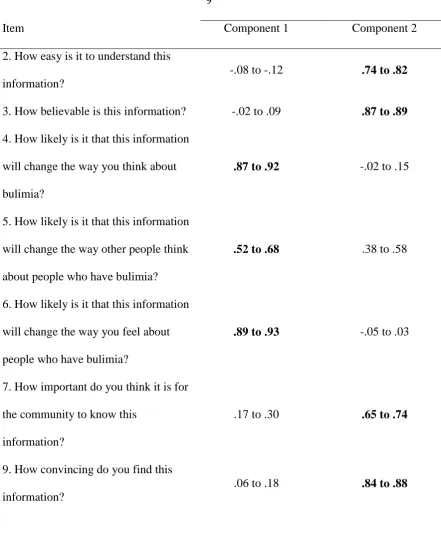
persuasiveness. Consistent patterns of results were found for PCAs across the nine health messages whereby for each message two components had eigenvalues greater than one and breaks between the second and third components were visible on the scree plots. One component contained four items that assessed the convincingness and believability of the message that we named “Convincingness”, and the other contained six items that assessed perceived likelihood that the message would change one’s own or others’ attitudes that we named “Likelihood of Changing Attitudes” (see Table 1). For items 5 and 13, which loaded on both components, consideration of the Elaboration Likelihood Model (Petty & Cacioppo, 1986) indicated that the items be retained on the likelihood of changing attitudes component as these items both assessed the likelihood that the information would change others’
attitudes toward people with BN. Three items (see Table 1) were omitted from the PCA analyses as they did not meet assumptions. These were items one and eight which had low communality values for all health messages and item 11 which had no correlation greater than .3 with any other item across all messages. Subscale scores were calculated from the mean score for items on each component. Internal consistency for Convincingness ranged from α = .81 to α = .86, and for Likelihood of Changing Attitudes ranged from α = .85 to α = .89.
Knowledge about bulimia
hobbies” are helpful for treating bulimia” on a scale from 1 (completely disagree) to 6
(completely agree). Responses were dichotomized so that completely disagree, mostly
disagree and slightly disagree were coded as disagree responses, and completely agree, mostly agree and slightly agree were coded as agree responses. Correct responses were summed to form a total score. Higher scores reflect greater levels of knowledge about BN.
Stigmatising attitudes and beliefs about bulimia nervosa
Four of the five subscales of the stigmatising attitudes and beliefs about bulimia nervosa (SAB-BN) scale were used to assess stigma (McLean et al., 2014). The Social Distance subscale was not included in the current study due to low internal reliability. The four subscales used were Advantages of Bulimia (7 items), Minimisation/Low Seriousness, (6 items), Unreliability (5 items), and Personal Responsibility (5 items). Items from each subscale respectively included “There are good things about having bulimia”, “Bulimia is a serious eating disorder”, “I’d find it difficult to trust someone with bulimia”, and “People with bulimia should just “pull themselves together” and “get over it”. Each item was rated on a 6-point scale (1= completely disagree, 2 = mostly disagree, 3 = slightly disagree, 4 =
slightly agree, 5 = mostly agree, 6 = completely agree). Items were reverse scored where
appropriate and total subscale scores calculated from the mean of the items for each subscale. Higher scores reflect higher stigma. In the current sample internal consistency for each subscale was α = .73, α = .70, α = .84, and α = .76 respectively.
Procedure
The study was approved by the Institutional Human Ethics Committee and all
participants provided informed consent. Participants received a mailed questionnaire package with an information statement, consent form, paper survey and reply paid envelope for survey return. The measures were presented in the following order, demographic questions,
measure was presented last to ensure that information provided in the messages did not influence participant’s responses to items assessing knowledge about and stigma towards BN. Non-respondents were sent a second package after one month.
Data analysis
Data were excluded from analyses when responses to nine or more of the 13
persuasiveness items were missing for three or more health messages. Data from participants with highly repetitive responses on the persuasiveness items, indicative of systematic
response styles, were excluded from analyses. Three subscales from the SAB-BN,
Advantages, Minimisation/Low Seriousness and Unreliability were positively skewed but logarithmic transformations substantially reduced skewness.
Repeated measures analyses of variance (ANOVA) with pairwise comparisons examined differences in scores across the nine health messages on convincingness and likelihood of changing attitudes. Due to the large sample size, rather than examining the statistical significance of post hoc pairwise comparisons of differences between messages on mean persuasiveness ratings, effect sizes of differences were examined and only values above
d = .20 were considered to be worthy of interpretation.
measure in zero order correlations at alpha = .01, adjusted from the conventional level of .05 due to the large sample size.
Results
Ratings of convincingness and likelihood of changing attitudes
Mean scores and 95% confidence interval error bars for ratings of convincingness and likelihood of changing attitudes of health messages are shown in Figures 1 and 2
respectively. The highest mean ratings for convincingness correspond to very convincing,
whereas for likelihood of changing attitudes, the means for the highest rated messages correspond to between somewhat and moderately likely to change attitudes. Repeated
measures ANOVA revealed that ratings of convincingness were significantly different across health messages, F(6.5, 11964.7) = 179.6, p< .001. Examination of effect sizes of the
differences between means on convincingness showed that message one (BN is a serious and distressing mental illness) and message five (BN is not appropriate for weight control and is physically and mentally damaging) both had higher scores than messages two (Treatment for BN helps stabilize eating and weight) (d = .25; d = .28), four (Psychological treatment and prescription medication can help treat BN) (d = .33; d = .37), six (There is no evidence for alternative or lifestyle therapies) (d = .56; d = .63), eight (BN is different from depression, anxiety or low self-esteem and requires BN specific treatment) (d = .33; d = .35), and nine (BN is a mental illness that is not caused by vanity) (d = .28; d = .30). Health message three (BN has nothing to do with attention seeking) also had higher convincingness ratings than messages four (d = .22), six (d = .48), and eight (d = .21). In addition, message six had lower convincingness ratings than messages two (d = .41), four (d = .35), seven (d = .46), and nine (d = .37).
For likelihood of changing attitudes, a repeated measures ANOVA revealed a
.001. Calculation of effect sizes for the differences in mean ratings for the nine messages revealed that message eight (BN is different from depression, anxiety or low self-esteem and requires BN specific treatment) had higher scores for likelihood of changing attitudes than all other health messages, with the exception of message one (two d = .29; three d = .21; four d = .33; five d = .24; six d = .49; seven d = .26; and nine d = .28). Conversely, message six (There is no evidence for alternative or lifestyle therapies) was rated lower than each of the other messages in relation to likelihood of changing attitudes (one d = .34; two d = .24; three
d = .30; four d = .21; five d = .29; seven d = .26; and nine d = .28). In addition, message one (BN is a serious and distressing mental illness) was rated more likely to change attitudes than message four (Psychological treatment and prescription medication can help treat BN) (d =
.20). Significance values for all pairwise comparisons for which effect sizes of the differences were greater than d = .20 were p < .001.
Relationships between ratings of convincingness and knowledge and stigma
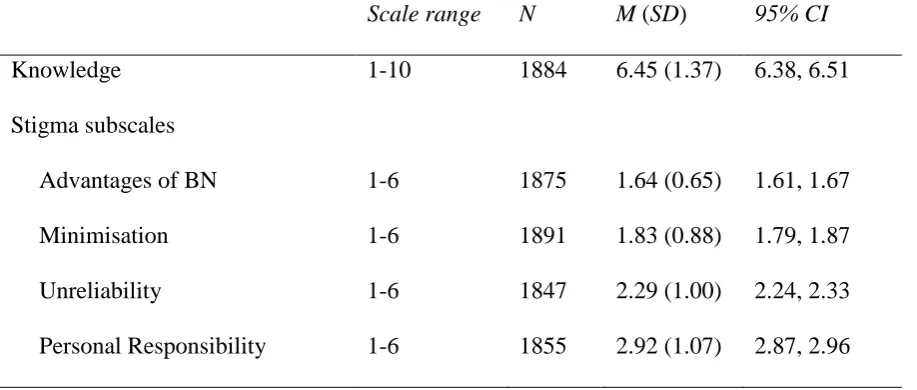
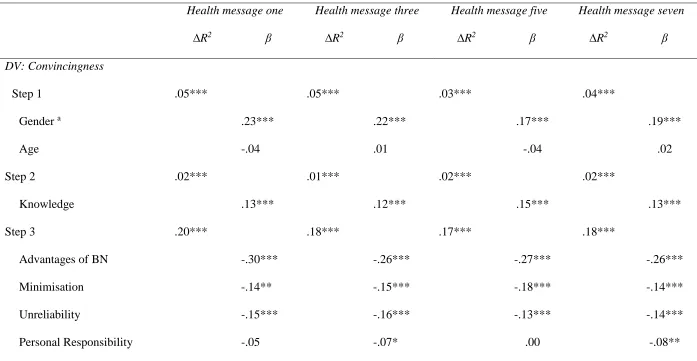
Descriptive statistics for knowledge and stigma variables are shown in Table 2. As hypothesized, higher ratings of convincingness on the four highest rated messages (one, three, five, and seven) were consistently significantly correlated with higher levels of knowledge (ranging from r = .14 to r = .16 for the four messages) and lower scores on advantages of BN (r = -.40 to r = -.45) minimisation (r = -.30 to r = -.33), unreliability (r = -.26 to r = -.30), and personal responsibility (r = -.23 to r = -.30). Each correlation was significant at p < .001. Results of the hierarchical linear regression analyses revealed that demographic variables accounted for significant variance for convincingness of each health message, with gender emerging as the only unique predictor variable, whereby being female predicted higher ratings of convincingness. The addition of knowledge at step 2 also
consistently accounted for unique variance in convincingness for each health message, as did personal responsibility with the exception of health message five. The final models accounted for between 22% and 26% of variance in convincingness of the health messages (see Table 3).
Relationships between ratings of likelihood of changing attitudes and knowledge and
stigma
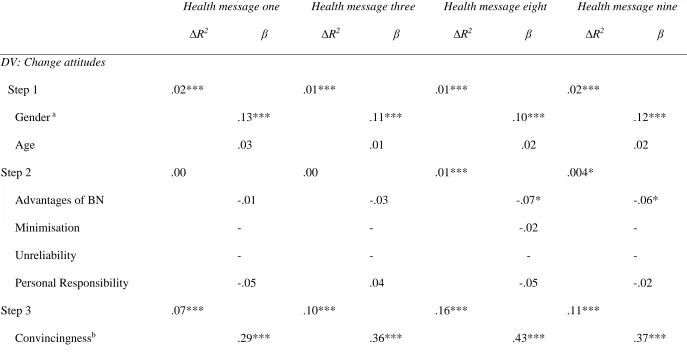
Only a few predictor variables correlated significantly with ratings of likelihood of changing attitudes for the top-rated health messages (one, three, eight, and nine). Lower ratings of likelihood of changing attitudes were significantly associated with higher scores on advantages of bulimia (r = -.06 to r = -.12; p < .01) and higher scores on personal
responsibility (r = -.07 to r = -.11; p < .01) for the top rated health messages. Minimisation was inversely correlated with health message eight (r = -.07, p < .01). Neither knowledge nor unreliability was significantly correlated with likelihood of changing attitudes for any of the top rated messages. Ratings of convincingness of messages were positively correlated with ratings of likelihood of changing attitudes for corresponding health messages (ranging from r
Discussion
In this research we endeavoured to identify potentially persuasive messages that could be used as the foundation for a public health campaign to reduce stigma and improve
knowledge about BN. Our hypotheses were partially supported. In relation to our first hypothesis, we anticipated that all messages would be rated as at least moderately convincing and moderately likely to change attitudes. This was the case for convincingness. All
messages were rated as at least moderately convincing (a rating of 3) with four messages rated as at least very convincing (a rating of 4). However, this was not the case for likelihood of messages to change attitudes. The message with the highest mean rating, message 8, (BN is different from depression, anxiety, or low self-esteem and requires BN specific treatment), received a rating of 2.8. Seven messages received mean ratings of at least 2.60, a little over half way between “a little” and “moderately” likely to change attitudes about BN.
controlling for age (which was unrelated to ratings) and gender (female ratings were higher than male ratings). However, message ratings for likelihood of changing attitudes were only uniquely predicted by being female, to a small degree by the stigma attitude advantages of bulimia, and in line with our fourth hypothesis, by message convincingness.
There is growing support for social marketing campaigns to improve mental health literacy and reduce stigma in relation to mental illness (e.g., Thornicroft et al., 2014), and to reduce the public health burden of mental health problems by promoting appropriate
treatment seeking (Kazdin & Rabbitt, 2013; Mond, 2014). However, we are unaware of attempts to evaluate the possible persuasive power of specific social marketing messages. In this research we identified messages about BN that were rated as convincing and believable which is a positive step. This is especially relevant in that being believable appeared to be a prerequisite for a message being regarded as likely to change attitudes. The finding that the most convincing messages targeted blame and increased understanding about the seriousness of BN suggests that these are likely to be productive directions for further development and dissemination for social marketing campaigns. Although we have explored messages individually, in practice, different messages may be combined and to produce additional impact. Interestingly, the two poorly rated messages on convincingness (messages four and six) were both about specific treatment approaches, medication and alternative therapies. It may be that these messages ran so much against prevailing beliefs about helpful treatment (Mond et al., 2010; Mond, Hay, et al., 2004) that they were less believable.
As one of the goals of social marketing campaigns is to increase treatment seeking, it is particularly interesting that the two messages rated most likely to change attitudes included information that BN is a mental health problem that requires treatment specific to BN
regarding specific treatment for BN was sufficiently engaging to capture the attention of our sample, producing higher ratings for likelihood of changing attitudes (Petty, Briñol, & Priester, 2009). Although further research is needed, the findings suggest that these themes would be valuable to develop and explore further.
the impact they may have had when delivered by a persuasive communicator, or in a more engaging format that would typically be used in a social marketing campaign. In particular, social marketing campaigns can not only present a specific message but can also provide a call for action that could enhance the likelihood of attitude and behaviour change.
A number of participant characteristics played a role in predicting convincingness and likelihood to change attitudes. In both cases, being female was associated with more positive ratings. It is crucial that social marketing messages are effective amongst females in light of the higher prevalence of eating disorders in females, but as males also make up an important part of the social environment of females, a relevant factor in the development of BN, and increases in eating disorder behaviour and impact on quality of life has been observed in males (Hay et al., 2008; Mitchison, Hay, Slewa-Younan, & Mond, 2014), more attention may need to be paid to identifying messages that males respond to strongly. Knowledge about BN only accounted for a small amount of variance in ratings of convincingness and none for likelihood of changing attitudes, suggesting that the most persuasive messages could be used to reach members of the community across the knowledge spectrum. Unexpectedly, although more stigmatizing attitudes predicted perceiving messages as less convincing, these attitudes were largely not associated with likelihood of changing attitudes, however, convincingness of messages was a significant contributor to variance in likelihood of changing attitudes. These relationships are complex, multi-directional and need further clarification.
Future research could use an experimental design with independent presentation of messages to further explore the impact of particular message content. In addition, future research could examine additional participant predictor characteristics such as eating disorder
References
Bacaltchuk, J., & Hay, P. (2003). Antidepressants versus placebo for people with bulimia nervosa. Cochrane Database of Systematic Reviews(4), CD003391.
beyondblue. (2012). Depression Monitor: Independent findings from 2004 to 2012.
Carnaghi, A., Cadinu, M., Castelli, L., Kiesner, J., & Bragantini, C. (2007). The best way to tell you to use a condom: The interplay between message format and individuals' level of need for cognition. AIDS Care, 19(3), 432-440. doi: 10.1080/09540120600582013 Cataldo, J. K., Hunter, M., Petersen, A. B., & Sheon, N. (2015). Positive and instructive
anti-smoking messages speak to older smokers: a focus group study. Tobacco Induced
Diseases, 13. doi: 10.1186/s12971-015-0027-x
Clark, J. K., Wegener, D. T., Habashi, M. M., & Evans, A. T. (2012). Source expertise and persuasion: The effects of perceived opposition or support on message scrutiny.
Personality and Social Psychology Bulletin, 38(1), 90-100. doi:
10.1177/0146167211420733
Clement, S., Jarrett, M., Henderson, C., & Thornicroft, G. (2010). Messages to use in population-level campaigns to reduce mental health-related stigma: consensus development study. Epidemiologica Psichiatria Sociale, 19(1), 72-79.
Clement, S., Schauman, O., Graham, T., Maggioni, F., Evans-Lacko, S., Bezborodovs, N., . . . Thornicroft, G. (2015). What is the impact of mental health-related stigma on help-seeking? A systematic review of quantitative and qualitative studies. Psychological
Medicine, 45(01), 11-27. doi: doi:10.1017/S0033291714000129
Corrigan, P. W. (2000). Mental health stigma as social attribution: Implications for research methods and attitude change. Clinical Psychology: Science and Practice, 7(1), 48-67. doi: 10.1093/clipsy/7.1.48
Corrigan, P. W. (2011). Strategic Stigma Change (SSC): Five principles for social marketing campaigns to reduce stigma. Psychiatric Services, 62(8), 824-826.
Corrigan, P. W., River, P. L., Lundin, R. K., Penn, D. L., Uphoff-Wasowski, K., Campion, J., . . . Kubiak, M. A. (2001). Three strategies for changing attributions about severe mental illness. Schizophrenia Bulletin PsycArticles, 27(2), 187-195.
Corrigan, P. W., & Watson, A. (2007). The stigma of psychiatric disorders and the gender, ethnicity, and education of the perceiver. Community Mental Health Journal, 43(5), 439-458. doi: 10.1007/s10597-007-9084-9
DeJong, H., Oldershaw, A., Sternheim, L., Samarawickrema, N., Kenyon, M., D, Broadbent, H., . . . Schmidt, U. (2013). Quality of life in anorexia nervosa, bulimia nervosa and eating disorder not-otherwise-specified. Journal of Eating Disorders, 1, 43.
Durkin, S. J., Paxton, S. J., & Wertheim, E. H. (2005). How do adolescent girls evaluate body dissatisfaction prevention messages? Journal of Adolescent Health, 37(5), 381-390. doi: 10.1016/j.jadohealth.2004.08.006
Ebneter, D. S., & Latner, J. D. (2013). Stigmatizing attitudes differ across mental health disorders: A comparison of stigma across eating disorders, obesity, and major depressive disorder. Journal of Nervous and Mental Disease, 201(4), 281-285. Ebneter, D. S., Latner, J. D., & O'Brien, K. S. (2011). Just world beliefs, causal beliefs, and
acquaintance: Associations with stigma toward eating disorders and obesity.
Personality and Individual Differences, 51(5), 618-622. doi:
Evans-Lacko, S., Brohan, E., Mojtabai, R., & Thornicroft, G. (2012). Association between public views of mental illness and self-stigma among individuals with mental illness in 14 European countries. Psychological Medicine, 42(08), 1741-1752. doi:
doi:10.1017/S0033291711002558
Fursland, A., & Watson, H. J. (2014). Eating disorders: A hidden phenomenon in outpatient mental health? International Journal of Eating Disorders, 47(4), 422-425. doi: 10.1002/eat.22205
Gratwick-Sarll, K., Mond, J., & Hay, P. (2013). Self-recognition of eating-disordered
behavior in college women: Further evidence of poor eating disorders “Mental Health Literacy”? Eating Disorders, 21(4), 310-327. doi: 10.1080/10640266.2013.797321 Hart, L. M., Granillo, M. T., Jorm, A. F., & Paxton, S. J. (2011). Unmet need for treatment in
the eating disorders: A systematic review of eating disorder specific treatment seeking among community cases. Clinical Psychology Review, 31(5), 727-735. doi:
10.1016/j.cpr.2011.03.004
Hay, P. J., Bacaltchuk, J., Stefano, S., & Kashyap, P. (2009). Psychological treatments for bulimia nervosa and binging. Cochrane Database of Systematic Reviews, (4). http://onlinelibrary.wiley.com/doi/10.1002/14651858.CD000562.pub3/abstract doi:10.1002/14651858.CD000562.pub3
Hay, P. J., Mond, J., Buttner, P., & Darby, A. (2008). Eating disorder behaviors are
increasing: findings from two sequential community surveys in South Australia. PLos
ONE, 3(2), e1541. doi:10.1371/journal.pone.0001541
Hepworth, N. S., & Paxton, S. J. (2007). Pathways to help-seeking in bulimia nervosa and binge eating problems: A concept mapping approach. International Journal of Eating
Disorders, 40(6), 493-504.
Hudson, J. I., Hiripi, E., Pope, H. G., Jr., & Kessler, R. C. (2007). The prevalence and correlates of eating disorders in the National Comorbidity Survey Replication.
Biological Psychiatry, 61(3), 348-358.
Jorm, A. F., Barney, L. J., Christensen, H., Highet, N. J., Kelly, C. M., & Kitchener, B. A. (2006). Research on mental health literacy: What we know and what we still need to know. Australian and New Zealand Journal of Psychiatry, 40(1), 3-5. doi:
10.1080/j.1440-1614.2006.01734.x
Kazdin, A. E., & Rabbitt, S. M. (2013). Novel models for delivering mental health services and reducing the burdens of mental illness. Clinical Psychological Science, 1(2), 170-191. doi: 10.1177/2167702612463566
Knaak, S., Modgill, G., & Patten, S. B. (2014). Key ingredients of anti-stigma programs for health care providers: A data synthesis of evaluative studies. Canadian Journal of
Psychiatry. Revue Canadienne de Psychiatrie, 59(10 Suppl 1), S19-S26.
Mackenzie, C. S., Erickson, J., Deane, F. P., & Wright, M. (2014). Changes in attitudes toward seeking mental health services: A 40-year cross-temporal meta-analysis.
Clinical Psychology Review, 34(2), 99-106. doi: 10.1016/j.cpr.2013.12.001
Mitchison, D., Hay, P., Slewa-Younan, S., & Mond, J. (2014). The changing demographic profile of eating disorder behaviors in the community. Bmc Public Health, 14(1), 943. doi: 10.1186/1471-2458-14-943
Mond, J. M. (2014). Eating disorders “mental health literacy”: an introduction. Journal of
Mental Health, 23(2), 51-54. doi: doi:10.3109/09638237.2014.889286
Mond, J. M., & Arrighi, A. (2011). Gender differences in perceptions of the severity and prevalence of eating disorders. Early Intervention in Psychiatry, 5(1), 41-49. doi: 10.1111/j.1751-7893.2010.00257.x
Mond, J. M., Hay, P. J., Paxton, S. J., Rodgers, B., Darby, A., Nillson, J., . . . Owen, C. (2010). Eating disorders "Mental Health Literacy" in low risk, high risk and
symptomatic women: Implications for health promotion programs. Eating Disorders:
The Journal of Treatment & Prevention, 18(4), 267 - 285. doi:
10.1080/10640266.2010.490115
Mond, J. M., Hay, P. J., Rodgers, B., Owen, C., & Beumont, P. J. V. (2004). Beliefs of the public concerning the helpfulness of interventions for bulimia nervosa. International
Journal of Eating Disorders, 36(1), 62-68.
Mond, J. M., Rodgers, B., Hay, P. J., Owen, C., & Beumont, P. J. V. (2004). Mode of delivery, but not questionnaire length, affected response in an epidemiological study of eating-disordered behavior. Journal of Clinical Epidemiology, 57(11), 1167-1171. Paxton, S. J., Wertheim, E. H., Pilawski, A., Durkin, S., & Holt, T. (2002). Evaluations of
dieting prevention messages by adolescent girls. Preventive Medicine: An
International Journal Devoted to Practice and Theory, 35(5), 474-491.
Petty, R. E., Briñol, P., & Priester, J. R. (2009). Mass media attitude change: Implications of the Elaboration Likelihood Model of Persuasion. In J. Bryant & M. B. Oliver (Eds.),
Petty, R. E., & Cacioppo, J. T. (1986). The Elaboration Likelihood Model of Persuasion.
Advances in Experimental Social Psychology, 19, 123-205. doi:
10.1016/S0065-2601(08)60214-2
Rodgers, R. F., Paxton, S. J., McLean, S. A., Massey, R., Mond, J. M., Hay, P. J., & Rodgers, B. Stigmatizing attitudes and beliefs toward bulimia nervosa: The importance of knowledge and eating disorder symptoms. Journal of Nervous and Mental Disease. Roehrig, J. P., & McLean, C. P. (2010). A comparison of stigma toward eating disorders
versus depression. International Journal of Eating Disorders, 43(7), 671-674. doi: 10.1002/eat.20760
Rousseau, A., Callahan, S., & Chabrol, H. (2012). Representations and beliefs about eating disorders in a sample of French adolescents. International Journal of Eating
Disorders, 45(2), 247-251. doi: 10.1002/eat.20887
Stice, E., Marti, C. N., & Rohde, P. (2013). Prevalence, incidence, impairment, and course of the proposed DSM-5 eating disorder diagnoses in an 8-year prospective community study of young women. Journal of Abnormal Psychology, 122(2), 445-457.
Striegel-Moore, R. H., Rosselli, F., Perrin, N., DeBar, L., Wilson, G. T., May, A., & Kraemer, H. C. (2009). Gender difference in the prevalence of eating disorder symptoms. International Journal of Eating Disorders, 42(5), 471-474. doi: 10.1002/eat.20625
Wingfield, N., Kelly, N., Serdar, K., Shivy, V. A., & Mazzeo, S. E. (2011). College students' perceptions of individuals with anorexia and bulimia nervosa. International Journal
Table 1
Pattern coefficients from rotated solution of Principal Components Analyses of items
assessing persuasiveness of health messages
Range of pattern coefficients across messages 1-9
Item Component 1 Component 2
2. How easy is it to understand this information?
-.08 to -.12 .74 to .82
3. How believable is this information? -.02 to .09 .87 to .89
4. How likely is it that this information will change the way you think about bulimia?
.87 to .92 -.02 to .15
5. How likely is it that this information will change the way other people think about people who have bulimia?
.52 to .68 .38 to .58
6. How likely is it that this information will change the way you feel about people who have bulimia?
.89 to .93 -.05 to .03
7. How important do you think it is for the community to know this
information?
.17 to .30 .65 to .74
9. How convincing do you find this information?
Range of pattern coefficients across messages 1-9
Item Component 1 Component 2
10. Does this information make you feel more sympathetic towards people with bulimia?
.64 to .74 .23 to .37
12. How likely is it that this
information will change your attitudes toward people with bulimia?
.86 to .90 .01 to .05
13. How likely is it that this
information will change the attitudes of others toward people with bulimia?
.41 to .67 .39 to .61
Items 1“How new is this information to you?”, 8“How important is it for you to know this
information?”, and 11 “Does this information make you feel more negative about people with
bulimia?” did not meet assumptions and were omitted from the analyses.
Major loadings on components for the pattern coefficients for each item are bolded.
Table 2
Means and standard deviations for knowledge and stigma subscales a
Scale range N M (SD) 95% CI
Knowledge 1-10 1884 6.45 (1.37) 6.38, 6.51
Stigma subscales
Advantages of BN 1-6 1875 1.64 (0.65) 1.61, 1.67
Minimisation 1-6 1891 1.83 (0.88) 1.79, 1.87
Unreliability 1-6 1847 2.29 (1.00) 2.24, 2.33
Personal Responsibility 1-6 1855 2.92 (1.07) 2.87, 2.96
Table 3
Summary statistics for hierarchical linear regression analyses predicting convincingness of the top four rated health messages
Health message one Health message three Health message five Health message seven
∆R2 β ∆R2 β ∆R2 β ∆R2 β
DV: Convincingness
Step 1 .05*** .05*** .03*** .04***
Gender a .23*** .22*** .17*** .19***
Age -.04 .01 -.04 .02
Step 2 .02*** .01*** .02*** .02***
Knowledge .13*** .12*** .15*** .13***
Step 3 .20*** .18*** .17*** .18***
Advantages of BN -.30*** -.26*** -.27*** -.26***
Minimisation -.14** -.15*** -.18*** -.14***
Unreliability -.15*** -.16*** -.13*** -.14***
Total R2 .26*** .24*** .22*** .23***
amale coded 1, females coded 2
N = 1847
Table 4
Summary statistics for hierarchical linear regression analyses predicting likelihood of changing attitudes of the top four rated health messages
Health message one Health message three Health message eight Health message nine
∆R2 β ∆R2 β ∆R2 β ∆R2 β
DV: Change attitudes
Step 1 .02*** .01*** .01*** .02***
Gender a .13*** .11*** .10*** .12***
Age .03 .01 .02 .02
Step 2 .00 .00 .01*** .004*
Advantages of BN -.01 -.03 -.07* -.06*
Minimisation - - -.02 -
Unreliability - - - -
Personal Responsibility -.05 .04 -.05 -.02
Step 3 .07*** .10*** .16*** .11***
Total R2 .09*** .12*** .18*** .13***
N = 1855
*p<.05, **p<.01, ***p<.001, a male coded 1, females coded 2
3.0 3.2 3.4 3.6 3.8 4.0 4.2
1 2 3 4 5 6 7 8 9
M
ea
n
c
o
n
vi
n
ci
n
n
ge
ss
r
ati
n
g
2.00 2.10 2.20 2.30 2.40 2.50 2.60 2.70 2.80 2.90 3.00
1 2 3 4 5 6 7 8 9
Appendix Table A1
Community Belief, Paired Counter Health Message and a Summary Descriptiona (in
brackets).
Community Belief Counter Health Message 1. Some people do not
believe that bulimia is a serious problem.
1. Bulimia is a serious mental illness. It causes a great deal of distress, poor quality of life, poor physical health and requires treatment from a mental health
professional. (BN is a serious and distressing mental illness).
2. Some people think that treatment for bulimia causes weight gain.
2. Treatment for bulimia does not cause weight gain. Rather, stopping the cycle of binge eating and extreme weight-control methods helps to stabilise eating patterns, and in turn, body weight. (Treatment for BN
helps stabilize eating and weight)
3. Some people think that people with bulimia are just trying to get attention.
3. Bulimia is a serious mental illness that has nothing to do with attention seeking. People with bulimia try to hide their illness, rather than bring attention to it. (BN
has nothing to do with attention seeking).
4. Some people are unsure whether medication
prescribed by a doctor, such as Prozac of Zoloft, is helpful for treating bulimia.
4. When combined with psychological treatment, medication prescribed by a doctor can be helpful for treating bulimia, although medication on its own is not likely to be helpful in the long term. (Psychological treatment and prescription medication can help treat
5. Some people think that bulimia is an okay way to control weight.
5. Using bulimia to try to control weight is not appropriate. In fact, bulimia causes difficulty in controlling weight and it does not lead to weight loss. Bulimia is also very damaging to physical and mental health. (BN is not appropriate for weight control and is
physically and mentally damaging).
6. Some people think that “alternative therapies”, such as herbal medicine, or “lifestyle changes”, such as finding some new hobbies, can help treat bulimia.
6. These approaches may be beneficial in other areas of life, but there is no evidence that “alternative” therapies of “lifestyle changes” are helpful for treating bulimia.
(There is no evidence for alternative or lifestyle
therapies).
7. Some people think that people with bulimia “bring it on themselves” or “have only themselves to blame”.
7. Like people with other mental illnesses, people with bulimia do not choose to be ill and they are not to blame for their illness. Rather, social pressures cause people to believe they are not worthwhile unless they look a particular way and then go to extreme lengths to meet these expectations. (People with BN are not to blame for
their illness).
8. Some people think that bulimia is caused by depression, anxiety or self-esteem problems and that fixing these problems will therefore cure bulimia.
depression, anxiety, or low self-esteem and requires BN
specific treatment).
9. Some people believe that bulimia is only a problem because people with bulimia are obsessed with their looks and weight, to the point of being vain.
9. Bulimia is a mental illness; it is not caused by vanity. Some people are personally vulnerable to the very strong social pressures (i.e. from media, friends) about the way they should look. They are then driven to use extreme ways of controlling weight, which is how bulimia starts. (BN is a mental illness that is not caused
by vanity).